
The BNPL Explosion: 96 Million Users and Counting
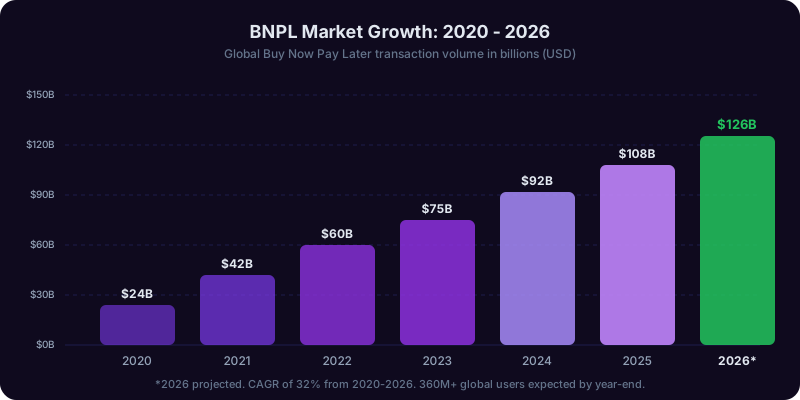
Buy Now Pay Later has gone from a niche checkout option to a mainstream financial product faster than almost any lending innovation in history. As of early 2026, approximately 96 million Americans have used a BNPL service at least once, up from 45 million in 2021. Global BNPL transaction volume is projected to exceed $560 billion in 2026, and the market is growing at roughly 25% year-over-year.
The appeal is obvious. You see something for $200 at checkout, and instead of paying $200 today, you pay four installments of $50 every two weeks. No interest. No credit check (in most cases). Instant approval in seconds. It feels like free money, which is exactly the problem.
Who Is Using BNPL
BNPL usage skews younger and lower-income, but it has expanded significantly across demographics:
- Gen Z (18-27): 55% have used BNPL. This is the heaviest-use demographic, often stacking multiple BNPL loans simultaneously.
- Millennials (28-43): 48% have used BNPL, frequently for larger purchases like electronics, furniture, and travel.
- Gen X (44-59): 31% have used BNPL, often for home goods and medical expenses.
- Boomers (60+): 14% have used BNPL, the fastest-growing adoption segment by percentage increase.
The income distribution is revealing. According to the Consumer Financial Protection Bureau (CFPB), 64% of BNPL users earn under $75,000 per year, and 43% report using BNPL specifically because they could not afford the purchase otherwise. That statistic alone signals a fundamental problem: BNPL is not being used as a convenience tool by people who have the money. It is being used as a credit product by people who do not.
Why This Matters Now
Three major changes in 2025-2026 have transformed BNPL from a relatively low-risk convenience into something that requires serious attention:
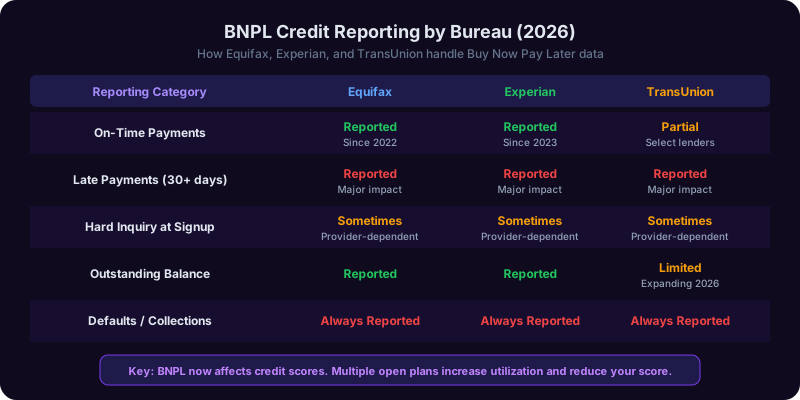
- Credit bureau reporting. All three major bureaus now accept BNPL data. Missed payments can damage your credit score just like a missed credit card payment.
- Regulatory scrutiny. The CFPB has classified BNPL providers as credit card issuers, subjecting them to the same consumer protection rules under the Truth in Lending Act.
- Loan stacking visibility. Lenders are beginning to factor BNPL obligations into mortgage, auto loan, and credit card underwriting decisions.
If you are using BNPL without understanding these changes, you may be accumulating risk without realizing it. The Finance Copilot can help you assess your current BNPL exposure and determine whether it is affecting your financial health.
How BNPL Actually Works: The Mechanics Behind the Magic
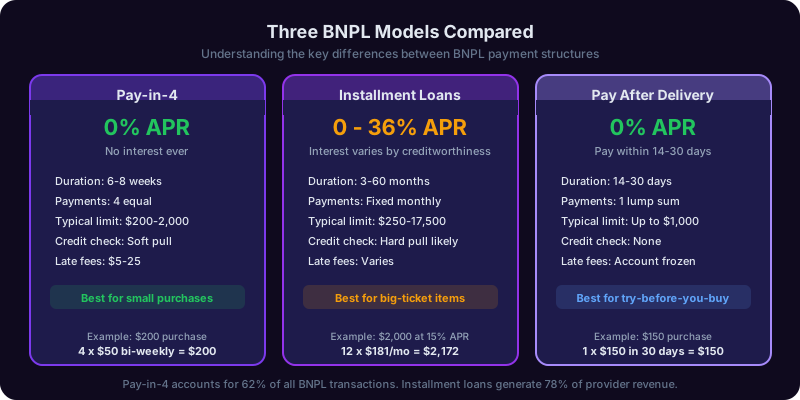
BNPL products are not all the same. There are three distinct models, and the risks vary significantly depending on which one you are using.
Model 1: Pay-in-4 (Short-Term Installments)
This is the most common BNPL format. You split a purchase into four equal payments made every two weeks over six weeks. Examples include Afterpay, Klarna "Pay in 4," and PayPal "Pay in 4."
- Interest: Typically 0% if you pay on time
- Credit check: Soft check only (does not affect your score)
- Late fees: $5-$8 per missed payment, capped at 25% of the order value
- Typical purchase size: $50-$500
The pay-in-4 model appears harmless because there is no interest. But the short repayment timeline means you are making payments every two weeks, and if you have multiple pay-in-4 loans running simultaneously, the biweekly obligations stack up fast.
Model 2: Longer-Term Installment Loans
Some BNPL providers offer financing over 3 to 36 months for larger purchases. Affirm is the primary provider in this category, along with Klarna's "Monthly Financing" and PayPal's "Pay Monthly."
- Interest: 0-36% APR depending on the merchant subsidy and your creditworthiness
- Credit check: Hard inquiry (impacts your credit score)
- Late fees: Varies; Affirm charges no late fees but does charge interest
- Typical purchase size: $200-$17,500
These are traditional installment loans dressed up as BNPL. When Affirm offers you 24 months at 15% APR on a $1,200 laptop, that is functionally identical to a personal loan.
Model 3: Pay-After-Delivery
Klarna offers a model where you receive the item, have 30 days to decide if you want to keep it, and only then pay. If you return the item, you owe nothing. This model encourages over-ordering ("I will just try three sizes and return two") which leads to returns management headaches and accidental charges when return deadlines are missed.
How Providers Make Money
Providers generate revenue from three sources:
- Merchant fees: Retailers pay the BNPL provider 2-8% of the transaction value. Merchants accept this because BNPL increases conversion rates by 20-30% and average order values by 30-50%.
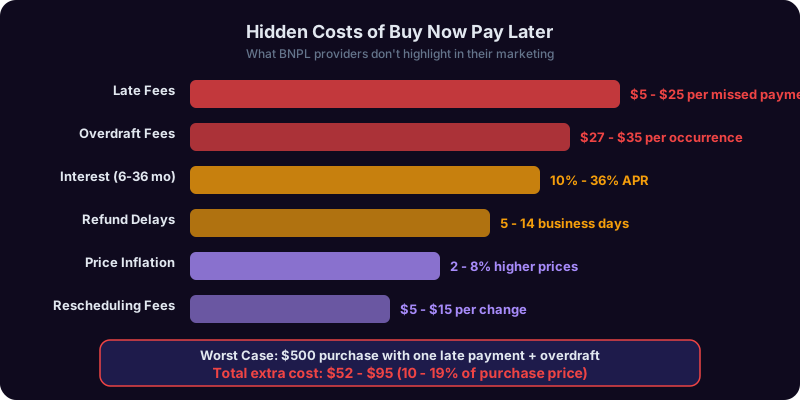
- Late fees: Despite marketing as "interest-free," BNPL providers collect significant revenue from late payments. Afterpay reported that late fees accounted for roughly 13% of total revenue in recent filings.
- Interest on longer-term loans: Affirm's interest-bearing loans generate substantial revenue, with average APRs of 15-20% on non-promotional plans.
The takeaway: you are not the customer, you are the product. The merchant pays the BNPL provider to convert you from a browser into a buyer, and the provider profits additionally when you pay late.

Get Answers From the Finance Copilot
Tell the Finance Copilot about your BNPL accounts and get a personalized payoff plan, total cost analysis, and safer alternatives for future purchases.
BNPL Now Reports to Credit Bureaus: What Changed and What It Means
Until 2024, most BNPL activity was invisible to credit bureaus. You could have 15 active BNPL loans and your credit report would show nothing. That era is over.
The New Credit Reporting Landscape
All three major credit bureaus now accept BNPL data. Here is the current reporting status for each major provider as of 2026:
| Provider | Reports to Bureaus | What Gets Reported | Impact on Score |
|---|---|---|---|
| Affirm | All 3 bureaus | On-time payments, missed payments, account open/close | Positive and negative |
| Afterpay | Experian (full), others selectively | Missed payments, defaults, collections | Primarily negative |
| Klarna | All 3 bureaus (started mid-2025) | On-time payments, missed payments, utilization | Positive and negative |
| PayPal Pay in 4 | Experian, TransUnion | Account status, payment history | Positive and negative |
| Zip (Quadpay) | Experian | Missed payments, defaults | Primarily negative |
How BNPL Appears on Your Credit Report
BNPL accounts may show up as installment loans (similar to a personal loan, with each purchase appearing as a separate account) or as open accounts with a credit limit equal to your BNPL spending cap. The inconsistency matters because scoring models treat these account types differently. FICO and VantageScore are actively updating their models to handle BNPL data, but the methodology is still evolving.
The Double-Edged Sword
Potential benefits:
- On-time BNPL payments add positive payment history (35% of your FICO score)
- Successfully completed accounts show a track record of managing installment debt
- For people with thin credit files, BNPL can accelerate credit history development (similar to the approach in our building credit from nothing guide)
Potential damage:
- A single missed payment can drop your score by 50-100 points, especially on a thin file
- Multiple active BNPL accounts increase your total debt load, affecting debt-to-income ratios
- Frequent new BNPL accounts reduce your average account age
- High BNPL utilization may be treated like high credit card utilization
Impact on Mortgage and Auto Loan Applications
Mortgage underwriters now see your BNPL obligations. A borrower with $800/month in BNPL payments may be denied a mortgage that would have been approved two years ago when those obligations were invisible. The CFPB has issued guidance encouraging lenders to consider BNPL obligations when calculating debt-to-income ratios.
If you are planning a major credit application within the next 6-12 months, pay off all active BNPL balances and avoid opening new ones. The Finance Copilot can help you understand how your current BNPL activity might affect your credit score and upcoming loan applications.
This is general information, not financial advice. Credit scoring models and bureau reporting practices change frequently. Consult a financial professional for guidance specific to your situation.
Loan Stacking: The Invisible Debt Spiral
Loan stacking is the single most dangerous behavior associated with BNPL, and it is alarmingly common. Loan stacking means having multiple active BNPL loans running simultaneously across one or more providers. Because each loan is small and the approval process is instant with no cross-provider checks, it is easy to accumulate obligations without realizing the total burden.
How Bad Is the Problem?
The numbers are sobering:
- 47% of BNPL users have missed at least one payment
- 36% of users have had three or more active BNPL loans at the same time
- 22% of users have used BNPL to pay for groceries or everyday essentials, indicating financial distress
- 18% of users have used a credit card to make a BNPL payment, layering debt on top of debt
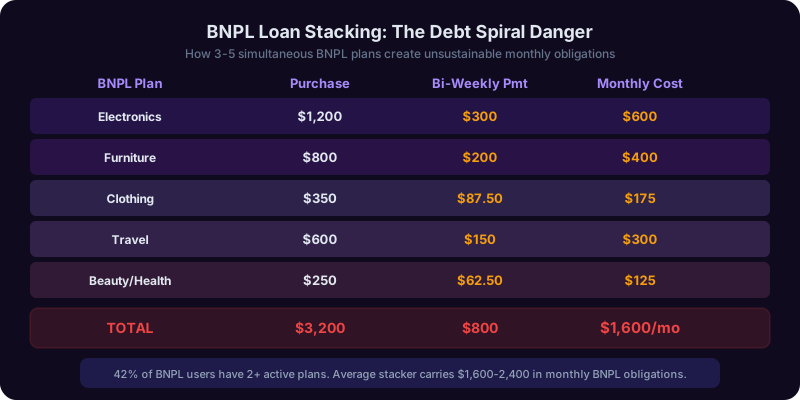
A Real-World Stacking Scenario
Over the course of a month, you make these BNPL purchases:
| Purchase | Provider | Total | Biweekly Payment |
|---|---|---|---|
| Sneakers | Afterpay | $180 | $45 |
| Skincare set | Klarna | $120 | $30 |
| Headphones | PayPal Pay in 4 | $200 | $50 |
| Clothing haul | Afterpay | $160 | $40 |
| Home decor | Zip | $100 | $25 |
Total BNPL debt: $760. Monthly payment obligation: approximately $380. None of these individual purchases felt excessive. But combined, $380/month in BNPL payments on top of rent, utilities, and groceries can push a tight budget past the breaking point.
Why Stacking Is Harder to Detect Than Credit Card Debt
With credit card debt, you receive a single monthly statement showing your total balance. BNPL debt is fragmented across multiple apps, each with different payment dates, and the individual amounts are small enough to mentally dismiss. A 2025 LendingTree survey found that 41% of BNPL users were not sure of their total outstanding BNPL balance. When asked to estimate, the average user underestimated by 35%.
The Cascade Failure
Loan stacking leads to a predictable cascade:
- You miss a payment on one BNPL loan because funds are spread too thin
- The late fee ($7-$8) reduces available funds for other payments
- The autopayment for a second BNPL loan triggers an overdraft ($25-$35 fee)
- You now owe the original installments plus $33-$43 in combined fees
- You use a credit card to cover the next BNPL payment, adding credit card interest
- The missed payment is reported to credit bureaus, damaging your score
This cascade can begin from a single $25 missed payment. If you suspect you are in a stacking situation, the audit section of this guide walks you through regaining control. The Budgeting Copilot can help you map out all your BNPL obligations and create a payoff timeline.
Provider Comparison: Afterpay vs. Klarna vs. Affirm vs. PayPal
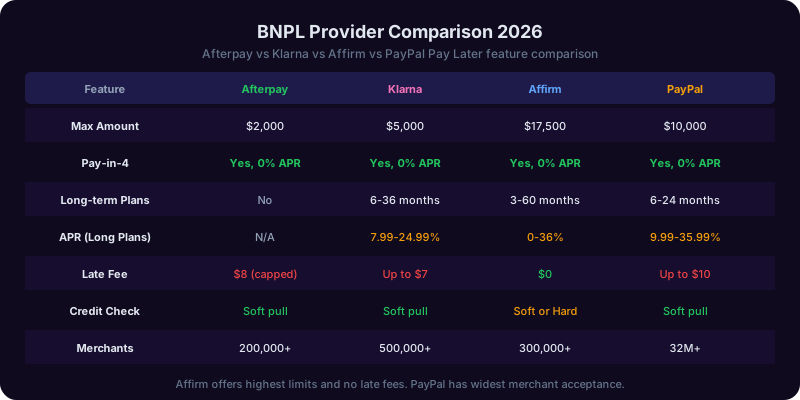
Not all BNPL providers carry the same risk. Here is a detailed comparison of the four largest providers in the US market.
Afterpay (Block/Square)
| Primary model | Pay in 4 (6-week repayment) |
| Interest | 0% on Pay in 4 |
| Late fees | $8 initial, +$8 after 7 days, capped at 25% of order |
| Credit reporting | Reports missed payments to Experian; expanding to all bureaus |
| Best for | Small fashion and retail purchases under $200 |
| Biggest risk | Late fees on small purchases can exceed 10% of purchase value |
Klarna
| Primary models | Pay in 4, Pay in 30, Monthly Financing (6-36 months) |
| Interest | 0% on Pay in 4 and Pay in 30; 0-29.99% on Monthly Financing |
| Late fees | $7 per missed payment |
| Credit reporting | Reports to all 3 bureaus (positive and negative) |
| Best for | Try-before-you-buy with 30-day payment window |
| Biggest risk | Multiple product types create confusion about which terms apply |
Affirm
| Primary models | Pay in 4, Monthly payments (3-60 months) |
| Interest | 0% on Pay in 4; 0-36% APR on monthly plans |
| Late fees | None (Affirm charges no late fees on any product) |
| Credit reporting | Reports to all 3 bureaus (positive and negative) |
| Best for | Larger purchases where 0% APR promotional financing is available |
| Biggest risk | High APR (up to 36%) on non-promotional plans |
PayPal Pay in 4 / Pay Monthly
| Primary models | Pay in 4, Pay Monthly (6-24 months) |
| Interest | 0% on Pay in 4; variable on Pay Monthly |
| Late fees | $7-$10 per missed payment on Pay in 4 |
| Credit reporting | Reports to Experian and TransUnion |
| Best for | Users already in the PayPal ecosystem |
| Biggest risk | Easy to stack with PayPal Credit without realizing total exposure |
The Verdict
If you are going to use BNPL, Affirm on a 0% APR promotional plan is the lowest-risk option because it charges no late fees and clearly discloses interest costs. Afterpay is reasonable for small purchases if you are confident you will pay on time. Klarna and PayPal require more vigilance because they offer multiple product types with different terms, and it is easy to accidentally select a higher-cost option at checkout. Regardless of provider, the safest approach is to treat every BNPL purchase as if you are spending real money today, because you are.
When BNPL Makes Sense vs. When It Does Not
BNPL is not inherently bad. Like any financial tool, it can be useful or destructive depending on how it is used. The key is understanding exactly when it helps and when it hurts.
BNPL Makes Sense When:
1. You have the full amount in your bank account right now. If you could pay $400 cash today but prefer to keep the cash earning 4.5% in your emergency fund HYSA for six more weeks, using a 0% pay-in-4 plan is a rational financial decision. You earn a small amount of interest, maintain liquidity, and pay nothing extra. This is the only scenario where BNPL is genuinely "free."
2. The 0% APR period covers the entire repayment. A 0% APR for 12 months on a $1,200 purchase means you can spread payments to $100/month with zero interest cost. The critical requirement: you must pay the balance in full before the promotional period ends.
3. You are making a planned, budgeted purchase. If you have been saving for new furniture and find a 0% BNPL option at checkout, using it to keep more cash liquid while you pay over 6-8 weeks is reasonable, provided the payments are already accounted for in your budget.
4. You need something urgently and the alternative is worse. If your car needs a $600 repair and the alternative is a payday loan at 400% APR, a 0% BNPL plan is dramatically less destructive. But this is an emergency use case, not a shopping strategy.
BNPL Does Not Make Sense When:
1. You cannot afford the item without BNPL. If $200 is too much to spend today, splitting it into four $50 payments does not change the fact that you cannot afford it. You are borrowing money for a discretionary purchase. The Budgeting Copilot can help you determine whether a purchase fits your actual budget.
2. You already have active BNPL loans. Adding a new BNPL loan when you have existing ones is loan stacking. If you are already making biweekly payments on two or more BNPL purchases, a third is moving into risky territory.
3. The purchase is impulsive. BNPL at checkout is specifically designed to reduce purchase friction. If you did not plan to buy this item before you saw it, BNPL is making an impulse purchase easier, not smarter.
4. Interest is involved. Any BNPL plan with an APR above 0% should be compared against your existing credit options. A credit card at 18% APR is better than an Affirm plan at 24% APR.
5. You are planning a major loan application. If you are applying for a mortgage, auto loan, or apartment rental in the next 6-12 months, active BNPL accounts can increase your debt-to-income ratio and reduce your approval odds.
6. You are using BNPL for essentials. If you are using BNPL for groceries, gas, or utility bills, this is a sign of deeper financial stress that BNPL will not solve. Explore alternatives like community assistance programs or the resources in our rent negotiation guide.
The 24-Hour Rule
Before using BNPL on any purchase over $100, wait 24 hours. Close the browser tab. Leave the store. If you still want the item tomorrow and can confirm that the total cost fits your budget after accounting for all existing obligations, proceed. If you have forgotten about it by tomorrow, you just saved yourself money and the hassle of managing another payment schedule.
This is general information, not financial advice. Consult a financial professional for guidance specific to your situation.
How to Audit Your BNPL, Smarter Alternatives, and Regulatory Protections
If you have used BNPL more than a few times, there is a good chance you do not know exactly how much you owe. Here is how to regain control, find better tools, and understand your rights.
The BNPL Audit Process
Open every BNPL app you have used and record active loans, remaining balance, next payment date, and payment amount. Create a simple tracker:
| Provider | Purchase | Balance | Next Payment | Amount | Overdue? |
|---|---|---|---|---|---|
| Afterpay | Shoes | $90 | July 5 | $45 | No |
| Klarna | Jacket | $60 | July 8 | $30 | No |
| Affirm | Laptop | $840 | July 15 | $70 | No |
| PayPal | Headphones | $50 | Overdue | $50 | Yes |
Address obligations in this order: overdue payments first (to stop late fees and credit damage), then interest-bearing loans, then smallest balances. If total BNPL debt exceeds $1,000, consider consolidating with a 0% APR balance transfer card or low-interest personal loan. Pull your credit report from AnnualCreditReport.com to check for BNPL tradelines and dispute inaccuracies.
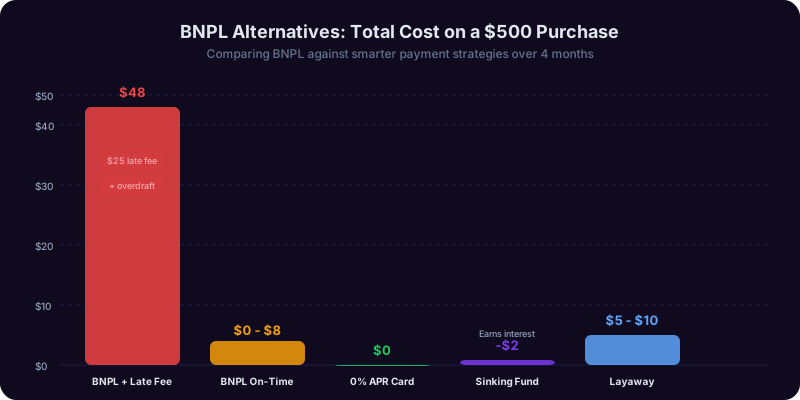
Smarter Alternatives to BNPL
0% APR credit cards offer 15-21 months interest-free with a single monthly payment, plus rewards and stronger consumer protections. You need a credit score of 670+ to qualify.
Savings sinking funds let you save $50/month into a dedicated category. After 4 months you have $200 cash with zero payment obligations.
Store financing at 0% APR from Apple, Best Buy, and major furniture retailers offers clearer terms and longer repayment periods than BNPL.
The 30-day rule: for any non-essential purchase over $100, add it to a wish list and wait. Research shows 70% of impulse purchase desire fades within 30 days.
Regulatory Protections in 2026
The CFPB classified BNPL providers as credit card issuers in 2024, extending Truth in Lending Act protections: dispute rights with payment withholding during investigation, timely refund obligations, billing error protections, and clear periodic statements.
California, New York, and Illinois have enacted or are considering legislation capping late fees and requiring clearer total cost disclosures. The FTC also accepts complaints about BNPL providers.
Prevention and How Copilotly Helps
Delete BNPL apps from your phone and remove saved payment methods from your browser. Set a personal rule: no more than one active BNPL loan at any time, and only on purchases you could pay cash for today.
The Finance Copilot can evaluate whether a BNPL offer is worth taking, compare total cost against your credit options, and build a payoff plan. The Budgeting Copilot integrates BNPL obligations into your overall budget so payments never catch you off guard.
This is general information, not financial or legal advice. Consult a financial professional for guidance specific to your situation.
Frequently Asked Questions
Recommended Copilots
Recommended Copilots
Get AI guidance on whether a BNPL offer is worth taking and how it affects your financial health
Try Free →Track BNPL obligations alongside your regular budget to prevent stacking and missed payments
Try Free →Related Articles
Get Answers From the Finance Copilot
Tell the Finance Copilot about your BNPL accounts and get a personalized payoff plan, total cost analysis, and safer alternatives for future purchases.