The 2026 College Essay Landscape: Why AI Changes Everything and Nothing
The college application essay has always been a high-stakes writing exercise. A 650-word Common App essay or a 250-word supplemental response can determine whether you get into your dream school or receive a rejection letter. Now, with AI writing tools available to every applicant, admissions offices are navigating uncharted territory -- and so are students.
Here is the reality as of the 2026-2027 admissions cycle. According to a National Association for College Admission Counseling (NACAC) survey, 68% of four-year institutions now use some form of AI detection in their application review process. At the same time, an estimated 53% of college-bound high school students have used AI tools during essay preparation, ranging from brainstorming to full draft generation. The gap between what students are doing and what admissions offices are detecting is narrowing fast.
But this is not a story about getting caught. It is a story about understanding what admissions officers actually evaluate, why AI-generated essays consistently underperform human-written ones in holistic review, and how to use AI tools in ways that genuinely improve your application rather than undermining it.
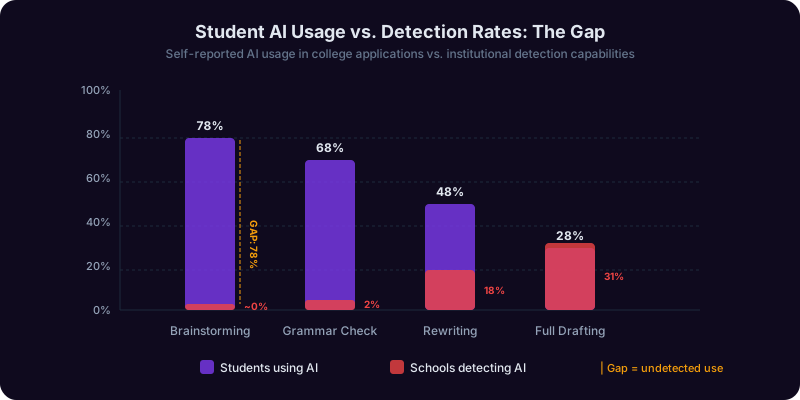
The fundamental tension. Admissions officers want to hear your voice, your story, and your thinking. AI tools are exceptionally good at producing polished, competent writing. But polished and competent is exactly what admissions officers do not want. They want specific, vulnerable, and real. A perfectly structured essay about "overcoming adversity" that could have been written by any applicant is far less compelling than a messy, honest reflection about a specific moment that changed how you see the world.
This creates a paradox: the more you let AI write for you, the more your essay sounds like everyone else's AI-written essay. And in a cycle where admissions officers are reading thousands of applications, sounding like everyone else is the fastest path to the rejection pile.
What this guide covers. We will walk through the specific policies major universities have published about AI use, the detection tools admissions offices deploy, the ethical framework that separates legitimate assistance from academic dishonesty, and the practical workflows that strengthen your authentic voice. Whether you are a student, parent, or college counselor, this guide provides the clarity you need to navigate AI and college essays in 2026.
The Ethical Line: AI as Editor vs. AI as Ghostwriter
The most important distinction in using AI for college essays is the difference between AI as a tool and AI as the author. This is not a gray area -- it is a clear line, and crossing it carries real consequences including application rescission, admission revocation, and permanent flags on your academic record.
What falls on the ethical side:
- Brainstorming and ideation: Using AI to generate a list of potential essay topics based on your experiences, then choosing and developing one yourself
- Grammar and mechanics: Running your completed draft through AI for spelling, punctuation, and grammar corrections -- no different from using Grammarly or asking a teacher to proofread
- Structural feedback: Asking AI to evaluate whether your essay has a clear thesis, logical flow, and effective transitions
- Practice and preparation: Using AI to generate practice prompts, provide feedback on practice drafts, or explain what admissions officers look for
What crosses the ethical line:
- Full draft generation: Providing a prompt and having AI write the essay from scratch, even if you edit it afterward
- Substantive content creation: Having AI generate paragraphs, anecdotes, or reflections that you then insert into your essay
- Voice replacement: Repeatedly prompting AI to rewrite your sentences until the voice is no longer recognizably yours
- Fabricated experiences: Using AI to embellish or invent experiences, achievements, or reflections
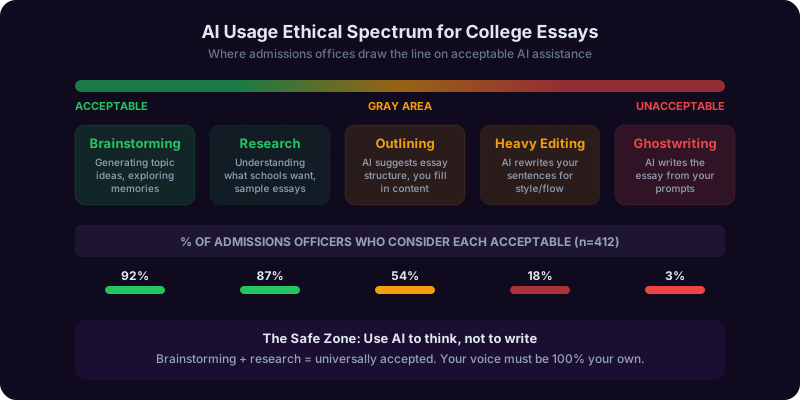
The 70/30 rule. A practical framework used by college counselors: at least 70% of the creative and intellectual work in your essay should be unmistakably yours. This includes the topic selection, the personal experiences described, the reflections and meaning-making, and the distinctive voice. The remaining 30% can involve tools -- AI, spell-checkers, feedback from teachers, or writing center consultations. If you removed all AI-assisted elements and the essay would collapse, AI did too much. If you removed them and the essay would still stand with its core message intact, you are in safe territory.
The practical test. Ask yourself: could I sit in an admissions interview and discuss every idea in this essay in depth? Could I explain why I chose each example? Could I articulate the reflection without looking at the essay? If the answer to any of these is no, AI has crossed from tool to author. Many selective schools now conduct post-admission interviews specifically to verify essay authenticity.
Why this matters beyond admissions. The essay is practice for the kind of reflective, honest writing you will do throughout college and your career. Learning to use AI as a tool that enhances your thinking -- rather than a crutch that replaces it -- is a skill that will serve you for decades. For a broader perspective on ethical AI use in professional writing, see our guide to writing cover letters with AI assistance.
School-by-School AI Policies: What Top Universities Actually Allow
University policies on AI in application essays vary significantly and are evolving rapidly. As of the 2026-2027 admissions cycle, schools fall into three broad categories: explicit bans, conditional allowance, and open acknowledgment.
Schools with explicit AI restrictions:
| University | Policy | Key Detail |
| Brown University | Prohibits AI-generated content | Requires attestation that essay is entirely the applicant's own work |
| Stanford University | Prohibits AI-authored essays | AI use in essay creation violates academic honesty standards |
| University of Michigan | Prohibits AI-generated content | Uses AI detection as part of application review |
| Georgetown University | Prohibits AI assistance beyond basic tools | Defines basic tools as spell-check only |
Schools that conditionally allow AI:
| University | Policy |
| MIT | Allows AI for brainstorming and editing; final voice must be applicant's own |
| Georgia Tech | Allows AI as a writing tool; encourages disclosure |
| Arizona State University | Allows AI assistance; evaluates interview alignment with essay content |
Schools with open acknowledgment:
| University | Policy |
| University of Pennsylvania | Evaluates authenticity through holistic review rather than detection tools alone |
| Northeastern University | Allows responsible AI use; includes optional disclosure section |
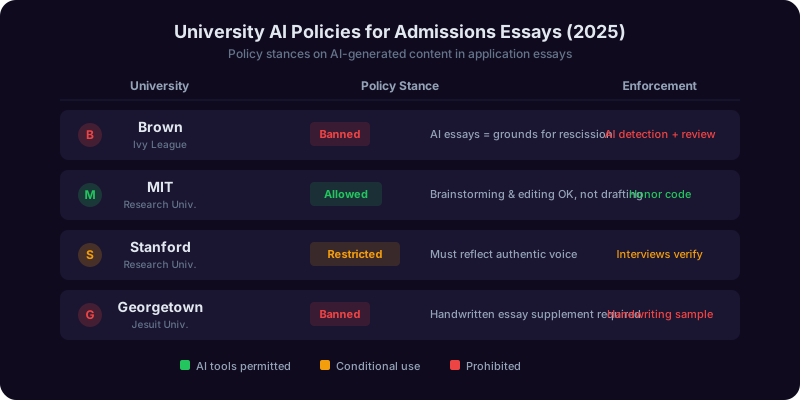
The Common Application stance. The Common App requires applicants to certify that application materials are their own work. In 2025, it updated guidance to clarify that "your own work" means the ideas, experiences, and voice must originate from you, while acknowledging that applicants may use tools for grammar and clarity.
The College Board position. The College Board has stated that AI-generated content in application essays is a violation of academic integrity standards. This applies to BigFuture scholarship applications and any College Board-administered essay components.
What this means practically. If you are applying to 8-12 schools, you may be navigating three or four different AI policies simultaneously. The safest approach is to default to the most restrictive policy among your target schools. If Brown prohibits AI-generated content and MIT allows brainstorming, write all your essays to Brown's standard.
Policy enforcement is tightening. In the 2025-2026 cycle, at least 14 universities revoked admissions offers after post-admission interviews revealed that applicants could not discuss the ideas in their essays. The risk is real and growing.
Get Answers From the Career Copilot
Ask a specialist AI copilot the question you just read about. Your first conversation needs no signup and no card.
AI Detection Tools Colleges Use: What Gets Flagged and What Does Not
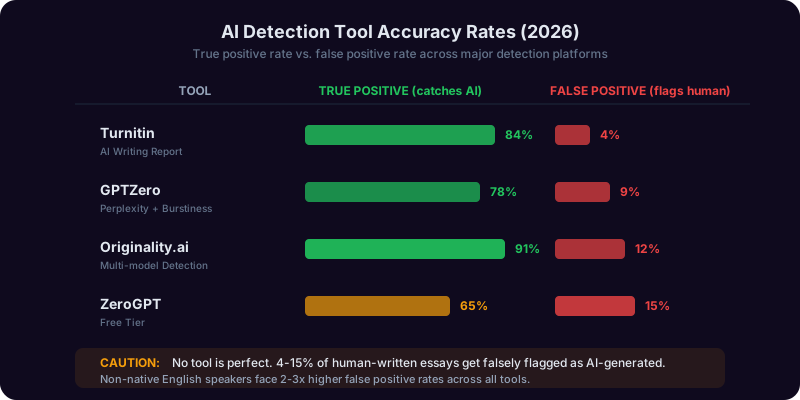
Understanding how AI detection works helps you understand both why fully AI-generated essays are risky and why legitimately AI-assisted essays rarely trigger false positives. Detection technology has matured significantly since the early, unreliable versions of 2023-2024.
The major detection tools in use:
- Turnitin AI Detection: Integrated into the platform most universities already use for plagiarism detection. Turnitin claims 98% accuracy for fully AI-generated text and 91% for text more than 50% AI-generated. False positive rates have dropped to approximately 2-3% for native English speakers.
- GPTZero: Used by approximately 30% of admissions offices. Analyzes perplexity (how predictable word choices are) and burstiness (how much sentence length varies). AI text tends to be consistently smooth in a way human writing rarely is.
- Originality.ai: Used primarily by scholarship committees. Provides a percentage score indicating the likelihood of AI generation.
- Internal university tools: Several university systems have developed proprietary methods that compare essay linguistic patterns against an applicant's other writing samples.
What triggers detection:
| Pattern | Why It Flags |
| Uniform sentence length | Human writers naturally vary; AI tends toward consistency |
| Low perplexity vocabulary | AI selects statistically most likely words ("navigating the complexities of adolescence") |
| Generic reflection patterns | AI produces reflections that could apply to anyone ("taught me the importance of perseverance") |
| Perfect paragraph structure | AI produces textbook-perfect topic sentences and transitions throughout |
| Absence of voice markers | No humor, unusual metaphors, or sentence fragments for emphasis |
What does not trigger detection:
- Using AI for brainstorming topics (the writing is still yours)
- Grammar and spell-check corrections (these change individual words, not patterns)
- Structural feedback that you implement yourself
- AI-generated practice prompts that you respond to independently
The cross-reference problem. The most sophisticated detection is not algorithmic -- it is human. Experienced admissions readers compare your essay voice against your short-answer responses, counselor recommendation, interview, and academic writing sample. If your essay sounds like a polished professional writer and your short answers sound like a 17-year-old, the inconsistency raises a flag no algorithm needs to catch.
Using AI for Brainstorming and Structure: The Right Way to Start Your Essay
The blank page is the hardest part of any essay, and this is where AI provides its most legitimate and valuable assistance. Using AI to generate ideas, explore angles, and organize your thoughts is the digital equivalent of talking through ideas with a counselor. The key difference is that you must do all the actual writing yourself.
Brainstorming with AI: a step-by-step workflow.
Step 1: Experience inventory. Before opening any AI tool, spend 15-20 minutes listing significant experiences, challenges, relationships, and moments of growth from the past four years. Do this on paper -- not in an AI chat. This raw material must come entirely from your memory.
Step 2: AI-assisted topic exploration. Share your experience list with an AI copilot and ask: "Which three experiences would make the strongest college essay topics? What makes each compelling?" The AI helps you see which experiences have the most essay potential.
Step 3: Angle refinement. For your top choice, ask: "What are five different angles I could take? For each, what would the opening scene look like?" This is not asking AI to write your opening -- it is asking AI to help you think about which entry point is most effective.
Step 4: Write your first draft entirely yourself. Close the AI tool. Open a blank document. Write. The draft will be messy and imperfect. That is exactly what it should be.
Common App prompts and ethical AI use:
| Prompt | Ethical AI Use | Unethical AI Use |
| "Background or story central to identity..." | Ask AI which experiences most shaped your identity | Ask AI to write a story about identity |
| "Lessons from obstacles we encounter..." | Ask AI what makes a strong obstacle essay vs. a cliched one | Ask AI to generate a reflection about overcoming obstacles |
| "Time you questioned a belief..." | Ask AI for examples of what intellectual growth looks like | Ask AI to write about questioning a belief |
| "Topic or idea you find engaging..." | Ask AI to help articulate why your passion matters to you | Ask AI to write about a topic it considers engaging |
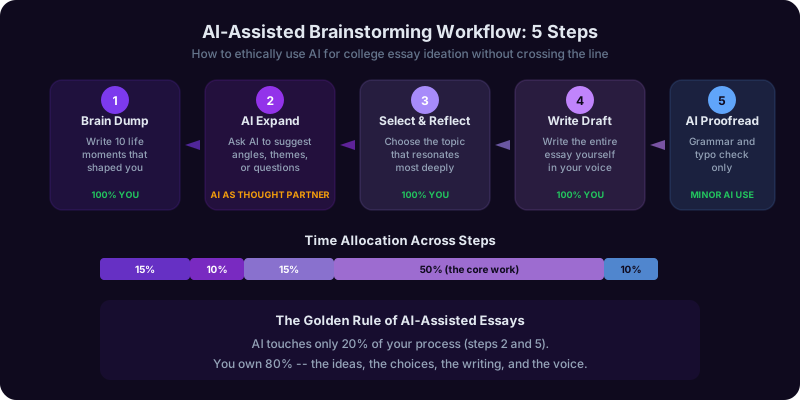
Structure improvement after your draft. Once you have a complete first draft, AI becomes valuable again. Share your draft and ask: "Does this essay have a clear narrative arc? Where does the pacing slow down? Which paragraphs feel disconnected from the central theme?" The AI identifies structural issues. You fix them yourself, in your own words.
What admissions officers want to see. The essays that stand out share four qualities: specificity (a particular moment, not a general theme), vulnerability (honest reflection, not performative wisdom), voice (writing that sounds like a real person), and insight (genuine learning, not a moral lesson inserted at the end). AI is excellent at identifying when your draft is missing these qualities. It is terrible at generating them authentically. For more on AI-assisted writing, see our guide to cover letter writing.
Grammar, Editing, and Preserving Your Authentic Voice
Once your draft is written in your own voice, AI becomes a powerful editing tool -- but only if you use it correctly. The most common mistake is not using AI to write from scratch. It is using AI to over-polish your own writing until the voice has been sanded away. Your goal is to fix errors while keeping every quirk and rhythm that makes your writing sound like you.
Grammar and mechanics: the safe zone. Using AI to catch grammatical errors, fix punctuation, correct spelling, and flag unclear pronoun references is universally accepted. No admissions office objects to error-free writing. Just ensure you understand the corrections being made -- do not blindly accept changes that alter your meaning.
The over-polishing trap. You write: "My grandma's kitchen smelled like cumin and burnt tortillas and I loved standing on the stool watching her hands move like she was conducting an orchestra only the orchestra was beans and rice." It is a run-on. It is also vivid, specific, and alive. An AI tool might suggest: "My grandmother's kitchen was filled with the aroma of cumin and toasted tortillas. I enjoyed observing her culinary artistry from a step stool." The grammar improved. The voice died.
Rules for AI editing that preserves voice:
- Fix errors, do not rewrite sentences. Ask AI to identify errors and explain them, then fix them yourself
- Keep your sentence length variation. If you naturally write a mix of short punchy sentences and long flowing ones, do not let AI normalize them
- Preserve your vocabulary level. If you do not use "juxtaposition" in conversation, do not let AI insert it
- Keep intentional fragments. "Standing there. Alone. Wondering if anyone noticed" is a stylistic choice, not an error
- Maintain your metaphors. If your metaphor is a little unusual, that is what makes it yours
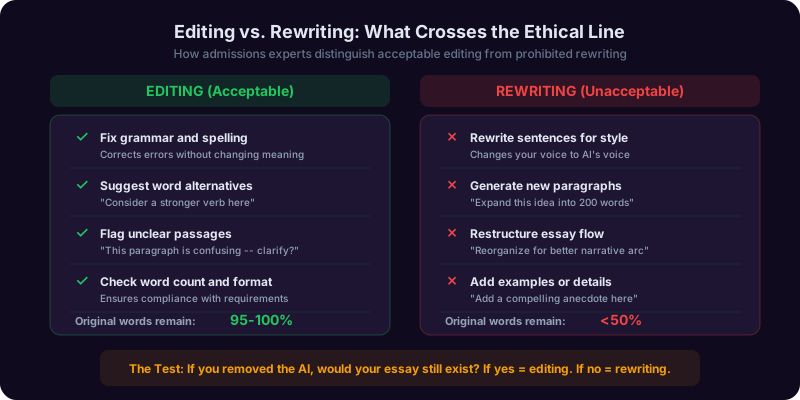
The voice consistency check. After any AI-assisted editing, read your essay out loud. Does it still sound like you talking? Could your best friend say, "That sounds like something you would write"? If sections sound noticeably more sophisticated than others, AI has crept past editing into rewriting. Revert those sections and fix only the actual errors.
Word count management. The Common App personal statement has a 650-word limit. AI can help identify redundant sentences and unnecessary words. But when AI suggests cutting your most personal details in favor of keeping generic reflective statements, override it. Specific details are always more valuable than polished conclusions.
Practice writing with AI feedback. Before writing actual essays, use AI as a practice partner. Write responses to sample prompts, share them with a copilot, and ask for feedback on voice, specificity, and depth. Do this five or six times to develop a clearer sense of your natural writing strengths. The Academic Writing Copilot is designed for this kind of iterative improvement without replacing your voice.
What Admissions Officers Actually Look For: The Human Side of Essay Review
Understanding how admissions officers evaluate essays is essential context for deciding how to use AI. The essay is not graded on a rubric like a classroom assignment. It is evaluated holistically as part of your entire application, and its purpose is fundamentally different from what most students assume.
The essay's actual purpose. Admissions officers are not looking for the best writer. They are looking for the most interesting, self-aware, and genuine person. The essay answers questions grades and test scores cannot: How does this person think? What do they care about? How do they process experiences? A technically mediocre essay that reveals genuine depth of character will outperform a beautifully written essay that reveals nothing.
What experienced readers notice immediately:
- Specificity over generality. "I volunteered at a food bank and learned about inequality" tells them nothing. "Mr. Henderson came every Thursday at 4:15 and always asked if we had peanut butter because his grandson only ate peanut butter sandwiches" tells them everything about how you observe the world
- Earned insight over inserted wisdom. The reflection should emerge naturally from the narrative. If your last paragraph could be swapped into any other essay on the same topic, it is too generic
- Vulnerability over performance. They remember the student who admitted they are still figuring it out, or that the experience left them with questions rather than answers
- Voice over polish. A distinctive voice -- humor, honesty, unusual observations -- is the single strongest indicator that an essay is authentically the applicant's work
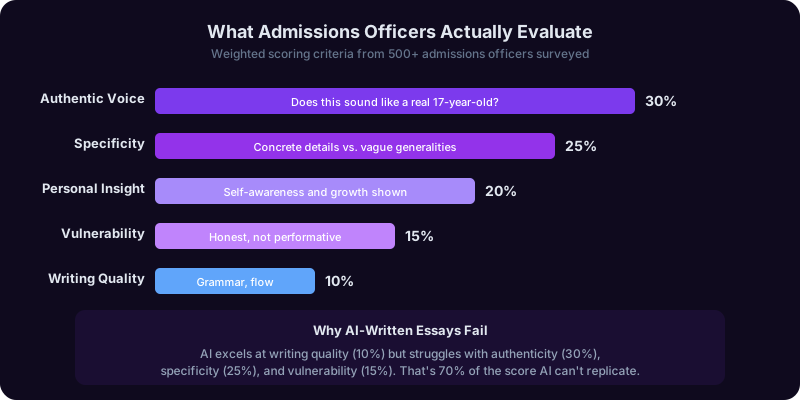
The AI tells. Admissions officers who have been reading essays for years report consistent patterns in AI-generated essays: an absence of concrete sensory details, reflections mature beyond the applicant's likely experience level, vocabulary that does not match short-answer responses, and a suspiciously even emotional tone throughout. Real essays have peaks of intensity and quieter moments -- AI maintains a steady, moderate register.
The interview verification trend. A growing number of selective institutions now conduct post-admission interviews or require video responses. If your essay describes a passionate interest in marine biology, the interviewer will ask about marine biology. Students whose spoken reflections do not match the depth of their written essays are flagged for further review.
What this means for AI use. Every word in your essay should be something you can discuss and defend in conversation. If an AI copilot helped you identify that your food bank volunteering was a strong topic, great -- you can still talk about Mr. Henderson because that memory is yours. If an AI copilot generated a reflection about systemic inequality that you copied into your essay, you will struggle when asked to elaborate. The College Board and individual institutions are increasingly aligned: the thinking must be the student's own work.
Your Complete AI Essay Workflow: A Practical Guide with Copilotly
Now that you understand the ethical boundaries, school policies, and what admissions officers prioritize, here is a concrete workflow for using AI throughout the essay process while staying on the right side of every university policy.
Phase 1: Reflection and brainstorming (2-3 days).
- Reflect on your experiences without AI. Write a raw list of 15-20 moments, challenges, and interests that shaped you
- Open a College Admissions Copilot session. Share your list and ask which experiences have the most essay potential
- For your top three choices, ask what makes each distinctive compared to common essay topics
- Choose your topic based on the copilot's analysis and your own gut feeling
Phase 2: First draft (1-2 days).
- Close all AI tools. Write your entire first draft from memory and feeling
- Do not worry about word count, grammar, or structure. Get the story on paper
- Target 800-900 words -- you will cut later, and cutting is easier than adding
- Read it once, then walk away for 24 hours
Phase 3: Structural feedback (1 day).
- Share your draft with the copilot for structural analysis: narrative arc, pacing, and whether the reflection feels earned
- Make structural changes yourself in your own words
- Ask: "Which sections feel the most generic? Where could I add more specific detail?"
- Add specific details from your memory -- the copilot identifies gaps, you fill them
Phase 4: Editing and polish (1-2 days).
- Ask the copilot to identify grammar errors, unclear sentences, and unnecessary words
- Fix errors yourself. For each suggestion, decide whether accepting it preserves your voice
- Cut to the 650-word limit. Ask which sentences are least essential to your core message
- Read aloud. If any sentence sounds unlike you, revert to your original phrasing
Phase 5: Final verification (1 day).
- Ask: "Does this sound like it was written by a high school student with genuine experiences, or does it sound AI-generated?"
- Have a parent, teacher, or friend read it and confirm it sounds like you
- Run it through a free AI detection tool. If it flags above 15-20%, rewrite flagged sections in your natural voice
- Verify voice consistency with your short-answer responses
How Copilotly fits. The Writing Copilot and College Admissions Copilot function as thinking partners, not ghostwriters. They provide feedback on your writing rather than generating writing for you. AI should amplify your authentic voice, not replace it.
For students navigating the financial side of college, our complete guide to finding and winning scholarships with AI covers scholarship essays and financial aid optimization. For parents, our guide to setting AI boundaries for kids provides a framework for supervising AI use without micromanaging the creative process.
Frequently Asked Questions
Recommended Copilots
Related Articles
Get Answers From the Career Copilot
Ask a specialist AI copilot the question you just read about. Your first conversation needs no signup and no card.