
Money & Finance
Is It Cheating to Use AI for Scholarship Essays? Rules, Limits, and a Winning Workflow
Over $100 million in scholarships goes unclaimed every year, and AI can help you find and win them, if you use it the right way. This guide draws the line between ethical AI essay assistance and disqualifying ghostwriting, then covers matching, FAFSA, and deadline workflows.
The 2026 Scholarship Landscape: Billions Left on the Table
The college scholarship ecosystem in the United States is enormous, fragmented, and deeply inefficient. There are over 1.7 million private scholarships available from foundations, corporations, community organizations, professional associations, and religious groups. Combined with institutional merit aid from colleges themselves, the total pool of available scholarship money exceeds $49 billion annually. Yet every year, a staggering portion of that money goes unawarded.
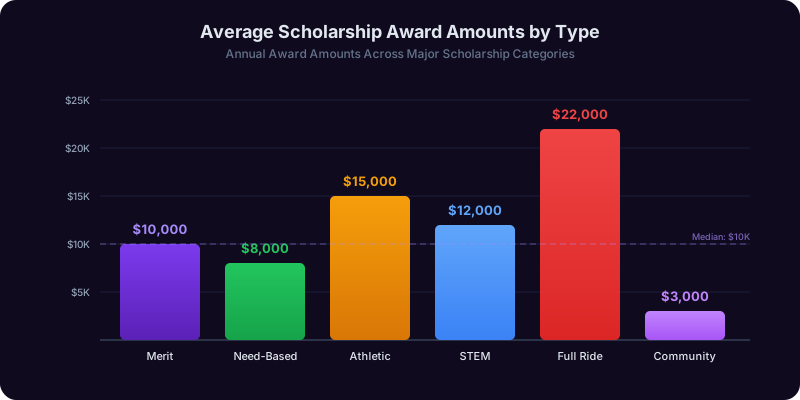
Here are the numbers that define the 2026 scholarship landscape:
| Metric | 2026 Figure |
|---|---|
| Total scholarship money available annually | $49.7 billion |
| Number of private scholarships | 1.7 million+ |
| Average private scholarship award | $4,200 |
| Percentage of students receiving any scholarship | 59% |
| Estimated unclaimed scholarship money | $100 million+ |
| Average number of scholarships applied to per student | 7 |
| Average number needed for meaningful results | 20-40 |
| Average tuition + fees (4-year public, in-state) | $11,260 |
| Average tuition + fees (4-year private) | $43,350 |
Why Scholarships Go Unclaimed
The often-cited "$100 million in unclaimed scholarships" figure, tracked by the National Scholarship Providers Association, comes down to three root causes:
- Discoverability: Most scholarships are offered by small organizations with minimal marketing budgets. A local Rotary club offering $2,000 to students in a specific county does not have the reach to find every eligible applicant. According to Fastweb, their database alone contains over 1.5 million scholarships, and new ones are added daily.
- Eligibility complexity: Many scholarships have narrow eligibility criteria - specific majors, ethnic backgrounds, geographic regions, extracurricular activities, or career goals. A student might qualify for hundreds of scholarships but never discover them because manual searching through databases is tedious and imprecise.
- Application friction: Each scholarship has its own application, its own essay prompts, its own deadlines, and its own submission process. The average student applies to just 7 scholarships, but research from the College Board suggests that students who apply to 20 or more see significantly higher total award amounts.
This is precisely where AI changes the game. The three barriers - discoverability, eligibility matching, and application friction - are problems that artificial intelligence is exceptionally well-suited to solve. AI can scan millions of scholarship listings, match them against your profile with far more precision than keyword search, and help you produce high-quality application materials at a pace that makes applying to 30-40 scholarships realistic instead of overwhelming.
The rest of this guide walks through exactly how to use AI at every stage of the scholarship process, from initial search through final interview prep. Whether you are a high school junior starting early, a college sophomore looking for renewal awards, or a non-traditional student returning to school, the strategies here will help you capture money that would otherwise go to someone else - or no one at all.
AI-Powered Scholarship Matching: Finding the Right Opportunities
Traditional scholarship searching works like this: you enter a few keywords into a database, scroll through hundreds of results, and manually check eligibility for each one. It is slow, incomplete, and the reason most students give up after finding a handful of opportunities. AI-powered matching flips this process entirely - instead of you searching for scholarships, the right scholarships find you.
How AI Scholarship Matching Works
Modern AI scholarship tools use a combination of natural language processing and profile matching to analyze your complete student profile against scholarship eligibility criteria. Instead of matching on simple keywords like "engineering" or "Hispanic," AI models understand context and nuance. A scholarship for "students who have demonstrated community leadership in underserved areas" can be matched to a student who organized a tutoring program in a low-income neighborhood, even if the student never used the exact phrase "community leadership" in their profile.
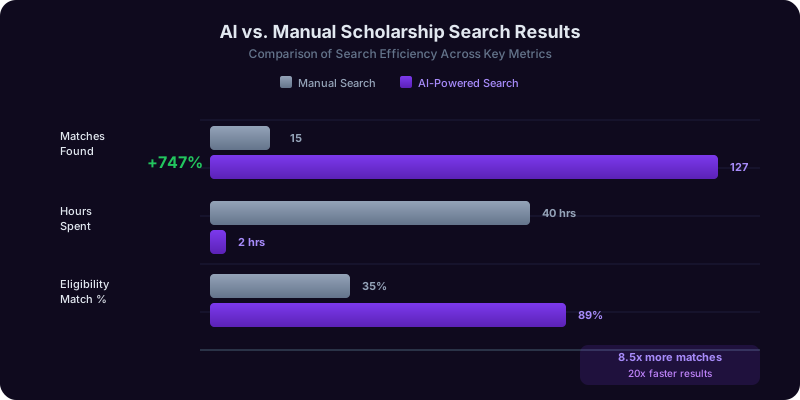
Here is what a strong AI-powered scholarship search strategy looks like:
Step 1: Build a Comprehensive Profile
The quality of your AI matches depends entirely on the quality of your input. Create a detailed profile that includes:
- Academic details: GPA (weighted and unweighted), SAT/ACT scores, AP/IB courses, class rank, academic honors, intended major, and academic interests
- Demographics: Age, gender, ethnicity, first-generation college student status, citizenship, state of residence, and county
- Financial situation: Estimated family income bracket, FAFSA EFC (Expected Family Contribution, now called Student Aid Index), number of siblings in college
- Extracurriculars: Every club, sport, volunteer activity, job, and hobby - with descriptions of your role and accomplishments in each
- Career goals: Intended profession, industries of interest, and any specific career-related experiences
- Special circumstances: Military family, foster care background, disability, single-parent household, rural community, or any unique life experiences
Step 2: Use Multiple Search Platforms
No single database contains every scholarship. For comprehensive coverage, use at least three sources:
| Platform | Scholarships Listed | AI Features | Best For |
|---|---|---|---|
| Fastweb | 1.5 million+ | Profile matching, deadline alerts | Broadest database coverage |
| Scholarships.com | 3.7 million+ | Eligibility matching | Volume of results |
| College Board Scholarship Search | 2,200+ programs | SAT score matching | Merit-based institutional awards |
| Going Merry | Curated selection | Common application for multiple awards | Reducing application friction |
| Your college's financial aid office | Varies | None (manual) | Institutional scholarships |
Step 3: Let AI Prioritize Your List
Once you have a list of 50-100+ potential scholarships, AI helps you prioritize. Using a tool like the Finance Copilot, you can rank scholarships by a weighted score that factors in:
- Award amount: Higher amounts get priority, obviously
- Eligibility strength: How closely your profile matches the stated criteria
- Competition level: National scholarships with 50,000 applicants have lower odds than local scholarships with 50 applicants
- Effort required: A 500-word essay is a different investment than a 2,500-word research proposal
- Deadline proximity: Upcoming deadlines need immediate attention
- Renewability: A $5,000/year renewable scholarship is worth $20,000 total - far more valuable than a one-time $5,000 award
The ideal outcome is a prioritized application calendar with 20-40 scholarships, organized by deadline, with estimated time investment and probability of award for each one. Students who follow this structured approach report winning 3-5 times more scholarship money than those who apply haphazardly to whatever they stumble across first. The key is treating the scholarship search like a part-time job - disciplined, data-driven, and systematic.
Writing Winning Scholarship Essays With AI Assistance
The scholarship essay is where most applications are won or lost. Committees reviewing hundreds or thousands of essays can spot generic, templated responses immediately. At the same time, many strong candidates lose out because they struggle to articulate their experiences compellingly. This is where AI becomes your most valuable tool - not to write the essay for you, but to help you write the best version of your own story.
What Scholarship Committees Actually Look For
Before discussing how AI helps, understand what wins. Scholarship reviewers at organizations like the Gates Millennium Scholars Program, Coca-Cola Scholars Foundation, and Jack Kent Cooke Foundation have consistently identified these qualities in winning essays:
- Specificity over generality: "I want to help people" loses to "I spent 200 hours building a free tutoring program for 12 refugee families in my apartment complex because I watched my own parents struggle with English when I was nine."
- Self-awareness: Committees want to see that you understand your own motivations, challenges, and growth - not just a list of accomplishments.
- Connection to the scholarship's mission: Every scholarship exists for a reason. The best essays demonstrate clear alignment between your story and what the organization is trying to support.
- Writing quality: Clear, grammatically correct prose with a distinctive voice. Not flowery, not robotic - authentic.
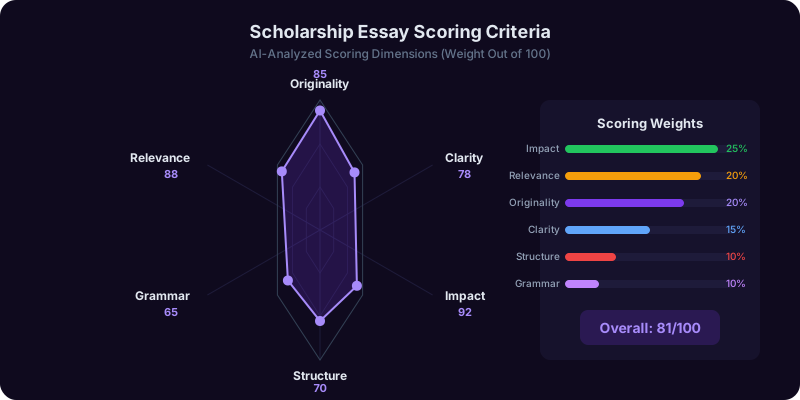
The AI-Assisted Essay Writing Process
Here is a five-step process for using AI to produce scholarship essays that are authentically yours but polished to a professional level:
Step 1: Brainstorm with AI
Start by telling an AI assistant about your background, experiences, and the specific essay prompt. Ask it to help you identify which experiences are most relevant and which angles might be most compelling. A Writing Copilot can ask probing questions that help you uncover stories you might not have considered - a seemingly minor experience that actually shaped your perspective in a meaningful way.
Step 2: Create a Story Outline
Use AI to structure your essay around a narrative arc. The most effective scholarship essays follow a pattern: a specific opening scene or moment, the context that led to it, the challenge or conflict, the actions you took, and the insight or growth that resulted. AI can help you map your experiences to this structure.
Step 3: Write the First Draft Yourself
This is critical. Write the first draft in your own voice, using your own words and memories. AI-generated first drafts sound like AI-generated first drafts, and experienced reviewers can tell. Your authentic voice, imperfect as it may be, is your greatest asset.
Step 4: Refine with AI Feedback
Paste your draft into an AI tool and ask for specific feedback: Is the opening compelling enough? Does the narrative flow logically? Are there places where I tell instead of show? Is the connection to the scholarship's mission clear? Which sentences are weakest? AI excels at this kind of structural and stylistic analysis.
Step 5: Polish and Proofread
Use AI for final proofreading - grammar, punctuation, word choice, and sentence variety. Ask it to check that you have stayed within the word count and that every paragraph serves a purpose. Then read the essay aloud yourself. If any sentence sounds unlike you, rewrite it.
Adapting One Essay Across Multiple Applications
You do not need to write a completely new essay for every scholarship. Most essay prompts fall into a few categories: "Tell us about yourself," "Describe a challenge you overcame," "Why do you deserve this scholarship," and "What are your goals." AI can help you adapt a strong core essay to different prompts by adjusting the framing, emphasis, and specific connections to each scholarship's mission. A single well-crafted personal narrative can serve as the foundation for 10-15 tailored applications. This is one of the highest-leverage uses of AI in the scholarship process, and it directly addresses the application friction problem that prevents students from applying to enough scholarships. For more on improving your writing workflow, explore the Writing Copilot.
FAFSA Optimization: Maximizing Your Need-Based Aid With AI
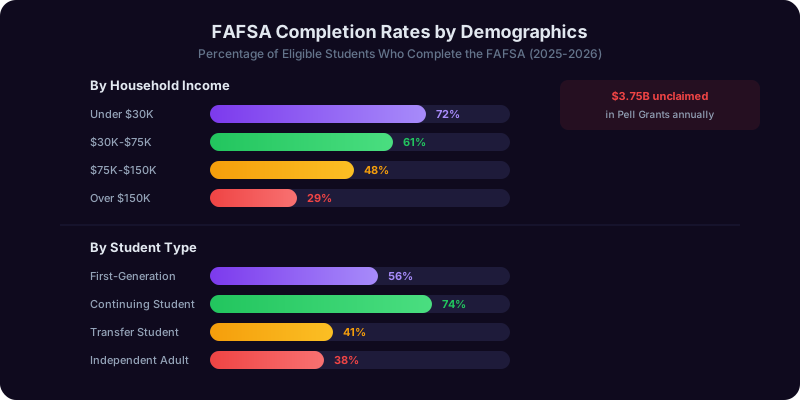
The Free Application for Federal Student Aid (FAFSA) is the gateway to over $112 billion in federal financial aid each year, including Pell Grants, federal work-study, subsidized loans, and the institutional need-based aid that most colleges distribute based on FAFSA data. Yet the FAFSA completion rate remains stubbornly below 60% of eligible students, and many who do complete it make errors that reduce their aid eligibility. The simplified FAFSA introduced for the 2024-2025 cycle reduced the number of questions from 108 to 36, but the underlying financial calculations remain complex - and strategically important.
Understanding the Student Aid Index (SAI)
The FAFSA produces a number called the Student Aid Index (SAI), which replaced the Expected Family Contribution (EFC) starting in 2024-2025. The SAI estimates how much your family can contribute toward college costs. The lower your SAI, the more need-based aid you qualify for. Unlike the old EFC, the SAI can be negative (down to -1,500), potentially qualifying you for more aid.
Key factors in the SAI calculation:
- Parent income (for dependent students): Adjusted Gross Income from tax returns, plus untaxed income and benefits
- Parent assets: Savings, investments, and real estate (excluding primary home and retirement accounts)
- Student income: Assessed more heavily than parent income - every dollar above the income protection allowance ($9,410 for 2026-2027) reduces aid eligibility
- Student assets: Assessed at 20% - meaning $10,000 in a student's savings account increases the SAI by $2,000
- Family size and number in college: The simplified FAFSA no longer divides the SAI by the number of children in college simultaneously, a significant change that reduced aid for multi-student families
AI-Powered FAFSA Strategy
This is where AI tools genuinely change outcomes. A Finance Copilot can analyze your family's financial situation and identify legal strategies to optimize your SAI before you file. Here are the most impactful strategies:
1. Asset positioning: The FAFSA does not count retirement accounts (401k, IRA, Roth IRA), the primary home, or the cash value of life insurance policies. Moving non-retirement savings into additional retirement contributions before the FAFSA reporting date can significantly reduce your SAI. For example, making a $6,500 IRA contribution removes $6,500 from your assessed assets.
2. Income timing: The FAFSA uses "prior-prior year" tax data (for 2026-2027 FAFSA, it uses 2024 tax returns). If you have control over income timing - bonuses, capital gains, business distributions - earning them in a non-FAFSA-reporting year can make a substantial difference. AI can model the impact of shifting $10,000 in income from one tax year to another.
3. Student asset management: Since student assets are assessed at 20% versus 5.64% for parent assets, money held in the student's name costs more in lost aid. UGMA/UTMA custodial accounts in the student's name count as student assets. Consider spending these on qualified education expenses before filing.
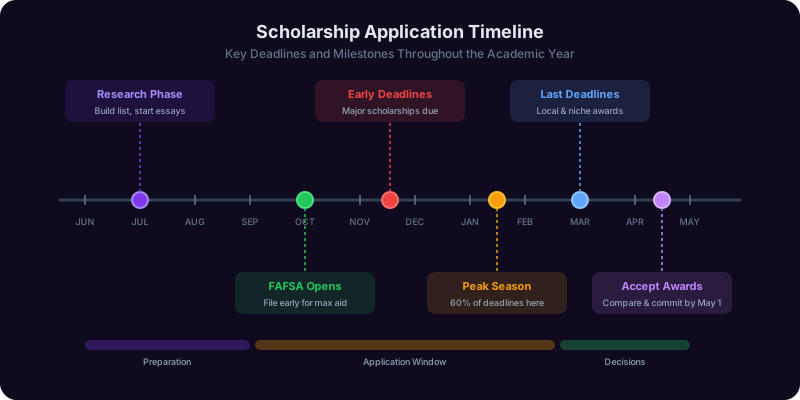
4. Filing deadline optimization: Many states and institutions award need-based aid on a first-come, first-served basis. Filing the FAFSA as soon as it opens (October 1 for the following academic year) maximizes your access to limited state and institutional funds. AI can remind you of your state's priority deadline - in some states, missing it by even a week can cost thousands in state grant money.
Visit StudentAid.gov to file your FAFSA and check your current aid status. For a comprehensive view of how financial aid fits into your broader money picture, see our student loan repayment strategies guide.
Common FAFSA Mistakes That AI Catches
- Reporting retirement assets: The FAFSA does not ask for 401k or IRA balances. Including them in the "net worth of investments" field inflates your SAI unnecessarily.
- Using the wrong tax year: The prior-prior year rule confuses many families. For the 2026-2027 FAFSA, you report 2024 income - not 2025.
- Forgetting to list all schools: You can list up to 20 schools. Each school receives your SAI and determines its own aid package. Failing to list a school means it cannot offer you need-based federal or institutional aid.
- Not filing because you think you will not qualify: Even high-income families can qualify for unsubsidized federal loans, and many colleges require the FAFSA for merit scholarships too. There is no income cutoff for filing.
Merit vs Need-Based Strategies: Positioning Yourself for Both
The most successful scholarship applicants do not choose between merit-based and need-based aid - they pursue both simultaneously with tailored strategies for each. Understanding how these two types of aid work differently allows you to maximize total awards.
How Merit Aid Decisions Are Made
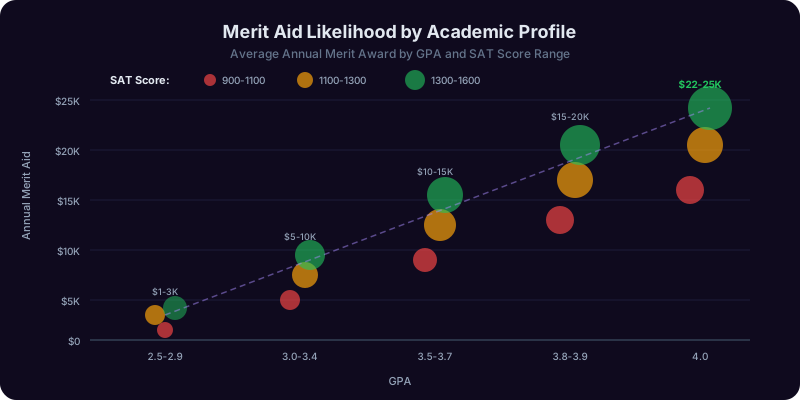
Institutional merit scholarships - awarded by colleges themselves - now represent the largest category of scholarship aid, averaging $12,700 per year at private four-year institutions and $4,800 per year at public universities. Unlike need-based aid, merit scholarships are competitive awards based on academic achievement, test scores, talents, and institutional priorities.
Here is what most families do not understand: colleges use merit aid strategically as a tuition discount to attract students who improve their institutional profile. A student with a 1450 SAT applying to a school where the median is 1280 is far more likely to receive merit aid than the same student applying to a school where the median is 1480. This is the concept of academic fit positioning, and it is one of the most powerful scholarship strategies available.
The Strategic School List
AI can analyze your academic profile against the admitted student profiles of hundreds of colleges to identify where you would fall in the top quartile - maximizing your merit aid probability. Here is how to structure your college list for maximum scholarship leverage:
| Category | Your Profile vs Median | Merit Aid Probability | How Many Schools |
|---|---|---|---|
| Financial safety schools | Top 10% of admits | Very high (80%+) | 2-3 schools |
| Merit match schools | Top 25% of admits | High (50-70%) | 3-4 schools |
| Academic match schools | Near median | Moderate (20-40%) | 2-3 schools |
| Reach schools | Below median | Low for merit (<15%) | 1-2 schools |
Many families make the mistake of building their college list entirely around prestige, then being surprised when the most selective schools offer no merit aid. The Ivy League, Stanford, MIT, and similar institutions do not offer merit scholarships at all - only need-based aid.
Stacking Awards Effectively
One of the most common questions is whether winning one scholarship reduces your eligibility for others. The answer depends on the type:
- External private scholarships + federal need-based aid: Some colleges reduce your institutional aid dollar-for-dollar when you win outside scholarships, a practice called "displacement." Others reduce your loan component first (beneficial to you) or allow stacking up to the total cost of attendance. Ask each school's financial aid office directly: "How do you treat outside scholarships?"
- Multiple private scholarships: These generally stack without issue. There is no limit to the number of private scholarships you can win, as long as the total does not exceed your cost of attendance at your institution.
- Merit + need-based aid at the same institution: Most colleges calculate your need-based package first, then apply merit awards. If the merit award exceeds your calculated need, the excess typically replaces loans and work-study before reducing grants.
Negotiating Your Financial Aid Package
This is the strategy most families never attempt: financial aid appeals. If you receive a stronger offer from a comparable institution, you can present that offer to your preferred school and ask them to match or improve their package. According to a 2025 survey by the College Board, approximately 1 in 4 families who appealed received additional aid, with average increases of $3,000-$5,000 per year.
AI can help you draft a professional financial aid appeal letter that presents your case clearly, references competing offers diplomatically, and highlights any special circumstances (job loss, medical expenses, sibling college costs) that the original FAFSA data may not have captured. The Writing Copilot can help you strike the right tone - respectful and factual, never demanding.
Deadline Tracking and Interview Preparation With AI
Missing a scholarship deadline by even one day means automatic disqualification, regardless of how strong your application is. And for the growing number of scholarships that include an interview component - particularly those worth $10,000 or more - preparation can mean the difference between winning and finishing as a runner-up. AI excels at both of these challenges.
Building a Scholarship Deadline System
When you are managing 20-40 scholarship applications across 3-6 months, a reliable tracking system is not optional - it is essential. Here is the framework that high-output scholarship applicants use:
| Timeline | Action | AI Assists With |
|---|---|---|
| 6 months before deadline | Identify scholarship, check eligibility | Profile matching, eligibility verification |
| 3 months before | Gather required documents (transcripts, recommendation letters) | Checklist generation, letter request templates |
| 6 weeks before | Draft essays and personal statements | Brainstorming, outlining, structural feedback |
| 3 weeks before | Revise and polish essays | Line editing, tone checking, word count optimization |
| 1 week before | Final review and submit | Proofreading, completeness check, submission confirmation |
| After submission | Prepare for potential interview | Mock interviews, question prediction, answer coaching |
The Finance Copilot can help you build a master scholarship tracker that includes every deadline, required document, essay prompt, award amount, and current status. Setting up this system at the beginning of your search saves hours of scrambling later and ensures no opportunity slips through the cracks.
AI-Powered Interview Preparation
Scholarship interviews can be intimidating, but they follow predictable patterns. AI can analyze the scholarship's mission, past winner profiles, and common interview formats to help you prepare effectively. Here is how:
Predict the Questions
Most scholarship interviews draw from a consistent pool of question types:
- "Tell us about yourself" - A 90-second personal narrative that highlights your most relevant experiences and connects to the scholarship's mission
- "Why do you deserve this scholarship?" - Not about need alone; it is about what you will do with the opportunity and how you align with the organization's values
- "Describe a challenge you overcame" - The committee wants to see resilience, problem-solving, and growth
- "What are your goals?" - Be specific and show how this scholarship fits into a larger plan
- "How will you give back?" - Community-focused scholarships especially want to see a commitment to service beyond personal achievement
Practice With AI Mock Interviews
Use a Writing Copilot to run mock interview sessions. Provide it with the scholarship's mission statement and your background, then have it ask you questions in the style of a scholarship committee. After each response, ask for specific feedback on:
- Did you answer the actual question asked, or did you go on a tangent?
- Was your response specific enough? Did you use concrete examples?
- Did you connect your answer to the scholarship's stated values?
- Was your response an appropriate length (typically 1-2 minutes per answer)?
- Did you sound authentic, or did you sound like you were reciting a script?
Research from the National Association of Student Financial Aid Administrators suggests that students who complete at least three practice interview sessions perform measurably better in actual scholarship interviews. AI makes this practice accessible to students who may not have a college counselor, parent, or mentor available to run mock sessions.
Recommendation Letter Strategy
Many scholarships require 1-3 recommendation letters, and the quality of these letters matters enormously. AI cannot write your recommendation letters (your recommenders need to do that), but it can help you make their job easier and improve the result. Prepare a "brag sheet" for each recommender that includes your key accomplishments, the scholarship's mission, specific examples they might reference, and what qualities the committee values most. AI can help you organize this information in a format that makes it easy for a busy teacher or mentor to write a strong, specific letter rather than a generic one.
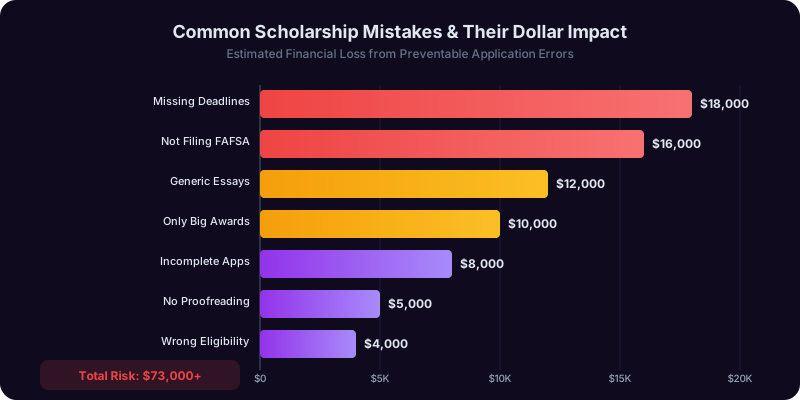
The 10 Most Expensive Scholarship Mistakes (and How AI Prevents Them)
After analyzing thousands of scholarship applications and interviewing financial aid professionals, these are the mistakes that cost students the most money. Every one of them is preventable with the right tools and awareness.
Mistake 1: Only Applying to Big-Name National Scholarships
The Gates Scholarship, Coca-Cola Scholars, and similar national programs receive 30,000-50,000 applications for a few hundred spots. Your odds are well below 1%. Meanwhile, local scholarships from community foundations, Rotary clubs, and employer-sponsored programs receive 20-200 applications for similar or larger awards. Local and niche scholarships have acceptance rates 10-50 times higher than national programs. AI matching tools surface these opportunities that manual searching typically misses.
Mistake 2: Waiting Until Senior Year
Many scholarships are available to juniors, sophomores, and even freshmen in high school. College students can apply for scholarships every year, not just as incoming freshmen. Starting early gives you more time to build your application profile, and some early scholarships are renewable for all four years of college - turning a $5,000 award into $20,000.
Mistake 3: Submitting Generic Essays
Reusing the exact same essay for every scholarship without tailoring it to the specific organization's mission is the fastest way to get rejected. Committees can tell when an essay was not written for them. AI helps you efficiently customize a core essay for each application, adjusting emphasis, opening hooks, and mission-specific connections without starting from scratch every time.
Mistake 4: Not Completing the FAFSA
Roughly 40% of eligible students do not complete the FAFSA, leaving an estimated $3.75 billion in Pell Grants alone on the table. Even if you think your family earns too much for need-based aid, many institutions require the FAFSA to determine eligibility for their own merit scholarships. Filing takes under an hour and costs nothing. There is zero downside.
Mistake 5: Ignoring Scholarship Scams
Legitimate scholarships never charge an application fee, never guarantee you will win, and never ask for your bank account or Social Security number upfront. The Federal Trade Commission reports that scholarship scams cost families over $80 million annually. AI can help you verify scholarship legitimacy by cross-referencing against known databases and checking for red flags in the application process.
Mistake 6: Not Following Instructions
This sounds obvious, but financial aid officers consistently cite it as a top reason for disqualification. Exceeding the word count by 50 words, submitting a PDF when they asked for a Word document, using the wrong font size, or missing a required supplemental form - any of these can eliminate your application before a reviewer reads a single word. AI proofreading catches these formatting and compliance issues.
Mistake 7: Undervaluing Small Scholarships
A $500 scholarship might not seem worth the effort, but consider: if the application takes you 2 hours and you win, you just earned $250/hour. Apply to ten $500 scholarships and win three, and that is $1,500 for roughly 20 hours of work - still $75/hour, tax-free. No part-time job pays that well. AI reduces the time per application, making smaller scholarships even more worthwhile.
Mistake 8: Not Appealing Financial Aid Offers
As mentioned in the merit aid section, families who appeal their financial aid packages receive additional aid roughly 25% of the time. Yet most families never ask. Use AI to draft a professional, fact-based appeal letter that references competing offers and any changed financial circumstances.
Mistake 9: Forgetting About Renewal Requirements
Many multi-year scholarships require you to maintain a minimum GPA, enroll full-time, or participate in specific activities. Losing a $10,000/year renewable scholarship because your GPA dropped from 3.5 to 3.4 in one semester is devastating. Set AI-powered reminders for renewal deadlines and GPA check-ins each semester.
Mistake 10: Applying Without Proofreading
Typos, grammatical errors, and poorly structured sentences signal a lack of effort to scholarship committees. In competitive pools, a single careless error can be the tiebreaker that eliminates your application. AI proofreading is free, instant, and catches errors that spell-check alone misses - subject-verb agreement issues, awkward phrasing, missing articles, and tonal inconsistencies. There is no excuse for submitting an application with errors in 2026.
Putting It All Together: Your AI Scholarship Action Plan
The difference between students who win substantial scholarship money and those who do not is rarely talent or qualifications - it is execution. Winning scholarships is a process, and AI tools make that process dramatically more efficient. Here is your complete action plan, organized into phases that you can start today regardless of where you are in your academic journey.
Phase 1: Profile and Research (Weeks 1-2)
- Build your comprehensive student profile with every detail that could match a scholarship criterion
- Complete the FAFSA at StudentAid.gov if you have not already
- Run your profile through at least three scholarship databases (Fastweb, Scholarships.com, and your school's financial aid portal)
- Use AI to generate a prioritized list of 30-40 scholarships ranked by award amount, eligibility fit, and competition level
- Create your master tracking spreadsheet with deadlines, requirements, and essay prompts
Phase 2: Essay Foundation (Weeks 3-4)
- Identify the 4-5 core essay themes that cover most prompts: personal narrative, challenge overcome, leadership experience, career goals, and community impact
- Write a strong draft for each theme - in your own voice, using specific personal details
- Use the Writing Copilot to refine each draft for structure, clarity, and emotional impact
- Create a library of adaptable essay components that you can mix and customize for different applications
Phase 3: Application Execution (Ongoing)
- Work through your prioritized list, adapting essays for each scholarship's specific prompt and mission
- Request recommendation letters at least 3 weeks before each deadline, providing your brag sheet to each recommender
- Submit applications at least 3 days before the deadline to avoid last-minute technical issues
- Track every submission and follow up on confirmation receipts
Phase 4: Interview and Follow-Up (As Needed)
- When selected for interviews, research the scholarship organization's history, mission, and past winners
- Run at least three AI mock interview sessions with scenario-specific questions
- Send thank-you notes to interviewers within 24 hours
- If you win, send thank-you letters to the scholarship organization - many renewable scholarships factor gratitude and engagement into renewal decisions
How Copilotly Fits Into Your Scholarship Strategy
Copilotly's AI copilots are designed to assist at every stage of this process, working directly in your browser wherever you are researching, writing, or applying:
| Task | Copilot | How It Helps |
|---|---|---|
| Financial analysis and FAFSA strategy | Finance Copilot | Analyzes your financial profile, models SAI optimization strategies, calculates the true value of different scholarship packages |
| Essay writing and editing | Writing Copilot | Brainstorms essay angles, provides structural feedback, polishes prose, adapts essays for different prompts while maintaining your voice |
| Research and fact-checking | Research Copilot | Verifies scholarship legitimacy, finds relevant statistics for essays, researches scholarship organizations for interview prep |
| Deadline and task management | Productivity Copilot | Creates application timelines, sets deadline reminders, organizes required documents and submission checklists |
The students who win the most scholarship money are not necessarily the smartest or most accomplished. They are the ones who treat the scholarship search as a systematic process, apply to enough opportunities, submit polished applications tailored to each organization, and never miss a deadline. AI does not replace the work - it removes the friction that stops most students from doing enough of it.
Start with your profile, build your list, write your core essays, and execute your application plan. The money is out there. With the right process and AI tools to support it, you are far more likely to claim your share. For a deeper understanding of how scholarships fit into your overall financial picture, including how they interact with student loan repayment and early investing, explore our related guides in the Money and Finance section.
Frequently asked questions
Is it cheating to use AI to write scholarship essays?
No, using AI as a writing assistant is not cheating, but there is an important distinction. Using AI to brainstorm ideas, get feedback on structure, polish grammar, and refine your arguments is the same as working with a writing tutor or college counselor - it is a legitimate tool that helps you produce your best work. What crosses the line is having AI generate the entire essay from scratch and submitting it as your own. Scholarship committees want to hear your voice, your experiences, and your perspective. AI should enhance your authentic story, not replace it. Most scholarship organizations have not explicitly banned AI assistance, but they can often detect fully AI-generated text, and submitting inauthentic work risks disqualification. The safest and most effective approach is to write your first draft yourself, then use AI for feedback and refinement.
How many scholarships should I apply to for the best results?
Research consistently shows that students who apply to 20 or more scholarships receive significantly more total aid than those who apply to fewer than 10. The sweet spot for most students is 25-40 applications spread across national, regional, and local opportunities. This might sound like a lot, but with AI tools to help you adapt essays and track deadlines, the marginal effort per additional application drops substantially after your first 5-10. Think of it as a numbers game with favorable odds: if the average private scholarship acceptance rate is 5-15%, applying to 30 scholarships statistically yields 2-4 wins. At an average award of $4,200, that is $8,400-$16,800 in free money. The key is diversifying across award sizes and competition levels rather than only targeting the most competitive national programs.
Can AI help me fill out the FAFSA more accurately?
Yes, AI can be extremely helpful with FAFSA preparation, though the actual form must be filed at StudentAid.gov. AI tools can help you in three key ways. First, pre-filing analysis: an AI copilot can review your family's financial situation and identify which assets need to be reported, which are excluded (retirement accounts, primary home), and where strategic adjustments might lower your Student Aid Index. Second, error prevention: AI can walk you through each question, explaining what is being asked and flagging common mistakes like reporting the wrong tax year or including non-reportable assets. Third, optimization strategy: by modeling different scenarios - such as the impact of making an IRA contribution before filing or understanding how student versus parent asset classifications affect your aid - AI can help you present your financial picture in the most accurate and favorable way possible, all within legal guidelines.
What is the difference between merit-based and need-based scholarships?
Merit-based scholarships are awarded based on academic achievement, athletic ability, artistic talent, leadership, or other measurable accomplishments, regardless of financial need. These include institutional merit awards from colleges (the largest category, averaging $12,700/year at private schools), as well as external awards from corporations and foundations. Need-based scholarships are awarded based on demonstrated financial need, typically determined by your FAFSA data and Student Aid Index. Pell Grants (up to $7,395 in 2026-2027) are the most common federal need-based award. Many scholarships combine both criteria - they require financial need and academic merit. The best strategy is to pursue both types simultaneously, using your FAFSA data for need-based opportunities and your academic profile for merit awards. Students who only focus on one type leave significant money on the table.
Are there scholarships available for college students who are not freshmen?
Absolutely. While many high-profile scholarships target incoming freshmen, there are thousands of awards available to sophomores, juniors, seniors, and even graduate students. Institutional scholarships often have renewal components that continue through graduation if you maintain GPA requirements. Many departmental scholarships within your major are available exclusively to upperclassmen who have declared a major and demonstrated academic performance in their field. Professional associations in fields like engineering, nursing, education, and business offer scholarships to students already enrolled in relevant degree programs. Additionally, transfer students, non-traditional students, and adult learners returning to school have dedicated scholarship categories. The scholarship search should be an annual activity, not a one-time effort during senior year of high school. Each year you are in college, your profile changes - new accomplishments, new experiences, new eligibility criteria - opening doors to scholarships you would not have qualified for before.
How do I know if a scholarship is legitimate or a scam?
Legitimate scholarships share several characteristics: they never charge an application fee, they have verifiable sponsoring organizations, they have clear eligibility criteria and selection processes, and they never guarantee that you will win. Red flags that indicate a scam include: requests for payment to apply or receive the award, requests for bank account or Social Security numbers during the application phase, unsolicited notifications that you have "won" a scholarship you never applied for, pressure to act immediately, and vague or unverifiable organizational information. To verify legitimacy, search for the scholarship on established databases like Fastweb or the College Board Scholarship Search, check the sponsoring organization's website and nonprofit status, and look for reviews or reports from past recipients. The Federal Trade Commission's consumer protection resources also maintain information on known scholarship scams. When in doubt, ask your school's financial aid office - they are familiar with legitimate local and national programs.
Will winning outside scholarships reduce my college financial aid package?
It depends on the college's policy, and this is one of the most frustrating realities of the scholarship process. Federal regulations require that total financial aid (including outside scholarships) cannot exceed your total cost of attendance. If outside scholarships push your total aid above that threshold, the college must reduce your package. However, how they reduce it varies significantly. Some colleges reduce your institutional grants dollar-for-dollar - meaning your outside scholarship effectively replaces money the college was already giving you, providing zero net benefit. Other colleges first reduce the self-help portion of your aid (loans and work-study), which genuinely benefits you by reducing debt. A few generous institutions allow outside scholarships to stack on top of their full aid package up to the cost of attendance. Before applying to scholarships, contact each college's financial aid office and ask their specific policy on outside scholarship coordination. This information should influence which colleges you prioritize and how you allocate your scholarship application effort.
When should I start searching for and applying to scholarships?
The ideal time to start is the summer before your junior year of high school, though it is never too late to begin. Starting early gives you several advantages: some scholarships are open to underclassmen, you have time to build your profile with targeted extracurriculars and leadership experiences, and you can develop strong essay foundations before the crush of college applications in senior year. Here is a general timeline: Summer before junior year - build your profile, research databases, and identify early-deadline scholarships. Fall of junior year - begin applying to scholarships with winter and spring deadlines. Spring of junior year - take SAT/ACT for the last time, apply to summer scholarships, and begin FAFSA preparation. Fall of senior year - file FAFSA on October 1, apply to the bulk of scholarships (most deadlines fall between November and March). Spring of senior year - continue applying, compare financial aid packages, and negotiate with colleges. Every year of college - search for new scholarships annually, as your updated profile will match different opportunities each year.
Get help with this from the Finance & Money Copilot
Describe your situation and get specific, actionable guidance - not the generic hedging a general-purpose chatbot gives you on finance & money questions.
Free plan, no card. Pro from $4.99/week for every copilot across all 20 domains - about what one hour with any single professional costs per year.
Not a financial advisorThis is financial information, not financial advice. Consult a licensed financial professional.