
Career & Business
6 Cover Letter Opening Hooks That Make Hiring Managers Keep Reading
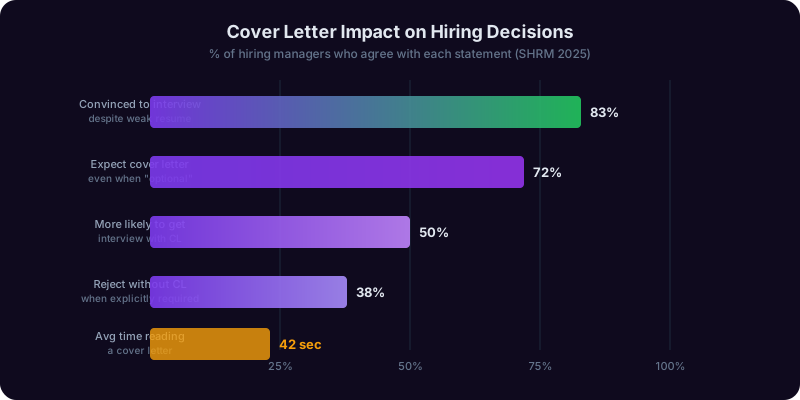
83% of hiring managers say a strong cover letter can win an interview even when your resume is not a perfect match. Learn 6 opening hook techniques, the story method for body paragraphs, and ATS formatting rules, plus templates for career change, entry level, senior, and remote roles.
Why Cover Letters Still Matter in 2026: What Hiring Manager Data Actually Shows
Every year, someone publishes an article declaring that cover letters are dead. And every year, the hiring data tells a different story. The truth is that cover letters are not dead. They are misunderstood. Most people write bad cover letters, which creates the illusion that cover letters do not work. The data from actual hiring managers tells the real story.
The Numbers That Should Change Your Mind
A 2025 survey by the Society for Human Resource Management (SHRM) found that 83% of hiring managers said a well-written cover letter has convinced them to interview a candidate whose resume alone was not a strong match. That single statistic should end the debate. Your cover letter is not a formality. It is a second chance, an opportunity to bridge gaps that your resume cannot.
Here is what else the data shows:
- 72% of recruiters in a 2025 ResumeGo study said they expect a cover letter even when the job posting says it is optional. "Optional" in hiring language almost always means "recommended."
- Candidates who submitted cover letters were 50% more likely to get an interview than those who did not, according to a 2024 study of 10,000 applications by Jobvite.
- 38% of hiring managers said they immediately reject applications without a cover letter for roles that explicitly request one (Robert Half, 2025).
- The average hiring manager spends 42 seconds reading a cover letter, which means your first paragraph is everything (Ladders eye-tracking study, 2024 update).
Why the "Cover Letters Are Dead" Myth Persists
The myth survives because of two real problems:
Problem 1: Most cover letters are terrible. The average cover letter is a bland summary of the resume, rewritten in paragraph form. "I am writing to express my interest in the Marketing Manager position at your company. I have five years of experience in marketing and I believe I would be a great fit." That is not a cover letter. That is a waste of a hiring manager's time. When recruiters say they do not read cover letters, what they mean is they do not read bad cover letters. A compelling, specific, well-crafted letter gets read every single time.
Problem 2: Volume applicants skip them. People who apply to 200 jobs a week do not write cover letters because the math does not work. But volume applications are a losing strategy anyway. The candidates who win interviews are the ones who apply strategically to 15-30 roles and write targeted materials for each one. Quality beats quantity in every hiring study ever conducted.
When a Cover Letter Gives You the Biggest Advantage
Cover letters provide the most value in these situations:
- Career changes: Your resume says "teacher" but you want a corporate training role. The resume alone raises questions. The cover letter answers them. It is where you explain the bridge between what you have done and what you want to do.
- Employment gaps: A six-month gap on your resume is a question mark. A cover letter lets you address it briefly and positively: "After a company-wide layoff, I used the time to earn my PMP certification and volunteer as a project lead for a nonprofit, which deepened my skills in stakeholder management."
- Relocation: If you are applying from a different city, your out-of-state address is a red flag. A cover letter that says "I am relocating to Austin in June and am targeting roles in the area" eliminates the concern.
- Overqualification or underqualification: If your experience level does not match the posting exactly, the cover letter is where you explain why you are applying and what you bring despite the mismatch.
- Competitive roles: For positions that receive hundreds of applications, a cover letter is your only chance to stand out as a human being, not just a list of bullet points.
What a Cover Letter Can Do That a Resume Cannot
Your resume is a structured document with strict formatting constraints. It tells the hiring manager what you have done. Your cover letter tells them why it matters. Specifically, a cover letter allows you to:
- Show personality and communication style. Your writing voice reveals how you think, how you prioritize, and how you communicate under constraint. These are things a resume cannot convey.
- Demonstrate company-specific research. A cover letter that references the company's recent product launch, strategic initiative, or public statements shows that you are not mass-applying. You chose them.
- Explain context that bullet points cannot capture. "Increased revenue by 40%" on a resume is impressive. "Increased revenue by 40% during a period when the company was simultaneously going through a merger, losing its largest client, and integrating two different CRM systems" in a cover letter is a story that demonstrates resilience, not just results.
- Make a direct case for fit. A resume presents evidence. A cover letter makes the argument. It says, "Here is why this evidence means I am the right person for this specific role at this specific company."
The Career Copilot can help you determine when a cover letter will have the most impact for your specific situation and target role, while the Writing Copilot can help you craft a letter that sounds authentically like you, not like a template everyone has already seen.
The Anatomy of a Winning Cover Letter: Every Section Broken Down
A great cover letter has five distinct sections, each with a specific job to do. Think of it as a 250-400 word argument for why you should be interviewed. Every sentence earns its place or gets cut. Here is the complete anatomy. Try our AI interview prep tool for step-by-step help.
Section 1: The Header (Matching Your Resume)
Your cover letter header should match your resume header exactly. Same name format, same contact information, same visual style. This creates a cohesive application package and signals professionalism. Include: Try our AI resume builder for step-by-step help.
- Your full name
- Phone number
- Professional email address (not [email protected])
- LinkedIn profile URL (make sure it is optimized; the LinkedIn Copilot can help)
- City and state (full address is no longer necessary or expected)
- Date
- Hiring manager's name and title (if you can find it)
- Company name and address
Section 2: The Opening Paragraph (The Hook)
This is the most important paragraph in the entire letter. The hiring manager decides within the first two sentences whether to keep reading or move on. Your opening must do three things simultaneously:
- Name the specific role you are applying for. Do not make them guess.
- Establish your most compelling qualification in one sentence. Lead with your strongest card.
- Create enough intrigue to make them read paragraph two. A specific number, a surprising result, or a bold claim all work.
The opening paragraph should be 2-3 sentences, no more. Think of it as the subject line of an email: its only job is to get the recipient to read the next line.
Section 3: The Body Paragraphs (The Evidence)
The body is where you make your case. This is typically 1-2 paragraphs (3-5 sentences each) that connect your experience to the job requirements. The body paragraphs should:
- Address the top 2-3 requirements from the job posting. Read the posting carefully and identify what the company cares about most. Then prove you can deliver on those specific things.
- Use specific accomplishments with quantified results. "Managed social media" is a task. "Grew Instagram following from 5,000 to 45,000 in 8 months and increased engagement rate from 1.2% to 4.8%" is an accomplishment.
- Connect your past results to their future needs. Do not just list what you did. Explain why it matters for this role. "That experience in scaling social audiences is directly relevant to your goal of building a community-driven brand presence, which I noticed is a priority in your recent investor letter."
Section 4: The "Why This Company" Paragraph
This is the paragraph that separates a targeted cover letter from a mass-produced one. Hiring managers can spot a generic letter instantly, and it immediately signals that you do not care enough to research them. This paragraph should include:
- A specific reference to the company. A recent product launch, a values statement you connect with, a strategic direction you have observed, an article or interview with a company leader.
- How your goals align with their mission. "Your commitment to making financial literacy accessible aligns with the work I have been doing for the past three years in community education."
- Why you chose them, not just why they should choose you. This flips the dynamic and shows intentionality.
Section 5: The Closing Paragraph (The CTA)
Your closing paragraph is a call to action. It should be 2-3 sentences that express enthusiasm, restate your fit, and make it easy for them to contact you. Never end with a passive "I hope to hear from you." End with confidence:
"I would welcome the opportunity to discuss how my experience in [specific skill] can contribute to [specific company goal]. I am available for a conversation at your convenience and can be reached at [phone] or [email]."
The Complete Structure at a Glance
| Section | Length | Purpose |
|---|---|---|
| Header | Contact info block | Professional presentation, matches resume |
| Opening paragraph | 2-3 sentences | Hook the reader, name the role, lead with your best |
| Body paragraph(s) | 3-5 sentences each (1-2 paragraphs) | Prove you can do the job with specific evidence |
| Why this company | 2-3 sentences | Demonstrate research and genuine interest |
| Closing paragraph | 2-3 sentences | Call to action, express enthusiasm, provide contact |
Total Length
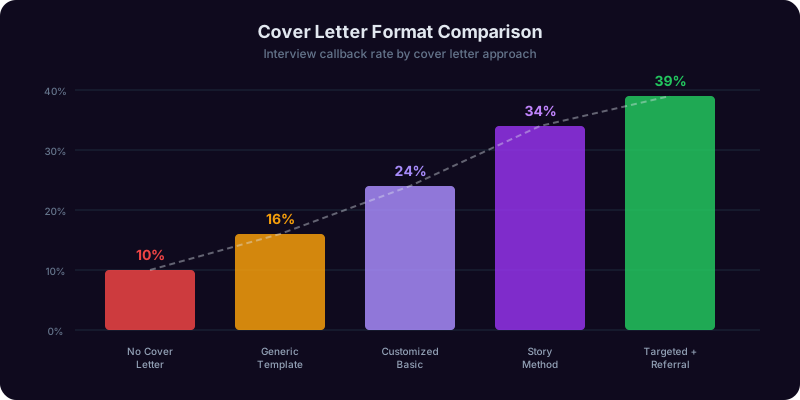
Your cover letter should be 250-400 words of body text (excluding the header). That is roughly three-quarters of a single page. Anything shorter feels thin. Anything longer will not get read. A 2024 Jobvite analysis found that cover letters between 250 and 350 words received 29% more positive responses than those over 500 words. Brevity is not a limitation. It is a skill, and hiring managers notice it. The Resume Copilot can help you ensure your resume and cover letter work together as a cohesive application package rather than repeating the same information in two different formats.
Opening Paragraph Strategies: 6 Hook Techniques That Make Hiring Managers Keep Reading
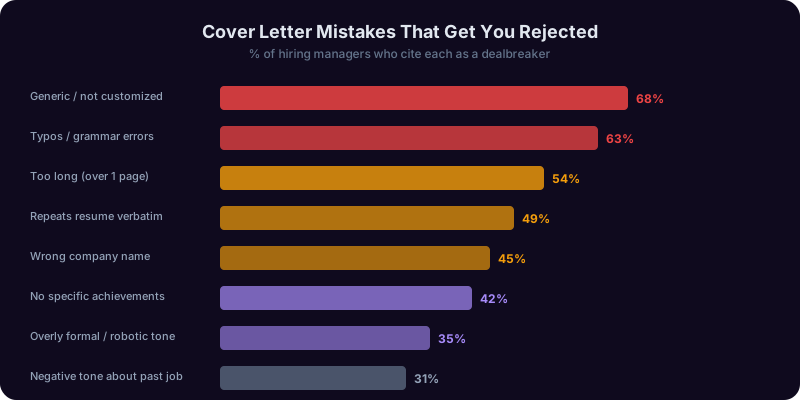
Your opening paragraph is where most cover letters fail. The default opening, "I am writing to express my interest in the [Role] position at [Company]," tells the hiring manager absolutely nothing they did not already know. They know you are interested. You applied. The question is whether you are worth interviewing, and a generic opener does not answer that question.
Here are six proven hook techniques that make hiring managers lean in instead of tuning out.
Hook #1: The Quantified Achievement Lead
Open with the single most impressive, relevant number from your career. Numbers are attention magnets because they are concrete in a sea of vague claims.
"In the past two years, I have generated $4.2 million in new revenue for a B2B SaaS company with a sales team of four. I am writing because the Senior Sales Manager role at [Company] is the exact challenge I have been looking for: scaling a lean team to hit ambitious targets in a competitive market."
Why it works: The number ($4.2 million) creates immediate credibility. The team size (four) adds context that makes the number more impressive. And the second sentence connects the achievement directly to the role.
Hook #2: The Company-Specific Insight
Open with something specific you know about the company that connects to your expertise. This signals research and genuine interest.
"When [Company] announced its expansion into the healthcare vertical last quarter, I saw an opportunity that aligns perfectly with my background. I have spent the past six years building compliance-first go-to-market strategies for healthtech companies, and the challenges your team is about to face are ones I have navigated before."
Why it works: It shows you follow the company closely enough to reference a specific strategic move. It positions you as someone who understands their upcoming challenges, not just their current job posting.
Hook #3: The Mutual Connection
If you have a referral or know someone at the company, lead with it. Referrals are the highest-converting source of hires in every industry.
"[Name], your Director of Engineering, suggested I reach out about the Senior Backend Developer role. After hearing her describe the team's migration to a microservices architecture, I knew this was the kind of technical challenge I want to take on next. I led a similar migration at [Company] that reduced deployment times by 70% and eliminated the single points of failure that were causing monthly outages."
Why it works: The referral name gets attention immediately. Hiring managers pay closer attention to referred candidates because they trust their own team's judgment. Adding a specific technical achievement after the referral ensures you are taken seriously on merit, not just connections.
Hook #4: The Problem-Solution Frame
Identify a challenge the company likely faces (based on the job posting, industry trends, or company news) and position yourself as the solution.
"Scaling a content operation from a two-person team to a full editorial department without losing quality is one of the hardest challenges in marketing. I know because I did it at [Company], growing the team from 2 to 12 while increasing organic traffic from 50,000 to 420,000 monthly visitors. Your Content Director posting describes exactly this challenge, and I would welcome the chance to bring that experience to [Company]."
Why it works: You have named their problem before they even told you about it. This creates an immediate sense of "this person understands what we need," which is exactly the feeling you want in the first two sentences.
Hook #5: The Passion Statement (Used Correctly)
Passion statements are the most misused hook. "I am passionate about marketing" is meaningless. But a passion statement with specificity and evidence is powerful.
"I have been building financial literacy tools since I was 19, when I created a budgeting app that 3,000 college students used to track their spending. Twelve years later, I am still solving the same problem at a larger scale. Your mission to make financial wellness accessible to underserved communities is the reason I am writing today, not just because the Product Manager role is a fit for my skills, but because this is the work I have been building toward for my entire career."
Why it works: The passion is grounded in action ("built a budgeting app used by 3,000 students"), not just feeling. The timeline ("since I was 19") demonstrates sustained commitment. And the connection to the company's mission is specific, not generic.
Hook #6: The Bold Claim
Make a confident statement about what you will bring to the role. This works best for senior candidates with strong track records.
"Every operations team I have led has reduced costs by at least 20% within the first year, not through layoffs but through process redesign and automation. I have done it three times across two industries, and I am confident I can do it again as your VP of Operations."
Why it works: It is specific ("at least 20%"), it has a track record ("three times"), and it addresses a potential concern proactively ("not through layoffs"). Bold claims backed by evidence are compelling. Bold claims without evidence are arrogant. Make sure yours is the former.
What to Avoid in Your Opening
- "I am writing to apply for..." They know. You applied. Skip it.
- "I believe I would be a great fit..." Everyone believes that. Show it instead.
- "I am a hard-working, detail-oriented team player..." These are meaningless adjectives. Prove these qualities with specific examples instead of claiming them.
- "To whom it may concern..." It is 2026. Find the hiring manager's name on LinkedIn, the company website, or by calling the front desk. If you truly cannot find a name, use "Dear [Department] Hiring Team."
The Writing Copilot can help you craft an opening hook that is specific to your experience and the role you are targeting, while the Career Copilot can help you identify which of these hook strategies will work best given your background and the competitive landscape for the position.
How to Match Your Skills to the Job Description (Without Sounding Like a Parrot)
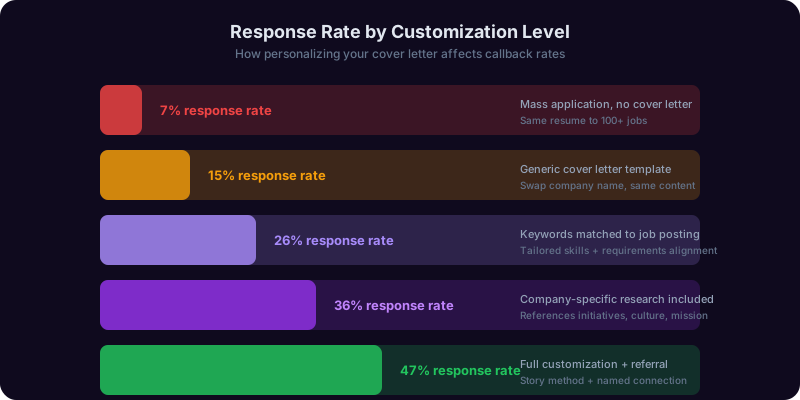
The most effective cover letters create a direct connection between what the company needs and what you have done. But there is a fine line between matching your skills to the job description and copying the job posting back at the hiring manager. The goal is alignment, not plagiarism.
Step 1: Decode the Job Posting
Job postings are written in code. The order of requirements, the specific language used, and the distinction between "required" and "preferred" all tell you what the company actually cares about most. Here is how to decode them:
- The first three bullet points under "Requirements" are the non-negotiables. These are what the hiring manager told HR they absolutely must have. Address at least two of these three in your cover letter.
- Repeated words and phrases signal priorities. If "cross-functional collaboration" appears three times in the posting, that is a core competency they are screening for. Use it in your letter (naturally, not forced).
- "Nice to have" requirements are differentiators. If you have them, mention them. They are often the tiebreaker between two otherwise equal candidates.
- The "About Us" section reveals culture signals. Words like "fast-paced," "scrappy," "mission-driven," or "data-obsessed" tell you how to frame your experience. A startup that says "scrappy" wants to hear about resourcefulness. A Fortune 500 that says "process-oriented" wants to hear about structure and scale.
Step 2: Build a Match Matrix
Before you write a single word, create a simple two-column matrix. This takes 5 minutes and it is the single most effective exercise for writing a targeted cover letter.
| What They Need (From Job Posting) | What I Have Done (From My Experience) |
|---|---|
| 5+ years of B2B SaaS marketing experience | 7 years at two SaaS companies, launched 4 products |
| Experience managing a $2M+ budget | Managed $3.4M annual marketing budget at [Company] |
| Proficiency with Salesforce and HubSpot | Salesforce admin-certified, used HubSpot for 3 years |
| Ability to collaborate cross-functionally | Led go-to-market with product, sales, and CS teams |
| Data-driven decision making | Built attribution model that influenced budget allocation |
Once you have this matrix, you know exactly which stories to tell in your cover letter. You are not guessing. You are matching evidence to requirements like a lawyer building a case.
Step 3: Mirror Their Language (Strategically)
This is where most people either overdo it or underdo it. Here is the right balance:
Do mirror:
- Industry-specific terminology ("ARR," "MQL," "sprint velocity")
- Role-specific competencies ("stakeholder management," "pipeline generation")
- Their exact phrasing for key requirements, woven into your own sentences
Do not mirror:
- Entire sentences from the job posting copied verbatim
- Buzzwords that you cannot back up with examples ("thought leader," "innovative disruptor")
- Internal company jargon that you would not naturally use
Good example: The job posting says "Drive pipeline generation through integrated campaigns." Your cover letter says: "At [Company], I drove $8.2 million in pipeline through integrated campaigns that combined targeted ABM, webinar sequences, and sales enablement content."
Bad example: The job posting says "Drive pipeline generation through integrated campaigns." Your cover letter says: "I am experienced in driving pipeline generation through integrated campaigns." That is parroting, and hiring managers see through it immediately.
Step 4: Address Requirements You Do Not Meet
If the job posting asks for 7 years of experience and you have 4, you have two options: ignore it (and hope they do not notice) or address it (and reframe it). The second option is almost always better.
"While I have four years of formal experience in product management, the scope and complexity of my work has been equivalent to roles typically held by more senior PMs. I have owned the full product lifecycle for a $15M revenue line, managed a team of three engineers, and shipped 12 features from ideation to launch. My growth trajectory has been accelerated because I sought out ownership that went beyond my title."
This approach works because it acknowledges the gap honestly ("four years") while reframing it with evidence that the gap is smaller than it appears. The key is specificity. Vague reassurances ("I am a quick learner") are unconvincing. Concrete evidence of outsized impact is compelling.
Step 5: Prioritize Ruthlessly
A 300-word cover letter cannot address every requirement in a 20-bullet-point job posting. It should not try. Pick the top 2-3 requirements that you match most strongly and go deep on those. It is far better to prove you are exceptional at 2-3 critical things than to claim you are adequate at 10 things.
The Resume Copilot can analyze a job posting and identify which requirements are most critical, helping you prioritize which skills to emphasize. And if you need help with the interview that comes after your cover letter lands, make sure your talking points are consistent across both your written and verbal materials. You should also prepare for salary negotiation once you reach the offer stage, and understand your rights regarding non-compete agreements if you are currently employed.
The "Story Method" for Body Paragraphs: How to Make Hiring Managers Remember You
The body of your cover letter is where most people lose the hiring manager's attention. They default to listing qualifications and responsibilities, which reads like a second resume. The fix is to stop listing and start telling stories. Specifically, micro-stories that prove your claims with concrete evidence in 2-4 sentences.
Why Stories Work Better Than Bullet Points
Neuroscience research from Princeton's Uri Hasson shows that when someone reads a story, their brain activity mirrors the brain activity of the person telling the story. This phenomenon, called neural coupling, does not happen when someone reads a list of facts. Stories literally synchronize the reader's brain with yours, creating empathy and engagement that a list of qualifications never will.
In practical hiring terms, this means a hiring manager who reads a story about your accomplishment will feel like they experienced it with you. A hiring manager who reads a list of your qualifications will feel like they read a list.
The Micro-Story Formula: Situation-Action-Impact
Each body paragraph in your cover letter should contain one micro-story using this three-part structure:
- Situation (1 sentence): Set the context. What was the challenge, the problem, or the opportunity?
- Action (1-2 sentences): What specifically did you do? Use first-person, active language. "I designed," "I led," "I built."
- Impact (1 sentence): What was the measurable result? Revenue, time saved, customers acquired, efficiency gained, problems solved.
Micro-Story Examples by Function
Marketing example:
"When [Company] entered the mid-market segment, we had zero brand recognition with that audience and a three-month deadline to generate pipeline. I designed and executed a targeted ABM campaign that combined personalized direct mail, LinkedIn outreach sequences, and a virtual roundtable series with industry analysts. Within 90 days, the campaign generated 142 qualified leads and $2.8 million in pipeline, which represented 34% of the quarter's total new business."
Engineering example:
"Our payment processing system was handling 50,000 transactions per day but failing intermittently during peak hours, costing an estimated $180,000 per month in abandoned carts. I led the migration to an event-driven architecture with automatic horizontal scaling, replacing a monolithic system that had been in production for six years. After the migration, the system handled 200,000 daily transactions at peak with zero downtime, and cart abandonment during peak hours dropped by 62%."
Operations example:
"Our warehouse fulfillment accuracy had dropped to 94.2%, generating customer complaints and $50,000 per month in reshipping costs. I implemented a barcode verification system at three checkpoints in the packing process and redesigned the pick path layout based on order frequency analysis. Within two months, accuracy improved to 99.7% and reshipping costs dropped by 89%."
Sales example:
"I inherited a territory that had been underperforming quota by 30% for two consecutive years. By rebuilding the account mapping strategy and implementing a consultative selling methodology that focused on multi-threading into the C-suite, I grew the territory from $1.2 million to $3.1 million in annual bookings within 18 months, making it the highest-performing territory in the region."
How Many Stories to Include
Your cover letter should contain 1-2 micro-stories, not more. Each story should directly address one of the top requirements from the job posting. If the job posting emphasizes leadership and technical skills, tell one leadership story and one technical story. If it emphasizes customer-facing experience and strategic thinking, tell one story about each.
The temptation is to cram in as many accomplishments as possible. Resist it. Two vivid, specific stories are infinitely more memorable than five vague ones. Remember, the hiring manager is reading dozens or hundreds of applications. The cover letters they remember are the ones with specific, concrete stories, not the ones with the longest list of qualifications.
Connecting Stories to the Job Posting
Each micro-story should end with a bridge sentence that connects it to the target role. This is the sentence that turns a good story into a persuasive argument.
Without a bridge: "...and cart abandonment during peak hours dropped by 62%." (Impressive, but the reader has to do the work of figuring out why it matters for this role.)
With a bridge: "...and cart abandonment during peak hours dropped by 62%. That kind of high-stakes, customer-impacting technical challenge is exactly what drew me to the Platform Engineering Lead role at [Company], where reliability at scale is a core priority." (Now the reader understands why you told this story.)
Common Body Paragraph Mistakes
- Listing responsibilities instead of accomplishments. "I was responsible for managing a team of 8" is a responsibility. "I grew my team from 3 to 8 and reduced average project delivery time by 40%" is an accomplishment.
- Using vague quantifiers. "Significantly increased revenue" means nothing. "Increased revenue by 45% in six months" means everything. If you cannot quantify the result, describe the concrete outcome instead: "launched the company's first enterprise product, which was adopted by 12 Fortune 500 clients within the first year."
- Telling stories that are not relevant to the job. Your marathon finish time and your Eagle Scout award are real accomplishments. But if you are applying for a data engineering role, they do not belong in your cover letter.
- Forgetting the impact. A story without a result is an anecdote. Always end with what changed because of your work.
The Writing Copilot can help you structure your micro-stories for maximum impact, ensuring each one follows the Situation-Action-Impact formula and connects directly to the role you are targeting. For identifying which accomplishments from your career will resonate most strongly, the Career Copilot can analyze your background against the job requirements.
Closing Paragraph and Call to Action: How to End With Confidence, Not Desperation
The closing paragraph of your cover letter is the last thing the hiring manager reads before deciding whether to put you in the "interview" pile or the "pass" pile. And yet, most people end their cover letters with some variation of "I hope to hear from you soon" or "Thank you for your time and consideration." These endings are polite. They are also forgettable. Your closing needs to do more.
The Three Functions of a Strong Closing
Your closing paragraph should accomplish three things in 2-4 sentences:
- Restate your core value proposition in one sentence. Not a summary of everything you wrote. A single, punchy sentence that captures why you are the right person for this role.
- Express specific enthusiasm (not generic gratitude). "I am excited about this role" is weak. "I am excited about the challenge of scaling your content operation from 50K to 500K monthly readers" is specific and memorable.
- Include a clear call to action. Make it easy for them to take the next step and signal your availability and eagerness without being pushy.
Strong Closing Examples
For a mid-level role:
"The combination of data-driven marketing strategy and hands-on execution is where I do my best work, and it is exactly what this role demands. I would welcome the opportunity to discuss how my experience growing [Company]'s pipeline by $8M can translate to your team's goals. I am available for a conversation at your convenience."
For a senior or leadership role:
"Building and scaling revenue teams through inflection points is what I have spent the last 15 years doing, and [Company]'s current growth stage is exactly the kind of challenge I am built for. I would appreciate the chance to share my perspective on how to take your sales organization from $20M to $50M ARR. I am reachable at [phone] or [email] and flexible on timing."
For a career change:
"My unconventional path from education to product management is not a liability. It is the reason I can build products that actually solve real user problems, because I have spent a decade learning how people learn. I would love to share more about how that perspective can serve [Company]'s mission to make financial tools accessible. I am available for a conversation anytime this month."
For an entry-level role:
"What I lack in years of experience, I make up for in the depth and intentionality of the work I have done. From my capstone project that saved a local business $40K in inventory waste to my internship leading the redesign of [Company]'s onboarding flow, I have consistently delivered results beyond what was expected for my level. I am excited about the opportunity to bring that same energy to [Company] and would welcome a conversation about the [Role Title] position."
Closings to Avoid
These endings are so common that they have become invisible. Hiring managers read them without processing them, which means your letter effectively ends at the paragraph before your closing:
- "Thank you for your time and consideration." This is the "sincerely" of cover letter closings. It is so standard that it conveys nothing.
- "I hope to hear from you soon." This puts the power entirely in their hands and sounds passive. You are a candidate, not a supplicant.
- "I believe I would be a valuable addition to your team." Everyone believes that. This is a claim without evidence.
- "Please find my resume attached for your review." They know your resume is attached. They received it through the application system.
- "I look forward to the opportunity to discuss my qualifications further." This is corporate filler. Replace it with something specific to the role.
The Signature Block
Below your closing paragraph, include:
- A professional sign-off: "Sincerely," "Best regards," or simply "Best," all work fine. Do not overthink this.
- Your full name
- Your phone number (even though it is in the header, include it again for easy access)
- Your email address
- Your LinkedIn URL (if not in the header)
The Post-Send Follow-Up
Your cover letter's call to action creates an expectation. If you say you are available for a conversation, be prepared to follow up if you do not hear back within 7-10 business days. A follow-up email should be brief:
"Hi [Name], I submitted my application for the [Role] position on [date] and wanted to reiterate my strong interest. I am particularly drawn to [one specific thing about the role or company]. I would welcome the chance to discuss how my experience in [skill] aligns with your team's goals. Is there a good time to connect this week or next?"
One follow-up is professional. Two is persistent. Three is a red flag. Send one follow-up after 7-10 days and then let it go. If the role progresses to an interview, make sure your verbal narrative matches the story you told in your cover letter. Our guide on answering "tell me about yourself" can help you build that bridge between your written and spoken materials.
The Writing Copilot can help you craft a closing that is confident without being presumptuous, and the LinkedIn Copilot can help you optimize your profile so that when the hiring manager inevitably looks you up after reading your letter, your online presence reinforces the same story.
Formatting, Length, and ATS Optimization: The Technical Side of Cover Letters
You can write the most compelling cover letter in the world and still get filtered out before a human ever sees it. Applicant Tracking Systems (ATS) process the majority of applications at mid-to-large companies, and if your cover letter is not formatted for these systems, your carefully crafted prose disappears into a digital void. Here is how to ensure your letter reaches human eyes.
ATS Compatibility Rules
Applicant Tracking Systems like Greenhouse, Lever, Workday, and iCIMS parse cover letters for keywords, formatting, and structure. To pass through these systems:
- Use a standard file format. Submit as .docx or .pdf unless the application specifically requests a different format. Some older ATS platforms struggle with PDFs, so when in doubt, .docx is the safest choice.
- Avoid headers and footers. Many ATS platforms cannot read text placed in the header or footer sections of a Word document. Put all content in the main body.
- Do not use text boxes, tables, or columns for layout. These look nice visually but ATS parsers often scramble the text order or skip them entirely. Use standard paragraph formatting.
- Use standard fonts. Arial, Calibri, Times New Roman, or Garamond in 10-12 point. Creative fonts can render as garbled characters in ATS systems.
- Include keywords from the job posting. ATS platforms scan for keyword matches. If the job posting says "project management" and you only say "PM," you may not get flagged as a match. Use the full phrase at least once.
- Do not use images, logos, or graphics. Your personal logo or a decorative header graphic will not render in an ATS and may cause parsing errors.
Formatting Best Practices
Even when a human reads your letter (and that is the goal), formatting affects readability and professionalism:
| Element | Best Practice | Why It Matters |
|---|---|---|
| Font | Calibri, Arial, or Garamond, 10-12pt | Clean, professional, ATS-compatible |
| Margins | 0.75" to 1" on all sides | Enough white space to feel readable |
| Line spacing | 1.0 to 1.15 | Dense enough to fit on one page, open enough to scan |
| Paragraph spacing | 6-8pt between paragraphs | Visual separation without wasting space |
| Alignment | Left-aligned (not justified) | Justified text creates uneven spacing |
| Length | One page maximum | No hiring manager will turn to page two |
The One-Page Rule Is Not Negotiable
Your cover letter must fit on one page. This is not a suggestion. It is a rule. A 2025 survey by TopResume found that 91% of hiring managers prefer a one-page cover letter, and 68% said they would not read past the first page even if there was a second. The one-page constraint is actually a gift: it forces you to prioritize and cut filler, which makes your letter stronger.
If you are struggling to fit on one page, cut in this order:
- Remove any sentence that repeats information from your resume verbatim. The cover letter adds context, not redundancy.
- Cut adjectives that are not attached to evidence. "Highly motivated, results-driven professional" can be deleted entirely. Your results demonstrate motivation. The adjective is unnecessary.
- Reduce your "why this company" paragraph to 2 sentences. You can elaborate in the interview.
- Remove your address and the company's full address. In 2026, most applications are digital. City and state are sufficient.
Keyword Optimization Without Keyword Stuffing
ATS keyword matching is real, but stuffing your cover letter with keywords makes it unreadable for humans. The right approach is natural integration:
Bad (keyword stuffing): "As a project manager with project management experience, I have managed projects using project management methodologies to deliver project management excellence."
Good (natural integration): "In my current role, I manage a portfolio of 12 concurrent projects using Agile methodology, consistently delivering on time and under budget. My PMP certification and experience with tools like Jira and Asana allow me to adapt my project management approach to the needs of each team and stakeholder group."
Both versions include the keyword "project management" multiple times. One sounds like a human wrote it. The other sounds like a robot optimizing for a search algorithm.
Email vs. Attachment vs. Application Portal
How you submit your cover letter matters:
- Application portal: Upload as a separate document (.docx or .pdf) if there is a dedicated cover letter upload field. If there is only a text box, paste the body text without the header.
- Email application: Include the cover letter as the body of the email, not as an attachment. Put the role title in the subject line: "Application: Senior Marketing Manager - [Your Name]." Attach your resume as a .pdf.
- LinkedIn Easy Apply: These applications typically do not include a cover letter field. If you want to include one, add it as an additional document or send a separate message to the hiring manager. The LinkedIn Copilot can help you craft effective outreach messages to accompany Easy Apply submissions.
File Naming Convention
Name your file professionally: [FirstName]-[LastName]-Cover-Letter-[Company].pdf. For example: "Sarah-Chen-Cover-Letter-Stripe.pdf". Never submit a file named "Cover Letter Final v3 (2).docx." It signals disorganization and suggests you have been applying to so many companies that you lost track of your versions.
The Resume Copilot can ensure both your resume and cover letter are ATS-optimized and formatted consistently, while the Writing Copilot can review your letter for keyword integration and readability before you submit. For a broader look at your job search strategy, visit /domains/career to explore career-focused tools and resources.
Cover Letter Templates for Every Scenario: Career Change, Entry Level, Senior, and Remote
Below are four complete cover letter templates designed for the most common job search scenarios. Each template follows the anatomy, hook strategies, and story method outlined in this guide. Customize them with your own details, accomplishments, and target company research. Do not use them verbatim. A hiring manager who has read 500 cover letters can spot a template from the first sentence.
Template 1: Career Change Cover Letter
Dear [Hiring Manager Name],
After eight years of building curriculum systems that served 15,000 students annually, I am bringing that same skill for designing user-centered experiences to product management. The Associate Product Manager role at [Company] is exactly where my background in education and my growing expertise in product development intersect.
In my most recent role as a Curriculum Director at [School/Organization], I led the redesign of our K-8 math program, a project that required stakeholder alignment across 40 teachers, 6 administrators, and a board of directors. I conducted user research (classroom observations, teacher interviews, and student performance data analysis), defined requirements, prioritized features based on impact, and shipped a curriculum that improved standardized test scores by 18% in the first year. That process, identifying user needs, building solutions within constraints, iterating based on data, is product management, even though my title said otherwise.
To formalize the transition, I completed a Product Management Certificate from [Program], built two side projects (a teacher scheduling app and a parent communication tool), and have been actively contributing to product communities including writing case studies on edtech product strategy. I am not asking you to take a chance on a career changer. I am offering a product thinker with eight years of practice in a different arena.
[Company]'s mission to make learning tools accessible to underserved schools is what drew me to this role specifically. I have spent my career in Title I schools, and I know the problems your product is solving firsthand. I would welcome the opportunity to discuss how that frontline experience can inform your product roadmap. I am reachable at [phone] or [email].
Best regards,
[Your Name]
Why this template works: It addresses the career change directly in the first sentence (no hiding). It uses the story method to prove transferable skills with a specific, quantified example. It provides evidence of commitment to the new field (certificate, side projects, community involvement). And it ends with a company-specific connection that is genuine, not generic.
Template 2: Entry-Level / New Graduate Cover Letter
Dear [Hiring Manager Name],
During my internship at [Company], I built an automated reporting dashboard that saved the analytics team 12 hours per week of manual data compilation. That project confirmed what my coursework at [University] had suggested: I want to build data tools that make decision-making faster and easier. The Junior Data Analyst position at [Company] is the right next step.
At [University], I completed a concentration in applied statistics and led a capstone research project analyzing customer churn for a regional telecom company. Using Python and SQL, I identified three behavioral patterns that predicted churn with 84% accuracy, and the company implemented two of my recommendations, reducing churn by 6% in the following quarter. The project taught me that the hardest part of data analysis is not the technical work. It is translating findings into actions that non-technical stakeholders will actually implement.
Beyond coursework, I served as president of the Data Science Club, where I organized a campus hackathon with 180 participants and secured sponsorship from [Company] and [Company]. Managing sponsors, coordinating volunteers, and delivering an event under a $3,000 budget gave me practical experience in project management and stakeholder communication that goes well beyond what a classroom can teach.
I have followed [Company]'s work in [specific area] closely, particularly the recent [specific initiative or product]. The Junior Data Analyst role offers exactly the kind of hands-on, business-facing analytics work I want to grow into. I would appreciate the chance to discuss how my skills can contribute to your team's goals.
Best regards,
[Your Name]
Why this template works: It opens with a specific accomplishment from an internship (not "I am a recent graduate"). It quantifies academic work the same way a professional would quantify job accomplishments. It demonstrates initiative beyond the minimum (club leadership, hackathon organization). And the closing references specific company knowledge.
Template 3: Senior / Executive Cover Letter
Dear [Hiring Manager Name],
In the past decade, I have built three marketing organizations from early-stage chaos to scalable, predictable growth engines, generating a combined $140 million in pipeline. The VP of Marketing role at [Company] represents the kind of inflection-point challenge I specialize in: a proven product, a growing market, and a marketing function that needs the systems and leadership to scale from $30M to $100M ARR.
Most recently, as Head of Marketing at [Company], I grew the team from 4 to 28, built the company's first demand generation function, and increased marketing-sourced pipeline from $8M to $52M annually over three years. I did this by implementing an account-based marketing strategy that aligned sales and marketing around the same target accounts, which increased win rates by 35% and reduced sales cycle length by 22 days. Before that, at [Company], I led the rebranding and repositioning effort that preceded a successful Series C raise of $75M.
What differentiates my approach is a belief that marketing at the growth stage is fundamentally an operations challenge, not a creative one. The companies that scale are the ones that build repeatable systems: content engines, demand generation playbooks, attribution models, and feedback loops between marketing and revenue teams. I have built those systems three times and I know what works, what does not, and what changes as you cross each revenue threshold.
I have been following [Company]'s trajectory since your Series B, and the opportunity to bring my scaling playbook to a company with this much product-market fit is compelling. I would value a conversation about your growth plans and how my experience can accelerate them.
Regards,
[Your Name]
Why this template works: It opens with a pattern of success, not a single accomplishment. At the senior level, repetition proves capability. It includes specific metrics at scale (team growth, pipeline numbers, ARR targets). It articulates a leadership philosophy ("marketing at the growth stage is an operations challenge"). And the closing demonstrates long-term awareness of the company, not last-minute research.
Template 4: Remote Position Cover Letter
Dear [Hiring Manager Name],
I have worked remotely for the past four years and delivered some of the strongest results of my career during that time, including a 45% increase in customer retention and the successful launch of a product feature used by 30,000 users in its first month. The Remote Customer Success Manager role at [Company] aligns with both my expertise and my proven ability to thrive in distributed environments.
At [Company], I manage a portfolio of 65 mid-market accounts ($2.8M ARR) entirely remotely across three time zones. When I inherited this book of business, NRR was 96%. I implemented a proactive health scoring system and a structured quarterly business review process that increased NRR to 112% within 18 months. I also built an asynchronous onboarding playbook that reduced time-to-value from 45 days to 19 days, which the company adopted as the standard for the entire CS team.
Remote work requires specific disciplines that go beyond job competence: rigorous documentation, proactive communication, disciplined time management, and the ability to build trust without in-person interaction. I have developed these habits over four years and can demonstrate them in my work products, my internal feedback scores (rated in the top 5% for cross-functional collaboration in our most recent 360 review), and my retention numbers.
[Company]'s remote-first culture and emphasis on async communication are aligned with how I do my best work. I am particularly interested in your approach to [specific aspect of their remote culture or product], and I would welcome the chance to discuss how my experience can contribute to your customer success goals.
Best regards,
[Your Name]
Why this template works: It addresses remote work head-on in the first sentence and leads with proof of remote productivity. It includes accomplishments that are specifically relevant to remote effectiveness (async playbooks, cross-timezone management, documentation habits). And it references the company's remote culture specifically, showing alignment beyond just wanting to work from home.
Customizing These Templates
Every template above needs three levels of customization before you send it:
- Replace all bracketed placeholders with your actual details, accomplishments, and target company information.
- Adjust the accomplishment stories to match the top 2-3 requirements in the specific job posting you are applying to.
- Research the company and replace generic company references with specific details: a recent product launch, a strategic initiative, a public statement by a leader, or a notable piece of company culture.
The Writing Copilot can help you customize these templates with your specific details and ensure the final version sounds authentically like you, not like a template. The Resume Copilot can make sure your resume and cover letter present a consistent, compelling narrative. And if you are navigating a career change, the Career Copilot can help you identify the strongest transferable skills to highlight. For interview preparation once your cover letter lands you a meeting, explore our scenarios library and the Interview Copilot to prepare for the questions that come next. If your job search involves salary negotiation or navigating a layoff or termination, those guides can help you handle the next stages of the process with the same confidence your cover letter projects.
Frequently asked questions
Should I write a cover letter if the job posting says it is optional?
How long should a cover letter be in 2026?
How do I write a cover letter with no experience?
Should I address my cover letter to a specific person or use a generic greeting?
Can AI help me write a cover letter, and will hiring managers know?
How do I write a cover letter for a career change?
What is the best cover letter format for ATS systems in 2026?
Should I include a cover letter when applying through LinkedIn Easy Apply?
Write a Cover Letter That Opens Doors
Stop sending generic cover letters into the void. The Writing Copilot helps you craft targeted, compelling letters that match your voice to the job description, while the Career Copilot identifies which accomplishments will resonate most with hiring managers in your industry.
- Career & Professional CopilotGet personalized guidance on job search strategy and identify which skills and accomplishments to highlight for specific roles
Free plan, no card. Pro from $4.99/week for every copilot across all 20 domains - about what one hour with any single professional costs per year.