
Understanding SSDI: What It Is, Who Qualifies, and How It Differs From SSI
Social Security Disability Insurance (SSDI) is a federal insurance program that pays monthly benefits to people who are unable to work due to a severe medical condition expected to last at least 12 months or result in death. Unlike welfare programs, SSDI is funded through payroll taxes (FICA) that you and your employers have paid throughout your working life. You earned this coverage. The challenge is proving you qualify.
Before diving into the application process, it is critical to understand the difference between the two main disability programs administered by the Social Security Administration (SSA):
SSDI vs. SSI: Key Differences
| Feature | SSDI (Title II) | SSI (Title XVI) |
|---|---|---|
| Based on | Work history and payroll tax contributions | Financial need (income and asset limits) |
| Work credits required | Yes (typically 20-40 credits) | No |
| Income/asset limits | No (but you must not be earning above SGA) | Yes ($2,000 individual / $3,000 couple in assets) |
| Monthly benefit (2026) | Average $1,580; max $3,822 | Max $967 individual / $1,450 couple |
| Medicare eligibility | After 24-month waiting period | Medicaid (immediate in most states) |
| Back pay | Up to 12 months before application date | From application date only |
Many applicants qualify for both programs simultaneously, receiving SSDI plus a small SSI supplement if their SSDI amount is low enough. Your application is automatically evaluated for both.
The Disability Standard
The SSA uses a strict definition of disability that is different from what most people assume. Under SSA rules, you are considered disabled if:
- You cannot do the work you did before due to your medical condition
- The SSA determines you cannot adjust to other work because of your condition
- Your disability has lasted or is expected to last at least 12 months or result in death
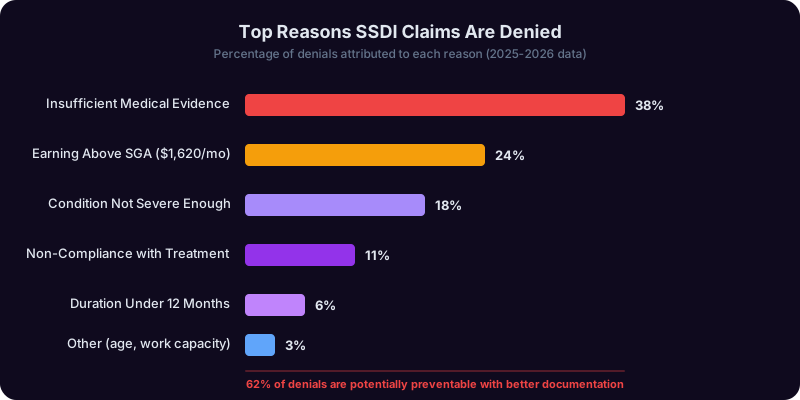
This is an all-or-nothing standard. The SSA does not award partial disability. You are either unable to perform substantial gainful activity (SGA) or you are not. In 2026, SGA is defined as earning more than $1,620 per month ($2,700 for blind applicants). If you are earning above these thresholds, the SSA will deny your claim regardless of how severe your condition is.
It is also important to understand that having a diagnosis alone does not qualify you. The SSA evaluates your functional limitations, not just your medical label. Two people with the same diagnosis can have vastly different outcomes because their functional abilities differ. This distinction is the single most important concept in the entire SSDI process, and misunderstanding it is the primary reason applications get denied.
Disclaimer: This guide provides general information about the SSDI application process. It is not legal advice. Disability law is complex, and the specific facts of your situation determine your options. For personalized guidance, consult with a qualified disability attorney or advocate.
Work Credits and Eligibility: Do You Have Enough to Qualify?
Before you invest time in a disability application, confirm that you meet the work credit requirements. This is a threshold question. If you do not have enough credits, your SSDI application will be denied regardless of how severe your condition is. You may still qualify for SSI, but the benefits are lower and the financial requirements are stricter.
How Work Credits Work
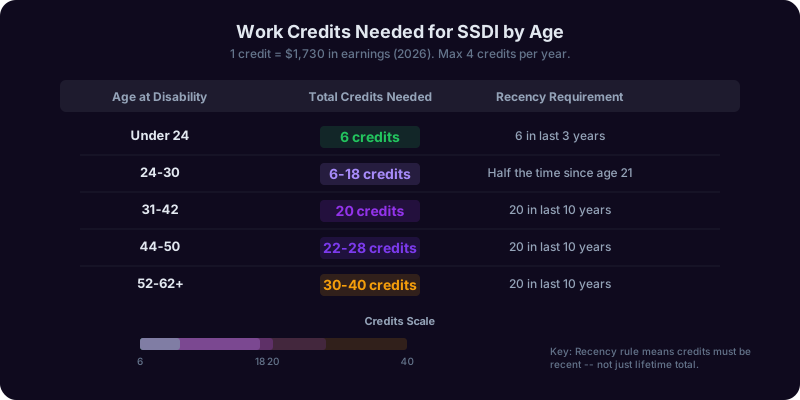
You earn Social Security work credits by working and paying FICA taxes. In 2026, you earn one credit for every $1,810 in wages or self-employment income, up to a maximum of four credits per year. This means you need to earn at least $7,240 in a year to get the full four credits.
The number of credits you need depends on your age when you become disabled:
| Age at Disability Onset | Total Credits Needed | Credits in Last 10 Years |
|---|---|---|
| Under 24 | 6 credits | 6 in last 3 years |
| 24-30 | Credits for half the time between age 21 and disability onset | All must be recent |
| 31-42 | 20 credits | 20 in last 10 years |
| 44 | 22 credits | 20 in last 10 years |
| 46 | 24 credits | 20 in last 10 years |
| 48 | 26 credits | 20 in last 10 years |
| 50 | 28 credits | 20 in last 10 years |
| 52 | 30 credits | 20 in last 10 years |
| 54 | 32 credits | 20 in last 10 years |
| 56 | 34 credits | 20 in last 10 years |
| 58 | 36 credits | 20 in last 10 years |
| 60 | 38 credits | 20 in last 10 years |
| 62+ | 40 credits | 20 in last 10 years |
The "Recency" Requirement
This catches many applicants by surprise. Even if you have 40 lifetime credits, you generally need 20 of those credits earned in the 10 years immediately before your disability began. This is sometimes called being "insured" for disability. If you stopped working five years ago and did not earn enough credits during that time, your insured status may have already expired.
You can check your work credit history by creating a my Social Security account on the SSA website. Your Social Security Statement shows your earnings history and the number of credits you have earned. Review it carefully for accuracy. If any earnings are missing (common with self-employment, cash jobs, or employer reporting errors), you will need to correct them with the SSA before applying.
What If You Do Not Have Enough Credits?
If you fall short on work credits, you have several options:
- Apply for SSI instead. SSI has no work credit requirement but has strict income and asset limits ($2,000 for individuals, $3,000 for couples). Many states supplement the federal SSI payment.
- Apply on a spouse's or parent's record. In certain cases, disabled adult children (if the disability began before age 22) can qualify for benefits on a parent's Social Security record. Disabled widows and widowers may also qualify on a deceased spouse's record.
- Check your date of disability onset. If your condition started years ago when you still had enough recent credits, establishing an earlier onset date could qualify you. This requires medical evidence showing the disability existed at that earlier date.
Estimating Your SSDI Benefit Amount
Your SSDI monthly benefit is calculated based on your average indexed monthly earnings (AIME) over your working life. Higher lifetime earnings mean higher benefits. In 2026, the average SSDI payment is approximately $1,580 per month, with the maximum payment being $3,822 per month. Your family members (spouse, dependent children) may also qualify for auxiliary benefits of up to 50% of your benefit amount, subject to a family maximum.
The SSA's online benefits calculator at ssa.gov can estimate your monthly benefit amount based on your actual earnings record. Run this calculation before applying so you know what to expect financially.
The SSDI Application Process: Step-by-Step Guide
Filing an SSDI application involves gathering extensive documentation, completing detailed questionnaires, and submitting everything to the Social Security Administration for review. The more thorough your initial application, the better your chances of approval without needing to appeal. Here is exactly how to do it.
Three Ways to Apply
- Online at ssa.gov. This is the most efficient method. You can save your progress and return later. The online application takes 1-2 hours if you have all your information ready.
- By phone. Call 1-800-772-1213 (TTY: 1-800-325-0778) to schedule an appointment. Available Monday through Friday, 8 a.m. to 7 p.m. local time.
- In person. Visit your local Social Security office. Schedule an appointment in advance to avoid long waits.
Information You Need Before Applying
Gather the following before you start your application. Having everything ready prevents delays:
- Personal information: Social Security number, birth certificate or proof of age, contact information for your spouse and minor children
- Work history: Names and addresses of employers for the last 15 years, job titles, duties performed, dates of employment, highest education level, and dates of any military service
- Medical information: Names, addresses, phone numbers, and patient ID numbers for every doctor, hospital, clinic, and mental health provider who has treated your condition. Dates of visits, medications prescribed (names, dosages, prescribing doctors), and medical tests performed
- Financial information: Sources and amounts of any current income, workers' compensation details, and information about any other disability benefits you receive or have applied for
Critical Forms You Will Complete
The SSA requires several detailed forms as part of your application:
- SSA-3368 (Disability Report): This is the core of your application. It asks about your medical conditions, how they limit your ability to work, your medications, and your medical providers. Be thorough and specific. Do not minimize your symptoms or limitations.
- SSA-3369 (Work History Report): Describes your jobs over the past 15 years in detail, including physical requirements (lifting, standing, walking), mental demands, and tools or machines used. The SSA uses this to determine whether you can return to past work.
- SSA-3373 (Function Report): This is the form most applicants underestimate. It asks about your daily activities: how you dress, cook, clean, shop, socialize, and handle personal care. Your answers must be consistent with your claimed limitations. If you claim you cannot stand for more than 10 minutes but report that you cook full meals daily, the inconsistency will hurt your case.
How to Fill Out the Function Report Effectively
The Function Report is where most applicants make critical mistakes. Here are the rules:
- Describe your worst days, not your best. The SSA is evaluating whether you can sustain full-time work. If you have three good days and two bad days per week, your bad days are what matters for work capacity.
- Be specific about limitations. Instead of "I have trouble walking," write "I can walk approximately one block (about 300 feet) before I need to stop and rest for 5-10 minutes due to pain in my lower back and left leg."
- Mention help you receive. If your spouse helps you dress, your daughter drives you to appointments, or your neighbor does your grocery shopping, say so. This demonstrates functional limitations.
- Include mental health impacts. Difficulty concentrating, memory problems, anxiety in public, difficulty following instructions, trouble getting along with others. These are all relevant functional limitations even if your primary condition is physical.
- Do not exaggerate, but do not minimize. The SSA compares your self-report against your medical records. Major inconsistencies in either direction damage your credibility.
Our guide to writing appeal letters with AI covers strategies for presenting your case clearly and professionally, which applies equally to the initial SSDI application forms.

Get Answers From the Legal Copilot
The Legal Copilot helps you understand disability eligibility requirements, organize your medical evidence, prepare for ALJ hearings, and draft appeal letters at every stage of the SSDI process.
Building Your Medical Evidence: The Make-or-Break Factor
Medical evidence is the foundation of every SSDI claim. The SSA's own data shows that insufficient medical evidence is the single most common reason for initial denials, accounting for roughly 35-40% of all unfavorable decisions. Your medical records need to tell a clear, consistent story about your condition, its severity, and how it prevents you from working.
What the SSA Considers Medical Evidence
The SSA accepts medical evidence from "acceptable medical sources," which include:
- Licensed physicians (MDs and DOs)
- Licensed psychologists (for mental health conditions)
- Licensed optometrists (for visual disorders)
- Licensed podiatrists (for foot disorders)
- Qualified speech-language pathologists (for speech and language disorders)
- Advanced practice registered nurses (APRNs, as of 2017 rule change)
- Licensed audiologists (for hearing disorders)
Evidence from other sources (chiropractors, therapists, social workers, naturopaths) can support your claim but cannot establish the existence of a medically determinable impairment on its own.
The Most Powerful Piece of Evidence: Your Doctor's RFC Statement
A Residual Functional Capacity (RFC) assessment from your treating physician is arguably the most important document in your disability file. The RFC describes exactly what you can and cannot do despite your medical condition. It answers questions like:
- How long can you stand or walk in an 8-hour workday?
- How much weight can you lift and carry?
- How often do you need to rest?
- Can you bend, stoop, crouch, or climb?
- Can you use your hands for fine manipulation or repetitive gripping?
- Do you need to elevate your legs during the day?
- How many days per month would you likely miss work due to your condition?
Ask your doctor to complete an RFC form (available from the SSA or from disability attorney websites) before you apply. A well-completed RFC from a treating physician who has examined you regularly over time carries substantial weight with disability examiners and judges.
Building a Strong Medical Record
The months before and during your application, take these steps to strengthen your medical evidence:
- See your doctors regularly. Gaps in treatment are interpreted as evidence that your condition is not severe. If you cannot afford treatment, document that fact and seek free or sliding-scale care at community health centers.
- Report all symptoms at every visit. If you have pain, fatigue, depression, cognitive difficulties, or side effects from medication, tell your doctor and make sure it is noted in your chart. Unreported symptoms effectively do not exist for SSA purposes.
- Get specialist evaluations. A general practitioner's notes are helpful, but opinions from specialists (rheumatologists, neurologists, orthopedists, psychiatrists) carry more weight for the specific conditions they treat.
- Keep a symptom diary. Record your pain levels, functional limitations, medication side effects, and activities daily. This can be submitted as evidence and helps you report accurately on SSA forms.
- Do not skip prescribed treatments. The SSA can deny your claim if you fail to follow prescribed treatment without a good reason. Valid reasons include inability to afford treatment, religious objections, or treatment side effects that are worse than the condition.
Consultative Examinations
If the SSA decides your medical records are insufficient, they will schedule a consultative examination (CE) with a doctor they choose and pay for. These examinations are typically brief (15-30 minutes) and are conducted by doctors who have never treated you. CEs are generally less favorable to claimants than treating physician records, so it is far better to submit comprehensive records from your own doctors than to rely on a CE.
If you are scheduled for a CE, attend it. Failing to appear is treated as failure to cooperate and will result in a denial. During the exam, be honest about your limitations but do not minimize them. Describe your worst days, not your best.
If your disability is related to a condition that also generates medical bills you are struggling to pay, our guide to appealing health insurance denials covers strategies for getting your treatments covered by insurance while your SSDI application is pending.
SSDI Approval Rates: What the Data Tells You About Your Chances
Understanding SSDI approval statistics helps you set realistic expectations and prepare strategically. The numbers are sobering at the initial level but improve significantly at higher levels of review, which is why persistence through the appeals process is so important.
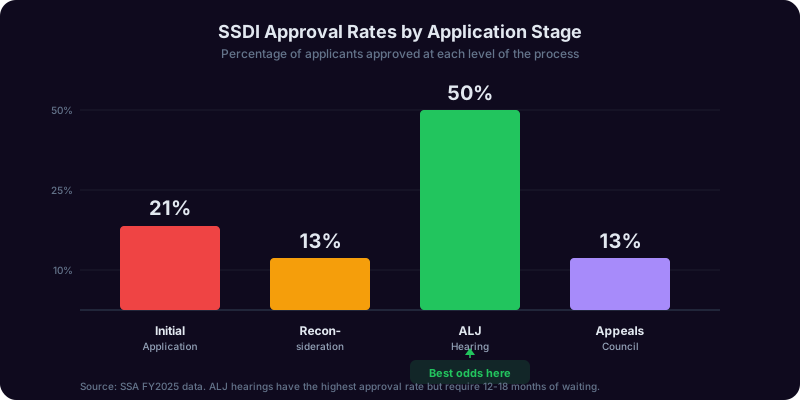
Approval Rates by Stage
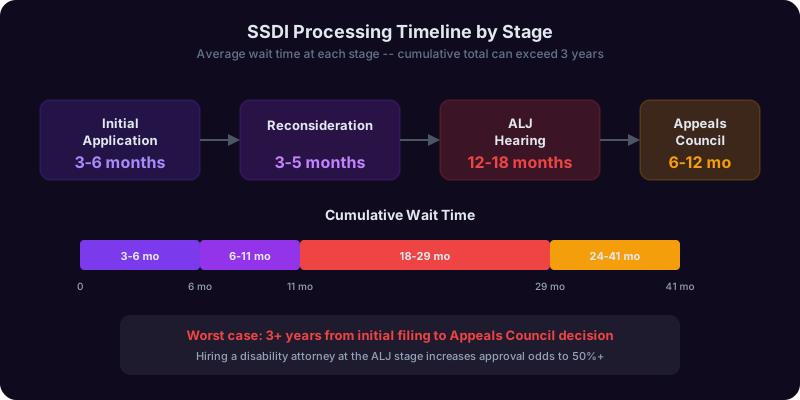
| Stage | Approval Rate | Average Processing Time |
|---|---|---|
| Initial application | 21-30% | 3-6 months |
| Reconsideration | 10-15% | 3-5 months |
| ALJ hearing | 45-55% | 12-18 months |
| Appeals Council | 1-2% (but 15-20% remanded) | 6-18 months |
| Federal court | Varies (40-50% remanded) | 12-24 months |
When you add up the cumulative approvals across all stages, approximately 50-55% of all SSDI applicants are eventually approved if they pursue their claims through the hearing level. The problem is that many applicants give up after the first or second denial, never reaching the ALJ hearing where approval rates are highest.
Conditions With the Highest Approval Rates
Certain medical conditions have higher approval rates than others, largely because they map more clearly to the SSA's listing of impairments (the "Blue Book"):
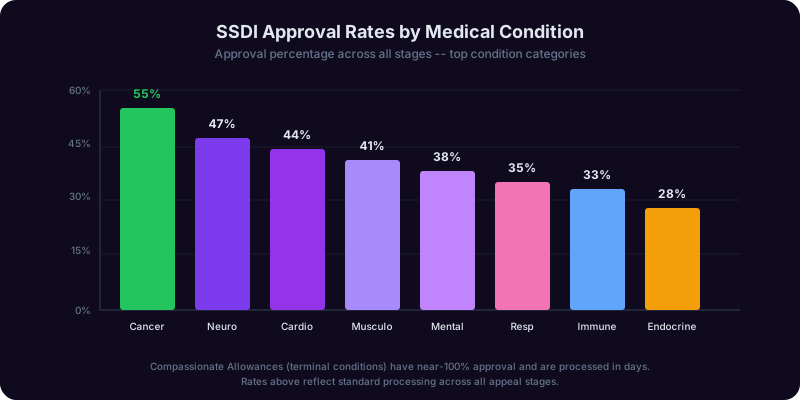
- Cancers (most types): 60-70% approval rate. Many cancers meet or equal SSA listings, especially during active treatment.
- Cardiovascular conditions: 50-60%. Chronic heart failure, coronary artery disease with documented limitations, and peripheral arterial disease with objective test results.
- Musculoskeletal disorders: 35-50%. Back injuries, degenerative disc disease, arthritis, and joint replacement are among the most commonly approved conditions, but require strong imaging and functional evidence.
- Neurological conditions: 45-60%. Multiple sclerosis, Parkinson's disease, epilepsy, and traumatic brain injury have relatively clear diagnostic criteria.
- Mental health conditions: 30-45%. Major depression, bipolar disorder, schizophrenia, PTSD, and anxiety disorders. Approval rates are lower partly because functional limitations can be harder to document objectively.
- Immune system disorders: 40-55%. Lupus, HIV/AIDS, inflammatory bowel disease, and rheumatoid arthritis.
Factors That Influence Your Individual Odds
Beyond your diagnosis, several factors significantly affect your chances:
- Age: Applicants over 50 have substantially higher approval rates. The SSA's vocational grid rules make it easier to prove disability for older workers with limited education or physical job histories because fewer alternative jobs exist for them.
- Education: Lower education levels increase approval chances, as the SSA considers whether you could be retrained for sedentary work. A college degree works against you because it implies adaptability.
- Work history: A history of physically demanding work (construction, nursing, warehouse work) strengthens your case if your condition prevents physical labor and your education or skills do not transfer to desk work.
- Consistency of evidence: Applicants with regular, long-term treatment records and consistent symptom reports have higher approval rates than those with sporadic treatment or conflicting evidence.
- Legal representation: According to data from the disability research by Nolo, applicants represented by an attorney or advocate at the ALJ hearing are approved at rates roughly three times higher than unrepresented applicants. Representation matters enormously at the hearing stage.
These statistics are not destiny. They are context. A condition with a 30% approval rate still means nearly one in three applicants with that condition gets approved. The difference between approval and denial almost always comes down to the quality of medical evidence and how effectively the case is presented.
SSDI Benefit Amounts, Back Pay, and What Happens After Approval
Understanding exactly what you will receive after approval helps you plan financially during the long application process and set expectations for life on disability benefits.
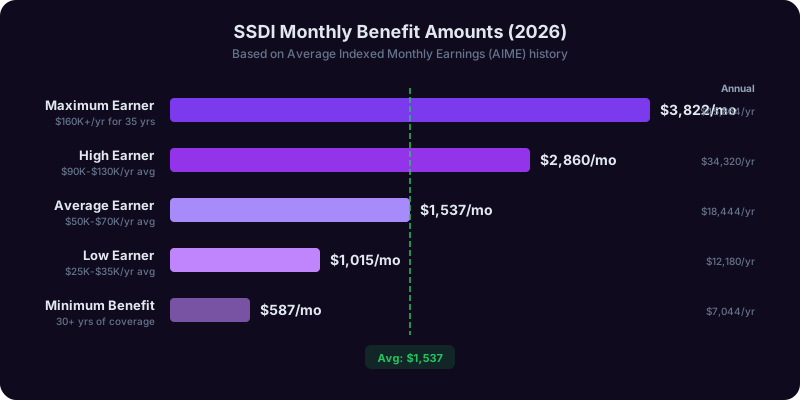
How Your Monthly Benefit Is Calculated
Your SSDI benefit is based on your average indexed monthly earnings (AIME) over your working life. The SSA applies a formula called the Primary Insurance Amount (PIA) to your AIME. In 2026, the PIA formula replaces:
- 90% of the first $1,174 of AIME, plus
- 32% of AIME between $1,174 and $7,078, plus
- 15% of AIME above $7,078
This progressive formula means that lower earners replace a higher percentage of their pre-disability income. Someone who earned $30,000 per year might receive about $1,200-$1,400 per month, while someone who earned $100,000 per year might receive $2,800-$3,200 per month.
The Five-Month Waiting Period
Even after approval, SSDI benefits do not start immediately. There is a mandatory five-month waiting period from your established onset date (EOD) before payments begin. The first month you are eligible for a check is the sixth full month after your disability started. This waiting period applies to everyone, regardless of how long the application took.
Back Pay (Past-Due Benefits)
If your application took months or years to approve, you are entitled to back pay for the months between your EOD (plus the five-month waiting period) and your approval date. For claims that go through the ALJ hearing level, back pay amounts of $20,000-$80,000+ are common, depending on your monthly benefit amount and how long the case took.
SSDI back pay can also cover up to 12 months before your application date if you can establish that your disability began at least 17 months before you applied (12 months of retroactive benefits plus the 5-month waiting period). This is why establishing the correct onset date with strong medical evidence is so important.
Medicare Coverage
SSDI beneficiaries become eligible for Medicare 24 months after their disability entitlement date (which is 29 months after the established onset date, accounting for the 5-month waiting period). There is no way to shorten this waiting period. During the gap, options include:
- COBRA continuation coverage (up to 18 months, but expensive)
- ACA marketplace plans (you may qualify for premium subsidies based on reduced income)
- Medicaid (if your income and assets fall below your state's thresholds)
- State disability programs that include health coverage
Working While on SSDI
The SSA offers several work incentive programs that let you test your ability to work without immediately losing benefits:
- Trial Work Period (TWP): You can work for up to 9 months (not necessarily consecutive) within a 60-month window and receive full SSDI benefits regardless of how much you earn. In 2026, a trial work month is any month you earn more than $1,110.
- Extended Period of Eligibility (EPE): After your TWP, you have 36 months during which your benefits are paid for any month your earnings are below the SGA level ($1,620). If you exceed SGA, benefits stop for that month but resume if earnings drop again.
- Expedited Reinstatement: If your benefits end because of work but you stop working within 5 years due to your disability, you can request expedited reinstatement without filing a new application.
Family Benefits
Your family members may also receive monthly benefits based on your SSDI record:
- Spouse: Up to 50% of your benefit if caring for your child under 16, or at age 62+
- Children: Up to 50% of your benefit for unmarried children under 18 (or under 19 if a full-time student, or any age if disabled before age 22)
- Family maximum: Total family benefits are capped at 150-180% of your PIA
If managing your finances during the SSDI process becomes challenging, the Finance Copilot can help you create a budget that accounts for reduced income during the waiting period and plan for benefit payments once they begin.
What to Do When Your SSDI Claim Is Denied: The Four Levels of Appeal
Most SSDI claims are denied on the first attempt. This is not the end. It is the beginning of the part of the process where most successful claimants ultimately win. The SSA's appeals process has four levels, and your chances improve significantly as you move through them, particularly at the ALJ hearing stage.
Level 1: Reconsideration
You have 60 days from the date of your denial letter to request reconsideration. A different examiner at the state Disability Determination Services (DDS) reviews your entire file, including any new evidence you submit. The approval rate at reconsideration is only 10-15%, which is why many disability advocates consider it a formality to get through on the way to the hearing.
What to do at reconsideration:
- Submit any new medical evidence obtained since your initial application
- Get an updated RFC statement from your treating physician
- Write a detailed letter explaining why you disagree with the denial, addressing the specific reasons cited
- Do not simply refile the same evidence and expect a different result
Note: Some states participate in a pilot program that eliminates the reconsideration step, allowing you to go directly from initial denial to requesting an ALJ hearing. Check with your local SSA office.
Level 2: ALJ Hearing (Where Most Cases Are Won)
If reconsideration is denied, you have 60 days to request a hearing before an Administrative Law Judge (ALJ). This is where SSDI cases are truly decided. The ALJ hearing is the most important stage because:
- You (or your attorney) present your case in person
- The judge can ask you questions directly and assess your credibility
- Medical and vocational experts testify
- The approval rate is 45-55%, far higher than any other stage
ALJ hearings are typically held at SSA hearing offices or by video. They last 30-60 minutes. The judge, a vocational expert (VE), and sometimes a medical expert (ME) participate. You and your attorney present evidence, answer questions, and cross-examine the experts.
Preparing for the ALJ Hearing
- Get a disability attorney or representative. This is the single most impactful step you can take. Represented claimants win at roughly three times the rate of unrepresented ones. Most disability attorneys work on contingency, charging 25% of back pay (capped at $7,200 in 2026) only if you win. You pay nothing if your case is denied.
- Submit all evidence at least 5 business days before the hearing. Late evidence can be excluded. Your attorney should send a pre-hearing brief summarizing your case and highlighting key medical evidence.
- Prepare to answer questions honestly. The ALJ will ask about your daily activities, pain levels, limitations, medications and side effects, and why you cannot work. Practice describing your limitations in specific, measurable terms.
- Understand the vocational expert's role. The VE testifies about what jobs exist in the national economy for someone with your limitations. Your attorney's cross-examination of the VE is often the most critical moment of the hearing. A skilled attorney can get the VE to concede that someone with your specific limitations could not sustain employment.
Level 3: Appeals Council
If the ALJ denies your claim, you have 60 days to request review by the SSA Appeals Council in Falls Church, Virginia. The Appeals Council does not hold hearings. They review the record and either deny review (upholding the ALJ), remand the case back to the ALJ for a new hearing, or (rarely) issue their own decision. Only about 1-2% of cases are reversed by the Appeals Council, but 15-20% are remanded for a new hearing.
Level 4: Federal Court
If the Appeals Council denies review, you have 60 days to file a civil lawsuit in federal district court. A federal judge reviews whether the ALJ's decision was supported by substantial evidence and followed proper legal standards. Roughly 40-50% of cases that reach federal court are remanded to the SSA for a new hearing, though outright reversals are rare. Federal court requires an attorney and can add 12-24 months to your case.
Throughout the appeals process, the techniques covered in our AI appeal letters guide can help you draft clear, persuasive written submissions for each level of review.
Top SSDI Approval Tips, Common Mistakes, and When to Hire an Attorney
After reviewing thousands of SSDI outcomes, disability advocates and attorneys consistently identify the same factors that separate successful claims from denied ones. Here are the most impactful strategies and the mistakes that most commonly lead to denial.
Top 10 SSDI Approval Tips
- Apply as soon as you become disabled. Do not wait to "see if you get better." Processing takes months, and delays can cause you to lose insured status or miss retroactive benefits.
- Get a treating physician RFC statement. This is the most powerful piece of evidence in your file. Ask your primary doctor and any specialists to complete detailed RFC forms documenting your specific functional limitations.
- Be consistent across all forms and statements. The SSA cross-references your application, Function Report, medical records, and hearing testimony. Inconsistencies damage your credibility.
- Document everything, including pain and mental health. Physical conditions often have psychological components (depression from chronic pain, anxiety about health). Report these to your doctors and include them in your application.
- Continue medical treatment throughout the process. Treatment gaps signal to the SSA that your condition may not be as severe as claimed. If cost is a barrier, document that and seek free or low-cost care.
- Describe your worst days in functional terms. The SSA evaluates whether you can sustain full-time work. Your bad days matter more than your good days for this assessment.
- Do not work above SGA during the application. Earning more than $1,620 per month in 2026 will result in automatic denial. Even working slightly below SGA can raise questions about your ability to work.
- File your appeals on time. The 60-day deadline for each appeal level is strict. Missing it usually means starting over from scratch.
- Get legal representation before the ALJ hearing. The statistics are clear: represented claimants win at dramatically higher rates. Most disability attorneys charge nothing upfront.
- Do not give up after the initial denial. The initial approval rate of 21-30% is misleading. The cumulative approval rate through the hearing level is over 50%.
The 8 Most Common Mistakes
- Listing only diagnoses without functional limitations. "I have fibromyalgia" is not enough. "Fibromyalgia causes me to need unscheduled rest breaks every 30-45 minutes, miss 4-5 days of work per month, and limits my ability to lift more than 5 pounds" is what the SSA needs.
- Inconsistent daily activity reports. Claiming total disability on your application but posting social media photos of physical activities. The SSA investigates and uses social media evidence.
- Not listing all impairments. Many applicants have multiple conditions that individually might not be disabling but in combination are. List every condition: physical, mental, and medication side effects.
- Failing to attend consultative examinations. If the SSA schedules a CE, go. Not showing up is treated as failure to cooperate and results in automatic denial.
- Underestimating mental health. Nearly 40% of approved SSDI claims involve mental health conditions. Even if your primary issue is physical, depression, anxiety, and cognitive difficulties from pain or medication should be documented and treated.
- Trying to look "healthy" at the hearing. Some applicants dress up, wear full makeup, and project an image of capability at their ALJ hearing. Be yourself. Wear comfortable clothes. If you need to stand up during the hearing because of pain, do it.
- Relying on emergency room visits instead of regular care. ER records document acute episodes but rarely provide the detailed, longitudinal evidence the SSA needs. Regular outpatient care builds a much stronger record.
- Not reading the denial letter carefully. The denial letter tells you exactly why your claim was denied. Your appeal needs to directly address those specific reasons with new evidence or arguments.
When and How to Hire a Disability Attorney
You can hire an attorney at any stage, but the optimal time is immediately after your initial denial or reconsideration denial, before the ALJ hearing. Here is what to know about disability attorneys:
- Fee structure: Federal law caps disability attorney fees at 25% of back pay or $7,200 (whichever is less) in 2026. You pay nothing if you lose. There are no upfront costs for most disability firms.
- What they do: Gather and organize medical evidence, obtain RFC statements from your doctors, write pre-hearing briefs, prepare you for ALJ testimony, cross-examine vocational and medical experts at the hearing, and handle all appeals.
- How to find one: The National Organization of Social Security Claimants' Representatives (NOSSCR) maintains a directory of disability attorneys and advocates. Most offer free case evaluations.
The Legal Copilot can help you understand the SSDI process, prepare questions for attorney consultations, organize your medical records and timeline, and draft correspondence with the SSA. For employment-related issues that may have contributed to your disability claim, our employment contract review guide covers understanding your workplace rights and accommodations obligations under the ADA.
Frequently Asked Questions
Recommended Copilots
Related Articles
Get Answers From the Legal Copilot
The Legal Copilot helps you understand disability eligibility requirements, organize your medical evidence, prepare for ALJ hearings, and draft appeal letters at every stage of the SSDI process.