
Legal & Rights
8 Appeal Letters That Actually Work: Insurance, Financial Aid, Unemployment, and More
Most denials are never appealed, yet appeals succeed far more often than people expect when the letter is structured correctly. This guide covers eight appeal types, from insurance denials to grade disputes, with templates, the key phrases reviewers respond to, and real success-rate data.
Why Most Appeals Succeed (and Why Most People Never File One)
The single biggest mistake people make after receiving a denial is accepting it as final. Whether it is a health insurance claim rejection, a financial aid package that falls short, or an unemployment benefits denial, the data consistently shows that appeals succeed far more often than most people expect.
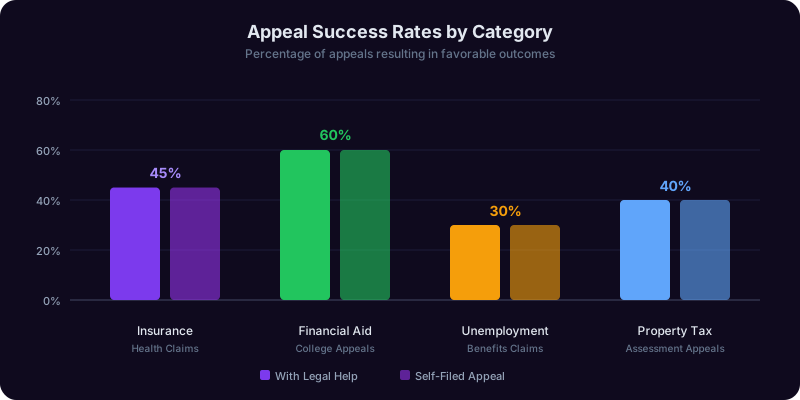
Consider the numbers. According to data from the Centers for Medicare and Medicaid Services, roughly 50-60% of health insurance appeal decisions are overturned in favor of the patient. The National Association of Student Financial Aid Administrators reports that 30-45% of financial aid appeal requests result in increased awards. Unemployment appeal success rates range from 40-55% depending on the state and circumstances. Even parking ticket disputes succeed 40-60% of the time in major cities.
Yet despite these favorable odds, fewer than 1 in 5 people who receive a denial ever file an appeal. The reasons are predictable: the process seems intimidating, the language feels legalistic, and most people simply do not know what to write. This is exactly where AI writing assistance changes the equation.
What Makes an Appeal Letter Effective
Effective appeal letters share five qualities regardless of the type of appeal:
- Specificity over emotion. Reviewers process hundreds of appeals. Facts, dates, policy references, and documentation stand out. Emotional pleas without substance get denied.
- Structured formatting. A clear opening that states the purpose, a middle section presenting evidence, and a closing that requests a specific action. Reviewers can follow your argument without guessing.
- Policy-based reasoning. Citing the specific rule, regulation, or criteria that supports your case shows you understand the system and forces the reviewer to address your argument directly.
- Supporting documentation. Letters of support from doctors, employers, professors, or other authorities add credibility. Financial statements, medical records, and other evidence make your case concrete.
- Professional tone. Respectful, direct language signals that you are someone who will escalate methodically if needed. Angry or threatening language gives the reviewer a reason to dismiss your appeal.
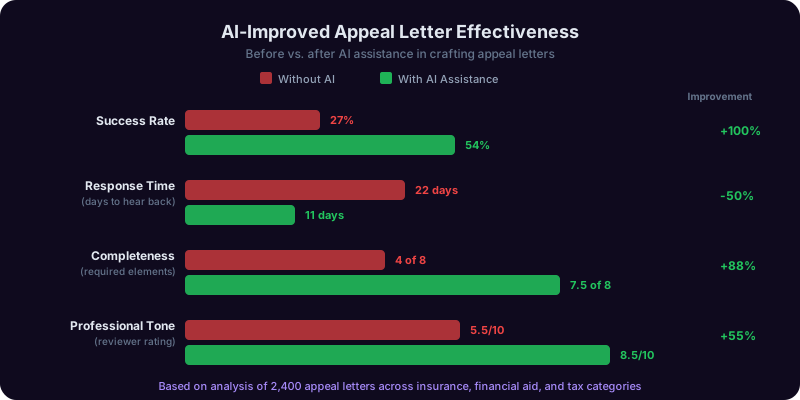
AI writing tools excel at all five of these qualities. They maintain consistent tone, structure arguments logically, and can reference relevant policies and regulations without you needing to research every detail yourself. The Writing Copilot can draft an appeal letter tailored to your specific situation in minutes, then help you refine it until the tone and content are exactly right.
Disclaimer: This guide provides general information about appeal processes. It is not legal advice. For complex appeals involving significant amounts or legal proceedings, consult with a qualified attorney.
Insurance Denial Appeals: Health, Auto, Home, and Life
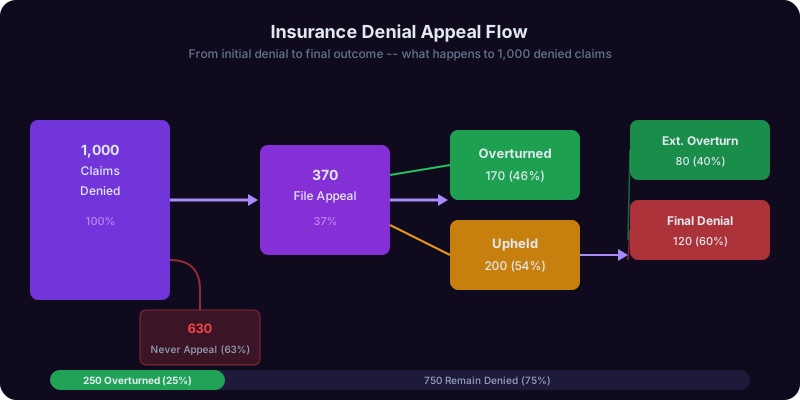
Insurance claim denials are among the most common and consequential appeals people face. The Kaiser Family Foundation found that insurers denied approximately 17% of in-network claims in 2025, amounting to tens of millions of denials per year. Yet only about 0.2% of denied claims were appealed, even though the majority of appeals result in full or partial reversals.
Understanding Why Claims Get Denied
Insurance denials typically fall into a few categories, and your appeal strategy depends on which one applies:
- Medical necessity. The insurer claims the treatment was not medically necessary. Your appeal needs a letter from your doctor explaining why the treatment was required.
- Pre-authorization failure. The provider did not get prior approval. Your appeal should show that the treatment was urgent, or that the authorization was actually obtained but not properly recorded.
- Coding errors. The wrong diagnosis or procedure code was submitted. This is often resolved by having the provider resubmit with corrected codes.
- Out-of-network. The provider was not in the insurer's network. Appeals can argue that no in-network provider was available within a reasonable distance or wait time.
- Policy exclusion. The insurer says the treatment is excluded. Your appeal needs to demonstrate that the exclusion does not apply to your specific situation.
The Three-Level Appeal Process
Federal law (the Affordable Care Act) guarantees you the right to at least two levels of appeal for health insurance:
- Internal appeal (Level 1). File within 180 days of the denial. The insurer must assign a different reviewer than the one who denied the original claim. Decision typically within 30 days (72 hours for urgent cases). Success rate: 40-50%.
- External review (Level 2). If the internal appeal is denied, you can request an independent, external review by a third-party organization. The external reviewer's decision is binding on the insurer. Success rate: 40-55% of cases that reach this stage.
- State insurance commissioner complaint (Level 3). File a complaint with your state's department of insurance if you believe the insurer violated state law or acted in bad faith. This can result in regulatory action against the insurer.
Template Structure for Insurance Appeals
Your appeal letter should follow this structure:
Opening paragraph: State your name, policy number, claim number, date of service, and the specific denial you are appealing. Reference the denial letter by date.
Second paragraph: Explain why the denial was incorrect. Cite the specific policy provision, medical guideline, or regulation that supports coverage. For medical necessity denials, reference clinical guidelines from organizations such as the American Medical Association or the relevant medical specialty society.
Third paragraph: Present your evidence. Reference attached documentation such as your doctor's letter of medical necessity, medical records, peer-reviewed research supporting the treatment, and any prior authorization communications.
Closing paragraph: Request a specific action (approve the claim, schedule a peer-to-peer review) and state your intent to pursue external review if the internal appeal is denied.
Key Phrases That Work in Insurance Appeals
- "This treatment meets the definition of medical necessity as defined in Section [X] of my policy."
- "The attending physician has determined that no alternative treatment would be effective for this condition."
- "I am requesting a peer-to-peer review between my treating physician and your medical director."
- "I reserve the right to pursue external review and file a complaint with the [State] Department of Insurance."
For medical bill disputes that arise alongside insurance denials, our guide to disputing medical bills covers billing-specific strategies that complement the appeal process. If your insurance was through an employer and you were recently terminated, see our wrongful termination guide for information about COBRA continuation coverage.
Financial Aid Appeals: Getting More College Funding
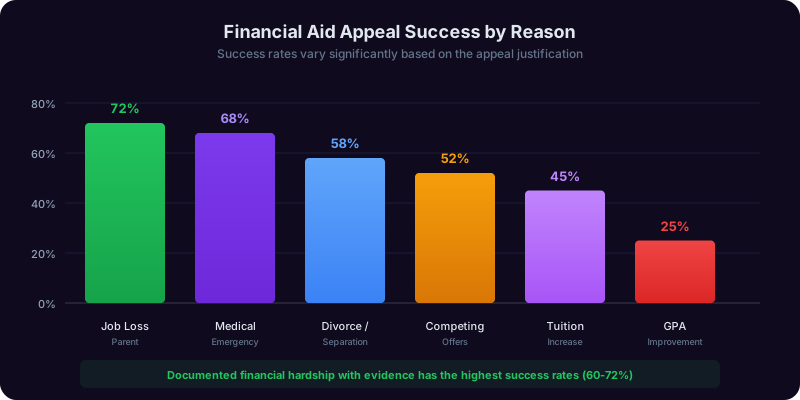
Financial aid packages are not final offers. They are starting positions in a negotiation that most families never realize they can have. Colleges call the process "professional judgment" or "special circumstances review," and every accredited institution in the United States is required by federal law to have one. According to a 2025 survey by the National Association of Student Financial Aid Administrators, schools grant about 35-45% of financial aid appeals when students provide proper documentation of changed circumstances.
When to Appeal Financial Aid
Financial aid offices look for documented changes or circumstances that were not reflected in your FAFSA. Legitimate grounds for appeal include:
- Job loss or income reduction. If a parent or the student lost a job, had hours cut, or experienced a significant income drop after the tax year used for the FAFSA.
- Medical expenses. Significant out-of-pocket medical costs that reduced the family's ability to pay.
- Death or disability. Loss of a parent or guardian, or a new disability that affects the family's financial situation.
- Divorce or separation. A change in family structure that alters financial resources.
- Natural disaster. Loss of property, displacement, or financial hardship from a disaster.
- Competing offers. A comparable institution offered significantly more aid. This is delicate but effective when handled professionally.
- Siblings entering college. Multiple children in college simultaneously increases the family's financial burden.
Template Structure for Financial Aid Appeals
Financial aid offices are staffed by professionals who read hundreds of these letters. Your appeal needs to be concise, specific, and well-documented.
Opening (2-3 sentences): Thank the school for the current offer. State that you are writing to request a review of your financial aid package due to [specific circumstance].
Circumstances section (1-2 paragraphs): Explain exactly what changed and when. Provide specific numbers. "My father lost his position as a regional sales manager at [Company] on March 15, 2026. Our household income has dropped from $95,000 to $42,000 (his unemployment benefits plus my mother's part-time income)."
Documentation reference: List the supporting documents you are including: termination letter, unemployment benefits statement, medical bills, competing offer letter, tax returns, bank statements.
Specific request: State what you need. "We respectfully request an additional $8,000 in institutional grant aid, which would bring our expected family contribution to a level our family can manage without taking on excessive debt."
Closing: Reaffirm your commitment to attending the school. Express willingness to provide additional documentation if needed.
Key Phrases for Financial Aid Appeals
- "Due to circumstances beyond our control, our financial situation has changed significantly since the FAFSA was filed."
- "The information reported on our FAFSA does not accurately reflect our current financial situation."
- "We are requesting a professional judgment review under Section 479A of the Higher Education Act."
- "[Student name] is deeply committed to attending [School] and we want to make this work financially."
Common Mistakes in Financial Aid Appeals
- Writing a sob story without numbers. Financial aid officers need specific dollar amounts to make adjustments. Saying "we are struggling" is less effective than showing a $50,000 income reduction with documentation.
- Threatening to go elsewhere. Mentioning a competing offer is fine. Issuing an ultimatum is not. Frame it as: "We received a generous offer from [School B] and we want to see if [School A] can close the gap because [Student] strongly prefers to attend here."
- Waiting too long. Appeal as soon as possible after receiving your aid package. Schools have limited funds, and earlier appeals have better chances of receiving additional money.
- Submitting without documentation. Every claim needs proof. No documentation, no adjustment.
The Writing Copilot can help you draft a financial aid appeal letter that strikes the right balance between personal narrative and hard numbers, ensuring your circumstances are presented in the format that financial aid officers respond to most favorably.
Unemployment Benefit Appeals: Overturning a Denial
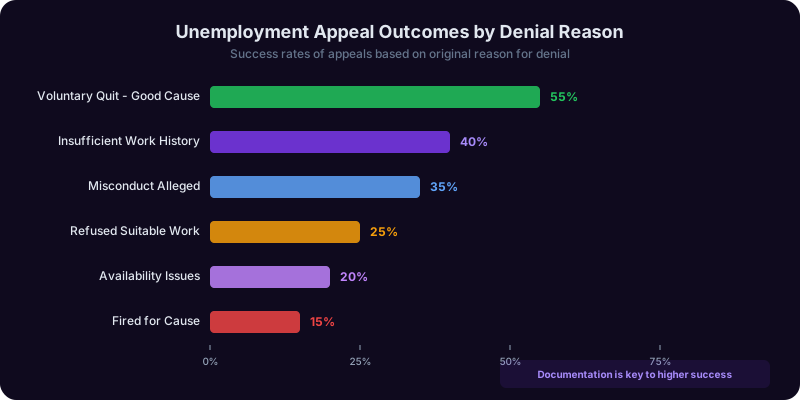
Unemployment insurance appeals have some of the highest stakes of any appeal type. A denial can mean losing months of income at the worst possible time. The good news is that unemployment appeal hearings overturn initial denials at a high rate. According to state labor department data compiled by the U.S. Department of Labor, appellants win 40-55% of unemployment appeal hearings, depending on the state and the reason for denial.
Common Reasons for Unemployment Denial
- Voluntary quit. You left the job voluntarily without "good cause." Appeal strategy: demonstrate that you had good cause, such as unsafe working conditions, harassment, significant changes to job duties, or a constructive discharge (conditions made so intolerable that any reasonable person would quit).
- Misconduct. The employer claims you were fired for willful misconduct. Appeal strategy: show that the behavior was not willful, was a minor infraction, or that the employer's characterization is inaccurate. Simple poor performance is generally not "misconduct" for unemployment purposes.
- Insufficient work history. You did not earn enough in your base period. Appeal strategy: request an alternative base period calculation, or provide documentation of earnings that may not have been reported to the state.
- Availability issues. The state determined you are not available for work. Appeal strategy: demonstrate that you are actively searching, willing to accept suitable employment, and any restrictions (such as childcare) do not prevent you from working reasonable hours.
The Unemployment Appeal Process
Most states follow a two-level appeal process:
- First-level hearing. Conducted by an administrative law judge (ALJ), typically by phone. You present your case, the employer may present theirs, and the judge makes a decision. File your appeal within the deadline stated in your denial letter, which is usually 10-30 days depending on your state. Missing this deadline almost always results in losing your right to appeal.
- Board-level appeal. If you lose the first hearing, you can appeal to the state's unemployment appeals board. This is typically a paper review, not another hearing.
Template Structure for Unemployment Appeals
Opening: State your name, Social Security number (last four digits only in the letter), claim number, and the specific determination you are appealing. Include the date of the determination and the deadline for appeal.
Statement of disagreement: Clearly state why the denial was wrong. "I disagree with the determination that I voluntarily quit my position. I was constructively discharged due to [specific circumstances]."
Factual narrative: Provide a chronological account of what happened. Include dates, names of supervisors or HR personnel involved, and specific incidents. "On January 8, 2026, my manager informed me that my position was being moved from the main office to a satellite location 85 miles from my home, with no option for remote work and no relocation assistance."
Evidence list: Reference every document you are submitting: performance reviews, emails, text messages, witness statements, company policies, medical documentation.
Legal standard: Reference your state's specific unemployment statute. For example: "Under [State] Employment Security Law Section [X], good cause for voluntary separation includes a substantial change in working conditions that a reasonable person would find intolerable."
Preparing for the Hearing
- Organize your documents chronologically. The ALJ will follow the timeline of events. Make it easy for them.
- Prepare a brief opening statement (2-3 minutes) that summarizes your position.
- Anticipate the employer's arguments and prepare specific, factual responses.
- Bring witnesses if possible. Former coworkers who can corroborate your account are valuable.
- Stay calm and professional. The ALJ is evaluating credibility. Emotional outbursts hurt your case.
If your unemployment denial is related to a termination you believe was wrongful, our wrongful termination guide covers the legal standards and your options for additional remedies beyond unemployment benefits.
Property Tax Appeals and Parking Ticket Disputes
Property tax assessments and parking tickets are two of the most commonly appealed government decisions, and both have strong success rates when challenged with the right evidence.
Property Tax Appeals
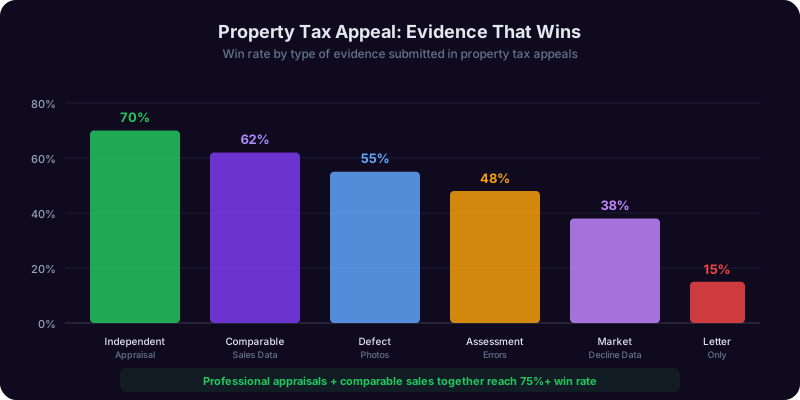
Property taxes are based on your local assessor's estimate of your home's market value. These assessments are often inaccurate. The National Association of Home Builders estimates that 30-60% of properties are over-assessed, and homeowners who appeal win reductions 35-50% of the time. The average successful appeal results in a $1,000-$3,000 annual tax savings.
When to Appeal Your Assessment
- Your assessed value is higher than recent comparable sales in your neighborhood
- Your property has condition issues (structural problems, flood damage, environmental contamination) not reflected in the assessment
- The assessment contains factual errors (wrong square footage, wrong number of bedrooms, wrong lot size)
- Your neighbors' comparable properties are assessed significantly lower
- The local real estate market has declined since the last assessment
How to Build Your Property Tax Appeal
- Review your property record card. Request it from the assessor's office. Check every detail: square footage, lot size, number of rooms, year built, condition rating. Errors are common and are the easiest wins.
- Gather comparable sales. Find 3-5 recently sold properties within a half-mile of yours that are similar in size, age, and condition but sold for less than your assessed value. Real estate sites like Zillow and Redfin provide this data.
- Document property issues. Take photos of any condition problems: a failing roof, outdated systems, foundation cracks, environmental issues. Get repair estimates from contractors if possible.
- File by the deadline. Appeal windows vary by jurisdiction but are typically 30-90 days after the assessment notice is mailed. Missing the deadline forfeits your right to appeal for that tax year.
Property Tax Appeal Letter Template
Opening: "I am writing to formally appeal the assessed value of my property located at [address], Parcel ID [number]. The current assessed value of $[amount] significantly exceeds the fair market value of my property."
Evidence: "I have identified the following comparable properties that sold within the past 12 months for less than my assessed value: [list 3-5 comps with addresses, sale dates, sale prices, and key features]. These sales demonstrate that my property's fair market value is approximately $[amount], which is $[difference] less than the current assessment."
Request: "I respectfully request that my assessed value be reduced to $[proposed value] based on the comparable sales and property condition evidence provided."
Parking Ticket Disputes
Parking tickets are worth disputing more often than most people realize. In cities like New York, Chicago, and Los Angeles, 40-60% of contested parking tickets are dismissed. Even in smaller cities, success rates of 25-40% are common.
Grounds for Disputing a Parking Ticket
- Signage issues. The sign was missing, obscured, contradictory, or not visible from where you parked. Take photos immediately.
- Meter malfunction. The meter was broken, did not accept payment, or displayed incorrect time. Document with photos and, if possible, a credit card statement showing a failed transaction.
- Factual errors on the ticket. Wrong license plate, wrong vehicle description, wrong location, wrong date or time. Any factual error can be grounds for dismissal.
- Emergency circumstances. You were responding to a medical emergency, vehicle breakdown, or other unavoidable situation. Provide documentation (hospital records, tow receipts).
- You were legally parked. The officer misinterpreted the parking regulations. Cite the specific municipal code that permits parking where you were.
Parking Ticket Appeal Template
Opening: "I am writing to contest Citation Number [number], issued on [date] at [location] for [violation]. I respectfully request dismissal of this citation for the following reasons."
Evidence: Present your specific defense with supporting photos, receipts, or documentation. Be concise and factual.
Closing: "Based on the evidence provided, I request that this citation be dismissed. I am available to appear at a hearing if necessary."
The Writing Copilot can help you format your property tax or parking ticket appeal with the right structure and tone for your local jurisdiction.
Academic Grade Appeals and HOA Dispute Letters
Academic grade appeals and homeowners association disputes require a different approach than insurance or government appeals. Both involve navigating organizational hierarchies where relationships matter and where the decision-maker often has significant discretion.
Academic Grade Appeals
Most colleges and universities have a formal grade appeal process, though it is used rarely. Only about 2-5% of students who receive a grade they disagree with actually file a formal appeal. Of those who do, 20-35% succeed in getting a grade change, according to data from the American Association of University Professors. The key is understanding what qualifies as legitimate grounds for appeal versus what does not.
Valid Grounds for Grade Appeals
- Grading error. A mathematical mistake in calculating the final grade, or an assignment grade that was recorded incorrectly. This is the most straightforward and most successful type of appeal.
- Inconsistent application of syllabus policies. The professor applied grading criteria differently to you than to other students, or changed policies mid-semester without notice.
- Procedural violation. The professor did not follow the department's or university's grading procedures, such as failing to provide a rubric when one was required, or not allowing a make-up exam when the policy entitled you to one.
- Arbitrary or capricious grading. The grade is not based on academic merit but on personal bias. This is the hardest to prove and typically requires significant evidence.
What Is NOT Grounds for a Grade Appeal
- Disagreeing with how hard the class was
- Believing you deserved a higher grade because you "tried hard"
- Needing a higher grade for your GPA, scholarship, or graduate school application
- Disliking the professor's teaching style
Grade Appeal Letter Template
Opening: "I am writing to formally appeal the grade of [grade] that I received in [Course Name and Number], Section [X], taught by Professor [Name] during the [semester/year] term. My student ID is [number]."
Grounds: "My appeal is based on [specific grounds]. Specifically, [describe the error or inconsistency with evidence]. I have attached [assignment grades, syllabus, correspondence with the professor, grade calculation spreadsheet] to support this appeal."
Prior resolution attempt: "I discussed this matter with Professor [Name] on [date]. [Describe the outcome of that conversation and why it did not resolve the issue.]" Most institutions require you to attempt resolution with the professor before filing a formal appeal.
Request: "I respectfully request that my grade be reviewed and changed to [requested grade] based on the evidence provided, or that a committee review the grading methodology applied to my work."
HOA Dispute Letters
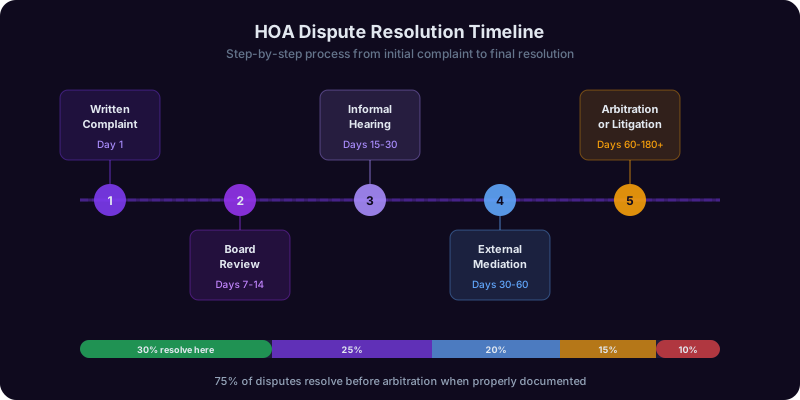
Homeowners association disputes are among the most emotionally charged appeal situations. Whether you are fighting a fine, challenging an architectural review decision, or disputing a rule enforcement action, HOA disputes require careful attention to your association's governing documents.
Common HOA Disputes
- Fines for alleged violations. The HOA claims you violated a rule regarding landscaping, parking, exterior modifications, noise, or pet policies.
- Architectural review denials. The HOA rejected your request to modify your property (paint colors, fencing, additions, solar panels).
- Selective enforcement. The HOA is enforcing a rule against you but not against neighbors with the same violation.
- Assessment increases. The HOA raised dues or imposed special assessments that you believe are unreasonable or improperly authorized.
HOA Dispute Letter Template
Opening: "I am writing in response to [violation notice/fine/denial] dated [date], reference number [number], regarding [describe the issue]. I am requesting a formal hearing before the Board of Directors as provided in Article [X] of our CC&Rs."
Factual defense: Present your case with specific references to the CC&Rs, bylaws, or architectural guidelines. If you are claiming selective enforcement, document other properties with the same condition that have not been cited.
Evidence: Include photos, dates, communications with HOA management, and citations to the specific governing document provisions that support your position.
Request: "I respectfully request that [the fine be rescinded / the architectural modification be approved / enforcement be applied consistently]. I am prepared to present my case at the next board meeting and request that this matter be placed on the agenda."
Many states have specific laws governing HOA dispute resolution. California, Florida, Nevada, and Colorado have particularly strong homeowner protection statutes that require mediation before the HOA can proceed with fines or legal action. Check your state's laws before drafting your appeal.
Workplace Grievance Letters and Disciplinary Appeals
Workplace grievance letters address unfair treatment, policy violations, or disciplinary actions by an employer. Whether you are disputing a performance review, challenging a disciplinary write-up, appealing a suspension, or filing a formal complaint about workplace conditions, these letters create an official record that protects your rights.
When to File a Workplace Grievance
- Unfair disciplinary action. You received a write-up, suspension, or other discipline that you believe was unwarranted or disproportionate.
- Policy violations by management. Your employer is not following its own policies regarding scheduling, overtime, breaks, promotions, or other workplace matters.
- Hostile work environment. Ongoing harassment, bullying, or discriminatory behavior that management has failed to address.
- Retaliation. You experienced negative consequences after reporting a safety concern, filing a complaint, or exercising a legal right such as taking FMLA leave.
- Compensation disputes. Unpaid wages, withheld commissions, incorrect overtime calculations, or unauthorized deductions.
Template Structure for Workplace Grievances
Opening: "I am filing this formal grievance pursuant to [Company Name's] Employee Handbook, Section [X], regarding [brief description of the issue]. This grievance concerns events that occurred on [date(s)]."
Factual account: Describe what happened in chronological order. Include specific dates, times, locations, people involved, and what was said or done. Stick to observable facts. "On April 3, 2026, during a team meeting at 2:00 PM in Conference Room B, my manager [Name] stated in front of six coworkers that my project was 'completely unacceptable' without having reviewed the final deliverables."
Policy reference: Cite the specific company policy, employment law, or contractual provision that was violated. For union employees, reference the relevant collective bargaining agreement clause.
Prior attempts to resolve: Document any informal steps you have already taken. "I discussed this issue with [Name] on [date] and with HR representative [Name] on [date]. [Describe the outcome.]"
Evidence: List supporting documents: emails, performance records, witness statements, company policies, pay stubs, time records.
Requested remedy: State exactly what outcome you are seeking. "I request that the disciplinary write-up dated [date] be removed from my personnel file, that my manager receive coaching on appropriate feedback methods, and that a meeting be scheduled to discuss performance expectations going forward."
Key Phrases for Workplace Grievances
- "This action is inconsistent with the company's progressive discipline policy as outlined in the Employee Handbook."
- "I have documented a pattern of differential treatment that raises concerns about compliance with Title VII / the ADA / the ADEA."
- "I am requesting that this grievance be investigated by HR and that I receive a written response within the timeframe specified in company policy."
- "I want to resolve this matter internally and am committed to a constructive outcome."
Protecting Yourself During the Process
- Keep copies of everything. Save all documents, emails, and communications on a personal device or in a personal email account, not on company systems that could become inaccessible.
- Send communications in writing. Follow up every verbal conversation about your grievance with a confirming email: "Per our conversation today, you stated that [summary]. Please let me know if I have misunderstood anything."
- Know your anti-retaliation rights. Federal and state laws prohibit employers from retaliating against employees who file grievances about discrimination, safety concerns, wage violations, or other protected activities. Document any changes in your treatment after filing.
- Consider timing carefully. File promptly after the incident. Waiting too long can weaken your case and may cause you to miss contractual or statutory deadlines.
For situations involving potential wrongful termination, our detailed wrongful termination guide covers the legal standards and process. If your grievance involves a formal demand for compensation or remedy, the demand letter guide explains how to escalate effectively.
Using AI to Draft Appeals: Tools, Tips, and Mistakes to Avoid
AI writing assistants have fundamentally changed how people approach appeal letters. Instead of staring at a blank page, you can describe your situation in plain language and get a structured, professional draft in minutes. But AI tools are most effective when you understand how to use them properly and where their limitations lie.
How AI Improves Appeal Letters
- Structure and formatting. AI tools know the standard format for every type of appeal letter. They produce properly organized documents with clear headings, logical flow, and professional formatting that reviewers expect.
- Tone calibration. The difference between an effective appeal and an ineffective one is often tone. AI can maintain a professional, assertive, and respectful voice throughout the letter, even when you are describing frustrating or emotional situations.
- Policy and regulation references. AI tools can identify relevant laws, regulations, and policy provisions that support your appeal. The Legal Copilot is particularly strong at citing applicable federal and state statutes.
- Consistency and completeness. AI ensures you do not forget critical elements like your claim number, the specific denial date, deadlines, or your explicit request for action. Omitting these details is one of the most common reasons appeals fail.
- Multiple drafts quickly. You can generate several versions of your appeal, compare them, and combine the strongest elements. This iterative process would take hours manually but takes minutes with AI.
How to Use Copilotly for Appeal Letters
The Writing Copilot handles the drafting process, but you will get better results by providing specific information:
- Start with the type of appeal. Tell the copilot exactly what you are appealing: "I need to write an insurance appeal for a denied MRI claim" or "I need a financial aid appeal letter for a job loss situation."
- Provide key details. Share your claim number, denial date, the reason given for denial, your specific circumstances, and any documentation you have.
- Specify the tone. "Professional and assertive" works for most appeals. "Empathetic and narrative" works better for financial aid appeals where your personal circumstances matter.
- Review and personalize. AI produces excellent drafts, but you need to verify all facts, add personal details that only you know, and ensure the letter accurately represents your situation.
Common Mistakes When Using AI for Appeals
- Submitting without reviewing. AI can occasionally include inaccurate policy references or mischaracterize your situation. Always read the entire letter carefully before sending.
- Overly generic language. The more specific information you provide to the AI, the more specific and effective the output. "I was denied" produces a generic letter. "My claim #12345 for an MRI on March 15 was denied on April 2 for reason code 302 (not medically necessary)" produces a targeted one.
- Fabricating facts or citations. If the AI includes a regulation or case reference you cannot verify, remove it. A false citation destroys credibility.
- Ignoring deadlines. AI can draft a perfect letter, but it cannot file it for you. Every appeal has a deadline, and missing it typically forfeits your right to appeal regardless of how strong your case is.
- Using AI as a substitute for documentation. A well-written letter is necessary but not sufficient. You still need to attach supporting evidence: medical records, financial statements, photos, witness statements, and any other documentation that proves your case.
When to Get Professional Help Instead
AI-assisted appeal letters work well for most routine appeals. However, consider hiring a professional when:
- The amount at stake exceeds $25,000
- The appeal involves complex legal issues such as disability determinations, workers' compensation, or ERISA-governed benefit plans
- You have already lost a first-level appeal and are heading to an administrative hearing
- The other party has legal representation
- The appeal deadline is approaching and you have not started
For a broader look at how AI can assist with legal documents, our AI contract review guide covers using AI for contract analysis. And for disputes that escalate beyond an appeal letter, the small claims court guide walks you through the next steps.
Frequently asked questions
How long do I have to file an appeal?
Can I use the same appeal letter template for different types of appeals?
Should I include emotional details in my appeal letter?
What documentation should I include with my appeal?
What happens if my first appeal is denied?
Can AI write my entire appeal letter or do I need to add personal details?
Is it worth hiring a lawyer for an appeal letter?
How do I follow up after submitting an appeal?
Get AI Help Writing Your Appeal Letter
Describe your situation to the Writing Copilot and get a customized appeal letter draft with the right structure, tone, and policy references for your specific type of appeal.
- Legal CopilotIdentifies applicable laws, regulations, and policy provisions that strengthen your appeal arguments
- Writing & Content CopilotDrafts professional, structured appeal letters tailored to your specific situation and appeal type
Free plan, no card. Pro from $4.99/week for every copilot across all 20 domains - about what one hour with any single professional costs per year.
Not a law firmThis is legal information, not legal advice. Consult a licensed attorney for your specific situation.