
Why You Need a Will (and What Happens If You Don't Have One)
A will is the single most important legal document most people will ever need, yet according to a 2025 Gallup survey, roughly 68% of American adults do not have one. The reasons are predictable: people assume they are too young, think they do not have enough assets, or simply find the topic uncomfortable. But dying without a will - called dying intestate - does not mean your assets go to the government. It means a probate court judge, following rigid state formulas, decides who gets everything. And those formulas almost never match what you would have chosen.
What Intestacy Actually Looks Like
Every state has intestacy laws that dictate a default distribution order when someone dies without a will. These laws treat your estate like a flowchart, prioritizing legal relationships over actual relationships. The Uniform Probate Code adopted by many states provides the framework, but each state has its own variations. Here is what that means in practice:
- Your unmarried partner gets nothing. You have been with your partner for 15 years, share a home, and consider them family. Under intestacy laws in most states, an unmarried partner has zero legal claim to your estate. Everything goes to your blood relatives - parents, siblings, or even distant cousins you have never met. Your partner may lose the home you shared.
- Your estranged relative inherits. You have not spoken to your brother in a decade. Without a will, he may receive a significant portion of your estate - potentially half if you have no spouse or children. Intestacy laws do not account for the quality of your relationships.
- A judge chooses your children's guardian. If both parents die without a will naming a guardian, the court appoints one. It will likely be a close relative, but which one? If your parents and your spouse's parents both petition for guardianship, you are looking at an expensive, emotionally devastating custody battle - at the worst possible time for your children.
- Your blended family faces chaos. If you have children from a previous marriage and a current spouse, intestacy laws vary wildly by state. In some states, your current spouse gets everything. In others, your spouse and your children from a prior relationship split the estate, potentially forcing the sale of the family home.
State Intestacy Laws: Who Gets What
The following table shows the default distribution when someone dies without a will in selected states. These rules apply regardless of what you may have told your family you wanted.
| State | Surviving Spouse (No Children) | Surviving Spouse + Children | No Spouse, No Children |
|---|---|---|---|
| California | Community property to spouse; separate property split with parents | Community property to spouse; separate property split: 1/3 to spouse if one child, or 1/3 to spouse and 2/3 to children if multiple | Parents, then siblings, then grandparents |
| New York | Entire estate to spouse | First $50,000 + 1/2 to spouse; remainder to children | Parents, then siblings |
| Texas | All community property to spouse; 1/2 personal property + life estate in 1/3 real property | Community property: spouse keeps their half, children split the other half; separate property: 1/3 personal to spouse, 2/3 to children | Parents (split), then siblings |
| Florida | Entire estate to spouse | Entire estate to spouse if children are also spouse's; otherwise 1/2 to spouse, 1/2 to children | Parents, then siblings |
| Illinois | Entire estate to spouse | 1/2 to spouse, 1/2 to children | Parents, then siblings |
The Real Cost of Not Having a Will
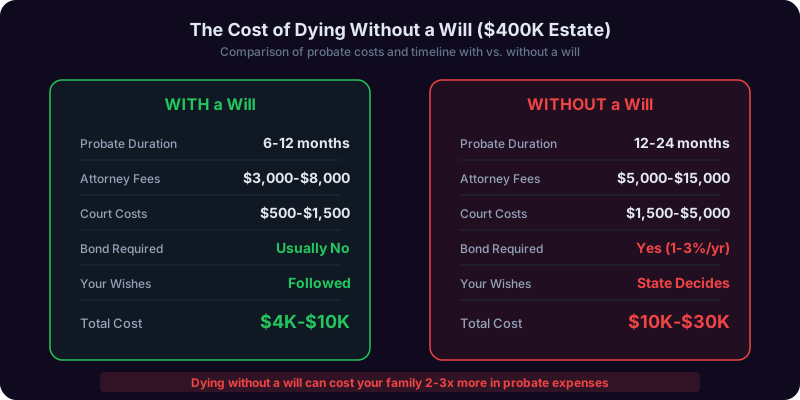
Beyond the emotional toll, dying intestate is expensive. Probate without a will typically takes 12 to 24 months, compared to 6 to 12 months with a valid will. Court-appointed administrators must post a bond (costing 1-3% of the estate's value annually), and attorney fees for intestate probate run 30-50% higher than probate with a will because everything requires court approval. For a modest $400,000 estate, the difference between dying with and without a will can easily be $10,000 to $30,000 in additional costs.
The good news: writing a will is far simpler, cheaper, and faster than most people assume. You do not need a lawyer for a straightforward will, and modern tools make the process accessible to anyone. The Estate Planning Copilot can help you understand whether your situation is simple enough for a DIY will or complex enough to warrant professional help.
Disclaimer: This guide provides general legal information for educational purposes, not legal advice. Will requirements and estate laws vary significantly by state. For situations involving substantial assets, blended families, business ownership, or special needs dependents, consult a licensed estate planning attorney in your state.
Types of Wills: Which One Is Right for You?
Not all wills are created equal. The type of will you need depends on the complexity of your assets, your family situation, and your estate planning goals. Understanding the differences helps you choose the right approach before you start writing.
1. Simple Will (Last Will and Testament)
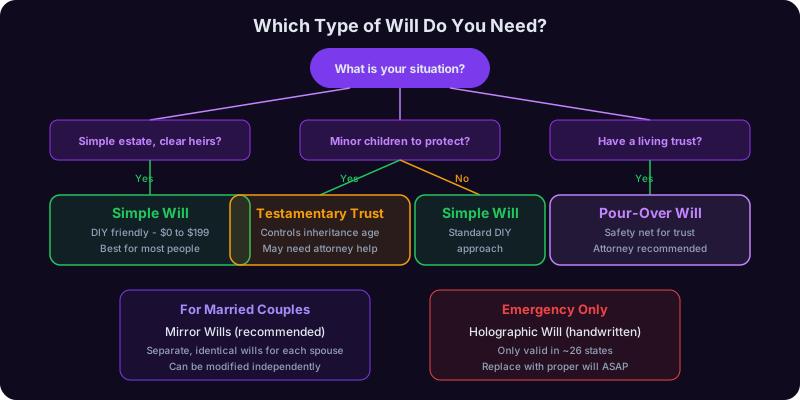
A simple will is the most common type and the one most people think of when they hear the word "will." It is a written document that states who receives your property when you die, names a guardian for minor children, and appoints an executor to carry out your wishes. A simple will goes through probate - the court-supervised process of validating the will, paying debts, and distributing assets.
Best for: Individuals and couples with straightforward estates - a home, bank accounts, retirement accounts, personal property, and minor children who need a named guardian. If your total estate is under $1 million and you have no complex family dynamics, a simple will is almost certainly sufficient.
Limitations: Everything in a simple will goes through probate, which is public, can take 6-12 months, and costs 2-7% of the estate's value in fees depending on the state. A simple will also provides no protection if you become incapacitated before death - for that, you need a separate power of attorney.
2. Testamentary Trust Will
A testamentary trust will includes provisions that create one or more trusts upon your death. The trust does not exist while you are alive - it is established through the will during probate. This is commonly used to manage assets for minor children, ensuring that a trustee manages their inheritance until they reach a specified age (often 25 or 30), rather than handing an 18-year-old a large sum of money.
Best for: Parents of minor children who want to control how and when their children receive their inheritance. Also useful when you want to leave assets to someone who is not good with money, has a substance abuse problem, or has creditor issues.
Limitations: The will itself still goes through probate. The trust is only created after the probate process is complete, so there is no probate avoidance benefit. Creating a testamentary trust will is more complex than a simple will and typically requires an attorney, though some advanced DIY tools can handle basic testamentary trusts.
3. Holographic Will (Handwritten Will)
A holographic will is written entirely in the testator's handwriting, signed by the testator, and - in most states that recognize them - requires no witnesses. About 26 states recognize holographic wills, including California, Texas, Virginia, and Michigan. However, they must be entirely handwritten (not typed with a handwritten signature) and clearly express testamentary intent. You can check whether your state recognizes holographic wills through the FindLaw holographic will guide.
Best for: Emergency situations where formal execution is not possible - you are deployed overseas, facing an imminent medical procedure, or in a location where witnesses and notaries are unavailable. A holographic will is better than no will at all.
Limitations: Holographic wills are the most frequently contested type of will. Handwriting disputes, questions about mental capacity, and ambiguous language are common grounds for challenge. Courts closely scrutinize holographic wills, and the lack of witnesses makes it harder to prove validity. Even in states that accept them, holographic wills should be treated as a temporary measure, replaced by a properly witnessed will as soon as possible. Several states - including New York, Florida, Illinois, and Ohio - do not recognize holographic wills at all.
4. Pour-Over Will
A pour-over will works in conjunction with a living trust. Any assets that were not transferred into your trust during your lifetime "pour over" into the trust upon your death. The pour-over will acts as a safety net, catching assets you forgot to retitle or acquired shortly before death.
Best for: Anyone who has established a revocable living trust as their primary estate planning tool. The pour-over will ensures nothing falls through the cracks. It is not a standalone document - it only makes sense if you already have a trust.
Limitations: Assets that pass through a pour-over will still go through probate before entering the trust. If a significant portion of your estate was not properly funded into the trust during your lifetime, the pour-over mechanism could result in a lengthy probate process - partially defeating the purpose of having a trust. Creating a living trust with a pour-over will is substantially more complex than a simple will and almost always requires an attorney.
5. Joint Will vs. Mirror Wills
A joint will is a single document shared by two people (usually spouses) that cannot be changed after one spouse dies. These are increasingly rare because they are inflexible - the surviving spouse cannot update the will even if circumstances change dramatically. Most attorneys now advise against joint wills.
Mirror wills (also called reciprocal wills) are separate, nearly identical wills created by two spouses. Each spouse leaves everything to the other, with the same contingent beneficiaries. Unlike joint wills, mirror wills can be independently modified after one spouse dies. This is the standard approach for married couples.
Which Type Should You Choose?
For most people reading this guide, a simple will or mirror wills (for couples) will be the right choice. These are the types you can confidently create without a lawyer using the DIY methods described in this guide. If you need a testamentary trust, pour-over will, or living trust, you are likely in territory where professional guidance is valuable. The Legal Copilot can help you assess which type fits your situation based on your assets, family structure, and goals.
What to Include in Your Will: The Complete Checklist
A valid will does not need to be long or written in dense legal language. But it does need to cover specific elements to be legally enforceable and practically useful. Here is everything your will should address, organized by priority.
1. Your Personal Information
Start with your full legal name, any other names you are known by (maiden name, nicknames used on accounts), your date of birth, and your current address. This establishes your identity and domicile - the state whose laws govern your will. If you have lived in multiple states recently, explicitly state your domicile: "I declare that I am a resident of [State] and intend this will to be governed by its laws."
2. Declaration of Testamentary Intent
Your will must clearly state that it is your will. Standard language: "I, [Full Legal Name], being of sound mind and legal age, do hereby declare this to be my Last Will and Testament, revoking all previous wills and codicils." The "revoking all previous wills" clause is critical - it prevents confusion if an old will surfaces after your death.
3. Executor (Personal Representative) Appointment
The executor is the person responsible for carrying out the instructions in your will. Their duties include filing the will with the probate court, inventorying assets, paying debts and taxes, and distributing property to beneficiaries. Choose someone who is:
- Organized and responsible - they will be managing paperwork, deadlines, and financial accounts for 6-18 months
- Trustworthy - they will have access to all your financial information and assets
- Willing to serve - executorship is time-consuming and sometimes thankless; ask them first
- Geographically accessible - some states restrict out-of-state executors or require them to post a bond
Always name a backup executor in case your first choice cannot or will not serve. You can also specify whether the executor should be compensated. Most states allow executors to collect a fee (typically 2-5% of the estate's value), but family members often waive compensation.
4. Guardian for Minor Children
If you have children under 18, naming a guardian is arguably the most important function of your will. Without this designation, a court will choose for you - and the judge's choice may not align with yours. Consider naming:
- A primary guardian - the person who will raise your children if both parents die
- An alternate guardian - a backup if the primary guardian cannot serve
- A property guardian or custodian - someone to manage your children's inherited assets until they reach adulthood (this can be the same person as the guardian or someone different)
If you and your co-parent disagree about guardianship, address this now. A will that names a guardian carries significant weight with the court, though the judge is not legally bound by your choice. The Family Law Copilot can help you think through guardianship considerations, especially in blended family situations.
5. Specific Bequests
Specific bequests are gifts of particular items or amounts to named individuals. Examples:
- "I leave my engagement ring to my daughter, Sarah Johnson."
- "I leave $10,000 to my nephew, Michael Chen."
- "I leave my 2024 Ford F-150, VIN [number], to my brother, David Smith."
Be as specific as possible. Use full legal names, not just "my son" or "my best friend." Include identifying details for valuable items. If the item no longer exists at your death (you sold the car), the bequest is considered adeemed - it simply lapses, and the beneficiary does not receive a substitute unless your will says otherwise.
6. Residuary Estate
The residuary estate is everything left over after specific bequests, debts, taxes, and administrative costs are paid. Your will should include a residuary clause: "I leave the rest, residue, and remainder of my estate to [beneficiary/beneficiaries]." This catches everything you did not specifically mention - assets you forgot about, assets you acquired after writing the will, and the proceeds from any specific bequest that lapsed.
Without a residuary clause, any unaddressed assets pass under state intestacy laws, even if you have a valid will covering everything else. This is one of the most common drafting oversights in DIY wills.
7. Digital Assets
Modern wills should address digital assets: online bank accounts, cryptocurrency wallets, social media accounts, email accounts, domain names, digital photo libraries, and any online business accounts. Specify who should have access and what they should do with each category. Include instructions for finding passwords (reference a password manager or a physical document, but do not list passwords in the will itself - wills become public records during probate). The Revised Uniform Fiduciary Access to Digital Assets Act adopted by most states provides the legal framework for digital asset management.
8. Debt and Tax Provisions
Specify how debts and estate taxes should be paid. Should they come from the residuary estate first? Should specific beneficiaries bear the tax burden on their bequests? Without clear direction, state law determines who pays, and the default rules often produce results that feel unfair to beneficiaries. For example, some states require that each beneficiary bears a proportional share of estate taxes, which can significantly reduce smaller bequests.
9. No-Contest Clause (Optional)
A no-contest clause (also called an in terrorem clause) states that any beneficiary who contests the will forfeits their inheritance. This can discourage frivolous challenges, but it is not enforceable in all states, and courts may not uphold it if the contestant had probable cause to challenge the will. Consider including one if you anticipate family disputes.
10. Funeral and Burial Wishes (Optional)
You can include your preferences for funeral arrangements, cremation, burial, or donation of remains to science. However, wills are often not read until days or weeks after death, so it is better to communicate these wishes in a separate letter to your executor and family members as well.
If you are organizing your assets and accounts as part of this process, the Insurance Copilot can help you review whether your life insurance beneficiary designations align with your will, and our guide on home buying covers how property ownership structures affect estate planning.
See our real-world walkthrough: negotiating a raise.

Get Answers From the Estate Planning Copilot
The Estate Planning Copilot helps you inventory your assets, understand state requirements, choose the right type of will, and review your document for common mistakes. Get personalized guidance for your situation before you sign anything.
Step-by-Step: How to Write Your Will
Now that you know what to include, here is the actual process for creating your will. Follow these steps in order, and you will have a legally valid document by the end.
Step 1: Take a Complete Asset Inventory
Before writing a single word, catalog everything you own and everything you owe. This is the foundation of your will and the step most people rush through.
Assets to list:
- Real estate (home, rental properties, vacant land) - note how title is held (sole ownership, joint tenancy, tenancy in common)
- Bank accounts (checking, savings, CDs) - note whether they have payable-on-death (POD) designations
- Investment accounts (brokerage, mutual funds, stocks) - note transfer-on-death (TOD) designations
- Retirement accounts (401(k), IRA, Roth IRA, pension) - these typically pass by beneficiary designation, not through your will
- Life insurance policies - these also pass by beneficiary designation
- Vehicles (cars, boats, motorcycles, RVs)
- Valuable personal property (jewelry, art, antiques, collectibles, firearms)
- Business interests (LLC membership, partnership interests, sole proprietorship assets, intellectual property)
- Digital assets (cryptocurrency, online business accounts, domain names, royalty streams)
- Money owed to you (personal loans, legal settlements)
Critical note about beneficiary designations: Assets with named beneficiaries - life insurance, retirement accounts, POD bank accounts, TOD investment accounts - pass directly to the named beneficiary, regardless of what your will says. If your 401(k) names your ex-spouse as beneficiary and your will leaves everything to your current spouse, your ex-spouse gets the 401(k). Review and update all beneficiary designations as part of writing your will.
Step 2: Make Your Key Decisions
With your inventory complete, decide:
- Who gets what? Assign specific items to specific people. Then decide who receives the residuary estate (everything else).
- Who is your executor? And your backup executor?
- Who is your children's guardian? And the backup guardian? Will the guardian also manage the children's finances, or will you name a separate property guardian?
- At what age should minor beneficiaries receive their inheritance? If you want to delay distribution beyond age 18, you may need a testamentary trust provision in your will.
- Should your executor be compensated? If so, what percentage or flat amount?
- How should debts and taxes be paid? From the residuary estate, or proportionally from each bequest?
Step 3: Choose Your Method
You have three main options for actually drafting the will:
- Online will-making service (LegalZoom, Trust & Will, FreeWill, Nolo) - guided questionnaire produces a state-specific document. Cost: $0-$199. Best for most people.
- Will template or form - downloadable blank form you fill in yourself. Cost: $0-$30. Requires more legal knowledge to ensure completeness.
- Write it yourself from scratch - drafting your own will with no template. Cost: $0. Not recommended unless you have legal knowledge, because missing a required element can invalidate the entire document.
We compare these tools in detail in Section 6 of this guide.
Step 4: Draft the Will
Whether you are using a service or a template, ensure your draft includes every element from the checklist in the previous section. Structure the document in this order:
- Opening declaration (name, domicile, revocation of prior wills)
- Executor appointment (primary and alternate)
- Guardian appointment (if applicable)
- Specific bequests (item-by-item gifts)
- Residuary clause (everything else)
- Debt and tax payment instructions
- No-contest clause (optional)
- Digital asset instructions
- Signature block with witness and notary provisions
Use clear, unambiguous language. Instead of "I leave my house to my kids," write "I leave my real property located at [address], currently held in my name as sole owner, to my children [Full Name 1] and [Full Name 2], in equal shares as tenants in common." Precision prevents litigation.
Step 5: Review the Draft Carefully
Before signing, review the draft against this checklist:
- Does it correctly identify you (full name, address, domicile)?
- Does it revoke prior wills?
- Does it name an executor and alternate?
- Does it name a guardian and alternate (if you have minor children)?
- Does it account for all significant assets?
- Does it include a residuary clause?
- Does it address debts and taxes?
- Are all beneficiary names full legal names?
- Are all bequests clear and unambiguous?
- Does it comply with your state's formal requirements (see Section 5)?
Have a trusted friend or family member read through it for clarity. Better yet, use the Contract Review Copilot to check your language for ambiguities, missing provisions, or clauses that could be challenged. For a broader understanding of reviewing legal documents, see our guide on how to read and negotiate contracts.
Step 6: Execute the Will Properly
Signing your will with the correct formalities is not optional - it is the difference between a valid legal document and an expensive piece of paper. The next section covers state-specific signing requirements in detail.
Step 7: Store and Distribute
After execution, store the original will in a secure but accessible location. Tell your executor where it is. Give copies (marked "COPY" to avoid confusion) to your executor, backup executor, and attorney if you have one. Do not put the original in a safe deposit box unless your executor is a co-signer on the box - in many states, a safe deposit box is sealed upon the owner's death, requiring a court order to open.
Signing and Witnessing Requirements: State-by-State Rules
The execution ceremony - the formal process of signing your will in front of witnesses - is where more DIY wills fail than at any other stage. A perfectly drafted will is legally worthless if it is not signed according to your state's requirements. This is not an area where "close enough" works. Missing one witness or skipping notarization in a state that requires it means the entire will can be thrown out.
General Requirements (Most States)
While each state has its own rules, most states require the following at minimum:
- The testator (you) must sign the will in the presence of witnesses. If you cannot physically sign, most states allow you to direct someone else to sign on your behalf in your presence.
- Two witnesses must watch you sign (or acknowledge your signature) and then sign the will themselves. Witnesses must generally be at least 18 years old and of sound mind.
- Witnesses should be "disinterested" - meaning they are not beneficiaries under the will. If a witness is also a beneficiary, some states invalidate the gift to that witness (but not the entire will), while others invalidate the will entirely.
- You must declare to the witnesses that the document is your will - this is called "publication." You do not need to show them the contents, just tell them you are signing your will.
State-by-State Requirements for Top 10 States by Population
| State | Witnesses Required | Notarization Required? | Self-Proving Affidavit? | Holographic Will Accepted? | Special Notes |
|---|---|---|---|---|---|
| California | 2 | Not required for validity | Recommended (separate affidavit signed by witnesses before notary) | Yes | Witnesses must be present at the same time; holographic wills must be entirely handwritten and signed |
| Texas | 2 | Not required for validity | Recommended (attached or separate affidavit) | Yes | Witnesses must be 14+ years old (lower than most states); self-proving affidavit avoids needing witnesses at probate |
| Florida | 2 | Required for self-proving status | Yes - requires notarized affidavit | No | Florida does NOT recognize holographic wills, even if valid in the state where they were created; witnesses must sign in presence of each other and the testator |
| New York | 2 | Not required for validity | Optional but recommended | No (limited exception for military personnel) | Testator must declare to each witness that the document is their will; witnesses must sign within 30 days of each other |
| Pennsylvania | 2 | Not required for validity | Available | No (but courts have accepted some under limited circumstances) | Testator does not need to sign in front of witnesses if they acknowledge their signature to the witnesses |
| Illinois | 2 | Not required for validity | Available (self-proving affidavit) | No | Witnesses must be competent and credible; attestation clause recommended but not strictly required |
| Ohio | 2 | Not required for validity | Available | No | Witnesses must hear the testator acknowledge the will as theirs; oral wills recognized only for military personnel in imminent peril |
| Georgia | 2 | Not required for validity | Available | No | Testator must sign or acknowledge signature in presence of both witnesses simultaneously; witnesses must be 14+ years old |
| North Carolina | 2 | Not required for validity but needed for self-proving | Yes - notarized self-proving affidavit | Yes (must be found after death in a place of safekeeping) | Holographic wills must be entirely handwritten, signed, and found among the testator's valuable papers |
| Michigan | 2 | Not required for validity | Available | Yes | Signed holographic will with material portions in testator's handwriting is valid; witnesses must sign within a reasonable time |
What Is a Self-Proving Affidavit (and Why You Want One)
A self-proving affidavit is a sworn statement, signed by the testator and witnesses before a notary public, confirming that the will was properly executed. It is typically attached to the will or included at the end of the document. The affidavit allows the will to be admitted to probate without requiring the witnesses to appear in court and testify that they watched you sign.
Without a self-proving affidavit, the probate court must locate your witnesses (who may have moved, become incapacitated, or died) and have them confirm the will's authenticity. If the witnesses cannot be found, the court must use alternative methods to validate the will, which adds months and costs to probate. A self-proving affidavit costs nothing beyond the notary fee ($5-$25) and eliminates this entire problem.
Practical tip: Even if your state does not require notarization for the will itself, you should always get a self-proving affidavit notarized. The small cost is worth the significant simplification it provides during probate.
The Signing Ceremony: How to Do It Right
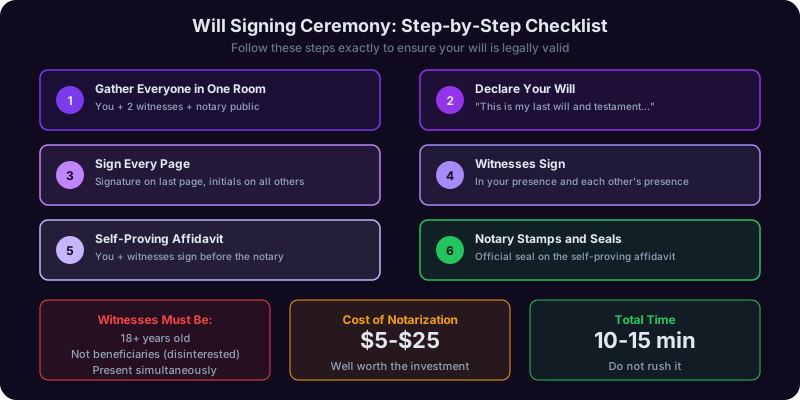
Here is the recommended procedure for signing your will, designed to satisfy the requirements of every U.S. state:
- Gather in one room: You, two disinterested witnesses (not named as beneficiaries), and a notary public.
- Declare your will: Tell the witnesses, "This is my last will and testament, and I am asking you to witness my signature." You do not need to let them read it.
- Sign every page: While the witnesses watch, sign the last page of the will where indicated. Many attorneys also recommend initialing the bottom of every other page to prevent page substitution.
- Witnesses sign: Both witnesses sign the will on the designated witness line, in your presence and in each other's presence.
- Complete the self-proving affidavit: You and both witnesses sign the affidavit in front of the notary. The notary notarizes the affidavit (not the will itself, unless your state requires it).
- The notary stamps and seals: The notary affixes their seal to the affidavit.
The entire ceremony takes 10-15 minutes. Do not rush it. An improperly conducted signing ceremony is the single most common reason wills are invalidated. If you are unsure about your state's specific requirements, the Legal Copilot can walk you through the execution formalities for your jurisdiction. For a broader view of how legal documents work and the formalities that make them enforceable, explore our legal resources hub.
DIY Will Tools Compared: LegalZoom vs. Trust & Will vs. FreeWill vs. Nolo
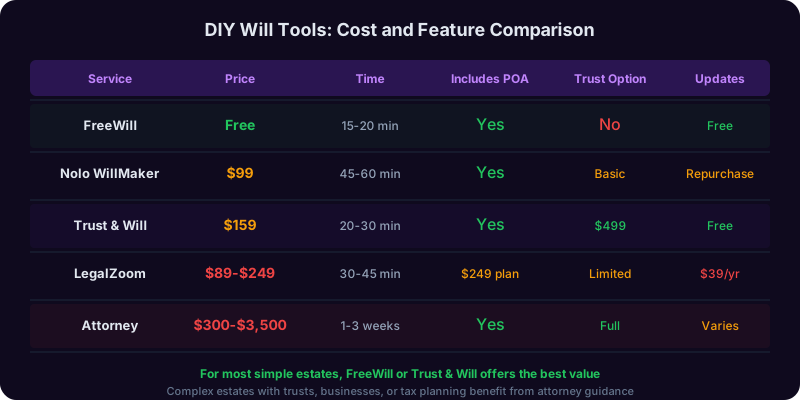
If you are writing a will without a lawyer, you will almost certainly use one of the major online will-making platforms. These services guide you through a questionnaire, generate a state-specific document, and provide instructions for proper execution. But they differ significantly in price, features, quality, and ongoing support. Here is an honest comparison based on the current 2026 offerings.
Comparison Table
| Feature | LegalZoom | Trust & Will | FreeWill | Nolo Quicken WillMaker |
|---|---|---|---|---|
| Price | $89 (basic will); $249 (comprehensive estate plan) | $159 (will-based plan); $499 (trust-based plan) | Free (basic will); donations encouraged | $99 (one-time software purchase; includes will, POA, healthcare directive) |
| State Coverage | All 50 states + DC | All 50 states + DC | All 50 states + DC | All 50 states + DC |
| Includes POA? | Yes (in comprehensive plan) | Yes (in all plans) | Yes (free) | Yes |
| Includes Healthcare Directive? | Yes (in comprehensive plan) | Yes (in all plans) | Yes (free) | Yes |
| Guardian Naming | Yes | Yes | Yes | Yes |
| Testamentary Trust | Limited (comprehensive plan only) | Yes (will-based plan) | No | Yes (basic provisions) |
| Attorney Review | Available for additional $199 | Not available as add-on | Not available | Not available (self-service software) |
| Updates/Changes | Free for 30 days; $39/year membership for ongoing updates | Free unlimited updates with active plan | Free unlimited updates | Free updates to current version; new versions require repurchase |
| Document Storage | Digital storage included | Digital vault included | Digital access included | Local storage (your computer) |
| User Experience | Clean interface; questionnaire takes 30-45 minutes | Modern interface; questionnaire takes 20-30 minutes | Simple interface; questionnaire takes 15-20 minutes | Desktop software; more detailed; takes 45-60 minutes |
LegalZoom: The Established Name
LegalZoom is the largest online legal services company and has been producing wills since 2001. Their process is straightforward: answer questions about your family, assets, and wishes, and receive a customized will document. The $89 basic plan covers a simple will only. The $249 comprehensive plan adds a financial POA, healthcare directive, and living will.
Pros: Established reputation; attorney review option ($199 extra) provides a real lawyer's eyes on your document; large knowledge base and customer support team; strong state-specific compliance.
Cons: Expensive compared to alternatives; the annual membership ($39/year) for ongoing document updates feels like a cash grab for what should be a one-time purchase; the basic plan is bare-bones. Attorney review is generic, not a deep dive into your specific situation.
Trust & Will: The Modern Option
Trust & Will launched in 2017 and has quickly become a preferred choice for younger users. Their interface is the most polished of the four options, and their $159 will-based plan includes everything most people need: a will, POA, healthcare directive, and guardian naming. The $499 trust-based plan adds a revocable living trust and pour-over will.
Pros: Clean, intuitive interface; includes POA and healthcare directive in the base price; free unlimited updates; strong educational content that explains each decision as you make it; good mobile experience.
Cons: More expensive than FreeWill and Nolo for the will-based plan; no attorney review option; the trust-based plan at $499 is approaching attorney-drafted territory without the benefit of actual legal counsel.
FreeWill: The Free Option
FreeWill generates revenue through charitable giving partnerships, not user fees. When you create your will, FreeWill suggests (but does not require) that you include a charitable bequest. The entire platform - will, POA, healthcare directive, beneficiary designation guidance - is genuinely free.
Pros: Completely free; fast and simple process; covers all essential documents; no upsells or hidden fees; excellent option for straightforward situations; charitable giving integration is a nice touch, not a hard sell.
Cons: The simplicity is a limitation - fewer customization options than paid services; no testamentary trust provisions; no attorney review; the document is less detailed than LegalZoom or Trust & Will output; limited customer support. Best for truly simple estates.
Nolo Quicken WillMaker: The Power User Option
Nolo is a respected legal self-help publisher that has been producing consumer-friendly legal tools since 1971. Their WillMaker software is a downloadable desktop application (not a web service) that produces comprehensive estate planning documents with more customization than any web-based competitor.
Pros: Most detailed and customizable option; includes extensive legal explanations for every provision; covers edge cases the web services skip; one-time purchase with no recurring fees; produced by the most respected name in legal self-help; includes provisions for digital assets, pet care, and complex bequests.
Cons: Desktop software feels dated compared to web-based interfaces; longer completion time (45-60 minutes vs. 20 minutes for FreeWill); new versions require a new purchase; no cloud storage or digital vault; learning curve is steeper. Best for detail-oriented users who want maximum control.
Which Should You Choose?
Here is the decision framework:
- Simple estate, tight budget: FreeWill. It is free, fast, and covers the basics.
- Standard estate, want peace of mind: Trust & Will ($159). Best balance of features, interface, and price. Includes POA and healthcare directive.
- Want attorney review: LegalZoom ($249 comprehensive + $199 attorney review). The only option with professional legal review, albeit generic.
- Want maximum control and detail: Nolo WillMaker ($99). Most customization, most legal education, best for people who want to understand every provision.
Whichever tool you choose, the Estate Planning Copilot can supplement the process by answering questions about provisions you are unsure about, explaining legal terminology, and helping you think through decisions like asset distribution and guardian selection.
8 Common Mistakes That Can Invalidate Your Will
A will that looks legitimate on its face can be entirely unenforceable if it contains certain errors. These are the most frequent mistakes, drawn from probate court records and estate planning attorneys' experiences, ranked by how often they cause real-world problems.
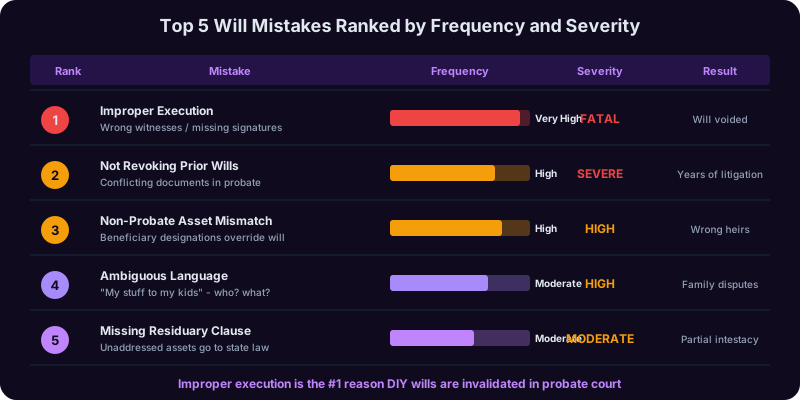
Mistake 1: Improper Execution (Wrong Witnesses or Missing Signatures)
This is the single most common reason wills are thrown out. The testator signs the will at their kitchen table with one witness instead of two. A beneficiary serves as a witness. The witnesses sign on different days. The testator forgets to sign one page of a multi-page document. Any of these can be fatal. Courts are strict about execution formalities because they are the primary safeguard against fraud and coercion.
How to avoid it: Follow the signing ceremony procedure outlined in Section 5 to the letter. Two disinterested witnesses, all present at the same time, watching you sign, then signing themselves, with a notarized self-proving affidavit.
Mistake 2: Not Revoking Prior Wills
You write a new will but do not include a revocation clause and do not destroy the old one. After your death, both wills are submitted to probate. Now the court must determine which provisions of which will control - a process that can take years, cost tens of thousands of dollars, and produce results that satisfy no one. Even if the new will is dated later, conflicting provisions can create ambiguity.
How to avoid it: Every will should begin with: "I hereby revoke all prior wills and codicils." Then physically destroy all copies of the old will.
Mistake 3: Failing to Account for Non-Probate Assets
You leave everything to your daughter in your will. But your $500,000 life insurance policy names your ex-spouse as beneficiary, and your $300,000 401(k) names your now-deceased mother. The will does not control these assets - beneficiary designations override wills. Your daughter gets whatever is left after the non-probate assets go elsewhere.
How to avoid it: Review every beneficiary designation on life insurance, retirement accounts, POD bank accounts, and TOD investment accounts at the same time you write your will. Update them to align with your overall estate plan.
Mistake 4: Ambiguous Language
"I leave my stuff to my kids" is not a valid bequest. Which kids? Biological only, or stepchildren too? What about a child born after the will is written? "My stuff" includes everything from the house to the kitchen utensils - is that really what you mean? Ambiguity is an invitation to litigation.
How to avoid it: Use full legal names for every beneficiary. Describe specific property with sufficient detail (addresses for real estate, VINs for vehicles). Define what happens if a beneficiary predeceases you. Include a residuary clause for everything not specifically mentioned.
Mistake 5: Not Updating After Major Life Events
You write a will leaving everything to your spouse. You get divorced but never update the will. In many states, divorce automatically revokes bequests to a former spouse - but not all states, and not all provisions. Your ex-spouse might still be named as executor or guardian. Failing to update after marriage, divorce, the birth of a child, the death of a beneficiary, or a major change in assets is one of the most common planning failures.
How to avoid it: Review your will after every major life event: marriage, divorce, birth or adoption of a child, death of a beneficiary or executor, significant change in assets or debts, relocation to a new state. Set a calendar reminder to review it at least every 3-5 years regardless.
Mistake 6: Forgetting the Residuary Clause
You make specific bequests - the house to your daughter, $50,000 to your son, your car to your brother. But you do not include a residuary clause for everything else. The $30,000 in your savings account, your investment portfolio, your personal property, and any assets you acquire after writing the will all pass under state intestacy laws as if you had no will. This partially intestate situation creates complications and costs.
How to avoid it: Always include a residuary clause: "I leave the rest, residue, and remainder of my estate to [beneficiary]." This is your safety net for everything not specifically addressed.
Mistake 7: DIY Amendments Instead of Proper Codicils
You want to change one provision of your will. Instead of creating a formal codicil (a witnessed and notarized amendment) or writing a new will, you cross out a line and write in a change. Or you add a handwritten note in the margin. These informal modifications are almost universally rejected by probate courts. In many states, any alteration to the face of a will after execution raises a presumption that the entire will has been revoked.
How to avoid it: Never write on, cross out, or modify a signed will. If you need to make changes, either execute a formal codicil (signed and witnessed with the same formalities as the original will) or, better yet, write an entirely new will that revokes the old one. With modern DIY tools, creating a new will is so easy that codicils are rarely worth the trouble.
Mistake 8: Ignoring State-Specific Rules After Moving
You create a valid will in California, then retire to Florida. Your California will may still be technically valid in Florida (most states honor out-of-state wills that were valid where executed), but Florida does not recognize holographic wills, has different execution requirements, and has its own homestead protection laws that can override your will's provisions about your home. A will drafted for one state may not work as intended in another.
How to avoid it: After moving to a new state, have your will reviewed for compliance with the new state's laws. Pay particular attention to homestead exemptions, community property vs. common law property rules, and execution requirements. It is often simplest to execute a new will that expressly complies with your new state's laws.
If you have already written a will and want to check it for these issues, the Contract Review Copilot can help you identify potential problems in your document's language and structure. For questions about how your will interacts with other estate planning documents, the Estate Planning Copilot can provide guidance on creating a comprehensive plan.
When You DO Need a Lawyer: Situations That Require Professional Help
This guide is about writing a will without a lawyer, and for many people, that is perfectly appropriate. A straightforward estate with clear beneficiaries, no family conflict, and moderate assets can be handled with a good DIY tool. But some situations genuinely require an estate planning attorney. Trying to DIY these scenarios is not frugal - it is risky. Here is when to invest in professional help.
1. Blended Families
If you have children from a previous relationship and a current spouse, your estate planning is inherently more complex than a DIY tool can reliably handle. The core tension: you want to provide for your current spouse during their lifetime while ensuring your children from a prior relationship ultimately inherit. A simple will that leaves everything to your spouse gives them complete control - and your children from a prior relationship may receive nothing if your spouse remarries, changes their will, or simply spends everything.
An attorney can create structures like a QTIP trust (Qualified Terminable Interest Property trust) that provides your spouse with income during their lifetime while preserving the principal for your children. This kind of planning is beyond the capability of standard DIY tools. If you are navigating family law questions as part of this process, our prenuptial agreement guide covers how prenups interact with estate planning.
2. Business Ownership
If you own a business - whether an LLC, S-corporation, partnership, or sole proprietorship - your will needs to address business succession in a way that does not destroy the business's value. Questions an attorney helps resolve: Who takes over management? Should the business be sold or continued? How is it valued for estate purposes? Do you have a buy-sell agreement that interacts with your will? Are there co-owners whose rights must be considered? What about business debts and liabilities? Try our AI contract review tool for step-by-step help.
A poorly drafted will can force a business into liquidation, trigger unexpected tax consequences, or create disputes between business partners and family members. The Legal Copilot can help you prepare for an attorney consultation by identifying the key business succession questions you need to address.
3. Estates Over the Federal Estate Tax Threshold
In 2026, the federal estate tax exemption is approximately $7 million per individual (the exemption dropped from approximately $13 million after the 2017 Tax Cuts and Jobs Act provisions sunset at the end of 2025). If your estate - including life insurance, retirement accounts, and real property - exceeds this threshold, you face a 40% federal estate tax on the excess. Several states impose their own estate or inheritance taxes at lower thresholds (Oregon at $1 million, Massachusetts at $2 million, New York at approximately $7 million). The IRS estate tax page provides current thresholds and filing requirements.
Estate tax planning involves strategies like irrevocable life insurance trusts (ILITs), charitable remainder trusts, annual gifting programs, and family limited partnerships. These are not DIY territory.
4. Special Needs Dependents
If you have a child or dependent with a disability who receives government benefits (SSI, Medicaid), leaving them a direct inheritance can disqualify them from those benefits. Even a modest bequest of $5,000 can push them over the asset limit and cause a loss of benefits that costs far more than the inheritance.
The solution is a supplemental needs trust (also called a special needs trust) that holds assets for the dependent's benefit without counting as their personal resources. The trust must be drafted with precise language to satisfy both federal and state requirements. This is not something to attempt without an attorney who specializes in special needs planning.
5. Property in Multiple States
If you own real estate in more than one state, your estate may need to go through ancillary probate in each state where you own property. A will valid in your home state may not fully comply with the laws of the state where your vacation home or rental property is located. An attorney can structure your estate to minimize multiple probate proceedings, often by recommending that out-of-state property be held in a trust or LLC.
6. Anticipated Family Disputes
If you expect anyone to contest your will - an estranged child, a disinherited relative, a former spouse - an attorney can build in protections that a DIY will cannot. These include: a formal capacity evaluation documented at the time of signing, video recording of the signing ceremony, detailed written explanations for distributions that might seem unfair, no-contest clauses tailored to your state's enforcement standards, and testimony from the drafting attorney about your intentions and mental state.
A contested will can cost an estate $50,000 to $200,000 or more in litigation costs. Spending $2,000 to $5,000 on an attorney who builds in contest protections is a sound investment.
7. Complex Asset Structures
Certain types of assets require specialized planning:
- Cryptocurrency and digital assets: Accessing crypto wallets after death requires specific private key management planning that most DIY tools do not address.
- Intellectual property: Copyrights, patents, royalties, and licensing agreements have complex transfer rules.
- Foreign assets: Property or accounts held in other countries may be subject to that country's inheritance laws.
- Closely held stock: Shares in private companies may have transfer restrictions in the company's operating agreement.
- Collectibles and art: High-value collections may require professional appraisal and specialized distribution planning.
What to Expect When Hiring an Estate Planning Attorney
If you determine you need an attorney, here is what to expect:
- Cost: A simple will from an estate planning attorney costs $300-$600. A comprehensive estate plan (will, trust, POA, healthcare directive) costs $1,500-$3,500. Complex estates with tax planning run $5,000-$15,000+.
- Time: Most attorneys can complete a will within 1-3 weeks after the initial consultation.
- What to bring to the consultation: Your asset inventory, a list of beneficiaries with full names and relationships, your choices for executor and guardian, any existing estate planning documents, and a list of questions.
You can use the Estate Planning Copilot to prepare for your attorney consultation - organizing your assets, clarifying your goals, and drafting preliminary decisions so you make the most of your billable time. For related legal planning needs, our guide on power of attorney covers the other essential document every estate plan needs.
Disclaimer: This guide is for informational purposes only and does not constitute legal advice. Estate planning laws vary by state and change frequently. The information provided reflects general legal principles as of 2026 and may not apply to your specific circumstances. For personalized guidance, consult a licensed estate planning attorney in your state. Copilotly provides AI-powered informational tools, not legal representation.
Frequently Asked Questions
Recommended Copilots
Recommended Copilots
Get guidance on will types, state requirements, and legal document preparation
Try Free →Navigate asset inventory, beneficiary decisions, and comprehensive estate planning
Try Free →Handle guardianship decisions, blended family dynamics, and custody considerations
Try Free →Review your will for ambiguous language, missing provisions, or structural issues
Try Free →Align life insurance beneficiary designations with your will and estate plan
Try Free →Continue Exploring
Related Articles
Get Answers From the Estate Planning Copilot
The Estate Planning Copilot helps you inventory your assets, understand state requirements, choose the right type of will, and review your document for common mistakes. Get personalized guidance for your situation before you sign anything.