
The 10-Year Rule Explained: What SECURE Act Changed
If you inherited an IRA from someone who died on or after January 1, 2020, the rulebook changed dramatically. The SECURE Act of 2019 eliminated the so-called stretch IRA for most non-spouse beneficiaries and replaced it with a 10-year deadline to fully empty the account. The follow-up SECURE 2.0 Act of 2022 tightened the rules further. And in 2026, the IRS begins formal enforcement of annual RMDs inside that 10-year window after years of waived penalties.
Under the old stretch IRA, a non-spouse beneficiary could take RMDs over their own life expectancy. A 30-year-old who inherited $500,000 from a parent could stretch distributions over 50+ years, letting the account compound tax-deferred for decades. That era is over.
The New Default Rule
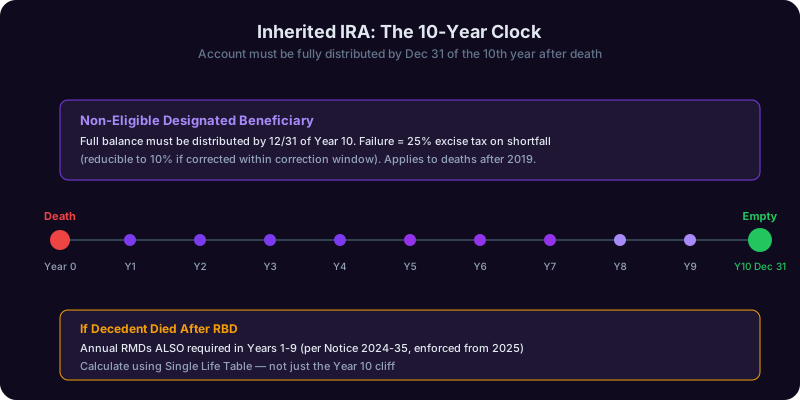
For most non-spouse beneficiaries (called non-eligible designated beneficiaries), the inherited IRA must be fully distributed by December 31 of the 10th year following the year of the original owner's death. That is the only hard deadline. Within those 10 years, you historically had flexibility on timing.
That flexibility narrowed considerably. The IRS clarified in Notice 2024-35 and in final regulations published in 2024 that if the original owner had already reached their required beginning date (RBD) for RMDs before death, the beneficiary must also take annual RMDs in years 1 through 9, with the full balance cleared in year 10.
What 2026 Enforcement Means
From 2020 through 2024, the IRS waived penalties for missed RMDs inside the 10-year window because the rules were genuinely unclear. 2025 was the first year annual RMDs were officially required, and 2026 is the first year the IRS is fully enforcing the 25% excise tax (reduced to 10% if you self-correct within two years) on missed distributions.
| Scenario | Old Rule (pre-2020) | New Rule (2020+ deaths) |
| Non-spouse adult child inherits at age 45 | RMDs over 40 years | Empty by year 10 |
| Annual RMD required? | Yes, life-expectancy-based | Yes, if decedent past RBD |
| Penalty for missed RMD | 50% | 25% (10% if corrected) |
| Roth account treatment | Stretch over life | 10-year deadline, no annual RMD |
Who Is Affected
- Adult children inheriting from parents
- Grandchildren over age 21 inheriting from grandparents
- Siblings more than 10 years younger than the decedent
- Trusts that do not qualify as see-through trusts
- Estates named as beneficiary
The stakes are real. A $400,000 inherited IRA that goes undistributed for 10 years and then must be taken as a lump sum can push the beneficiary into the 32% or 35% federal bracket in that final year, on top of state taxes. Smart sequencing across the 10-year window can save tens of thousands in tax. Bad sequencing costs the same.
Tax Disclaimer: This article is for informational purposes only and does not constitute tax, legal, or financial advice. Inherited IRA rules interact with your overall tax situation, state law, and trust documents. Consult a qualified tax professional or estate attorney for guidance specific to your situation.
Eligible Designated Beneficiaries: The 5 Categories That Escape the 10-Year Rule
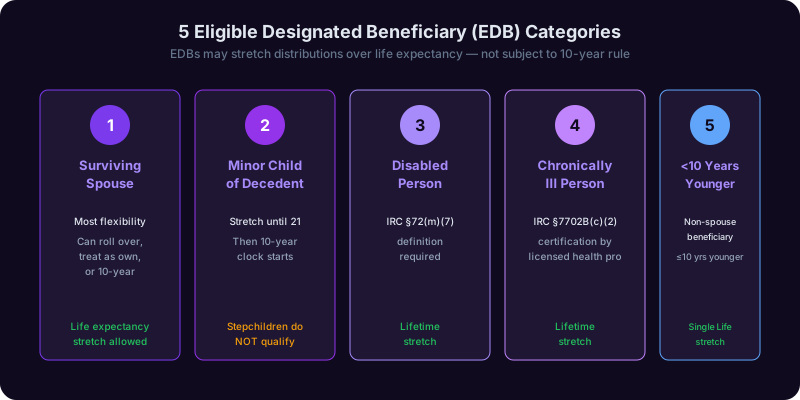
Not every beneficiary is bound by the 10-year deadline. The SECURE Act created a protected class called Eligible Designated Beneficiaries (EDBs) who retain stretch-IRA-like treatment based on their own life expectancy. If you fall into one of these five categories, you may be able to spread distributions across decades rather than a single decade.
1. Surviving Spouse
Spouses have the broadest set of options. They can treat the inherited IRA as their own (rollover into their existing IRA), establish a beneficiary IRA with life-expectancy distributions, or elect the 10-year rule. Each path has different tax and RMD implications, which we explore in detail in section 7.
2. Minor Child of the Decedent
A minor child (under age 21 under federal rules, regardless of state age of majority) can take life-expectancy distributions until they reach age 21. Once they hit 21, the 10-year clock starts, requiring the account to be empty by their 31st birthday.
Important: this only applies to the decedent's own children, not grandchildren, nieces, or nephews. A grandchild who inherits is not an EDB unless they meet another category.
3. Disabled Individual
A beneficiary qualifies if they meet the Social Security definition of disability under IRC Section 72(m)(7): unable to engage in substantial gainful activity due to a medically determinable impairment expected to last at least 12 months or result in death.
Documentation is essential. The IRA custodian will typically require either a Social Security disability determination letter or a physician's certification. Without proper documentation by the deadline (generally October 31 of the year after death), the beneficiary is treated as non-eligible.
4. Chronically Ill Individual
A chronically ill beneficiary is one who is unable to perform at least 2 activities of daily living (bathing, dressing, eating, transferring, toileting, continence) for at least 90 days, or who requires substantial supervision due to cognitive impairment. Certification must come from a licensed healthcare practitioner.
5. Beneficiary Less Than 10 Years Younger Than the Decedent
Often a sibling, partner, or close friend within a similar age range. If the decedent was 75 and the beneficiary is 70, the beneficiary is an EDB. If the beneficiary is 60, they are not.
| EDB Category | Distribution Method |
| Surviving spouse | Multiple options (see section 7) |
| Minor child | Life expectancy until 21, then 10-year |
| Disabled | Life expectancy |
| Chronically ill | Life expectancy |
| Within 10 years of age | Life expectancy |
The Status Election Deadline
EDB status is determined by facts on the date of death, but the formal election is generally made by September 30 of the year after death (the beneficiary determination date) or October 31 for trust documents. Missing this window can default you into the 10-year rule even if you would otherwise qualify.
If you believe you qualify as an EDB, gather documentation immediately and work with the IRA custodian to properly title the account. A beneficiary IRA for an EDB looks the same operationally as any inherited IRA, but the distribution schedule is calculated using the IRS single-life expectancy table starting the year after death.
Annual RMDs INSIDE the 10-Year Window: The 2025 Final Rule
For three years after the SECURE Act passed, the question of whether non-eligible beneficiaries had to take annual RMDs during the 10-year window was genuinely unresolved. The IRS finalized the answer in IRS Notice 2024-35 and the accompanying final regulations: yes, annual RMDs are required if the decedent died after their required beginning date.
The Decision Rule
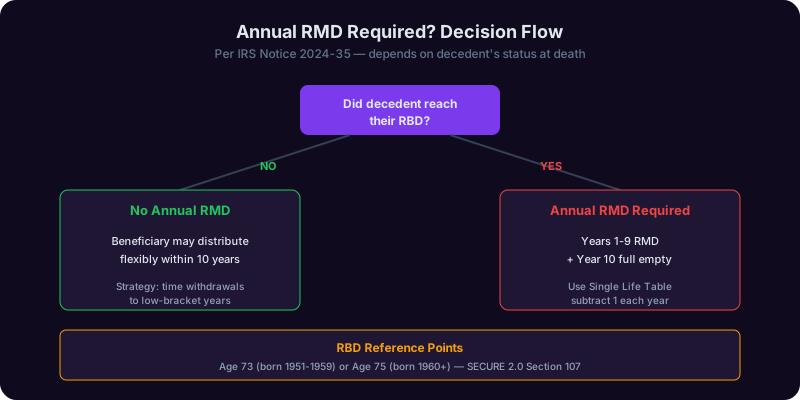
The rule comes down to two questions:
- Did the original owner die before or after their RBD? The RBD is April 1 of the year after the owner turned 73 (or 72/70.5 under older rules).
- Is this a traditional IRA or a Roth IRA?
| Scenario | Annual RMDs Inside Window? |
| Traditional IRA, decedent past RBD | Yes, required years 1-9, empty year 10 |
| Traditional IRA, decedent before RBD | No annual RMDs, just empty by year 10 |
| Roth IRA, any age at death | No annual RMDs, just empty by year 10 |
How the Annual RMD Is Calculated
For traditional IRAs where the decedent was past RBD, the annual RMD inside the 10-year window is calculated using the IRS Single Life Expectancy Table. You take the prior-year-end account balance and divide by your life expectancy factor based on your age in year 1, then subtract 1 from the divisor each subsequent year.
Example: A 50-year-old inheriting a $500,000 traditional IRA from a parent who died at age 78 (past RBD). The single-life factor for age 50 is 36.2. Year 1 RMD is approximately $13,812. Each subsequent year, the divisor drops by 1 (35.2, 34.2, etc.), increasing the RMD. By year 10, the entire remaining balance must come out regardless of the calculated RMD.
The 25% Penalty (10% if Self-Corrected)
SECURE 2.0 reduced the missed-RMD penalty from 50% to 25% of the missed amount. If you self-correct within 2 years (take the missed distribution and file Form 5329), the penalty drops to 10%. The IRS may waive the penalty entirely for reasonable cause, but you must request the waiver in writing.
2020-2024 Waiver: A One-Time Pass
The IRS waived all missed RMD penalties for inherited IRAs from 2020 through 2024 because of the confusion. You do not need to make up those missed RMDs. But the 10-year clock still runs from the original death date, so the account must still be empty by the end of year 10.
This creates a quirky outcome: someone who inherited in 2021 only owes annual RMDs starting in 2025, but still must empty the account by end of 2031. That leaves fewer remaining years to spread distributions, often resulting in larger annual amounts than if they had been required from day one.
Action Steps
- Look up the date of death and the decedent's age at death
- Determine if they were past RBD (generally age 73+)
- If yes, calculate annual RMDs starting in 2025 using the single-life table
- Plan the year-10 lump distribution carefully to avoid bracket creep
- Document calculations and keep them with your tax records

Get Answers From the Finance Copilot
The Finance Copilot runs year-by-year tax projections across front-load, back-load, level, and bracket-stuffing strategies. See exactly how much you save by sequencing distributions correctly across the 10-year window, with state tax, IRMAA, and ACA subsidy preservation factored in. Get a custodian-ready distribution schedule in minutes.
Roth Inherited IRA vs Traditional Inherited IRA Tax Math
The 10-year rule applies to both traditional and Roth inherited IRAs, but the tax implications are wildly different. Understanding the math is the difference between a smart distribution strategy and a costly one.
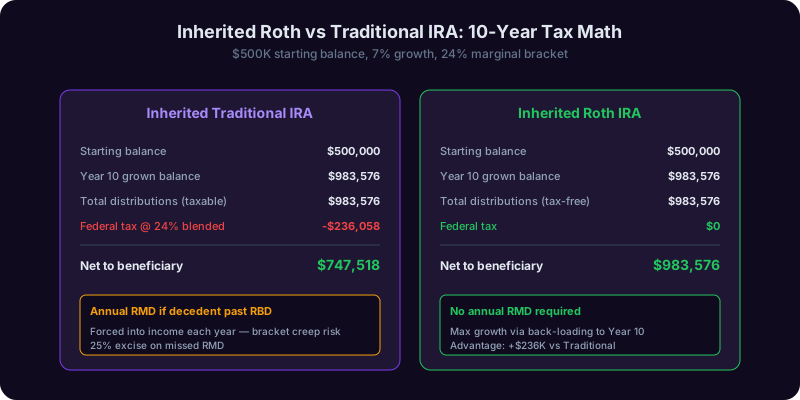
Inherited Traditional IRA: Fully Taxable on Distribution
Every dollar distributed from an inherited traditional IRA is ordinary income in the year received. There is no 10% early-withdrawal penalty (the inheritance exception applies regardless of beneficiary age), but federal and state income taxes both apply.
For a beneficiary in the 24% federal bracket with a 5% state tax rate, every $50,000 distribution costs roughly $14,500 in combined tax. The remaining $35,500 is the actual cash benefit.
Inherited Roth IRA: Tax-Free Distributions (Usually)
Distributions from an inherited Roth IRA are generally federal-tax-free if the original owner held any Roth IRA for at least 5 years before death (the 5-year rule). The 5-year clock starts from the original owner's first Roth contribution or conversion, and it carries over to the beneficiary.
The 10-year deadline still applies. The Roth account must be empty by December 31 of the 10th year following death. But there are no annual RMDs required inside the window regardless of the decedent's age, because Roth IRAs are not subject to lifetime RMDs for the original owner.
| Feature | Traditional | Roth |
| Tax on distribution | Ordinary income | Tax-free (if 5-year met) |
| 10-year deadline | Yes | Yes |
| Annual RMD in window | Yes (if past RBD) | No |
| Optimal strategy | Spread evenly | Delay to year 10 |
| State tax | Yes (most states) | No (federal-conforming states) |
The Math on a $500,000 Inheritance
Consider a 45-year-old beneficiary in the 24% federal bracket inheriting $500,000:
- Traditional IRA, taken as $50,000/year for 10 years (assuming 7% growth): Total distributions approximately $700,000, total federal tax approximately $168,000.
- Traditional IRA, taken as $500,000 lump in year 10: Pushes beneficiary into 32-35% bracket. Federal tax approximately $250,000+. $80,000 worse than spreading.
- Roth IRA, delayed to year 10 then taken as lump: $500,000 grows to approximately $980,000. Federal tax: $0. Net to beneficiary: $980,000.
The Optimal Roth Strategy
For an inherited Roth IRA, the math almost always favors maximum delay. Let the account grow tax-free for the full 10 years, then withdraw the lump sum at the end. Since the distribution is tax-free, there is no bracket-creep concern.
The exception: if you need the cash for living expenses, withdraw what you need without guilt. Tax-free is tax-free regardless of when you take it.
The Optimal Traditional Strategy
For an inherited traditional IRA, the goal is bracket smoothing: spreading distributions to avoid pushing yourself into a higher bracket in any single year. This usually means taking roughly equal annual amounts, possibly weighted toward lower-income years (job loss, sabbatical, early retirement) and away from higher-income years (promotion, bonus, business sale).
For coordination with your broader retirement plan, see our Roth conversion ladder guide and AI retirement planning guide.
The Distribution Strategy Decision Tree
Once you understand the rules, the next question is: how do I actually sequence the distributions? There are three primary strategies for a non-eligible beneficiary of a traditional IRA: front-load, back-load, or level. The right choice depends almost entirely on your projected tax bracket in years 1 through 10.
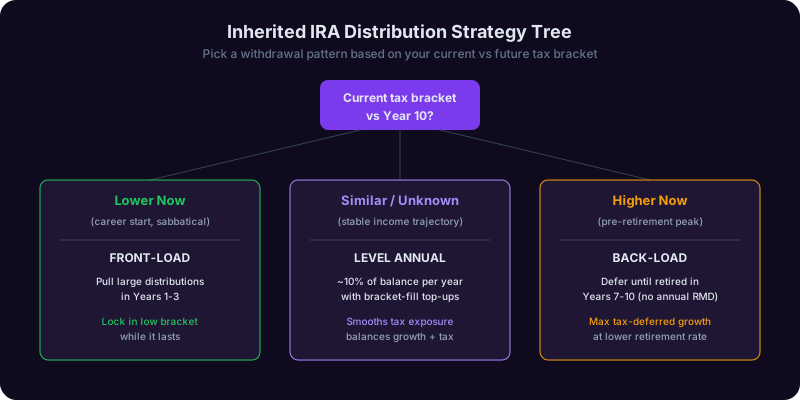
Strategy 1: Front-Load (Take More Early)
Take larger distributions in years 1-3, then taper down. Best when:
- You are currently in a lower bracket than you expect to be later (e.g., between jobs, recent graduate, sabbatical year)
- You expect a major income event in years 5-10 (business sale, equity vesting, partner promotion)
- You want to invest the proceeds in a taxable brokerage with long-term capital gains treatment
- You plan to make large Roth conversions of your own IRA in later years and want to clear the inherited balance first
Strategy 2: Back-Load (Delay to Years 8-10)
Take only the required annual RMD (or nothing if not required) for years 1-7, then larger distributions years 8-10. Best when:
- You are currently in a high bracket and expect to be in a lower one later (planned early retirement, anticipated job change, business pivot)
- The account is a Roth (always back-load when possible)
- You want maximum tax-deferred growth
- You have an ACA marketplace subsidy you cannot afford to lose
Strategy 3: Level (Even Annual Distributions)
Take roughly equal distributions each year (1/10, 1/9, 1/8 of remaining balance, etc.). Best when:
- Your income is stable and predictable
- You are already retired with a known bracket
- You want the simplest planning with no surprises
- You do not have strong views on future bracket changes
The Bracket-Stuffing Approach
A refined version of level distribution: each year, take only enough to fill up your current bracket without pushing into the next one. If you have $30,000 of room left in the 22% bracket before the 24% bracket kicks in, take exactly $30,000 from the inherited IRA. This requires annual recalculation but maximizes tax efficiency.
| Year | Your Other Income | Room in 22% Bracket | Inherited IRA Distribution |
| 1 | $110,000 | $60,000 | $60,000 |
| 2 | $115,000 | $55,000 | $55,000 |
| 3 | $120,000 | $50,000 | $50,000 |
Interactions With Other Tax Decisions
Your inherited IRA strategy does not exist in a vacuum. It interacts with:
- Your own Roth conversions: Both stack as ordinary income. Coordinate to avoid double-bracket-stuffing.
- Capital gains harvesting: Large IRA distributions can push you out of the 0% LTCG bracket.
- NIIT (3.8% surcharge): Above $200K single / $250K joint, your inherited IRA distribution may trigger the net investment income tax indirectly.
- State tax: Some states (CA, NJ) have high top brackets. Front-loading while in a low-tax state, then relocating to a high-tax state, can backfire badly.
For coordinated tax strategy across multiple accounts, our OBBBA tax guide covers how the new tax brackets interact with retirement income.
Lump Sum Withdrawal: When It Actually Makes Sense
Most financial advisors will tell you a lump-sum withdrawal of an inherited traditional IRA is a bad idea. They are usually right. But there are specific scenarios where taking the whole thing at once is actually the optimal move.
Scenario 1: A Truly Bad Income Year
If you have a year with almost zero other income, a lump-sum distribution from a modest inherited IRA can be remarkably efficient. Imagine a beneficiary who got laid off in January, took the year to retrain, and inherited a $150,000 traditional IRA.
With no other income, the first $15,750 is shielded by the standard deduction. The next $11,925 fills the 10% bracket. The next $36,550 fills the 12% bracket. The next $52,150 fills the 22% bracket. The remaining $33,625 hits the 24% bracket. Total federal tax: approximately $18,400, an effective rate of just 12.3%.
Spreading the same $150,000 over 10 years while earning $80,000/year would mean every distribution hits the 22%+ bracket. Total tax: approximately $33,000. Lump-sum wins by $14,600.
Scenario 2: Small Account, Simplification Value
For inherited IRAs under $50,000-$75,000, the tax difference between strategies is small and the administrative burden of tracking annual RMDs for 10 years is real. Many beneficiaries reasonably choose to take a lump sum or 2-3 year distribution and move on.
Scenario 3: ACA Subsidy Preservation
If you receive ACA marketplace subsidies, every dollar of additional income can reduce your premium tax credit. The subsidy cliff and IRMAA-style phase-outs can create effective marginal rates well above your stated bracket.
If you are already losing all subsidies in a given year (because of a large bonus, business sale, or other income event), the marginal cost of additional inherited IRA distribution that year is just your federal/state rate, not the rate + lost subsidy. That can make a lump-sum in a known high-income year less painful than spreading into years where you would otherwise qualify for subsidies. See our ACA subsidy cliff guide for the full math.
Scenario 4: IRMAA Threshold Management
If you are on Medicare, your premiums are based on your modified AGI from 2 years prior (IRMAA). The thresholds are sharp cliffs. Pushing into a higher IRMAA bracket can cost $70 to $400+ per month in additional Medicare premiums for Parts B and D.
A lump-sum in a single year (rather than 10 smaller distributions) only triggers one year of IRMAA penalty instead of 10. For retirees on Medicare, this can sometimes outweigh the income tax disadvantage of bunching.
Scenario 5: Beneficiary is Already in the Top Bracket
If you are already in the 37% federal bracket and expect to stay there for the next 10+ years, there is no bracket-smoothing benefit. Taking the money sooner means more time to invest it in a taxable account with long-term capital gains treatment, which is taxed at 20% + 3.8% NIIT rather than 37% ordinary.
When NOT to Take a Lump Sum
| Scenario | Why Not |
| Account > $200K, income > $100K | Pushes into 32-35% bracket unnecessarily |
| Planning early retirement in 3-5 years | Lower bracket coming, delay |
| Inherited Roth | Never lump-sum a Roth early |
| State move planned | Wait for low-tax-state residency |
| Major deductions coming (medical, charity) | Use deductions to offset distributions |
The lump-sum question is fundamentally a bracket arithmetic question. Run the numbers both ways for your actual situation.
Spousal Inheritance: The 4 Options
Surviving spouses have the most flexible inheritance options under federal law. The right choice depends on your age, your deceased spouse's age, your income needs, and your overall tax picture.
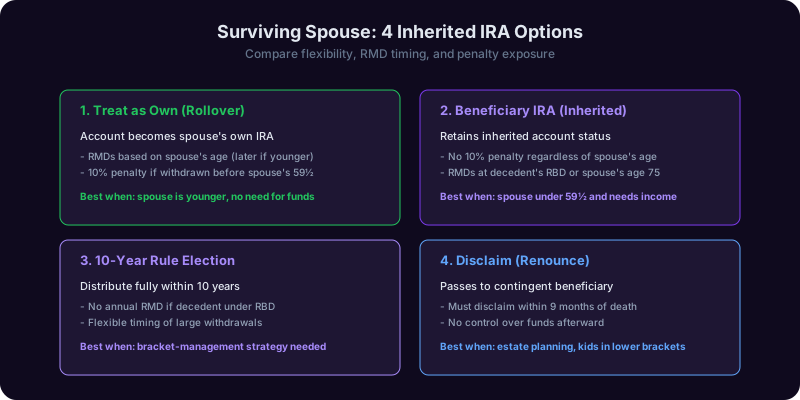
Option 1: Treat as Your Own IRA
The most common choice. The IRA becomes your own for all tax purposes. You name your own beneficiaries. RMDs are calculated based on your age and start at your RBD (currently age 73).
Best when:
- You are over 59.5 (no early-withdrawal penalty concern)
- You want to defer distributions until your own RBD
- Your deceased spouse was younger than you (their RBD would be later, but this gives you more flexibility on inheritance planning)
Option 2: Beneficiary IRA (Inherited IRA)
Keep the account titled as an inherited IRA with you as the beneficiary. RMDs are based on the decedent's age or your own age, whichever is more favorable.
Best when:
- You are under 59.5 and need access without the 10% penalty (inheritance exception applies)
- Your deceased spouse was older than you (you delay your own RBD by treating the account as inherited)
- You want to preserve the original 5-year Roth clock
Option 3: Elect the 10-Year Rule
Treat the account like a non-spouse beneficiary would. Empty within 10 years.
Best when:
- You have significant other retirement assets and want to extract this account quickly
- You want to convert to a Roth in a controlled timeline (note: spousal Roth conversions of inherited assets have specific rules)
- The account is small enough that a 10-year drawdown does not move your bracket meaningfully
Option 4: Rollover to Your Own IRA
A direct rollover of the inherited IRA into your own existing IRA. After the rollover, the assets are indistinguishable from your other IRA assets.
Best when:
- You want consolidated administration
- You are over 59.5 and have no need for early access
- You plan to do Roth conversions at your own pace
| Option | RMD Start | Early Withdrawal Penalty | Best Use |
| Treat as own | Your RBD (age 73) | Yes, before 59.5 | You are 59.5+ |
| Beneficiary IRA | Decedent's schedule | No | You are under 59.5 |
| 10-year rule | None (just deadline) | No | Small accounts, quick extraction |
| Rollover | Your RBD | Yes, before 59.5 | Consolidation |
The Switching Rule
Spouses generally can switch from a beneficiary IRA to treating as own at any time, but cannot switch back. This means many surviving spouses under 59.5 start with a beneficiary IRA (for penalty-free access) and convert to own-IRA treatment once they reach 59.5.
One nuance: if your spouse died after their RBD and you elected beneficiary IRA treatment, you must take RMDs based on the longer of your single-life expectancy or the decedent's remaining life expectancy. This usually results in smaller RMDs than treating as own for younger surviving spouses, which can be valuable if you do not need the income.
IRS Publication 590-B has official guidance, and custodians like Fidelity and Schwab publish decision matrices.
Successor Beneficiaries: What Happens If You Die With Funds Left
Here is a question many beneficiaries do not think to ask: what happens if I die before emptying the inherited IRA? The rules for successor beneficiaries (the people who inherit from you, the original beneficiary) are nuanced and depend on the original beneficiary's status.
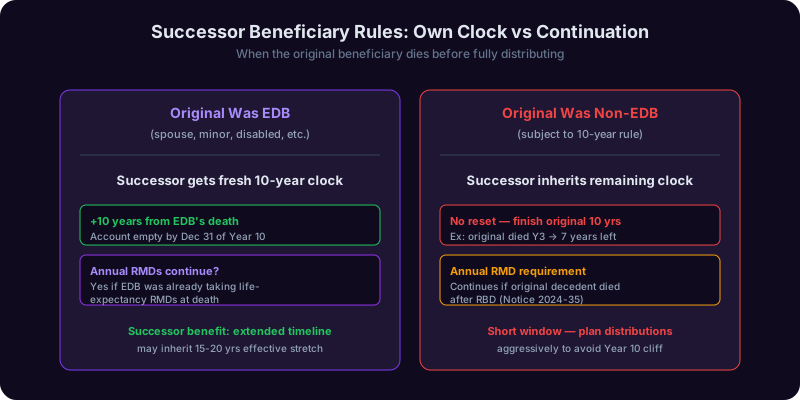
Case 1: Original Beneficiary Was an EDB
If you (the original beneficiary) qualified as an Eligible Designated Beneficiary and were taking life-expectancy distributions, your successor beneficiary does NOT get a new 10-year clock. Instead, the successor must empty the account within 10 years of your death.
This is a significant SECURE Act change. Before 2020, successor beneficiaries could often continue the original life-expectancy schedule. Now, the 10-year deadline kicks in regardless.
Example: A 60-year-old EDB (within 10 years of decedent's age) inherits a $400,000 IRA in 2020 and takes life-expectancy distributions. They die in 2026 with $300,000 left in the account. Their successor must empty that $300,000 by December 31, 2036.
Case 2: Original Beneficiary Was a Non-Eligible Beneficiary on the 10-Year Rule
If you were a non-eligible beneficiary (the standard 10-year rule), your successor beneficiary continues your original 10-year clock. They do NOT get a fresh 10 years.
Example: An adult child inherits in 2025 with a 10-year deadline of December 31, 2035. They die in 2030 with $200,000 remaining. Their successor must empty the account by December 31, 2035, the original deadline. Only 5 years to distribute $200,000.
Case 3: Original Beneficiary Was a Surviving Spouse Treating as Own
If a surviving spouse treated the account as their own IRA, then died, the rules for their beneficiaries are the standard inherited IRA rules, not successor beneficiary rules. The IRA is now being inherited fresh, so the new beneficiary gets their own 10-year clock (or EDB treatment if applicable).
| Original Beneficiary Status | Successor Outcome |
| EDB on life-expectancy | New 10-year clock from your death |
| Non-eligible on 10-year rule | Continues original 10-year clock |
| Spouse treated as own | Standard inherited IRA rules apply |
| Minor child of decedent (EDB) | 10-year clock starts at child's age 21 |
Annual RMDs for Successors
The successor beneficiary inherits whatever RMD requirement was on the original beneficiary. If the original was taking annual RMDs inside a 10-year window, the successor continues those RMDs based on the original beneficiary's life expectancy schedule, with the account emptied by the deadline.
Planning Implications
- Name your beneficiaries. If you do not name a successor beneficiary on the inherited IRA, it defaults to your estate, which is generally the worst tax outcome.
- Update beneficiary designations promptly. Most custodians do not let your spouse-as-successor treat your inherited IRA as their own, since it was never your own to begin with.
- Consider Roth conversions. If you have substantial inherited Roth assets and the math favors leaving them tax-free, plan for your successor to continue that strategy.
- Account for the compressed timeline. A successor inheriting in year 8 of a 10-year clock has only 2 years to distribute. That can be a brutal tax outcome if not planned for.
For coordinated estate planning across multiple retirement accounts, see our 401(k) vs Roth 401(k) guide.
Common Mistakes That Cost Beneficiaries Thousands
Across thousands of inherited IRA cases, the same handful of mistakes show up repeatedly. Avoiding these errors is often worth more than choosing the optimal distribution strategy.
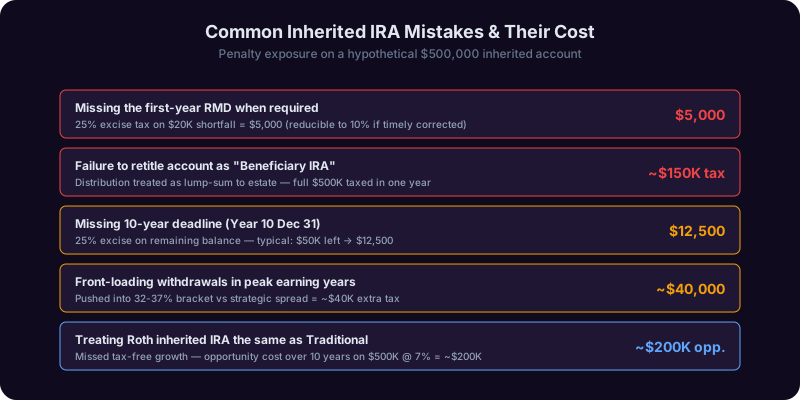
Mistake 1: Missing the First-Year RMD
The 10-year clock starts the year after the original owner's death. If the decedent was past RBD and you are subject to annual RMDs, the first RMD is due by December 31 of the year after death. Many beneficiaries spend the first year grieving and dealing with the estate, missing this deadline entirely.
The 25% penalty on a $15,000 missed RMD is $3,750. Self-correcting drops it to $1,500, still painful. The IRS may waive for reasonable cause, but it requires a formal Form 5329 request.
Mistake 2: Taking Too Much in a High-Bracket Year
A beneficiary who waits until year 10, then takes a lump sum that pushes them from the 22% to the 35% bracket, hands the IRS $30,000-$50,000 needlessly. The costliest mistake.
Mistake 3: Forgetting State Tax
Federal tax planning ignores state tax at your peril. California's top bracket is 13.3%. New York City residents face up to 14.776% combined state and city. An inherited IRA distribution that looks reasonable at the federal level can become brutal after state tax.
Worse, some states (like California) do not conform to federal tax treatment of certain inherited IRA aspects. Always check your state's department of revenue rules.
Mistake 4: Splitting the Account Before Retitling
When multiple beneficiaries are named, each beneficiary's share should be split into a separate inherited IRA by December 31 of the year after death. Failure to split means all beneficiaries must use the oldest beneficiary's life expectancy for any EDB calculations, often producing larger RMDs for younger heirs.
The split must be done through the custodian using trustee-to-trustee transfer. Taking the money out and depositing it elsewhere destroys the inherited IRA status and triggers full immediate taxation.
Mistake 5: Rolling Into Your Own IRA (Non-Spouse)
Non-spouse beneficiaries cannot roll an inherited IRA into their own IRA. Taking possession of the funds makes the balance fully taxable and destroys inherited IRA status. Always use a direct trustee-to-trustee transfer.
Mistake 6: Ignoring the 5-Year Roth Clock
For inherited Roth IRAs, distributions are tax-free only if the original owner held any Roth IRA for at least 5 years before death. If the decedent opened their first Roth in 2022 and died in 2024, the 5-year clock is not met until 2027. Distributions before that date may be partially taxable on earnings.
Mistake 7: Not Documenting EDB Status
EDB status can save tens of thousands in tax over a lifetime of distributions, but you must document and elect it by the deadline. Disabled or chronically ill status requires medical certification. Age-based EDB status requires birth-date documentation. Without proper paperwork by September 30 of the year after death, you default to the 10-year rule.
| Mistake | Typical Cost |
| Missed first-year RMD | $1,500 - $5,000 |
| Lump in high-bracket year | $15,000 - $50,000 |
| Forgetting state tax | $5,000 - $25,000 |
| Not splitting accounts | $3,000 - $10,000 |
| Rolling into own IRA | $50,000 - $200,000+ |
| Missing EDB documentation | $10,000 - $40,000 |
The Single Best Avoidance Step
Get a written plan in year 1. Whether DIY, AI-assisted, or CPA-prepared, a year-by-year distribution schedule with projected tax impact is the difference between a smooth drawdown and a costly scramble.
How Copilotly's Finance Copilot Models Your Decisions
Inherited IRA planning is exactly the kind of multi-year, multi-variable problem that AI tools handle well. The math is repetitive but compounding. The deadlines are firm. The decision-tree branching is what software does better than humans.
Scenario Modeling
The Finance Copilot runs your inherited IRA scenarios across multiple distribution strategies:
- Front-load, back-load, level, and bracket-stuffing strategies side by side
- Year-by-year tax projection using current and OBBBA bracket structures
- State tax integration for all 50 states plus DC
- IRMAA threshold tracking for Medicare-age beneficiaries
- ACA subsidy preservation for under-65 beneficiaries
- NIIT modeling for higher-income beneficiaries
Deadline Tracking
The copilot tracks the calendar dates you need to hit:
- First annual RMD deadline (December 31 of year after death)
- September 30 beneficiary determination date
- October 31 trust documentation deadline
- Year-by-year RMD calculation refreshes
- The hard December 31 deadline in year 10
Custodian Instruction Drafting
The Finance Copilot drafts paperwork language for beneficiary IRA establishment, trustee-to-trustee transfers, RMD distribution requests, EDB status elections, and successor beneficiary designations, saving hours of research on formatting requirements.
Coordination With Tax Copilot
The Tax Copilot handles Roth conversion ladder coordination, quarterly estimated tax calculations, state tax conformity differences, Form 5329 for missed-RMD penalty relief, and Form 8606 for nondeductible basis tracking.
A Practical Walkthrough
Sarah, 48, inherited a $380,000 traditional IRA from her mother who died at age 79 (past RBD). Sarah works as a marketing director earning $145,000 in California. She is currently in the 24% federal bracket and 9.3% California bracket.
The Finance Copilot models four scenarios:
| Strategy | 10-Year Total Tax | After-Tax Inheritance |
| Lump sum year 1 | $159,000 | $221,000 |
| Back-load to year 10 | $172,000 | $304,000 (with growth) |
| Level annual | $133,000 | $293,000 (with growth) |
| Bracket-stuffing | $118,000 | $308,000 (with growth) |
The copilot recommends bracket-stuffing, projecting that Sarah's planned career break in years 6-7 (already discussed with her employer) creates two years of significantly lower income where she can accelerate distributions cheaply. Savings vs lump sum: approximately $87,000.
What the AI Cannot Do
The Finance Copilot is a planning and modeling tool, not a fiduciary. For trusts as beneficiaries, multiple inherited accounts, estate tax issues, or beneficiary disputes, engage a qualified CPA or estate attorney. The AI prepares you with concrete scenarios, making professional advice more efficient and less expensive.
Getting Started
Try the Finance Copilot with your specific inheritance details: account type, current balance, decedent's age at death, your age, your state, and your projected income for the next 10 years. Within minutes you will have a year-by-year distribution schedule with projected tax impact under multiple strategies.
For broader retirement planning context, our AI retirement planning guide and Social Security Fairness Act guide cover related topics.
Tax Disclaimer: This article is for informational purposes only and does not constitute tax, legal, or financial advice. Inherited IRA rules are highly fact-specific. Distribution strategies should be reviewed with a qualified CPA or estate attorney before implementation. Copilotly tools provide modeling and education, not personalized financial advice subject to fiduciary standards.
Frequently Asked Questions
Recommended Copilots
Related Articles
Get Answers From the Finance Copilot
The Finance Copilot runs year-by-year tax projections across front-load, back-load, level, and bracket-stuffing strategies. See exactly how much you save by sequencing distributions correctly across the 10-year window, with state tax, IRMAA, and ACA subsidy preservation factored in. Get a custodian-ready distribution schedule in minutes.