
Money & Finance
ACA Premium Doubled at Renewal? 7 Moves to Cut Marketplace Costs
Enhanced premium tax credits expired January 1, 2026, and 22 million marketplace enrollees are seeing premiums double or triple. These 7 moves, from metal-tier rebalancing to income smoothing, can recover hundreds of dollars a month.
What Just Happened: The Enhanced Premium Tax Credit Cliff
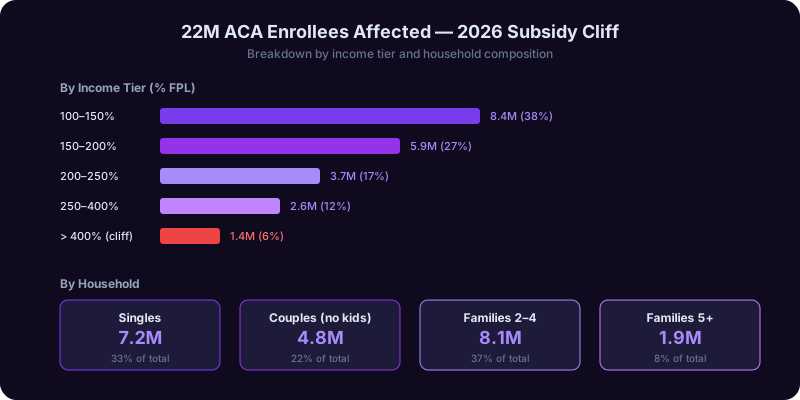
On December 31, 2025, the enhanced Advance Premium Tax Credits (APTCs) that Congress originally passed in the American Rescue Plan and extended through the Inflation Reduction Act expired. As of January 1, 2026, the subsidy formula reverted to the pre-2021 statutory rules in Section 36B of the Internal Revenue Code - and roughly 22 million Americans who buy coverage through HealthCare.gov or a state-based marketplace are now opening renewal letters showing 2-3x premium increases.
Quick disclaimer: This article is educational. It is not tax, legal, or medical advice. Subsidy math, eligibility, and state rules change frequently - verify your specific situation with a licensed broker, your state marketplace, or a CPA before acting.
What the enhanced PTCs actually did
From 2021 through 2025, two changes made marketplace coverage dramatically cheaper:
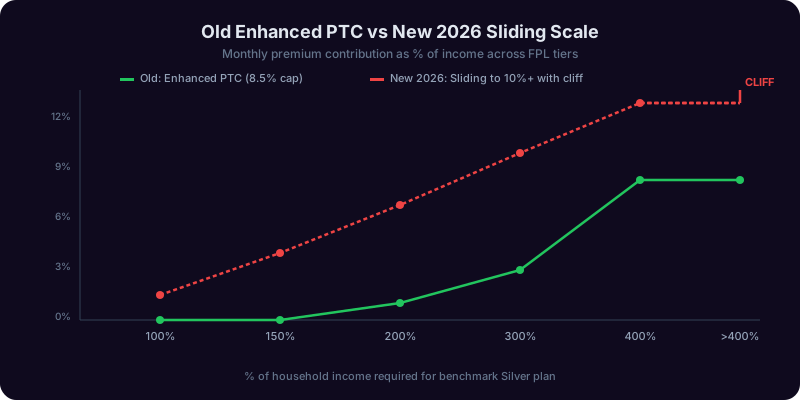
- Lower percentage caps. The maximum share of household income you had to pay toward the benchmark Silver plan dropped to a sliding scale of 0% to 8.5% (instead of roughly 2% to 9.83%).
- No 400% FPL cliff. Anyone over 400% of the Federal Poverty Level (FPL) became eligible for a subsidy if the benchmark plan cost more than 8.5% of their income. Before 2021 - and again now in 2026 - crossing 400% FPL meant losing the credit entirely.
Who is hit hardest in 2026
According to the Kaiser Family Foundation (KFF) 2026 marketplace analysis, the largest dollar increases land on three groups:
- Older enrollees just above 400% FPL. A 60-year-old couple earning $82,000 (roughly 405% FPL) in a high-cost rating area can see their share of premium jump from about $580/month to $1,900+/month.
- Self-employed and gig workers in the 250-400% FPL band. Their cap moves from 4-6% of income to 6-9.83% - a real-dollar swing of $150-$400/month.
- Rural enrollees in single-insurer counties where benchmark Silver premiums were already 30-50% higher than urban markets.
Why this matters beyond your wallet
The Congressional Budget Office projects that 3-4 million people will drop coverage entirely in 2026 - not because they want to, but because the math no longer works. If you are reading this with a renewal letter in hand, your goal for the next 30-60 days is to avoid joining that group while not overpaying for coverage you cannot use. The seven moves in this guide are ordered roughly by how much money they save the average household. Several moves - particularly Moves 3 and 7 - compound with each other and together can cover the full annual hit shown in the examples that follow.
Calculate Your Real Premium: The 8.5% Rule vs the New Math
Before you pick a strategy, you need to know what you are actually being charged. The marketplace shows you the net premium after APTC, but that number now varies wildly with income. Here is the math that drives it.
The old rule (2021-2025)
Under the enhanced credits, your maximum contribution toward the benchmark Silver plan followed a smooth ramp:
- 0-150% FPL: 0% of income
- 150-200% FPL: 0% to 2%
- 200-250% FPL: 2% to 4%
- 250-300% FPL: 4% to 6%
- 300-400% FPL: 6% to 8.5%
- 400%+ FPL: capped at 8.5%
The 2026 rule (statutory rates restored)
Per IRS Publication 974, the applicable percentages for plan year 2026 (indexed for inflation) are approximately:
- 100-133% FPL: 2.07%
- 133-150% FPL: 3.10% to 4.14%
- 150-200% FPL: 4.14% to 6.52%
- 200-250% FPL: 6.52% to 8.33%
- 250-300% FPL: 8.33% to 9.83%
- 300-400% FPL: 9.83%
- 400%+ FPL: NO SUBSIDY (cliff returns)
Three worked examples
| Household | 2025 Net Premium | 2026 Net Premium | Annual Hit |
|---|---|---|---|
| Single, age 35, $40K (260% FPL) | $133/mo (4% cap) | $295/mo (8.85% cap) | +$1,944 |
| Family of 4, age 45, $75K (240% FPL) | $200/mo (3.2% cap) | $478/mo (7.65% cap) | +$3,336 |
| Couple, age 60, $82K (405% FPL) | $581/mo (8.5% cap) | $1,920/mo (full price, cliff) | +$16,068 |
The cliff in plain English
That last row is the brutal one. At $81,759 of household income (the 400% FPL line for a couple), this 60-year-old pair still qualifies for the 9.83% cap - about $670/month. One extra dollar of income - $81,760 - and they lose the entire credit and owe the full $1,920. That is the cliff. Move 7 (income smoothing) exists almost entirely to keep you on the left side of that line.
Pull your most recent pay stubs, your 1099 dashboard, and last year's Form 1040 line 11 (AGI). Add expected 2026 self-employment income, capital gains, and IRA distributions. That projected Modified AGI - not your gross paycheck - is what drives every number in the rest of this guide.
The MAGI gotchas that surprise people
MAGI for ACA purposes is not the same as your taxable income. It includes tax-exempt municipal bond interest, excluded foreign earned income, and Social Security benefits that were excluded from gross income. It does not subtract the standard deduction or itemized deductions. Self-employed taxpayers must include the deductible half of SE tax in the calculation. If you own an S-Corp, your W-2 wages plus pass-through K-1 income both count. Cash gifts, life insurance proceeds, and most personal injury settlements do not count. When in doubt, check Worksheet 1-1 in IRS Publication 974 or run the calculation through a tax pro before locking in your projection.
Move 1: Reassess Your Metal Tier Choice
The most common mistake in 2026 is sticking with the same Silver plan you had in 2025 just because auto-renewal made it easy. The subsidy change rewires the math behind every metal tier. Here is how to think about it.
What the tiers actually mean
| Tier | Actuarial Value | Typical Deductible | 2026 Premium vs Silver |
|---|---|---|---|
| Bronze | 60% | $7,000-$8,500 | 20-30% cheaper |
| Silver (no CSR) | 70% | $4,500-$6,500 | Baseline |
| Silver CSR 94 (under 150% FPL) | 94% | $0-$500 | Baseline |
| Silver CSR 87 (150-200% FPL) | 87% | $500-$1,500 | Baseline |
| Gold | 80% | $1,500-$2,500 | 10-20% more |
| Platinum | 90% | $0-$1,000 | 30-40% more |
The silver loading anomaly
Most marketplaces still practice silver loading - insurers price Cost-Sharing Reduction (CSR) costs into Silver premiums only, which inflates the benchmark and therefore inflates everyone's APTC. In 2026, that means in many states a Gold plan is actually cheaper than Silver after subsidy if you qualify for any APTC at all. HealthCare.gov does not surface this - you have to compare net premiums side by side.
When Bronze wins
Bronze plans pair best with an HSA (see Move 3). If you are healthy, expect under $2,000 in medical spending, and can fund the deductible from savings, Bronze + HSA almost always beats Silver in 2026 because:
- Lower premium = more cash to fund the HSA
- HSA contributions cut your AGI, which can pull you back under 400% FPL and restore some APTC
- Preventive care is still 100% covered pre-deductible
When Gold wins
If you take a maintenance drug, are pregnant, or expect 8+ doctor visits in 2026, Gold's lower deductible and copays almost always beat Silver on total annual cost - and in silver-loaded states the premium difference is shockingly small.

How to actually run the comparison
- Pull every plan in your county via the HealthCare.gov plan finder
- Filter to plans that include your doctors and prescriptions
- For each, compute total annual cost = (net premium x 12) + expected deductible spend + (estimated copays)
- Sort ascending - the top result is usually NOT Silver in 2026
This single exercise saves the average household $800-$2,400/year. See our companion complete guide to understanding health insurance in 2026 for the deeper plan-anatomy breakdown.
Move 2: Check Medicaid + CHIP Eligibility Below 138% FPL
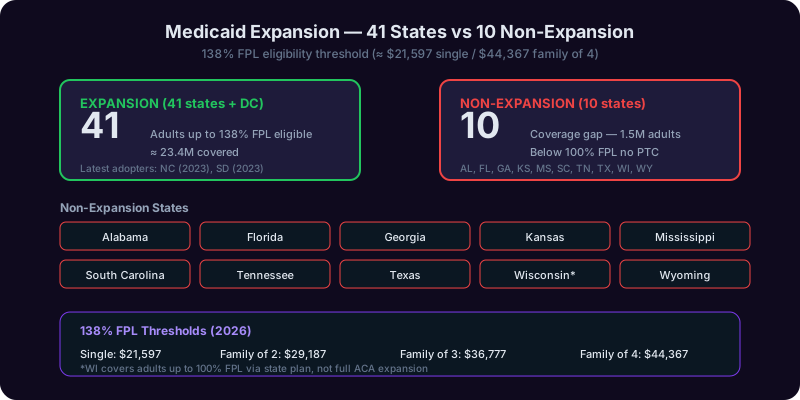
If your projected 2026 MAGI puts you under 138% of FPL ($20,783 single, $43,056 family of 4), you should not be on a marketplace plan at all - you almost certainly qualify for Medicaid or your child qualifies for CHIP, and both are typically free or nearly free.
Expansion vs non-expansion states
As of 2026, 41 states plus DC have adopted ACA Medicaid expansion. The 10 non-expansion holdouts (AL, FL, GA, KS, MS, SC, TN, TX, WI, WY) have stricter eligibility - usually parents under 50% FPL and no coverage for childless adults at all. If you live in a non-expansion state and earn between 100-138% FPL, you fall into the infamous coverage gap where you are too rich for Medicaid but too poor for the largest APTC.
Automatic redetermination - and the post-PHE unwinding aftermath
Since the COVID public health emergency ended in 2023, states have been working through the Medicaid unwinding - redetermining eligibility for everyone enrolled during continuous coverage. If you were dropped during unwinding but your income is now back below 138% FPL, you can re-apply at any time - there is no enrollment period for Medicaid. The Centers for Medicare and Medicaid Services (CMS) requires states to evaluate you for Medicaid first before referring you to the marketplace, but in practice you should apply directly through your state Medicaid agency to avoid the handoff delay.
The family glitch (now permanently fixed)
In 2022, the IRS fixed the so-called family glitch: family members of an employee with affordable self-only employer coverage can now qualify for marketplace APTCs if the family premium exceeds 9.12% of household income (the 2026 affordability threshold). This fix survived the 2026 subsidy cliff. If your spouse's employer offers cheap single coverage but charges $1,800/month to add you and the kids, you may qualify for the marketplace credit - run the numbers.
CHIP - the secret affordable kids program
The Children's Health Insurance Program covers kids in households up to 200-400% FPL depending on the state. Premiums are typically $0-$50/month per child and dental/vision are included. If your overall household income disqualifies you from Medicaid but your kids would qualify for CHIP, you can enroll the parents in a marketplace plan and the kids in CHIP separately - often cutting total family premiums by 40-60%.
Action items
- Project your 2026 MAGI honestly (line 11 of Form 1040 plus tax-exempt interest plus excluded foreign income)
- If under 138% FPL in an expansion state: apply to Medicaid before finalizing marketplace enrollment
- If kids are under 200% FPL: apply to CHIP separately
- If you live in a non-expansion state and fall in the gap: see Moves 5, 6, and 7
For people stuck between programs, our guide to affording the doctor when uninsured covers community health centers and sliding-scale clinics that bridge coverage gaps.
Move 3: HSA-Eligible HDHPs as the Tax Hack
The Health Savings Account paired with an HSA-eligible High Deductible Health Plan (HDHP) is the most tax-advantaged account in the US code - and it becomes more valuable, not less, as marketplace premiums rise.
The triple tax advantage refresher
- Contributions are deductible (above the line, even if you do not itemize). This lowers your MAGI - which lowers the FPL percentage that drives your APTC.
- Growth is tax-free. Most providers let you invest balances above $1,000-$2,000 in mutual funds.
- Qualified withdrawals are tax-free for medical expenses at any age, and after 65 you can withdraw for any purpose (paying ordinary income tax, like a Traditional IRA).
2026 HSA limits
| Coverage | 2026 Contribution Limit | 2026 Catch-up (55+) | Min HDHP Deductible | Max OOP |
|---|---|---|---|---|
| Self-only | $4,300 | +$1,000 | $1,650 | $8,300 |
| Family | $8,550 | +$1,000 each spouse | $3,300 | $16,600 |
The HSA + APTC double dip
Here is the move most people miss. Imagine you are a 45-year-old self-employed couple projecting $84,000 of MAGI - $2,241 over the 400% FPL cliff for 2026. You owe full price on premiums: cliff territory.
Now contribute $8,550 to a family HSA. Your MAGI drops to $75,450 - about 369% FPL. Suddenly you are back on the subsidy ramp at the 9.83% cap, saving roughly $14,000/year in premiums plus $1,800 in income tax on the HSA deduction itself. That single contribution converts $8,550 of cash into roughly $24,350 of after-tax value.

Bronze HDHP vs Silver CSR - which wins?
If your income is below 200% FPL, the answer is almost always Silver CSR. The 94/87 CSR variants give you Platinum-level cost sharing for free. Do not trade that away for HSA eligibility unless you have specific tax-planning reasons.
Above 200% FPL, Bronze HDHP + HSA usually wins because:
- Premium is 20-30% cheaper than Silver
- You convert the savings into tax-advantaged HSA dollars
- You stay healthy enough that the higher deductible rarely hits
One trap to avoid
Not every plan labeled HDHP is HSA-eligible. The plan must meet IRS minimums (above) and cannot have copays for non-preventive care before the deductible. The marketplace plan-finder includes a filter - use it. The complete rules are in IRS Publication 969 and referenced in Publication 974.
Move 4: Short-Term Limited Duration Insurance (STLDI) Trade-Offs
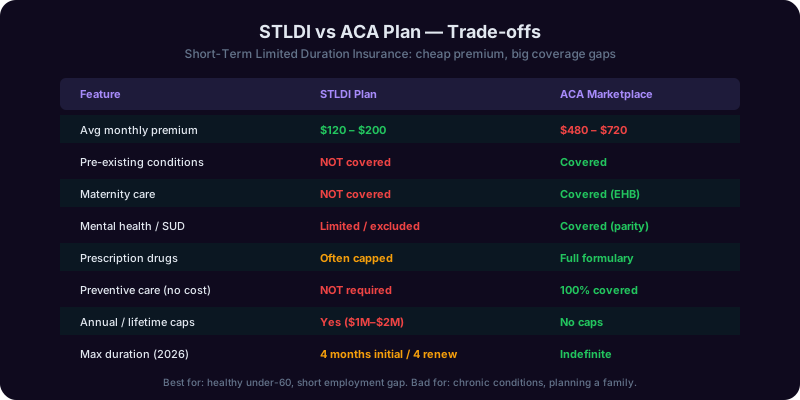
Short-Term Limited Duration Insurance was repositioned by federal rules effective in late 2024 to limit initial terms to 3 months with one 1-month renewal (4 months total in most states). In 2026, with marketplace premiums spiking, STLDI plans are being marketed aggressively again as a cheap alternative. Read this section before signing one.
What STLDI actually is
STLDI plans are not ACA-compliant. They can:
- Deny coverage for pre-existing conditions
- Exclude maternity, mental health, prescription drugs, and substance use treatment
- Impose annual or lifetime benefit caps
- Rescind coverage retroactively if you fail to disclose any condition
In exchange, premiums are typically 50-70% lower than ACA marketplace plans for healthy applicants. A 30-year-old in good health might pay $80-$150/month for STLDI vs $400+ for unsubsidized Bronze.
When STLDI legitimately makes sense
- You missed Open Enrollment and do not qualify for a Special Enrollment Period (SEP).
- You are between jobs for 30-90 days and COBRA is too expensive.
- You are healthy with no chronic conditions and need a bridge to Medicare, employer coverage, or next year's Open Enrollment.
When STLDI is a trap
STLDI is dangerous if:
- You have any diagnosed condition - diabetes, depression, hypertension, prior cancer. Any claim related to a pre-existing condition can trigger rescission.
- You are pregnant or planning to be - maternity is excluded.
- You take a prescription drug regularly - most STLDI plans cap or exclude Rx.
- You live in a state that bans or restricts STLDI - California, New York, New Jersey, Massachusetts, Colorado, Washington, and others have effectively banned them.
The federal rule you must understand
The 2024 federal rule limits STLDI to 4 months including any renewal. Some states allow longer terms, others shorter or none. You cannot stack multiple STLDI policies back-to-back from the same insurer. You also cannot use STLDI to trigger a Special Enrollment Period - losing STLDI is not a qualifying event because STLDI is not minimum essential coverage.
Decision rule
If you are healthy, under 50, and need a 90-day bridge: STLDI can save real money. If any of the trap conditions apply: pay the higher ACA premium. Our deep-dive on appealing health insurance denials covers the rescission patterns STLDI insurers use when claims come in.
Real-world rescission patterns to know
The Commonwealth Fund documented STLDI claim denial rates 4-6x higher than ACA plans, with rescissions concentrated in three patterns: claims within the first 90 days (assumed pre-existing), claims for conditions with any prior mention in pharmacy records, and claims that exceed an undisclosed annual maximum. If you do enroll in STLDI, request the policy in writing before signing, confirm in writing what counts as a pre-existing condition lookback period (some go back 5 years), and keep meticulous records of every health-related interaction during the policy term. If a claim is denied, the appeal process is far weaker than ACA plans - internal review only, no external review right.
Move 5: Hardship Exemption from the Individual Mandate (5 Jurisdictions)
The federal individual mandate penalty was zeroed out in 2019 - but five jurisdictions kept their own mandates with real penalties. If you live in one of them and cannot afford 2026 coverage, you need a hardship exemption or you will owe the penalty on your 2026 tax return.
The five jurisdictions with active mandates in 2026
| Jurisdiction | 2026 Penalty (estimated) | Hardship Exemption Process |
|---|---|---|
| California | $900/adult, $450/child (max ~$2,700/family or 2.5% AGI, whichever is greater) | Covered California exemption application |
| Massachusetts | 50% of cheapest ConnectorCare premium (~$1,200-$2,400/yr) | Health Connector hardship form |
| New Jersey | $695/adult, $347.50/child (max ~$2,085 or 2.5% AGI) | NJ Health Insurance Mandate exemption |
| Rhode Island | $695/adult or 2.5% AGI | HealthSource RI hardship application |
| District of Columbia | $700/adult or 2.5% AGI | DC Health Link exemption |

Qualifying hardship events
Each jurisdiction uses slightly different criteria, but the common qualifying events are:
- Affordability hardship - the cheapest available Bronze plan exceeds ~8.13% of household income
- Homelessness or eviction in the past 6 months
- Domestic violence displacement
- Death of a close family member in the past 90 days
- Disaster damage to property (wildfire, hurricane, flood)
- Bankruptcy filing in the past 6 months
- Medical debt over $1,000 in the past 24 months
- Utility shutoff notice in the past 6 months
- Ineligible for Medicaid in a non-expansion state (federal exemption only; not applicable in any of the 5 mandate states since all 5 expanded)
How to apply
- Gather documentation - shutoff notices, eviction filings, medical bills, bankruptcy petition, etc.
- Submit the exemption application through your state marketplace before filing your state tax return. Most states accept applications year-round.
- Receive an Exemption Certificate Number (ECN). Enter the ECN on your state tax return to zero out the penalty.
- Keep documentation for 7 years in case of audit.
Affordability is the workhorse
In 2026, the affordability hardship is the most-used exemption because so many people now face premiums exceeding the threshold. Run the math: if Bronze-cheapest x 12 / household income > 8.13%, you almost certainly qualify. This does not solve your coverage problem - you are still uninsured - but it eliminates the penalty stacking on top of medical risk.
Move 6: Direct Primary Care + Catastrophic Plan Combo
For healthy people under 30 - or anyone who qualifies for the hardship exemption above - a Direct Primary Care (DPC) membership stacked with a Catastrophic marketplace plan can deliver excellent practical coverage for $150-$300/month total.
The Catastrophic plan eligibility rule
Catastrophic plans are ACA-compliant plans with very high deductibles (2026 deductible: $9,200) that cover essential health benefits and provide unlimited preventive care. They are only available to:
- Adults under 30, OR
- Anyone with a valid hardship or affordability exemption from the marketplace (see Move 5)
Catastrophic plans do not qualify for APTC - you pay full price. But full price is typically $250-$400/month for a young adult, vs $400-$600 for unsubsidized Bronze.
What Direct Primary Care is
DPC is a flat-fee monthly membership directly with a primary care physician. Typical pricing:
| Age Band | Typical Monthly Fee | Typically Included |
|---|---|---|
| Pediatric (0-17) | $10-$40 | Unlimited visits, basic labs, vaccines at cost |
| Young adult (18-39) | $50-$80 | Unlimited visits, basic labs, in-office procedures |
| Adult (40-64) | $80-$150 | Unlimited visits, chronic disease management |
| Senior (65+) | $120-$200 | Adds care coordination with Medicare |
Why the combo works
DPC handles 80-90% of what people actually use healthcare for - annual physicals, sick visits, blood pressure management, basic mental health, urgent care for non-emergencies, prescriptions for common drugs. Catastrophic plans handle the other 10-20% - hospitalization, surgery, cancer, ER visits. The combo costs less than unsubsidized Silver and gives you faster access to your PCP.
Who should NOT do this
- Anyone with a chronic condition requiring specialist care or expensive drugs
- Anyone over 30 without a hardship exemption (Catastrophic is unavailable)
- Anyone in a state without a robust DPC market (DPC laws vary)
How to find DPC near you
The DPC Frontier Mapper (run by Hint Health) lists 1,800+ DPC practices nationwide. The American Academy of Family Physicians also maintains a directory. Ask each practice:
- What is the monthly fee for my age bracket?
- Are labs included or at cost?
- Do you have a 24/7 contact channel (text, telehealth)?
- How do you coordinate with specialists?
The cost stack
For a healthy 28-year-old not eligible for APTC in 2026: Catastrophic plan ($310/mo) + DPC ($65/mo) = $375/month total, vs unsubsidized Bronze at $480/month with no included primary care. Annual savings: ~$1,260, plus you actually have a doctor you can reach.
Billing pitfalls to avoid with the combo
The most common mistake with a DPC + Catastrophic combo is double-billing for the same service. DPC visits should never be submitted to your Catastrophic insurer - they are a separate cash relationship and submitting them can violate your DPC contract or trigger an audit. Conversely, if your DPC sends you to the ER or admits you to the hospital, those are your Catastrophic plan claims. Keep DPC and Catastrophic claims streams separate and ensure your DPC provider does not bill insurance for membership services. Also confirm your Catastrophic plan covers prescriptions written by your DPC physician - some narrow-network plans only honor in-network prescribers.
Move 7: Income Smoothing to Maximize APTC
Above 400% FPL, the cliff is the single largest premium event in the US tax code. Every dollar you can defer, exclude, or convert into a deduction in 2026 has roughly $5-$15 of multiplier value if it pulls you back below the cliff. Here is the playbook.
The four levers
- Traditional 401(k) and IRA contributions - reduce MAGI dollar-for-dollar
- HSA contributions - reduce MAGI dollar-for-dollar (see Move 3)
- Self-employment retirement plans (Solo 401(k), SEP-IRA) - reduce MAGI dollar-for-dollar up to ~$70,000
- Capital loss harvesting - reduce MAGI up to $3,000 net per year against ordinary income
The Roth conversion trap
If you are doing Roth conversions for long-term tax planning, stop in 2026 if you are anywhere near the 400% FPL line. A $20,000 conversion that adds $20,000 of MAGI can cost you $14,000-$16,000 in lost APTC - an effective marginal rate of 70-80%. Convert in years where you have employer coverage or are on Medicare instead.
Form 8962 reconciliation - the underpayment trap
APTCs are advance credits based on your projected income. At tax time, Form 8962 reconciles what you received against what you actually qualified for based on real income. If you under-estimated your income and received too much APTC, you owe the excess back. In 2026, with the cliff restored, the repayment caps are:
| Income (% FPL) | Single repayment cap | Family repayment cap |
|---|---|---|
| Under 200% | $375 | $750 |
| 200-300% | $975 | $1,950 |
| 300-400% | $1,625 | $3,250 |
| 400% and over | UNLIMITED | UNLIMITED |
That last row is the second cliff. If you projected $79,000 of MAGI (under 400%) and received APTC all year, then earned $82,000 by December, you owe back every dollar of APTC received. For the older couple example from Section 2, that could be $14,000+ due on April 15.
The defensive playbook
- Project conservatively - assume your higher likely income, not your lower hopeful income
- Monitor MAGI monthly if you are self-employed; report income changes to the marketplace within 30 days
- Stack last-minute deductions in December: max out HSA, IRA, Solo 401(k), bunch charitable contributions, harvest losses
- If you blow through the cliff anyway, treat the APTC clawback as a known liability and set aside cash for April 15
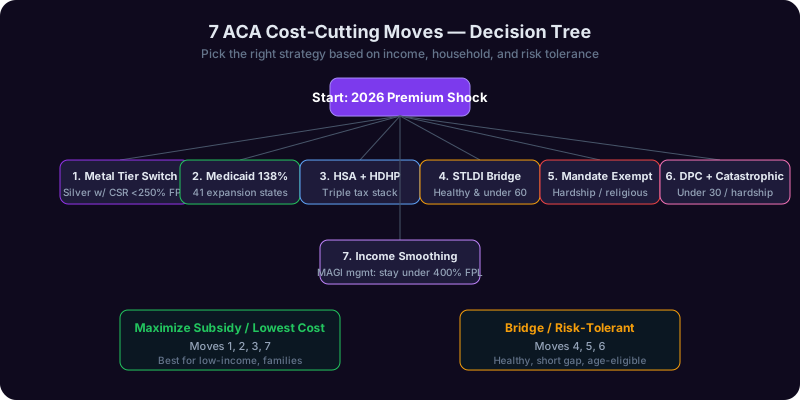
Income smoothing is the single most powerful lever for high earners - but it requires discipline and a tax projection updated quarterly. Our 2026 tax changes guide covers the OBBBA brackets and deduction floors that drive the rest of this math.
How Copilotly's Insurance Copilot Runs Your Numbers
The seven moves above each require running 5-15 calculations against your specific income, household, state, and health profile. Doing this manually with a spreadsheet is possible - and exhausting. Copilotly's Insurance Copilot automates the full pipeline.
Health and tax disclaimer: Copilotly is a decision-support tool. It does not replace a licensed insurance broker, CPA, or your state marketplace navigator. Always verify final enrollment decisions with a licensed professional before submitting an application.
What the Insurance Copilot does
- Ingests your situation. You enter (or import from prior tax return) your projected 2026 MAGI, household composition, state, zip code, and a short health questionnaire.
- Pulls live marketplace data. The Copilot queries the federal and state marketplace plan-finder APIs to retrieve every plan available in your county, including net premiums after estimated APTC.
- Runs all 7 moves in parallel. For each move, it computes the annual all-in cost and identifies the disqualifiers (e.g., over 30 for Catastrophic, pre-existing condition for STLDI).
- Stack-tests the combinations. The Copilot does not just compare moves individually - it tests combinations like Bronze HDHP + HSA max + IRA top-off to see if the stacked deductions pull you under the 400% FPL cliff.
- Generates a Special Enrollment Period narrative. If you qualify for an SEP (loss of coverage, marriage, birth, income change), the Copilot drafts the supporting narrative and document checklist for upload.
Output: a ranked plan
You get a one-page output with:
- Top 3 plan + strategy combinations ranked by annual all-in cost
- The MAGI target needed to hit each tier of subsidy
- Exact HSA / IRA / Solo 401(k) contribution amounts needed to reach the target
- Form 8962 projection showing expected reconciliation outcome
- State-specific enrollment links and document checklist
What the Copilot will not do
The Insurance Copilot will not:
- Submit your enrollment for you (you complete this on the marketplace or with a broker)
- Give state-specific Medicaid eligibility determinations - those require the state agency
- Override a medical underwriting decision
- Replace a tax professional for complex returns with K-1s, multi-state income, or business depreciation
Getting started
Try the Insurance Copilot free for 7 days. Bring last year's Form 1040, an income estimate for 2026, your zip code, and a list of any prescriptions you take. Most users complete the intake in 8-12 minutes and have a ranked enrollment plan in under 15.
Related reading
- Understanding Health Insurance: Complete Guide 2026
- How to Appeal a Health Insurance Denial (2026)
- Can't Afford the Doctor? Complete Guide 2026
- 2026 Tax Changes (OBBBA) Explained
- Homeowners Insurance Non-Renewal Rescue Playbook
External references: KFF 2026 marketplace analysis, HealthCare.gov, CMS.gov, IRS Publication 974, The Commonwealth Fund.
Frequently asked questions
What if I qualify for COBRA at the same time as marketplace coverage?
Can I switch plans mid-year if my income drops?
How does losing the enhanced subsidy affect my taxes?
Is the 400% FPL cliff really back permanently or could Congress reinstate enhanced subsidies?
What is the difference between APTC and PTC and which one matters?
Are off-marketplace plans cheaper than on-marketplace plans in 2026?
Should I drop coverage entirely if I cannot afford 2026 premiums?
How does the Insurance Copilot handle state-specific marketplace rules?
Get help with this from the Finance & Money Copilot
Copilotly's Insurance Copilot pulls live marketplace plans for your zip code, runs every strategy in this guide against your income and household, and ranks your top 3 enrollment combinations - including the exact HSA and IRA contributions needed to stay under the 400% FPL cliff.
Free plan, no card. Pro from $4.99/week for every copilot across all 20 domains - about what one hour with any single professional costs per year.
Not a financial advisorThis is financial information, not financial advice. Consult a licensed financial professional.