

What Is the One Big Beautiful Bill Act and Why It Matters
The One Big Beautiful Bill Act (OBBBA) is the most sweeping federal tax legislation since the Tax Cuts and Jobs Act of 2017. Signed into law in 2025, it makes permanent many provisions that were set to expire, introduces entirely new deductions, and reshapes the tax landscape for individuals and businesses through 2030 and beyond.
The bill's tax provisions fall into three broad categories: extensions of expiring TCJA provisions (standard deduction, tax brackets, child tax credit), new benefits (no tax on tips, overtime pay exemption), and business incentives (permanent Section 199A, expanded Section 179, restored bonus depreciation). Each provision has its own effective dates, phase-outs, and eligibility rules, making the bill unusually complex to navigate.
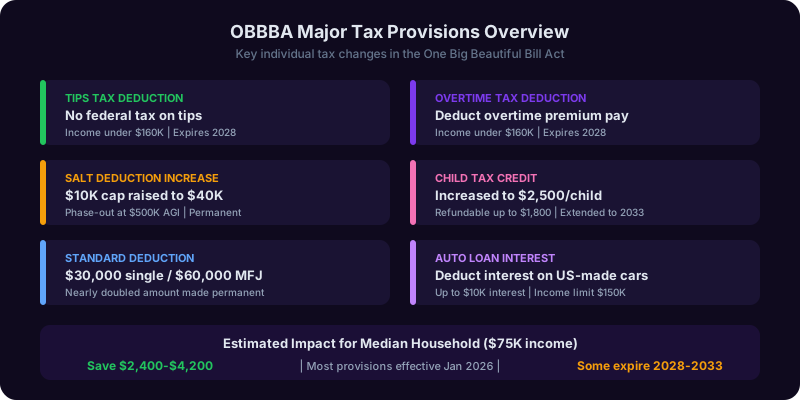
Here is the scope of what changed:
- SALT deduction cap: Raised from $10,000 to $40,000 (through 2029)
- No tax on tips: Up to $25,000 in tip income exempt (through 2028)
- Overtime pay exemption: Up to $12,500 in overtime exempt (through 2028)
- Standard deduction: Increased to $15,750 single / $31,500 joint (indexed for inflation)
- Child tax credit: Raised to $2,200 per child (indexed for inflation, permanent)
- Section 199A QBI deduction: Made permanent with a $400 minimum deduction
- Section 179 expensing: Raised to $2.56 million
- Bonus depreciation: Restored to 100% through 2030
- Medicaid work requirements: New rules for able-bodied adults
The Congressional Budget Office (CBO) estimates these provisions will reduce federal revenue by over $3.8 trillion over the next decade. Whether you are a W-2 employee, self-employed, a small business owner, or retired, at least several of these changes directly impact your 2026 tax return.
In this guide, we break down each provision in plain language, explain who benefits most, highlight the gotchas, and show you how to adjust your tax strategy now rather than scrambling at filing time.
Disclaimer: This article is for informational purposes only and does not constitute tax, legal, or financial advice. Consult a qualified tax professional for guidance specific to your situation.
SALT Deduction Quadrupled: $40,000 Cap Explained
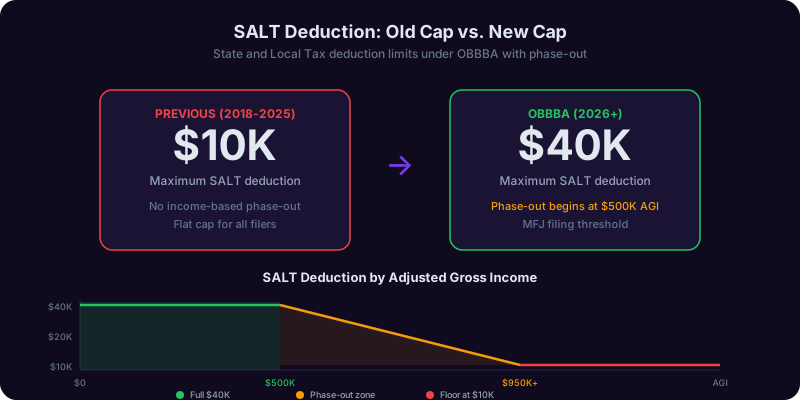
The state and local tax (SALT) deduction cap has been the single most controversial provision since the 2017 TCJA limited it to $10,000. The OBBBA raises that cap to $40,000 per return for tax years 2025 through 2029, a fourfold increase that delivers substantial relief to taxpayers in high-tax states like New York, California, New Jersey, Connecticut, and Illinois.
However, the benefit is not unlimited. The new law introduces an income phase-out that begins at $500,000 of adjusted gross income (AGI). Above that threshold, the $40,000 cap is gradually reduced, eventually reaching zero for the highest earners. This means the SALT increase primarily benefits upper-middle-income taxpayers rather than the very wealthy.
Who Benefits Most
The biggest winners are homeowners in high-tax states who itemize deductions. If you pay $15,000 in state income tax and $12,000 in property tax, your combined SALT of $27,000 was previously capped at $10,000. Under OBBBA, you can deduct the full $27,000, saving you $3,740 or more in federal taxes (assuming the 22% bracket).
For a married couple in the 32% bracket paying $35,000 in combined state and property taxes, the increased cap saves them $8,000 per year compared to the old $10,000 limit.
Key Details to Watch
- The cap is per return, not per person. Married couples filing jointly share a single $40,000 cap, just as they shared the $10,000 cap. This is still a marriage penalty for two-earner couples in high-tax states.
- It expires. The $40,000 cap applies from 2025 through 2029. In 2030, the cap permanently reverts to $10,000 unless Congress acts again. Plan accordingly.
- You must itemize. The SALT deduction only matters if your total itemized deductions exceed the standard deduction ($15,750 single / $31,500 joint). With the higher standard deduction under OBBBA, many taxpayers still benefit more from the standard deduction.
- SALT includes: State and local income taxes (or sales taxes if you elect), real property taxes, and personal property taxes. It does not include foreign taxes.
If you were one of the millions who switched from itemizing to the standard deduction after 2017, now is the time to recalculate. The combination of a $40,000 SALT cap plus your mortgage interest and charitable contributions may push your itemized deductions well above the standard deduction. For detailed guidance on how state and local tax deductions interact with your overall strategy, the Tax Foundation's OBBBA analysis provides useful state-by-state breakdowns.
No Tax on Tips: Who Qualifies and How It Works
One of the most headline-grabbing provisions of the OBBBA is the tip income exemption. For tax years 2025 through 2028, workers who receive tips can deduct up to $25,000 in tip income from their federal taxable income. This effectively makes the first $25,000 in tips tax-free for qualifying workers.
This is structured as an above-the-line deduction, meaning you subtract it from your gross income to arrive at adjusted gross income. You do not need to itemize to claim it. The deduction applies to federal income tax only. Social Security and Medicare taxes (FICA) still apply to tip income, and state income taxes may or may not conform to the federal provision depending on your state.
Eligibility Requirements
- Income limit: The deduction phases out for single filers with AGI above $150,000 and married filing jointly above $300,000.
- Type of tips: The exemption covers tips received in the course of employment where tipping is customary. Cash tips, credit card tips, and tip pools all qualify.
- Reporting requirement: You must properly report your tips to your employer using Form 4070 or equivalent. Unreported cash tips do not qualify for the deduction.
- Temporary provision: This expires after the 2028 tax year unless extended by future legislation.
Real-World Impact
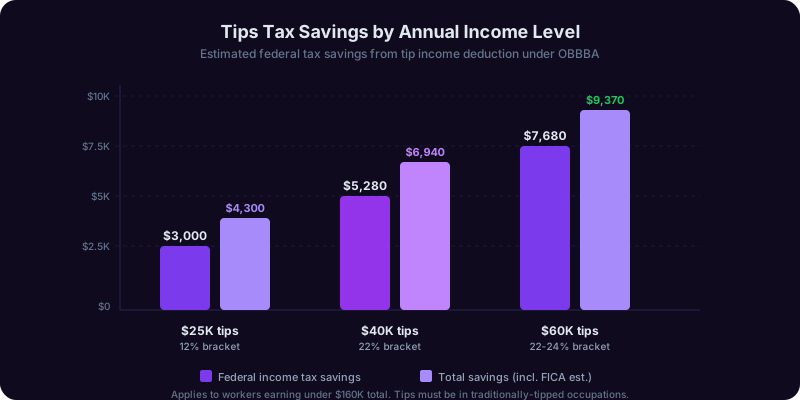
Consider a restaurant server earning $35,000 per year in base wages plus $25,000 in tips. Under the old rules, the full $60,000 was taxable income. Under OBBBA, the server claims the $25,000 tip deduction, reducing taxable income to $35,000. At the 12% bracket, that saves approximately $2,750 in federal income tax. The server still pays FICA taxes on the tip income ($25,000 x 7.65% = $1,912), but the overall savings are significant.
For a valet, bartender, or delivery driver earning $15,000 in annual tips, the savings amount to roughly $1,650 in the 12% bracket or $1,800 in the 22% bracket.
What This Does Not Cover
- Service charges: Mandatory service charges added by the restaurant are classified as wages, not tips, and do not qualify.
- Gig worker tips: If you are an independent contractor (not a W-2 employee), your tip income is self-employment income. The provision is structured for traditional employees. Gig workers should consult a tax professional about eligibility.
- FICA taxes: Social Security and Medicare taxes still apply to all tip income. The exemption only covers federal income tax.
If you are a tipped worker, ensure your employer is correctly reporting your tips on your W-2. Discrepancies between your reported tips and the deduction you claim will raise IRS audit flags. Keep your own records of daily tips as backup documentation.

Get Answers From the Tax Copilot
The Tax Copilot models your income under the new OBBBA provisions, identifies every deduction you qualify for, and calculates your optimal filing strategy -- no CPA appointment needed.
Overtime Pay Tax Exemption: $12,500 Deduction for Hourly Workers
For the first time in U.S. tax history, a portion of overtime pay is exempt from federal income tax. Under OBBBA, workers can deduct up to $12,500 in overtime compensation per year from their taxable income for tax years 2025 through 2028.
Like the tips provision, this is an above-the-line deduction. You subtract it before calculating your adjusted gross income, and you do not need to itemize. The deduction phases out for individuals with AGI above $150,000 (single) or $300,000 (married filing jointly).
What Counts as Overtime
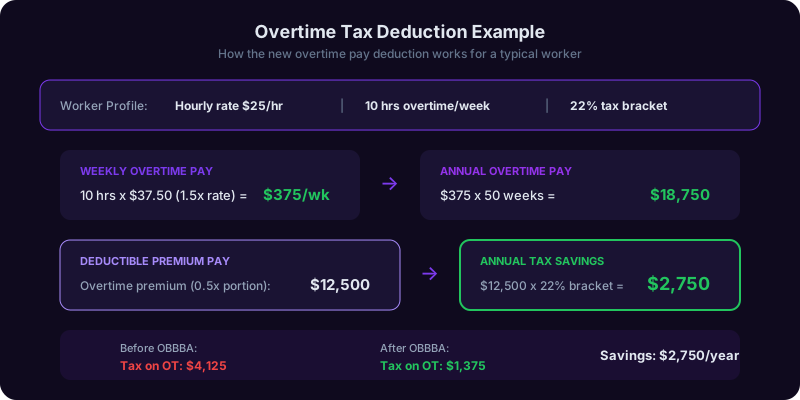
Only the premium portion of overtime pay qualifies. Under the Fair Labor Standards Act (FLSA), overtime is paid at 1.5 times the regular rate for hours worked beyond 40 in a workweek. The deductible portion is the premium, which is the extra 0.5x, not the full 1.5x amount.
Here is an example. A construction worker earns $30/hour regular pay and works 50 hours in a week:
| Regular pay (40 hrs) | $1,200 |
| Overtime pay (10 hrs at 1.5x) | $450 |
| Premium portion (10 hrs at 0.5x) | $150 |
In this example, only the $150 premium portion qualifies for the deduction, not the full $450 of overtime pay. Over a full year of working 10 overtime hours per week, the deductible premium totals $7,800.
Who Benefits
This provision primarily helps hourly W-2 employees who regularly work overtime: manufacturing workers, healthcare staff, construction workers, truck drivers, retail managers, and warehouse employees. Salaried employees who are exempt from FLSA overtime requirements generally do not receive overtime premiums and therefore cannot claim this deduction.
For a nurse earning $40/hour who works 8 hours of overtime per week, the annual premium portion is approximately $8,320. At the 22% bracket, that translates to a $1,830 tax savings per year.
Limitations
- Only the premium portion: The most common misunderstanding. Your full overtime check is not deductible, only the extra half-time premium above your regular rate.
- W-2 employees only: Independent contractors and self-employed individuals do not receive overtime under FLSA and cannot claim this deduction.
- Temporary: Expires after the 2028 tax year.
- FICA still applies: Social Security and Medicare taxes are assessed on the full overtime amount including the premium.
- Employer reporting: Your employer must separately identify overtime premium amounts on your W-2 or pay records. If they do not, you may need to calculate it yourself from your pay stubs. Our pay stub guide can help you identify overtime breakdowns.
If you are a worker who relies on overtime, factor this deduction into your overall tax strategy to ensure you are not overpaying estimated taxes or over-withholding on your W-4.
Business Tax Changes: Section 199A, Section 179, and Bonus Depreciation
The OBBBA delivers three major wins for business owners, freelancers, and self-employed individuals. Each provision operates independently, and many business owners will benefit from all three simultaneously.
Section 199A QBI Deduction: Now Permanent
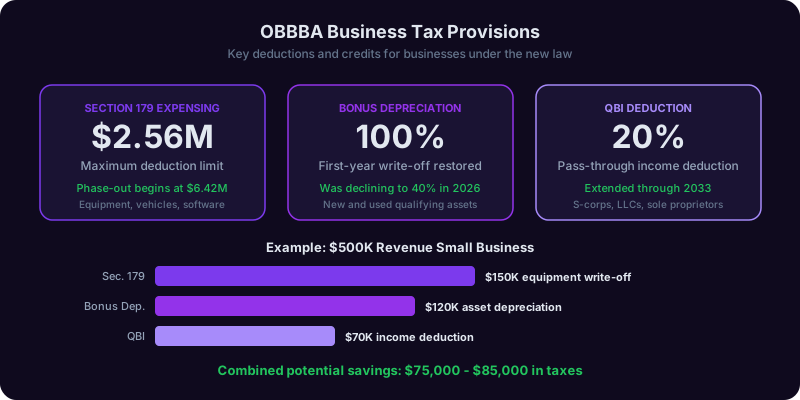
The qualified business income (QBI) deduction allows owners of pass-through businesses (sole proprietorships, partnerships, S-corps, and LLCs) to deduct 20% of their qualified business income from their taxable income. The TCJA created this deduction in 2018 with a sunset date of 2025. The OBBBA makes it permanent and adds a $400 minimum deduction for lower-income filers.
For a freelance consultant earning $100,000 in net business income, the QBI deduction is $20,000, saving roughly $4,400 to $6,400 in federal income tax depending on the bracket. This deduction was always complex, with limitations based on W-2 wages paid, the type of business (specified service trades), and taxable income thresholds. Those rules remain under OBBBA, but the permanence provides long-term planning certainty that business owners did not have before.
Section 179 Expensing: Raised to $2.56 Million
Section 179 allows businesses to immediately expense the full cost of qualifying assets (equipment, machinery, vehicles, software, certain improvements) in the year of purchase, rather than depreciating them over several years. The OBBBA raises the maximum deduction to $2.56 million, with a phase-out beginning at $4.09 million in total asset purchases.
This matters most for small and mid-sized businesses that invest in equipment. A contractor who buys $200,000 in heavy equipment can deduct the entire amount in the year of purchase. A dental practice investing $500,000 in new equipment and office buildout can write it all off immediately. For details on how Section 179 interacts with other deductions, see our complete freelancer deductions guide.
100% Bonus Depreciation: Restored Through 2030
Under the original TCJA, bonus depreciation began phasing down from 100% to 80% in 2023, 60% in 2024, 40% in 2025, and 20% in 2026. The OBBBA restores 100% bonus depreciation for qualified property placed in service through December 31, 2030. A new temporary provision also extends 100% expensing to certain production structures through 2028.
Bonus depreciation applies to assets with a recovery period of 20 years or less, including machinery, equipment, computers, furniture, and qualified improvement property. Unlike Section 179, bonus depreciation has no dollar limit and can create or increase a net operating loss.
Combined Strategy Example
A small manufacturing company purchasing $3 million in equipment in 2026 can use Section 179 for the first $2.56 million and bonus depreciation for the remaining $440,000, deducting the full $3 million in the first year. Without these provisions, the deduction would be spread over 5 to 7 years, significantly reducing the immediate cash flow benefit.
For self-employed individuals and small business owners, these provisions create powerful incentives to invest in your business now while the full benefits are available.
Standard Deduction and Child Tax Credit: What Changed
Two of the most widely used tax provisions, the standard deduction and the child tax credit, receive meaningful upgrades under the OBBBA. Unlike some of the temporary provisions, these changes are permanent and indexed for inflation, providing long-term benefit to nearly every taxpayer.
Standard Deduction Increases
The OBBBA sets the standard deduction at $15,750 for single filers and $31,500 for married filing jointly for the 2025 tax year, with annual inflation adjustments going forward. For 2026, expect these figures to increase modestly based on the Consumer Price Index.
To put this in perspective, the standard deduction before the TCJA in 2017 was $6,350 for single filers. It has roughly doubled and then some, which is why approximately 90% of taxpayers now take the standard deduction rather than itemizing.
| Filing Status | Pre-TCJA (2017) | TCJA (2024) | OBBBA (2025+) |
| Single | $6,350 | $14,600 | $15,750+ |
| Married Filing Jointly | $12,700 | $29,200 | $31,500+ |
| Head of Household | $9,350 | $21,900 | $23,625+ |
The higher standard deduction is permanent. Without the OBBBA, the standard deduction would have reverted to roughly $8,300 single / $16,600 joint in 2026 (pre-TCJA levels adjusted for inflation), a change that would have resulted in a significant tax increase for most Americans.
Child Tax Credit Raised to $2,200
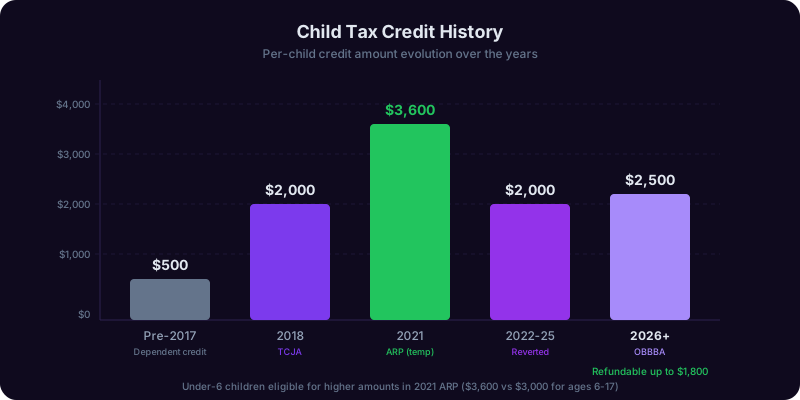
The OBBBA raises the maximum child tax credit from $2,000 to $2,200 per qualifying child under age 17, effective for 2025 and indexed for inflation going forward. The credit is now permanent rather than set to expire.
Key details of the updated child tax credit:
- Phase-out thresholds: The credit begins to phase out at $200,000 AGI for single filers and $400,000 for married filing jointly. These thresholds remain unchanged from the TCJA.
- Refundability: Up to $1,700 of the credit is refundable (the Additional Child Tax Credit), meaning you can receive it even if you owe no federal income tax. This amount is also indexed for inflation.
- Qualifying child: Must be under 17 at the end of the tax year, a U.S. citizen or resident, your dependent, and must have a valid Social Security number.
- No more sunset: The TCJA's $2,000 credit was set to drop back to $1,000 in 2026. The OBBBA eliminates that cliff entirely.
Impact by Family Size
A married couple with three children under 17 earning $85,000 receives a $6,600 child tax credit under OBBBA, compared to $6,000 under the TCJA and $3,000 under the pre-TCJA rules. Combined with the higher standard deduction, a family of five in this income range sees their effective federal tax rate drop by 2-3 percentage points.
For retirees and taxpayers without children, the standard deduction increase is the primary benefit. A retired couple taking the standard deduction of $31,500 plus the additional standard deduction for age 65+ ($1,600 each) shields $34,700 from federal income tax before any other deductions or credits apply.
Medicaid Work Requirements and Who Benefits Most by Taxpayer Type
Beyond the direct tax provisions, the OBBBA includes Medicaid work requirements that affect healthcare access for millions of Americans. While not a tax change per se, these requirements interact with your tax situation in meaningful ways.
Medicaid Work Requirements
The OBBBA introduces federal work requirements for able-bodied adults aged 19 to 64 who receive Medicaid benefits. To maintain coverage, recipients must demonstrate at least 80 hours per month of qualifying activity, which includes employment, job training, education, community service, or caregiving for a dependent.
Exemptions exist for pregnant women, individuals with disabilities, primary caregivers of children under 6, and people in areas with high unemployment. States have some flexibility in implementation, but the federal floor is mandatory.
The tax connection: if you lose Medicaid coverage due to work requirements and purchase insurance through the ACA marketplace, your premium tax credits are calculated based on your AGI. The OBBBA's changes to income (tips deduction, overtime deduction, higher standard deduction) can lower your AGI, which may increase your marketplace premium subsidies.
Who Benefits Most: A Breakdown by Taxpayer Type

W-2 Employees
The standard deduction increase helps every employee. If you live in a high-tax state and itemize, the SALT cap increase to $40,000 is your biggest win. Hourly workers who log overtime should claim the overtime premium deduction. Tipped employees get the tips exemption. Combined, a server in New York who works overtime shifts and pays $20,000 in state and local taxes could see $4,000 to $6,000 in annual tax savings.
Self-Employed and Freelancers
The permanent Section 199A QBI deduction is the headline benefit, saving 20% of your qualified business income from federal income tax. If you invest in equipment or technology, Section 179 and 100% bonus depreciation let you write off the full cost immediately. The tips provision applies if you receive tips in a qualifying employment arrangement, but most self-employed tip earners (gig workers) may not qualify. Review our side hustle tax guide for strategies that stack with these new provisions.
Small Business Owners
All three business provisions apply, plus you benefit personally from the standard deduction and potential SALT relief. If you have employees, you do not benefit from the tips or overtime provisions directly, but your employees do, which can improve retention and recruitment as workers see higher take-home pay.
Retirees
The higher standard deduction shelters more retirement income from tax. If you are a grandparent with legal guardianship of grandchildren, the $2,200 child tax credit applies. Retirees who work part-time tipped jobs benefit from the tips exemption. The SALT increase helps retirees in high-tax states who own their homes and itemize deductions.
For a personalized breakdown of which provisions apply to your specific situation, the Tax Copilot can analyze your income sources and filing status to estimate your total savings under OBBBA.
Action Steps for 2026 and How Copilotly Can Help
The OBBBA changes are extensive, but the concrete actions you need to take are straightforward. Here is a checklist organized by urgency.
Do Now (Before Year-End 2026)
- Recalculate your W-4 withholding. If the tips exemption, overtime deduction, or higher standard deduction lowers your tax liability, you may be over-withholding. Submit an updated W-4 to your employer to increase your take-home pay now rather than waiting for a refund.
- Run the itemize-vs-standard-deduction calculation. With the SALT cap at $40,000, taxpayers who switched to the standard deduction after 2017 should recalculate. If your SALT + mortgage interest + charitable contributions exceed $15,750 (single) or $31,500 (joint), itemizing saves you money.
- Accelerate equipment purchases. If you are a business owner considering a major purchase, buying before December 31 lets you claim Section 179 and 100% bonus depreciation for the 2026 tax year.
- Start tracking tips and overtime separately. If you are a tipped or hourly worker, ensure your records distinguish between base pay, tips, and overtime premiums. You will need these breakdowns to claim the new deductions accurately.
Do Before Filing (Early 2027)
- Verify your employer's W-2 reporting. The IRS W-2 form should reflect tip income in Box 7 and overtime details in your pay records. Discrepancies between your records and the W-2 need to be resolved before filing.
- Calculate your QBI deduction. If you have pass-through business income, the permanent Section 199A deduction requires Form 8995 or 8995-A. The calculation involves your taxable income, W-2 wages, and the unadjusted basis of qualified property.
- Review state conformity. Not all states conform to federal tax law changes immediately. Your state may not recognize the tips deduction, overtime exemption, or SALT cap change for state income tax purposes. Check your state's department of revenue website.
How Copilotly Helps You Navigate These Changes
The Tax Copilot is built to handle exactly this kind of complexity. It can:
- Model your tax scenarios: Input your income, filing status, and deductions to see your estimated tax under the old rules versus OBBBA, so you know exactly how much you save.
- Optimize your W-4: Calculate the right withholding allowances so you keep more of each paycheck without owing a large balance at filing time.
- Identify stacking opportunities: Many taxpayers qualify for multiple OBBBA provisions simultaneously. The Tax Copilot identifies which combination of deductions maximizes your savings.
- Track deadlines: Quarterly estimated payment dates, state filing deadlines, and provision expiration dates so nothing falls through the cracks.
The Finance Copilot complements this by helping you plan what to do with your tax savings, whether that means building an emergency fund, starting to invest, or accelerating debt payoff.
For business owners, the Bookkeeping Copilot ensures your asset purchases, depreciation schedules, and QBI calculations are properly tracked throughout the year so filing is seamless.
Tax law changes this significant create both opportunities and risks. The opportunity is real savings. The risk is missing provisions you qualify for, or misapplying rules that trigger an IRS audit. Getting it right matters, and AI-powered guidance makes it accessible to everyone, not just those who can afford a $500/hour tax attorney.
Disclaimer: This article is for informational purposes only and does not constitute tax, legal, or financial advice. Tax laws are complex and individual circumstances vary. Consult a qualified tax professional for guidance specific to your situation.
Frequently Asked Questions
Recommended Copilots
Recommended Copilots
Model your tax scenarios under OBBBA and optimize your deductions and withholding
Try Free →Plan what to do with your tax savings, from investing to debt payoff strategies
Try Free →Related Articles
Get Answers From the Tax Copilot
The Tax Copilot models your income under the new OBBBA provisions, identifies every deduction you qualify for, and calculates your optimal filing strategy -- no CPA appointment needed.