

Why Your Pay Stub Matters More Than You Think
Most employees glance at the bottom line of their pay stub and move on. That is a mistake that can cost you hundreds or even thousands of dollars per year. Your pay stub is a detailed accounting of every dollar your employer pays you and every dollar taken out before you receive your check. Errors are more common than you think.
According to the IRS, roughly 33% of employers make payroll errors at some point during the year. The American Payroll Association estimates that payroll error rates range from 1% to 8% of total payroll. These errors include incorrect tax withholding, missed overtime pay, wrong deduction amounts, and classification mistakes.
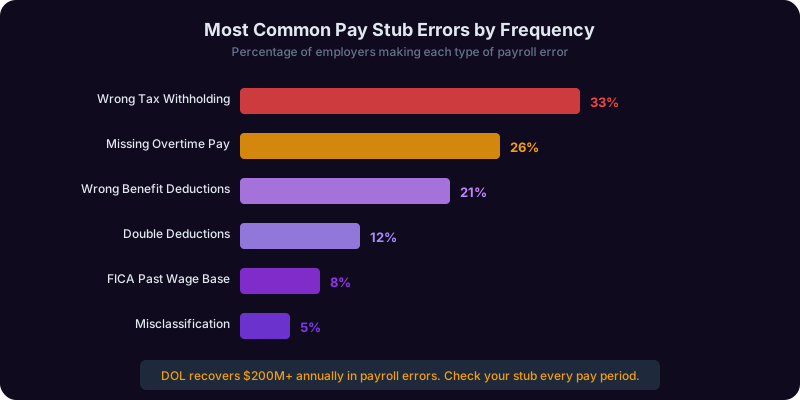
Here is what reviewing your pay stub regularly helps you catch:
- Incorrect tax withholding: Too much withheld means you are giving the government an interest-free loan. Too little means a surprise tax bill in April.
- Missing overtime or bonus pay: If you worked 45 hours but your stub shows 40, that is money owed to you.
- Wrong benefit deductions: Open enrollment changes, rate increases, or administrative errors can cause incorrect deductions for health insurance, retirement, or other benefits.
- Year-to-date totals that do not add up: Comparing YTD figures across consecutive pay stubs can reveal one-time errors that might otherwise go unnoticed.
Beyond error-catching, understanding your pay stub is fundamental to budgeting effectively. You cannot plan your finances around your gross salary. You plan around your net pay, and your net pay depends on dozens of decisions about withholding, deductions, and contributions that most people set once and never revisit.
Let us walk through every section of a typical pay stub so you know exactly what you are looking at.
This is general information, not financial advice. Consult a tax professional for guidance specific to your situation.
Gross Pay Breakdown
Gross pay is the total amount your employer pays you before anything is taken out. It is the starting point, and everything else on your pay stub is a subtraction from this number.
Components of Gross Pay
Regular pay is your base compensation. For salaried employees, this is your annual salary divided by the number of pay periods. If you earn $60,000/year and are paid biweekly (26 pay periods), your regular gross pay is $2,307.69 per paycheck. For hourly employees, it is your hourly rate multiplied by hours worked.
Overtime pay applies to non-exempt employees who work more than 40 hours in a workweek. Federal law (the Fair Labor Standards Act) requires overtime at 1.5 times your regular rate. Some states have additional rules. California, for example, requires overtime after 8 hours in a single day, not just 40 hours in a week. If your regular rate is $25/hour, your overtime rate is $37.50/hour.
Tips, bonuses, and commissions appear as separate line items. Bonuses are typically taxed at a higher withholding rate (a flat 22% federal rate for supplemental wages under $1 million), which is why your bonus check looks smaller than expected. The actual tax owed is the same as your regular rate. The extra withholding is reconciled when you file your annual return.
Holiday and PTO pay shows paid time off used during the pay period. Some stubs also display your remaining PTO balance, which is worth tracking.
What to Check
- Verify your hourly rate or salary is correct
- Confirm hours worked match your records (keep your own log)
- Ensure overtime is calculated at the correct rate
- Check that bonuses and commissions match what was promised
- Compare current period gross to year-to-date gross for consistency
Your gross pay is the number your employer reports to the IRS on your W-2 at year end. If it is wrong on your pay stub, it will be wrong on your W-2, which means your tax return will be wrong too. Try our AI tax filing assistant for step-by-step help.
Tax Withholdings Explained: Federal, State, FICA, and Medicare
Tax withholdings are the largest chunk taken from most paychecks. Understanding each one helps you verify accuracy and make informed decisions on your W-4.
Federal Income Tax
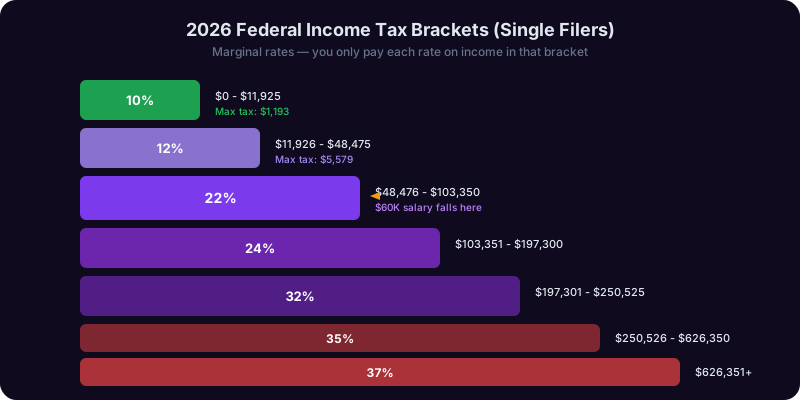
This is calculated based on the information you provided on your Form W-4 (Employee's Withholding Certificate). The amount depends on your filing status, income level, and any adjustments you claimed. For 2026, federal tax brackets for single filers range from 10% on income up to $11,925 to 37% on income above $626,350. Your employer uses IRS withholding tables to calculate the correct amount each pay period.
If your pay stub shows "FIT" or "Fed Tax" or "Federal W/H," this is your federal income tax withholding. For a single person earning $60,000 with standard deductions, expect roughly $300-$400 withheld per biweekly paycheck.
State Income Tax
Labeled as "SIT," "State Tax," or your state's abbreviation (e.g., "CA-IT" for California). The amount varies dramatically by state. Nine states have no income tax: Alaska, Florida, Nevada, New Hampshire (dividends/interest only), South Dakota, Tennessee, Texas, Washington, and Wyoming. Other states range from flat rates like Pennsylvania's 3.07% to California's top rate of 13.3%.
FICA (Social Security)
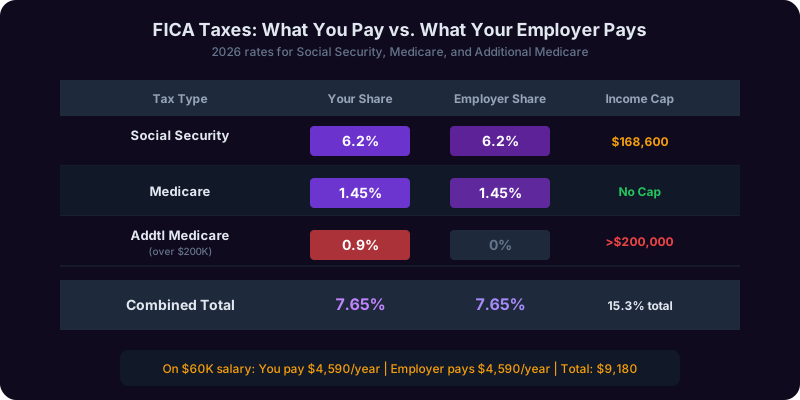
FICA stands for Federal Insurance Contributions Act. On your pay stub, the Social Security portion is often labeled "FICA," "SS," or "OASDI." The rate is 6.2% of your gross pay, up to the wage base limit of $168,600 for 2026. Your employer pays a matching 6.2%. Once your year-to-date earnings hit the cap, Social Security withholding stops for the rest of the year. If you notice FICA deductions continuing past this threshold, flag it with payroll immediately.
Medicare
Labeled "Medicare" or "MED" on your stub. The rate is 1.45% of all gross pay with no income cap. Your employer pays a matching 1.45%. If your wages exceed $200,000, an additional 0.9% is withheld (the Additional Medicare Tax). Your employer does not match this extra amount.
Quick Reference Table
| Tax | Rate | Cap |
|---|---|---|
| Social Security | 6.2% | $168,600 |
| Medicare | 1.45% | No cap |
| Additional Medicare | 0.9% | Above $200,000 |
If any of these numbers look off, use the Tax Copilot to run a quick check against your expected withholding based on your W-4 selections.

Get Answers From the Finance Copilot
Upload your pay stub to the Finance Copilot and get a plain-English explanation of every line item, plus recommendations for optimizing your withholdings and deductions.
Pre-Tax Deductions: 401(k), Health Insurance, and More
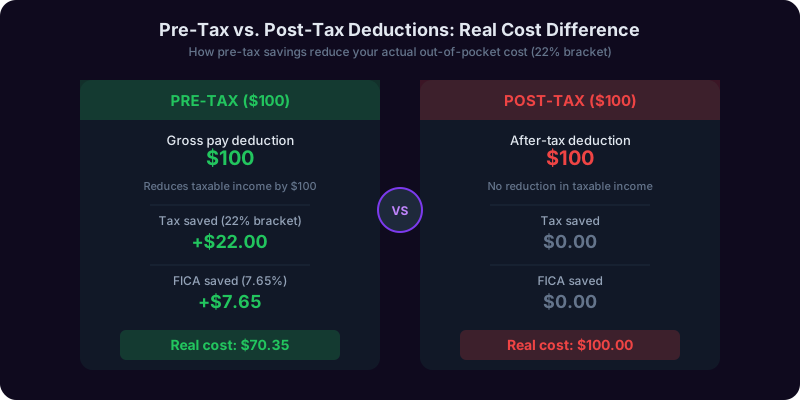
Pre-tax deductions are subtracted from your gross pay before taxes are calculated. This is significant because they reduce your taxable income, which means you pay less in federal income tax, state income tax, and in most cases, FICA taxes.
401(k) / 403(b) Retirement Contributions
If you contribute to your employer's retirement plan, the amount is deducted pre-tax. For 2026, the employee contribution limit is $23,500 (or $31,000 if you are 50 or older, thanks to the catch-up provision). If you contribute 6% of a $60,000 salary, that is $3,600/year or $138.46 per biweekly paycheck. For a deeper dive into choosing between traditional and Roth 401(k) contributions, see our 401(k) vs Roth 401(k) guide.
The tax savings are real. That $138.46 contribution might only reduce your take-home pay by about $100 because you are not paying income tax on it. Some stubs also show employer matching contributions as a separate informational line. While these do not affect your take-home pay, they represent additional compensation worth tracking.
Health Insurance Premiums
Most employer-sponsored health plans are deducted pre-tax through a Section 125 cafeteria plan. This includes medical, dental, and vision premiums. The average employee share of health insurance premiums in 2026 is approximately $110/month for individual coverage and $480/month for family coverage, according to the Bureau of Labor Statistics. These figures vary significantly by employer, plan type, and region.
HSA Contributions
Health Savings Account contributions through payroll are pre-tax and also exempt from FICA taxes, making them one of the most tax-advantaged savings vehicles available. The 2026 limits are $4,300 for individual coverage and $8,550 for family coverage. You must be enrolled in a high-deductible health plan (HDHP) to contribute.
FSA Contributions
Flexible Spending Accounts for healthcare or dependent care are also pre-tax. The 2026 healthcare FSA limit is $3,300. Unlike HSAs, FSA funds generally must be used within the plan year (some plans allow a $640 rollover or 2.5-month grace period).
Other Pre-Tax Deductions
- Commuter benefits: Up to $325/month for transit and $325/month for parking (2026)
- Life insurance premiums: Employer-paid coverage up to $50,000 is tax-free. Employee-paid supplemental coverage may be pre-tax.
- Disability insurance: If premiums are pre-tax, benefits are taxable if you ever collect. If post-tax, benefits are tax-free.
Review your pre-tax deductions at least once per year, especially after open enrollment. Changes you made should be reflected on your first paycheck of the new plan year.
Post-Tax Deductions
Post-tax deductions are subtracted from your pay after taxes have been calculated. They do not reduce your taxable income, which means you are paying for these with fully taxed dollars.
Roth 401(k) Contributions
Unlike traditional 401(k) contributions, Roth contributions are made with after-tax dollars. You pay taxes now, but withdrawals in retirement are tax-free (including all the growth). If your stub shows a "Roth 401k" or "R401k" line, this is a post-tax deduction. The contribution limits are the same as traditional 401(k): $23,500 for 2026 ($31,000 with catch-up). For a detailed comparison, see our Roth IRA vs Traditional IRA guide.
Garnishments
Court-ordered deductions including child support, alimony, tax levies, and creditor garnishments. Federal law limits garnishments to 25% of disposable earnings for consumer debts and 50-65% for child support depending on circumstances. If you see a garnishment you do not recognize, contact your payroll department immediately. Errors do happen, and garnishments intended for someone with a similar name or Social Security number occasionally hit the wrong account.
Union Dues
If you belong to a labor union, dues are typically deducted post-tax. These are no longer deductible on your federal tax return as of the Tax Cuts and Jobs Act (2017), though some states still allow a state-level deduction.
Life Insurance Over $50,000
If your employer provides group life insurance coverage exceeding $50,000, the cost of coverage above that threshold is treated as taxable income (called "imputed income"). You will see both the imputed income added to your gross pay and the corresponding tax withheld. This often confuses employees because it increases your gross pay without putting more money in your pocket.
Other Common Post-Tax Deductions
- Voluntary supplemental insurance: Accident, critical illness, or hospital indemnity policies through companies like Aflac or Colonial Life
- Charitable contributions: Some employers allow payroll deductions for charitable giving (United Way campaigns, for example)
- Employee stock purchase plan (ESPP): Contributions are typically post-tax, though you may receive a discount on the purchase price
- Loan repayments: 401(k) loans are repaid through post-tax payroll deductions
The distinction between pre-tax and post-tax matters for your overall financial planning. Every dollar moved from post-tax to pre-tax (where available) reduces your current tax bill.
Net Pay: What Actually Hits Your Bank Account
Net pay is the final number at the bottom of your pay stub. It is your gross pay minus all taxes and deductions. This is the amount deposited into your bank account (or printed on your physical check).
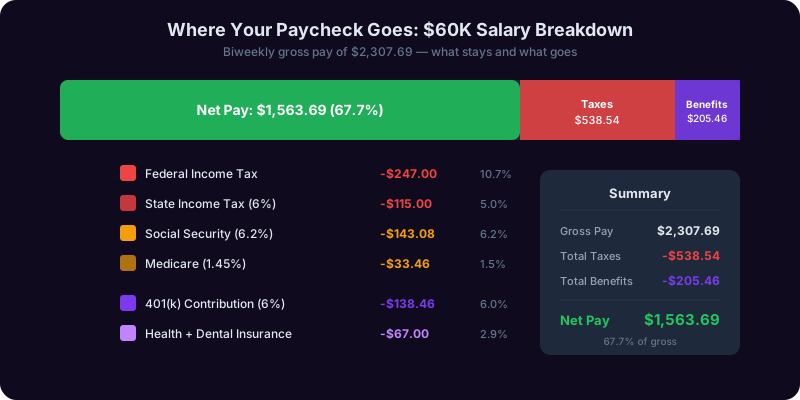
For a concrete example, here is how a $60,000 annual salary breaks down on a biweekly pay stub:
| Line Item | Amount |
|---|---|
| Gross Pay | $2,307.69 |
| Federal Income Tax | -$247.00 |
| State Income Tax (6%) | -$115.00 |
| Social Security (6.2%) | -$143.08 |
| Medicare (1.45%) | -$33.46 |
| 401(k) (6%) | -$138.46 |
| Health Insurance | -$55.00 |
| Dental Insurance | -$12.00 |
| Net Pay | $1,563.69 |
In this example, the employee takes home 67.7% of their gross pay. That means 32.3% goes to taxes, retirement savings, and insurance before a single dollar is spent on rent, food, or anything else.
This is why financial planning based on gross salary is misleading. When someone says they earn $60,000, their actual spendable income is closer to $40,655 per year (in this example). Your budget should be built around net pay, not gross. Understanding this number is also critical when building your emergency fund -- base it on net pay, not gross.
Direct Deposit Details
If you split your direct deposit between multiple accounts (e.g., checking and savings), your pay stub should show the split. Verify the amounts match your intended allocation. A common strategy is to direct a fixed amount to savings each pay period and the remainder to checking. This automates your savings and removes the temptation to spend it.
Year-to-Date (YTD) Totals
Every pay stub should include YTD totals for gross pay, each tax category, each deduction, and net pay. These are cumulative figures from January 1 through the current pay period. Your final pay stub of the year should closely match your W-2. Compare them when you receive your W-2 in January. Discrepancies mean either a pay stub error went unnoticed or the W-2 was generated incorrectly.
Common Pay Stub Errors to Watch For
Payroll departments process thousands of transactions. Errors happen, and catching them is your responsibility. Here are the most frequent mistakes and how to spot them.
1. Wrong Filing Status or Allowances
If your federal withholding seems too high or too low, your W-4 information may have been entered incorrectly. Compare your expected withholding (using the IRS Tax Withholding Estimator) to what is actually being deducted. A single vs. married filing status error alone can swing your withholding by hundreds of dollars per paycheck.
2. Missing or Incorrect Overtime
If you are a non-exempt hourly employee, every hour over 40 in a workweek must be paid at 1.5x your regular rate. Keep your own record of hours worked. If your pay stub shows 40 hours but you worked 44, you are owed 4 hours of overtime. This is one of the most common wage theft issues in the United States. The Department of Labor recovers over $200 million annually in unpaid overtime.
3. Benefit Deductions Not Updating After Open Enrollment
If you changed your health plan, retirement contribution, or other benefits during open enrollment, verify the changes appear on the first paycheck of the new plan year. It is not uncommon for changes to be missed or delayed by one or two pay periods. Try our AI investment analysis tool for step-by-step help.
4. Double Deductions
Occasionally, a deduction is applied twice in one pay period due to a processing error. Check your current-period deductions against the previous pay period. If a number doubles unexpectedly, report it immediately.
5. FICA Withholding Beyond the Wage Base
Social Security tax should stop once your year-to-date earnings reach $168,600. If you work multiple jobs, each employer withholds independently, and you may overpay. Claim the excess as a credit on your tax return (you will get it back). But if a single employer continues withholding past the cap, that is a payroll error that should be corrected.
What to Do If You Find an Error
- Document the error with screenshots or copies of the affected pay stubs
- Contact your payroll or HR department in writing (email creates a paper trail)
- Reference the specific pay period, line item, and discrepancy
- Request correction in the next pay cycle and a written confirmation
- If unresolved, file a complaint with your state's Department of Labor or the federal DOL's Wage and Hour Division
Use the Finance Copilot to double-check your withholding calculations and identify whether your current deductions are optimized for your financial goals.
For more on this topic, read our guide on Side Hustle Taxes: Everything the IRS Expects From You. If you have freelance income in addition to your W-2 job, check out our complete list of freelancer tax deductions.
See our real-world walkthrough: side hustle taxes.
Frequently Asked Questions
Recommended Copilots
Recommended Copilots
Get a complete breakdown of your take-home pay and optimize your deductions
Try Free →Understand your tax withholdings and whether you're over- or under-paying
Try Free →Build a budget based on your actual net pay and deductions
Try Free →Continue Exploring
Related Articles
Get Answers From the Finance Copilot
Upload your pay stub to the Finance Copilot and get a plain-English explanation of every line item, plus recommendations for optimizing your withholdings and deductions.