

Home Office Deduction: Simplified vs. Actual Method
The home office deduction is one of the most valuable write-offs for freelancers, but it is also one of the most misunderstood. You qualify if you use a specific area of your home regularly and exclusively for business. It does not need to be a separate room, but it must be a dedicated space. A corner of your living room that you use only for client work counts. Your kitchen table where you also eat dinner does not. The IRS home office deduction page provides the official requirements and qualification criteria.
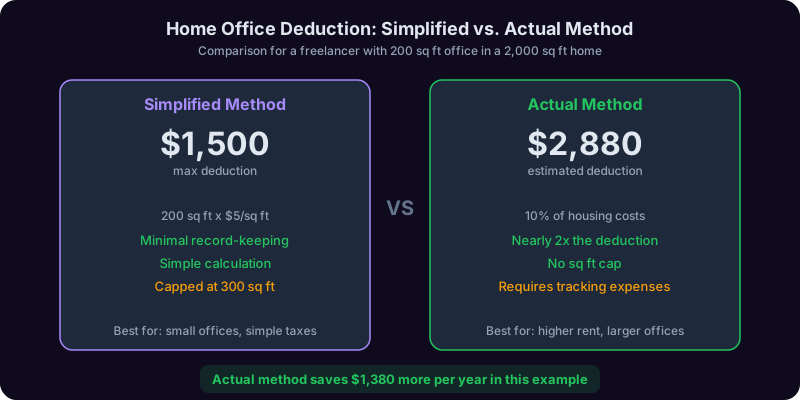
Simplified Method
The simplified method gives you $5 per square foot of your home office, up to a maximum of 300 square feet. That is a maximum deduction of $1,500. The advantage: minimal record-keeping. You do not need to track utility bills, mortgage interest, or homeowner's insurance allocations. You just measure your office space and multiply.
This method makes sense if your office is small or if the hassle of tracking actual expenses is not worth the extra deduction. Try our AI budget planning tool for step-by-step help.
Actual Expense Method
The actual method calculates the percentage of your home used for business and applies it to your actual housing costs. If your office is 200 square feet and your home is 2,000 square feet, your business percentage is 10%.
You can then deduct 10% of:
- Rent or mortgage interest (not principal)
- Property taxes
- Homeowner's or renter's insurance
- Utilities: electricity, gas, water, internet
- Repairs and maintenance to the home (not just the office)
- Depreciation (if you own the home)
For a freelancer paying $2,000/month rent with $300/month in utilities and $100/month in renter's insurance, the actual method at 10% yields a deduction of approximately $2,880/year, nearly double the simplified method's maximum. Repairs made specifically to the office (new lighting, painting the office) are 100% deductible, not just the business percentage.
The Tax Copilot can run both calculations with your actual numbers so you choose the method that saves you more.
This is general information, not financial advice. Consult a qualified tax professional for guidance specific to your situation.
Equipment and Software
Anything you buy to run your freelance business is deductible. The IRS draws the line at items that are ordinary and necessary for your specific work. Here is what qualifies and how to deduct it.
Section 179 and Bonus Depreciation
For items costing more than $2,500, you have options. Section 179 allows you to deduct the full purchase price in the year you buy it (up to $1,220,000 for 2026). Bonus depreciation for 2026 allows you to deduct 60% of the cost in the first year (this percentage has been stepping down from 100% in 2022). Alternatively, you can depreciate the item over its useful life (typically 5-7 years for equipment). For full details on Section 179 limits and phase-outs, see the IRS Publication 946.
For items under $2,500, the de minimis safe harbor election lets you expense them fully in the year purchased without worrying about depreciation schedules.
Common Equipment Deductions
- Computers and laptops: If used 100% for business, deduct the full cost. If mixed use (personal and business), deduct only the business percentage. A $1,500 laptop used 80% for business is a $1,200 deduction.
- Monitors, keyboards, mice, webcams: All deductible if used for business
- Phones and tablets: Deduct the business-use percentage. If you use your phone 60% for business calls and communication, 60% of the cost and monthly bill is deductible.
- Printers, scanners, office furniture: Desks, chairs, bookshelves, and filing cabinets for your home office are deductible.
- Specialized equipment: Cameras for photographers, microphones for podcasters, tools for contractors, kitchen equipment for food businesses.
Software and Digital Tools
- Adobe Creative Cloud: $659.88/year (full suite). Fully deductible for designers, photographers, and video editors.
- Accounting software: QuickBooks ($180-$600/year), FreshBooks, Wave (free)
- Project management: Asana, Monday.com, Notion, Trello
- Website hosting and domains: Squarespace, WordPress hosting, domain renewals
- Industry-specific tools: Figma, GitHub, AWS credits, stock photo subscriptions, legal document services
Keep receipts for every purchase and note the business purpose. If audited, you need to demonstrate that each expense was necessary for your business, not a personal purchase disguised as a business one.
Travel and Meals
Business travel and meals are deductible, but the rules are specific. Getting them right can save you thousands. Getting them wrong can trigger an audit.
Business Travel
Travel expenses are deductible when you travel away from your tax home (the city where your primary business is located) for business purposes. The trip must be primarily for business, though incidental personal activities do not disqualify the entire trip.
Deductible travel expenses include:
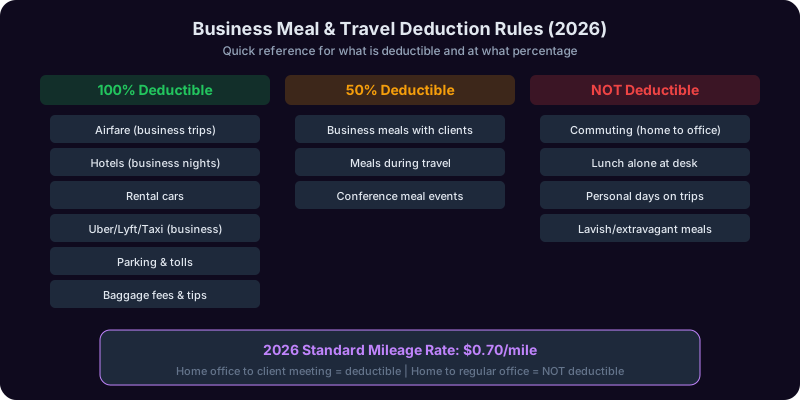
- Airfare, train, and bus tickets: Fully deductible for business travel
- Hotel and lodging: Deductible for business nights. If you extend a business trip for personal reasons, only the business nights are deductible.
- Rental cars: Fully deductible during business travel
- Taxis, Uber, and Lyft: Deductible for business transportation
- Parking and tolls: Deductible for business-related driving
- Baggage fees: Deductible
- Tips: Deductible on business meals and transportation
A key rule: if you combine business and personal travel, you must allocate expenses. A 5-day trip where 3 days are business and 2 are personal means you deduct the airfare in full (since the primary purpose is business) but only 3/5 of hotel costs.
Business Meals
Business meals are 50% deductible for 2026. The temporary 100% deduction for restaurant meals that existed in 2021-2022 has expired. To qualify:
- The meal must be with a client, potential client, colleague, or business associate
- Business must be discussed before, during, or after the meal
- The expense must not be lavish or extravagant (use good judgment)
For each meal, record: the date, restaurant, amount, who attended, and the business purpose discussed. The IRS requires this documentation for every meal deduction. "Lunch with client" is not sufficient. "Lunch with Sarah Chen of Acme Corp to discuss Q3 project proposal" is.
Vehicle Expenses
If you drive for business (meeting clients, delivering work, traveling to project sites), you can deduct either:
- Standard mileage rate: $0.70 per mile for 2026. Simpler, requires a mileage log.
- Actual expenses: Gas, insurance, repairs, depreciation, registration. Requires tracking all costs and calculating business-use percentage.
Commuting from home to a regular office is never deductible. But if your home is your primary office, driving from home to a client meeting is a business trip and fully deductible. Track every business trip with the Freelance Copilot to make sure nothing falls through the cracks. For a deeper dive into side income tax obligations, read our side hustle taxes guide.

Get Answers From the Tax Copilot
The Tax Copilot analyzes your freelance expenses and identifies deductions you're probably overlooking - home office, vehicle, health insurance, retirement, and more.
Health Insurance Deduction
If you are self-employed and pay for your own health insurance, you can deduct 100% of the premiums for yourself, your spouse, and your dependents. This is one of the most significant deductions available to freelancers.
How It Works
The self-employed health insurance deduction is taken on Schedule 1 of Form 1040, not on Schedule C. This is an important distinction. It reduces your adjusted gross income (AGI) but does not reduce your self-employment tax. You do not need to itemize deductions to claim it. For the official rules, see IRS Topic No. 502.
What Qualifies
- Medical insurance premiums (including marketplace/ACA plans)
- Dental insurance premiums
- Vision insurance premiums
- Long-term care insurance premiums (age-based limits apply)
- Medicare Part B and Part D premiums (if self-employed and not covered by an employer plan)
Eligibility Rules
You qualify if:
- You have net self-employment income (Schedule C shows a profit)
- You are not eligible for employer-subsidized health insurance through your own job, your spouse's job, or your parent's plan (if under 26)
The deduction cannot exceed your net self-employment income. If your freelance profit is $8,000 and your premiums are $10,000, you can only deduct $8,000. The remaining $2,000 may be deductible as an itemized medical expense if your total medical costs exceed 7.5% of AGI.
The Numbers
In 2026, the average health insurance premium for a self-employed individual is approximately:
| Individual (age 30) | $350-$500/month |
| Individual (age 50) | $600-$900/month |
| Family | $1,200-$2,500/month |
At an average of $6,000/year for individual coverage, this deduction saves a freelancer in the 22% federal bracket approximately $1,320 in federal taxes plus state tax savings. For a family paying $20,000/year, the savings can exceed $5,000.
If you are shopping for health insurance as a freelancer, the Freelance Copilot can walk you through marketplace options and help you estimate the tax impact of different plan choices based on your projected income.
See our real-world walkthrough: first freelance tax season.
Retirement Contributions: SEP IRA, Solo 401(k), and More
Retirement contributions are among the largest deductions available to freelancers. The right retirement account can shelter tens of thousands of dollars from current taxes while building long-term wealth. Try our AI tax filing assistant for step-by-step help.
SEP IRA (Simplified Employee Pension)
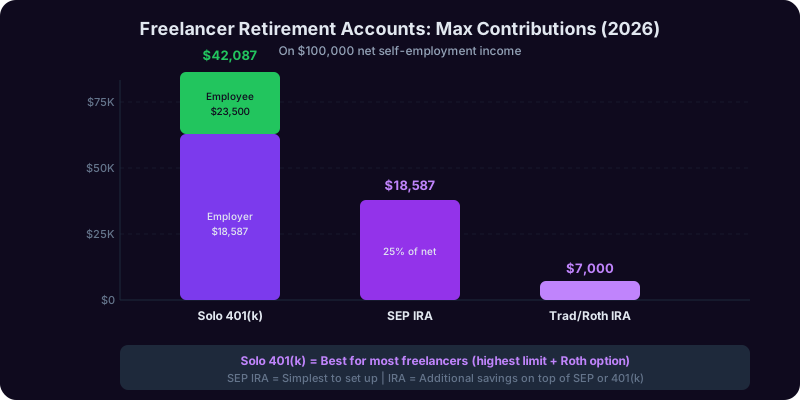
The simplest option for freelancers. You can contribute up to 25% of net self-employment income, with a maximum of $70,000 for 2026. "Net self-employment income" means your Schedule C profit minus half of your self-employment tax.
Example: If your freelance net profit is $100,000, your maximum SEP contribution is approximately $18,587 (the formula accounts for the SE tax deduction). The entire amount is tax-deductible, reducing your federal and state income tax.
Pros: Easy to set up (most brokerages offer free SEP IRAs), no annual filing requirements, high contribution limits. Cons: No Roth option, no catch-up contributions, and if you have employees, you must contribute the same percentage for them.
Solo 401(k)
The most powerful option for freelancers with no employees (other than a spouse). You can contribute as both employee and employer:
- Employee contribution: Up to $23,500 (or $31,000 if 50+)
- Employer contribution: Up to 25% of net self-employment income
- Combined maximum: $70,000 (or $77,500 with catch-up)
The Solo 401(k) also offers a Roth option on the employee contribution side, allowing after-tax contributions that grow tax-free. This flexibility makes it superior to a SEP IRA for most freelancers. For a detailed comparison of retirement account types, see our Roth IRA vs. Traditional IRA guide.
Example: With $100,000 in net profit, you could contribute $23,500 as employee deferrals plus approximately $18,587 as employer contributions, for a total of roughly $42,087 in tax-deductible retirement savings.
Traditional and Roth IRA
In addition to a SEP or Solo 401(k), you can contribute to a traditional or Roth IRA. The 2026 limit is $7,000 ($8,000 if 50+). Traditional IRA contributions may be tax-deductible depending on your income and whether you are covered by an employer plan. Roth contributions are not deductible but provide tax-free growth.
Which One Should You Choose?
| Account | Best For | Max Contribution |
|---|---|---|
| SEP IRA | Simplicity, high income | $70,000 |
| Solo 401(k) | Maximum flexibility, Roth option | $70,000-$77,500 |
| Traditional IRA | Lower income, additional savings | $7,000-$8,000 |
The Tax Copilot can calculate the optimal contribution for your specific income level and help you compare the tax savings between a SEP IRA and Solo 401(k).
Education and Training
If you invest in skills that maintain or improve your abilities in your current freelance work, those costs are deductible. The key distinction: education that maintains or improves existing skills is deductible. Education that qualifies you for a new career is not.
Deductible Education Expenses
- Online courses: Udemy, Coursera, Skillshare, LinkedIn Learning, MasterClass (if related to your field). A web developer taking an advanced React course is deductible. That same developer taking a culinary arts course is not (unless they also freelance as a food writer).
- Conferences and workshops: Registration fees, travel, and lodging for industry conferences. A photographer attending a lighting workshop or a writer attending a publishing conference. Include associated travel expenses (airfare, hotel, meals at 50%).
- Professional certifications: CPA exam prep, PMP certification, AWS certification, Google Analytics certification. The exam fees and study materials are deductible.
- Books and publications: Industry books, technical manuals, trade magazine subscriptions, and research materials directly related to your work.
- Coaching and mentoring: Business coaching, industry mentorship programs, and mastermind groups with a clear business purpose.
- Webinars and virtual events: Paid webinars and virtual conference fees related to your field.
What Is NOT Deductible
- Degree programs that qualify you for a new profession (law school when you are currently a freelance designer)
- Education that meets minimum requirements for a field (you cannot deduct the accounting degree that makes you eligible to become a CPA if you were not already one)
- Courses unrelated to your current business
The Lifetime Learning Credit Alternative
If your education expenses do not qualify as business deductions (perhaps you are pursuing a degree), you may qualify for the Lifetime Learning Credit of up to $2,000 per year. This is a tax credit (directly reduces your tax bill) rather than a deduction (reduces taxable income). Income limits apply: the credit phases out between $80,000-$90,000 AGI for single filers.
Document each educational expense with the date, provider, course title, cost, and a note about how it relates to your current freelance work. This documentation is essential if audited.
Often-Missed Deductions Most Freelancers Overlook
Beyond the big categories, there are dozens of smaller deductions that add up. Here are the ones most freelancers miss entirely.
Half of Self-Employment Tax
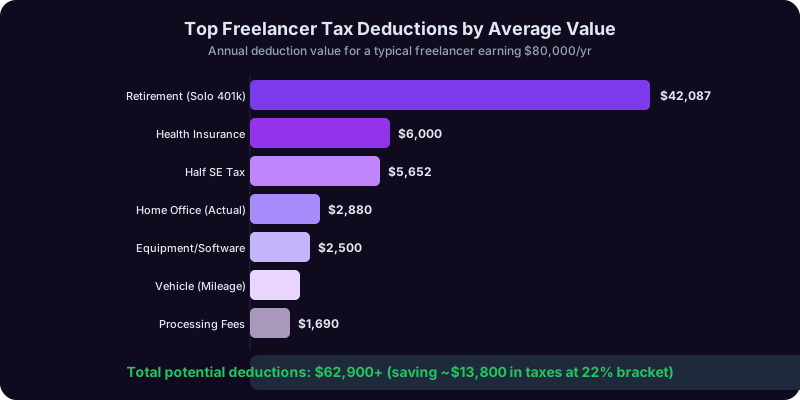
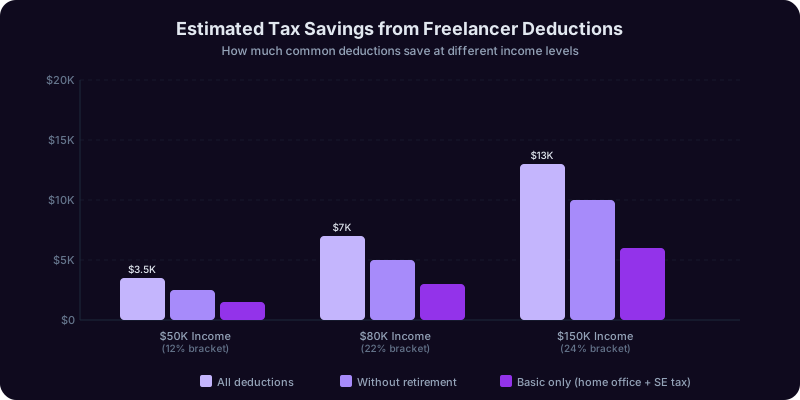
You can deduct 50% of your self-employment tax on your 1040. On $80,000 of freelance income, your SE tax is approximately $11,304. Half of that ($5,652) is deductible, saving you roughly $1,243 in federal income tax at the 22% bracket. This is automatic on your return, but many freelancers do not realize it exists. The IRS self-employment tax page explains how this deduction works.
Business Insurance
- Professional liability (E&O) insurance: $500-$2,000/year depending on your field. Fully deductible.
- General liability insurance: Required by many clients, especially for consultants and contractors.
- Business property insurance: Covers your equipment against theft, damage, or loss.
- Cyber liability insurance: Increasingly important for freelancers handling client data.
Bank and Payment Processing Fees
PayPal fees, Stripe fees, Square fees, credit card processing charges, wire transfer fees, and business bank account fees. These are often small per transaction but add up to hundreds of dollars per year. PayPal alone charges 2.89% + $0.49 per transaction. On $50,000 in payments processed, that is approximately $1,690 in deductible fees.
Professional Memberships and Dues
Industry associations, professional organizations, chambers of commerce, coworking space memberships. If the membership benefits your business, it is deductible.
Advertising and Marketing
- Business cards and printed materials
- Portfolio website hosting and maintenance
- Social media advertising (Facebook Ads, LinkedIn Ads, Google Ads)
- SEO tools and services
- Email marketing platforms (Mailchimp, ConvertKit)
Legal and Professional Services
- Contract review by an attorney
- Business formation (LLC filing fees)
- Tax preparation fees (the Schedule C portion)
- Bookkeeping services
Home Internet and Phone
The business percentage of your internet bill and phone bill. If you use your internet 70% for business, 70% of the monthly bill is deductible. Track actual usage or use a reasonable estimate.
Startup Costs
If you started freelancing this year, you can deduct up to $5,000 in startup costs immediately (the remainder is amortized over 15 years). This includes market research, advertising before launch, training, and legal fees to set up your business.
How to Track Everything Without Losing Your Mind
Deductions only count if you can prove them. The IRS requires documentation for every business expense, and in an audit, missing records mean lost deductions. Here is a system that works without consuming hours of your time.
The Weekly 15-Minute System
Set aside 15 minutes once a week (same day, same time) to:
- Review bank and credit card transactions for the week
- Categorize each business expense in your accounting software or spreadsheet
- Photograph any paper receipts and attach them to the transaction
- Note the business purpose for any expense that might be questioned (meals, travel, equipment)
This single habit prevents the December panic of trying to reconstruct 12 months of expenses from bank statements.
Required Documentation
For every deduction, keep:
- Amount: The exact dollar amount
- Date: When the expense was incurred
- Place/Vendor: Where you bought it
- Business purpose: Why it was necessary for your business
- Receipt: Physical or digital. The IRS specifically requires receipts for expenses over $75.
Tools That Make It Easy
- Separate bank account: This is non-negotiable. Every business transaction through one account creates an automatic paper trail. Opening a business checking account takes 15 minutes and many banks offer them free.
- Dedicated credit card: Use one card exclusively for business expenses. The statement becomes a categorized record of spending.
- Receipt scanning: Apps like Dext (formerly Receipt Bank) or the built-in receipt capture in QuickBooks let you photograph receipts and auto-extract the data.
- Mileage tracking: Use MileIQ or Everlance to automatically log business drives. Manual tracking in a spreadsheet works but requires discipline.
End-of-Year Checklist
Before filing, review these categories to make sure nothing was missed:
- All 1099 forms received match your records
- Home office square footage measured and documented
- Total business mileage calculated
- Health insurance premiums totaled
- Retirement contributions confirmed with custodian
- All subscriptions and recurring charges accounted for
- Equipment purchases logged with receipts
- Professional development expenses documented
Building an emergency fund alongside your tax savings ensures that quarterly estimated payments do not catch you off guard. And if you are thinking about structuring your freelance business, our guide on how to start a side hustle covers the business setup basics.
The Bookkeeping Copilot can help you set up a tracking system, review your categories, and identify deductions you might be missing based on your specific freelance work.
This is general information, not financial advice. Consult a qualified tax professional for guidance specific to your situation.
For more on this topic, read our guide on Side Hustle Taxes: Everything the IRS Expects From You.
Frequently Asked Questions
Recommended Copilots
Recommended Copilots
Identify every deduction you qualify for based on your specific freelance situation
Try Free →Set up expense tracking to maximize deductions and minimize audit risk
Try Free →Get comprehensive freelance business guidance including tax strategy
Try Free →Continue Exploring
Related Scenarios
For You
How It Works
Related Articles
Get Answers From the Tax Copilot
The Tax Copilot analyzes your freelance expenses and identifies deductions you're probably overlooking - home office, vehicle, health insurance, retirement, and more.