
Finance & Money
Side Hustle Taxes: What You Actually Owe
Side income changes your taxes - here's how to stay ahead of it
Free plan, no card. Or read the whole plan below first.
What is happening
You have a day job with a regular W-2, but you also earn money on the side - maybe from freelance gigs, an Etsy shop, driving for a rideshare service, tutoring, renting out a room, or selling digital products. Now tax season is approaching and you realize your side income creates tax obligations you've never dealt with before. You're not sure if you need to file quarterly, what you can deduct, or how much extra you actually owe.
The IRS requires you to report all income, including side hustle earnings. If your net self-employment income exceeds $400 in a year, you owe self-employment tax (15.3%) on top of your regular income tax. Many side hustlers are blindsided by a tax bill of $2,000-$8,000 because they didn't plan for it. But there's good news: side hustlers also qualify for dozens of deductions that can significantly reduce what they owe. The difference between doing this right and doing this wrong can easily be $3,000 or more.
This usually looks like
- Receiving a 1099-NEC or 1099-K for the first time
- Earning more than $400 in side income during the year
- Getting a penalty notice from the IRS for underpayment of estimated taxes
- Realizing your W-2 withholding doesn't cover your side income tax liability
- Starting to sell products or services through an online marketplace
- A friend or colleague mentioning quarterly estimated payments
What to do, in order
- 01
Determine Whether You Need to File
January - February
If your net self-employment income (gross income minus business expenses) exceeds $400 for the year, you must file Schedule C and Schedule SE with your tax return. This threshold is cumulative across all side hustles. Even if no single client sent you a 1099, you are still required to report the income. If you earned less than $400 net, you still report the income on your 1040 but skip the self-employment tax forms.
How a copilot helpsThe tax copilot can help you calculate your net self-employment income by walking through your gross earnings and allowable expenses to confirm whether you cross the $400 threshold.
- 02
Gather All Income Records
January - February
Collect every 1099-NEC, 1099-K, and 1099-MISC you receive. Cross-reference them against your own records because platforms sometimes underreport or delay sending forms. If you received cash, Venmo, Zelle, or other direct payments, you must report those too. Check your PayPal, Stripe, or marketplace dashboards for annual summaries. Remember: the IRS receives copies of your 1099s, so any mismatch will generate a notice.
How a copilot helpsThe bookkeeping copilot can help you create an income reconciliation worksheet that tracks every payment source and flags discrepancies between your records and official tax forms.
- 03
Identify and Document Deductible Expenses
February
Every ordinary and necessary expense related to your side hustle is deductible. Common deductions include supplies and materials, software subscriptions, a portion of your phone and internet bill, mileage (67 cents per mile in 2025), home office space, professional development, advertising costs, and transaction or platform fees. The key is that the expense must be directly connected to generating your side income. Keep receipts or digital records for everything.
How a copilot helpsThe tax copilot can walk you through the full list of Schedule C deduction categories, help you determine which of your expenses qualify, and estimate the tax savings for each deduction.
- 04
Understand Your Self-Employment Tax Obligation
February - March
As a W-2 employee, your employer pays half of your Social Security (6.2%) and Medicare (1.45%) taxes. For your side income, you pay both halves - a combined 15.3% on net earnings. On $20,000 of net side income, that's roughly $3,060 in self-employment tax alone, on top of your regular income tax. However, you can deduct half of your SE tax from your adjusted gross income, which reduces your income tax. This deduction happens automatically on Schedule 1 of your 1040.
How a copilot helpsThe tax copilot can calculate your exact self-employment tax liability and show how the 50% deduction reduces your overall effective rate, giving you a clearer picture of what you actually owe.
- 05
Determine Whether You Need Quarterly Estimated Payments
Ongoing (quarterly)
If you expect to owe more than $1,000 in total tax (after subtracting W-2 withholding and credits), the IRS expects you to make quarterly estimated payments. Due dates are April 15, June 15, September 15, and January 15. You can avoid penalties by paying at least 90% of your current year tax or 100% of your prior year tax (110% if your AGI exceeds $150,000). Alternatively, you can increase your W-2 withholding to cover the shortfall - this is often simpler for people with relatively modest side income.
How a copilot helpsThe tax copilot can estimate your quarterly payment amounts using both the current-year and prior-year safe harbor methods, and help you decide whether adjusting your W-2 withholding is a smarter approach.
- 06
File Schedule C and Schedule SE
March - April 15
Schedule C reports your side hustle income and expenses. If you have multiple unrelated side hustles, you may file a separate Schedule C for each one. Schedule SE calculates your self-employment tax based on your net profit. Both schedules attach to your Form 1040. If your side hustle had a net loss, that loss may offset your W-2 income, but the IRS scrutinizes hobby losses closely, so make sure your activity qualifies as a business.
How a copilot helpsThe tax copilot can guide you through each line of Schedule C and Schedule SE, flagging common mistakes like forgetting to deduct the employer-equivalent portion of SE tax or misclassifying personal expenses as business costs.
- 07
Separate Business and Personal Finances Going Forward
Any time (start now)
Open a dedicated checking account for your side hustle income and expenses. This makes bookkeeping dramatically easier, strengthens your deduction claims in an audit, and gives you a clean record at tax time. You do not need to form an LLC or get a separate EIN for this - a simple second checking account in your own name works fine. Route all business payments through this account.
How a copilot helpsThe bookkeeping copilot can recommend a simple record-keeping system that takes less than 15 minutes per week and keeps your side hustle finances audit-ready year-round.
- 08
Plan Ahead for Next Year
Year-round planning
If your side hustle is growing, consider whether it makes sense to set up a SEP-IRA or Solo 401(k) to shelter some of that income from taxes. Contributions reduce your taxable income dollar for dollar. Also evaluate whether forming an LLC or electing S-Corp status would save you money on self-employment tax - this typically becomes worthwhile once net side income consistently exceeds $40,000-$50,000 per year.
How a copilot helpsThe finance copilot can model different scenarios - sole proprietor vs. LLC vs. S-Corp - and show you the tax savings at various income levels, helping you decide when it makes sense to change your business structure.
Questions worth asking
These are the ones that change the outcome. Most people do not know to ask them.
Do I need to pay quarterly estimated taxes, or can I adjust my W-2 withholding instead?
Many side hustlers don't realize they can increase their W-2 withholding (by filing a new W-4 with their employer) to cover the extra tax from side income. The IRS doesn't care where the money comes from, as long as your total payments meet the safe harbor threshold. This is often simpler than mailing quarterly checks.
The tax copilot can calculate how much to increase your W-2 withholding per paycheck to cover your estimated side income tax, and help you fill out the W-4 correctly.
What counts as a deductible business expense for my specific side hustle?
Deductions vary significantly by industry. A rideshare driver's biggest deduction is mileage. An Etsy seller deducts materials and shipping. A freelance designer deducts software subscriptions and equipment. Understanding which expenses apply to your specific side hustle is the fastest way to reduce your tax bill.
The tax copilot can generate a personalized deduction checklist based on your specific type of side hustle, including commonly overlooked deductions that many people miss.
Is my side hustle a business or a hobby in the eyes of the IRS?
If the IRS reclassifies your side hustle as a hobby, you lose all your business deductions. The IRS looks at several factors: whether you keep good records, whether you operate in a businesslike manner, whether you have a profit motive, and whether you have been profitable in at least 3 of the last 5 years. If your side hustle consistently loses money, this is a real risk.
The tax copilot can evaluate your side hustle against the IRS nine-factor hobby loss test and suggest steps to strengthen your position as a legitimate business.
Do I need to collect and remit sales tax on my side hustle income?
Sales tax is separate from income tax and applies to the sale of goods (and some services) in most states. If you sell physical or digital products, you may be required to collect sales tax from buyers in states where you have nexus. The rules changed significantly after the 2018 Supreme Court Wayfair decision, and thresholds vary by state.
The tax copilot can identify which states you may have sales tax obligations in based on your sales volume and where your customers are located.
What records do I need to keep, and for how long?
The IRS can audit you for up to 3 years after filing (6 years if you underreport income by more than 25%). You need to keep receipts, bank statements, mileage logs, and any documentation supporting your income and deductions for at least 3 years. Digital records are perfectly acceptable.
The bookkeeping copilot can help you set up a simple digital filing system and create a record retention schedule so you know exactly what to keep and when it's safe to delete.
How Side Income Is Taxed Differently Than W-2 Income
When you earn a paycheck from an employer, taxes are straightforward. Your employer withholds federal income tax, Social Security (6.2%), and Medicare (1.45%) from each paycheck, and they match your Social Security and Medicare contributions on their end. You file a return in April, and it's done.
Side hustle income works differently. No one withholds taxes for you. No employer is paying the other half of Social Security and Medicare. You are responsible for the full 15.3% self-employment tax plus your federal and state income tax on every dollar of net profit. On $10,000 of net side income, expect to owe roughly $1,530 in self-employment tax plus $1,200-$2,200 in income tax (depending on your bracket), for a total of roughly $2,700-$3,700. The IRS's official self-employment tax explainer covers the mechanics in detail.
The silver lining is the deduction for half of your self-employment tax. You can subtract 50% of your SE tax from your adjusted gross income on Schedule 1 of your 1040. This reduces your income tax, though not your SE tax itself. It's an above-the-line deduction, meaning you get it regardless of whether you itemize.
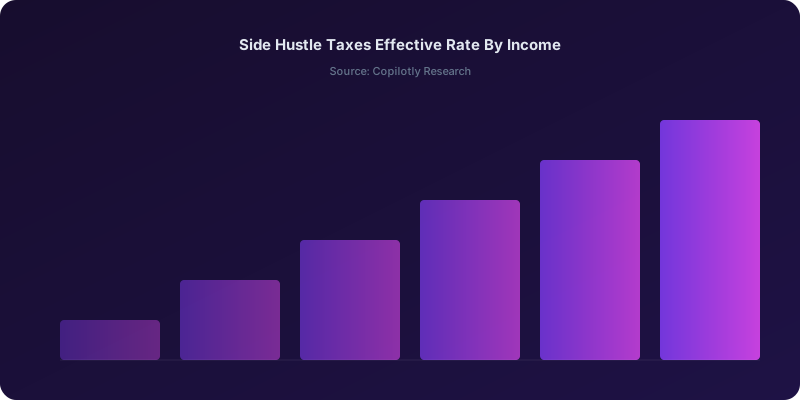
Another key difference: side income can push you into a higher marginal tax bracket. If your W-2 income puts you at the top of the 22% bracket, even modest side income gets taxed at 24% (or higher). The tax copilot can model your exact bracket situation and show you how each additional dollar of side income is taxed, so there are no surprises. See our complete side hustle tax guide for 2026 for a full walkthrough, or explore when to form an LLC for your side hustle if your income is growing.
One common misconception: earning side income does not mean you should automatically switch to itemizing your deductions. The standard deduction ($15,000 for single filers in 2025) applies to your overall return, and your side hustle business deductions are taken on Schedule C, completely separate from the standard deduction vs. itemized deduction decision. You can take the standard deduction and deduct all your business expenses. For more on structuring a growing side hustle, see how Copilotly helps freelancers manage taxes, contracts, and client relationships.
The Complete Guide to Side Hustle Deductions
Business deductions are the most powerful tool for reducing your side hustle tax bill. Every dollar you deduct reduces your taxable income and your self-employment tax base. Here are the major categories, organized by how commonly they apply.
Nearly universal deductions: Transaction and platform fees (PayPal, Stripe, Etsy, Uber fees), software and tools (accounting software, design tools, scheduling apps), phone and internet (the percentage used for business), office supplies, and professional development (courses, books, conferences related to your work).
Home office deduction: If you use a dedicated space in your home regularly and exclusively for your side hustle, you can deduct a portion of your rent or mortgage interest, utilities, insurance, and repairs. The simplified method gives you $5 per square foot up to 300 sq ft ($1,500 max). The actual expense method can yield significantly more but requires tracking real costs. The tax copilot can calculate both methods and recommend the better option.
Vehicle and mileage: If you drive for your side hustle (deliveries, client meetings, rideshare), you can deduct either the standard mileage rate (67 cents/mile for 2025) or actual vehicle expenses (gas, insurance, maintenance, depreciation) prorated by business use. Keep a mileage log - apps like MileIQ make this easy. Commuting from home to a regular job does not count, but driving from your home office to a client site does.
Health insurance premiums: If you are not eligible for employer-sponsored health insurance and you pay your own premiums, you may be able to deduct them as a self-employed health insurance deduction. This is an above-the-line deduction, not a Schedule C deduction, but it can save you thousands. The finance copilot can help you determine eligibility and calculate the benefit.
Retirement contributions: SEP-IRA contributions (up to 25% of net self-employment income) and Solo 401(k) contributions are deductible and reduce your taxable income. This is one of the most effective tax-reduction strategies for side hustlers with consistent income.
Commonly overlooked deductions: Bank fees on your business account, business insurance, legal and accounting fees, bad debts (invoices you were never paid for), business cards and marketing materials, and continuing education directly related to your side hustle.
Quarterly Estimated Payments: When, How Much, and How to Avoid Penalties
The U.S. tax system is pay-as-you-go. Employees handle this through withholding. Side hustlers handle it through quarterly estimated payments - or by increasing their W-2 withholding. If you don't pay enough throughout the year, the IRS charges an underpayment penalty.
Do you need to pay quarterly? You must make estimated payments if you expect to owe $1,000 or more in tax after subtracting your W-2 withholding and any credits. There are two safe harbors that protect you from penalties: (1) pay at least 90% of your current year tax liability, or (2) pay at least 100% of your prior year tax liability (110% if your AGI was over $150,000). If your W-2 withholding covers either threshold, you can skip quarterly payments. The IRS's estimated taxes guide explains both safe harbor methods with official examples.
The W-2 withholding workaround. Many side hustlers find it easier to file a new W-4 with their employer and increase their federal withholding by an extra amount per paycheck. If you're paid biweekly and expect to owe $4,000 in extra tax, withholding an additional $154 per paycheck covers it. The IRS treats withholding as paid evenly throughout the year, even if you increase it late, which means this approach can eliminate underpayment penalties even if you set it up in December. The tax copilot can calculate the exact per-paycheck amount.
How to make quarterly payments. Use IRS Direct Pay at irs.gov/payments, the EFTPS system, or mail a check with Form 1040-ES. Payments are due April 15, June 15, September 15, and January 15. Note the uneven spacing - the second quarter is only two months. Mark these dates in your calendar. Late payments accrue interest at the current federal rate (approximately 8% annualized in 2025).

What if you missed a quarter? Make the payment as soon as possible. The penalty is calculated on a per-quarter basis, so a late payment still reduces your total penalty. If this is your first year with side income, the prior-year safe harbor (100% of last year's tax) may still protect you, since your prior year likely had lower total tax. The budgeting copilot can help you set up a system to automatically save a percentage of each side hustle payment for taxes, so you're never caught short at payment time. You can also read our complete freelancer tax deductions list to make sure you're capturing every dollar before your next quarterly payment, and see how Copilotly helps gig workers stay on top of their tax obligations year-round.
State Tax Obligations for Side Hustlers
Federal taxes get most of the attention, but your state has its own rules for side hustle income. Most states with an income tax require you to report self-employment income and pay state estimated taxes using a schedule similar to the federal one.
State income tax. If your state has an income tax, your side hustle net profit is taxable at your state's rate. Some states (like California, New York, and New Jersey) have high rates that can add 6-10% to your total tax bill. Nine states have no income tax at all: Alaska, Florida, Nevada, New Hampshire (limited), South Dakota, Tennessee, Texas, Washington, and Wyoming. If you live in a no-income-tax state, you only deal with federal self-employment and income taxes.
Multi-state issues. If your side hustle serves clients in multiple states, you generally owe tax in the state where the work is performed (for services) or where the sale occurs (for goods). For most side hustlers working from home, this means you only owe tax in your home state. But if you travel to client sites in other states or have significant sales into states with economic nexus thresholds, you may have additional filing obligations.
Sales tax. If your side hustle involves selling goods (physical or digital in some states), you may need to collect and remit sales tax. After the 2018 South Dakota v. Wayfair decision, states can require out-of-state sellers to collect sales tax once they exceed certain thresholds (commonly $100,000 in sales or 200 transactions). Marketplace facilitators like Etsy and Amazon often handle this for you, but if you sell through your own website, you may be responsible. The tax copilot can identify your sales tax obligations based on where you sell and what you sell.
Business licenses and local taxes. Some cities and counties require a business license even for sole proprietors working from home. Fees are typically $50-$200 per year. A few cities (Philadelphia, for example) impose local income taxes or business privilege taxes on all self-employment income earned within city limits. Check your city and county requirements - the penalty for operating without a required license is usually small, but it's an easy thing to get right.
Understanding 1099s: What You Receive and What You Report
The 1099 form is the IRS's way of tracking non-employment income. There are several types, and understanding what triggers them helps you plan.
1099-NEC (Nonemployee Compensation): This is the most common form for freelancers and independent contractors. Any client who pays you $600 or more during the year must send you a 1099-NEC by January 31. You should receive one from each qualifying client. If you have 10 clients who each paid you $500, none of them are required to send a 1099, but you still must report all $5,000 in income.
1099-K (Payment Card and Third-Party Network Transactions): Payment processors like PayPal, Stripe, Venmo (business), and marketplace platforms like Etsy, Uber, and Airbnb send this form when your gross payments exceed $600 (the threshold dropped from $20,000 starting in 2024). Important: the 1099-K reports gross payments before fees and refunds. If your 1099-K shows $15,000 but you paid $2,000 in platform fees and issued $1,000 in refunds, your net income is $12,000. Reconcile carefully.
What if you don't receive a 1099? You still owe tax on the income. The $600 threshold is a reporting requirement for the payer, not an exemption for you. Cash payments, Zelle transfers, personal Venmo payments, and small-amount gigs all count. The IRS matches 1099s to your return using your Social Security number, so underreporting income that was reported on a 1099 will almost certainly trigger a CP2000 notice.
What if a 1099 is wrong? Contact the issuer and request a corrected form (1099-C). If they refuse or are unresponsive, report the correct amount on your return and keep documentation supporting your figure. You can also file Form 4852 as a substitute. The bookkeeping copilot can help you reconcile your records against your 1099s and draft communication to issuers when corrections are needed.
Reporting income without a 1099: On Schedule C, you report total gross income from all sources. The IRS does not require you to break it down by client. Simply total your income from all side hustle activities and enter it on Line 1 of Schedule C. Keep your own records of who paid you what, in case the IRS ever asks.
Common Side Hustle Tax Mistakes and How to Avoid Them
After working through thousands of side hustle tax situations, certain mistakes come up again and again. Here are the ones that cost people the most money or cause the most problems.
Mistake #1: Not setting aside money for taxes. The single biggest problem. Side hustle income arrives without any tax withheld, and it's easy to spend it all. Then April comes and you owe $3,000 you don't have. The fix: set aside 25-30% of every side hustle payment the moment it arrives. Put it in a separate savings account. Don't touch it. The budgeting copilot can help you determine the right percentage based on your tax bracket.
Mistake #2: Missing deductions. Many side hustlers forget to deduct expenses they're entitled to - especially mileage, home office, and the self-employed health insurance deduction. Others forget that half of their self-employment tax is deductible. These missed deductions can cost $500-$3,000 per year. The tax copilot generates a personalized deduction checklist so nothing falls through the cracks.
Mistake #3: Confusing gross revenue with net income. Your 1099-K from Etsy might show $25,000 in sales, but if you had $8,000 in materials, $3,000 in shipping, and $2,500 in platform fees, your net Schedule C income is $11,500. Tax software often asks you to enter your 1099-K amount, and then you deduct expenses separately. Don't panic at the gross number.
Mistake #4: Not keeping a mileage log. The IRS requires contemporaneous records for vehicle deductions. A spreadsheet you create in April from memory is not sufficient. Use a mileage tracking app that runs in the background, or keep a simple notebook in your car. Without proper records, your entire vehicle deduction can be disallowed in an audit.
Mistake #5: Claiming personal expenses as business expenses. Your Netflix subscription is not a business expense unless you are a film critic. Your gym membership is not deductible unless you are a personal trainer. The IRS applies an 'ordinary and necessary' test: is the expense common in your type of business and helpful for generating income? Be honest. Aggressive deductions increase audit risk and can result in penalties.
Mistake #6: Ignoring state filing requirements. Many side hustlers file their federal return but forget about state estimated payments or sales tax obligations. State penalties and interest can add up just as quickly as federal ones. The finance copilot can map out all your filing requirements across jurisdictions.
When to get a professional
Including the cases where you probably do not need one. That half matters as much as the other.
Definitely get one
- Your net side income exceeds $50,000 and you want to evaluate S-Corp election
- You received a notice from the IRS about unreported income or underpayment
- You have side income from multiple states and need to file in each one
- You are being audited or have received a CP2000 mismatch notice
- You have complex situations like international income or cryptocurrency earnings
Probably worth it
- Your net side income exceeds $20,000 and you have significant deductions to claim
- You work in a cash-heavy business and want to make sure your reporting is bulletproof
- You are unsure whether your activity qualifies as a business or a hobby
- You want to set up a retirement account specifically for your side hustle income
- You had a loss and want to offset it against your W-2 income
Probably not needed
- Your side income is under $5,000 with simple, well-documented expenses
- You received a single 1099-NEC and have few deductions to claim
- You are comfortable using tax software and your situation is straightforward
- Your side hustle is clearly profitable and your records are well organized
- You only need to file in one state and have no special circumstances
Common questions
How much tax do I owe on side hustle income?
Do I need to pay taxes if I made less than $600 from a side hustle?
Can I deduct expenses if I don't have an LLC?
What happens if I didn't make quarterly estimated tax payments?
Should I form an LLC for my side hustle?
Can my side hustle losses offset my W-2 income?
Get help with this from the Finance & Money Copilot
Describe your situation and get specific, actionable guidance - not the generic hedging a general-purpose chatbot gives you on finance & money questions.
Free plan, no card. Pro from $4.99/week for every copilot across all 20 domains - about what one hour with any single professional costs per year.
Not a financial advisorThis is financial information, not financial advice. Consult a licensed financial professional.