
Money & Finance
DIF Scores and Machine Learning: How the IRS Decides Which Returns to Audit
Every return you file gets a DIF score, and the IRS now layers machine learning on top of it to choose audit targets from an $80 billion enforcement budget. This guide explains what the algorithms flag at each income level, what to do in the first days after a notice, and how to pre-audit your own return before the IRS does.
How the IRS Uses AI and Machine Learning to Flag Returns
The IRS has moved well beyond random selection. Since the Inflation Reduction Act injected $80 billion into IRS enforcement and modernization starting in 2023, the agency has systematically deployed machine learning models to identify returns most likely to yield additional tax revenue. By 2026, AI-driven return selection is the primary mechanism for initiating audits.
The foundation is the Discriminant Information Function (DIF) score, a statistical model the IRS has used since the 1960s. Every return filed receives a DIF score based on how its deductions, income ratios, and credits compare to statistical norms for similar taxpayers. Returns with high DIF scores are flagged for human review. What changed is the sophistication: modern DIF scoring incorporates machine learning models trained on millions of historical audit outcomes, not just static statistical thresholds.
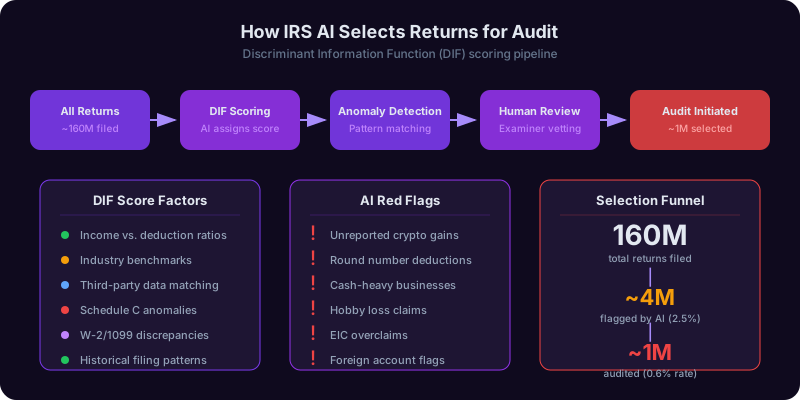
The IRS publicly disclosed in its Strategic Operating Plan that it uses AI for three core functions in audit selection:
- Anomaly detection: ML models compare your return to clusters of similar taxpayers by income source, occupation, geography, and filing status. Deductions or credits that fall far outside the cluster norms get flagged. If 95% of freelance graphic designers in your income bracket claim $4,000-$8,000 in home office deductions but you claim $18,000, the model notices.
- Third-party data matching: The IRS receives over 4 billion information returns annually (W-2s, 1099s, 1098s, K-1s). AI cross-references these against filed returns at scale, catching unreported income that manual review would miss. A 2025 Treasury Inspector General report found automated matching detected $32 billion in underreported income in a single fiscal year.
- Predictive scoring: Models predict the expected additional tax yield from auditing a specific return. The IRS prioritizes audits that are most likely to result in additional revenue, not just audits most likely to find errors. This means high-income returns with complex structures receive disproportionate AI attention.
The IRS also uses AI to detect patterns of fraud and identity theft. Returns that match known fraud schemes, use suspicious preparer identification numbers, or exhibit unusual electronic filing patterns are routed to the Criminal Investigation division before any audit begins.
Understanding this system matters because it shapes your defense strategy. An audit triggered by a DIF score anomaly requires different documentation than one triggered by a 1099 mismatch. The Tax Copilot can help you understand which elements of your return are most likely to draw AI scrutiny based on your specific income profile.
Audit Rates by Income Level and the Top Triggers in 2026
Not all taxpayers face equal audit risk. IRS data shows dramatic variation in audit rates based on income, filing type, and specific return characteristics. Knowing where you fall helps you allocate preparation effort appropriately.
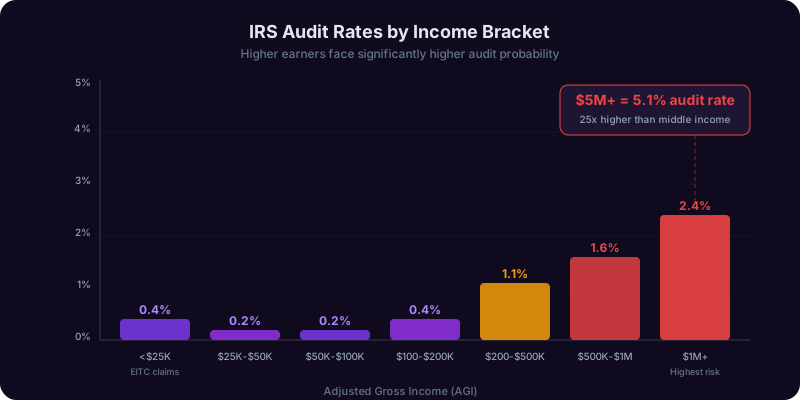
Based on the most recent IRS examination coverage statistics and TRAC Syracuse research, here are audit rates by income bracket for returns filed in 2025:
| Income Level | Audit Rate | Primary Trigger |
|---|---|---|
| Under $25,000 (with EITC) | 0.5% | EITC eligibility verification |
| $25,000 - $100,000 | 0.2 - 0.3% | Information return mismatch |
| $100,000 - $500,000 | 0.4 - 0.7% | Schedule C deductions, rental losses |
| $500,000 - $1 million | 1.3% | Complex investment income, K-1 reporting |
| $1 million - $5 million | 2.4% | Partnership/S-corp pass-through income |
| $5 million - $10 million | 5.2% | Entity structuring, foreign accounts |
| Over $10 million | 13.7% | Comprehensive review priority |
The IRS announced in 2024 that it would increase audit rates on high-income taxpayers while reducing audits on those earning under $400,000. By 2026, this shift is visible: audit rates for filers above $1 million have roughly tripled from their 2019 lows.
Top Audit Triggers Across All Income Levels
- Unreported income: If a 1099 or W-2 reports income that does not appear on your return, you will receive a notice. This accounts for roughly 40% of all IRS correspondence.
- High Schedule C deductions relative to income: Business deductions exceeding 50-60% of gross receipts trigger scrutiny. The AI compares your ratio to industry averages from NAICS code data.
- Large cash transactions: Banks report transactions over $10,000 on Currency Transaction Reports. Structured transactions just below $10,000 are flagged even more aggressively.
- EITC and refundable credit claims: The IRS verifies EITC eligibility on approximately 1 in 200 claims, with a 25% improper payment rate historically.
- Rental property losses: Claiming passive losses against active income without meeting material participation or real estate professional requirements.
- Cryptocurrency reporting gaps: Beginning in 2025, exchanges report transactions on Form 1099-DA. AI cross-references these against Schedule D and Form 8949.
- Round number deductions: Exact figures like $5,000 or $10,000 suggest estimation rather than actual expense tracking.
For self-employed taxpayers, understanding these triggers is critical. Our freelancer tax deductions guide covers how to document each deduction category to withstand scrutiny.
Correspondence vs. Office vs. Field Audits: What to Expect
The word audit covers a wide range of IRS examination activities, from a simple letter asking for one document to a multi-week in-person review of your entire financial life. Understanding the type you face determines your preparation strategy and whether you need professional representation.
Correspondence Audit (75% of All Audits)
This is the most common type. You receive a CP2000 notice or similar letter identifying a specific discrepancy. Common examples: unreported 1099 income, EITC documentation requests, or questions about a specific deduction. The IRS proposes an adjustment and gives you 30 days to respond.
What to expect: you never meet an IRS agent. Everything happens by mail. The IRS identifies the issue, proposes additional tax owed, and you either agree, partially agree, or disagree with documentation. Resolution typically takes 3-6 months. Average additional tax assessed: $8,100 for correspondence audits that result in changes.
Defense strategy: respond promptly with clear documentation. A CP2000 for unreported income is often resolved by showing the income was reported elsewhere on the return (e.g., on Schedule C instead of Schedule D) or that the 1099 amount was incorrect.
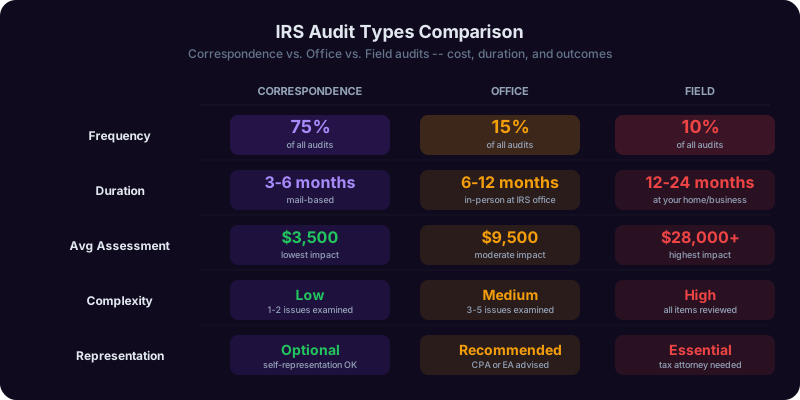
Office Audit (20% of All Audits)
You receive a letter requesting that you appear at a local IRS office with specific records. These typically examine 2-4 items on your return: charitable deductions, business expenses, rental income, or dependency claims. The examiner reviews documents in person.
What to expect: a 2-4 hour appointment. The examiner has a checklist of items and supporting documentation requirements. You bring only what is requested, nothing more. Office audits typically resolve in 1-3 months after the initial meeting. Average additional tax assessed: $14,300.
Defense strategy: organize documentation by category before the appointment. Bring original receipts, bank statements, and a summary spreadsheet linking each deduction to its supporting document. The Tax Copilot can help you create an organized audit file matching each questioned item to its documentation.
Field Audit (5% of All Audits)
An IRS revenue agent comes to your home, business, or accountant's office. Field audits examine your entire return and may expand to prior or subsequent years. These target high-income taxpayers, complex business returns, and suspected fraud.
What to expect: multiple meetings over 3-12 months. The agent reviews books, records, bank statements, and may interview you about your lifestyle to assess whether reported income supports your spending. Average additional tax assessed: $68,000+ for field audits resulting in changes. Agents have quotas for case closures and are evaluated on the revenue they generate.
Defense strategy: never face a field audit without professional representation. A CPA, enrolled agent, or tax attorney should attend every meeting and handle all communication. You have the right to have your representative present and to refuse to answer questions without counsel. For understanding your legal protections, the Legal Copilot can walk you through your rights at each audit stage.
Documentation Requirements: What the IRS Expects and How to Organize It
The single most important factor in audit defense is documentation. The IRS operates under a simple principle: if you cannot prove it, you cannot deduct it. The burden of proof rests on you, not the IRS, for nearly all individual tax matters. Knowing exactly what documentation satisfies IRS requirements eliminates most audit risk.
The Legal Standard: Adequate Records
IRC Section 6001 requires taxpayers to maintain records sufficient to determine the correct tax liability. In practice, the IRS follows the IRS Publication 583 guidelines. Acceptable records include receipts, canceled checks, bank and credit card statements, invoices, mileage logs, and written records made at or near the time of the expense.
Documentation by Category
Income: Keep all W-2s, 1099s (NEC, MISC, K, INT, DIV, B, DA), K-1s, and bank deposit records. If income is cash-based, maintain a daily log with dates, sources, and amounts. The IRS can reconstruct income using bank deposit analysis if your records are insufficient, and this method typically results in higher assessed income than actual earnings.
Business expenses: For any single expense over $75, you need a receipt showing the amount, date, place, and business purpose. For expenses under $75, a log entry or bank/credit card statement is sufficient. For travel, meals, and entertainment, document the business purpose, attendees, and business relationship. The Cohan rule allows courts to estimate deductions when records are lost, but relying on this is risky and results in reduced deductions.
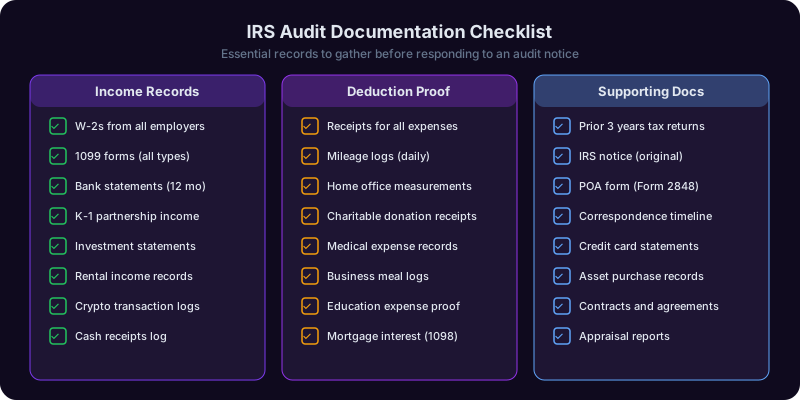
Vehicle expenses: The IRS requires a contemporaneous mileage log: date, destination, business purpose, and miles driven for each trip. Reconstructed logs created after receiving an audit notice carry significantly less weight. If you claim the standard mileage rate, also keep records of total annual miles to establish the business-use percentage.
Home office: Floor plan or measurements showing the dedicated workspace area. Photos of the office space. Utility bills, rent or mortgage statements, and insurance documents if using the actual expense method. Records proving regular and exclusive business use.
Charitable donations: Cash donations of any amount require a bank record, receipt, or written communication from the charity. Donations over $250 require a contemporaneous written acknowledgment from the charity. Non-cash donations over $500 require Form 8283. Items valued over $5,000 require a qualified appraisal.
The Digital Advantage
Digital records are fully accepted by the IRS and are easier to organize and search. Photograph every paper receipt on the day you receive it. Store digital receipts in folders organized by tax year and category. Cloud storage ensures you do not lose records to hardware failure. The Bookkeeping Copilot can help you set up a categorization system that maps directly to Schedule C line items, so your records are audit-ready from day one.
For business owners tracking extensive expenses, our AI bookkeeping guide covers how to automate most of this record-keeping process.
Your Rights During an Audit and the Statute of Limitations
The IRS has enormous power, but it operates within legal boundaries. Knowing your rights prevents you from being pressured into agreements you should not accept. The Taxpayer Advocate Service publishes the Taxpayer Bill of Rights, which codifies these protections.
Key Taxpayer Rights During an Audit
- Right to be informed: The IRS must explain why it is requesting information and what happens if you do not provide it.
- Right to challenge: You can object to formal IRS actions, provide additional documentation, and expect timely consideration.
- Right to appeal: You can appeal most IRS decisions to the Independent Office of Appeals.
- Right to privacy: Inquiries and enforcement actions must be no more intrusive than necessary.
- Right to representation: You may authorize an enrolled agent, CPA, or tax attorney to represent you. During an interview, you can stop and consult with your representative at any time.
- Right to finality: You have the right to know the maximum time the IRS can audit a particular tax year.
Statute of Limitations: How Long the IRS Has
The general statute of limitations is 3 years from the date you filed your return (or the due date, whichever is later). Several exceptions extend this period:
| Situation | Statute Period |
|---|---|
| Standard return | 3 years from filing |
| Substantial understatement (over 25% of gross income omitted) | 6 years |
| Failure to file a return | No limit |
| Fraud | No limit |
| Foreign income over $5,000 not reported | 6 years |
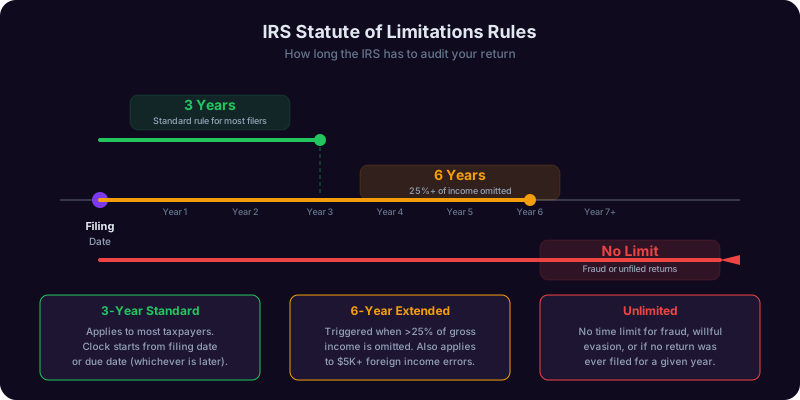
Critical rule: The IRS may ask you to sign Form 872 to extend the statute of limitations. You are not required to agree. However, refusing may lead the IRS to issue a statutory notice of deficiency based on available information, which could be unfavorable. Consult a tax professional before signing any extension.
Practical Rights During an Active Audit
- You can request a different examiner if you believe the current one is biased.
- You can record the interview if you provide 10 days advance notice.
- You are not required to answer questions on the spot. You can respond in writing later.
- You have 30 days to respond to proposed changes before they become final.
If the IRS is not following its own procedures, the Taxpayer Advocate Service (TAS) is an independent organization within the IRS that helps taxpayers resolve problems. Contact TAS if you are experiencing economic hardship due to IRS actions or if normal channels have not resolved your issue within 30 days.
Using AI to Pre-Audit Your Own Return Before the IRS Does
The most effective audit defense happens before you file. Running your return through an AI-powered pre-audit identifies the same anomalies the IRS detection models flag, giving you the opportunity to either correct errors or prepare documentation in advance.
What Pre-Auditing Means in Practice
A pre-audit compares every line of your return against statistical norms for your income level, filing status, occupation, and geography. It identifies items where your numbers deviate significantly from the expected range. Deviation alone does not mean error. It means the item deserves a second look and supporting documentation.
The Tax Copilot walks you through a systematic pre-audit by asking targeted questions about flagged items and helping you verify that each deduction is legitimate and documented. This process typically takes 30-60 minutes and can save thousands in penalties and professional fees if issues are caught before filing.
The Five-Step Pre-Audit Process
Step 1: Income verification. Compare every W-2, 1099, and K-1 against your return. The most common audit trigger is unreported income from a 1099 you forgot or never received. Request your IRS Wage and Income Transcript (available through your IRS Online Account) to see exactly what has been reported to the IRS under your Social Security number.
Step 2: Deduction ratio analysis. Calculate your Schedule C deduction-to-income ratio. AI benchmarking data shows these industry averages:
| Industry | Typical Expense Ratio |
|---|---|
| Consulting/professional services | 25-40% |
| Rideshare/delivery | 50-65% |
| Construction/trades | 55-70% |
| Retail/e-commerce | 60-75% |
| Creative services (design, writing) | 20-35% |
If your ratios significantly exceed these ranges, verify every expense has documentation.
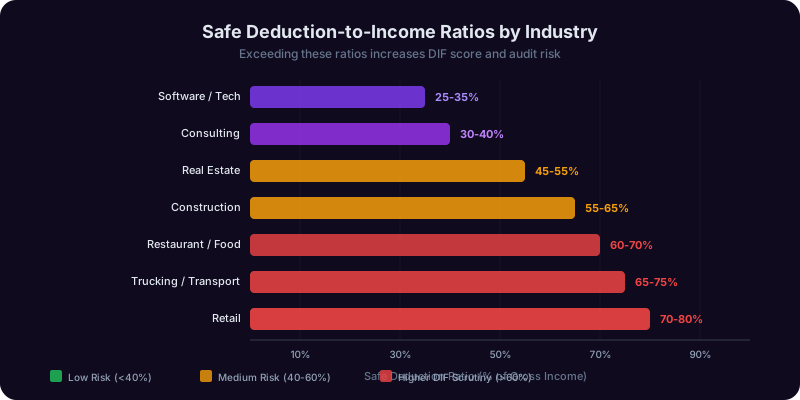
Step 3: Large or unusual items. Any single deduction that represents more than 10% of your total deductions deserves special documentation. Large vehicle deductions, home office deductions, and business travel expenses over $5,000 should each have a clear paper trail.
Step 4: Mathematical consistency. Verify that numbers reported in different sections of your return are internally consistent. Your Schedule C gross receipts should match your 1099 income plus any cash receipts. Your depreciation schedules should carry forward correctly from prior years.
Step 5: Red flag review. Check for known IRS triggers: round numbers, hobby losses for three or more consecutive years, large charitable deductions relative to income, and cash businesses with unusually low reported income. If any apply, prepare additional documentation proactively.
This pre-audit approach is especially valuable for self-employed taxpayers. If you report side hustle income, running a pre-audit before filing can flag issues like miscategorized personal expenses or missing quarterly estimated payments before they become audit triggers.
When to Hire a Tax Attorney vs. CPA vs. Enrolled Agent
Receiving an audit notice triggers a critical decision: do you handle it yourself, or hire a professional? And if you hire someone, which type of professional fits your situation? The wrong choice can cost you thousands in unnecessary fees or, worse, lead to a poor audit outcome.
The Three Types of Tax Professionals Who Can Represent You
Enrolled Agents (EAs): Licensed by the IRS after passing a rigorous three-part exam covering individual taxation, business taxation, and representation. EAs have unlimited practice rights before the IRS, meaning they can represent you in any type of audit, appeal, or collection matter. Average cost for audit representation: $1,500-$4,000. EAs are often the best value for straightforward audits involving income verification, deduction substantiation, or correspondence audit responses.
Certified Public Accountants (CPAs): Licensed by state boards and trained in accounting, auditing, and tax. CPAs who specialize in tax have deep knowledge of tax law and can represent you before the IRS. Average cost for audit representation: $2,500-$8,000. CPAs are ideal when the audit involves complex accounting issues: business valuation, cost basis calculations, inventory methods, or multi-entity structures.
Tax Attorneys: Lawyers specializing in tax law with Juris Doctor degrees and bar admission. Tax attorneys provide attorney-client privilege, which is critical when fraud is suspected or criminal liability is possible. Average cost: $5,000-$25,000+. You need a tax attorney when: the IRS alleges fraud, criminal charges are possible, you are negotiating an Offer in Compromise for large amounts, or the dispute involves novel legal interpretations.
Decision Matrix: Who to Hire and When
| Situation | Best Professional | Estimated Cost |
|---|---|---|
| CP2000 correspondence notice | Self or EA | $0 - $1,500 |
| Office audit (2-3 items) | EA or CPA | $1,500 - $4,000 |
| Field audit (full return) | CPA or Tax Attorney | $5,000 - $15,000 |
| Suspected fraud or criminal | Tax Attorney (mandatory) | $10,000 - $50,000+ |
| Offer in Compromise | EA or Tax Attorney | $3,000 - $10,000 |
| Tax Court petition | Tax Attorney | $8,000 - $30,000+ |
| International reporting issues | CPA with international specialty | $3,000 - $12,000 |
Red Flags in Choosing a Representative
- Avoid anyone who guarantees a specific outcome. No professional can guarantee what the IRS will accept.
- Avoid representatives who charge a percentage of the reduction. This creates incentives for aggressive positions that may not hold up.
- Verify credentials. Confirm EA enrollment at IRS.gov. Verify CPA licenses through your state board. Verify attorneys through your state bar association.
- Ask about audit experience specifically. Tax preparation and audit representation are different skills. A CPA who prepares 500 returns per year but has handled three audits is not the right choice for a field audit.
For initial guidance on whether your situation requires professional help, the Legal Copilot can help you assess the severity of an IRS notice and understand your options before committing to representation. Our guide to AI tax tools also covers how AI fits alongside professional help for different complexity levels.
IRS Penalties, Resolution Options, and How Copilotly Helps You Stay Compliant
Understanding the penalty structure helps you assess audit risk in dollar terms. The IRS imposes penalties at several levels, and most compound over time with interest.
Common IRS Penalties
| Penalty Type | Amount |
|---|---|
| Failure to file | 5% of unpaid tax per month, up to 25% |
| Failure to pay | 0.5% of unpaid tax per month, up to 25% |
| Accuracy-related (negligence) | 20% of the underpayment |
| Substantial understatement | 20% of the underpayment |
| Civil fraud | 75% of the underpayment |
| Estimated tax underpayment | ~8% annual rate on quarterly shortfall |
| FBAR failure (non-willful) | Up to $16,117 per account (2026) |
Penalty Abatement: Your Best Defense
The IRS grants first-time penalty abatement (FTA) if you have a clean compliance history for the prior three years: all returns filed on time, all taxes paid, and no prior penalties. FTA can eliminate thousands in failure-to-file and failure-to-pay penalties. Beyond FTA, you can request abatement for reasonable cause: serious illness, natural disaster, reliance on professional advice, or death of an immediate family member.
Resolution Options After an Audit Assessment
- Pay in full: Stops penalty and interest accrual immediately.
- Installment agreement: Monthly payments over up to 72 months. Setup fee: $31-$225. Interest continues accruing.
- Offer in Compromise (OIC): Settle for less than you owe. The IRS accepted approximately 35% of OIC applications in recent years. Application fee: $205.
- Currently Not Collectible (CNC): Temporarily halts collection during economic hardship.
- Innocent Spouse Relief: Relief from joint liability under IRC Section 6015 if your spouse caused the tax issue.
How Copilotly Helps You Stay Compliant
The best audit defense is not needing one. Copilotly provides AI-powered tools that keep your tax situation clean year-round:
- The Tax Copilot runs pre-audit checks, identifies anomalies before filing, and calculates quarterly estimated payments based on your actual income patterns.
- The Bookkeeping Copilot categorizes expenses in real time, ensuring every deduction has documentation from day one.
- The Legal Copilot explains IRS notices in plain language and guides you through response timelines.
- The Finance Copilot integrates tax awareness into broader financial planning.
AI cannot replace a CPA or tax attorney in a complex audit. But it can dramatically reduce your chances of being selected for one by catching anomalies, organizing documentation, and ensuring accurate reporting before you file.
This article is for informational purposes only and does not constitute tax, legal, or financial advice. Tax laws are complex and change frequently. Consult a qualified tax professional for guidance specific to your situation. Copilotly provides AI-assisted educational guidance and is not a substitute for licensed professional advice.
Frequently asked questions
How does the IRS use AI to select returns for audit?
What is a DIF score and how does it affect my audit risk?
What should I do first when I receive an IRS audit notice?
How long does the IRS have to audit my tax return?
Can I represent myself in an IRS audit or do I need a professional?
What are the most common IRS audit triggers for self-employed taxpayers?
What is first-time penalty abatement and how do I request it?
How can AI tools help me prepare for a potential IRS audit?
Get help with this from the Finance & Money Copilot
Describe your situation and get specific, actionable guidance - not the generic hedging a general-purpose chatbot gives you on finance & money questions.
Free plan, no card. Pro from $4.99/week for every copilot across all 20 domains - about what one hour with any single professional costs per year.
Not a financial advisorThis is financial information, not financial advice. Consult a licensed financial professional.