
The Macro Shift: Why Vertical AI Is the Defining Trend of 2026
A structural transformation is underway in the AI industry. After three years of general-purpose AI dominance led by ChatGPT, Claude, and Gemini, the market is pivoting decisively toward domain-specific AI systems built for particular industries and professional workflows. This is not a niche trend. It is the central story of enterprise AI in 2026.
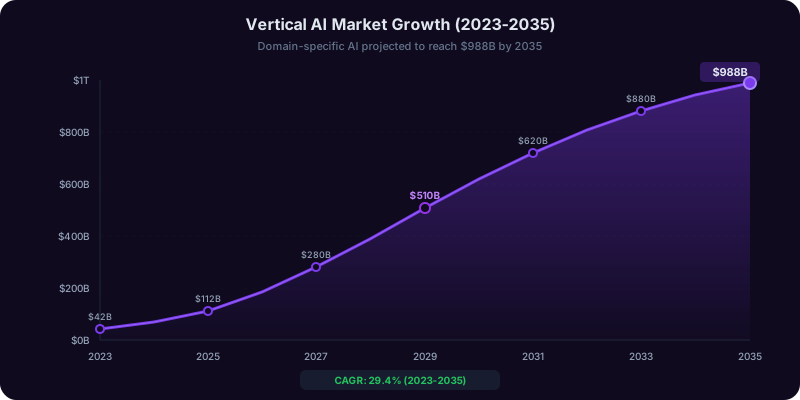
The numbers tell the story. According to Grand View Research, the vertical AI market is projected to reach $988 billion by 2035, growing at a compound annual growth rate of 35.1%. In 2026 alone, enterprise spending on domain-specific AI tools is expected to surpass $82 billion, up from $49 billion in 2025. For context, spending on general-purpose AI assistants like ChatGPT Enterprise and similar products is growing at roughly 18% annually, less than half the rate of vertical AI.
| Metric | General-Purpose AI | Vertical / Domain-Specific AI |
|---|---|---|
| Projected Market (2035) | $320B | $988B |
| CAGR (2025-2035) | 18.2% | 35.1% |
| Enterprise Adoption (2026) | 72% | 58% (and accelerating) |
| Avg. Accuracy (Domain Tasks) | 68-74% | 89-96% |
| User Retention (90-day) | 34% | 71% |
Why the shift is happening now. Three converging forces are driving this transition. First, foundation model costs have plummeted. Fine-tuning a domain-specific model on proprietary data now costs 80-90% less than it did in 2024, making it economically viable for companies to build specialized AI tools for narrower audiences. Second, enterprises have moved past the experimentation phase. After two years of piloting ChatGPT and similar tools, organizations discovered that general-purpose AI creates more problems than it solves for regulated, high-stakes work. Third, users are demanding higher accuracy. A Gartner survey from early 2026 found that 67% of enterprise AI users rated accuracy and domain expertise as their top priorities, ahead of speed and cost.
The parallel to SaaS. This mirrors what happened in enterprise software over the past two decades. Horizontal tools like Salesforce and Microsoft Office dominated initially, but the fastest-growing SaaS companies of the 2010s and 2020s were verticals: Veeva (pharma), Procore (construction), Toast (restaurants), ServiceTitan (home services). The same unbundling is now happening in AI. General-purpose AI is the new horizontal SaaS; domain-specific copilots are the new vertical SaaS. And history shows that verticals ultimately capture more total market value.
Why General-Purpose AI Fails for Domain-Specific Professional Work
ChatGPT is an extraordinary general-purpose tool. It can write poetry, debug code, explain quantum physics, and draft a birthday card, all in the same conversation. But that breadth is precisely what makes it unreliable for professional work where accuracy, compliance, and domain depth matter.
The jack-of-all-trades problem. General-purpose large language models are trained on the entire internet. They know a little about everything and a lot about nothing. When a lawyer asks ChatGPT to analyze a non-compete clause under California law, the model draws on a statistical distribution of all legal text it has seen, not on a curated, verified corpus of California employment law. The result is often plausible-sounding but subtly wrong, missing the nuance that California's Business and Professions Code Section 16600 voids most non-competes entirely, or confusing California's rules with those of a state that enforces them.
Five failure modes of general-purpose AI in professional contexts:
- Hallucinated citations. General-purpose models routinely fabricate case law, medical studies, and financial regulations. A 2025 study by Stanford's CodeX center found that ChatGPT-4 hallucinated legal citations in 17% of responses involving case law. For a professional relying on those citations, even one fabricated reference can destroy credibility or lead to malpractice.
- Outdated regulatory knowledge. Tax codes change annually. Medical guidelines update quarterly. Building codes vary by jurisdiction and revision cycle. General-purpose models have training cutoffs that make them unreliable for any domain where the rules change faster than the model updates.
- Missing domain context. When a financial advisor asks about Roth conversion strategies, the answer depends on the client's tax bracket, state of residence, age, existing retirement accounts, and anticipated future income. A general-purpose model gives a textbook answer. A domain-specific copilot asks the right follow-up questions and generates advice tailored to the specific scenario.
- Compliance blind spots. HIPAA, SOC 2, GDPR, FINRA, and industry-specific regulations impose strict requirements on how information is processed and stored. General-purpose AI tools were not built with these compliance frameworks in mind. Domain-specific copilots are designed around them from the ground up.
- Inconsistent output quality. The same prompt to ChatGPT can produce vastly different quality outputs on different days or even different sessions. For professionals who need consistent, repeatable results, contract analysis that flags the same clauses every time, medical summaries that always include the same critical data points, this inconsistency is a deal-breaker.
The confidence calibration problem. Perhaps the most dangerous failure mode is that general-purpose AI is equally confident whether it is right or wrong. It presents a hallucinated legal citation with the same tone and certainty as a verified one. Domain-specific copilots address this by incorporating confidence scoring, source attribution, and explicit uncertainty flags. When a legal copilot is not confident about a jurisdictional question, it says so. When a health copilot encounters a symptom combination outside its training data, it recommends consulting a physician rather than guessing.
As we discussed in our analysis of professional decisions that need a second opinion, the cost of acting on incorrect AI output in high-stakes domains can be measured in lawsuits, misdiagnoses, and financial losses. The shift to domain-specific tools is fundamentally about reducing that risk.
How Specialized Copilots Deliver Superior Accuracy
Domain-specific AI copilots are not simply ChatGPT with a different system prompt. They are architecturally different products built on four pillars that general-purpose tools lack: curated training data, domain-specific evaluation, structured output pipelines, and compliance-first design.
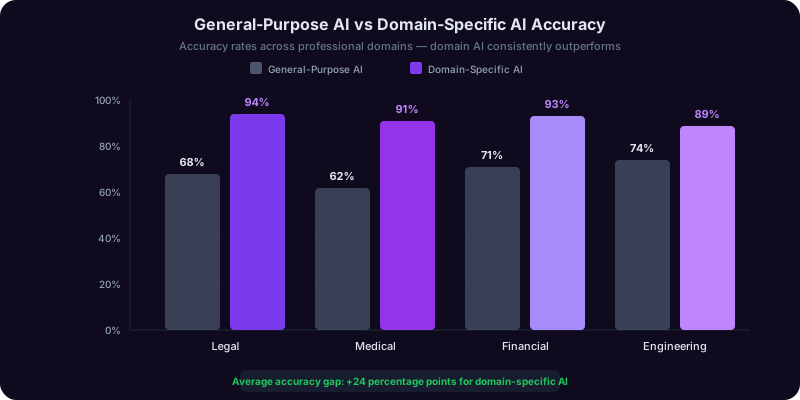
Pillar 1: Curated, verified training data. A legal copilot trained on verified case law, annotated statutes, and expert-reviewed legal analyses will outperform a general model every time on legal tasks. The key word is "verified." General-purpose models ingest legal content from the open web, including outdated statutes, student essays, and forum posts that may contain errors. Domain-specific copilots are built on licensed, authoritative datasets. Thomson Reuters reported that their AI-assisted legal research tools, built on Westlaw's curated database, achieve 94% accuracy on legal research tasks, compared to 71% for general-purpose models tested on the same queries.
Pillar 2: Domain-specific evaluation and benchmarking. General-purpose models are evaluated on broad benchmarks like MMLU, HumanEval, and HellaSwag. These benchmarks tell you almost nothing about how a model will perform on a specific professional task. Domain-specific copilots are evaluated on task-specific benchmarks: can this model correctly identify the problematic clause in a 40-page vendor agreement? Does it accurately interpret lab results within the context of a patient's medication history? Does it calculate after-tax returns correctly when accounting for state-specific capital gains treatment? The evaluation framework drives the model's capabilities, and narrow evaluation produces narrow excellence.
Pillar 3: Structured output pipelines. Professional work requires structured, consistent outputs, not free-form text. A contract review copilot does not write a paragraph about a contract. It produces a structured risk assessment: each clause flagged, risk level assigned, specific language quoted, and recommended action itemized. A financial copilot does not write an essay about your tax situation. It generates a structured analysis with numbered scenarios, calculated outcomes, and ranked recommendations. This structured approach is built into the model's output layer and post-processing pipeline, not bolted on as an afterthought.
| Capability | General-Purpose AI | Domain-Specific Copilot |
|---|---|---|
| Training Data | Broad web corpus, unverified | Licensed, expert-reviewed datasets |
| Evaluation | Generic benchmarks (MMLU, etc.) | Task-specific professional benchmarks |
| Output Format | Free-form text | Structured, actionable reports |
| Confidence Scoring | None (always confident) | Built-in uncertainty flagging |
| Compliance | Generic data handling | Industry-specific (HIPAA, FINRA, SOC 2) |
| Source Attribution | Often missing or fabricated | Linked to verified sources |
Pillar 4: Compliance-first architecture. Domain-specific copilots are designed with regulatory compliance as a foundational requirement, not an afterthought. A health copilot processes patient information within HIPAA-compliant infrastructure. A financial copilot handles portfolio data within SOC 2-certified environments. A legal copilot maintains attorney-client privilege protections by design. These are not features you can add to ChatGPT with a custom instruction. They require architectural decisions about data routing, storage, access controls, and audit logging that are baked into the product from day one.
The result is measurable. Across every major professional domain, domain-specific copilots outperform general-purpose AI by 15-25 percentage points on accuracy benchmarks, and by even wider margins on compliance, consistency, and actionability metrics.

Get Your Answer Now, Free
Stop relying on general-purpose AI for work that demands professional-grade accuracy. Try a domain-specific copilot built for your field and see measurable improvements in accuracy, speed, and confidence.
Legal: How Domain-Specific AI Is Transforming Legal Work
The legal profession was among the first to confront the limitations of general-purpose AI and among the first to embrace specialized alternatives. The reason is straightforward: in law, an AI error is not an inconvenience. It is potential malpractice.
The ChatGPT legal debacle that changed everything. In June 2023, New York attorney Steven Schwartz was sanctioned by a federal judge for submitting a brief containing six fabricated case citations generated by ChatGPT. The cases did not exist. The model had invented them wholesale, complete with plausible-sounding party names, docket numbers, and holdings. This incident became the catalyst for the legal industry's shift toward verified, domain-specific AI tools. By 2026, over 40 state bar associations have issued guidance on AI use in legal practice, and nearly all of them recommend or require the use of tools with verified source attribution.
Where legal copilots outperform general AI:
- Contract analysis. Domain-specific legal copilots trained on hundreds of thousands of annotated contracts can identify non-standard clauses, missing protections, and one-sided terms with 92-96% accuracy. General-purpose models achieve 68-75% on the same tasks, and critically, they miss subtle issues like the interaction between an indemnification clause and a liability cap that, taken together, expose one party to unlimited risk.
- Legal research. Tools built on verified legal databases like Westlaw and LexisNexis eliminate the hallucination problem entirely. Every citation is linked to an actual source. Every holding is verified against the actual opinion. Thomson Reuters reports that AI-assisted legal research reduces research time by 60% while improving accuracy from 78% (manual research by junior associates) to 94% (AI-assisted research verified by the same associates).
- Regulatory compliance. Employment law, data privacy, intellectual property, and tax law all involve complex, jurisdiction-specific rules that change frequently. A domain-specific compliance copilot maintains updated regulatory databases and can flag conflicts between a company's practices and current law in specific jurisdictions.
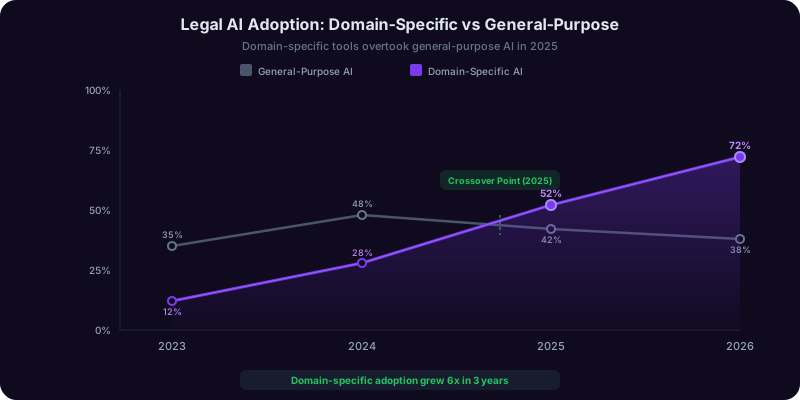
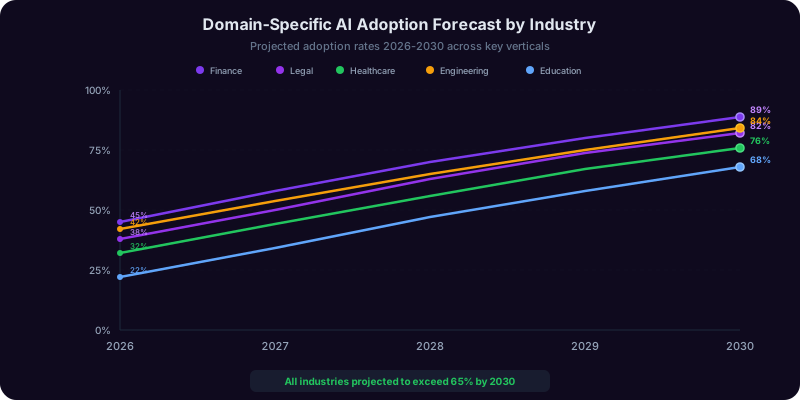
Real-world adoption numbers. A 2026 survey by the American Bar Association found that 41% of law firms now use some form of AI, up from 12% in 2024. Among firms using AI, 73% report using domain-specific legal AI tools rather than general-purpose chatbots, a complete reversal from 2024 when 81% of AI-using firms relied primarily on ChatGPT. The top use cases: document review (68%), legal research (59%), contract drafting and analysis (54%), and client intake questionnaires (38%).
How a legal copilot works in practice. When you upload a contract to the Copilotly Legal Copilot, it does not generate a generic summary. It performs clause-by-clause analysis against a database of standard contract provisions, flags deviations from market norms, identifies missing protections, scores overall risk on a structured rubric, and generates specific questions you should ask before signing. For a detailed walkthrough of preparing for legal consultations with AI assistance, see our guide to using AI to prepare for a lawyer consultation.
The compliance imperative. Beyond accuracy, legal AI must maintain confidentiality, preserve privilege, and create auditable records. General-purpose AI tools that send client data to third-party servers for processing create privilege waiver risks that no responsible attorney would accept. Domain-specific legal copilots address this with client-side processing, encrypted data handling, and audit trails that satisfy bar association requirements.
Health, Finance, and Engineering: Domain-Specific AI Across Industries
The legal profession's shift to domain-specific AI is mirrored across every major professional domain. Health, finance, and engineering are each experiencing their own version of the same transformation, driven by the same forces: the need for higher accuracy, regulatory compliance, and workflow integration.
Healthcare: From Generic Symptom Checkers to Clinical Decision Support
Healthcare has the highest stakes and the strictest compliance requirements of any AI application domain. General-purpose AI chatbots were never designed to handle the complexity of clinical reasoning, and the consequences of errors, missed diagnoses, dangerous drug interactions, inappropriate treatment recommendations, are measured in patient harm, not mere inconvenience.
The accuracy gap in healthcare AI. A 2025 study published in Nature Medicine compared general-purpose and domain-specific AI on clinical reasoning tasks across 12 medical specialties. The results were stark: general-purpose models achieved 61% diagnostic accuracy, while domain-specific clinical AI achieved 87% accuracy on the same cases. For complex cases involving multiple comorbidities, the gap widened further: 43% versus 79%.
Domain-specific health copilots like the Copilotly Health Copilot are designed to ask the right follow-up questions, consider drug interactions, account for patient history, and explicitly flag when a situation requires in-person medical attention rather than AI-assisted guidance. They do not diagnose. They help patients prepare, understand, and ask better questions.
Finance: Beyond Basic Calculations to Contextual Analysis
Financial decisions involve calculations that general-purpose AI can handle, but they also require contextual reasoning that only domain-specific models deliver well. Tax-advantaged Roth conversion strategies depend on current and projected tax brackets, state residency, existing account balances, and time horizons. A general-purpose model can explain what a Roth conversion is. A domain-specific financial copilot can model five scenarios for your specific situation and rank them by after-tax outcome.
| Domain | General AI Accuracy | Specialized AI Accuracy | Enterprise Adoption (2026) |
|---|---|---|---|
| Legal Research | 71% | 94% | 41% of firms |
| Clinical Diagnosis | 61% | 87% | 34% of health systems |
| Financial Planning | 74% | 93% | 52% of advisors |
| Engineering Analysis | 66% | 91% | 38% of firms |
| Contract Review | 72% | 95% | 47% of legal depts |
The Copilotly Finance Copilot handles the calculation-heavy work that general-purpose AI struggles with: multi-scenario retirement projections, tax-loss harvesting optimization, mortgage comparison with full amortization schedules, and insurance coverage gap analysis. These outputs require not just mathematical accuracy but awareness of current tax brackets, contribution limits, and state-specific rules.
Engineering: Code That Compiles, Designs That Meet Spec
Software engineering was ChatGPT's breakout use case, but professional engineers are increasingly turning to specialized coding copilots for production work. The reason: general-purpose AI generates code that looks right but often contains subtle bugs, security vulnerabilities, or architectural anti-patterns that only become apparent in production. Domain-specific engineering copilots trained on production codebases, security best practices, and framework-specific patterns produce code that is measurably more reliable.
The Copilotly Engineering Copilot goes beyond code generation to include architecture review, security analysis, performance optimization, and documentation generation, all calibrated to specific technology stacks and engineering standards. Firms using domain-specific coding tools report 40% fewer production bugs and 25% faster code review cycles compared to general-purpose AI-assisted development.
Adoption Barriers and How Organizations Are Overcoming Them
Despite the clear advantages, the transition from general-purpose AI to domain-specific copilots is not frictionless. Organizations face real challenges in adoption, integration, and change management. Understanding these barriers, and how leading organizations are addressing them, is essential for anyone considering the switch.
Barrier 1: Tool proliferation and vendor fatigue. After years of adopting point solutions for everything, many organizations resist adding yet another tool. The concern is valid. A law firm that already uses separate tools for document management, time tracking, billing, e-discovery, and case management does not want a sixth tool that does not integrate with the others. The solution: domain-specific copilots that integrate with existing workflows rather than replacing them. The most successful vertical AI tools embed directly into the platforms professionals already use: legal copilots that work within document management systems, financial copilots that plug into portfolio management platforms, health copilots that integrate with electronic health records.
Barrier 2: Trust and verification. Professionals who were burned by ChatGPT hallucinations are understandably cautious about trusting any AI tool. They need proof that the specialized tool is meaningfully better, not just marketing. The solution: transparent benchmarking and pilot programs. Organizations that successfully adopt domain-specific copilots typically run 30-60 day pilots with measurable outcomes: accuracy rates on real tasks, time savings on real workflows, and error rates compared to manual processes. When domain-specific tools consistently outperform general AI by 15-25 percentage points on relevant tasks, trust follows naturally.
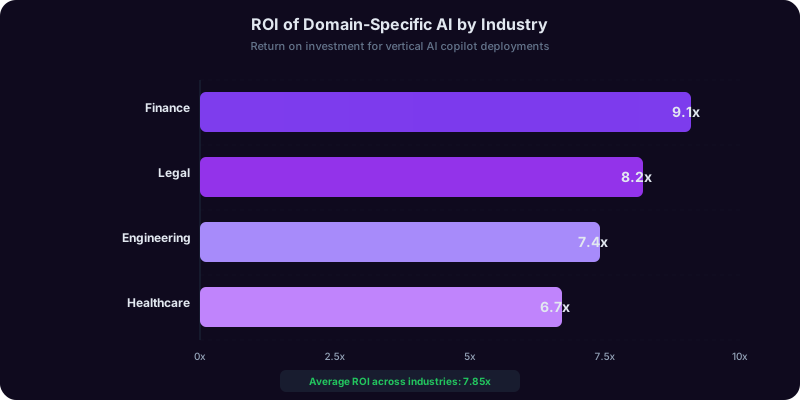
Barrier 3: Cost justification. Domain-specific copilots often cost more per seat than general-purpose AI subscriptions. ChatGPT costs $20-$25 per month for individual use. Specialized legal, financial, or medical AI tools can cost $50-$500 per month depending on capabilities and compliance requirements. The solution: ROI framing rather than cost comparison. A legal copilot that saves an associate 8 hours per week on research and document review pays for itself many times over. A financial copilot that catches a tax optimization opportunity worth $15,000 justifies years of subscription costs. The question is not "is this tool more expensive than ChatGPT" but "does this tool generate more value than it costs?"
Barrier 4: Data privacy and security concerns. Regulated industries have legitimate concerns about where their data goes and how it is processed. Law firms cannot send client documents to a general-purpose AI API without creating privilege and confidentiality risks. Healthcare organizations cannot process patient data through non-HIPAA-compliant systems. Financial firms face SEC and FINRA restrictions on data handling. The solution: domain-specific copilots are built with these constraints as architectural requirements. They offer on-premises deployment options, end-to-end encryption, data residency controls, access audit logging, and compliance certifications specific to their target industry.
Barrier 5: Change management and training. Even the best tool fails if people do not use it correctly. Professionals who have been doing their jobs successfully for years may resist changing their workflows, especially if previous AI tools disappointed them. The solution: embedded training and progressive disclosure. Rather than requiring professionals to learn a new interface, the best domain-specific copilots surface capabilities contextually. A legal copilot that highlights a risky clause while the attorney is already reviewing a document is more effective than one that requires the attorney to switch to a separate application and upload the document manually.
The tipping point. Most organizations report that adoption reaches a tipping point 60-90 days into a pilot, when enough team members have experienced the accuracy and time savings firsthand to become internal advocates. The key is starting with a specific, measurable use case rather than trying to transform everything at once. Start with contract review. Start with financial modeling. Start with clinical documentation. Prove the value, then expand.
How to Evaluate and Choose the Right Domain-Specific Copilot
Not all domain-specific copilots are created equal. Some are genuinely specialized tools built on curated data and rigorous evaluation. Others are general-purpose models with a domain-specific skin, offering the branding of specialization without the substance. Knowing how to tell the difference is critical for making a sound investment.
The evaluation framework. Use these seven criteria to assess any domain-specific copilot before committing:
- 1. Training data provenance. Ask what data the model was trained or fine-tuned on. Is it licensed, authoritative data from recognized sources in the domain? Or is it scraped from the open web? A legal copilot should be trained on verified case law and annotated statutes, not Reddit legal advice threads. If the vendor cannot or will not disclose their data sources, that is a red flag.
- 2. Domain-specific benchmarks. Ask for accuracy metrics on tasks relevant to your use case. Not generic benchmarks, but specific ones: "What is your accuracy on identifying non-standard indemnification clauses in vendor agreements?" or "What is your agreement rate with board-certified cardiologists on cardiac symptom triage?" Vendors who can only cite generic benchmarks likely have not done the domain-specific evaluation work.
- 3. Source attribution and verifiability. Every factual claim the copilot makes should be traceable to a specific, verifiable source. Can you click through from the copilot's output to the underlying statute, study, or data point? If not, you are back in hallucination territory.
- 4. Compliance certifications. For regulated industries, ask for specific compliance certifications: HIPAA for healthcare, SOC 2 Type II for financial services, and relevant bar association approvals for legal tools. Ask for the actual certificates, not just marketing claims.
- 5. Integration with existing workflows. The tool should work within your current technology stack, not require you to adopt an entirely new workflow. API availability, browser extensions, and direct integrations with industry-standard platforms are all good signs.
- 6. Human-in-the-loop design. The best domain-specific copilots are designed to augment professional judgment, not replace it. They should present findings, flag uncertainties, and recommend actions, but always leave the final decision to the human professional. Tools that present their outputs as definitive answers rather than informed inputs are poorly designed for professional use.
- 7. Transparent pricing and ROI tracking. You should be able to calculate the tool's return on investment within 30 days of adoption. Vendors should provide ROI calculators, case studies with measurable outcomes, and clear pricing without hidden fees.
| Evaluation Criterion | Red Flag | Green Flag |
|---|---|---|
| Training Data | "Trained on diverse internet data" | Named, licensed data sources |
| Benchmarks | Only generic scores (MMLU, etc.) | Task-specific accuracy metrics |
| Citations | No source links or vague references | Clickable links to verified sources |
| Compliance | "We take security seriously" | Named certifications with proof |
| Integration | Standalone web app only | APIs, plugins, workflow integrations |
| Decision Design | Presents outputs as final answers | Flags uncertainty, defers to humans |
The Copilotly approach. Copilotly's suite of domain-specific copilots is built on these principles. Each copilot, whether for legal, health, finance, or engineering, is designed to augment professional judgment with domain-calibrated analysis, structured outputs, source attribution, and explicit uncertainty flagging. They are tools for professionals, not replacements for professional judgment.
The Future of Vertical AI: What Comes Next After 2026
The shift from general-purpose to domain-specific AI is not the end of the story. It is the beginning of a much larger transformation in how professionals work, how industries operate, and how AI integrates into the fabric of specialized knowledge work. Here is what the next phase looks like.
Multi-agent domain systems. The current generation of domain-specific copilots are single-purpose tools: one copilot for contract review, another for financial planning, another for medical preparation. The next generation will be multi-agent systems where specialized copilots collaborate. Imagine a business acquisition scenario where a legal copilot analyzes the contract terms, a financial copilot models the deal economics, a compliance copilot checks regulatory requirements, and a tax copilot evaluates the tax implications, all working in concert and sharing context. This is not science fiction. Early multi-agent frameworks are already in development at major AI labs, and domain-specific implementations are expected to reach production by late 2027.
Continuous learning from professional feedback. Today's domain-specific copilots are trained and then deployed, with periodic updates. The next evolution is continuous learning systems that improve from every interaction with domain professionals. When an attorney corrects a copilot's analysis of a contract clause, that correction improves the model for all future analyses of similar clauses. When a physician flags a copilot's recommendation as inappropriate for a specific patient population, the model adapts. This creates a flywheel where the copilot gets better as more professionals use it, which attracts more professionals, which makes it better still. The key challenge is implementing this feedback loop while maintaining privacy and preventing any single user's corrections from degrading the model for others.
Regulatory convergence. As domain-specific AI becomes standard in regulated industries, regulators are beginning to create frameworks specifically for AI tools in their domains. The FDA is developing guidelines for AI-assisted clinical decision support. The SEC is evaluating rules for AI in financial advisory services. Bar associations are establishing standards for AI in legal practice. This regulatory clarity will accelerate adoption by reducing the legal uncertainty that currently holds some organizations back. By 2028, most major regulated industries will have clear AI governance frameworks, and domain-specific copilots that meet those standards will have significant competitive advantages.
The democratization of expertise. Perhaps the most profound long-term impact of domain-specific AI is the democratization of professional expertise. Today, access to high-quality legal, medical, financial, and engineering advice is gated by cost and geography. A small business owner in a rural area pays the same complexity premium as a Fortune 500 company when navigating employment law, but without the budget to hire a specialist. Domain-specific copilots make tier-one professional analysis available to everyone, not as a replacement for human experts, but as a first line of defense that ensures no one makes a major decision completely uninformed.
What this means for professionals. Domain-specific AI does not eliminate professional jobs. It transforms them. Attorneys spend less time on document review and more time on strategy and client counsel. Financial advisors spend less time on calculations and more time on relationship building and complex planning. Physicians spend less time on documentation and more time on patient care. The professionals who thrive in this new landscape are those who embrace domain-specific AI as a force multiplier rather than viewing it as a threat.
The bottom line for 2026. If you are still using ChatGPT or a similar general-purpose AI for professional work in a specialized domain, you are accepting lower accuracy, higher risk, and worse compliance than purpose-built alternatives offer. The vertical AI revolution is not coming. It is here. The question is not whether to switch, but how quickly you can adopt the domain-specific tools that will define professional excellence for the next decade.
Start with the domain that matters most to your work. Try a Legal Copilot for your next contract review. Use a Finance Copilot for your next financial analysis. Bring a Health Copilot to your next medical conversation. Experience the difference that domain specificity makes. Then decide whether general-purpose AI still belongs in your professional toolkit.
Frequently Asked Questions
Recommended Copilots
Recommended Copilots
Domain-specific legal analysis for contract review, compliance, and legal research
Try Free →Specialized health guidance with clinical reasoning and medical preparation support
Try Free →Contextual financial analysis for tax planning, investment modeling, and budgeting
Try Free →Production-grade code analysis, architecture review, and engineering best practices
Try Free →Related Articles
Get Your Answer Now, Free
Stop relying on general-purpose AI for work that demands professional-grade accuracy. Try a domain-specific copilot built for your field and see measurable improvements in accuracy, speed, and confidence.