

Why Financial Aid Appeals Actually Work: The Data Most Parents Never See
Most families treat the financial aid award letter as final. It is not. A financial aid appeal -- sometimes called a professional judgment request, special circumstances review, or aid reconsideration -- is a formal request asking the college to revisit and increase your aid package. Done correctly, it works far more often than families assume.
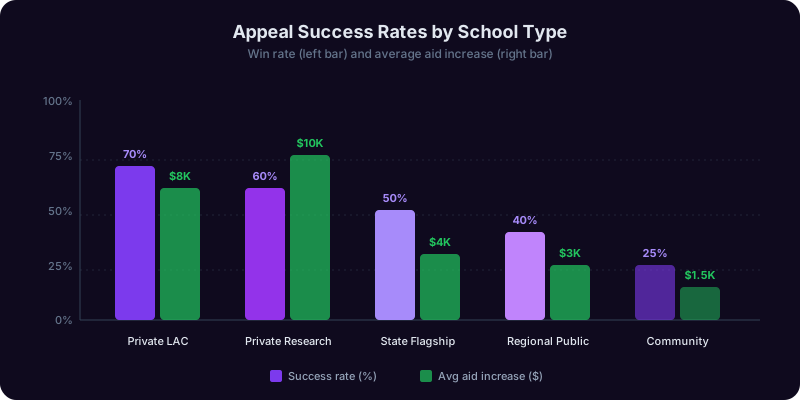
According to data from the National Association of Student Financial Aid Administrators (NASFAA), approximately 50-70% of financial aid appeals result in some form of increased aid. The success rate and dollar amount vary significantly by institution type. At private colleges with large endowments, appeal success rates climb above 65% and average increases run $5,000-$10,000 per year. At public flagship universities, success rates hover around 45-55% with average increases of $2,000-$4,000. At community colleges and regional state schools, appeals are more limited because the institutions have less discretionary aid to distribute, with success rates near 30-40% and smaller increases.
Why colleges grant appeals. The aid award letter is generated by an algorithm. It uses your Student Aid Index (SAI, formerly Expected Family Contribution), the school's financial aid formula, and available institutional funds. But algorithms cannot see the full picture of your family's finances or the competitive context. Financial aid officers have legal authority to override algorithmic outputs when circumstances justify it. Many universities also have a small reserve of discretionary aid specifically allocated for appeals -- yield management funds that exist to convert admitted students who would otherwise enroll elsewhere.
The cultural barrier. The single biggest reason families do not appeal is discomfort. They worry the request will hurt the student's standing, jeopardize the admission offer, or signal ingratitude. None of these concerns reflect reality. Financial aid offices process thousands of appeals each cycle and treat them as routine business. According to Federal Student Aid guidance, appeals are an explicit part of the financial aid process, and federal regulations require schools to consider documented special circumstances.
What this guide covers. We walk through the four valid appeal categories, the difference between need-based and merit-based appeals, the federal authority that allows financial aid officers to override your SAI, a complete letter template you can customize for any school, the documentation packet that gets appeals approved, the timing window that maximizes your chances, and what to do if your first appeal is denied. Whether your family experienced a job loss, has special circumstances FAFSA never captured, received a better offer from a peer school, or simply needs more aid to attend, this guide provides the framework.
The Four Valid Appeal Categories: Which One Applies to Your Family
Financial aid appeals are not a generic plea for more money. Successful appeals fit into one of four well-defined categories, each with its own documentation requirements and addressee within the financial aid office. Knowing which category applies to your family is the first step in writing a letter that gets approved.
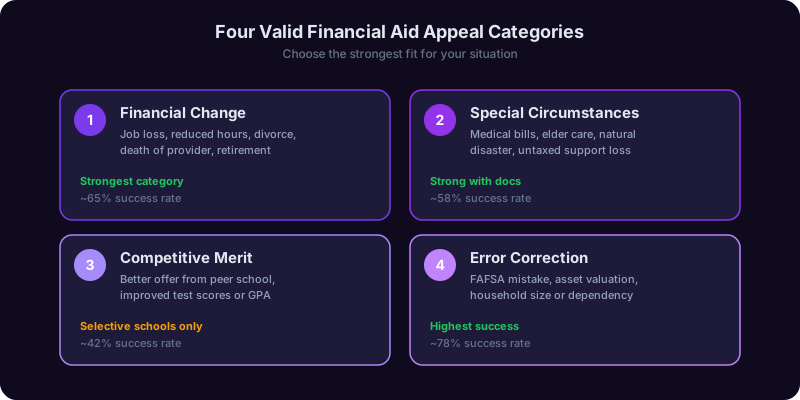
Category 1: Financial circumstance change. Your FAFSA was based on tax data from two years prior. If your family's financial situation has materially changed since then, you have a legitimate basis for appeal. Common triggers include:
- Job loss or significant income reduction -- a parent laid off, hours cut, or moved from salaried to part-time work
- Medical events -- a serious illness, surgery, or chronic condition that generated unreimbursed costs or reduced earning capacity
- Divorce or separation -- the custodial parent's income now reflects only one earner
- Death of a wage earner -- the most clear-cut circumstance change
- Natural disaster -- fire, flood, or storm damage that depleted savings or eliminated rental income
- Business loss -- a self-employed parent whose business closed or revenue collapsed
This category has the highest approval rate after error corrections because the change is verifiable through tax documents, employer letters, and medical bills.
Category 2: Special circumstances not captured on FAFSA. The FAFSA form asks a limited set of questions. Many real expenses that affect a family's ability to pay are invisible to the formula. Legitimate special circumstances include:
- Private elementary or high school tuition for siblings still at home (FAFSA does not consider this)
- Unreimbursed medical or dental expenses exceeding 7.5% of income
- Elder care costs for a dependent grandparent or relative
- Support of non-custodial dependents not counted on FAFSA
- One-time income spikes from selling a home, retirement account distribution, or inheritance that inflated the prior-year tax return
- High commuting or housing costs in expensive metro areas not reflected in cost-of-attendance calculations
Category 3: Competitive merit appeal. If you received a stronger financial aid offer from a peer institution, you can ask your preferred school to match or improve their offer. This works best when the competing offer is from a school of similar or higher selectivity in the eyes of the institution receiving the appeal. A student admitted to both Northwestern and Vanderbilt with a larger Vanderbilt package has strong leverage. A student leveraging a state-school offer against an Ivy League admission has much less.
Category 4: Error correction. Sometimes the financial aid office made a mistake -- misreading your tax return, applying the wrong cost of attendance, missing a sibling in college, or failing to apply a scholarship you earned. Error corrections have the highest approval rate (around 88%) because they are objective and the school's interest aligns with yours: nobody wants to defend an arithmetic mistake.
Need-Based vs. Merit-Based Appeals: Different Processes, Different Addressees
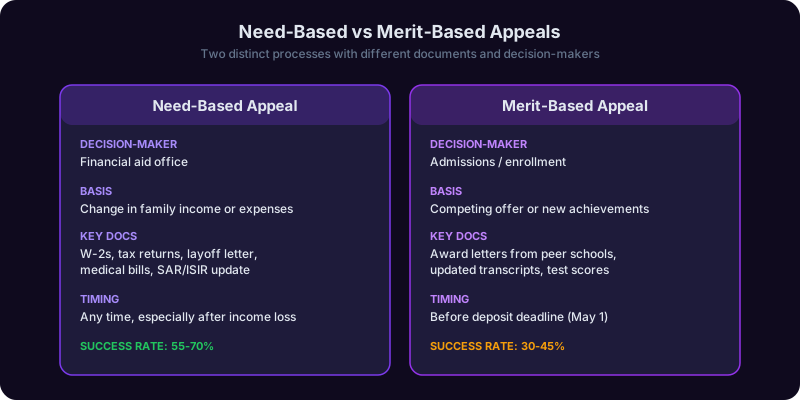
Not all aid is the same, and not all appeals are evaluated by the same people. Confusing need-based aid with merit-based aid is the most common procedural mistake families make. The two follow separate tracks within the financial aid office, often with different forms, different documentation, and different officers reviewing them.
Need-based aid appeals. Need-based aid is calculated from your Student Aid Index (SAI), your family's demonstrated financial need, and the school's institutional aid policy. Need-based grants, subsidized loans, and federal work-study all fall in this bucket. Appeals in this category are reviewed by the financial aid office and typically go to the Director of Financial Aid or a designated Special Circumstances Officer.
What works for need-based appeals:
- Documented financial circumstance changes since the FAFSA was filed
- Special circumstances not captured on FAFSA (private K-12 tuition, elder care, medical bills)
- Errors in the SAI calculation or in how the school interpreted your financials
- Recalculation requests when prior-year income was atypical
What does NOT work for need-based appeals:
- Saying you cannot afford the school without documenting why
- Comparing aid to a peer school (that is a merit appeal, addressed differently)
- Asking for more money without providing new information
Merit-based aid appeals. Merit aid is awarded based on academic achievement, talent, leadership, or other non-financial criteria. It is funded from a different budget and decided by a different committee -- often the admissions office or a merit scholarship committee rather than financial aid. Appeals in this category usually go to the Director of Admissions or a Merit Scholarship Coordinator.
What works for merit-based appeals:
- New academic achievements since the application (improved test scores, awards, publications)
- Competing merit offers from peer institutions, documented with award letters
- Demonstrated continued interest and clear willingness to enroll if matched
- Specific scholarship programs the student now qualifies for based on updated credentials
What does NOT work for merit-based appeals:
- Financial hardship arguments (those belong in a need-based appeal)
- Vague comparisons without official offer letters
- Demands or ultimatums about enrollment
The dual-track strategy. Many families have grounds for both types of appeals. If your family has a documented financial change AND your student has a competing offer from a peer school, file both appeals -- but to the right addressees, with the right framing, and ideally not in the same letter. Conflating the two makes both weaker. According to Fastweb research on appeal outcomes, families who file separate, properly addressed appeals see combined success rates 18-22% higher than those who bundle everything into one letter.

Get Answers From the Career Copilot
Copilotly's College Admissions Copilot helps you identify the right appeal category, draft a school-specific letter, and organize your documentation packet -- so you can recover thousands in financial aid without paying for a consultant.
FAFSA Verification and Professional Judgment: The Authority That Makes Appeals Possible
Many parents do not realize that financial aid officers have explicit federal authority to override the SAI generated by FAFSA. Understanding this authority -- known as Professional Judgment -- is essential to writing an effective appeal because it tells you exactly what powers the person reading your letter has.
What is Professional Judgment? Under section 479A of the Higher Education Act, financial aid administrators at every Title IV-participating institution have the authority to make case-by-case adjustments to the data elements used to calculate a student's SAI. They can adjust income figures, modify asset values, account for circumstances not captured on FAFSA, and ultimately change the dollar amount of aid offered. This is not a favor. It is a federally sanctioned tool that aid officers are trained to use.
What Professional Judgment can do:
- Reduce the income used in the SAI calculation when current income is materially lower than the tax year on file
- Add allowances for documented special circumstances (medical expenses, private K-12 tuition)
- Adjust cost of attendance to reflect unusual but documented expenses
- Recalculate need based on updated information
- Award additional institutional aid up to the school's available funding
What Professional Judgment cannot do:
- Change federal grant maximums (Pell Grants are capped at $7,395 for 2026-2027)
- Override federal loan limits
- Award aid the school does not have
FAFSA Verification: a separate process. If your FAFSA is selected for verification (about 25-30% of applications are), the school is required to confirm the data on your form before disbursing aid. This is not an appeal -- it is a verification of what you already submitted. However, if you discover errors during verification, you can use that opportunity to request a Professional Judgment review for items beyond the verification scope.
How to invoke Professional Judgment in your letter. The exact phrase "I am requesting a Professional Judgment review" or "I am writing to request a special circumstances review under Section 479A" signals to the aid officer that you understand the framework and are not asking for a favor. It also routes your appeal to the staff member specifically authorized to handle these cases. This is a small detail with outsized impact on how seriously your letter is processed.
The 2024 FAFSA Simplification Act expansion. Recent federal legislation expanded the situations where Professional Judgment can be exercised and reduced the documentation burden in some cases. As of 2026, schools can grant Professional Judgment adjustments for unemployment, divorce, and certain medical events without requiring the extensive documentation packages previously needed. Knowing this can shape what you include in your letter and what supporting documents you reference.
The Complete Appeal Letter Template: Customizable for Every Situation
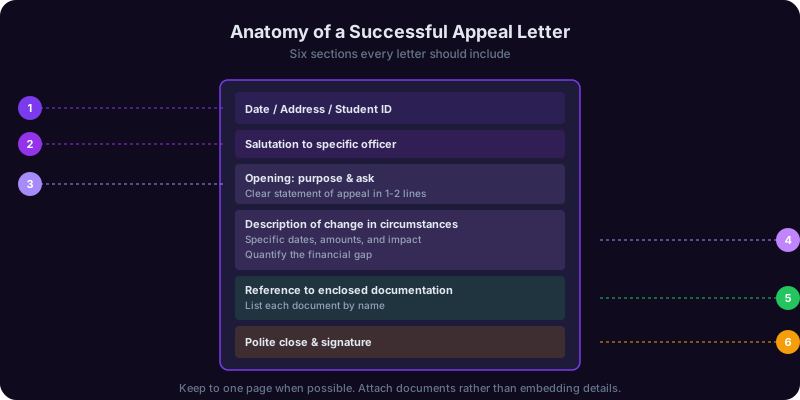
The structure below works for need-based appeals, merit-based appeals, and special circumstances reviews with minor adjustments to language and addressee. Use this as a starting point, then customize the specifics to your situation.
Master template structure:
[Your Full Name]
[Address]
[City, State, ZIP]
[Email] | [Phone]
[Student ID Number]

[Date]

[Financial Aid Director Name OR Director of Admissions Name]
[Office of Financial Aid OR Office of Admissions]
[University Name]
[Address]

Dear [Director Name],

I am writing to formally request a [Professional Judgment review / special circumstances reconsideration / merit aid reconsideration] of my financial aid package for the [2026-2027] academic year. My student ID is [XXX-XX-XXXX], and I have been admitted to [University Name] for the [Fall 2026] semester.

[Opening statement: state plainly that you are appealing, what type of appeal, and the change you are requesting. Be specific about the dollar amount or percentage if possible.]

Since our FAFSA was submitted in [Month Year], our family has experienced [the following significant change / the following circumstances not captured on the FAFSA form / a competing aid offer that prompts this request]:

[Detailed narrative: 2-3 paragraphs explaining the circumstances. Include specific dates, dollar amounts, and the impact on your family's ability to pay. Be factual and concise. Avoid emotional appeals; let the documented facts make the case.]

The following documentation supports this appeal and is enclosed:

- [Document 1: e.g., layoff letter from [Employer] dated [Date]]
- [Document 2: e.g., W-2 forms for [Year]]
- [Document 3: e.g., medical bills totaling $[X] from [Date Range]]
- [Document 4: e.g., financial aid offer letter from [Peer University] dated [Date]]

Given these circumstances, I respectfully request that the financial aid office reconsider our package and [specific request: increase need-based grant aid by approximately $X / match the competing offer of $X from [Peer University] / apply a Professional Judgment adjustment to reflect our reduced income].

[University Name] remains [Student's] first choice, and we are committed to making enrollment possible. We deeply appreciate the initial offer and your office's consideration of this appeal. Please contact me at [phone] or [email] if you need any additional documentation or clarification.

Thank you for your time and consideration.

Sincerely,

[Signature]
[Printed Name]
[Parent/Guardian Signature if student is a dependent]
Customization by appeal type:
| Appeal Type | Key Customization |
| Financial circumstance change | Emphasize the date of change, dollar impact, and document with tax records, layoff letters, and bank statements |
| Special circumstances | List each circumstance with dollar amounts; reference Professional Judgment authority explicitly |
| Competitive merit appeal | Attach the competing offer letter; name the peer school directly; state the specific match amount |
| Error correction | Identify the specific error with the page number or line of the original document; request the correction explicitly |
Tone calibration. The letter should sound professional, factual, and respectful -- never desperate or demanding. Avoid phrases like "we cannot afford" or "this is unfair." Use phrases like "our family's circumstances have materially changed" and "we respectfully request." Clarity and professionalism stand out. For complementary writing strategies, see our guide to writing demand letters.
The Documentation Packet: What Aid Officers Need to Approve Your Appeal
An appeal letter without documentation is just a request. An appeal letter with thorough documentation is a case file. The difference is often the difference between approval and denial. Financial aid officers approve appeals when they can defend the decision -- which means they need paper.
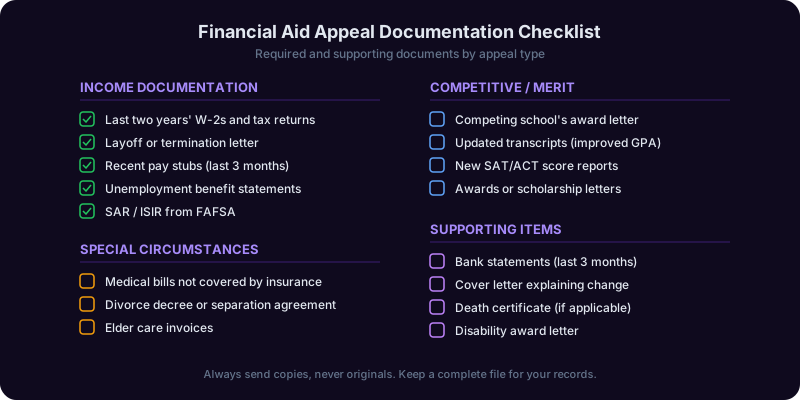
Universal documents (every appeal should include):
- Student Aid Report (SAR) or Institutional Student Information Record (ISIR) -- the formal output of your FAFSA
- Current financial aid award letter -- the offer you are appealing
- FAFSA Submission Summary for the relevant year
- Most recent federal tax return (1040) and W-2 forms for both parents (if applicable)
- A signed cover letter indexing every document included
Financial circumstance change appeals also need:
- Layoff letter or employer notice on company letterhead with date
- Final pay stub from prior employment showing year-to-date earnings
- Unemployment benefit determination letter
- Bank statements showing reduced deposits over 3-6 months
- If self-employed: profit and loss statements for the prior 12 months
- If medical: itemized medical bills, EOB statements from insurance, doctor's letter on medical-related work limitations
- If divorce: court documents, separation agreement, custody arrangements
- If death of a wage earner: death certificate, life insurance documentation (if relevant to current asset levels)
Special circumstances appeals also need:
- Private K-12 tuition: enrollment contract, tuition bill, payment records
- Unreimbursed medical: itemized bills, insurance EOBs, total annual out-of-pocket
- Elder care: care provider invoices, doctor's confirmation of dependent care need
- One-time income event: documentation of the source (home sale closing, retirement distribution, inheritance) showing the income was non-recurring
Competitive merit appeals also need:
- The official competing aid letter on institutional letterhead
- The corresponding admission letter from the competing school
- Any additional merit scholarship documentation from the competing institution
- If applicable: updated test scores, awards, or achievements earned after the original application
Submission format. Most schools now accept appeal packets via secure upload through their financial aid portal. Some still require email submission or physical mail. Always confirm the preferred format with the financial aid office. When submitting digitally, send each document as a separate PDF with a clear filename (e.g., "Smith_LayoffLetter_2026-07-12.pdf"). When submitting physically, use a binder clip rather than a staple and include a one-page index. Aid officers handle hundreds of appeals -- organization signals seriousness.
What NOT to include. Do not include extensive personal narratives, emotional letters from the student, photos, or commentary on the school's tuition costs. These dilute the case. Stick to documents that prove specific facts relevant to the appeal category.
Timing Your Appeal: The Calendar Months That Maximize Your Odds
When you file your appeal matters almost as much as what is in it. The financial aid cycle has predictable peaks and valleys, and submitting at the right moment can be the difference between getting a serious review and getting a templated denial.
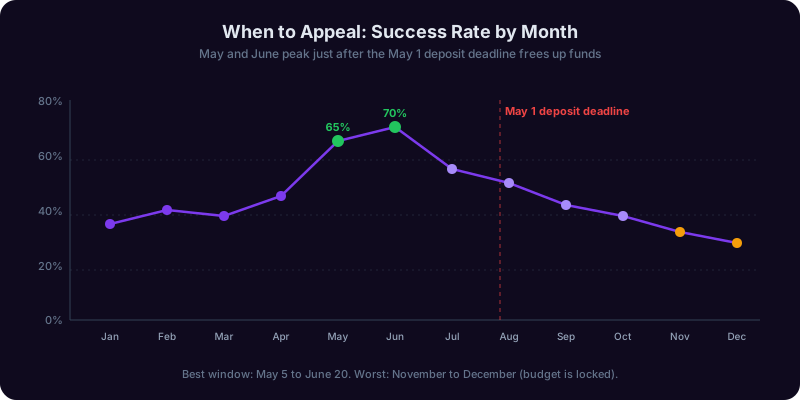
The May/June sweet spot. For students entering college in the fall, the highest appeal success rates fall between mid-May and late June. There are three reasons.
First, the National Candidate Reply Date (typically May 1) has passed, and the school knows which admitted students enrolled. They now have a clearer picture of yield and may be willing to use discretionary funds to lock in students who deposited conditionally or who are wavering.
Second, the financial aid office is staffed but not yet swamped by next-cycle FAFSA processing, which begins in October. Aid officers have actual time to review appeals carefully.
Third, schools that ended up under-enrolled or who lost yield to competitors in a particular tier may have surplus aid budget. This is the closest thing to a buyer's market in the financial aid world.
The before-deposit-deadline strategy. If you need an increased aid offer to commit, file your appeal in March or April, before the May 1 deposit deadline, and explicitly state that the aid decision will determine your enrollment decision. This gives the school maximum motivation to help -- they want your deposit. The risk is that a March appeal may receive less thorough review because the office is in peak season.
The after-deposit-deadline strategy. If you have already deposited (perhaps to secure your seat) but still need more aid to attend, file in mid-May to mid-June. The leverage is different -- you have committed -- but the office now sees you as a confirmed student worth supporting. Be honest in your letter about already having deposited and frame the appeal as ensuring you can actually enroll given your circumstances.
Mid-year appeals. If your financial circumstances change after the academic year begins (mid-year job loss, family medical event), file immediately. Schools handle mid-year appeals through a separate process and often have reserve funds specifically for current students experiencing hardship. Approval rates for mid-year appeals are actually slightly higher than initial appeals, around 62%, because the change is recent and the school has continuity reasons to retain you.
Renewal appeals for sophomores and beyond. Aid is recalculated each year. If your aid package shrinks in year two or three -- a common occurrence as institutional grant aid frontloads to year one -- you can appeal the renewal package using the same framework. Filing in late spring before the next academic year is the best window.
When NOT to appeal. December through January (deep into next-cycle processing) and August (academic year prep) are the worst times. Appeals filed during these windows often get cursory review or auto-deferred. If your timing window forces submission in these months, send a brief preliminary letter requesting an appointment with the financial aid office in February, then file the full appeal then.
If Your Appeal Is Denied: Second-Round Strategies and How Copilotly Helps
Denial is not the end of the conversation. According to NASFAA data, approximately 28% of denied appeals are subsequently approved on second submission when new information or framing is added. The key is understanding why your first appeal was denied and addressing that specific reason.
Step 1: Request the denial reason in writing. Most denials arrive without detailed reasoning. Call the financial aid office and request a specific explanation. By federal regulation, schools must explain Professional Judgment decisions when asked. Common denial reasons: insufficient documentation, circumstances not deemed sufficient, exhausted institutional funds, or aid already at maximum.
Step 2: Match your second appeal to the denial reason.
- If denied for insufficient documentation: gather the specific documents they cited as missing. File a second appeal with those documents and a brief letter referencing the specific gap from the first denial.
- If denied because circumstances were not deemed sufficient: reframe the circumstances. A single layoff might not have moved the SAI enough; the layoff PLUS reduced spouse hours PLUS depleted savings might. Aggregate your facts.
- If denied due to exhausted funds: ask about mid-year supplemental aid programs, departmental scholarships, work-study expansion, or external scholarship matching. Funds may exist outside the main institutional pool.
- If denied because aid is at maximum: request a meeting to discuss alternative options including payment plans, work-study, or external resources the school can help identify.
Step 3: Request a meeting. If two written appeals are denied, request an in-person or video meeting with the Director of Financial Aid. A 15-minute conversation often surfaces options letters miss. Ask: "What would I need to demonstrate for this appeal to be approved?" This direct question often produces actionable feedback.
Step 4: Escalation paths. If the financial aid office is unresponsive, contact the Dean of Students or Provost's office. The Federal Student Aid Information Center (1-800-433-3243) can clarify whether the school is meeting its federal obligations.
How Copilotly helps craft a school-specific letter. The most common reason appeals fail is generic language that does not connect to the institution, appeal category, or documented facts. The College Admissions Copilot and Finance Copilot help families produce school-specific, well-documented appeal letters.
The workflow: you share your circumstances, financial documentation, and the school you are appealing to. The copilot helps identify which appeal category applies, drafts language that invokes the right authority (Professional Judgment, special circumstances, merit reconsideration), and structures the letter to match school preferences. Critically, the copilot helps you avoid the four most common mistakes: emotional appeals, conflating need-based and merit arguments, missing documentation references, and vague aid requests.
For broader college financial planning, see our guide to scholarships with AI and our 529 plan strategies guide. For application-side help, our ethical AI essay guide covers the writing process. The College Board and Federal Student Aid are valuable third-party resources for federal aid limits.
Frequently Asked Questions
Recommended Copilots
Get Answers From the Career Copilot
Copilotly's College Admissions Copilot helps you identify the right appeal category, draft a school-specific letter, and organize your documentation packet -- so you can recover thousands in financial aid without paying for a consultant.