
Money & Finance
What to Do With Unused 529 Funds: Roth IRA Rollovers, Scholarships, and Beneficiary Swaps
SECURE 2.0 lets you roll unused 529 money into the beneficiary's Roth IRA, up to a $35,000 lifetime cap, instead of eating taxes and a penalty. Here is how the 15-year rule works, plus scholarship exceptions, beneficiary swaps, and the new grandparent FAFSA loophole.
The College Cost Crisis: Why a 529 Plan Is No Longer Optional
College costs in the United States have outpaced inflation for four consecutive decades. The average annual cost of tuition, fees, room, and board at a four-year public university reached $29,150 for in-state students in the 2025-2026 academic year, according to the College Board. For private nonprofit institutions, that figure climbs to $57,570 per year. Over four years, families are looking at total costs of $116,600 to $230,280 before accounting for textbooks, transportation, and personal expenses.

Here is what makes the numbers genuinely alarming: college costs have historically increased at approximately 5% per year, roughly double the general inflation rate. A child born today will face four-year costs of approximately $268,000 at a public university and over $530,000 at a private institution by the time they enroll in 2044.
| Metric | 2026 Figure |
|---|---|
| Average 4-year public university (in-state) | $116,600 |
| Average 4-year public university (out-of-state) | $178,400 |
| Average 4-year private nonprofit | $230,280 |
| Average family savings at enrollment | $35,934 |
| Savings gap (public in-state) | $80,666 |
| Families with any college savings | 39% |
| Average student loan debt at graduation | $37,850 |
| Historical annual cost increase | ~5% |
The most revealing number in that table is the savings gap. The average family that does save for college has accumulated approximately $35,934 by enrollment day, based on data from Savingforcollege.com. That covers less than one-third of in-state public university costs. The remaining $80,666 is typically filled by a combination of financial aid, scholarships, current income, and student loans.
A 529 plan is the single most powerful tool available to close that gap. It offers tax-free investment growth, state tax deductions, high contribution limits, and new flexibility thanks to the SECURE 2.0 Act. Yet only 35% of families with children under 18 have opened one. If you are reading this and have not started yet, you are not alone - but every month of delay costs you compound growth that cannot be recovered. The Finance Copilot can calculate exactly how much a delayed start costs based on your child's age and your target school costs.
This article is for educational purposes and does not constitute financial advice. Tax rules and contribution limits may change. Consult a qualified financial advisor and tax professional before making education savings decisions.
How 529 Plans Work: The Complete Tax Advantage Breakdown
A 529 plan is a tax-advantaged savings account designed specifically for education expenses. Named after Section 529 of the Internal Revenue Code, these plans are sponsored by states, state agencies, or educational institutions and managed by financial services firms. Understanding the three layers of tax advantage is essential before choosing a strategy.
Layer 1: Tax-Free Investment Growth
Money invested in a 529 plan grows completely free of federal income tax. There is no capital gains tax, no dividend tax, and no tax on interest earned - as long as withdrawals are used for qualified education expenses. This is the same tax treatment as a Roth IRA but specifically for education costs. On a $50,000 account that grows to $120,000 over 18 years, you pay $0 in federal tax on the $70,000 in gains when used for college. In a regular taxable brokerage account, that same $70,000 gain would cost you $10,500 to $14,000 in federal capital gains taxes.
Layer 2: State Tax Deductions or Credits
Over 30 states and the District of Columbia offer a state income tax deduction or credit for 529 plan contributions. The value varies dramatically by state:
| State | Deduction/Credit | Annual Maximum | Estimated Annual Tax Savings |
|---|---|---|---|
| Indiana | 20% tax credit | $7,500 contribution ($1,500 credit) | $1,500 |
| Vermont | 10% tax credit | $5,500 contribution ($550 credit) | $550 |
| New York | Deduction | $5,000 single / $10,000 joint | $310-$685 |
| Illinois | Deduction | $10,000 single / $20,000 joint | $495-$990 |
| Pennsylvania | Deduction | $18,000 per beneficiary | $554 |
| Colorado | Deduction | Unlimited | Varies (4.4% of contribution) |
| Ohio | Deduction | $4,000 per beneficiary | $156-$198 |
Tax savings are approximate and depend on your marginal state tax rate. See the Savingforcollege.com state comparison tool for current figures. Some states (like Arizona, Kansas, Maine, Missouri, and Pennsylvania) allow deductions for contributions to any state's 529 plan, not just their own.
Layer 3: Tax-Free Withdrawals
When you withdraw money from a 529 plan to pay for qualified education expenses, the entire withdrawal - contributions plus all investment earnings - is free of federal income tax and, in most states, free of state income tax. This triple layer of tax protection makes the 529 the most tax-efficient education savings vehicle available.
What Happens If You Do Not Use the Money for Education?
Non-qualified withdrawals incur a 10% federal penalty on the earnings portion plus ordinary income tax on the earnings. However, the SECURE 2.0 Act (effective 2024) added a major escape valve: unused 529 funds can now be rolled over to a Roth IRA for the beneficiary, subject to specific rules we cover in detail in the SECURE 2.0 section below. You can also change the beneficiary to another qualifying family member - a sibling, cousin, parent, or even yourself - at any time with no tax consequences.

For a side-by-side comparison of how 529 accounts stack up against other tax-advantaged savings options, the Tax Copilot can model the specific dollar impact based on your state, income, and contribution level. If you are weighing education savings against retirement contributions, see our Roth IRA vs Traditional IRA guide for context on retirement account trade-offs.
2026 Contribution Limits and the Superfunding Strategy
Unlike IRAs and 401(k)s, 529 plans do not have a fixed annual federal contribution limit. Instead, they use a combination of the annual gift tax exclusion and aggregate state-imposed maximums to determine how much you can contribute. This creates opportunities for accelerated savings that most families overlook.
Annual Gift Tax Exclusion: The Baseline
In 2026, the annual gift tax exclusion is $19,000 per donor, per beneficiary. This means each parent can contribute $19,000 per child per year without filing a gift tax return. A married couple can contribute $38,000 per child per year with no gift tax implications. This is not a 529-specific limit - it is the general IRS gift tax rule that applies to all gifts, but it effectively caps the most common 529 contribution level.
Superfunding: The 5-Year Gift Tax Averaging Election
Section 529 of the Internal Revenue Code includes a unique provision: you can front-load up to five years of gifts in a single year by making an election on IRS Form 709. This is commonly called "superfunding." For 2026:
| Donor | Standard Annual Limit | Superfunding Maximum (5x) |
|---|---|---|
| Single donor | $19,000 | $95,000 |
| Married couple (per child) | $38,000 | $190,000 |
| Married couple (two children) | $76,000 | $380,000 |
| Grandparent (single) | $19,000 | $95,000 |
A married couple can deposit $190,000 into a single child's 529 plan in one lump sum with no gift tax consequences, as long as they file Form 709 and make no additional gifts to that beneficiary for the next four years. If the donor dies within the five-year period, a prorated portion of the gift is added back to their estate.

Why Superfunding Is So Powerful
The math behind superfunding is dramatic. Consider two scenarios for a newborn:
Scenario A: Superfunding. A married couple contributes $190,000 at birth. At a 7% average annual return, the account grows to approximately $580,000 by age 18. No additional contributions needed.
Scenario B: Annual contributions. The same couple contributes $19,000 per year for 18 years ($342,000 total contributed). At the same 7% return, the account reaches approximately $380,000 by age 18.
Superfunding produces $200,000 more despite contributing $152,000 less in total dollars. The difference is 18 years of compound growth on the full lump sum versus incremental growth on gradually added contributions. This is the most powerful legal strategy for maximizing a 529 plan, but it requires significant upfront capital.
Aggregate State Maximums
Each state sets a maximum aggregate balance for its 529 plan, after which no further contributions are accepted. These limits range from approximately $235,000 to over $575,000 depending on the state. The highest limits as of 2026 include:
- Pennsylvania: $511,758
- New York: $520,000
- California: $529,000
- New Hampshire: $569,123
- Connecticut: $575,000
These limits apply per beneficiary across all accounts for that beneficiary in a given state. Once the balance exceeds the limit through investment growth, you cannot make additional contributions until it falls below the threshold - but existing funds continue to grow without restriction. For families in low-limit states, opening a plan in a different state may provide more room to grow, though you would forfeit your home state's tax deduction. The Finance Copilot can help you compare the trade-off between a higher contribution ceiling in another state versus the annual tax deduction value of your home state plan.
For details on gift tax filing requirements, see the IRS Form 709 instructions.
SECURE 2.0 Act: The Game-Changing Roth IRA Rollover Rules
The SECURE 2.0 Act of 2022, effective for 529-to-Roth IRA rollovers beginning January 1, 2024, fundamentally changed the risk calculus of 529 plans. Before this law, one of the biggest concerns families had was overfunding - what happens if there is money left over because the child earns scholarships, attends a cheaper school, or does not go to college at all? The answer used to be: pay a 10% penalty plus income tax on the earnings, or find another family member to use it. Now, there is a third option that makes 529 plans dramatically more attractive.
How the 529-to-Roth IRA Rollover Works
Unused 529 funds can be rolled over into a Roth IRA in the name of the 529 beneficiary (not the account owner). The Roth IRA then belongs to the beneficiary and follows standard Roth IRA rules - tax-free growth and tax-free withdrawals in retirement. This effectively means that worst-case scenario money does not go to waste but instead becomes a powerful head start on the beneficiary's retirement savings.
Rules and Limitations
The rollover comes with several important restrictions that you must understand before building a strategy around it:
| Rule | Requirement |
|---|---|
| 529 account age | Must have been open for at least 15 years |
| Annual rollover limit | Subject to the annual Roth IRA contribution limit ($7,000 in 2026) |
| Lifetime rollover cap | $35,000 per beneficiary |
| Recent contributions | Contributions made in the last 5 years (and their earnings) are not eligible |
| Beneficiary income | Beneficiary must have earned income equal to or greater than the rollover amount |
| Income limits | Standard Roth IRA income limits do NOT apply to 529 rollovers |
Strategic Implications
The 15-year clock and $35,000 lifetime cap create several important planning considerations:
- Open 529 plans early. Even if you can only contribute a small amount, opening the account starts the 15-year clock. A $100 contribution to a newborn's 529 plan means the 15-year requirement is satisfied by age 15 - well before they need to decide about college.
- The $35,000 cap takes at least 5 years to reach. At the $7,000 annual Roth IRA limit, it takes a minimum of 5 years of rollovers to transfer the full $35,000. Planning ahead is essential.
- The earned income requirement matters. The beneficiary needs earned income in each year they do a rollover. A 16-year-old with a part-time job earning $7,000 can roll over $7,000 that year. A 15-year-old with no income cannot roll over anything.
- Beneficiary changes reset nothing. If you change the 529 beneficiary, the IRS has not yet clarified whether the 15-year clock restarts. Conservative planning assumes it does. Open separate accounts for each child rather than planning to change beneficiaries later.
A Worked Example
The Johnsons open a 529 plan for their daughter Maya at birth in 2026 with a $5,000 contribution. They contribute $500 per month for 18 years. Maya earns a full scholarship and uses only $20,000 of the 529 for qualified expenses. The remaining balance at age 18 is approximately $215,000.
Here is Maya's rollover timeline:
- Age 18-22: Maya has part-time and then full-time earned income. She rolls over $7,000 per year to her Roth IRA - $35,000 total over five years.
- Remaining $180,000: The Johnsons change the beneficiary to Maya's younger sibling, who uses the funds for their own college expenses. If no sibling exists, they can change the beneficiary to a cousin, niece, nephew, or even themselves for continuing education.
That $35,000 in a Roth IRA at age 22, growing at 7% for 43 years until age 65, becomes approximately $650,000 in tax-free retirement savings. This is an extraordinary head start that did not exist before SECURE 2.0.
The Retirement Copilot can project the long-term value of early Roth IRA rollovers for your specific situation, while the Tax Copilot can help you navigate the filing requirements for each annual rollover.
Age-Based vs Static Portfolios: Choosing the Right Investment Strategy
Choosing the right investment option inside your 529 plan is just as important as choosing the right plan. Most 529 plans offer two broad categories of investment options: age-based portfolios that automatically adjust over time and static portfolios that maintain a fixed allocation. Making the wrong choice can cost tens of thousands of dollars in missed growth or expose your savings to unnecessary risk at the wrong time.
Age-Based Portfolios: The Autopilot Approach
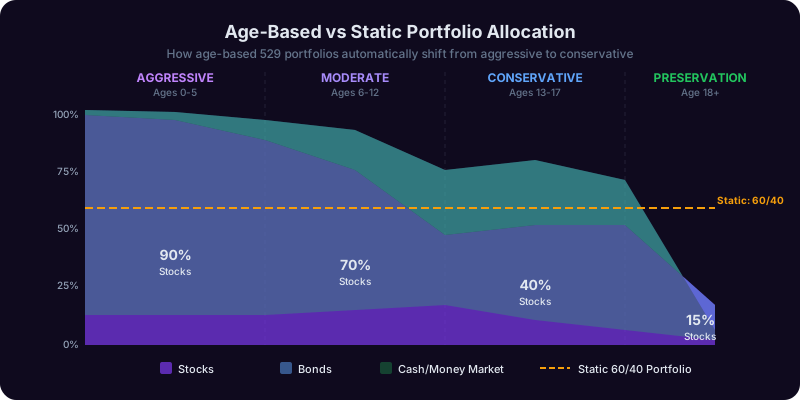
An age-based portfolio starts with a heavy stock allocation when the beneficiary is young and gradually shifts toward bonds and stable-value funds as the child approaches college age. This is the same concept as a target-date retirement fund but calibrated for an 18-year college timeline instead of a 40-year retirement timeline.
| Beneficiary Age | Typical Stock Allocation | Typical Bond/Stable Allocation | Expected Annual Return |
|---|---|---|---|
| 0-5 (aggressive) | 80-90% | 10-20% | 7-9% |
| 6-10 (growth) | 65-75% | 25-35% | 6-7% |
| 11-14 (moderate) | 45-55% | 45-55% | 5-6% |
| 15-17 (conservative) | 20-30% | 70-80% | 3-4% |
| 18+ (capital preservation) | 0-10% | 90-100% | 2-3% |
When to use age-based: This is the right choice for most families. If you do not want to actively manage your 529 investments and you are comfortable with a standard glide path, an age-based portfolio handles everything automatically. It is the default option for a reason - it protects against the two biggest risks: being too conservative when the child is young (missing growth) and being too aggressive when the child is near college (risking a market crash at the worst time).
Static Portfolios: The Hands-On Approach
Static portfolios maintain a fixed allocation regardless of the beneficiary's age. Common options include aggressive growth (90% stock), moderate growth (60% stock / 40% bond), conservative (30% stock / 70% bond), and capital preservation (100% bonds or stable value). You choose the allocation and it stays there until you manually change it.
When to use static:
- You have multiple funding sources. If the 529 covers only a portion of expected costs and other funds (grandparent gifts, financial aid) will cover the rest, you can keep the 529 aggressive longer because you do not need every dollar on a specific date.
- You are a sophisticated investor. If you actively manage your own investment portfolio and want to coordinate your 529 allocation with your overall asset allocation strategy.
- You are starting late. A family that begins saving when the child is 12 might choose a moderate static allocation rather than the very conservative age-based allocation designed for that age group, accepting more risk for the chance of higher returns over the shorter time horizon.
- You plan to use the SECURE 2.0 rollover. If you expect leftover funds to roll into a Roth IRA, keeping the portfolio in growth mode longer may make sense since the money has a 40+ year time horizon in the Roth.
Expense Ratios Matter Inside 529 Plans
Unlike a regular brokerage account where you can choose from thousands of funds, 529 plans offer a curated menu. Expense ratios vary significantly between plans and can erode returns over 18 years. The best direct-sold 529 plans offer index-based age-based portfolios with total expense ratios of 0.12% to 0.20%. Advisor-sold plans often charge 0.50% to 1.50% or more. Over 18 years on a $100,000 balance, the difference between a 0.15% and a 1.00% expense ratio is approximately $18,000 in lost growth.
Check your plan's expense ratios at Savingforcollege.com and compare with top-rated low-cost plans. The Investment Copilot can analyze your current 529 plan's fee structure and flag whether switching to a lower-cost plan would save you enough to justify forfeiting your state tax deduction.
Most plans allow you to change your investment option twice per calendar year or when changing the beneficiary. Plan your allocation strategy carefully to avoid running out of switches.
Grandparent-Owned 529 Plans and the New FAFSA Rules
Grandparent-owned 529 plans have historically been a double-edged sword. The contributions gave grandparents estate planning benefits and the satisfaction of funding education, but distributions from grandparent-owned 529s were counted as untaxed student income on the FAFSA - reducing financial aid eligibility by up to 50% of the distribution amount. The 2024-2025 FAFSA Simplification Act eliminated this penalty, making grandparent 529 plans one of the most powerful college savings tools available today.
What Changed
Under the old FAFSA rules, distributions from 529 plans owned by anyone other than the student or their parents were reported as student income, which reduced aid eligibility at a rate of up to 50%. A $20,000 grandparent 529 distribution could reduce financial aid by $10,000.
Under the new FAFSA rules effective for the 2024-2025 cycle and beyond:
- Distributions from grandparent-owned 529 plans are no longer reported on the FAFSA.
- The FAFSA no longer asks about cash support or gifts from non-custodial relatives.
- Only 529 plans owned by the student or a parent are reported as assets - and parental assets reduce aid eligibility at a maximum rate of 5.64%, far less than the old 50% income hit.
Why This Makes Grandparent 529s So Powerful
With the FAFSA penalty eliminated, grandparent-owned 529 plans now offer several distinct advantages over parent-owned plans:
| Feature | Parent-Owned 529 | Grandparent-Owned 529 |
|---|---|---|
| Reported on FAFSA as asset | Yes (up to 5.64% impact) | No |
| Distributions counted as income | No | No (post-2024 FAFSA) |
| Estate planning benefits | Limited | Significant |
| Control of funds | Parent controls | Grandparent controls |
| State tax deduction | Parent claims (if available) | Grandparent claims (if available) |
| Superfunding eligible | Yes | Yes |
Estate Planning Benefits for Grandparents
529 plans are one of the few vehicles that allow large gifts to be removed from the grandparent's taxable estate immediately while retaining a degree of control. Key benefits:
- Superfunding removes up to $95,000 (single) or $190,000 (married) from the estate per grandchild in a single year, using the five-year gift tax averaging election.
- The grandparent retains control. Unlike an irrevocable trust, the grandparent can change the beneficiary, change the investment allocation, or even reclaim the funds (with a penalty on earnings) if circumstances change.
- No impact on the grandparent's own retirement. The funds are separate from retirement accounts and do not affect Social Security or Medicare eligibility.
- Multi-generational benefit. If the original beneficiary does not need the funds, the grandparent can change the beneficiary to another grandchild, a great-grandchild, or even a niece or nephew.
Strategy: The Grandparent Superfunding Approach
A grandparent couple with four grandchildren can superfund $190,000 per grandchild, removing $760,000 from their taxable estate in a single year while creating dedicated education funds for each grandchild. If the grandparents live in a state with a 529 tax deduction (like New York at $10,000 per person), they also receive an immediate state tax benefit on the contributions.
After the FAFSA changes, there is virtually no downside to grandparent-owned 529 plans for families who expect to apply for need-based financial aid. The Finance Copilot can model how grandparent 529 contributions interact with your family's overall financial aid strategy, estate plan, and state tax situation. For broader estate planning considerations, consult a qualified estate planning attorney - AI tools can help you prepare questions and understand options, but legal advice for estate matters requires professional counsel.
Qualified vs Non-Qualified Expenses and K-12 Tuition Rules
Understanding exactly what counts as a qualified 529 expense is critical for avoiding the 10% penalty and income tax on earnings. The rules have expanded significantly in recent years, but there are still common expenses that families mistakenly assume are covered.
Qualified Higher Education Expenses
The following expenses qualify for tax-free 529 withdrawals when the beneficiary is enrolled at least half-time at an eligible educational institution (any school that participates in federal financial aid programs, including most accredited colleges, universities, community colleges, and vocational schools):
| Expense | Qualified? | Notes |
|---|---|---|
| Tuition and mandatory fees | Yes | Full tuition at any eligible institution |
| Room and board | Yes | Up to the school's cost of attendance allowance |
| Books and supplies | Yes | Required for enrollment or attendance |
| Computer and internet | Yes | Equipment, software, and internet access used primarily by beneficiary during college |
| Special needs equipment | Yes | For beneficiaries with special needs |
| Student loan repayment | Yes | Up to $10,000 lifetime per beneficiary (added by SECURE Act 2019) |
| Apprenticeship programs | Yes | Registered apprenticeships (added by SECURE Act 2019) |
Common Expenses That Do NOT Qualify
| Expense | Qualified? | Why Not |
|---|---|---|
| Transportation and travel | No | Gas, airfare, and car expenses to/from school are not covered |
| Health insurance and medical | No | Student health insurance premiums and medical expenses are excluded |
| Room and board above COA | No | Only covered up to the school's published cost of attendance figure |
| Application fees | No | College application fees are not qualified expenses |
| Extracurricular activities | No | Club fees, sports equipment, and activities not required for enrollment |
| Cell phone service | No | Even if used for school, cell phone plans do not qualify |
K-12 Tuition: The $10,000 Annual Limit
Since the Tax Cuts and Jobs Act of 2017, 529 plans can be used for K-12 tuition at public, private, and religious elementary and secondary schools. However, there are important restrictions:
- Maximum $10,000 per beneficiary per year for K-12 tuition
- Tuition only - books, supplies, computers, room, and board for K-12 do not qualify
- State treatment varies. While federal law allows K-12 withdrawals, several states (including New York, Vermont, Montana, and Oregon) do not conform to this provision. Using 529 funds for K-12 tuition in these states may trigger state income tax on the earnings and possible recapture of prior state tax deductions.
The Student Loan Repayment Option
The SECURE Act of 2019 added a $10,000 lifetime limit for using 529 funds to repay student loans. This applies per beneficiary, not per account. If you have multiple children who each took out student loans, each child can receive up to $10,000 from 529 funds toward their loans. This also applies to the beneficiary's siblings - up to $10,000 per sibling. For deeper strategies on managing student loan debt, see our student loan repayment guide.
Record-Keeping Best Practices
The IRS can audit 529 withdrawals, and the burden of proof is on you. Keep the following records for every distribution:
- Receipts and invoices for all qualified expenses
- School's published cost of attendance for room and board verification
- Tuition bills and enrollment verification
- Computer and technology purchase receipts
- Form 1099-Q (sent by your 529 plan each year you take distributions)
The Tax Copilot can help you categorize expenses, calculate how much to withdraw each semester, and ensure you are not inadvertently triggering penalties. If you are dealing with a mix of 529 distributions, scholarships, and education tax credits, coordination is essential - the same expense cannot be used for both a tax-free 529 withdrawal and an American Opportunity Tax Credit.
How AI Tools Optimize Your 529 Plan Strategy
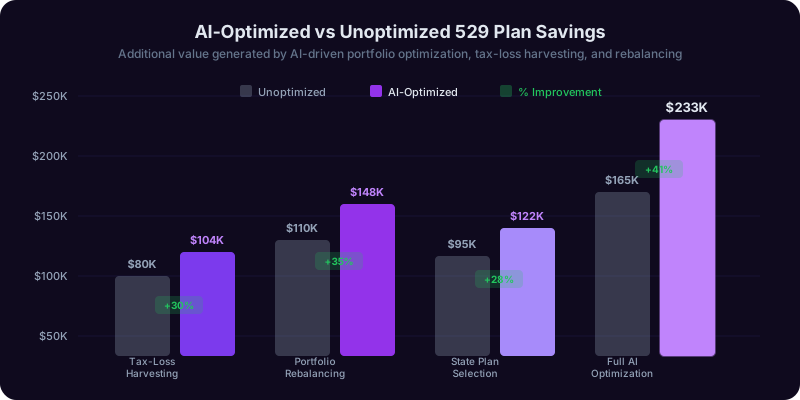
College savings involves more interconnected variables than almost any other personal finance decision. Your optimal strategy depends on your state of residence, income level, marginal tax rate, number of children, each child's age, expected college costs, financial aid eligibility, existing savings, risk tolerance, estate planning goals, and dozens of other factors that shift over time. This is precisely the kind of multi-variable optimization problem where AI tools deliver outsized value.
What AI Can Do for Your College Savings
Here is how Copilotly's AI copilots help families make better 529 decisions at every stage:
1. State Plan Comparison and Selection
There are over 100 different 529 plans across all 50 states and the District of Columbia. Each plan has different investment options, expense ratios, state tax benefits, and minimum contribution requirements. The Finance Copilot can analyze your specific situation - state of residence, marginal tax rate, planned contribution level, investment preferences - and recommend whether your home state plan or an out-of-state plan provides better overall value. In states like Arizona and Pennsylvania where you get a tax deduction for contributing to any state's plan, the analysis becomes especially nuanced.
2. Contribution Strategy Optimization
Should you superfund at birth or contribute monthly? Should grandparents open their own accounts or contribute to the parents' plan? How much should you allocate to 529 savings versus retirement savings when both compete for the same dollars? AI can model these trade-offs with your actual numbers. A common finding: families contributing $500 per month often benefit more from a lump-sum superfunding approach in the early years, even if it means temporarily reducing retirement contributions, because the compound growth advantage over 18 years outweighs the opportunity cost.
3. Investment Allocation Guidance
AI tools can evaluate your current 529 portfolio allocation against your child's age, your total college savings picture (including other accounts), and your risk tolerance. If your child is 14 and your 529 is still in an aggressive age-based track, that may be appropriate if you have other conservative funds earmarked for tuition - or it may be reckless if the 529 is your only source. Context matters, and AI can process all variables simultaneously.
4. Tax Coordination Across Accounts
The interaction between 529 withdrawals, education tax credits (American Opportunity and Lifetime Learning), scholarship income, and student loan interest deductions creates a complex optimization problem. Using the same expense for both a 529 withdrawal and a tax credit is not allowed, so you need to allocate expenses strategically. The Tax Copilot can model the optimal allocation of expenses across all available tax benefits, often finding $1,000 to $3,000 in additional tax savings that families miss when filing manually.
5. FAFSA Impact Modeling
AI can project how your 529 balances, withdrawals, and other assets will affect your Expected Family Contribution (now the Student Aid Index) on the FAFSA. This includes timing strategies - for example, making large 529 withdrawals in years that are not counted in the FAFSA income lookback window, or understanding when grandparent distributions can be made with zero aid impact under the new rules.
6. Ongoing Monitoring and Rebalancing Alerts
College savings is not a set-it-and-forget-it decision. Market conditions change, tax laws change, your income changes, and your child's college plans evolve. AI tools can send proactive alerts when your allocation drifts too far from target, when tax law changes affect your strategy, or when your child approaches ages where investment shifts should occur.
Getting Started With AI-Powered College Savings
The Finance Copilot is the best starting point for comprehensive college savings planning. Bring your current 529 balance (if any), your monthly savings capacity, your state of residence, your child's age, and your target schools. The copilot can generate a personalized savings plan, recommend a state plan, suggest an investment allocation, and project whether you are on track to meet your goals. For tax-specific questions, pair it with the Tax Copilot. For investment allocation deep dives, use the Investment Copilot. And if college costs are intersecting with your own investment strategy or emergency fund goals, the copilots can model the trade-offs across all of your competing financial priorities.
Frequently asked questions
What is the maximum I can contribute to a 529 plan in 2026?
Can I use 529 funds for K-12 private school tuition?
How does the SECURE 2.0 Act Roth IRA rollover work for unused 529 funds?
Do grandparent-owned 529 plans still hurt financial aid eligibility?
What happens if my child gets a scholarship and does not need the 529 money?
Should I open a 529 plan in my home state or another state?
Can I use 529 funds to pay off student loans?
How does a 529 plan affect my taxes if I move to a different state?
Get AI-Powered College Savings Guidance
The Finance Copilot analyzes your state, income, tax bracket, and family situation to recommend the optimal 529 plan, contribution strategy, and investment allocation - so you can maximize every dollar saved for education.
- Finance & Money CopilotGet a personalized college savings plan with state plan comparison, contribution optimization, and long-term cost projections
Free plan, no card. Pro from $4.99/week for every copilot across all 20 domains - about what one hour with any single professional costs per year.
Not a financial advisorThis is financial information, not financial advice. Consult a licensed financial professional.