
What Is the W-4 and What Changed for 2026
The Form W-4 tells your employer how much federal income tax to withhold from each paycheck. You are not paying taxes with this form. You are telling your employer how much to set aside on your behalf so that when you file your tax return, you have already paid close to what you owe. Get it right and you keep more money in every paycheck without a surprise tax bill in April. Get it wrong and you either owe the IRS hundreds (or thousands) at filing time, or you give the government an interest-free loan all year through over-withholding.
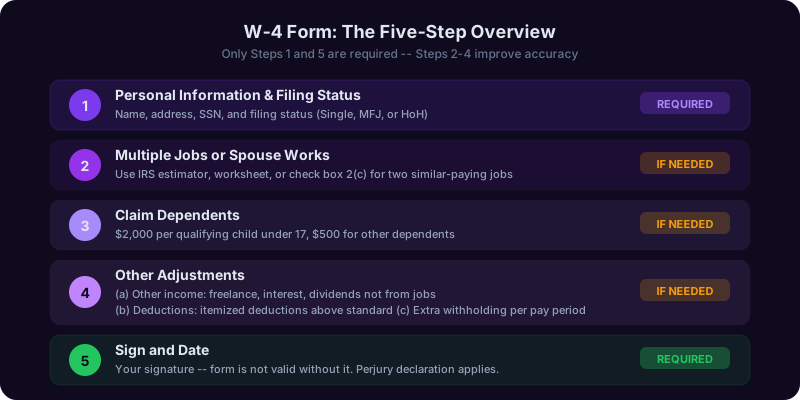
The current W-4 design, introduced in 2020, eliminated the old system of personal allowances. Instead, it uses a five-step process that accounts for multiple jobs, dependent credits, and itemized deductions. The form itself is one page, but the decisions behind each line require understanding your full financial picture.
Major 2026 Tax Law Changes Affecting Your W-4
The One Big Beautiful Bill Act (OBBBA), signed into law in 2025, introduced several provisions that directly impact how you should fill out your W-4 for 2026:
- No federal income tax on overtime pay: Starting in 2026, overtime wages (hours worked beyond 40 per week for hourly employees) are exempt from federal income tax. This means your W-4 withholding calculations should exclude overtime income, and your employer's payroll system should not withhold federal income tax on those overtime dollars. If your employer has not updated their systems, you may need to adjust your W-4 to compensate.
- No federal income tax on tips (up to $25,000): Tipped workers can exclude up to $25,000 in tips from federal income tax. This is a massive change for restaurant workers, bartenders, delivery drivers, and anyone who earns tips regularly. Your W-4 should reflect this exclusion so you are not over-withholding.
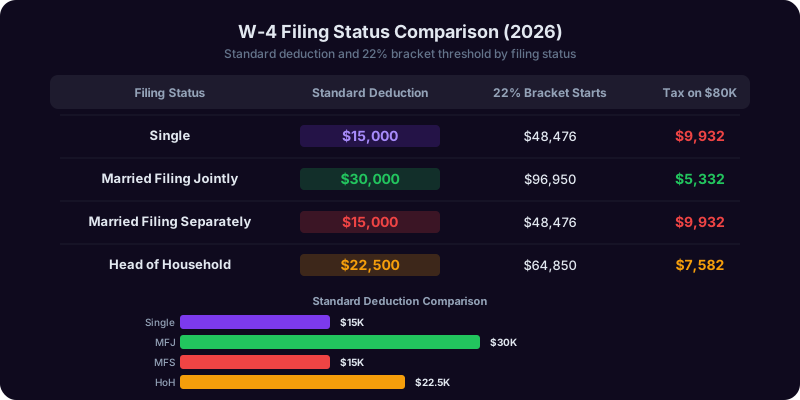
- Increased standard deduction: The 2026 standard deduction has been adjusted for inflation to $15,000 for single filers and $30,000 for married filing jointly. Your employer's withholding tables automatically account for this, but it affects your calculations on Step 4(b).
- Updated tax brackets: All bracket thresholds have been adjusted upward for inflation, meaning slightly more of your income falls into lower brackets compared to 2025.
These changes mean that if you filled out a W-4 in 2024 or 2025 and have not updated it, your withholding may now be too high, especially if you earn overtime or tips. You are giving the government money you do not need to.
For a comprehensive breakdown of all provisions in the new tax law, see our complete guide to the 2026 OBBBA tax changes.
This article provides general tax information, not professional tax advice. Consult a qualified tax professional for guidance specific to your individual situation.
Step-by-Step: Filling Out Every Line of the W-4
Let us walk through the entire form, line by line. Have your most recent pay stub, last year's tax return, and a calculator ready before you start.
Step 1: Personal Information
This step is straightforward. Enter your name, address, Social Security number, and filing status. Your filing status choice here is critical because it determines which withholding tables your employer uses:
- Single or Married Filing Separately: Check this if you are unmarried, legally separated, or married but choosing to file a separate return. This results in the highest withholding rate per dollar earned.
- Married Filing Jointly: Check this if you are married and plan to file a joint return. This results in lower withholding per dollar because the tax brackets are wider for joint filers. However, if both spouses work, under-withholding is common if you do not also complete Step 2.
- Head of Household: Check this if you are unmarried and pay more than half the cost of keeping up a home for a qualifying dependent. This gives you wider tax brackets than Single but narrower than Married Filing Jointly.
Step 2: Multiple Jobs or Spouse Works
This step applies if you hold more than one job at the same time, or if you are married filing jointly and your spouse also works. If neither applies, skip to Step 3. We cover the details of this step in the next section because it is where most errors happen.
Step 3: Claim Dependents
If your total annual income from all jobs will be $200,000 or less ($400,000 or less for married filing jointly), you can claim dependent tax credits here:
- $2,000 for each qualifying child under age 17
- $500 for each other dependent (children 17+, elderly parents, etc.)
Multiply the number of qualifying children by $2,000, add the number of other dependents multiplied by $500, and enter the total. This amount reduces your withholding per paycheck because it anticipates the credit you will receive when you file.
If your income exceeds those thresholds, the child tax credit phases out and you should enter $0 here to avoid under-withholding.
Step 4: Other Adjustments (Optional)
This step has three lines:
- 4(a) Other income: Enter income you expect to receive that is not from jobs, such as interest, dividends, or retirement distributions. Do not enter side hustle income here if you already make quarterly estimated payments on it. Including it here would result in double withholding. For guidance on handling side income, see our side hustle taxes guide.
- 4(b) Deductions: If you plan to itemize deductions or claim above-the-line deductions (student loan interest, IRA contributions, HSA contributions) that exceed the standard deduction, enter the excess amount here. This reduces your withholding. We explain the calculation in a later section.
- 4(c) Extra withholding: Enter any additional dollar amount you want withheld per pay period. Use this as a safety net if you have complex income or want to ensure you do not owe at filing time.
Step 5: Sign and Date
Sign the form and submit it to your employer. Your employer cannot refuse a properly completed W-4 or advise you on how to fill it out. They must implement your withholding elections as submitted.
Step 2 Deep Dive: Multiple Jobs and Two-Income Households
Step 2 is where the W-4 gets complicated and where the most costly mistakes happen. If you skip this step when it applies to you, each employer withholds as if their paycheck is your only income. The result is significant under-withholding because each employer uses the full standard deduction and lower bracket ranges when calculating your taxes, but the IRS stacks all your income together on one return.
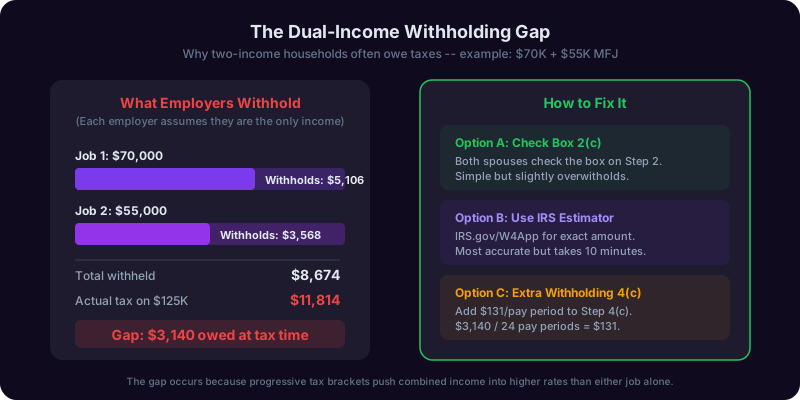
You have three options for handling Step 2. Here is when to use each one:
Option A: Use the IRS Tax Withholding Estimator (Recommended)
The IRS Tax Withholding Estimator is the most accurate method. You enter income, withholding to date, deductions, and credits for all jobs and your spouse's job, and it tells you exactly what to put on each W-4. This is the best option for most people because it accounts for your specific situation, including mid-year job changes, bonuses, and varying pay rates.
Option B: Use the Multiple Jobs Worksheet (Page 3 of the W-4)
The worksheet on page 3 uses a table-based lookup to estimate the extra withholding needed. You compare the higher-paying job's annual wages to the lower-paying job's annual wages and find the corresponding amount to add to your withholding. This works well for two jobs with relatively stable income but becomes less accurate with three or more jobs or highly variable pay.
For example, if one spouse earns $60,000 and the other earns $50,000 (both married filing jointly), the worksheet directs you to add approximately $2,840 in additional annual withholding, split across pay periods. For someone paid biweekly, that is about $109 extra per paycheck on the higher-paying job's W-4.
Option C: Check the Box (Simplest but Least Precise)
The checkbox in Step 2(c) tells your employer to use a higher withholding rate that assumes your job is one of two roughly equal-paying jobs. Both you and your spouse (or both employers, if you have two jobs) must check the box for this to work. It is most accurate when both incomes are similar. If one spouse earns significantly more than the other, this method tends to over-withhold.
Two-Income Household Strategies
The most common mistake for married couples: both spouses fill out their W-4 as Married Filing Jointly and claim the full standard deduction independently. This effectively doubles the deduction used in withholding calculations, leading to a large tax bill at filing time.
Here is the practical approach for dual-income couples:
- One primary W-4: The higher-earning spouse fills out the W-4 with Steps 3 and 4. Claim all dependents on this W-4 only.
- The other spouse: Fills out a basic W-4 with only Steps 1 and 5, checking the box in Step 2(c) or using the estimator to determine extra withholding.
- Review quarterly: Use the IRS estimator every 3-4 months to verify your combined withholding is on track. Adjust the extra withholding in Step 4(c) as needed.
If both spouses claim dependents on their separate W-4s, you will under-withhold because the credit is applied twice in the calculation but can only be claimed once on your actual return. For more on how your paycheck withholding works, see our complete pay stub guide.

Get Answers From the Tax Copilot
The Tax Copilot calculates your optimal W-4 settings based on your income, filing status, dependents, and the new 2026 overtime and tips exemptions -- so you keep more in every paycheck without owing in April.
New for 2026: Overtime and Tips Tax Exemptions on Your W-4
The overtime and tips exemptions under the OBBBA are the biggest W-4 changes in years. Here is exactly how they work and what you need to do on your form.
Overtime Pay Exemption
Starting in 2026, overtime wages are exempt from federal income tax. This applies to hours worked beyond 40 per week for non-exempt (hourly) employees under the Fair Labor Standards Act. Key details:
- The exemption covers the overtime premium portion of your pay. If you earn $30/hour and get time-and-a-half for overtime ($45/hour for OT hours), the full $45 per overtime hour is exempt from federal income tax.
- Overtime pay is still subject to Social Security tax, Medicare tax, and state income tax (unless your state adopts its own exemption).
- Salaried exempt employees who do not receive overtime pay under the FLSA do not benefit from this provision.
- The exemption is scheduled through 2028 unless Congress extends it.
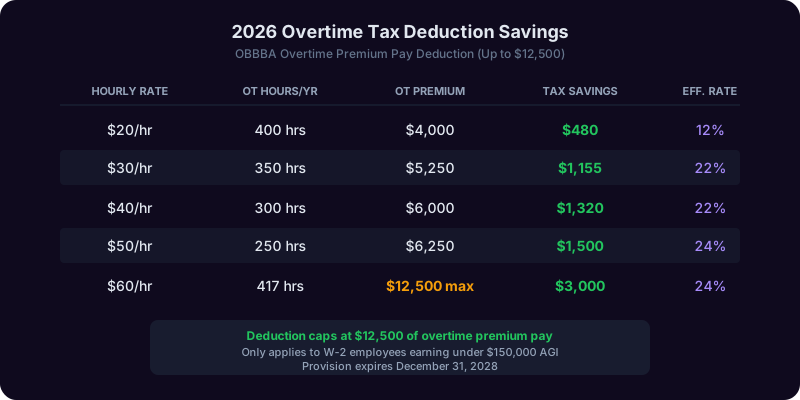
If your employer's payroll system has been updated for 2026, it should automatically exclude overtime from federal income tax withholding. Check your pay stub: if you see federal income tax being withheld on overtime hours, your employer may not have updated their systems yet. In that case, you can estimate your annual overtime pay and enter an offsetting amount in Step 4(b) of your W-4 to reduce your overall withholding.
For example, if you work an average of 5 hours of overtime per week at $30/hour (time-and-a-half = $45/hour), your annual overtime is roughly $11,700. If your employer is still withholding federal tax on it, adding $11,700 to your Step 4(b) deductions will offset the excess withholding.
Tips Exemption (Up to $25,000)
The No Tax on Tips Act provision within the OBBBA exempts up to $25,000 in cash and credit card tips from federal income tax for eligible workers. Key details:
- Applies to workers in traditionally tipped occupations (restaurant servers, bartenders, hairstylists, delivery drivers, hotel workers, and others).
- Tips above $25,000 in a calendar year are taxed normally.
- Tips remain subject to Social Security and Medicare taxes (FICA) regardless of the exemption.
- Your employer should adjust withholding automatically, but verify by checking your pay stub.
If your employer has not updated their withholding for the tips exemption, estimate your annual tips (up to $25,000) and add that amount to Step 4(b) on your W-4. This tells your employer to withhold as if your income is lower by that amount, compensating for the tax you do not actually owe.
For workers who earn both overtime and tips, the combined tax savings can be substantial. A restaurant worker earning $15/hour base pay with 5 hours of weekly overtime and $20,000 in annual tips could save over $5,000 in federal income tax compared to 2025. This is money that should stay in your paycheck, not get refunded to you 12 months later.
For the full details on these and other 2026 tax provisions, see our OBBBA tax changes guide.
Step 4(b): Estimating Your Deductions to Reduce Withholding
Step 4(b) lets you reduce your withholding if you expect deductions beyond the standard deduction. Most people leave it blank and over-withhold all year. Here is how to use it correctly.
When to Use Step 4(b)
Use this line if your itemized deductions plus above-the-line adjustments exceed the standard deduction. For 2026:
- Standard deduction for Single: $15,000
- Standard deduction for Married Filing Jointly: $30,000
- Standard deduction for Head of Household: $22,500
If your total deductions exceed these amounts, enter the difference on line 4(b). Your employer will withhold tax as if your income is lower by that amount.
The Deductions Worksheet (Page 3)
The W-4 includes a Deductions Worksheet for this calculation. Here is a practical example for a married couple filing jointly:
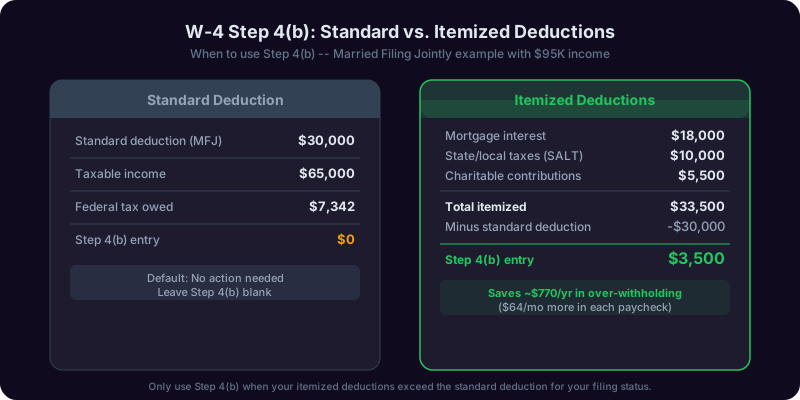
| Mortgage interest | $18,000 |
| State and local taxes (SALT, capped at $10,000) | $6,000 |
| Charitable contributions | $5,000 |
| Total itemized deductions | $29,000 |
| Above-the-line adjustments: | |
| Student loan interest | $2,500 |
| HSA contributions (employee portion) | $1,500 |
| Total adjustments | $4,000 |
| Grand total | $33,000 |
| Minus standard deduction (MFJ) | -$30,000 |
| Amount for line 4(b) | $3,000 |
By entering $3,000 on line 4(b), this couple reduces their annual withholding by roughly $660 to $720 (assuming a 22-24% marginal bracket), which translates to about $25-$28 more per biweekly paycheck.
Common Above-the-Line Deductions to Include
- Traditional IRA contributions: Up to $7,000 ($8,000 if age 50+) if eligible
- Student loan interest: Up to $2,500
- HSA contributions: Up to $4,300 for self-only or $8,550 for family coverage in 2026
- Educator expenses: Up to $300 for qualifying teachers
Important Warning
Do not overestimate your deductions on line 4(b). If you claim $10,000 in excess deductions but only actually have $3,000 when you file, you will owe the difference plus potential underpayment penalties. Be conservative. It is better to slightly over-withhold than to face a surprise bill. If you are unsure, the IRS Tax Withholding Estimator can calculate the right number based on your actual situation.
For those who also earn side income, be strategic about where you account for deductions. If you claim deductions on your W-4 that reduce withholding, make sure you are not also reducing your quarterly estimated payments by the same amount. Our freelancer tax deductions guide covers which deductions go where.
7 Common W-4 Mistakes That Cost You Money
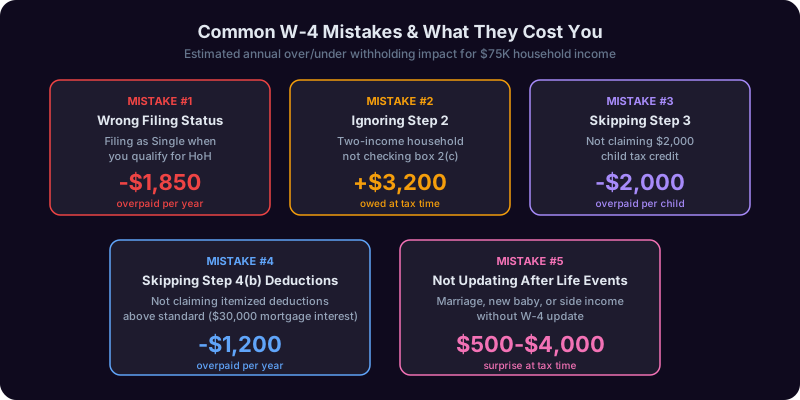
Filing errors on the W-4 are incredibly common. A 2025 Treasury Inspector General report found that over 70% of taxpayers either over-withhold or under-withhold by more than $500 annually. Here are the mistakes driving those numbers and how to avoid them.
1. Ignoring Step 2 When Both Spouses Work
As covered earlier, when two married spouses each file a W-4 as Married Filing Jointly without completing Step 2, each employer withholds as if that paycheck is the only household income. The standard deduction and lower brackets are applied twice, leading to under-withholding that typically ranges from $1,500 to $4,000 depending on income levels. The fix: always complete Step 2 when both spouses work.
2. Both Spouses Claiming Dependents
If you have two children and both spouses claim $4,000 in dependent credits on their respective W-4s, your combined withholding is reduced by $8,000 worth of credits, but you can only claim $4,000 on your actual tax return. This creates a $4,000 under-withholding gap that becomes a tax bill in April. Only one spouse should claim dependents on their W-4.
3. Not Updating After Major Life Changes
A W-4 from three years ago does not reflect your current situation. Marriage, divorce, a new child, buying a home, a spouse starting or stopping work, a significant raise -- all of these change your tax picture. The IRS recommends reviewing your W-4 after every major life event.
4. Over-Withholding to Get a Big Refund
Some people intentionally over-withhold because they like getting a large refund. This is financially irrational. A $3,000 refund means you gave the government $3,000 of your money for up to 12 months with zero interest. If you had kept that money and put it in a high-yield savings account at 4.5% APY, you would have earned roughly $135 in interest. Worse, if you carry credit card debt at 24% APR, that $3,000 locked up in over-withholding costs you $720 in interest charges you could have avoided. Understanding credit scores and debt management makes this tradeoff even clearer.
5. Choosing the Wrong Filing Status
A single parent who qualifies for Head of Household but selects Single on the W-4 will over-withhold because the Single withholding tables have narrower brackets. The Head of Household status provides a higher standard deduction ($22,500 vs. $15,000) and wider tax brackets, resulting in significantly lower withholding on the same income.
6. Not Accounting for the New Overtime Exemption
If you work regular overtime and your employer has not updated their payroll system for the 2026 overtime exemption, federal income tax is being withheld on income that is now tax-free. This is new money you are leaving on the table. Check your pay stub and adjust your W-4 accordingly.
7. Ignoring Side Income Entirely
If you have a side hustle and do not make estimated quarterly payments or account for that income on your W-4's Step 4(a), you will owe taxes plus potential penalties at filing time. Either increase your W-4 withholding to cover it or make quarterly estimated payments.
When to Update Your W-4 (and How Often)
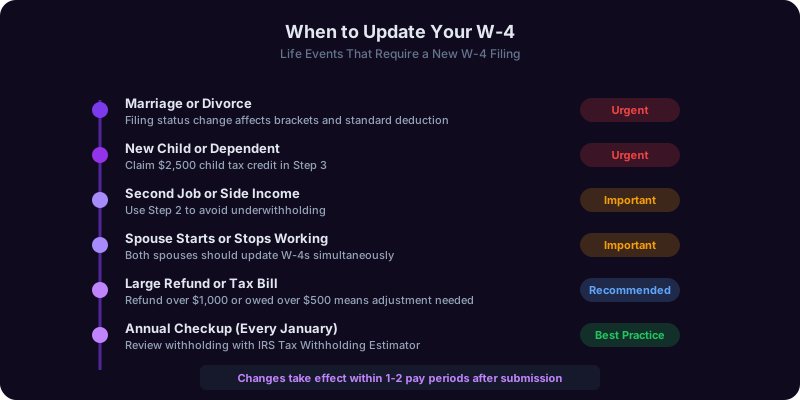
Your W-4 is not a set-it-and-forget-it form. The IRS recommends doing a paycheck checkup at least once a year, but certain events should trigger an immediate review.
Life Events That Require a W-4 Update
- Marriage or divorce: Your filing status changes, your household income likely changes, and your withholding tables shift. A newly married couple where both spouses work should complete new W-4s immediately.
- Birth or adoption of a child: You gain a $2,000 dependent credit. Add it to Step 3 on your W-4 to reduce withholding starting with your next paycheck rather than waiting for a refund months later.
- Buying a home: Mortgage interest may push you above the standard deduction, allowing you to claim excess deductions on Step 4(b).
- Spouse starts or stops working: If your household goes from two incomes to one or vice versa, your withholding needs change significantly.
- Significant raise or promotion: A higher income may push you into a new tax bracket, and if you have dependents, could push you above the child tax credit phase-out thresholds ($200,000 single / $400,000 MFJ).
- Starting or ending a second job: Any change in the number of concurrent jobs requires revisiting Step 2.
- Starting a side hustle: Decide whether to cover side income taxes through W-4 withholding (Step 4(a)) or quarterly estimated payments. Our side hustle taxes guide helps you choose.
The Annual Checkup
Even without a major life event, do a paycheck checkup every January. The IRS Tax Withholding Estimator takes about 10 minutes and tells you exactly whether your current withholding will result in a refund, a balance due, or a break-even at filing time.
Mid-Year Adjustments
You can submit a new W-4 to your employer at any time. There is no limit to how often you can update it. If you realize in September that you have been under-withholding, increase your withholding for the remaining pay periods to catch up. Divide the shortfall by the number of remaining paychecks and enter that amount on Step 4(c).
For example, if the IRS estimator shows you are $2,000 short in September and you are paid biweekly with 8 paychecks remaining, enter $250 in extra withholding per paycheck on line 4(c). This avoids an underpayment penalty at filing time.
You do not need permission to change your W-4. Some employees mistakenly think they can only update it during open enrollment or at the start of the year. That is incorrect. You can submit a new W-4 at any time, and your employer must implement the changes by the start of the first payroll period ending 30 days after submission (per IRS Publication 15). Your employer processes the W-4 mechanically and does not see your total income, your spouse's income, or your overall tax strategy.
How to Use Copilotly to Get Your W-4 Right
The W-4 is one of those forms where generic advice only gets you so far. Your specific situation -- your income level, filing status, number of dependents, deductions, overtime hours, tip income, side hustles, and spouse's earnings -- determines the right answer for each line. That is exactly where the Tax Copilot adds value.
What the Tax Copilot Can Do for Your W-4
- Calculate your optimal withholding: Tell the copilot your gross pay, pay frequency, filing status, and number of dependents, and it will walk you through the exact numbers for each step of the W-4. No IRS worksheets or lookup tables required.
- Model the overtime exemption impact: If you work overtime, the copilot can estimate how much federal tax you should no longer be paying and whether your employer's payroll system is handling it correctly. If not, it calculates the Step 4(b) offset you need.
- Handle dual-income scenarios: For married couples, the copilot can calculate the Step 2 adjustment using your actual incomes rather than the IRS table estimates, which only provide approximations for income ranges.
- Estimate deductions for Step 4(b): Describe your mortgage, property taxes, charitable giving, and other deductions, and the copilot calculates whether you exceed the standard deduction and by how much.
- Run what-if scenarios: Considering a new job? About to start earning overtime? The copilot can model how changes to your income affect your W-4 before they happen, so you can submit an updated form proactively.
Real-World Example
Consider Maria, a nurse who earns $75,000 base salary and works an average of 8 hours of overtime per week at time-and-a-half ($54.09/hour OT rate). She is married filing jointly with two children under 17. Her husband earns $55,000. Here is what the Tax Copilot would help her determine:
| Annual overtime pay | $22,533 (exempt from federal income tax in 2026) |
| Step 2 adjustment | $3,200 additional annual withholding (split across 26 paychecks = $123/check) |
| Step 3 dependents | $4,000 (two children x $2,000, claimed on Maria's W-4 only) |
| Step 4(b) deductions | $22,533 (overtime offset, if employer hasn't updated payroll) |
| Net annual tax savings from overtime exemption | $4,957 |
Without adjusting her W-4 for the overtime exemption, Maria would over-withhold by nearly $5,000 over the course of the year. That is $190 per biweekly paycheck she does not need to give up.
The Finance Copilot can also help you think about what to do with the extra take-home pay from optimized withholding -- whether that is building an emergency fund, paying down high-interest debt, or starting to invest.
You can also use the IRS Form W-4 page to download the latest version of the form and its instructions.
This article provides general tax information and is not professional tax advice. Tax laws are complex and change frequently. Consult a qualified tax professional or CPA for guidance specific to your individual financial situation.
Frequently Asked Questions
Recommended Copilots
Recommended Copilots
Calculate your optimal W-4 withholding and model the impact of overtime and tips exemptions
Try Free →Plan what to do with extra take-home pay from optimized withholding
Try Free →Related Articles
Get Answers From the Tax Copilot
The Tax Copilot calculates your optimal W-4 settings based on your income, filing status, dependents, and the new 2026 overtime and tips exemptions -- so you keep more in every paycheck without owing in April.