
What Is Small Claims Court and Who Is It For?
Small claims court is a simplified court system designed to resolve disputes involving relatively small amounts of money without requiring lawyers, complex procedures, or lengthy trials. It exists in every U.S. state, though the name varies - some states call it "magistrate court," "justice court," or "district court small claims division."
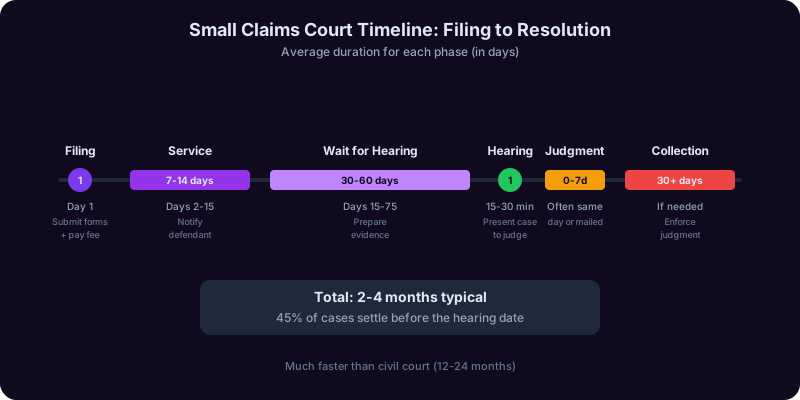
The system was built for regular people. The procedures are simplified, the filing fees are low, and you present your case directly to a judge in plain language rather than through formal legal arguments. Most hearings take 15-30 minutes.
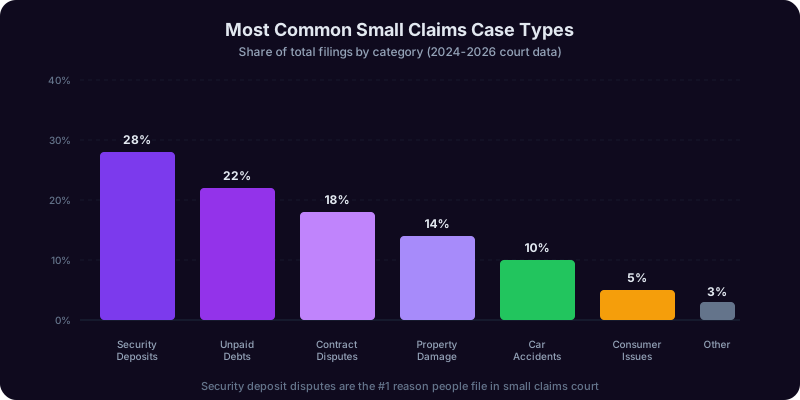
Common Types of Small Claims Cases
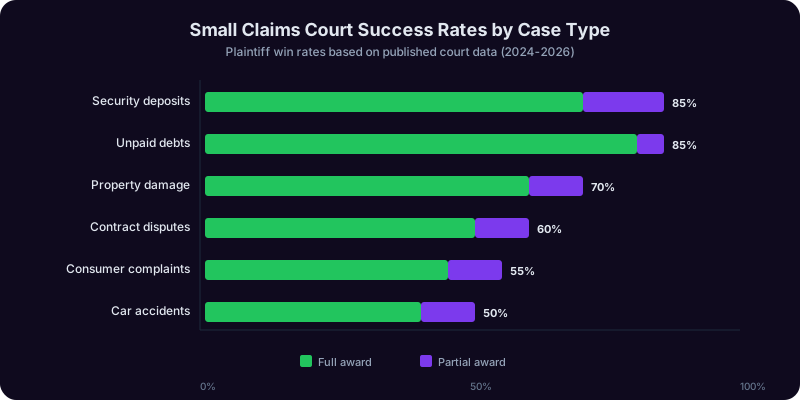
- Security deposit disputes: Your landlord withheld your deposit unfairly
- Unpaid debts: Someone owes you money and refuses to pay
- Property damage: Someone damaged your car, belongings, or home
- Contract disputes: A contractor did not finish work, a vendor did not deliver goods, or a service provider did not meet their obligations
- Consumer complaints: Defective products, misleading services, unauthorized charges
- Car accidents: Property damage claims (not injury claims) from auto collisions
- Neighbor disputes: Property damage, fallen trees, boundary issues
Who Cannot Use Small Claims Court
Small claims court has limitations. You generally cannot use it for:
- Claims exceeding the state's dollar limit
- Personal injury cases (in some states)
- Evictions or other landlord-tenant actions requiring specific legal procedures
- Family law matters (divorce, custody, child support)
- Claims against the federal government
The Small Claims Copilot can help you determine whether your case is appropriate for small claims court and walk you through the filing process for your state. For general guidance from the federal judiciary, the U.S. Courts website explains different types of legal cases and which courts handle them.
Disclaimer: This is general information, not legal advice. Court procedures vary by jurisdiction.
See our real-world walkthrough: landlord keeping security deposit.
Small Claims Court Dollar Limits by State
Every state sets a maximum dollar amount for small claims court. If your claim exceeds the limit, you either need to file in regular civil court (which is more complex and may require a lawyer) or reduce your claim to fit within the small claims limit.
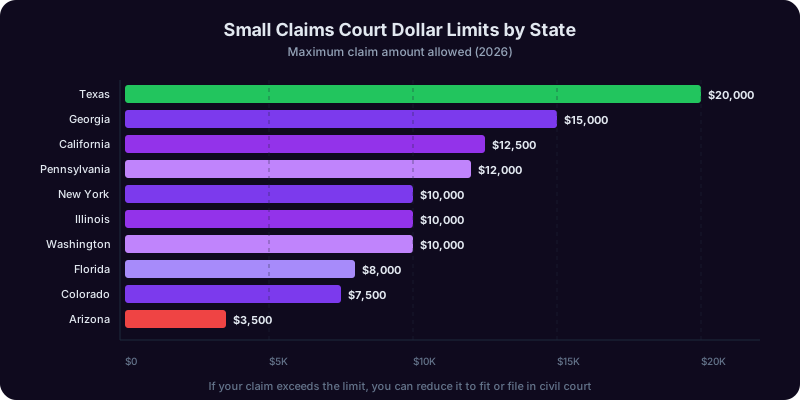
Here are the limits for the most populous states as of 2026:
| State | Small Claims Limit | Notes |
|---|---|---|
| California | $12,500 | $6,250 for businesses; can file max 2 claims over $2,500/year |
| Texas | $20,000 | One of the highest limits in the country |
| New York | $10,000 | $5,000 in town/village courts |
| Florida | $8,000 | Attorneys are allowed |
| Illinois | $10,000 | Cook County has specific procedures |
| Pennsylvania | $12,000 | Filed in magisterial district court |
| Ohio | $6,000 | Lower than many states |
| Georgia | $15,000 | Filed in magistrate court |
| Michigan | $6,500 | No attorneys allowed |
| Washington | $10,000 | No attorneys allowed |
| Arizona | $3,500 | One of the lowest limits |
| Colorado | $7,500 | No attorneys allowed |
| Massachusetts | $7,000 | Businesses limited to $5,000 |
| Virginia | $5,000 | Filed in general district court |
| Oregon | $10,000 | No attorneys allowed |
Strategic Considerations
If your claim is slightly above the limit, you can choose to reduce your claim to fit within small claims. For example, if you have a $13,000 claim in New York (limit: $10,000), you can file for $10,000 and waive the remaining $3,000. This is often worth it because the speed, simplicity, and low cost of small claims court outweigh the $3,000 difference - especially when you factor in attorney fees for civil court.
If your claim is well above the limit, small claims is not the right venue. Consider consulting an attorney about filing in regular civil court, or explore whether the Consumer Rights Copilot can identify alternative resolution paths. For a detailed breakdown of each state's rules, Nolo's small claims limits chart is updated regularly.
What Does Small Claims Court Actually Cost?
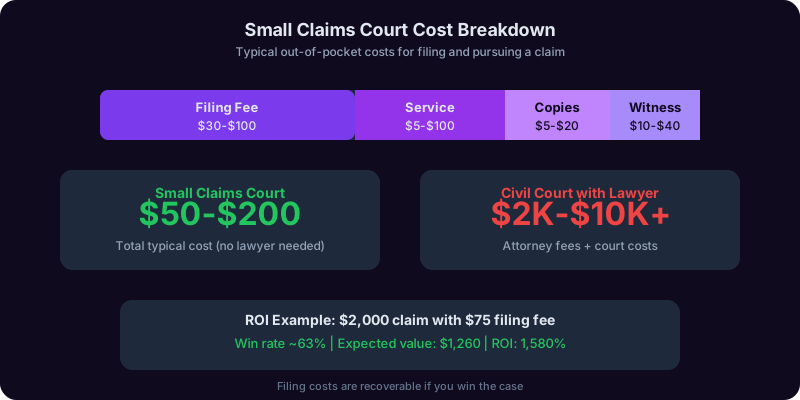
One of the biggest advantages of small claims court is the low cost. Here is a realistic breakdown of what you will spend.
Filing Fees
Filing fees vary by state and county, and sometimes by the amount of the claim. Typical ranges:
- Claims under $1,500: $30-$50
- Claims $1,500-$5,000: $50-$75
- Claims $5,000-$10,000: $75-$100
- Claims over $10,000: $100-$200
Some states have flat fees regardless of claim amount. Check your county court's website for the exact fee schedule.
Service of Process
After filing, you must formally notify the defendant (called "service of process"). Options and costs:
- Certified mail: $5-$15 (cheapest option, accepted in most states)
- Sheriff or marshal service: $25-$75 (required in some states)
- Professional process server: $50-$100 (most reliable option)
Other Potential Costs
- Copies of documents: $5-$20 for court copies
- Time off work: You will need 2-4 hours for the hearing. Some courts offer evening sessions.
- Transportation: Getting to and from the courthouse
- Witness fees: If you subpoena a witness, you may need to pay a small statutory fee ($10-$40 per witness)
Total Realistic Cost: $50-$200
For most small claims cases, your total out-of-pocket cost is under $200. If you win, you can typically recover your filing fees and service costs as part of the judgment. Compare this to hiring a lawyer for a civil case, where you might spend $2,000-$10,000+ before even getting to trial.
Is It Worth It Financially?
Do the math: if your claim is $2,000, your filing costs are $75, and you spend half a day in court, the return on investment is clear. Even for claims as small as $500, the $50-$75 filing fee and a few hours of your time is a reasonable trade for recovering money that is rightfully yours. The break-even point for most people is a claim of around $200-$300 - below that, the filing fee and time may not be worth it.

Get Answers From the Small Claims Copilot
The Small Claims Copilot walks you through filing, evidence preparation, and courtroom strategy. Know your state's limits, deadlines, and procedures before you file.
The Small Claims Court Process: Step by Step
The process is simpler than most people expect. Here is exactly what happens from start to finish.
Step 1: Determine Where to File
File in the county where the defendant lives or where the dispute occurred. For business disputes, you can often file where the business is located. Filing in the wrong county means the case gets dismissed and you start over - check your state's rules.
Step 2: Send a Demand Letter First
Most courts expect (and some require) that you attempted to resolve the dispute before filing. Send a formal demand letter giving the other party 14-30 days to pay or resolve the issue. Keep a copy and the certified mail receipt - you will show these to the judge. Our demand letter guide walks through the process in detail.
Step 3: Fill Out the Claim Form
Go to your county courthouse or their website. Fill out the small claims complaint form. You will need: your name and address, the defendant's full legal name and address, the amount you are claiming, and a brief description of your claim. Be specific: "Defendant owes $2,500 for incomplete kitchen renovation contracted on March 1, 2026." Try our AI contract review tool for step-by-step help.
Step 4: Pay the Filing Fee and File
Submit the form with your filing fee. The clerk will assign a case number and a hearing date, typically 30-60 days out.
Step 5: Serve the Defendant
You must formally notify the defendant of the lawsuit. Use certified mail, a sheriff, or a professional process server (depending on your state's requirements). You cannot serve the defendant yourself. File proof of service with the court.
Step 6: Prepare Your Case
Organize your evidence (covered in the next section). Practice explaining your case in 3-5 minutes - judges appreciate concise presentations.
Step 7: Attend the Hearing
Show up on time, dressed professionally. The judge will call your case, hear both sides, review evidence, and issue a decision - often on the spot. If the defendant does not show up, you typically win by default judgment.
Step 8: Receive the Judgment
The judge rules in your favor or against you. If you win, the judgment specifies the amount owed and when it must be paid (usually 30 days).
Evidence Preparation: What Wins (and Loses) Cases
The quality of your evidence is the single biggest factor in your outcome. Judges decide small claims cases quickly, so your evidence needs to be clear, organized, and compelling.
Types of Evidence That Win Cases
- Written contracts or agreements: The original document showing what was agreed to. This is your strongest evidence in contract disputes.
- Receipts and invoices: Proof of payment, proof of the amount owed, proof of the goods or services purchased.
- Photographs: Dated photos of property damage, defective work, the condition of an apartment at move-in and move-out, damaged goods. Print copies for the judge - do not rely on showing your phone screen.
- Communication records: Emails, text messages, and letters between you and the defendant. Print them in chronological order. Highlight the key messages.
- Witness testimony: If someone witnessed the events, they can testify. Written statements are acceptable if the witness cannot attend.
- Expert estimates: For property damage or defective work, get a written repair estimate from an independent professional. This establishes the cost of repair.
How to Organize Your Evidence
- Create a timeline. Write a one-page chronological summary of events with dates.
- Number your exhibits. Label each document: Exhibit A (contract), Exhibit B (receipt), Exhibit C (photos), etc.
- Make three copies of everything. One for you, one for the judge, one for the defendant.
- Prepare a brief opening statement. "Your Honor, I am here because [defendant] owes me $2,500 for work that was never completed under our contract dated March 1, 2026. I have the contract, proof of payment, photos of the incomplete work, and an estimate from an independent contractor for the cost to complete the job."
Common Evidence Mistakes
- Bringing everything on your phone. Judges need to see printed documents. Phone screens are hard to read, glare in courtroom lighting, and cannot be entered into the court record.
- Disorganized presentation. Fumbling through a pile of papers wastes the judge's time and patience. Use a binder or folder with tabs.
- Emotional testimony instead of facts. "He is a terrible person" loses cases. "He accepted $2,500 on March 1, did not complete the work by the April 1 deadline, and has not responded to my demand letter dated April 15" wins cases.
Need help organizing your evidence and preparing your case? The Small Claims Copilot can help you build a structured evidence package and practice your courtroom presentation. The American Bar Association's Free Legal Help page can also connect you with pro bono resources in your area.
Day of Court: What to Expect and How to Present Your Case
Your hearing day can feel intimidating, but small claims court is intentionally informal. Here is what to expect and how to make a strong impression.
Before the Hearing
- Arrive 15-30 minutes early. Find the courtroom, check in with the clerk, and get comfortable with the environment.
- Dress professionally. You do not need a suit, but business casual shows respect for the court. Avoid jeans, shorts, flip-flops, or anything with slogans.
- Bring everything. Your evidence binder, three copies of all documents, a pen, and a notepad. Bring the originals of all documents in case the judge wants to see them.
- Turn off your phone. Seriously. A ringing phone in a courtroom makes a terrible impression.
The Hearing Process
The judge will call your case by name or case number. Both parties approach the front. The process typically follows this order:
- Plaintiff (you) presents first. Explain your case clearly and briefly. Stick to facts and chronological order. Present your evidence as you go: "Your Honor, Exhibit A is the contract showing the agreed work and price. Exhibit B is my bank statement showing the $2,500 payment on March 1."
- Defendant responds. They present their side. Listen carefully and take notes on anything you want to address.
- Judge asks questions. The judge may ask either party for clarification. Answer directly and honestly.
- Rebuttal. You may have an opportunity to respond to the defendant's claims. Keep it brief and factual.
- Judgment. The judge may rule immediately or take the case "under advisement" and mail the decision within a few days.
Courtroom Etiquette
- Address the judge as "Your Honor."
- Do not interrupt - not the judge, not the defendant. You will get your turn.
- Stay calm. Even if the defendant lies or says something infuriating, your composure strengthens your credibility. Let your evidence do the arguing.
- Be respectful to court staff. Clerks and bailiffs can be helpful if you are polite.
If the Defendant Does Not Show Up
You will likely receive a default judgment - meaning you win automatically because the other party failed to appear. You still need to present a brief version of your case so the judge can determine the appropriate amount.
Collecting Your Judgment: The Part Nobody Talks About
Winning in court is step one. Collecting the money is step two - and it is often the harder step. The court does not collect the money for you. You have to enforce the judgment yourself.
After the Judgment
The defendant typically has 30 days to pay or to file an appeal. During this period, you wait. Some defendants pay promptly. Many do not.
If They Pay Voluntarily
Accept payment and file a "satisfaction of judgment" with the court, which formally closes the case. Get payment by cashier's check or money order - not personal check, which can bounce.
If They Do Not Pay
This is where enforcement comes in. You have several tools available:
- Wage garnishment: You can ask the court to order the defendant's employer to withhold a portion of each paycheck and send it to you. This is one of the most effective collection methods for employed individuals. The process involves filing a "writ of execution" or "earnings withholding order" with the court.
- Bank levy: If you know where the defendant banks, you can obtain a court order to freeze and seize funds from their bank account up to the judgment amount. This requires knowing the bank name and branch.
- Property lien: You can place a lien on the defendant's real property (house, land). This does not give you immediate cash, but the lien must be paid when the property is sold or refinanced. Record the lien with the county recorder's office.
- Vehicle lien: In some states, you can place a lien on the defendant's vehicle through the DMV.
- Debtor's examination: You can request the court to order the defendant to appear and disclose their assets, income, and bank accounts under oath. This helps you determine the best collection method.
Judgment Interest
In most states, your judgment accrues interest from the date it is entered until it is paid. Interest rates vary by state (typically 5-12% annually). This means the longer the defendant waits to pay, the more they owe.
How Long Is a Judgment Valid?
Small claims judgments are typically valid for 5-20 years depending on the state, and can usually be renewed. Even if the defendant cannot pay now, the judgment does not disappear. It sits on their record, affects their credit, and can be enforced when their financial situation changes.
If you are dealing with a defendant who claims they cannot pay, our guide on debt collector rights covers the legal framework for pursuing debts owed to you.
Alternatives to Small Claims Court
Small claims court is not the only option. Depending on your situation, an alternative approach may be faster, cheaper, or more effective.
Mediation
A neutral mediator helps both parties negotiate a resolution. Mediation is faster than court (often scheduled within 1-2 weeks), cheaper (many courts and community organizations offer free mediation), and less adversarial (which matters if you have an ongoing relationship with the other party). Many courts offer mediation as a first step before the hearing. Success rates for mediation in civil disputes range from 60-80%.
Arbitration
Similar to a trial, but handled by a private arbitrator instead of a judge. Arbitration is binding - the decision is final and enforceable. It is faster than court but may cost more ($200-$500 for consumer arbitration). Check your contract - many business agreements include mandatory arbitration clauses, which means you may be required to arbitrate rather than go to court. The American Arbitration Association provides resources on how arbitration works.
Demand Letters
As discussed in our demand letter guide, a well-written demand letter resolves 30-50% of disputes without further action. If you have not sent one yet, start there before filing in court.
Chargeback (Credit Card Disputes)
If you paid by credit card, you may be able to dispute the charge directly with your credit card company. This is often the fastest path for consumer disputes involving purchases of goods or services. You typically have 60 days from the statement date to file a chargeback, though some card companies allow longer. Chargebacks work best for clear-cut cases: goods not received, services not delivered, or charges you did not authorize. The CFPB's credit card resource center explains your chargeback rights under federal law.
Regulatory Complaints
For disputes with licensed businesses (contractors, auto dealers, healthcare providers, financial institutions), filing a complaint with the relevant licensing board or regulatory agency can be effective. Businesses that depend on their license take regulatory complaints seriously. Your state's attorney general also handles consumer complaints and may intervene for patterns of bad behavior.
Online Dispute Resolution
Increasingly, courts and private services offer online dispute resolution (ODR) platforms where both parties submit their positions and evidence electronically. A mediator or arbitrator reviews the submissions and issues a resolution without either party appearing in person. This is particularly convenient for disputes where the parties are in different locations.
The Consumer Rights Copilot can help you evaluate which resolution path is best for your specific situation, considering the amount at stake, the strength of your evidence, and the nature of the dispute.
For more on this topic, read our guide on How to Write a Demand Letter That Gets Results. If your dispute involves a security deposit, our landlord security deposit guide provides a focused walkthrough of the process.
Frequently Asked Questions
Recommended Copilots
Recommended Copilots
Get step-by-step guidance for your specific small claims case
Try Free →Understand your legal rights and build your case argument
Try Free →General legal guidance on evidence gathering and court procedures
Try Free →Continue Exploring
Related Scenarios
How It Works
Related Articles
Get Answers From the Small Claims Copilot
The Small Claims Copilot walks you through filing, evidence preparation, and courtroom strategy. Know your state's limits, deadlines, and procedures before you file.