

What Is a Demand Letter and Why Does It Matter?
A demand letter is a formal written notice sent to a person or business that owes you money, damaged your property, breached a contract, or otherwise wronged you. It is the standard first step before filing a lawsuit, and in many jurisdictions, courts expect you to send one before taking legal action.
The purpose is straightforward: you are telling the other party exactly what they did, what you want them to do about it, and what will happen if they refuse. Think of it as putting someone on official notice that you are serious about resolving the dispute.
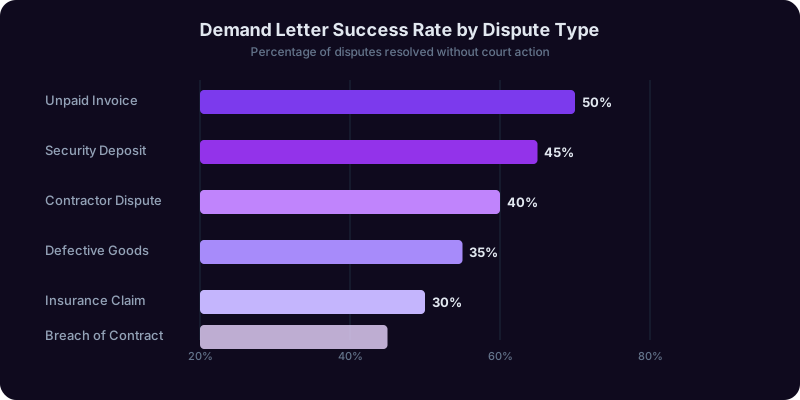
Demand letters work surprisingly often. Studies from the American Bar Association's Dispute Resolution Section suggest that a clear, professional demand letter resolves roughly 30-50% of disputes without further legal action. The reason is simple - most people and businesses would rather settle a legitimate claim than deal with the cost, time, and uncertainty of a lawsuit.
A demand letter also serves critical legal functions beyond just asking for money:
- It creates a paper trail - proving you attempted to resolve the matter before going to court
- It starts the clock - some statutes of limitations or contractual deadlines require formal notice
- It establishes your position - documenting your version of events while details are fresh
- It demonstrates seriousness - showing the other party you have organized your case and are prepared to escalate
Whether you are dealing with an unpaid invoice, a security deposit dispute, defective goods, or a broken contract, a demand letter is almost always the right first move. It costs nothing to send, and the upside is significant. If your dispute involves a landlord withholding your security deposit, a demand letter is especially effective since landlords face statutory penalties in most states for failing to return deposits on time.
Disclaimer: This is general information, not legal advice. Consult an attorney for advice specific to your situation.
See our real-world walkthrough: landlord keeping security deposit.
When Should You Send a Demand Letter?
Timing matters. Send a demand letter too early and you may not have gathered enough evidence. Send it too late and the statute of limitations may have reduced your leverage - or expired entirely.
Send a Demand Letter When:
- Someone owes you money and has stopped responding. Verbal reminders and emails have failed. A formal letter signals you are escalating.
- A business delivered defective goods or poor service. You have tried their customer service process and gotten nowhere. The FTC's guide on getting your money back outlines your rights for defective products.
- Your landlord is withholding your security deposit. The legal return deadline has passed and you have not received your money or an itemized deduction list.
- Someone damaged your property. Their insurance company is stalling, lowballing, or denying your claim.
- A contractor did not finish the work. They took your deposit and either disappeared or delivered substandard results.
- You are preparing to file in small claims court. Many small claims courts require or strongly recommend sending a demand letter first.
Wait Before Sending If:
- You are still in active negotiations. A demand letter can feel adversarial and may derail a conversation that is still productive.
- You do not have documentation. A demand letter without evidence behind it is weak. Gather your receipts, contracts, photos, and correspondence first.
- The situation involves ongoing personal relationships. For disputes with family, close friends, or long-term business partners, consider mediation first.
As a general rule, if informal resolution attempts have failed and you have documentation supporting your claim, it is time to send a demand letter. Most attorneys recommend sending the letter within 30-60 days of the dispute arising, while evidence is fresh and the other party still remembers the details. The Nolo legal encyclopedia provides additional guidance on when demand letters are most effective.
What to Include in Your Demand Letter
Every effective demand letter contains the same core elements. Miss any of these and you weaken your position.
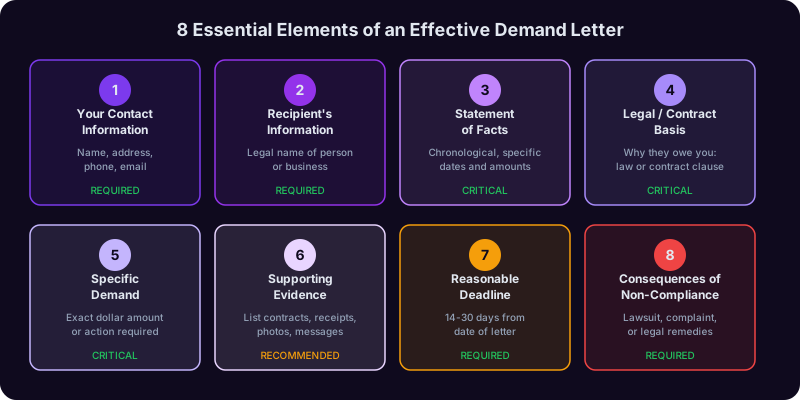
1. Your Contact Information
Full name, address, phone number, and email. This establishes who you are and how to reach you for a response.
2. The Recipient's Information
Full legal name of the person or business. If writing to a company, address it to a specific person - the owner, manager, or legal department. A letter addressed to "To Whom It May Concern" is easier to ignore.
3. A Clear Statement of Facts
Describe what happened in chronological order. Be specific with dates, amounts, and details. "On March 15, 2026, I paid $3,200 for kitchen renovation work" is strong. "You took my money and didn't finish the job" is weak.
4. The Legal or Contractual Basis
Explain why the other party is obligated to you. Reference the specific contract clause, consumer protection law, warranty, or legal principle that supports your claim. You do not need to cite case law - just identify the basis. For reference, the Uniform Commercial Code (Article 2) governs most sales of goods disputes, and the CFPB's consumer regulations cover financial product disputes.
5. The Specific Amount or Action Demanded
State exactly what you want. A dollar amount for monetary claims. A specific action for non-monetary claims (return my property, complete the work, stop the behavior). Vague demands get vague responses.
6. Supporting Evidence Referenced
List the documents that support your claim: contracts, invoices, receipts, photographs, text messages, emails. You do not need to attach everything, but mentioning it shows you have a documented case.
7. A Reasonable Deadline
Give the recipient a specific date to respond - typically 14 to 30 days from the date of the letter. Too short seems unreasonable. Too long loses urgency.
8. Consequences of Non-Compliance
State what you will do if they do not comply. Typically this means filing a lawsuit in small claims court or civil court, reporting to a regulatory agency, or pursuing other legal remedies. Be factual, not threatening. If you need to understand how to read and negotiate contracts, our separate guide covers that topic in depth.

Get Answers From the Consumer Rights Copilot
Tell the Consumer Rights Copilot your situation and get a customized demand letter draft with the right legal language, proper formatting, and strategic tone.
Step-by-Step: Writing Your Demand Letter
Follow this process to draft a demand letter that is professional, complete, and effective.

Step 1: Gather Your Evidence
Before writing a single word, organize everything: the original contract or agreement, all payment receipts, photos of damage or defective work, email and text message threads, notes from phone calls with dates and summaries. Your letter is only as strong as the evidence behind it.
Step 2: Write the Header
Format it like a formal business letter. Your name and address at the top, followed by the date, then the recipient's name and address. Add a subject line: "RE: Demand for Payment - [Brief Description]" or "RE: Breach of Contract - [Project/Agreement Name]."
Step 3: Open with the Relationship
Start by establishing context. "On [date], I entered into an agreement with [name/company] for [service/product]. I paid [amount] on [date] via [method]." Keep it factual and chronological.
Step 4: Describe the Problem
Explain what went wrong. "The work was scheduled for completion by April 1, 2026. As of today, the kitchen cabinets have not been installed, the countertop was cut to incorrect dimensions, and the contractor has not returned my calls since April 10."
Step 5: State Your Legal Basis
"Under our written agreement dated March 1, 2026, you were obligated to complete all work by April 1. Your failure to do so constitutes a breach of contract. Additionally, under [State] consumer protection law, failure to complete contracted work after accepting payment may constitute an unfair business practice."
Step 6: Make Your Demand
"I demand a full refund of $3,200, representing the total amount paid for incomplete work, within 21 days of the date of this letter."
Step 7: State Consequences
"If I do not receive payment by [specific date], I intend to file a claim in [County] Small Claims Court and report this matter to the [State] Attorney General's consumer protection division." You can find your state's Attorney General's office through the USA.gov directory.
Step 8: Close Professionally
"I prefer to resolve this matter without legal action and hope we can reach an agreement promptly. Please contact me at [phone/email] to discuss." Sign and date the letter.
Need help drafting your demand letter? Try the Consumer Rights Copilot - it walks you through each section and helps you write clear, professional language based on your specific situation.
5 Common Mistakes That Kill Demand Letters
Most demand letters that fail share the same problems. Avoid these and you dramatically increase your chances of a successful outcome.
1. Being Emotional Instead of Factual
"You are a scammer and a liar" accomplishes nothing except making you look unreasonable. Judges and opposing attorneys read demand letters too. Every sentence should be something you would be comfortable reading aloud in court. Stick to facts, dates, and amounts. Let the evidence speak for itself.
2. Being Vague About What You Want
"I want to be compensated for my troubles" is not a demand. "I demand payment of $3,200, representing the full amount paid under our agreement dated March 1, 2026" is a demand. Specify the exact dollar amount or the exact action required. If you are unsure what to ask for, calculate your actual damages: money paid, cost to hire someone else to finish the work, cost of replacement goods, documented lost wages.
3. Making Empty or Illegal Threats
Threatening to "ruin their reputation online" or "call the police" for a civil matter weakens your letter and may actually expose you to liability. Stick to legitimate legal remedies: filing a lawsuit, reporting to consumer protection agencies, contacting your state's attorney general, or filing a complaint with the Better Business Bureau or relevant licensing board. If you have received threats yourself, our guide on cease and desist letters explains your options.
4. Sending It to the Wrong Person
A demand letter sent to a general company email or the wrong department gets buried or ignored. Research the correct recipient. For a small business, send it to the owner by name. For a corporation, send it to the registered agent or legal department. Check your state's Secretary of State business registry for the official registered agent address.
5. Not Sending It by Certified Mail
Email demand letters are easy to claim were never received. Always send your demand letter via USPS Certified Mail with Return Receipt Requested. This gives you proof of delivery - a signed receipt showing who accepted the letter and when. This proof becomes evidence if you go to court. You can also send a copy by email for speed, but the certified mail version is what matters legally.
When a Demand Letter Will Not Work (and You Need a Lawyer)
Demand letters are powerful tools, but they have limits. Recognize when your situation has moved beyond what a letter can accomplish.
Your Claim Exceeds Small Claims Limits
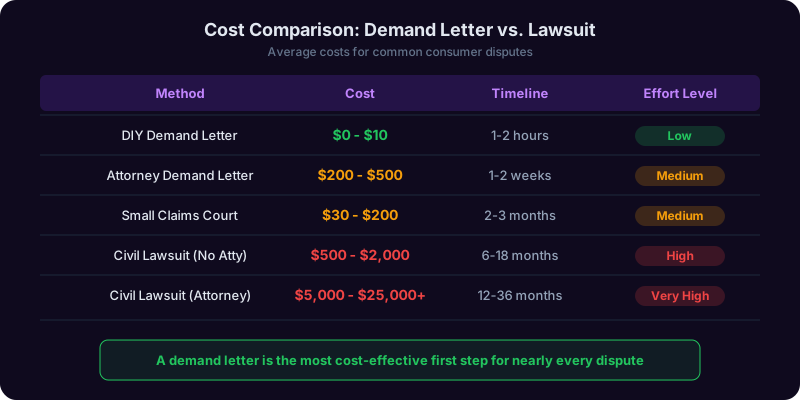
If your damages exceed your state's small claims court limit (typically $5,000-$15,000 depending on the state), you may be heading into civil court territory where legal representation becomes important. A demand letter can still be your first step, but if it fails, the next step involves formal litigation that benefits from an attorney. Our small claims court guide covers state-by-state limits and procedures.
The Other Party Has a Lawyer
If you receive a response from an attorney, the dynamic changes. You are no longer negotiating directly - you are dealing with someone trained to protect their client's interests. Consider at least a consultation with your own attorney before responding. The ABA's lawyer referral directory can connect you with an attorney in the relevant practice area.
The Dispute Involves Complex Legal Issues
Employment discrimination, medical malpractice, intellectual property disputes, and cases involving government entities involve specialized law. A demand letter template will not address the specific legal requirements of these claims. Get professional help. For employment-related disputes specifically, see our wrongful termination guide.
You Need Emergency Relief
If someone is actively causing damage - violating a non-compete agreement, infringing your trademark, harassing you - a demand letter may be too slow. You may need a temporary restraining order or preliminary injunction, which requires court action through an attorney.
The Other Party Is Judgment-Proof
If the person or business has no assets, no income, and no insurance, even winning in court may not result in payment. A demand letter to someone who cannot pay is unlikely to produce results. Research the other party's ability to pay before investing time in the process.
For situations that fall into a gray area, a Contract Review Copilot session can help you evaluate whether your case is straightforward enough to handle yourself or complex enough to warrant professional legal help.
Sample Demand Letter Template
Below is a complete sample demand letter you can adapt to your situation. Replace the bracketed information with your specific details.
[Your Full Name]
[Your Street Address]
[City, State, ZIP]
[Your Phone Number]
[Your Email Address]
[Date]
[Recipient's Full Name]
[Recipient's Street Address or Business Address]
[City, State, ZIP]
RE: Demand for Payment of $[Amount] - [Brief Description]
Dear [Recipient's Name],
I am writing to formally demand payment of $[amount] for [brief description of the claim]. Despite my previous attempts to resolve this matter informally, the issue remains unresolved.
Background: On [date], I [entered into an agreement with you / purchased / hired you to] [describe the transaction]. I paid $[amount] on [date] via [payment method]. [Describe what was promised and what was delivered or not delivered, with specific dates and details.]
Breach: [Describe how the other party failed to meet their obligation. Reference the specific contract term, warranty, or legal standard that was violated.]
Damages: As a result of your [breach/failure/negligence], I have suffered the following damages:
- [Itemized damage 1 with amount]
- [Itemized damage 2 with amount]
- [Total amount demanded]
Demand: I demand payment of $[total amount] within [14/21/30] days of the date of this letter, by [specific date].
Consequences: If I do not receive payment by [date], I intend to [file a claim in [County] Small Claims Court / pursue all available legal remedies, including filing a civil lawsuit]. I will also seek recovery of court costs and any additional damages permitted by law.
I prefer to resolve this matter without legal action. Please contact me at [phone number] or [email] to arrange payment or discuss a resolution.
Sincerely,
[Your Signature]
[Your Printed Name]
Enclosures: [List any documents you are including as copies]
Send via USPS Certified Mail, Return Receipt Requested.
Next Steps After Sending Your Demand Letter
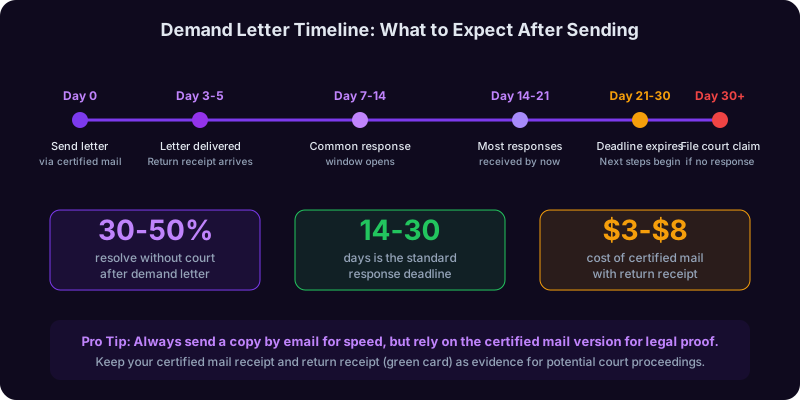
You have sent the letter. Now what? Here is what to expect and how to handle each scenario.
If They Pay or Agree to Your Terms
Success. Get any agreement in writing before considering the matter closed. If they offer a payment plan, document the terms in a simple written agreement signed by both parties. Do not accept verbal promises.
If They Respond with a Counteroffer
This is common and usually a good sign - it means they are taking your claim seriously. Evaluate their offer against your actual damages and the cost and time of going to court. A reasonable settlement now is often better than a full judgment months from now. Consider whether meeting in the middle makes practical sense.
If They Respond with a Denial
Read their response carefully. Do they raise valid defenses? If so, you may need to strengthen your case before proceeding. If their denial is baseless, proceed to your stated next step - typically filing in small claims court.
If They Do Not Respond at All
Wait until your stated deadline passes. Confirm delivery using your certified mail receipt. Then follow through on your stated consequence. In small claims court, a judge will note that you sent a demand letter and the other party ignored it - this reflects poorly on them.
Document Everything
Keep copies of your demand letter, the certified mail receipt, the return receipt (green card), and any responses. If the other party calls you, take notes with the date, time, and what was said. All of this becomes evidence if you go to court.
Know Your Deadlines
Every state has statutes of limitations for different types of claims. Written contracts typically have 4-6 years. Oral contracts have 2-4 years. Property damage claims vary. Do not let your deadline expire while waiting for a response that never comes. If your statute of limitations is approaching, file your court claim regardless of whether you have heard back. The Nolo statute of limitations guide provides state-by-state deadlines.
For help evaluating your next steps after sending a demand letter, the Consumer Rights Copilot can walk you through your options based on the response (or lack of response) you received.
For more on this topic, read our guide on landlord security deposit rights. If a debt collector is involved in your dispute, know your rights under the FDCPA before engaging. And if the dispute stems from a contract you signed, our contract negotiation guide can help you understand your obligations and options.
Frequently Asked Questions
Recommended Copilots
Recommended Copilots
Get AI help drafting your demand letter and understanding your legal options
Try Free →Prepare your small claims case if the demand letter doesn't work
Try Free →General legal guidance on dispute resolution and your rights
Try Free →Continue Exploring
Related Scenarios
How It Works
Related Articles
Get Answers From the Consumer Rights Copilot
Tell the Consumer Rights Copilot your situation and get a customized demand letter draft with the right legal language, proper formatting, and strategic tone.