
Why Interviewers Ask "Tell Me About Yourself" (And What They Are Really Evaluating)
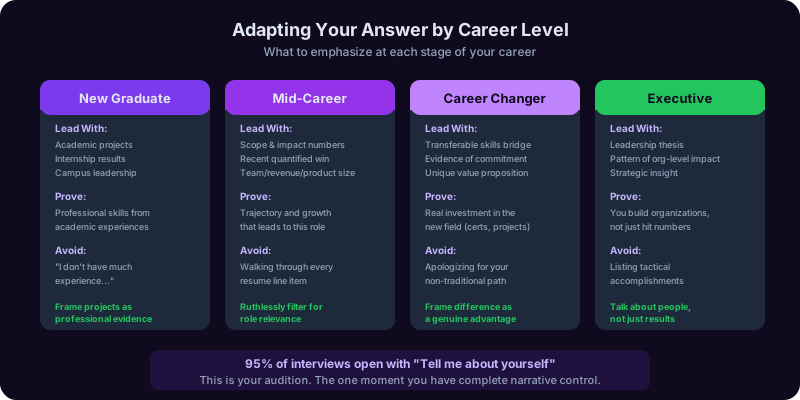
Every interviewer asks this question. It is the opening move in roughly 95% of all job interviews, according to a 2025 LinkedIn Talent Solutions survey. And yet, most candidates treat it as a throwaway warmup. That is a critical mistake, because this question is not casual. It is a test, and interviewers are evaluating you on at least four dimensions before you finish your second sentence.
What the Interviewer Is Actually Measuring
When an interviewer says "tell me about yourself," they do not want your life story. They do not want you to read your resume back to them. They are listening for something much more specific: Try our AI resume builder for step-by-step help.
- Communication ability: Can you organize your thoughts and deliver a coherent narrative under pressure? This is a proxy for how you will communicate in meetings, with clients, and with stakeholders. If you ramble for three minutes without a clear point, the interviewer is already imagining you doing the same thing in a team meeting.
- Self-awareness: Do you understand what makes you valuable? Candidates who cannot articulate their strengths in 60-90 seconds often struggle to prioritize, advocate for their ideas, or lead others. The best candidates know exactly what they bring to the table and can say it clearly.
- Relevance judgment: Can you filter information for your audience? The interviewer wants to see whether you tailor your response to the role you are applying for or whether you deliver a generic monologue. This reveals how you will handle client presentations, project updates, and cross-functional communication.
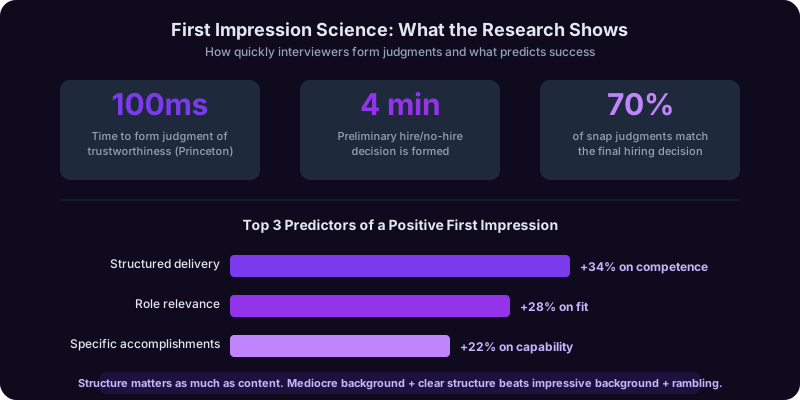
- Confidence and presence: Your tone, pacing, and body language during this answer set the emotional baseline for the entire interview. Research from Princeton psychologist Alexander Todorov shows that people form first impressions within 100 milliseconds, and those impressions are remarkably sticky. Your opening answer either confirms a positive first impression or forces you to spend the rest of the interview climbing out of a hole.
The First Impression Science
The psychological research on first impressions is clear and somewhat terrifying. A 2024 study published in the Journal of Applied Psychology found that interviewers make preliminary hire/no-hire decisions within the first 4 minutes of an interview, and approximately 70% of those snap judgments align with the final hiring decision. Your "tell me about yourself" answer occupies most of those first 4 minutes.
The same study found that the three strongest predictors of a positive first impression were:
- Structured delivery: Candidates who gave answers with a clear beginning, middle, and end were rated 34% higher on competence.
- Role relevance: Candidates who connected their background directly to the open role were rated 28% higher on fit.
- Specific accomplishments: Candidates who included at least one quantified achievement in their opening were rated 22% higher on capability.
This means the structure of your answer matters as much as the content. A mediocre background delivered with clear structure outperforms an impressive background delivered as a rambling stream of consciousness.
What This Question Is NOT
Knowing what the question is not helps you avoid the most common traps:
- It is not a biography request. "I was born in Ohio, went to State University, and then..." is the fastest way to lose your interviewer's attention.
- It is not a resume recitation. They already have your resume. If you just read it back to them, you have wasted the one chance you had to add context, personality, and narrative.
- It is not a therapy session. "I left my last job because my boss was terrible" tells the interviewer more about your judgment than your boss's management style.
- It is not a one-word answer. "I am a marketing professional" followed by silence is just as bad as rambling. You need 60-90 seconds of purposeful content.
The bottom line: this question is your audition. It is the one moment in the interview where you have complete control over the narrative. Every other question is reactive. This one is proactive. The Interview Copilot can help you rehearse your answer with real-time feedback on structure, pacing, and content before the actual interview.
The Present-Past-Future Framework: A Structure That Works Every Time
The biggest reason people botch this question is not a lack of experience. It is a lack of structure. When you do not have a framework, your brain tries to organize 10-20 years of career history in real time, and the result is a meandering answer that starts strong and dissolves into "and then I... um... also did some work in..."
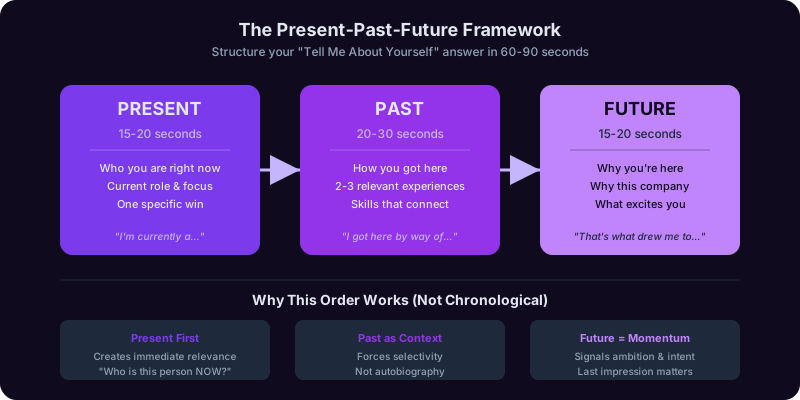
The fix is a framework called Present-Past-Future. It works for every career level, every industry, and every type of role. Once you learn it, you will never fumble this question again.
The Three Parts
Part 1 - Present (15-20 seconds): Start with who you are right now. Your current role, your core focus, and one specific thing you are doing well. This grounds the interviewer in your current reality and establishes your professional identity.
Template: "I am currently a [title] at [company], where I focus on [core responsibility]. Recently, I [one specific accomplishment or current project]."
Part 2 - Past (20-30 seconds): Bridge backward to explain how you got here. This is not your full career history. It is the 2-3 most relevant career moves or accomplishments that explain why you are qualified for the role you are interviewing for. Every sentence in this section should connect to the job you want.
Template: "Before that, I [previous role or experience] where I [relevant accomplishment]. That experience taught me [skill or insight that is directly relevant to this role]."
Part 3 - Future (15-20 seconds): End with why you are here, in this interview, for this specific role. This is where you connect your trajectory to the company's needs. It shows intentionality and genuine interest.
Template: "Now I am looking to [what you want next] and that is what drew me to this role at [company]. Specifically, I am excited about [specific thing about the role or company]."
Why This Order Works
Most people instinctively go chronological: past, then present, then future. The Present-Past-Future framework flips this deliberately, and for good reason:
- Starting with the present creates immediate relevance. The interviewer's first question when they meet you is unconsciously "who is this person right now?" Answer that question first and you have their attention.
- The past becomes context, not autobiography. When your past follows your present, it naturally focuses on explaining how you got here rather than listing everything you have ever done. It forces you to be selective.
- Ending with the future creates momentum. You finish by looking forward, which signals ambition, intentionality, and genuine interest in the role. The interviewer's last impression of your answer is your enthusiasm for their opportunity.
Timing: The 60-90 Second Rule
Your answer should be 60-90 seconds. That is it. Here is why:
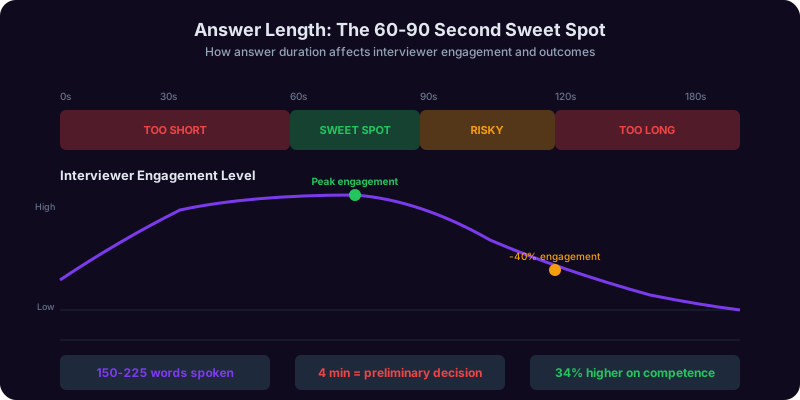
- Under 60 seconds: Feels too brief. The interviewer wonders whether you are nervous, unprepared, or lacking substance.
- 60-90 seconds: The sweet spot. Long enough to be substantive, short enough to hold attention. This is approximately 150-225 words when spoken at a natural pace.
- Over 90 seconds: Attention starts to drift. The interviewer begins planning their next question instead of listening to your answer. By 2 minutes, they are actively waiting for you to stop talking.
- Over 3 minutes: You have lost them. A 2025 study by Interview Edge found that interviewer engagement drops by 40% after the 2-minute mark for open-ended questions. Rambling past 3 minutes was the single strongest predictor of a "not recommended" outcome in first-round interviews.
The Glue Sentences
The transitions between Present, Past, and Future are where most answers feel choppy. Use these "glue sentences" to connect the sections smoothly:
- Present to Past: "I got here by way of..." or "My background in [X] is what led me to this work..." or "Before stepping into this role, I spent [X years] in..."
- Past to Future: "That experience showed me that what I really want to focus on is..." or "Which brings me to why I am here today..." or "Now I am looking to bring that experience to a company where..."
The framework is simple by design. The power is not in complexity. It is in consistency. When you know the structure, you can adapt the content to any role, any interviewer, any situation. Practice it once and you own it forever. The Career Copilot can help you identify which accomplishments from your background are most relevant to highlight for specific roles and industries.
Script for New Graduates and Entry-Level Candidates
If you are a new graduate or early in your career, you might think you do not have enough material for a strong "tell me about yourself" answer. That is wrong. You have internships, academic projects, campus leadership, volunteer work, and relevant coursework. The key is framing these experiences as evidence of professional skills, not just academic achievements.
The Full Script
"I recently graduated from [University] with a degree in [Major], where I focused heavily on [relevant concentration or area]. During my senior year, I led a capstone project where my team [specific accomplishment with a measurable result, e.g., 'built a customer segmentation model for a local retailer that identified three underserved market segments and led to a 15% increase in their targeted email campaign performance']. That project taught me how to work with ambiguous requirements and deliver results on a tight deadline.
Before that, I interned at [Company] as a [Role], where I [specific accomplishment, e.g., 'managed the social media calendar for two product lines and increased engagement by 22% over three months by testing different content formats']. That experience confirmed that I want to build my career in [field/function].
What drew me to this role at [Company] is [specific thing: the product, the team's approach, a recent company initiative]. I am looking for a place where I can apply the analytical skills I have built and grow into a [target role or responsibility], and everything I have learned about your team tells me this is that place."
Line-by-Line Breakdown
"I recently graduated from [University] with a degree in [Major], where I focused heavily on [relevant concentration]."
This is your Present. It is short, factual, and immediately tells the interviewer your current status. The "focused heavily on" phrase is strategic: it signals depth, not just a degree. If you studied marketing but concentrated on analytics, that distinction matters for a data-driven marketing role. Try our AI interview prep tool for step-by-step help.
"During my senior year, I led a capstone project where my team [specific accomplishment]."
This is the most critical line. Notice the structure: action verb ("led"), context ("capstone project"), and result (measurable outcome). Academic projects count as real experience when you frame them with the same specificity you would use for a job. Avoid vague descriptions like "worked on a project about marketing." Instead: "built a customer segmentation model that identified three underserved segments."
"That project taught me how to work with ambiguous requirements and deliver results on a tight deadline."
This is the bridge sentence. It translates the academic experience into professional skills. "Ambiguous requirements" and "tight deadlines" are universal workplace challenges. By naming them, you show the interviewer you understand what real work looks like.
"Before that, I interned at [Company] as a [Role], where I [specific accomplishment]."
This is your Past. If you have internship experience, lead with it. If you do not, substitute campus leadership, volunteer work, or a significant personal project. The rule is the same: specific action, specific result.
"What drew me to this role at [Company] is [specific thing]."
This is your Future. The phrase "what drew me" signals intentionality. You did not just apply to 200 jobs and end up here. You chose this company for a reason. Name that reason and make it specific to them, not generic.
Variations for Different Situations
If you have no internship experience:
"Outside of coursework, I served as [leadership role, e.g., 'president of the Data Science Club'], where I [accomplishment, e.g., 'organized a campus-wide hackathon with 150 participants and secured $5,000 in sponsorship from three local companies']. That experience taught me how to manage stakeholders, coordinate logistics, and deliver under pressure, which is exactly the kind of work I want to do professionally."
If you are switching fields from your degree:
"My degree is in [Original Major], but during my studies I discovered that what I really loved was [New Field]. I pursued that through [specific action: online certifications, side projects, relevant coursework]. For example, I [specific project or accomplishment in the new field]. That experience convinced me that [New Field] is where I want to build my career."
The Resume Copilot can help you identify which of your academic and extracurricular experiences will resonate most strongly with employers in your target industry, and the Interview Copilot can run you through practice rounds so your delivery feels natural, not rehearsed.

Get Answers From the Interview Copilot
Practice your 'tell me about yourself' answer with real-time AI feedback on content, pacing, and delivery. The Interview Copilot simulates realistic interview scenarios so you walk in with confidence, not anxiety.
Script for Mid-Career Professionals (5-15 Years of Experience)
If you are mid-career, your challenge is the opposite of a new graduate's. You do not lack material. You have too much of it. The temptation is to walk the interviewer through every role on your resume, and that is exactly what you must avoid. Your answer should cover 5-15 years of experience in under 90 seconds by ruthlessly filtering for relevance. According to SHRM research on talent acquisition, hiring managers spend an average of 7.4 seconds scanning a resume before deciding whether to read further. Your verbal introduction faces the same ruthless filtering, so make every sentence count.
The Full Script
"I am a [functional title, e.g., 'product marketing manager'] with [X years] of experience in [industry or domain]. Right now, I am at [Current Company], where I lead [scope of responsibility, e.g., 'the go-to-market strategy for a $40 million B2B SaaS product line']. The work I am most proud of this year is [specific recent accomplishment, e.g., 'redesigning our launch playbook, which cut our time-to-market by 30% and contributed to a 18% increase in pipeline from new product launches'].
I got here through a path that started in [earlier function or role]. I spent my first few years at [Previous Company or type of company] doing [relevant early experience], which gave me a strong foundation in [core skill]. From there, I moved into [next phase] where I [key accomplishment that bridges to current expertise, e.g., 'managed my first cross-functional team and discovered that I am strongest when I am sitting at the intersection of product, sales, and marketing'].
The reason I am exploring this opportunity is [honest, specific motivation]. I have been following [Company]'s work in [specific area], and the [Role Title] role is a natural next step for someone with my background in [connecting skill]. I am particularly excited about [specific aspect of the role or company]."
Line-by-Line Breakdown
"I am a product marketing manager with 8 years of experience in B2B SaaS."
Open with your professional identity in one sentence. This is your label, your category. It tells the interviewer immediately what box you fit in. Use the functional title that matches the role you are applying for. If your current title is "Marketing Manager III" but the role is "Senior Product Marketing Manager," describe yourself by function, not by your company's internal titling system.
"Right now, I am at [Company], where I lead [scope]."
Scope is the keyword here. Do not describe your daily tasks. Describe the size and impact of what you own. Revenue numbers, team sizes, product lines, customer segments. "I lead go-to-market for a $40M product line" tells the interviewer far more than "I create marketing campaigns and work with the sales team."
"The work I am most proud of this year is [specific accomplishment]."
This sentence is your proof point. It is the single most important line in your entire answer. Choose an accomplishment that is (a) recent, (b) relevant to the target role, and (c) quantified. "Cut time-to-market by 30%" is specific and memorable. "Improved our processes" is forgettable.
"I got here through a path that started in [earlier function]."
This transition sentence signals that you are about to give context, not a chronological history. The phrase "path that started in" implies selectivity. You are picking the thread that matters, not listing every stop.
"The reason I am exploring this opportunity is [honest motivation]."
Mid-career candidates often stumble here because they are afraid to be honest about why they are leaving. You do not need to trash your current employer. Good reasons include: "I have grown as far as I can in my current role," "I want to work at a company with a stronger [product/engineering/sales] culture," "The scale of this opportunity is what I am ready for." Bad reasons: "My boss is terrible," "I am bored," "The commute is too long." If you are planning to leave your current role, our guide on how to quit your job professionally covers the logistics of a graceful exit.
Customization by Industry
For a tech role: Emphasize the technical problems you have solved, the scale of systems you have worked on, and the metrics you have moved. "I led the migration of our data pipeline from batch to real-time processing, reducing latency from 4 hours to under 5 minutes for 12 million daily events."
For a finance role: Lead with the size of portfolios, deals, or budgets you have managed. "I currently manage a $200 million fixed-income portfolio and generated 340 basis points of alpha over the benchmark last year."
For a healthcare role: Emphasize patient outcomes, regulatory expertise, and cross-functional coordination. "I led the implementation of our new EHR system across 14 clinics, which reduced documentation time by 25% and improved patient satisfaction scores from 78 to 91."
For help identifying which accomplishments to feature and how to quantify them, the Career Copilot can analyze your background and suggest the strongest talking points for specific roles. If you need to update your resume to match this narrative, the Resume Copilot can ensure your written materials tell the same story as your interview answers. For a complete interview preparation plan beyond just this opening question, see our comprehensive interview preparation guide.
Script for Career Changers: Addressing the Elephant in the Room
If you are switching industries or functions, you face a unique challenge: the interviewer is going to wonder why you are making this change and whether you can actually do the new job. Your answer needs to address both questions head-on. The worst thing you can do is pretend the career change is not happening or hope they will not notice. They will notice. Own it.
The Full Script
"I am making a deliberate transition into [new field/function], and I want to be upfront about that because I think my background is actually a significant advantage here. For the past [X years], I have been working as a [current/previous role] in [industry], where I [specific accomplishment that demonstrates a transferable skill, e.g., 'managed a team of 12 and delivered $3.2 million in projects on time and under budget']. That work required [transferable skill #1, e.g., 'stakeholder management'], [transferable skill #2, e.g., 'data-driven decision making'], and [transferable skill #3, e.g., 'leading cross-functional teams'], which are exactly the skills this role demands.
The shift started when I [specific catalyst for the career change, e.g., 'led a digital transformation project at my company and realized I was more engaged by the technology strategy than by the operations work I was officially doing']. Since then, I have [concrete steps you have taken: certifications, courses, freelance projects, volunteer work, e.g., 'completed the Google UX Design Certificate, redesigned the internal tools portal for my current company as a side project, and volunteered with a nonprofit to build their donor management system'].
What I bring that a traditional [new field] candidate might not is [your unique value proposition, e.g., 'deep operational experience that means I do not just design solutions in a vacuum. I understand the business constraints, the stakeholder dynamics, and the implementation realities']. That is exactly why this role at [Company] excites me. You are looking for someone who can [specific requirement from the job description], and that is what I have been doing from a different angle for [X years]."
The Three Rules for Career Changers
Rule 1: Lead with the bridge, not the gap.
Your answer should start with what connects your old career to your new one, not with what separates them. The framing "I am making a deliberate transition" is stronger than "I do not have direct experience in this field." Both are true. One positions you as intentional and strategic. The other positions you as unqualified.
The bridge is your transferable skills. Every career has them:
- Sales to product management: customer empathy, market understanding, competitive analysis, stakeholder communication
- Teaching to corporate training: curriculum design, audience analysis, public speaking, assessment and feedback
- Military to operations: leadership under pressure, logistics, process optimization, team management
- Journalism to content marketing: storytelling, deadline management, research, interviewing stakeholders
- Finance to data science: quantitative analysis, modeling, risk assessment, data interpretation
Rule 2: Show evidence of commitment, not just interest.
Saying "I am interested in switching to UX design" is worthless. Everyone is interested in things. The interviewer needs to see evidence that you have invested real time and effort into the transition. This means:
- Certifications or courses completed (not just enrolled in)
- Side projects or portfolio work you have done
- Freelance or volunteer experience in the new field
- Informational interviews or mentorship relationships you have built
- Industry events or communities you are active in
The more concrete your evidence, the less your career change feels like a risk and the more it feels like a natural evolution.
Rule 3: Frame your difference as an advantage, not a liability.
Career changers often apologize for their background. Do not. Your non-traditional background is a genuine asset. If you are changing careers and also need to write a cover letter that addresses the transition, frame your transferable skills prominently if you can articulate why. The former teacher who becomes a UX researcher brings a depth of understanding about how people learn that a traditional UX candidate may lack. The former military officer who moves into project management brings crisis leadership skills that you cannot learn in a classroom. Name your advantage explicitly.
Handling the Follow-Up: "Why Are You Leaving Your Current Field?"
This question will come, and your answer matters. The interviewer is listening for red flags (running away from something vs. running toward something). Strong answers:
"I loved the [specific aspect] of my previous work, but I found that the part of the job that energized me most was [thing that connects to the new field]. Over time, I realized I wanted to make that my primary focus rather than a side piece of my role."
Avoid: "I was burned out," "There is no money in [old field]," or "I hated my job." Even if these are true, they are red flags. Focus on what you are moving toward, not what you are running from.
The Career Copilot can help you map your transferable skills to specific roles and identify the strongest bridge between your old career and your new one. If your resume needs to be restructured to tell a career-change story, the Resume Copilot can help you reformat it around skills and accomplishments rather than chronological job titles. And for practicing the delivery of your career change narrative, the Interview Copilot can simulate real interview scenarios with follow-up questions so you are prepared for the pushback.
Script for Executives and Senior Leaders
If you are interviewing for a VP, C-suite, or senior director role, the expectations for your "tell me about yourself" answer are fundamentally different. The interviewer is not evaluating whether you can do the job. They are evaluating whether you can lead the organization through its next phase. Your answer needs to sound like a leadership narrative, not a career summary.
The Full Script
"I am a [functional leader, e.g., 'revenue leader'] who builds and scales [what you build, e.g., 'go-to-market organizations in high-growth B2B environments']. Over the past [X years], I have taken [scope description, e.g., 'three companies from $20 million to $100 million-plus in ARR'], and the common thread across all of them has been [your leadership thesis, e.g., 'building repeatable systems rather than relying on heroics, which means investing heavily in process, enablement, and talent development'].
Most recently, I was [Title] at [Company], where I [headline accomplishment, e.g., 'grew the sales organization from 25 to 110 people, expanded into two new international markets, and increased net revenue retention from 105% to 128% over three years']. Before that, I held [Title] roles at [Company] and [Company], where I [one accomplishment from each that reinforces your leadership thesis, e.g., 'built the first enterprise sales function at a company that had been purely self-serve, and later redesigned the partner channel strategy that now accounts for 35% of total revenue'].
What I have learned across these experiences is that [strategic insight, e.g., 'the difference between a company that hits $50 million and one that reaches $200 million is almost never the product. It is the operating system: the systems, the talent, and the culture of accountability']. That is the lens I bring to every leadership role. And it is why I am excited about what [Company] is building. You are at [stage or inflection point], which is exactly the kind of challenge I am built for."
Line-by-Line Breakdown
"I am a revenue leader who builds and scales go-to-market organizations in high-growth B2B environments."
This opening sentence is your leadership positioning statement. Notice what it does not include: your current title, your current company, or any specifics. At the executive level, you lead with your identity and your impact thesis. "I am a revenue leader who builds and scales" is a declaration of what you do for organizations, not a description of a job you hold.
"Over the past 15 years, I have taken three companies from $20 million to $100 million-plus in ARR."
This is the executive proof point. It establishes scale and repetition. Doing something once could be luck. Doing it three times is a pattern. At the senior level, interviewers are looking for patterns because patterns predict future performance.
"The common thread across all of them has been [leadership thesis]."
This is the sentence that separates good executives from great ones in interviews. Your leadership thesis is your philosophy of how organizations succeed. It shows the interviewer that you do not just execute; you think strategically about why things work. Examples of strong leadership theses:
- "Building repeatable systems rather than relying on heroics"
- "Investing in talent density over process complexity"
- "Treating customer success as a revenue function, not a cost center"
- "Building engineering cultures where shipping speed and code quality are not in tension"
"What I have learned across these experiences is that [strategic insight]."
This is where you demonstrate executive-level thinking. You are not just listing what you did. You are telling the interviewer what you learned, which signals that you are still growing, still synthesizing, and still capable of adapting to new environments.
Executive-Level Details That Matter
At the senior level, the details you include signal your operating altitude:
- Include: Revenue numbers, team sizes, market expansion, organizational transformations, board-level outcomes, M&A integration, culture-building initiatives.
- Exclude: Individual contributor accomplishments, tactical metrics (unless they roll up to a strategic outcome), technology or tool expertise (unless it is a CTO role).
Talk about people, not just results. The best executive candidates mention their teams. "I grew the organization from 25 to 110 people" is about the team, not just the revenue. "I invested heavily in talent development" signals that you build organizations, not just hit quarterly numbers.
Talk about what you learned, not just what you achieved. Confidence at the executive level includes intellectual humility. The interviewer wants to know that you have the self-awareness to learn from each experience, not just the ego to list accomplishments.
Adapting for Board Interviews vs. Peer Panels
If you are interviewing with a board of directors, emphasize governance experience, risk management, and strategic vision. If you are interviewing with a peer panel (other VPs or C-suite), emphasize collaboration, cross-functional impact, and how you work with peers who have competing priorities.
For executive-level interview preparation, the Interview Copilot can simulate board-level and executive panel interviews with the kind of strategic follow-up questions you will actually face. For refining your leadership narrative and positioning, explore resources at /domains/career.
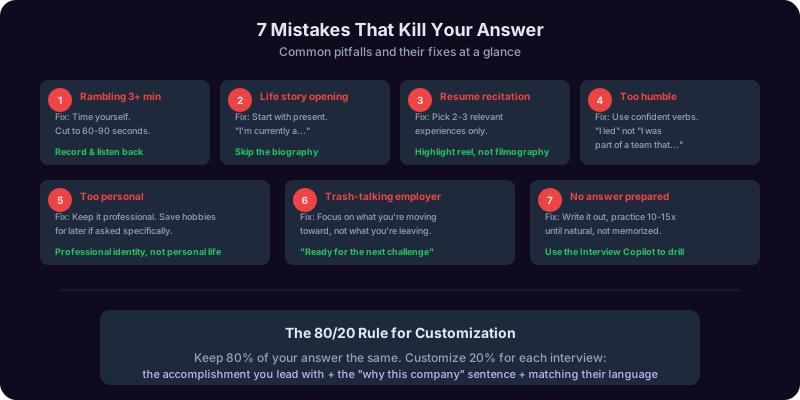
The 7 Mistakes That Kill Your Answer (And How to Fix Each One)
You can have the perfect framework and the perfect script, and still torpedo your answer with one of these seven mistakes. Each one is common, each one is fixable, and each one will make your interviewer mentally check out.
Mistake #1: Rambling Past 90 Seconds
This is the most common and most damaging mistake. When you talk for 3+ minutes without a clear point, the interviewer hears: "This person cannot prioritize, cannot read the room, and will dominate meetings without adding value."
The fix: Time yourself. Literally. Record your answer on your phone and play it back. If it is over 90 seconds, cut it. The rule is simple: if a sentence does not directly support your candidacy for this specific role, delete it. You can cover more ground in the rest of the interview. This one answer needs to be tight.
Mistake #2: Starting With Your Life Story
"So I grew up in a small town in Michigan, and I always loved computers, and then I went to State University where I majored in..." By the time you get to anything relevant, the interviewer has already decided you lack professional communication skills.
The fix: Start with the present. "I am currently a [title] at [company]." That is your first sentence. Everything before that is preamble nobody asked for. The only exception is if your origin story is genuinely relevant and extraordinary (e.g., "I grew up on a farm, which is where I first started building the automation systems that became my career"). Even then, keep it to one sentence.
Mistake #3: Reciting Your Resume
"So first I worked at Company A for two years, then I moved to Company B where I spent three years, then Company C..." This is not an answer. It is a table of contents. The interviewer already has your resume. They do not need you to read it to them.
The fix: Pick the 2-3 experiences from your resume that are most relevant to the role you are interviewing for and tell a narrative that connects them. The rest of your career history can come up naturally during behavioral questions. Your "tell me about yourself" is a highlight reel, not a filmography.
Mistake #4: Being Too Humble
"I mean, I have done a few things... I guess I was part of a team that kind of helped with..." False modesty is transparent and damaging. The interviewer is trying to assess your capabilities, and when you downplay everything, they have no choice but to take you at your word: you did not do much.
The fix: Use confident, direct language. Replace "I was part of a team that" with "I led" or "I drove" or "I built." Replace "we kind of improved" with "we increased revenue by 25%." This is not arrogance. It is clarity. You can acknowledge your team's contributions without erasing your own.
Mistake #5: Getting Too Personal
"I am a mom of three, I love hiking, and I am really passionate about work-life balance." These are fine things to be. They are not what this question is asking. When you lead with personal details, the interviewer does not know how to respond professionally, and you have used your most valuable real estate on information that does not help your candidacy.
The fix: Keep it professional. If the interviewer asks about your hobbies or personal interests later, share them then. Your "tell me about yourself" answer should be about your professional identity, your accomplishments, and your goals. The one exception: if a personal detail directly connects to the role (e.g., "I have been investing in real estate for 15 years, which is what led me to pursue this property management role").
Mistake #6: Trash-Talking Your Current or Previous Employer
"I am looking to leave because my current company has terrible management and there is no growth." Even if this is 100% true, saying it in an interview makes you look unprofessional. The interviewer immediately thinks: "If I hire this person, will they say the same thing about us in two years?"
The fix: Frame your departure positively. "I have learned a lot in my current role and I am ready for the next challenge" or "I am looking for an opportunity to work at a larger scale." You do not need to lie. You need to focus on what you are moving toward, not what you are leaving behind. For more on handling this gracefully, especially if you were let go, see our guide on navigating being fired vs. laid off.
Mistake #7: Having No Answer Prepared
"Oh, um, well, where do I start? I guess... let me think about this..." The interviewer has asked you the most predictable question in the history of interviews. If you did not prepare for it, they reasonably conclude that you did not prepare for anything else either.
The fix: Prepare. There is no shortcut. Use the Present-Past-Future framework from Section 2, write out your answer, and practice it 10-15 times until it sounds natural, not memorized. You should be able to deliver it while making eye contact, with natural pacing, without any "ums" or "uhs." The Interview Copilot can be your practice partner, giving you real-time feedback on pacing, filler words, and content quality so you walk into the real interview with muscle memory, not anxiety.
How to Practice and Customize Your Answer for Any Role
Having a great script is only half the battle. The other half is delivery. A perfectly written answer delivered stiffly sounds rehearsed. A well-practiced answer delivered naturally sounds effortless. Here is exactly how to bridge the gap.
Step 1: Write It Out in Full
Start by writing your answer word for word using the Present-Past-Future framework. Do not worry about perfection on the first draft. Just get your key points on paper. Your first draft will probably be 200-300 words. That is fine. The editing comes next.
Once written, read it aloud. You will immediately notice sentences that look good on paper but sound awkward when spoken. "I leveraged cross-functional synergies to drive stakeholder alignment" reads fine in a resume bullet point but sounds ridiculous coming out of a human mouth. Rewrite anything that does not sound like something you would actually say in conversation.
Target: 150-225 words in your final version. That translates to 60-90 seconds at a natural speaking pace.
Step 2: Record Yourself and Listen Back
This is the step most people skip, and it is the most important one. Use your phone to record yourself delivering your answer. Then listen to it. Pay attention to:
- Pacing: Are you rushing through the beginning? Slowing down in the middle? Most people start fast (nervous energy) and lose momentum. Aim for a consistent, conversational pace throughout.
- Filler words: Count your "ums," "uhs," "likes," and "you knows." One or two is natural. Five or more signals nervousness and undermines your authority. The fix is not to eliminate pauses. It is to replace filler words with silent pauses. A 1-second pause sounds confident. An "um" sounds uncertain.
- Tone: Do you sound enthusiastic or flat? Confident or apologetic? The content can be perfect and the delivery can still kill it. If you sound like you are reading a grocery list, inject more energy. If you sound like a used car salesman, dial it back.
- Ending strength: Most people trail off at the end of their answer. "...and, yeah, that is kind of why I am here." No. Your last sentence should be your strongest. Practice ending with conviction: "That is exactly why this role is the right next step for me."
Step 3: Practice 10-15 Times (But Stop Memorizing)
There is a critical difference between practicing and memorizing. Memorizing means you lock in every word and deliver it identically every time. Practicing means you internalize the key points and can deliver them naturally with slight variations each time.
Here is the practice progression:
- Times 1-3: Read from your script. Focus on getting the content right.
- Times 4-6: Put the script away. Deliver from memory, but do not worry about getting every word exactly right. Focus on hitting the three sections (Present, Past, Future) and your key proof points.
- Times 7-10: Practice in front of a mirror or on camera. Focus on eye contact, facial expressions, and hand gestures. Your body language should match the confidence of your words.
- Times 11-15: Practice with another person. A friend, a partner, or a career coach. Ask them: "Did I sound natural? Was it too long? Did you lose interest at any point?"
Step 4: Customize for Every Interview
Your base script should be 80% reusable across interviews. The 20% you customize is:
- The accomplishment you highlight: Choose the one that is most relevant to the specific role. If the job posting emphasizes leadership, lead with a leadership accomplishment. If it emphasizes technical skills, lead with a technical win.
- The "why this company" sentence: This must be unique for every interview. Research the company and name something specific: a product launch, a strategic initiative, a value they hold, a recent press release. Generic flattery ("I admire your innovative culture") is transparent. Specific knowledge ("I was impressed by your expansion into the healthcare vertical last quarter") signals genuine interest.
- The language you use: Mirror the job posting's language. If they say "cross-functional collaboration," use that phrase. If they say "data-driven decision making," weave it in. This is not pandering. It is speaking the same language as your audience, which is a professional skill.
Step 5: Use AI to Practice and Refine
One of the most effective ways to prepare in 2026 is to practice with an AI interview partner. This gives you the ability to run through your answer dozens of times without wearing out a friend or paying for a career coach.
The Interview Copilot can simulate realistic interview scenarios, including follow-up questions that interviewers commonly ask after "tell me about yourself":
- "You mentioned [accomplishment]. Can you walk me through that in more detail?"
- "Why are you leaving your current role?"
- "What specifically about our company attracted you?"
- "Where do you see yourself in five years?"
Practicing with an AI partner helps you build the muscle memory to transition smoothly from your opening answer into the rest of the interview. It also helps you identify weak spots: vague claims that need specifics, transitions that feel choppy, or sections that run too long.
The Adaptation Matrix
Use this quick reference to adapt your script for different interview contexts:
- Phone screen: Keep it tighter (45-60 seconds). Phone screeners are evaluating baseline fit, not depth. Be concise and energetic because your voice is doing all the work.
- Panel interview: Slightly broader, because you are addressing multiple people with different priorities. Include a wider range of skills and accomplishments.
- Technical interview: Emphasize technical accomplishments and specific technologies. The interviewer wants to hear that you can do the work, not just that you are a nice person.
- Final round / executive interview: More strategic framing. Focus on impact and vision rather than tactical execution.
For comprehensive interview preparation beyond just this one question, explore our full scenarios library for common interview situations, or use the Career Copilot to build a complete job search strategy. If you are also preparing for salary negotiation or navigating a non-compete agreement at your current employer, those guides pair well with your interview prep.
Frequently Asked Questions
Recommended Copilots
Recommended Copilots
Practice mock interviews with AI-powered feedback on your answers, delivery, and body language
Try Free →Build a complete job search strategy and identify which accomplishments to highlight for specific roles
Try Free →Ensure your resume tells the same story as your interview answers with consistent messaging
Try Free →Optimize your LinkedIn profile to attract recruiters and support your interview narrative
Try Free →Related Articles
Get Answers From the Interview Copilot
Practice your 'tell me about yourself' answer with real-time AI feedback on content, pacing, and delivery. The Interview Copilot simulates realistic interview scenarios so you walk in with confidence, not anxiety.