
Why AI Changes the Retirement Planning Equation
Traditional retirement planning relies on static spreadsheets, rules of thumb like the 4% withdrawal rule, and periodic meetings with financial advisors who may see you once or twice a year. The problem is that retirement planning is not a static problem. It involves dozens of interconnected variables -- your savings rate, investment returns, tax brackets, inflation, Social Security benefits, healthcare costs, life expectancy, and spending patterns -- all shifting simultaneously over a 30- to 40-year horizon. A spreadsheet captures a snapshot. AI captures the full movie.
What AI Brings to Retirement Planning
Modern AI tools can process thousands of scenarios in seconds, something that would take a human advisor hours or days to model manually. Here is what that means in practice:
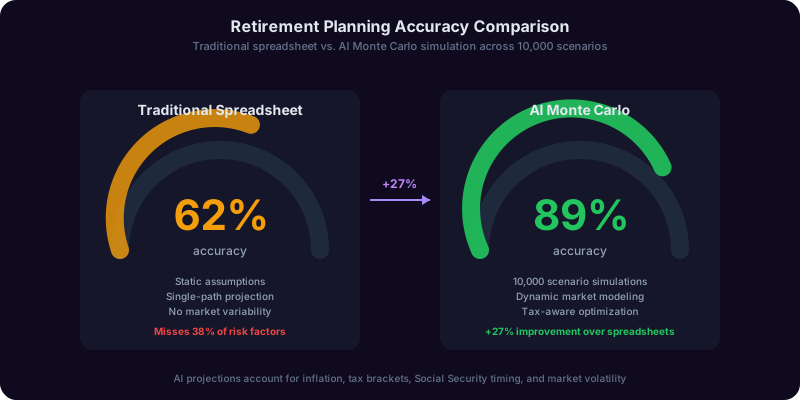
- Monte Carlo simulations at scale: Instead of modeling 3 to 5 return scenarios, AI can run 10,000 simulations incorporating historical market data, varying inflation rates, and different economic conditions to give you a probability-weighted retirement success rate.
- Tax-aware optimization: AI can model the interplay between Traditional 401(k) withdrawals, Roth conversions, Social Security timing, capital gains harvesting, and Medicare IRMAA thresholds to minimize your lifetime tax bill -- a problem with too many variables for most humans to solve optimally.
- Dynamic adjustment: When the market drops 20% or you receive an unexpected inheritance, AI recalculates your entire plan instantly rather than waiting for your next annual review.
- Behavioral nudges: AI can identify when you are falling behind your savings targets and suggest specific, actionable corrections -- increase contributions by $200/month, delay retirement by 8 months, or reduce projected spending by 5%.
The Limitations of Traditional Approaches
Consider a common scenario: a 40-year-old couple earning a combined $150,000, with $200,000 saved so far, planning to retire at 65. A traditional calculator might tell them they need to save $1,500 per month to reach a $1.5 million target. But that single number ignores critical questions. What if one spouse retires at 62 and the other at 67? What if they move from New York to Florida, eliminating state income tax? What if healthcare costs rise at 6% annually while general inflation runs at 3%? What if they want to spend more in early retirement for travel and less after age 80?
AI handles these multi-dimensional questions naturally. Research from MIT Sloan has shown that machine learning models can improve retirement income projections by accounting for non-linear interactions between variables that traditional linear models miss entirely. When market volatility clusters (as it does in real life, unlike the smooth curves in spreadsheets), AI models that incorporate this behavior produce meaningfully different -- and more accurate -- projections.
What This Guide Covers
This guide walks you through seven practical steps to build an AI-assisted retirement plan:
- Calculating your personal retirement savings target based on actual spending needs
- Choosing the right mix of tax-advantaged accounts (401k, Roth, IRA, HSA)
- Estimating and optimizing your Social Security benefits
- Modeling withdrawal strategies that minimize taxes and maximize income
- Stress-testing your plan against market crashes, inflation, and longevity risk
- Building a healthcare cost buffer that accounts for medical inflation
- Setting up ongoing AI monitoring to keep your plan on track
Each section includes specific dollar amounts, realistic scenarios, and instructions for using AI tools -- including the Finance Copilot -- to run these analyses yourself, for free, without needing to hire a financial advisor for the initial planning phase.
This article is general information, not financial or tax advice. Consult a qualified financial advisor for guidance specific to your situation.
Step 1: Calculate Your Personal Retirement Savings Target with AI
The first question everyone asks is: how much do I need to retire? The standard answer -- save 10 to 12 times your final salary -- is a starting point, but it treats all retirees the same. A couple planning to travel extensively in their 60s and downsize in their 70s has fundamentally different needs than a couple planning to stay in their paid-off home and live modestly. AI lets you build a target based on your actual projected expenses, not population averages.
The Expense-Based Approach
Instead of starting with an income multiple, start with what you expect to spend. Here is a framework that AI tools use to build a personalized target:
| Expense Category | Pre-Retirement (Annual) | Early Retirement (65-75) | Late Retirement (75+) |
|---|---|---|---|
| Housing | $24,000 | $18,000 (mortgage paid off) | $18,000 |
| Healthcare | $8,000 | $14,000 (Medicare + supplement) | $22,000 (increased care) |
| Food and groceries | $9,600 | $8,400 | $7,200 |
| Transportation | $10,000 | $7,000 | $4,000 |
| Travel and leisure | $6,000 | $12,000 (active years) | $4,000 |
| Insurance | $5,000 | $3,000 | $3,000 |
| Utilities and maintenance | $6,000 | $6,000 | $6,000 |
| Other (gifts, hobbies, misc) | $6,400 | $6,600 | $5,800 |
| Total Annual | $75,000 | $75,000 | $70,000 |
Notice the pattern: total spending stays roughly constant in early retirement even though the mix shifts dramatically. Housing drops as the mortgage is paid off, but healthcare and travel rise to fill the gap. After 75, overall spending typically declines as travel and activity slow, but healthcare costs continue climbing.
How AI Calculates the Required Nest Egg
An AI retirement planner takes your expense projections and works backward, incorporating inflation, investment returns, Social Security income, and tax obligations. Here is a simplified version of the calculation for our example couple (both age 40, combined income $150,000, current savings $200,000, target retirement age 65):
- Annual retirement spending need: $75,000 in today's dollars
- Inflation-adjusted spending at age 65 (2.8% avg inflation over 25 years): $149,400 per year
- Estimated Social Security (combined): $48,000/year in today's dollars ($95,700 inflation-adjusted)
- Gap to fill from savings: $53,700 inflation-adjusted per year
- Years in retirement (to age 92): 27 years
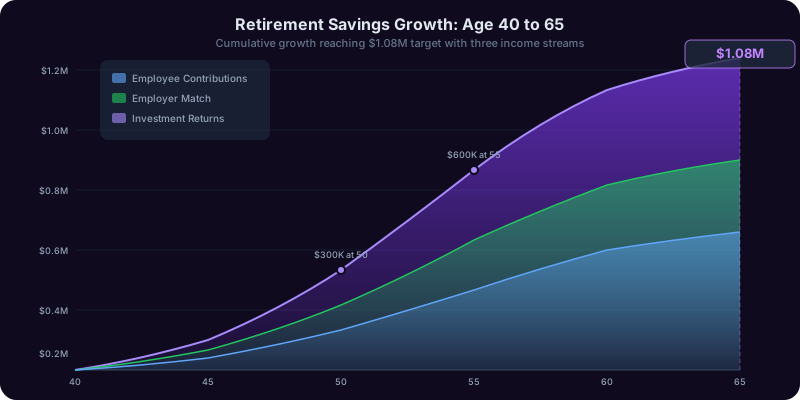
- Required nest egg at 65 (accounting for continued growth at 5% real and withdrawals): approximately $1,080,000 in today's dollars
The Monthly Savings Number
With $200,000 already saved and 25 years to go, our couple needs to save approximately $1,400 per month combined (assuming a 7% nominal return, 2.8% inflation, and the $200,000 growing alongside new contributions). That is $700 per person, or roughly 11% of their combined gross income. With employer matches averaging 3-4% of salary, their total retirement savings rate reaches 14-15% -- right in line with what most financial planners recommend.
What Happens When You Adjust the Variables
This is where AI truly shines. Change one input and the entire plan recalculates:
| Scenario Change | Impact on Monthly Savings Need |
|---|---|
| Retire at 62 instead of 65 | +$380/month (3 fewer saving years, 3 more spending years) |
| Retire at 67 instead of 65 | -$290/month (2 more saving years, higher Social Security) |
| Spend $85,000/year instead of $75,000 | +$310/month |
| Move to no-income-tax state | -$160/month (lower tax drag on withdrawals) |
| One spouse has a pension of $20,000/year | -$420/month |
| Expect inheritance of $100,000 at age 55 | -$180/month |
A traditional advisor would need to rebuild the spreadsheet for each scenario. AI generates all six variations simultaneously and shows you which levers have the biggest impact. In this example, delaying retirement by two years and receiving a pension have the largest effects -- information that helps you prioritize career decisions and negotiate benefits.
The Finance Copilot can run this full analysis using your actual income, expenses, savings, and goals. It accounts for state-specific tax rates, your particular Social Security earnings history, and the specific investment options in your employer's retirement plan.
Step 2: Choose the Right Mix of Retirement Accounts
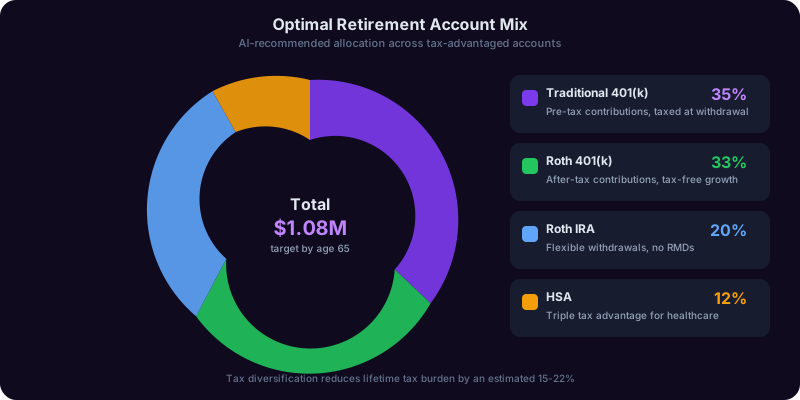
One of the most consequential retirement planning decisions is not how much to save but where to save it. The tax treatment of your retirement accounts determines how much of your savings you actually get to spend in retirement versus how much goes to the IRS. AI can model the tax impact of different account combinations across your entire lifetime -- something that is nearly impossible to do accurately by hand.
The Four Key Account Types
| Account | 2026 Limit | Tax on Contributions | Tax on Growth | Tax on Withdrawals |
|---|---|---|---|---|
| Traditional 401(k) | $23,500 ($31,000 age 50+) | Pre-tax (deductible) | Tax-deferred | Ordinary income tax |
| Roth 401(k) | $23,500 ($31,000 age 50+) | After-tax (not deductible) | Tax-free | Tax-free (if qualified) |
| Roth IRA | $7,000 ($8,000 age 50+) | After-tax | Tax-free | Tax-free (if qualified) |
| HSA | $4,300 individual / $8,550 family | Pre-tax (deductible) | Tax-free | Tax-free (for medical expenses) |
The HSA is often overlooked in retirement planning, but it is the only account that offers a triple tax advantage: deductible contributions, tax-free growth, and tax-free withdrawals for qualified medical expenses. After age 65, HSA withdrawals for non-medical expenses are taxed like a Traditional IRA (ordinary income, no penalty), making it a flexible supplemental retirement account. For a deeper comparison of IRA options, see our Roth IRA guide.
How AI Determines the Optimal Account Mix
The right mix depends on your current tax bracket, expected retirement tax bracket, state taxes, and the specific accounts available to you. Here is how AI models the decision for three different profiles:
Profile A: Early Career, $65,000 Salary, Age 28, Single
Current marginal bracket: 22% federal. AI recommendation:
- Roth 401(k): $10,000/year (enough to capture full employer match)
- Roth IRA: $7,000/year
- HSA: $4,300/year (if enrolled in HDHP)
- Total tax-advantaged savings: $21,300/year
Reasoning: At the 22% bracket early in your career, paying taxes now and locking in tax-free growth for 37 years is advantageous. The Roth IRA adds flexibility since contributions (not earnings) can be withdrawn penalty-free at any time. The HSA covers future healthcare costs tax-free. AI projects that this person's retirement income from Social Security plus Roth withdrawals of $60,000-$80,000/year would face an effective tax rate of 12-14% if it were in Traditional accounts -- confirming that paying 22% now to avoid 12-14% later is not optimal from a pure tax perspective, but the tax-free flexibility, no-RMD advantage, and hedge against rising tax rates make the Roth worthwhile at this bracket.
Profile B: Mid-Career Couple, $180,000 Combined, Ages 42 and 40
Current marginal bracket: 22% federal (MFJ). AI recommendation:
- Traditional 401(k): $12,000/year each ($24,000 total) -- split 50/50 Traditional and Roth
- Roth 401(k): $11,500/year each ($23,000 total)
- Roth IRA: $7,000/year each ($14,000 total) via backdoor if needed
- HSA: $8,550/year (family coverage)
- Total: $69,550/year
Reasoning: The 50/50 split between Traditional and Roth 401(k) provides tax diversification. Traditional contributions save $5,280/year in federal taxes today ($24,000 at 22%). In retirement, the couple can withdraw from Traditional accounts to fill the lower brackets (10% and 12%) and tap Roth accounts for spending above that threshold, keeping their effective tax rate well below 22%. AI models show this split produces $127,000 more after-tax wealth over 30 years compared to going 100% in either direction.
Profile C: High Earner, $300,000 Salary, Age 50, Single
Current marginal bracket: 35% federal. AI recommendation:
- Traditional 401(k): $31,000/year (max with catch-up, 100% Traditional)
- Mega Backdoor Roth: $34,500/year (if plan allows after-tax contributions with in-plan conversion)
- Backdoor Roth IRA: $8,000/year
- HSA: $4,300/year
- Total: $77,800/year
Reasoning: At the 35% bracket, Traditional 401(k) contributions save $10,850/year in federal taxes. The mega backdoor Roth (explained in detail in our 401(k) vs Roth 401(k) guide) channels additional savings into Roth territory without paying the 35% rate because after-tax contributions are already post-tax. This combination gives the high earner both an immediate tax break on the Traditional side and a growing pool of tax-free Roth assets.
The Account Priority Order
Regardless of your specific profile, the general priority for where to direct each additional dollar of retirement savings is:
- 401(k) up to employer match -- always first, regardless of account type
- HSA to maximum -- triple tax advantage makes this the most tax-efficient account
- Roth IRA to maximum -- tax-free growth with withdrawal flexibility
- 401(k) to annual maximum -- additional tax-advantaged space
- Mega backdoor Roth -- if your plan allows it
- Taxable brokerage account -- for savings beyond all tax-advantaged limits
The Tax Copilot can model the specific tax savings of each account type based on your income, state of residence, filing status, and existing account balances. It factors in state income tax (which varies from 0% in Texas and Florida to 13.3% in California) and the impact on credits and deductions that phase out at higher income levels.

Get Answers From the Finance Copilot
Use the Finance Copilot to calculate your personal savings target, optimize your account mix, model Social Security claiming strategies, and stress-test your plan against market crashes and inflation -- all for free, in minutes.
Step 4: Model Tax-Efficient Withdrawal Strategies
Accumulating retirement savings is half the challenge. The other half -- often more complex -- is drawing down those savings efficiently. The order in which you withdraw from different account types, the amounts you withdraw each year, and the timing of Roth conversions can collectively save or cost you hundreds of thousands of dollars in taxes over a 25- to 30-year retirement. This is where AI provides the most measurable value, because the optimization problem involves too many interacting variables for manual calculation.
The Three-Bucket Withdrawal Strategy
Most retirees accumulate savings across three types of accounts, each with different tax treatment:
| Bucket | Examples | Tax on Withdrawal | When to Draw |
|---|---|---|---|
| Pre-tax | Traditional 401(k), Traditional IRA | Ordinary income tax on every dollar | Fill lower tax brackets first |
| Tax-free | Roth 401(k), Roth IRA | No tax (if qualified) | Spending above your target bracket |
| Taxable | Brokerage accounts | Capital gains rates (0%, 15%, 20%) | Harvest losses; use for bridge income |
The conventional wisdom -- spend taxable first, then tax-deferred, then Roth last -- is a reasonable starting point but far from optimal. AI-driven approaches consistently outperform this default ordering by dynamically adjusting withdrawals year by year based on actual tax brackets, Social Security phase-ins, and Medicare thresholds.
AI-Optimized Withdrawal in Practice
Consider a retired couple, both age 65, with the following assets:
- Traditional 401(k)/IRA: $800,000
- Roth IRA: $300,000
- Taxable brokerage: $200,000
- Social Security (combined): $48,000/year (starting at 67)
- Annual spending need: $80,000
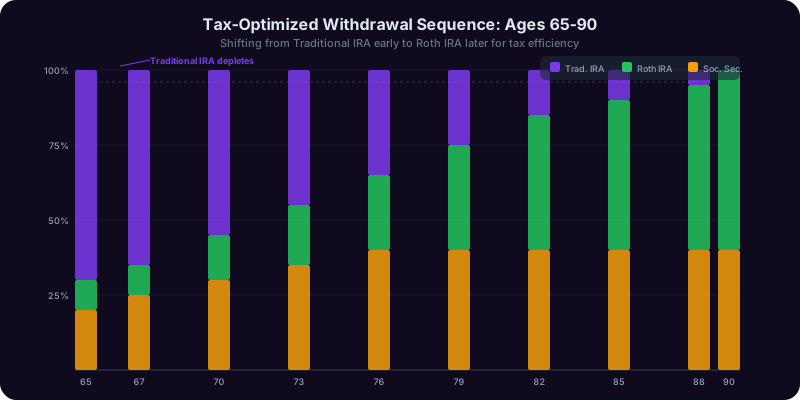
Years 65-66 (before Social Security): AI recommends withdrawing $80,000 from the Traditional IRA. With the standard deduction of $32,300 (MFJ, age 65+), their taxable income is only $47,700 -- well within the 12% bracket. Federal tax: approximately $5,200. Effective rate: 6.5%. This is an incredibly tax-efficient time to draw from pre-tax accounts.
Years 67-72 (Social Security begins, before RMDs): Social Security provides $48,000. They need $32,000 more from savings. AI recommends pulling $20,000 from the Traditional IRA (keeping them in the 12% bracket after the standard deduction and Social Security taxation thresholds) and $12,000 from the Roth IRA (tax-free, does not increase their bracket). AI also recommends converting an additional $30,000/year from Traditional to Roth during these years, paying 12% tax on the conversion to permanently reduce future RMD obligations.
Years 73+ (RMDs begin): Required Minimum Distributions from the Traditional IRA now dictate minimum withdrawals. Thanks to the Roth conversions in years 67-72, the Traditional balance is $180,000 smaller, reducing RMDs by approximately $6,800/year. Any spending above the RMD comes from the Roth IRA (tax-free). The Roth balance has continued growing tax-free and now provides a flexible, tax-invisible income source.
The Roth Conversion Ladder: A Key AI Strategy
The Roth conversion ladder is one of the most powerful tax optimization strategies that AI models consistently recommend. The concept: in the years between retirement and the start of RMDs (and/or Social Security), you have an unusually low income. This creates a window to convert Traditional IRA money to Roth at rock-bottom tax rates.
Using our example couple's numbers, converting $30,000 per year for 6 years (ages 67-72) at a 12% effective rate costs $21,600 in total taxes. But it eliminates approximately $180,000 from their Traditional IRA, which would have been withdrawn via RMDs at a 22% effective rate (when combined with Social Security and other income). Tax savings: approximately $18,000 over the remaining retirement years. The Roth account also continues compounding tax-free, adding further value.
Avoiding the Medicare IRMAA Trap
Income-Related Monthly Adjustment Amounts (IRMAA) add surcharges to Medicare Part B and Part D premiums when your Modified Adjusted Gross Income exceeds certain thresholds. In 2026, a married couple with income above $212,000 pays an extra $1,680/year in Medicare premiums. Above $318,000, the surcharge rises to $5,376/year. AI monitors your projected income against these thresholds and recommends withdrawal amounts that stay just below the nearest cliff -- sometimes suggesting pulling $1,000 less from the Traditional IRA and $1,000 more from the Roth IRA to avoid triggering thousands in Medicare surcharges.
Dynamic Withdrawal Rates
The traditional 4% rule (withdraw 4% of your initial balance, adjusted for inflation each year) was developed using historical data from Vanguard's research on retirement spending and assumes a fixed withdrawal approach. AI improves on this by adjusting the withdrawal rate based on current portfolio performance:
- Market up 15%+ last year: Increase withdrawal by up to 10% (enjoy the gains)
- Market flat or slightly positive: Standard withdrawal (inflation-adjusted)
- Market down 10-20%: Reduce withdrawal by 5-10% (preserve capital)
- Market down 20%+: Reduce withdrawal by 15-20% and draw from Roth or cash reserves
This guardrails approach, which AI tools implement automatically, has been shown to increase the safe withdrawal rate from 4% to approximately 5.0-5.4% while maintaining a 95% success rate over 30 years. On a $1 million portfolio, that is an additional $10,000-$14,000 per year in retirement income.
The Finance Copilot can model your specific withdrawal sequence, recommend annual Roth conversion amounts, and flag any IRMAA threshold risks based on your projected income sources.
Step 5: Stress-Test Your Plan Against Real-World Risks
A retirement plan that works under average conditions is not a retirement plan -- it is a hope. The real test of a plan is whether it survives the worst-case scenarios: a market crash in your first year of retirement, a decade of high inflation, an unexpected health crisis, or simply living longer than expected. AI excels at stress-testing because it can simulate thousands of adverse scenarios simultaneously and show you exactly where your plan breaks down.
The Five Major Retirement Risks
| Risk | What It Means | Historical Worst Case | How AI Models It |
|---|---|---|---|
| Sequence of returns risk | Market crash in early retirement years | 2000-2002: S&P 500 fell 49% | Tests your plan starting in every historical bear market |
| Inflation risk | Sustained price increases erode purchasing power | 1973-1982: Avg 8.7% annual inflation | Models 3%, 5%, and 8% sustained inflation scenarios |
| Longevity risk | Outliving your savings | 12% chance of reaching 95 for a 65-year-old couple | Extends projections to age 95 and 100 |
| Healthcare cost risk | Medical expenses exceeding projections | Long-term care: $108,405/year (private room, 2025) | Models base case plus catastrophic healthcare scenarios |
| Policy risk | Changes to tax rates, Social Security, Medicare | Social Security projected 23% benefit cut by 2035 | Tests scenarios with reduced benefits and higher tax rates |
Sequence of Returns: The Silent Killer
Sequence of returns risk is the most dangerous threat to early retirees. A 30% market drop in year one of retirement, combined with ongoing withdrawals, can permanently impair a portfolio in a way that even strong subsequent returns cannot repair. Here is a concrete example:
Scenario A (good sequence): $1 million portfolio, $50,000/year withdrawal, returns of +15%, +12%, +8%, -20%, +25% in years 1-5. Portfolio after 5 years: $1,084,000.
Scenario B (bad sequence): Same portfolio, same withdrawal, same returns but reversed: -20%, +25%, +8%, +12%, +15%. Portfolio after 5 years: $938,000.
The average return is identical in both scenarios (8% per year), but the bad sequence leaves you with $146,000 less -- a 13.5% difference. Over 30 years, this gap compounds into a substantially higher probability of running out of money.
AI mitigates sequence risk by recommending:
- Maintaining 2 to 3 years of expenses in cash or short-term bonds as a buffer
- Reducing equity withdrawals during market downturns (drawing from bonds or Roth instead)
- Implementing guardrails that automatically reduce spending by 10-15% when the portfolio drops below a threshold
Running a Monte Carlo Simulation
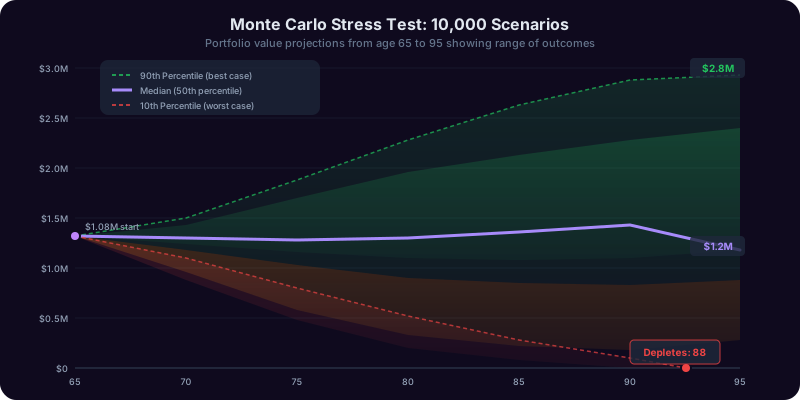
A Monte Carlo simulation generates thousands of possible futures by randomly sampling from historical return distributions (or parameterized distributions that capture realistic market behavior including fat tails and volatility clustering). For each simulation, the model tracks your portfolio balance year by year, accounting for withdrawals, taxes, Social Security, inflation, and RMDs.
The output is a success rate -- the percentage of simulations where your money lasts through your target age. General guidelines:
- 95%+ success rate: Very comfortable. You can likely increase spending or leave a larger legacy.
- 85-95% success rate: Solid. Minor adjustments may be needed if markets underperform early.
- 70-85% success rate: Marginal. Consider reducing spending, working 1-2 years longer, or increasing savings.
- Below 70% success rate: Significant changes needed. The plan has a meaningful risk of failure.
Inflation Stress Test
Most retirement calculators assume 2.5-3% average inflation. But retirees face a different inflation basket than working adults. Healthcare costs have historically risen at 5-7% annually, and healthcare becomes a larger share of spending as you age. AI models a separate inflation rate for healthcare expenses versus general living expenses, which produces more realistic (and often more sobering) projections.
Under a sustained 5% inflation scenario (versus the baseline 2.8%), a retiree spending $75,000/year in today's dollars would need $201,000/year at age 85 instead of $149,000. That is an additional $52,000/year in spending power erosion. AI responds by recommending higher equity allocations (stocks historically outpace inflation over long periods), Treasury Inflation-Protected Securities (TIPS) for the bond allocation, and a larger initial nest egg.
Social Security Solvency Risk
The Social Security Trustees Report projects that the combined trust funds will be depleted by approximately 2035, after which incoming payroll taxes would cover only about 77% of scheduled benefits. AI models three scenarios:
- Base case: Full benefits as scheduled (assumes Congress acts to shore up funding)
- Moderate cut: 15% benefit reduction starting in 2035
- Severe cut: 23% benefit reduction (the projected shortfall if no action is taken)
For our example couple receiving $48,000/year in combined benefits, a 23% cut would reduce annual benefits by $11,040. AI calculates the additional savings needed to cover this gap: approximately $220,000 more in retirement accounts to generate $11,040/year over 25 years of retirement. That translates to roughly $350/month in additional savings during the 20 years before retirement.
The Second Opinion Copilot can review your retirement plan assumptions and identify risks you may have overlooked, from healthcare cost underestimates to over-optimistic return assumptions.
Step 6: Plan for Healthcare Costs and Longevity
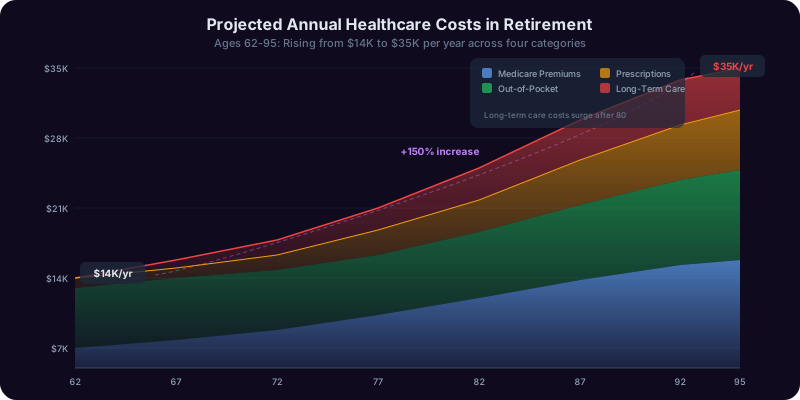
Healthcare is the single largest variable cost in retirement and the one most people underestimate. A 65-year-old couple retiring today can expect to spend $351,000 to $415,000 on healthcare throughout retirement, according to estimates from Fidelity and the Employee Benefit Research Institute. That figure does not include long-term care, which can add $100,000 to $300,000 or more. AI helps by modeling healthcare costs as a separate, faster-inflating expense category and by stress-testing scenarios that include extended care needs.
Healthcare Cost Breakdown by Retirement Phase
| Phase | Ages | Annual Healthcare Cost (2026 Dollars) | Key Components |
|---|---|---|---|
| Pre-Medicare | 62-64 | $14,000 - $24,000 | ACA marketplace premiums, deductibles, prescriptions |
| Early Medicare | 65-74 | $8,000 - $14,000 | Medicare Part B, Medigap or Advantage, Part D, dental/vision |
| Mid Medicare | 75-84 | $14,000 - $22,000 | Increased specialist visits, prescriptions, potential chronic conditions |
| Late Medicare | 85+ | $20,000 - $35,000 | Higher care needs, possible home health aide, mobility assistance |
The pre-Medicare gap (ages 62-64) is particularly expensive for early retirees. Without employer-sponsored insurance, you must purchase coverage on the ACA marketplace or through COBRA (which typically costs $1,500-$2,200/month for a couple). AI models this gap and adjusts your withdrawal strategy to minimize your Modified AGI, which can qualify you for significant ACA premium subsidies. A couple with $50,000 in MAGI might pay $400/month for a Silver plan, while the same couple with $120,000 in MAGI would pay $1,800/month. Controlling your income through strategic Roth withdrawals (which do not count as MAGI) can save $16,800 per year in premiums during the pre-Medicare years.
The HSA as a Retirement Healthcare Fund
If you have access to a High Deductible Health Plan (HDHP) during your working years, the Health Savings Account is a powerful tool for retirement healthcare funding. Here is why AI models recommend maximizing HSA contributions:
- Triple tax advantage: Contributions are tax-deductible, growth is tax-free, and withdrawals for qualified medical expenses are tax-free
- No use-it-or-lose-it rule: Unlike FSAs, HSA balances carry forward indefinitely
- Investment option: Most HSAs allow you to invest in index funds once your balance exceeds a threshold (typically $1,000-$2,000)
- After 65: Non-medical withdrawals are taxed as ordinary income (like a Traditional IRA) but with no penalty
A couple contributing $8,550/year to an HSA from age 35 to 65, investing in a total stock market index fund averaging 7% returns, would accumulate approximately $856,000 -- enough to cover the majority of their lifetime healthcare costs entirely tax-free. AI recommends paying current medical expenses out of pocket (keeping receipts) and letting the HSA grow, since there is no deadline for reimbursement. You can reimburse yourself for a medical expense incurred at age 40 when you are 70, withdrawing the amount tax-free with 30 years of investment growth.
Long-Term Care: The Elephant in the Room
Approximately 70% of people turning 65 today will need some form of long-term care during their lifetimes, according to the Department of Health and Human Services. The costs are staggering:
| Care Type | National Median Annual Cost (2026) |
|---|---|
| Home health aide (44 hrs/week) | $75,500 |
| Assisted living facility | $64,200 |
| Nursing home (semi-private room) | $104,000 |
| Nursing home (private room) | $118,500 |
AI models long-term care as a probability-weighted scenario rather than a certainty. It might assign a 40% probability to needing 2 years of home care, a 20% probability to needing 1 year of assisted living, and a 10% probability to needing 2+ years of nursing home care. This probabilistic approach produces a more realistic expected cost (perhaps $80,000-$120,000 as a weighted average) rather than planning for the worst case ($354,000 for 3 years of nursing home care) or ignoring the risk entirely.
Insurance Options for Long-Term Care
AI can model three approaches to long-term care funding and recommend the best fit:
- Self-insure: Maintain an additional $150,000-$250,000 in liquid assets designated for potential long-term care needs. Best for couples with portfolios above $2 million.
- Traditional long-term care insurance: Premiums of $2,000-$5,000/year (purchased in your 50s) provide $150-$300/day in benefits. Risk: premiums can increase, and you may never use the policy. Approximately 30% of policyholders never file a claim.
- Hybrid life/LTC insurance: A life insurance policy with a long-term care rider. If you need care, the policy pays for it. If you never need care, your beneficiaries receive the death benefit. More expensive upfront but eliminates the use-it-or-lose-it concern.
Longevity Planning
When your AI retirement model asks for your life expectancy, do not use the average. Use the 75th or 90th percentile for your demographic. A 65-year-old man has a 25% chance of living to 93 and a 10% chance of living to 97. A 65-year-old woman has a 25% chance of living to 95 and a 10% chance of living to 99. Planning to age 95 covers the vast majority of longevity scenarios. AI models use actuarial life tables and can adjust for your personal health factors -- family history, chronic conditions, lifestyle -- to generate a more personalized estimate.
The Finance Copilot can integrate healthcare cost projections into your overall retirement plan, model ACA subsidy optimization during the pre-Medicare gap, and evaluate long-term care funding strategies based on your portfolio size and risk tolerance.
Step 7: Set Up Ongoing AI Monitoring and Annual Reviews
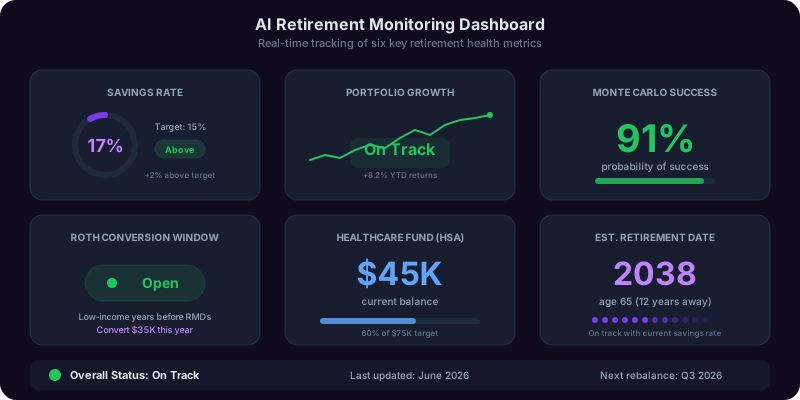
A retirement plan is not a document you create once and file away. It is a living system that needs regular updates as your life circumstances change, markets move, tax laws evolve, and your retirement date approaches. AI transforms the annual review from a cumbersome spreadsheet exercise into an automated, always-current dashboard that flags issues before they become problems.
What AI Monitors Continuously
An AI-powered retirement monitoring system tracks several key metrics and alerts you when any of them drift outside acceptable ranges:
| Metric | Target Range | Alert Trigger | Recommended Action |
|---|---|---|---|
| Savings rate | 15-20% of gross income | Below 12% for 3+ months | Increase 401(k) contribution by 2% |
| Portfolio allocation | Within 5% of target | Any asset class drifts 7%+ | Rebalance by directing new contributions |
| Retirement success rate | 85%+ on Monte Carlo | Drops below 80% | Review spending assumptions or savings rate |
| Emergency fund | 3-6 months expenses | Below 3 months | Pause extra retirement contributions temporarily |
| Account balance vs target | Within 10% of glide path | Falls 15%+ behind target | Increase contributions or adjust timeline |
| Tax bracket proximity | Aware of next bracket | Income within $5,000 of bracket edge | Shift to Traditional 401(k) for remaining income |
The Annual Review Checklist
Even with continuous AI monitoring, a thorough annual review ensures nothing falls through the cracks. Here is a structured checklist that AI can walk you through each January:
1. Update income and expenses. Did you receive a raise, change jobs, or have a significant expense change? AI recalculates your savings rate, contribution amounts, and retirement timeline based on the updated numbers.
2. Review contribution rates. Are you on track to max out your 401(k) and IRA? If you received a raise, increase your contribution rate by at least half the raise amount. A $5,000 raise should translate to at least $2,500 more in annual retirement savings.
3. Reassess Traditional vs Roth split. If your income pushed you into a new tax bracket, the optimal split may have changed. AI recalculates the recommended allocation based on your current and projected retirement brackets.
4. Check investment performance and fees. Compare your portfolio's actual returns to the benchmark. If your 401(k) changed investment options or fee structures, AI evaluates whether to reallocate.
5. Verify beneficiaries. Life events (marriage, divorce, birth of a child, death of a beneficiary) require beneficiary updates. This is not an AI task -- it is a manual action that AI can remind you to complete.
6. Run an updated Monte Carlo simulation. With one more year of actual data, re-run the stress test. Your success rate should be improving year over year as you approach retirement with a growing balance. If it is declining, AI identifies the cause (market downturn, lower savings rate, updated inflation assumptions) and recommends corrections.
7. Check Social Security statement. Review your annual Social Security statement at SSA.gov to ensure your earnings are recorded correctly. Errors in your earnings record directly reduce your future benefits. AI can compare your W-2 income to your SSA statement and flag any discrepancies.
Life Event Triggers for Plan Updates
Beyond the annual review, certain life events should trigger an immediate plan recalculation:
- Job change: New salary, different employer match, different 401(k) investment options. AI re-optimizes your account mix and contribution strategy.
- Marriage or divorce: Filing status change affects tax brackets, Social Security spousal benefits, and IRA contribution eligibility. AI recalculates all projections for the new filing status.
- Home purchase or sale: Mortgage payments, property taxes, and housing equity affect both your expense projections and net worth calculations.
- Inheritance or windfall: A $100,000 inheritance at age 50 can reduce your required monthly savings by $180/month. AI determines the optimal deployment -- pay down debt, boost retirement accounts, or invest in a taxable account.
- Health diagnosis: A chronic condition changes both your healthcare cost projections and potentially your life expectancy assumptions. AI adjusts both sides of the equation.
- Children's education: College funding competes with retirement savings. AI models the tradeoffs and recommends the optimal split between 529 plans and retirement accounts. The general rule: fund retirement first, since you can borrow for college but not for retirement.
How AI Keeps You Accountable
One of the most valuable functions of AI in retirement planning is behavioral coaching. Research consistently shows that the biggest threat to retirement success is not market performance but investor behavior -- panic selling during downturns, chasing recent performance, and failing to rebalance. AI provides an emotionless, data-driven counterbalance:
- During market drops, AI reminds you of your long-term plan and shows historical recovery timelines
- When a hot stock or sector is surging, AI shows the risk-adjusted impact of concentrating your portfolio
- When you consider raiding your retirement accounts for a non-emergency, AI quantifies the true cost (taxes + penalties + lost compounding)
The Finance Copilot provides ongoing retirement plan monitoring and can walk you through the annual review checklist using your actual financial data. For complex decisions like whether to accept a buyout, take early retirement, or make a large Roth conversion, the Second Opinion Copilot can evaluate the decision from multiple perspectives, highlighting tradeoffs you might not have considered. To learn more about how AI can help with major financial and career decisions, see our guide to AI-powered second opinions.
This article is general information, not financial or tax advice. Tax laws change frequently, and the rules described here are based on current 2026 law. Consult a qualified financial advisor or tax professional for guidance specific to your situation.
Frequently Asked Questions
Recommended Copilots
Recommended Copilots
Model retirement savings targets, optimize account allocations, run Monte Carlo simulations, and build a personalized withdrawal strategy based on your actual financial data.
Try Free →Analyze the tax impact of Traditional vs Roth contributions, optimize Roth conversion ladder timing, and minimize lifetime taxes across all retirement income sources.
Try Free →Get an independent review of your retirement plan assumptions, stress-test your withdrawal strategy, and evaluate major decisions like early retirement or pension buyouts.
Try Free →Related Articles
Get Answers From the Finance Copilot
Use the Finance Copilot to calculate your personal savings target, optimize your account mix, model Social Security claiming strategies, and stress-test your plan against market crashes and inflation -- all for free, in minutes.


Step 3: Estimate and Optimize Your Social Security Benefits
Social Security is the foundation of most Americans' retirement income, yet the claiming decision -- when to start benefits -- is one of the most financially consequential choices you will make. The difference between claiming at 62 versus 70 can exceed $200,000 in lifetime benefits for a single person and over $400,000 for a married couple. AI can model the optimal claiming age based on your health, other income sources, tax situation, and life expectancy.
How Benefits Are Calculated
Your Social Security benefit is based on your Average Indexed Monthly Earnings (AIME) -- the average of your 35 highest-earning years, adjusted for wage inflation. The Social Security Administration applies a progressive formula called the Primary Insurance Amount (PIA) to your AIME:
The progressive formula means lower earners replace a higher percentage of their pre-retirement income. Someone earning $40,000 might replace 55% of their income, while someone earning $150,000 replaces only 28%. This is why higher earners need proportionally more savings beyond Social Security.
You can check your own projected benefits by creating an account at SSA.gov/myaccount, which shows your estimated benefits at ages 62, 67, and 70 based on your actual earnings history.
The Claiming Age Decision
You can claim Social Security as early as 62 or as late as 70. Your benefit amount changes significantly based on when you start:
Delaying from 62 to 70 increases your annual benefit by 77% -- from $25,200 to $44,640 in this example. That is an additional $19,440 per year, every year, for the rest of your life, adjusted annually for inflation.
How AI Optimizes the Decision
The break-even analysis is straightforward: if you claim at 70 instead of 62, you forgo 8 years of benefits ($201,600) but receive $19,440 more per year starting at 70. The break-even point is approximately age 82. If you live past 82, delaying was the right call. The average 62-year-old today is expected to live to about 84 (men) or 87 (women), so statistically, delaying pays off for most people.
But AI goes far beyond this simple calculation. It incorporates:
A Concrete Spousal Optimization Example
Consider a married couple: Mark (PIA $3,200) and Lisa (PIA $1,800), both age 62, planning to retire now.
Without AI optimization, they both claim at 62: Mark gets $2,240/month, Lisa gets $1,260/month. Combined annual benefits: $42,000.
With AI optimization: Lisa claims at 62 ($1,260/month) while Mark delays to 70 ($3,968/month). During ages 62-70, they draw $35,000/year from their 401(k) to supplement Lisa's benefits. At 70, their combined annual benefits jump to $62,820. If Mark predeceases Lisa, she steps up to Mark's $3,968/month benefit -- 77% more than if Mark had claimed at 62. Over their joint lifetimes, AI projects this strategy produces $387,000 more in total household income than both claiming at 62.
The SSA retirement planner provides basic claiming comparisons, but for the multi-variable optimization that accounts for taxes, spousal coordination, and withdrawal sequencing, the Finance Copilot can run the full analysis using your actual benefits and retirement account balances.