
How 401(k) Plans Work: Pre-Tax vs After-Tax Contributions
A 401(k) is an employer-sponsored retirement account that lets you contribute a portion of your paycheck before it ever hits your bank account. Most large and mid-size employers offer one, and increasingly, many plans offer two flavors: a Traditional (pre-tax) 401(k) and a Roth (after-tax) 401(k). Understanding how each works is the foundation for every decision that follows.
Traditional 401(k): Tax Break Now, Pay Later
With a Traditional 401(k), your contributions come out of your paycheck before federal and state income taxes are calculated. If you earn $80,000 and contribute $10,000, your W-2 shows taxable wages of $70,000. You pay less income tax today, your money grows tax-deferred inside the account, and you pay ordinary income tax on every dollar you withdraw in retirement. FICA taxes (Social Security and Medicare) still apply to the full $80,000 -- the 401(k) deduction does not reduce your payroll tax.
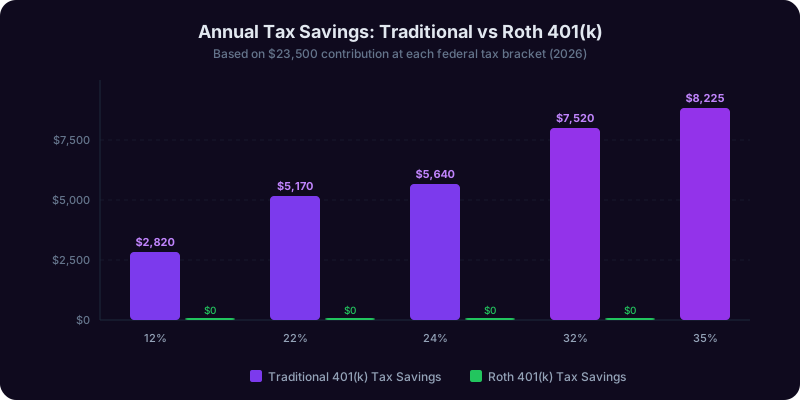
The immediate benefit is tangible: a $10,000 contribution in the 22% federal bracket reduces your federal tax bill by $2,200. Add state tax savings (for example, 5% in a state like Virginia), and the total tax reduction is $2,700. Your take-home pay drops by only $7,300 even though $10,000 went into your retirement account. This "discount" is why the Traditional 401(k) feels less painful in your paycheck.
Roth 401(k): Pay Now, Tax-Free Later
A Roth 401(k) flips the equation. Your contributions come from after-tax dollars -- your paycheck is taxed normally, and the contribution comes out of what remains. There is no upfront tax break. But in exchange, both your contributions and all investment growth are completely tax-free when you withdraw in retirement, provided you are at least 59 1/2 and the account has been open for at least five years.
Using the same example: you earn $80,000 and contribute $10,000 to a Roth 401(k). Your W-2 still shows $80,000 in taxable wages. You pay the full $2,700 in federal and state tax on that $10,000. Your take-home pay drops by the full $10,000. It costs more today -- but decades from now, when the account has grown to several hundred thousand dollars, you owe nothing to the IRS on withdrawals.
A Side-by-Side Comparison
| Feature | Traditional 401(k) | Roth 401(k) |
|---|---|---|
| Tax on contributions | Pre-tax (reduces current taxable income) | After-tax (no current tax benefit) |
| Tax on investment growth | Tax-deferred | Tax-free |
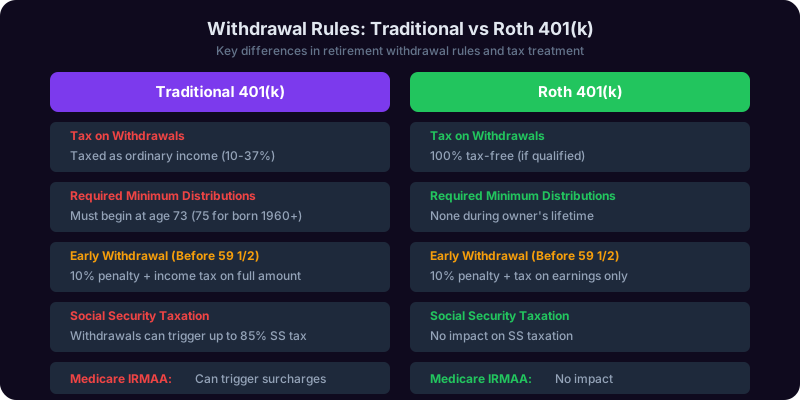
| Tax on withdrawals | Taxed as ordinary income | Tax-free (if qualified) |
| Effect on paycheck | Smaller reduction in take-home pay | Larger reduction in take-home pay |
| Income limits for eligibility | None | None |
| RMDs during your lifetime | Yes, starting at age 73 | No (after SECURE Act 2.0, starting 2024) |
| Best when | Current tax rate is higher than retirement rate | Retirement tax rate will be higher or equal |
The Key Difference from Roth IRAs
Unlike a Roth IRA, the Roth 401(k) has no income limits. A surgeon earning $500,000 per year can contribute the full amount to a Roth 401(k), whereas that income level would completely disqualify direct Roth IRA contributions. This makes the Roth 401(k) the most accessible Roth vehicle for high earners who want to build a pool of tax-free retirement income. According to the Bureau of Labor Statistics, approximately 73% of private industry workers with access to defined contribution plans are now offered a Roth option.
One critical nuance: regardless of whether you choose Traditional or Roth for your own contributions, your employer match always goes into the Traditional (pre-tax) side. Even if you designate 100% of your contributions as Roth, the matching dollars sit in a separate pre-tax bucket and will be taxed as ordinary income when withdrawn. Some plans now offer a Roth match option under SECURE Act 2.0 provisions, but adoption has been slow and most employers still default to pre-tax matching.
The Retirement Copilot can analyze your specific plan's options and help you determine the optimal Traditional vs Roth split based on your current income, expected retirement income, and state tax situation.
This article is general information, not financial or tax advice. Consult a qualified financial advisor or tax professional for guidance specific to your situation.
2026 Contribution Limits: How Much Can You Put In?
The IRS sets annual limits on how much you can contribute to a 401(k), and these limits apply to your combined Traditional and Roth 401(k) contributions. For 2026, the numbers are the most generous they have ever been.
Employee Contribution Limits
| Age Group | Employee Limit | Monthly Amount to Max Out |
|---|---|---|
| Under 50 | $23,500 | $1,958.33 |
| 50 to 59 | $31,000 ($23,500 + $7,500 catch-up) | $2,583.33 |
| 60 to 63 | $34,750 ($23,500 + $11,250 super catch-up) | $2,895.83 |
| 64 and older | $31,000 ($23,500 + $7,500 catch-up) | $2,583.33 |
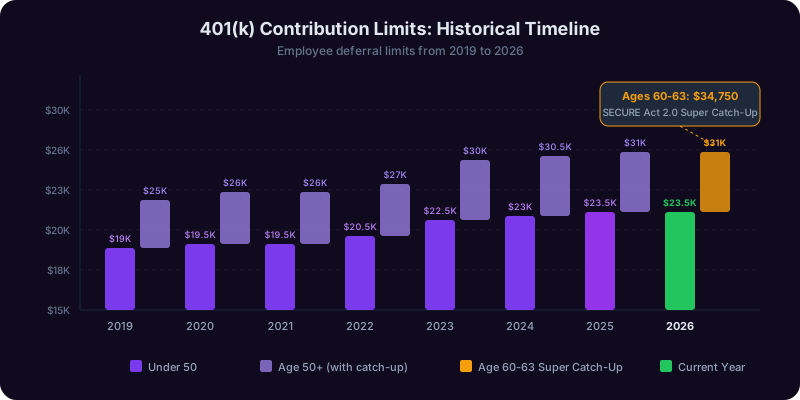
The $23,500 base limit is a combined cap across Traditional and Roth contributions. You can split it any way you like -- $23,500 all Traditional, $23,500 all Roth, $15,000 Traditional and $8,500 Roth, or any other combination. But the total cannot exceed $23,500 (plus applicable catch-up).
The SECURE Act 2.0 Super Catch-Up
Starting in 2025, the SECURE Act 2.0 introduced an enhanced catch-up contribution for participants aged 60 through 63. Instead of the standard $7,500 catch-up, this age group can contribute an additional $11,250 for a total employee contribution of $34,750. This is a significant opportunity for people in their early 60s who are in peak earning years and want to accelerate their retirement savings in the final stretch. Once you turn 64, the catch-up drops back to the standard $7,500.
Overall Plan Limit (Including Employer Contributions)
There is a separate, higher limit that caps all contributions combined -- your employee deferrals plus employer matching and profit-sharing contributions plus any after-tax contributions:
| Age Group | Total Plan Limit (2026) |
|---|---|
| Under 50 | $70,000 |
| 50 to 59 | $77,500 |
| 60 to 63 | $81,250 |
| 64 and older | $77,500 |
This overall limit matters for the mega backdoor Roth strategy discussed later. The gap between your employee contributions plus employer match and the $70,000 ceiling represents the space available for additional after-tax contributions.
How These Limits Interact with IRAs
Your 401(k) contribution limit is completely separate from your IRA contribution limit. In 2026, you can contribute $23,500 to your 401(k) and also contribute $7,000 to an IRA (Traditional or Roth) for a combined $30,500 in tax-advantaged retirement savings. If you are 50 or older, that jumps to $39,000 ($31,000 + $8,000). If you are 60-63, it reaches $42,750. For the latest IRS guidance on these limits, see IRS.gov retirement plan contribution limits.
Multiple 401(k)s and the Aggregation Rule
If you work multiple jobs or change employers mid-year, the $23,500 employee contribution limit applies across all your 401(k), 403(b), and 457(b) plans combined. Contributing $15,000 to your primary employer's 401(k) and $10,000 to a side job's Solo 401(k) totals $25,000 -- exceeding the limit by $1,500. Excess deferrals must be corrected by April 15 of the following year or you face double taxation (taxed when contributed and again when withdrawn).
The overall plan limit ($70,000), however, applies per employer. Two separate employers each have their own $70,000 ceiling. This distinction matters for people with side businesses who operate a Solo 401(k) alongside their W-2 employer's plan.
What Percentage of Your Salary Should You Contribute?
At minimum, contribute enough to capture your full employer match -- that is free money with an immediate 50-100% return. Beyond that, financial planners commonly recommend saving 15% to 20% of your gross income for retirement across all accounts. If you are behind on savings or started late, aim higher. If you are already on track, the Finance Copilot can model whether you should prioritize maxing out your 401(k) or directing extra dollars to other goals like paying down a mortgage, building an investment portfolio, or funding college savings.
Employer Match Mechanics: True Match, Safe Harbor, and Vesting
The employer match is the single most valuable feature of a 401(k) plan -- and the most misunderstood. Getting the match wrong can cost you thousands of dollars per year. Here is exactly how employer matching works, the different formulas, and the vesting schedules that determine when the money is truly yours.
Common Match Formulas
Employers are not required to match your contributions, but most do. The three most common formulas are:
| Match Type | Formula | Example (on $80,000 salary) | Max Annual Match |
|---|---|---|---|
| Dollar-for-dollar up to a % | 100% match on first 3% of salary | Contribute $2,400 (3%), employer adds $2,400 | $2,400 |
| Partial match on a higher % | 50% match on first 6% of salary | Contribute $4,800 (6%), employer adds $2,400 | $2,400 |
| Tiered match | 100% on first 3%, 50% on next 2% | Contribute $4,000 (5%), employer adds $3,200 | $3,200 |
The most common formula in the United States is the 50% match on the first 6%. Notice that both the dollar-for-dollar 3% match and the 50%-on-6% match produce the same employer contribution ($2,400 on an $80,000 salary) -- but the second formula requires you to contribute twice as much of your own money to capture it.
Safe Harbor Plans
A safe harbor 401(k) is a plan design that allows employers to bypass certain IRS nondiscrimination testing (which ensures highly compensated employees do not benefit disproportionately). In exchange, the employer must provide one of the following:
- Basic safe harbor match: 100% match on the first 3% of salary, plus 50% match on the next 2% (effectively a 4% match if you contribute at least 5%).
- Enhanced safe harbor match: 100% match on the first 4% of salary or higher.
- Non-elective contribution: The employer contributes 3% of salary for all eligible employees, regardless of whether they contribute anything themselves. This is free money even if you contribute $0.
Safe harbor contributions are always immediately 100% vested. You own them from day one. This is a significant advantage over discretionary matches that may have multi-year vesting schedules.
Understanding Vesting Schedules
Vesting determines how much of the employer match you get to keep if you leave the company. Your own contributions (employee deferrals) are always 100% vested immediately -- that money is yours no matter what. But the employer match may vest over time:
| Years of Service | Cliff Vesting | Graded Vesting (6-year) |
|---|---|---|
| Year 1 | 0% | 0% |
| Year 2 | 0% | 20% |
| Year 3 | 100% | 40% |
| Year 4 | 100% | 60% |
| Year 5 | 100% | 80% |
| Year 6 | 100% | 100% |
Cliff vesting means you own nothing until a specified date (usually 3 years), then suddenly own 100%. Graded vesting gives you increasing ownership each year. Under federal law, cliff vesting cannot exceed 3 years and graded vesting cannot exceed 6 years for employer matching contributions.
Vesting has real financial consequences. If your employer contributes $3,000 per year in matching funds and your plan has 3-year cliff vesting, leaving after 2 years means you forfeit $6,000 in employer contributions. If you are considering a job change, check your vesting schedule -- sometimes waiting a few extra months can be worth thousands of dollars.
The True-Up Match: Do Not Leave Money on the Table
Some employers calculate the match on a per-paycheck basis, not annually. This creates a trap for employees who front-load their contributions. Example: You earn $80,000 and want to max out your 401(k) at $23,500. Your plan matches 50% on the first 6% of salary ($2,400 annual match). If you contribute aggressively and hit the $23,500 limit by October, your contributions stop. November and December paychecks have $0 in 401(k) contributions, so the employer match for those months is $0. You miss out on roughly $400 in matching.
A true-up provision corrects this by reconciling the match at year-end based on your annual compensation and contributions. Not all plans have true-up. If yours does not, spread your contributions evenly across all pay periods to capture every matching dollar. Ask your HR department or check your plan's Summary Plan Description (SPD).
Does the Match Go Into Traditional or Roth?
As noted earlier, the employer match almost always goes into the Traditional (pre-tax) bucket, regardless of whether your contributions are Roth. Some plans have begun offering a Roth match option under SECURE Act 2.0, but it remains uncommon. When offered, the Roth match means the employer contribution is included in your taxable income for the year it is made -- you pay tax upfront but the match grows and is withdrawn tax-free. For most employees, the traditional match treatment is fine and does not require any action.
The Retirement Copilot can calculate the exact dollar value of your employer match based on your salary, contribution rate, and plan formula, and flag whether your plan has a true-up provision or if you need to pace your contributions differently.

Get Answers From the Retirement Copilot
The Retirement Copilot models your Traditional vs Roth 401(k) split using your actual salary, tax bracket, employer match, and retirement timeline to show you the contribution strategy that maximizes your after-tax retirement wealth.
Tax Math: When Roth Wins vs Traditional at Every Bracket
The Traditional vs Roth 401(k) decision ultimately comes down to a tax rate comparison: your marginal tax rate today versus your effective tax rate in retirement. Let us work through the math with real 2026 federal tax brackets and concrete scenarios.
2026 Federal Income Tax Brackets
| Rate | Single Filer | Married Filing Jointly |
|---|---|---|
| 10% | $0 - $11,925 | $0 - $23,850 |
| 12% | $11,926 - $48,475 | $23,851 - $96,950 |
| 22% | $48,476 - $103,350 | $96,951 - $206,700 |
| 24% | $103,351 - $197,300 | $206,701 - $394,600 |
| 32% | $197,301 - $250,525 | $394,601 - $501,050 |
| 35% | $250,526 - $626,350 | $501,051 - $751,600 |
| 37% | Over $626,350 | Over $751,600 |
Remember: these are marginal rates. A single filer earning $100,000 does not pay 22% on all income. After the $15,000 standard deduction, taxable income is $85,000. The first $11,925 is taxed at 10%, the next $36,550 at 12%, and the remaining $36,525 at 22%. The effective federal rate is approximately 14.7%.
The Core Principle
When you contribute to a Traditional 401(k), you avoid tax at your current marginal rate -- the rate on your highest dollar of income. When you withdraw in retirement, the dollars fill up brackets from the bottom: first the 10% bracket, then 12%, then 22%, and so on. Your effective rate in retirement is almost always lower than your current marginal rate. This is the Traditional 401(k)'s structural advantage, and it is larger than most people realize.
Scenario 1: Early-Career -- $55,000 Salary, Single, Age 28
Current marginal bracket: 22% (taxable income after standard deduction: $40,000).
| Traditional 401(k) | Roth 401(k) | |
|---|---|---|
| Annual contribution | $10,000 pre-tax | $10,000 after-tax |
| Annual tax savings | $2,200 (at 22% marginal rate) | $0 |
| Account value at 65 (7% return, 37 years) | $1,335,592 | $1,335,592 |
| Tax on withdrawal (effective ~14% retirement rate) | $186,983 | $0 |
| After-tax retirement value | $1,148,609 | $1,335,592 |
| Tax savings reinvested (7%, 37 yrs, taxable account) | +$240,248 (after 15% cap gains) | N/A |
| Total after-tax wealth | $1,388,857 | $1,335,592 |
Surprise: the Traditional 401(k) wins by $53,265 even for an early-career earner -- but only if the tax savings are actually reinvested. The 22% marginal rate on contributions versus the ~14% effective rate on withdrawals creates a spread that compounds over decades. However, if this person's career trajectory pushes them into the 32% bracket by their 40s, and retirement spending will be high (travel, healthcare, multiple income sources), the Roth may win. The margin here is close enough that either choice is defensible.
Scenario 2: Mid-Career -- $120,000 Salary, Married Filing Jointly, Age 40
Combined household income $180,000. Current marginal bracket: 22%. Both spouses contribute to 401(k)s.
| Traditional 401(k) | Roth 401(k) | |
|---|---|---|
| Annual contribution (each spouse) | $15,000 pre-tax | $15,000 after-tax |
| Annual tax savings (both spouses) | $6,600 (at 22%) | $0 |
| Combined value at 65 (7%, 25 years) | $1,625,886 | $1,625,886 |
| Tax on withdrawal (effective ~13%) | $211,365 | $0 |
| After-tax retirement value | $1,414,521 | $1,625,886 |
| Tax savings reinvested | +$287,430 | N/A |
| Total after-tax wealth | $1,701,951 | $1,625,886 |
Traditional wins by $76,065. With two spouses withdrawing from Traditional accounts in retirement, they can fill up the 10% and 12% brackets with a large standard deduction, keeping the effective rate well below the 22% marginal rate they saved at. This gap widens further if they relocate to a no-income-tax state in retirement.
Scenario 3: High Earner -- $250,000 Salary, Single, Age 35
Current marginal bracket: 35%. Plans to maintain high spending in retirement.
| Traditional 401(k) | Roth 401(k) | |
|---|---|---|
| Annual contribution | $23,500 pre-tax | $23,500 after-tax |
| Annual tax savings | $8,225 (at 35%) | $0 |
| Account value at 65 (7%, 30 years) | $2,218,027 | $2,218,027 |
| Tax on withdrawal (effective ~20%) | $443,605 | $0 |
| Tax savings reinvested | +$556,260 | N/A |
| Total after-tax wealth | $2,330,682 | $2,218,027 |
Traditional wins by $112,655. At the 35% bracket, the upfront tax savings are enormous, and even with a 20% effective withdrawal rate (reflecting high retirement spending), the spread is substantial. However, if this person believes future tax rates will increase by 5+ percentage points, the calculus shifts.
When the Roth 401(k) Definitively Wins
- You are in the 12% bracket now and expect retirement income above $100,000 (from Social Security, pensions, and withdrawals). Paying 12% now to avoid 22% later is a clear win.
- You expect significant tax rate increases. If the 22% bracket becomes 28% in a future tax law change, every dollar in your Traditional 401(k) costs more to withdraw.
- You already have large pre-tax balances and want tax diversification. If $1.5 million is in Traditional accounts and $0 is in Roth, shifting new contributions to Roth gives you flexibility to manage your tax bracket in retirement.
- You will have pension income or large Social Security benefits that already fill your lower brackets. Additional Traditional withdrawals stack on top at higher rates, making the Roth more valuable.
The Tax Copilot can model your specific numbers -- factoring in your filing status, state taxes, expected Social Security benefits, and other retirement income -- to show which option produces more after-tax wealth in your case.
Investment Options Inside Your 401(k): Choosing Wisely
Your 401(k) is a container -- the investments you choose inside it determine how fast your money grows. Unlike an IRA at Fidelity or Schwab where you can buy almost anything, a 401(k) offers a curated menu of options selected by your employer and their plan administrator. Here is how to evaluate what is available and build a strong portfolio. Try our AI investment analysis tool for step-by-step help.
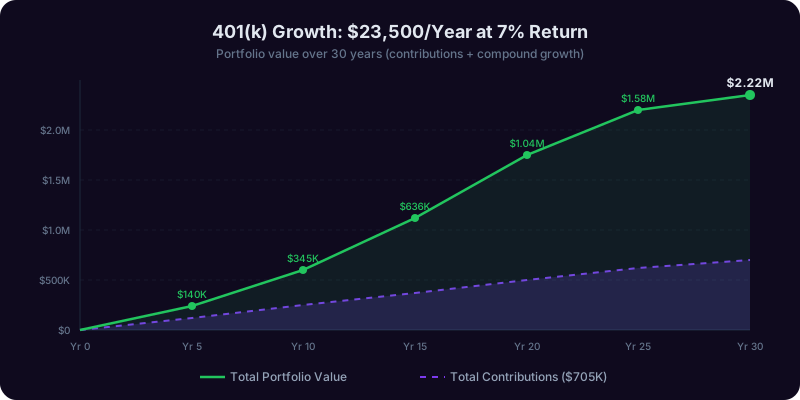
Common 401(k) Investment Categories
| Investment Type | Typical Options | Expense Ratio Range | Best For |
|---|---|---|---|
| Target-date funds | Vanguard Target Retirement 2055, Fidelity Freedom Index 2050 | 0.08% - 0.75% | Hands-off investors who want a single-fund solution |
| US stock index funds | S&P 500 index, total stock market index | 0.01% - 0.15% | Core US equity exposure at the lowest possible cost |
| International stock funds | International index, developed markets, emerging markets | 0.05% - 0.40% | Diversification beyond the US market |
| Bond funds | Total bond market index, intermediate-term bond, TIPS | 0.03% - 0.30% | Stability, income, and diversification as you near retirement |
| Actively managed funds | Large-cap growth, mid-cap value, small-cap blend | 0.30% - 1.20% | Investors who believe active management can outperform (evidence is mixed) |
| Company stock fund | Employer stock | Often $0 | Caution -- see below |
| Stable value / money market | Capital preservation fund | 0.20% - 0.60% | Extremely conservative investors or those very close to retirement |
Target-Date Funds: The Best Default Choice
If you want a simple, effective approach, a target-date fund is hard to beat. You pick the fund closest to your expected retirement year (turning 65 around 2055? Choose the 2055 fund), and the fund automatically adjusts its stock-to-bond ratio as you age. Early on, it holds 90% stocks for growth. As retirement approaches, it shifts toward 60% stocks and 40% bonds for stability.
The key variable is cost. A Vanguard Target Retirement Fund at 0.08% expense ratio costs $80 per year on a $100,000 balance. A comparable fund from a different provider at 0.75% costs $750 -- nearly 10 times more. Over 30 years, that fee difference on a $500,000 average balance costs approximately $100,000 in lost returns. If your plan offers low-cost index-based target-date funds, they are an excellent one-stop solution. Research from S&P Global's SPIVA scorecard consistently shows that low-cost index-based approaches outperform the majority of actively managed funds over time.
Building Your Own Portfolio
If your plan's target-date fund has high fees, or you want more control, a three-fund approach works well:
- US total stock market or S&P 500 index: 60-70% of your portfolio. This is your growth engine.
- International stock index: 20-30% of your portfolio. International diversification reduces risk when US markets underperform.
- Bond index fund: 0-20% of your portfolio, increasing as you approach retirement. Bonds provide stability and reduce volatility.
Rebalance once per year by shifting contributions (not selling) toward whichever allocation has drifted below your target. Most plans let you set contribution percentages by fund, making this straightforward.
The Danger of Company Stock
Many employers offer company stock as a 401(k) investment option, sometimes at a discount. Some even match contributions in company stock. While it can feel loyal or exciting to own shares in your employer, this is one of the most dangerous concentrations of risk in personal finance.
When you own company stock in your 401(k), your income and your retirement savings are tied to the same company. If the company struggles, you could lose your job and see your retirement account plummet simultaneously. This is exactly what happened to Enron employees in 2001, who lost both their jobs and their retirement savings when the company collapsed. Lehman Brothers employees in 2008 experienced the same fate.
The prudent limit is no more than 5-10% of your total portfolio in any single stock, including your employer's. If your employer match comes in company stock, diversify out of it as soon as the plan allows (many plans impose a holding period before you can sell matched company stock).
Evaluating Fund Quality: What to Look For
- Expense ratio: The single most important factor. For index funds, anything above 0.20% is expensive. For actively managed funds, anything above 0.80% requires strong justification.
- Index vs active: Over 15-year periods, approximately 90% of actively managed large-cap funds underperform the S&P 500 index after fees. The odds are heavily in favor of index funds.
- Tracking error: For index funds, this measures how closely the fund follows its benchmark. Lower is better.
- Turnover ratio: High turnover (100%+) can generate taxable events in a taxable account, though this is less relevant inside a 401(k) where growth is tax-deferred.
What If Your Plan Has Terrible Options?
Some 401(k) plans -- particularly at small employers -- offer only high-fee, actively managed funds with expense ratios of 1.0% or more. Even in this case, you should still contribute enough to capture the full employer match. The match (often 50-100% of your contribution) far outweighs the drag of high fees. Beyond the match, consider directing additional savings to a Roth IRA or low-cost brokerage account where you control the investment options.
The Investment Copilot can analyze the funds available in your 401(k) plan, compare their expense ratios and historical performance, and recommend an allocation that minimizes fees while maximizing diversification for your age and risk tolerance.
The Mega Backdoor Roth Strategy: Supercharging Tax-Free Savings
The mega backdoor Roth is one of the most powerful -- and least understood -- retirement savings strategies available. It allows eligible participants to contribute far beyond the standard $23,500 limit and funnel those extra dollars into a Roth account. If your plan supports it, this strategy can add tens of thousands of dollars per year to your tax-free retirement savings.
How the Mega Backdoor Roth Works
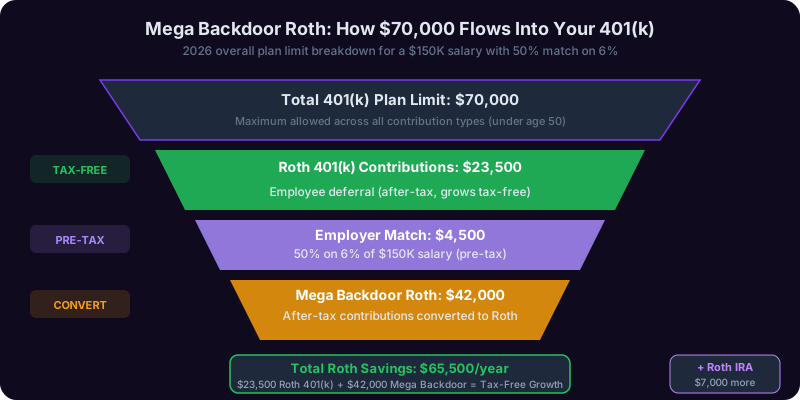
Recall that the 2026 overall 401(k) plan limit is $70,000 (under age 50). This includes your employee contributions ($23,500), employer matching contributions, and a third category that many people never think about: voluntary after-tax contributions. These are not the same as Roth contributions. After-tax contributions are made with after-tax dollars (like Roth), but the earnings on those contributions grow tax-deferred and are taxed as ordinary income upon withdrawal (unlike Roth, where qualified withdrawals are completely tax-free).
The mega backdoor Roth adds a critical step: you make after-tax contributions, then immediately convert them to Roth -- either via an in-plan Roth conversion or by rolling them out to a Roth IRA. Because you already paid tax on the contributions, the conversion is tax-free on the contributed amount. Any minimal earnings between the contribution and conversion are taxable, which is why speed matters.
Step-by-Step Example
Sarah earns $150,000. Her employer matches 50% on the first 6% of salary.
| Contribution Type | Amount | Tax Treatment |
|---|---|---|
| Employee Roth 401(k) contributions | $23,500 | After-tax (Roth) |
| Employer match (50% on 6%) | $4,500 | Pre-tax (Traditional) |
| After-tax contributions (mega backdoor) | $42,000 | After-tax, then converted to Roth |
| Total | $70,000 | Fills up the entire plan limit |
Sarah gets $65,500 into Roth accounts in a single year ($23,500 Roth 401(k) + $42,000 mega backdoor). Combined with a $7,000 Roth IRA contribution, she shelters $72,500 in tax-free growth annually. Over 20 years at 7% returns, the mega backdoor contributions alone grow to approximately $1,722,000 -- all tax-free.
Requirements: Does Your Plan Qualify?
The mega backdoor Roth requires your 401(k) plan to offer two specific features:
- Voluntary after-tax contributions: Your plan must allow employee contributions beyond the $23,500 pre-tax/Roth limit, up to the $70,000 overall plan limit. Not all plans offer this.
- In-service distributions or in-plan Roth conversions: You need a way to convert the after-tax dollars to Roth while you are still employed. "In-service distribution" means rolling after-tax money out to a Roth IRA while still working. "In-plan Roth conversion" means converting within the 401(k) itself to a Roth 401(k) sub-account.
Check your plan's Summary Plan Description (SPD) or ask your HR benefits team: "Does our 401(k) allow voluntary after-tax contributions, and can I do in-plan Roth conversions or in-service withdrawals of after-tax money?" If both answers are yes, you have access to the mega backdoor Roth. Try our AI tax filing assistant for step-by-step help.
Companies Known to Offer This
Large tech companies, major financial institutions, and Fortune 500 employers are most likely to offer mega backdoor Roth-eligible plans. Companies including Microsoft, Google, Meta, Amazon, Apple, and many others have historically offered plans with the necessary features. Smaller employers and startup plans are less likely to support it, but it is worth asking.
Tax Implications and Timing
The conversion should happen as quickly as possible after the after-tax contribution to minimize taxable earnings. Many plans now support automatic in-plan Roth conversion -- every after-tax contribution is immediately converted to Roth, sometimes on the same day. If your plan requires manual conversion, set a calendar reminder to convert after each paycheck.
If you let after-tax contributions sit unconverted and they generate significant earnings, those earnings are taxable upon conversion. On $5,000 in after-tax contributions that grow to $5,100 before conversion, you owe ordinary income tax on the $100 gain. Annualized, this is negligible if you convert promptly, but it can add up if you forget for months.
Interaction with IRA Backdoor Roth
The mega backdoor Roth through your 401(k) is separate from the regular backdoor Roth IRA strategy. You can do both in the same year. The regular backdoor Roth IRA moves $7,000 into a Roth IRA via a Traditional IRA conversion. The mega backdoor Roth moves up to $42,000+ (depending on your match) into a Roth account through your 401(k). They are complementary strategies that together can shelter enormous amounts in tax-free accounts.
If you are self-employed and operate a Solo 401(k), you can design the plan to allow after-tax contributions and in-plan Roth conversions, giving you access to the mega backdoor Roth without needing an employer to offer it. The Finance Copilot can help you evaluate whether the mega backdoor Roth makes sense for your income level, existing Roth balances, and overall tax optimization strategy.
Required Minimum Distributions and SECURE Act 2.0 Changes
Required Minimum Distributions (RMDs) are the government's way of ensuring that tax-deferred retirement accounts do not remain untaxed forever. Understanding how RMDs work -- and how recent legislation has changed the rules -- is essential for choosing between Traditional and Roth 401(k) contributions today.
How RMDs Work
Once you reach RMD age, you must withdraw a minimum amount from your Traditional 401(k) and Traditional IRA each year, whether you need the money or not. The amount is calculated by dividing your account balance (as of December 31 of the prior year) by a life expectancy factor from the IRS Uniform Lifetime Table.
| Age | Life Expectancy Factor | RMD on $500,000 Balance | RMD on $1,000,000 Balance |
|---|---|---|---|
| 73 | 26.5 | $18,868 | $37,736 |
| 75 | 24.6 | $20,325 | $40,650 |
| 80 | 20.2 | $24,752 | $49,505 |
| 85 | 16.4 | $30,488 | $60,976 |
| 90 | 12.9 | $38,760 | $77,519 |
Notice how the withdrawal percentage increases with age. At 73, you must withdraw about 3.8% of your balance. By 90, it rises to 7.8%. This accelerating withdrawal means your taxable income from RMDs grows over time, potentially pushing you into higher tax brackets, increasing Medicare premiums (IRMAA surcharges), and subjecting more of your Social Security benefits to taxation.
The RMD Starting Age: A Moving Target
Recent legislation has pushed the RMD starting age later:
| Birth Year | RMD Starting Age | Legislation |
|---|---|---|
| Before 1951 | 72 | SECURE Act (2019) |
| 1951 - 1959 | 73 | SECURE Act 2.0 (2022) |
| 1960 and later | 75 | SECURE Act 2.0 (2022) |
If you were born in 1960 or later, your first RMD is not due until the year you turn 75. This gives your Traditional 401(k) two additional years of tax-deferred growth compared to the previous rules. You have until April 1 of the year after you turn 75 to take your first RMD, but delaying the first RMD means taking two RMDs in the same calendar year (the delayed first RMD plus the regular second-year RMD), which can create a large tax bill.
The Roth 401(k) RMD Elimination
This is one of the most significant changes from the SECURE Act 2.0: starting in 2024, Roth 401(k) accounts are no longer subject to RMDs during the account owner's lifetime. Previously, Roth 401(k)s required RMDs just like Traditional 401(k)s (even though Roth IRAs did not). This inconsistency has been eliminated.
This change is a major win for the Roth 401(k). Your Roth 401(k) balance can now grow tax-free indefinitely during your lifetime, just like a Roth IRA. You are never forced to withdraw, which means:
- More money continues compounding tax-free for longer
- You have complete control over when and how much you withdraw
- Your Roth 401(k) becomes a powerful estate planning tool
- You avoid the tax bracket escalation that forced Traditional RMDs can cause
How RMDs Affect the Traditional vs Roth Decision
For people with large Traditional 401(k) balances, forced RMDs can create a cascade of negative tax consequences in retirement:
- Higher tax bracket: RMDs of $50,000-$100,000+ push retirees into the 22% or 24% bracket, even if their lifestyle spending would otherwise keep them in the 12% bracket.
- Social Security taxation: Up to 85% of Social Security benefits become taxable when combined income exceeds $34,000 (single) or $44,000 (married filing jointly). Large RMDs easily push retirees over these thresholds.
- Medicare IRMAA surcharges: Modified AGI above $106,000 (single) or $212,000 (married) triggers income-related monthly adjustment amounts that increase Medicare Part B and Part D premiums by $70 to $420+ per month per person.
- Net Investment Income Tax: RMD income can push AGI above $200,000 (single) or $250,000 (married), triggering the 3.8% surtax on net investment income from taxable accounts.
Roth 401(k) withdrawals avoid all of these traps. They do not appear on your tax return, do not count as income for Social Security taxation, and do not trigger IRMAA surcharges.
The Still-Working Exception
If you are still employed at the company sponsoring your 401(k) and you are not a 5% or greater owner, you can delay RMDs from that specific employer's plan until you actually retire, even past age 73 or 75. This does not apply to IRAs or 401(k)s from former employers. Some people use this by rolling old 401(k) balances into their current employer's plan to shelter them from RMDs while still working.
Roth Conversion Strategy to Minimize Future RMDs
If you have a large Traditional 401(k) balance and are concerned about future RMDs, consider a Roth conversion ladder in the years between retirement and your RMD start date. Converting $50,000-$100,000 per year from Traditional to Roth during low-income years (after leaving work but before Social Security and RMDs begin) lets you pay tax at favorable rates and permanently reduce your future RMD obligations. The Tax Copilot can model the optimal annual conversion amount to minimize your lifetime tax bill across all retirement income sources. For more on how RMDs affect IRA accounts specifically, see our Roth IRA vs Traditional IRA guide.
Your Action Plan: How to Split Contributions and Optimize Your 401(k)
You have the knowledge. Now it is time to act. Here is a step-by-step action plan to optimize your 401(k) strategy, including how to decide the Traditional vs Roth split, set your contribution rate, choose investments, and review annually.
Step 1: Capture the Full Employer Match
Before any Traditional vs Roth analysis, make sure you are contributing enough to get the full employer match. This is non-negotiable. If your employer matches 50% on the first 6% of salary, you must contribute at least 6% to capture the match. On a $90,000 salary, that is $5,400 from you and $2,700 from your employer -- an immediate 50% return on your money. No investment in the world reliably offers that.
Step 2: Decide Your Traditional vs Roth Split
Use this decision framework based on your current situation:
| Your Situation | Recommended Split | Reasoning |
|---|---|---|
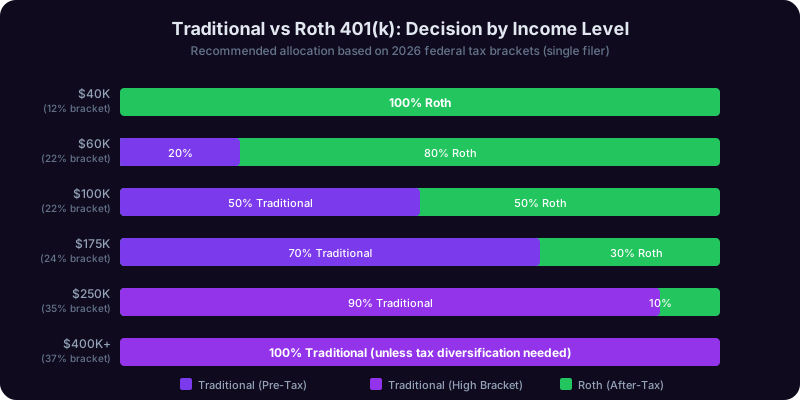
| 12% bracket or lower | 100% Roth | Tax rates are historically low. Lock in the low rate and grow tax-free. |
| 22% bracket, early career (under 35) | 70-100% Roth | Long time horizon amplifies tax-free growth. Your retirement income may push into higher brackets. |
| 22% bracket, mid-career (35-50) | 50/50 split | Tax diversification. Hedge against uncertain future rates with both buckets. |
| 24% bracket | 50% Traditional / 50% Roth | The tipping point. Traditional saves meaningfully, but Roth provides flexibility. |
| 32% bracket or higher | 80-100% Traditional | Upfront tax savings are large. You will likely withdraw at a lower effective rate. |
| Large existing Traditional balance, any bracket | 100% Roth new contributions | Tax diversification. Avoid concentrating all retirement in one tax treatment. |
| Expecting pension or significant other retirement income | Lean toward Roth | Pension fills your lower brackets. Traditional withdrawals stack on top at higher rates. |
Step 3: Set Your Contribution Rate
Here is a priority order for where your retirement savings dollars should go:
- 401(k) up to the employer match -- always first. Free money.
- Roth IRA up to $7,000 (if income-eligible) -- more investment options, lower fees, and withdrawal flexibility.
- 401(k) up to the $23,500 maximum -- additional tax-advantaged savings.
- Mega backdoor Roth (if available) -- for those who can save beyond $23,500.
- Taxable brokerage account -- for savings beyond all tax-advantaged limits.
If you cannot max out the 401(k) right now, increase your contribution rate by 1-2% every six months or with every raise. Most people adapt to the smaller paycheck within one or two pay periods. Building a solid emergency fund alongside your retirement savings ensures you do not need to tap your 401(k) early.
Step 4: Choose Your Investments
Inside your 401(k), follow these guidelines:
- Default option: A low-cost target-date fund matching your expected retirement year. If the expense ratio is under 0.20%, this is an excellent choice for most people.
- DIY option: If your plan's target-date funds are expensive (above 0.50%), build a three-fund portfolio: 60-70% US stock index, 20-30% international stock index, 0-20% bond index (more bonds as you approach retirement).
- Avoid: Company stock beyond 10% of your portfolio, high-fee actively managed funds (above 1.0% expense ratio), and stable value/money market funds unless you are within 5 years of retirement.
Step 5: Tax-Location Optimization (Advanced)
If you have both Traditional and Roth accounts, you can optimize which types of investments go in each account:
| Account Type | Best Investments to Hold | Why |
|---|---|---|
| Roth 401(k) / Roth IRA | High-growth stocks, small-cap funds, emerging markets | Maximum growth compounds tax-free. The bigger the Roth grows, the more you benefit. |
| Traditional 401(k) / Traditional IRA | Bonds, REITs, dividend-paying stocks | Income-generating assets would be taxed annually in a taxable account. Tax deferral shelters the income. |
| Taxable brokerage | Tax-efficient index funds, tax-managed funds, individual stocks (for loss harvesting) | Low turnover minimizes capital gains distributions. Qualified dividends get preferential rates. |
Step 6: Review Annually and Adjust
Every January (or when you receive a raise, change jobs, or have a significant life event), review:
- Contribution rate: Are you on track to max out? Can you increase by 1-2%?
- Traditional vs Roth split: Has your income or bracket changed? Adjust the split accordingly.
- Investment allocation: Rebalance if any fund has drifted more than 5% from your target.
- Employer match: Has the match formula changed? Are you capturing the full match?
- Vesting: How much of your employer match is vested? Factor this into any job-change decision.
- Beneficiaries: Are your beneficiary designations current? This is especially important after marriage, divorce, or children.
What to Do When Changing Jobs
When you leave an employer, you have four options for your 401(k):
- Roll to new employer's 401(k): Good if the new plan has excellent low-cost options. Keeps everything consolidated.
- Roll to a Traditional or Roth IRA: Usually the best option. You gain access to unlimited investment choices at brokerages like Fidelity, Schwab, or Vanguard. Roth 401(k) balances roll to a Roth IRA; Traditional balances roll to a Traditional IRA.
- Leave it in the old plan: Acceptable if the plan has great options and low fees, but you will have an extra account to track.
- Cash out: Almost always the worst option. You owe income tax on the full amount plus a 10% penalty if under 59 1/2. A $100,000 cashout at the 24% bracket costs you $34,000 in taxes and penalties.
The Retirement Copilot can build a personalized contribution and investment strategy based on your salary, employer match, tax bracket, existing account balances, and retirement timeline. For a broader view of how your 401(k) fits into your complete financial plan -- including budgeting, emergency savings, debt payoff, and other goals -- the Finance Copilot can help you prioritize across all of your financial objectives. Explore more AI-powered financial planning scenarios to see how these strategies work together.
This article is general information, not financial or tax advice. Tax laws change frequently, and the rules described here are based on current 2026 law. Consult a qualified financial advisor, tax professional, or your plan administrator for guidance specific to your situation.
Frequently Asked Questions
Recommended Copilots
Recommended Copilots
Analyze your 401(k) fund options, compare expense ratios, and build a portfolio allocation matched to your age and risk tolerance
Try Free →Model your Traditional vs Roth 401(k) split, project retirement income, and optimize your contribution strategy
Try Free →Calculate the tax impact of Traditional vs Roth contributions at your bracket and plan Roth conversion strategies
Try Free →Build a complete financial plan that balances 401(k) savings with emergency funds, debt payoff, and other goals
Try Free →Find room in your monthly budget to increase 401(k) contributions without sacrificing essential spending
Try Free →Continue Exploring
Related Scenarios
How It Works
Related Articles
Get Answers From the Retirement Copilot
The Retirement Copilot models your Traditional vs Roth 401(k) split using your actual salary, tax bracket, employer match, and retirement timeline to show you the contribution strategy that maximizes your after-tax retirement wealth.