

What a Roth Conversion Ladder Is and Why It Matters in 2026
A Roth conversion ladder is a multi-year tax strategy where you systematically move money from a pre-tax retirement account (Traditional IRA, 401(k), 403(b), SEP-IRA) into a Roth IRA, paying ordinary income tax on each conversion in the year you do it. The 'ladder' refers to stacking conversions one year on top of another so that, after a five-year seasoning period for each rung, you have a continuous stream of penalty-free, tax-free Roth dollars you can withdraw before age 59 1/2.
The strategy matters for four very different audiences in 2026:
- FIRE practitioners (Financial Independence, Retire Early) who need to access retirement accounts decades before 59 1/2 without the 10% early-withdrawal penalty.
- Early retirees and career-pause planners in their 50s and early 60s with low earned income and high pre-tax balances. Those low-bracket years are a non-renewable resource.
- High earners worried about RMDs (Required Minimum Distributions). Under SECURE 2.0, RMDs begin at age 73 (rising to 75). A large Traditional IRA can push retirees into the 32 to 37% bracket once RMDs hit, plus IRMAA Medicare surcharges.
- Estate-planning families. Roth IRAs pass income-tax-free to heirs and, post-SECURE Act, beneficiaries get a 10-year tax-free growth window before they must drain the account.
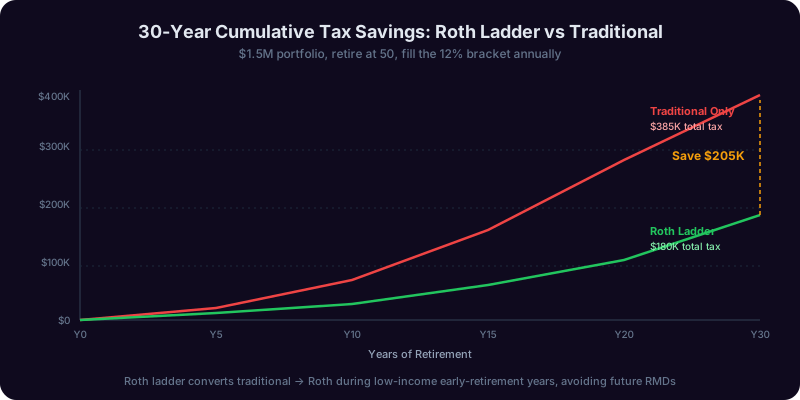
The economic logic is simple: pay tax now at a known low rate, then never pay tax on growth again. If you convert $50,000 at a 12% federal rate and that money grows to $250,000 over 25 years, you have effectively paid 12% on $250,000 of future spending, an after-the-fact 2.4% effective rate. Compared to leaving it in a Traditional IRA and paying 24% on the eventual $250,000, the ladder is worth roughly $30,000 of lifetime tax.
The trade-off is liquidity and the two five-year rules, which we cover next. Conversions are irrevocable as of 2018, the Tax Cuts and Jobs Act ended 'recharacterization' of conversions. Once you convert, you cannot undo it, so the math has to be right before you click the button.
Financial disclaimer: This article is for educational purposes only and is not personalized tax, investment, or legal advice. Roth conversion outcomes depend on your specific income, state, filing status, account composition, and future tax law. Consult a CPA, Enrolled Agent, or fee-only fiduciary advisor before executing a conversion.
The Two 5-Year Rules: Contribution vs. Conversion (Most People Confuse Them)
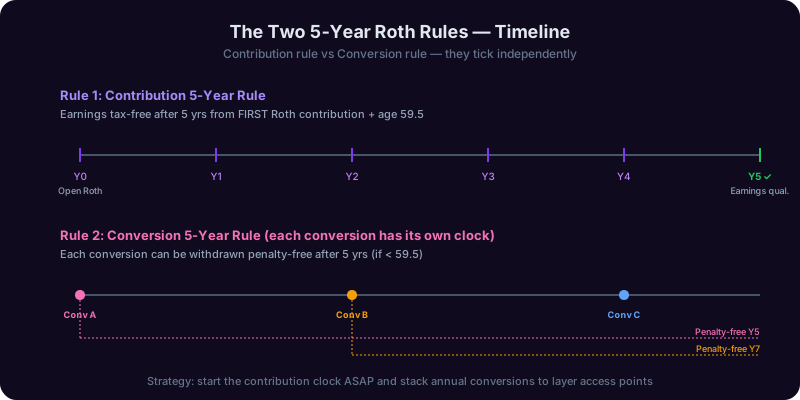
The Roth IRA has two completely separate five-year rules, and conflating them is the single most common ladder mistake. Both come from IRC Section 408A and are explained in IRS Publication 590-B.
Rule 1: The Contribution 5-Year Rule (Earnings Rule)
Before you can withdraw earnings from a Roth IRA tax-free, you must satisfy two conditions:
- You are at least 59 1/2 (or disabled, deceased, or using up to $10,000 for a first home), AND
- At least five tax years have passed since January 1 of the year you made your first Roth contribution to any Roth IRA.
This clock starts once, with your very first Roth contribution, and never resets. If you opened a Roth in 2019 with a $100 contribution, your contribution five-year clock was already satisfied on January 1, 2024. Smart move: open a Roth with $1 the moment you legally can, just to start the clock.
Rule 2: The Conversion 5-Year Rule (10% Penalty Rule)
This is the rule the ladder is built on. Each conversion has its own five-year clock. If you withdraw converted principal before five tax years have passed and you are under 59 1/2, you owe the 10% early-withdrawal penalty on the converted amount (no income tax, since you already paid it on conversion).
Each conversion year starts its own clock on January 1 of that year. A conversion executed on December 31, 2026 is treated as if it happened on January 1, 2026, so its five-year clock expires January 1, 2031.
The Ladder Timeline
This is why ladders take 5 years to mature and must be started 5 years before you need the income:
- Year 1 (2026): Convert $60K. Pay tax. Wait.
- Year 2 (2027): Convert $60K. Pay tax. Wait.
- Year 3-5: Continue converting and waiting.
- Year 6 (2031): The Year 1 conversion is now seasoned. Withdraw up to $60K tax-free and penalty-free.
- Year 7 (2032): Year 2 conversion seasons. Withdraw another $60K.
The ladder runs forever as long as you keep adding new rungs at the bottom each year you continue to need income.
Order of withdrawals also matters. Roth IRA distributions follow an IRS-ordered rule: contributions first (always tax/penalty-free), then conversions oldest-first (subject to 5-year rule), then earnings. This ordering is your friend, it means you can often access principal long before any 5-year rule becomes relevant.
Tax Bracket Arbitrage: ACA Subsidies, IRMAA Cliffs, and Filling Brackets
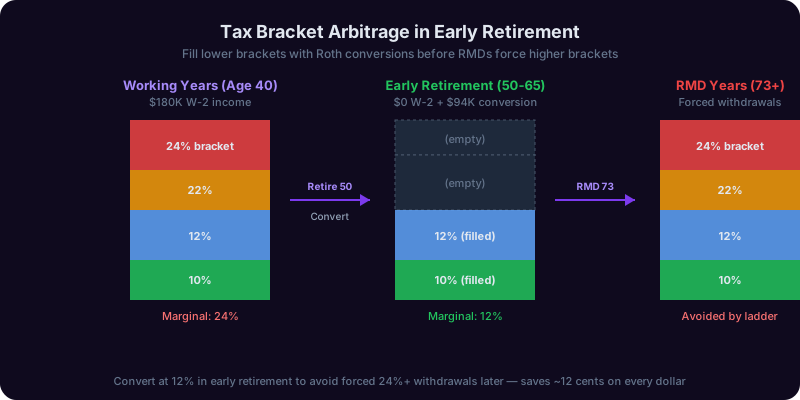
The Roth ladder only saves money when your conversion-year marginal rate is lower than your future withdrawal-year rate. Identifying those low years is where most of the value is created or destroyed.
Filling the Lower Brackets
For 2026 (post-OBBBA), the federal married-filing-jointly brackets are approximately:
- 10% up to $23,850
- 12% from $23,850 to $96,950
- 22% from $96,950 to $206,700
- 24% from $206,700 to $394,600
With the 2026 standard deduction of roughly $30,000 (MFJ), a couple with $0 of other income can convert about $127,000 and stay entirely within the 12% bracket. Total federal tax: about $9,000. Effective rate on the conversion: roughly 7%. That is a once-a-year, non-bankable opportunity.
The ACA Premium Tax Credit Cliff
If you buy health insurance on the ACA marketplace before Medicare eligibility (a near-universal FIRE situation), Roth conversions count as MAGI and directly reduce your Premium Tax Credit. The enhanced PTC subsidies from the Inflation Reduction Act expired after 2025, meaning 2026 reintroduces a hard 400% Federal Poverty Level cliff at roughly $84,600 MFJ. One dollar over and you can lose $15,000 to $25,000 of subsidies overnight.
Practical implication: many early retirees deliberately keep MAGI below 400% FPL during pre-Medicare years and accept smaller conversions, then convert aggressively from age 65 to 73 once Medicare is in place.
IRMAA Surcharges (Age 63+)
Medicare Part B and Part D premiums are surcharged for higher-income retirees via IRMAA, calculated from your tax return two years prior. In 2026, the tiers (MFJ) jump at $212,000, $266,000, $334,000, $400,000, and $750,000 MAGI. Crossing any tier by even $1 triggers thousands in extra annual Medicare premiums per spouse.
This means conversions in the two years before Medicare eligibility (so age 63 and 64 if you start Medicare at 65) are particularly sensitive, they will set your IRMAA for ages 65 and 66.
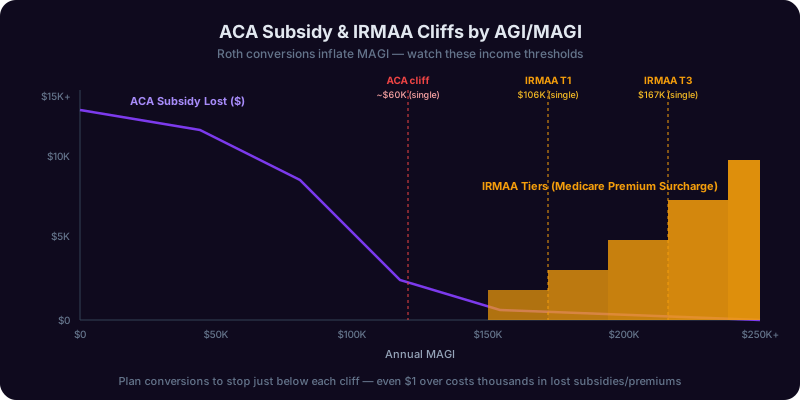
The 'true' marginal rate on a conversion is not just the federal bracket. It is federal + state + ACA subsidy clawback + IRMAA + NIIT + Social Security taxation increase. In practice, this 'stacked marginal rate' can hit 40 to 50% at certain income bands even while your nominal bracket is only 22%.

Get Answers From the Tax Copilot
Stop guessing how much to convert each year. Copilotly Tax Copilot models multi-year scenarios across federal brackets, ACA cliffs, IRMAA tiers, and state taxes so you convert the optimal amount every year.
Step-by-Step Ladder Setup: $30K, $50K, and $90K Scenarios
Here is the operational playbook for executing a Roth conversion ladder in 2026, with three realistic scenarios. All assume MFJ, $30,000 standard deduction, no other income, and a residence in a no-income-tax state for simplicity.
Step 1: Inventory Your Accounts
List every pre-tax retirement account: Traditional IRA, Rollover IRA, SEP-IRA, SIMPLE IRA, old 401(k)s. The pro-rata rule (covered in section 7) applies across all your IRAs combined, so this inventory is critical.
Step 2: Choose Your Conversion Amount
Scenario A: Conservative ($30K conversion)
- Taxable income after deduction: $0
- Federal tax owed: roughly $0 to $700 (10% bracket)
- Effective rate: 0 to 2%
- Best for: ACA-sensitive early retirees keeping MAGI low
Scenario B: Moderate ($50K conversion)
- Taxable income after deduction: $20,000
- Federal tax owed: roughly $2,000 (10% bracket)
- Effective rate: 4%
- Best for: Most FIRE retirees, fills the 10% bracket without touching ACA cliff
Scenario C: Aggressive ($90K conversion)
- Taxable income after deduction: $60,000
- Federal tax owed: roughly $6,650
- Effective rate: 7.4%
- Best for: Post-Medicare retirees in the gap years before RMDs, or households with no ACA exposure
Step 3: Pay Tax From Taxable Accounts (Not Withholding)
Critical rule: never let the IRA itself withhold taxes if you are under 59 1/2. Withheld amounts that do not get rolled into the Roth within 60 days are treated as a distribution and trigger the 10% penalty. Always pay conversion tax from a separate taxable brokerage or checking account.
Step 4: Execute the Conversion
Most custodians (Fidelity, Schwab, Vanguard) have an online 'Convert to Roth IRA' button. The conversion is reported on Form 1099-R with code 2 (if under 59 1/2 with conversion) and reconciled on Form 8606 with your tax return.
Step 5: Track Each Rung Separately
Keep a spreadsheet listing each year's conversion, the date, the amount, and the 5-year seasoning expiration. Form 8606 must be filed every year you have basis in a Traditional IRA or perform a conversion.
Step 6: Adjust Annually
Re-evaluate every December. Did your other income come in higher than expected? Convert less. Did the market drop? Conversions in down markets are bonus value, you pay tax on a depressed balance and get the recovery tax-free in the Roth.
State Tax Considerations and the No-Income-Tax Strategy
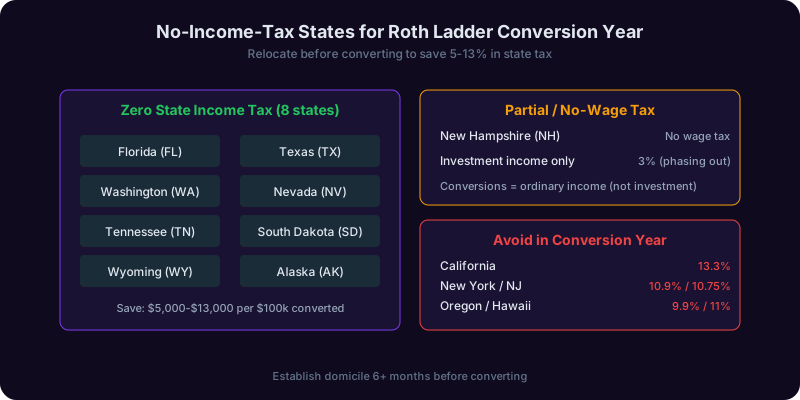
Federal tax dominates Roth conversion conversation, but state tax can add 0 to 13.3% on top, and the difference between converting in California and converting in Texas can be tens of thousands of dollars per year.
The Nine No-Income-Tax States
As of 2026, nine states have no state income tax on retirement distributions and conversions: Alaska, Florida, Nevada, New Hampshire (no wage tax; small investment tax phased out), South Dakota, Tennessee, Texas, Washington, and Wyoming. Washington does have a 7% capital gains tax above $270,000 but does not tax Roth conversions, which are ordinary income.
States That Exempt Retirement Income
Several states tax wages but partially or fully exempt retirement distributions, including Illinois (fully exempt), Pennsylvania (fully exempt after retirement age), and Mississippi (fully exempt). Whether a Roth conversion qualifies as 'retirement income' varies by state, in Illinois and Pennsylvania, yes; in others, the conversion is taxable.
The Domicile-Change Strategy
For high-conversion years, some retirees establish domicile in a no-income-tax state before executing large conversions. To shift domicile legitimately (this is heavily audited by states like California and New York), you generally need to:
- Spend more than 183 days in the new state
- Move driver's license, voter registration, and primary residence
- Update banking, doctor, dentist, place of worship, and professional licenses
- Sever or substantially reduce ties to the old state
This is not casual planning. California in particular has aggressive 'clawback' audits going back years and applies a 'closest connections' test, not just day counting.
State Tax Impact Example
A $90,000 conversion at California's marginal 9.3% bracket is $8,370 in state tax. Over a 10-year ladder, that is $83,700 in state tax avoided by being domiciled in Texas or Florida. For ladders involving $1M+ in lifetime conversions, the present-value tax savings often justify the move on its own.
Reciprocity, Source Income, and Edge Cases
If you moved partway through the year, you may owe state tax pro-rata. Also, if your IRA was funded by 401(k) deferrals you made while working in a high-tax state, that state generally cannot 'reach back' under federal law (4 USC 114), but check your specific facts with a tax professional. Some states also tax Roth conversions of accounts built with employer pension contributions differently.
OBBBA 2026 Impact: What Changed for Roth Strategies
The One Big Beautiful Bill Act (OBBBA), passed in 2025 and effective in tax year 2026, made several changes that reshape the Roth conversion calculus.
Permanent TCJA Brackets
The seven tax brackets from the 2017 Tax Cuts and Jobs Act (10, 12, 22, 24, 32, 35, 37%) were scheduled to sunset on December 31, 2025. OBBBA made them permanent. For ladder planners, this is consequential: the 2026 ladder is no longer a 'race against the sunset' the way 2024 and 2025 conversions were. You no longer need to front-load conversions to lock in the 12% and 22% brackets before they jumped to 15% and 25%.
However, 'permanent' in tax law means 'until Congress changes it.' If you believe rates will rise in the late 2020s due to deficit pressure, the front-loading logic still applies.
Standard Deduction Increase
OBBBA raised the standard deduction further, to approximately $30,000 for MFJ and $15,000 for single filers in 2026 (indexed). That extra deduction headroom means you can convert a slightly larger amount at 0% effective federal tax than under prior law.
Senior Bonus Deduction
OBBBA added a temporary $6,000 bonus deduction for taxpayers age 65+ (per qualifying individual), phased out at higher income levels. For married couples both 65+, that is an extra $12,000 of room. This makes ages 65 to 72 (post-Medicare, pre-RMD) an even more attractive conversion window than under prior law.
SALT Cap Adjustments
The state and local tax deduction cap was raised from $10,000 to a higher figure (with income-based phaseouts). This indirectly affects high-income converters in high-tax states, allowing slightly more federal deduction of the state tax on the conversion itself.
What Did NOT Change
- The 5-year rules are unchanged.
- The pro-rata rule is unchanged.
- RMD ages remain 73 (rising to 75 in 2033 under SECURE 2.0).
- Roth 401(k) RMDs were eliminated by SECURE 2.0 effective 2024, still in force.
- The 10-year inherited IRA rule is unchanged.
- Recharacterization of conversions remains permanently disallowed.
Net Effect on Ladder Strategy
OBBBA modestly improves Roth ladder economics for retirees age 65+ (via senior bonus deduction), removes the artificial 2025 deadline panic, and preserves the 12% bracket as the workhorse rung for early retirees. Ladders started in 2026 do not need to be larger or front-loaded; they can run at a steady, optimized pace.
Common Ladder Mistakes: Pro-Rata, Wash Sales, and Mega Backdoor Confusion
The Roth ladder looks simple on paper. In practice, six common mistakes cost converters thousands.
Mistake 1: Ignoring the Pro-Rata Rule
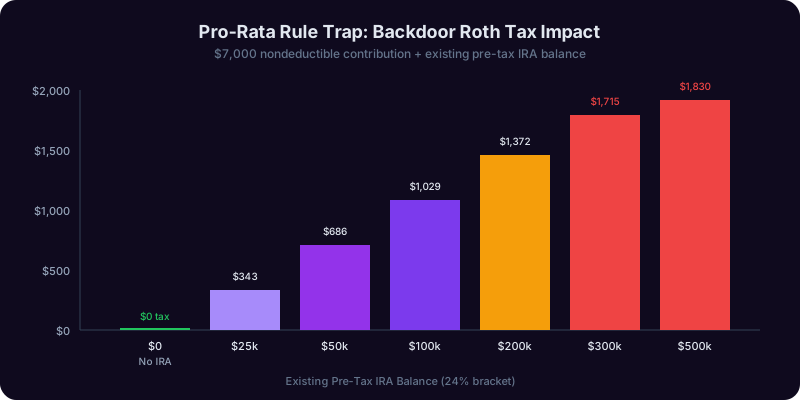
If you have any pre-tax money in any Traditional IRA, SEP-IRA, or SIMPLE IRA on December 31, the IRS aggregates them all and treats every conversion as a pro-rata mix of pre-tax and after-tax dollars (Form 8606 line 6-15).
Example: $90,000 pre-tax IRA + $10,000 after-tax (basis) IRA = $100,000 total, of which 90% is pre-tax. A 'backdoor Roth' of $7,000 (the 2026 contribution limit) is treated as 90% taxable. You pay tax on $6,300 even though you intended to convert only the after-tax $7,000.
Fix: Roll all pre-tax IRA money into your current employer's 401(k) (if the plan accepts roll-ins) before December 31 of the conversion year. 401(k) balances do not count in the pro-rata calculation.
Mistake 2: Confusing Backdoor and Mega Backdoor with Ladder
These are three different strategies that get conflated constantly:
- Roth conversion ladder = systematic Traditional-to-Roth conversion over multiple years (this article)
- Backdoor Roth = non-deductible Traditional IRA contribution ($7,000 in 2026) followed immediately by Roth conversion. Used when income exceeds Roth direct-contribution limits.
- Mega backdoor Roth = after-tax 401(k) contributions (above the $23,500 elective deferral) followed by in-plan Roth conversion or in-service rollover to Roth IRA. Up to $46,500 extra per year if your 401(k) plan allows it.
You can do all three simultaneously if your situation supports it.
Mistake 3: Thinking the Wash-Sale Rule Applies
The wash-sale rule applies to selling securities at a loss in a taxable account and repurchasing within 30 days. Roth conversions are not sales, they are transfers. There is no wash-sale issue from a conversion itself, but if you sell a taxable-account holding at a loss and then buy the same security inside your Roth via conversion timing, the IRS may disallow the loss (Rev. Rul. 2008-5).
Mistake 4: Triggering NIIT
The 3.8% Net Investment Income Tax kicks in at $250,000 MAGI (MFJ). Roth conversions are not investment income, but they raise MAGI, which can push your other investment income into NIIT territory. A large conversion can effectively cost 3.8% extra on dividends and capital gains you would have had anyway.
Mistake 5: Bad Withholding
As mentioned in section 4, never withhold conversion tax from the IRA itself if under 59 1/2. Pay from external taxable funds.
Mistake 6: Missing Form 8606
Every year with a conversion or non-deductible contribution requires Form 8606. Miss it and the IRS can later disallow your basis, taxing you again on money you already paid tax on. The penalty for failing to file 8606 is only $50, but the downstream tax cost can be five figures.
Building YOUR Ladder With Copilotly Tax Copilot
The Roth ladder is one of the most powerful strategies in personal finance, and one of the most spreadsheet-intensive. You are simultaneously modeling federal brackets, state tax, ACA cliffs, IRMAA tiers, NIIT, RMD projections, market returns, and your own age-based income needs across a 10 to 40 year horizon.
This is exactly the kind of multi-variable, scenario-heavy decision the Copilotly Tax Copilot was built for.
What the Tax Copilot Does for Roth Ladders
- Year-by-year scenario modeling. Input your accounts, expected income, ages, state, and ACA status. The copilot projects 30 years of conversions across multiple amount levels and shows you the lifetime after-tax wealth difference of each path.
- Bracket-fill optimization. The copilot calculates the exact dollar amount to convert each year to fill a target bracket (10%, 12%, 22%) without crossing into the next one or triggering ACA / IRMAA cliffs.
- Pro-rata rule analysis. Upload account balances and the copilot flags pro-rata exposure and recommends roll-in sequencing to neutralize it.
- OBBBA-current. All bracket math reflects the 2026 OBBBA changes, senior bonus deduction, and updated SALT cap.
- State-specific. Models state tax in all 50 states plus the financial impact of a domicile change scenario.
- RMD projection. Compares 'do nothing' vs. 'aggressive convert' RMD tax bills at age 73, 80, 90.
How to Get Started
- Sign up at copilotly.com/copilots/tax
- Enter your account types, balances, ages, state, and rough annual spending
- Run the 'Roth Ladder Scenarios' workflow
- Review the recommended conversion schedule, including specific December checklists for each year
- Export the schedule to share with your CPA
The free tier supports basic single-year conversion planning. The paid tier unlocks multi-decade modeling, Monte Carlo market return simulations, and CPA-ready export.
Related Reading
- Roth IRA vs. Traditional IRA: Complete Guide 2026
- 401(k) vs. Roth 401(k): Complete Guide 2026
- AI Retirement Planning: Step-by-Step Guide 2026
- 2026 Tax Changes: OBBBA Explained
Authoritative Sources
- IRS Publication 590-B: Distributions from IRAs
- IRS Publication 590-A: Contributions to IRAs
- Fidelity Roth Conversion Checklist
- Schwab Roth Conversion Calculator
- Bogleheads Roth Conversion Wiki
Financial disclaimer: Copilotly Tax Copilot is a planning and education tool, not a substitute for personalized professional advice from a CPA, Enrolled Agent, or fiduciary advisor. Tax laws change, and individual circumstances vary. Always verify recommendations with a qualified professional before executing a Roth conversion or any other irrevocable tax decision. Past performance and projected returns are not guarantees of future results.
Frequently Asked Questions
Recommended Copilots
Get Answers From the Tax Copilot
Stop guessing how much to convert each year. Copilotly Tax Copilot models multi-year scenarios across federal brackets, ACA cliffs, IRMAA tiers, and state taxes so you convert the optimal amount every year.