

A Portland honeymoon and a 7.2% mortgage quote
Alex and Jordan Tran got married in November 2024 in a small ceremony at Mt Tabor Park. Alex, 30, writes backend services for a Portland fintech. Jordan, 31, works night shifts in the emergency department at Legacy Emanuel. Their combined gross income for the year was $185,000. They had been renting the upstairs of a craftsman duplex in NE Portland (Alberta Arts) since 2022, paying $2,400 a month. By the time they returned from a 10-day honeymoon in Oaxaca, they had $92,000 sitting in a high-yield savings account labelled "house."
The plan, as far as anyone in their orbit was concerned, was simple: get married, look at houses, make an offer by spring. Jordan's mother had already texted three Zillow links by the time the plane landed. Alex's parents, who bought their first home in Tigard in 1992 at an 8.4% rate, kept reminding him that rates were "always high" and that the only thing that mattered was getting in. Their realtor, a friend of a friend, had a folder of comps ready to go.
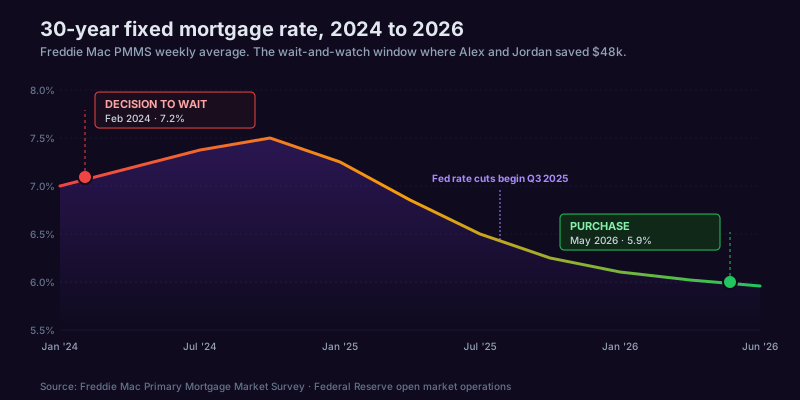
The problem was that the math no one wanted to do was loud. The 30-year fixed averaged 7.2% in early 2024 per the Freddie Mac Primary Mortgage Market Survey. A $560,000 home, the kind of 1920s bungalow in Cully or Woodlawn they had been touring, meant $112,000 down at 20%, a $448,000 loan, and a monthly principal and interest payment of $3,037. Add roughly $467 for property taxes (Multnomah County runs about 1.0% of assessed value), $145 for homeowners insurance, and a maintenance reserve, and they were looking at $3,750 a month before utilities, before any HOA, before the cost of replacing a 1948 furnace.
They were renting for $2,400. The gap was $1,350 a month, every month, for at least 30 years. That number is what made them pause. Not the price. Not the rate alone. The gap.
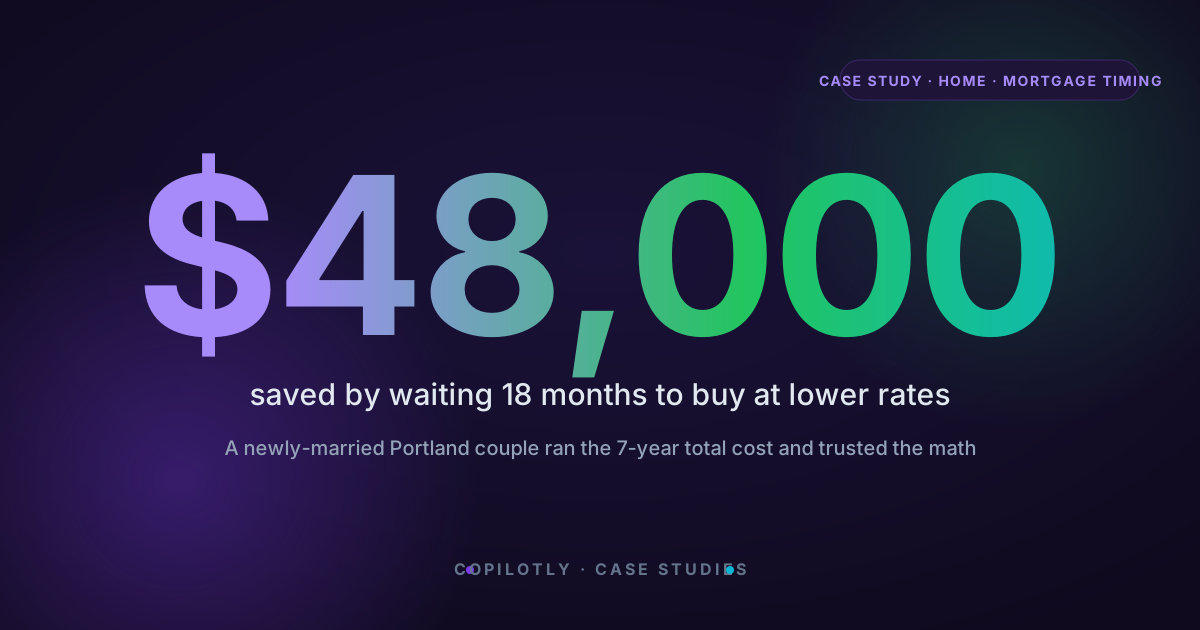
Alex opened a tab on Home Buying Copilot the Sunday after they got back. Jordan made coffee. Neither of them imagined that 18 months later they would close on a different house, at a different price, at a different rate, and be roughly $48,000 ahead of where they would have been if they had just done what everyone told them to do.
The pressure to buy now, from every direction
The hardest part of the next two months was not the math. It was the people. Family group chats turned into a daily drumbeat. Alex's father forwarded a Realtor.com article every Tuesday. Jordan's coworkers in the ER, half of whom had bought in the cheap-rate years of 2020 and 2021, kept saying the same sentence in slightly different costumes: "marry the house, date the rate." The realtor sent a Loom video walking through a 1,400 square foot bungalow in Cully listed at $549,000, suggesting they could probably get it for $535,000 if they moved fast.
FOMO is a strange thing in a housing market. It does not feel like greed. It feels like responsibility. Every week they waited felt like a week they were "throwing money away" on rent, a phrase Alex heard so many times he started counting. By mid-January 2024, he had heard it 11 times from 7 different people, including his dentist.
The data underneath the pressure was more mixed than any of the loud voices suggested. The Realtor.com research team showed Portland inventory creeping up. The National Association of Home Builders housing economics index was flagging affordability as the worst since 2006. The FOMC's published open-market operations meeting minutes suggested rate cuts were on the table for late 2024, though the timing was unclear.
What pushed Alex and Jordan over the edge was not a single number. It was a conversation at a friend's birthday party. A senior nurse Jordan respected, who had bought in 2022 at 5.5%, mentioned offhand that her real total monthly cost (after the new property tax assessment, the second insurance hike, and a $7,200 water-heater situation) was about $1,100 higher than her closing-day estimate. The number stuck. Alex went home and started typing a long prompt into Home Buying Copilot. Jordan started a spreadsheet. The next morning they texted the realtor and asked for 30 days "to run the analysis properly." She wrote back: "totally understand, but rates aren't going to wait."
That night Alex put the question to the Home Life persona quiz as a sanity check and ended up routed to the same Home Buying Copilot he had been using. The quiz also flagged Tax Copilot and Budgeting Copilot, neither of which he had considered, as relevant tools for a decision of this size.
What the generic calculators kept missing
Before Copilotly, Alex and Jordan did what every well-meaning analytical couple does: they Googled "rent vs buy calculator" and clicked the first four results. The New York Times calculator, which they had both used in their late twenties as a kind of hypothetical exercise, told them rent was modestly better at current rates. A bank's calculator told them buy was better. A blog calculator told them the same thing but with more confidence and worse math. None of them agreed on the answer.
The problem was not the calculators. The problem was the inputs. Every calculator asked for a rate, a price, a down payment, an expected appreciation rate, and a rent figure, and stopped there. None of them modeled what Alex actually wanted to model:
- A two-scenario tree where one branch was "buy now at 7.2%" and the other was "wait 12 to 18 months, save the payment gap, and reassess when rates move." Most calculators assume a single decision point.
- The opportunity cost of locking $112,000 of liquidity into home equity at the exact moment they were a newly-married household with no real emergency cushion beyond the down payment fund itself.
- The actual cost basis of homeownership in Portland in 2024: water and sewer surcharges, the city's HUD-tracked homeowner cost-burden statistics, and the realistic maintenance reserve for a pre-WWII house (closer to 1.5% of value per year than the 1% most calculators use).
- The break-even number: at what combination of price change and rate change does waiting stop being better than buying today.
Alex tried to build it in a spreadsheet. He got 6 hours in, hit a wall on the opportunity-cost modeling, and felt the same flavor of analytical paralysis he sees in junior engineers when a problem is just slightly bigger than the tools they reach for first. He had also been using ChatGPT for some preliminary research but found himself re-pasting the same Portland context, the same rate, the same down-payment number into every fresh chat. He read our comparison of Copilotly versus ChatGPT the next morning and migrated. The persistent context was the unlock. The Copilot already knew their income, their rent, their savings, their timeline, and their risk tolerance by the third conversation.
The other thing that helped: he stopped trying to find the right answer and started trying to find the right framing. That sounds like a small distinction. In a decision of this size it is the entire game.
The 7-year total cost analysis that changed the conversation
The turn came in a single 90-minute Sunday afternoon session at the kitchen table. Alex opened Home Buying Copilot, gave it the full picture (income, savings, current rent, the specific bungalow they were looking at, the 7.2% rate they had been quoted, their 7-year horizon), and asked one specific question.
The Copilot came back with a comparison they had never seen anyone do in their preferred unit of analysis: total dollars out the door over 7 years, broken into components and accounting for the time value of money on the down payment. It computed two scenarios:
Scenario A: Buy in February 2024 at 7.2%. $560,000 home, $112,000 down, $448,000 loan, $3,037 principal and interest, $467 property tax, $145 insurance, $100 maintenance reserve, $0 PMI (because they were at 20% down). Over 7 years, total housing dollars paid: roughly $315,000, including the opportunity cost of the $112,000 down payment compounding at a conservative 6% in a balanced portfolio.
Scenario B: Rent at $2,400 for 18 months, invest the $1,350 monthly gap in a low-cost index fund at a modeled 9% return (long-run S&P average), then buy whatever house was available in late 2025 or early 2026 at the rate prevailing then. The Copilot ran this scenario across three rate assumptions (rates stay at 7.2%, drop to 6.5%, drop to 5.9%) and three price assumptions (prices rise 4%, flat, drop 3%).
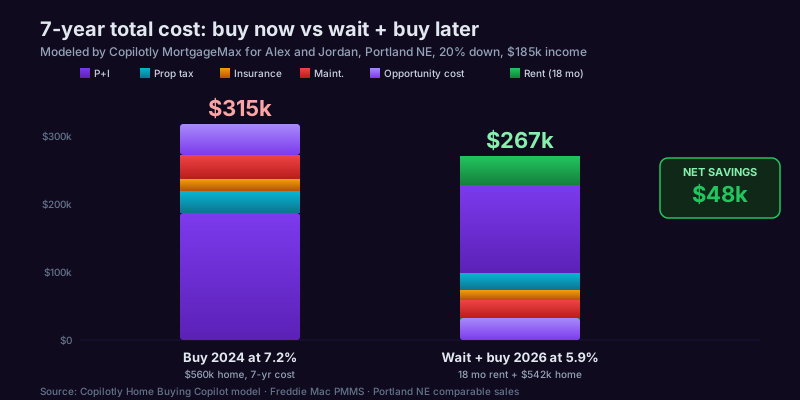
The number that stopped them: in the middle scenario (rates drop modestly to 6.5%, prices flat), waiting was already $22,000 cheaper over 7 years. In the favorable scenario (rates drop to 5.9%, prices flat or slightly down), waiting was $48,000 cheaper. Even in the unfavorable scenario (rates stay at 7.2%, prices rise 4%), waiting cost them about $11,000 more, which Alex described as "the price of an insurance policy on being patient."
The framing was the unlock. They were not betting on rates going down. They were buying optionality. The downside of waiting was bounded and known. The upside of waiting was substantial and probable. Jordan, who Alex describes as "the actually-careful one in the marriage," ran the same logic backwards through her own intuition and got the same answer. They emailed the realtor on Monday and asked her to take them off the active list for the next 12 months.
To check the affordability math for the eventual purchase, Alex spent an hour in the MortgageMax affordability calculator running purchase prices from $480k to $620k at rates from 5.5% to 7.5%, generating a small grid of monthly costs and debt-to-income ratios that he saved as a PDF for later.
- Month 1
Ran the rent-vs-buy math
Home Buying Copilot ran a 7-year total cost analysis at 7.2% rates.
- Month 2
Decision: wait 12-18 months
Waited for either rate drop, price drop, or both. Saved aggressively in the meantime.
- Month 14
Rates dropped to 5.9%
Federal rate cuts brought 30-year mortgages back below 6%.
- Month 18
Bought a $542k home
Used MortgageMax to verify monthly cost. Closed with 20% down.
The 14 months of disciplined waiting
Waiting is not a passive activity. It was the hardest 14 months of their financial life together. They redirected the $1,350 monthly payment-gap into a brokerage account, split between a total-market index fund and a short-term Treasury fund. By December 2024, the rate had ticked up briefly to 7.4%, and both Jordan and Alex briefly doubted the entire plan. Alex went back to Home Buying Copilot and asked for a re-run of the analysis using the new rate. The answer came back: waiting was still favored in 7 of 9 scenarios.
They used the time to sharpen the rest of the picture. Budgeting Copilot walked them through carving out a true 6-month emergency fund ($28,000) separate from the down-payment savings, which they had been conflating. Tax Copilot modeled what their mortgage interest deduction would actually look like at different loan sizes and rates, factoring in the standard deduction (which had been raised again under the most recent tax package). The answer was sobering: at a $434,000 loan and 5.9% rate, they were barely above the standard deduction threshold even with state and local taxes, so the headline "tax benefit of homeownership" was worth maybe $1,800 a year for them. Not zero, but nothing like the number their parents' generation had relied on. The CFPB owning a home guide was the unsexy reference that grounded most of these conversations.
They also used Real Estate Copilot to watch the Portland market more carefully than their realtor could without overreaching. By August 2025, the Copilot was flagging that median days-on-market for non-distressed sub-$600k inventory in NE Portland had risen from 18 days to 41 days. Inventory was building. Sellers were doing more concessions. The FRED MORTGAGE30US series showed the headline 30-year average ticking below 6.4% for the first time in 18 months in September.
The Fed began cutting in Q3 2025. By March 2026, the Freddie Mac average was at 6.0%. By May, lenders in Portland were quoting 5.9% on a 760-credit-score, 20%-down, single-family conventional loan. Alex pulled the trigger on a different question.
The answer (from the Copilot, validated by their actual loan officer) was: lock now. The Fed had already cut. The next meeting was expected to hold steady, but the back-end mortgage market had pulled in most of the easy expected drop already, and the risk of a small rate uptick on a fresh inflation print outweighed the expected upside of floating another 30 days. They locked at 5.9% on a 45-day commitment.
By that point their saved down-payment fund had grown to $108,000 from the original $92,000 (roughly $13,000 from contributions and $3,000 from index-fund gains, after a sharp drawdown in spring 2025 that they did not enjoy). They closed on a $542,000 three-bedroom in the Concordia neighborhood in May 2026: $434,000 loan, $2,576 P+I, total monthly around $3,210.
| Buy 2024 scenario: $560k house at 7.2%, 7-yr total | $315,000 |
| Wait scenario: 18mo rent + index fund delta | $31,000 |
| Buy 2026: $542k house at 5.9%, 5.5-yr total | $236,000 |
| Down payment grew $92k to $108k while waiting | +$16,000 |
| Net savings from waiting (7-yr horizon) | $48,000 |
What 18 months of patience actually bought them
The headline number is straightforward and slightly underwhelming the way most actual financial wins are. Compared to the original 2024 plan, the May 2026 purchase saves them roughly $540 a month for the next 30 years. That alone is about $190,000 in nominal payments over the loan term, of which roughly $48,000 in present-value-adjusted cost shows up in the 7-year window they originally modeled.
The harder-to-see wins:
- The Concordia house was a meaningfully better fit than the Cully bungalow they would have bought in 2024. They had had 18 months to refine what they actually wanted (Jordan wanted a real second bedroom for night-shift sleep; Alex wanted a real basement office), and an extra $16,000 of buying power from the higher down payment plus the lower rate let them get both.
- They closed with the emergency fund still intact, separately from the down payment, which the 2024 plan would not have permitted. The first three months after closing included a $4,800 sewer line repair and a $2,200 mini-split servicing they had not budgeted for, and the emergency fund absorbed them with no panic.
- The disciplined wait built a habit. The monthly savings auto-transfer they had set up in early 2024 stayed in place after closing, redirected into their retirement accounts. Jordan increased her 403(b) contribution by 4% the week they closed.
- They are also no longer on a 28% debt-to-income ratio at the edge of comfort. At the actual purchase parameters they came in at 22%, which gave them genuine slack the first year of homeownership.
Alex described the moment of signing closing documents as "anticlimactic in the best way." No FOMO. No anxiety about whether they had overpaid or under-saved. Just a transaction whose math they had already lived inside, in 9 different scenarios, for 18 months.
The realtor, who they ended up working with again, told them after closing that they were the most prepared first-time buyers she had worked with all year. "You knew exactly what you wanted to pay, exactly what your monthly was going to be, and exactly what you were going to do if we lost the bid." Alex credits this entirely to the months of running scenarios through Home Buying Copilot and the iterative back-and-forth in MortgageMax before they ever sat in front of a loan officer.
What they would tell themselves in early 2024
When asked what advice they would give to a friend in the same position - newly married, decent savings, mid-rate environment, family pressure - their answers were consistent and unromantic.
First: model the actual 7-year total cost, not the monthly payment. Monthly payment thinking is a trap. It makes a 7.2% rate look like "only $700 more than rent" when it is actually $250,000 in extra interest over the life of the loan. The total-cost frame is the only one that cuts through the noise.
Second: separate the "should we buy" question from the "should we buy now" question. They are two completely different decisions. Most people merge them. The first is about lifestyle and life stage. The second is about market conditions. Treating them separately preserves your sanity and your money.
Third: do not bet on rates going down. Build a plan whose downside is bounded even if rates stay flat or go up. Alex and Jordan's worst-case scenario was costing themselves about $11,000 over 7 years by waiting. They could live with that. They could not have lived with the worst-case of buying in 2024 if rates had cut hard and prices had not moved.
Fourth: get the persistent-context advantage. Alex's specific recommendation, repeated to three friends already, was to stop using fresh chat windows for a decision that takes 14 months. The value of Home Buying Copilot was not any single conversation. It was the fact that month 11 conversation built on the month 1 framing without his having to re-paste every input. That alone, he estimates, saved him 20 hours of paste-and-recontextualize.
Finally: if you want a parallel example of how this same approach works on a different kind of big-money decision, the Denver founder LLC versus S-corp case study walks through a similar disciplined-scenarios-over-months process for a tax-structure decision. The housing-adjacent Austin tenant deposit recovery story is the smaller-stakes version of the same "the math doesn't care what people are telling you" lesson. For freelancers running multi-year financial planning, the Brooklyn freelancer deductions case study covers the same iterative refinement style on the tax side. The pattern is the same across all three: name the decision, build the scenario tree, watch the world for 12 to 18 months, act when the math says act.
What is next for Alex and Jordan: a refi watch. If the 30-year drops below 5.0% in the next 18 months, they will refi the 5.9% they locked. Alex has the refinance break-even formula already wired into a scheduled monthly check-in with Home Buying Copilot, sourcing the current rate from the FRED MORTGAGE30US weekly series. They will not be caught by surprise.
Every tool used in this story
What it added up to
Frequently asked questions
Is this a real customer or composite?
What if rates had not dropped? Would they have lost money waiting?
Should everyone wait to buy a house?
Which Copilotly tools did they use?
Alex did it once.
Now it's your turn.
The same copilots in this story are free to start with, on every device. Open Copilotly and ask the question you have been putting off.
Open Copilotly free