
How AI Is Reshaping the Real Estate Agent's Role in 2026
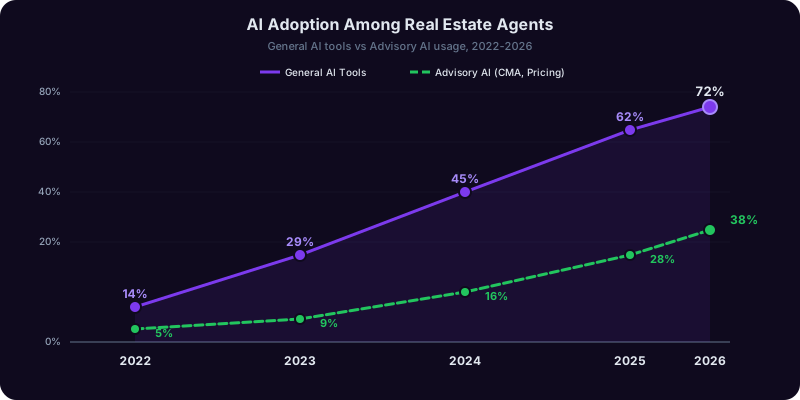
The real estate industry has always been relationship-driven, and that has not changed. What has changed is the analytical backbone that supports those relationships. According to the National Association of Realtors 2025 Technology Survey, 72% of real estate agents now use some form of AI tool in their daily workflow, up from just 31% in 2023. But the majority are still using AI for surface-level tasks -- auto-generating social media posts, scheduling emails, and populating CRM fields. The agents pulling ahead are using AI for something far more valuable: the thinking work.
Property analysis that once required hours of spreadsheet manipulation now takes minutes. Comparative market analyses that relied on gut feeling and a handful of comps now draw from hundreds of data points. Investment return calculations that buyers used to wait days for now happen in the middle of a showing. This is not about replacing the agent's judgment. It is about feeding that judgment with better data, faster.
What advisory AI looks like in practice:
- Property analysis: Evaluating a listing's strengths and weaknesses against comparables, identifying pricing opportunities, and spotting red flags in disclosures
- CMA preparation: Generating comprehensive comparative market analyses adjusting for condition, lot size, upgrades, and micro-market trends
- Client Q&A prep: Anticipating buyer or seller questions about neighborhoods, schools, flood zones, and tax implications with data-backed answers
- Investment calculations: Running cap rate, cash-on-cash return, and mortgage payment scenarios in real time
- Listing descriptions: Crafting descriptions that highlight features most likely to drive interest based on current buyer demand
- Closing coordination: Tracking 40-60 tasks between offer acceptance and closing, flagging deadlines, and drafting communications
This guide covers each of these functions in detail. The goal is to show you how to use AI as an analytical partner that makes you a better advisor -- not a shinier version of the same transactional service every other agent offers. If you run your real estate business solo, this pairs well with our guide on the solopreneur AI toolkit for one-person businesses.
AI-Powered Comparative Market Analysis: From Hours to Minutes
A comparative market analysis is the foundation of every listing presentation and every pricing conversation. Traditional CMAs involve manually pulling comps from the MLS, adjusting for differences in square footage, condition, lot size, and upgrades, and presenting a price range that balances seller expectations with market reality. This process typically takes 2-4 hours per property. AI reduces it to 15-30 minutes while improving accuracy.
How AI transforms the CMA process. An AI copilot does not just pull comps -- it evaluates them. It cross-references sale prices with days on market to identify whether comps sold quickly (suggesting underpricing) or slowly (suggesting overpricing). It adjusts for seasonal trends in your specific micro-market. It flags outlier sales -- foreclosures, estate sales, or off-market transactions -- that do not reflect true market value.
The AI-assisted CMA workflow:
- Data collection: Input the subject property details. The AI pulls comparable sales from the past 6-12 months within a defined radius.
- Comp scoring: The AI ranks each comparable by relevance, weighting proximity, recency, size similarity, and feature comparability.
- Adjustment analysis: For each comp, the AI calculates adjustments based on local market data -- not national averages. A renovated kitchen in a market where renovations add $15,000-$25,000 gets adjusted accordingly.
- Price range recommendation: The AI generates three tiers: aggressive (multiple offers), market rate (sell within 30 days), and aspirational (test the ceiling).
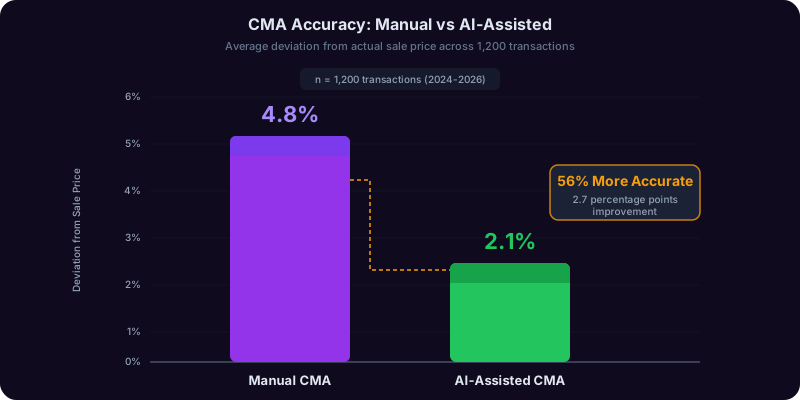
Competitive positioning analysis. An AI-enhanced CMA also answers, "How does this property compete against what is currently on the market?" It analyzes active listings in the same price range and geography, identifying advantages and weaknesses. This data is gold in a listing presentation. According to HousingWire's real estate technology reporting, agents who present data-rich CMAs secure listings at a 23% higher rate than those who rely on MLS printouts alone.
| CMA Component | Traditional Time | AI-Assisted Time |
| Comp identification | 45-60 min | 5-10 min |
| Adjustment calculations | 30-60 min | 3-5 min |
| Active listing analysis | 30-45 min | 5-8 min |
| Narrative and presentation | 30-45 min | 5-10 min |
| Total | 2-4 hours | 18-33 min |
AI Listing Descriptions and Property Marketing That Converts
Every agent has written a listing description that reads like every other listing description: "Beautiful 3-bedroom home in desirable neighborhood. Updated kitchen, spacious backyard, close to schools." These descriptions fail because they describe features without connecting them to what buyers care about. AI changes the listing description from a checkbox exercise into a strategic marketing asset.
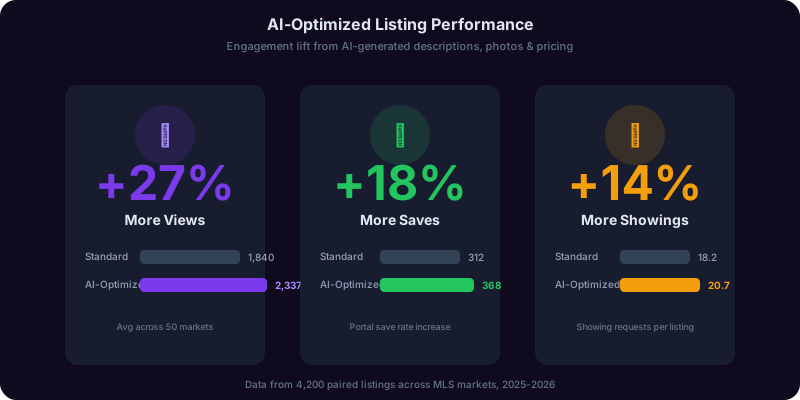
Why most listing descriptions underperform. According to Zillow Research, listings with descriptions that emphasize specific lifestyle benefits rather than generic features receive 18% more saves and 12% more showing requests. The word "granite" does not sell a kitchen. The fact that the kitchen has a 9-foot island overlooking the backyard where you can watch your kids play while making dinner -- that sells a kitchen.
The AI listing description workflow:
- Input property details: Feed the AI the property's specs, unique features, upgrades, and what the sellers love about the home
- Market-aware drafting: In a market driven by remote workers, the AI emphasizes the home office and fiber internet. For young families, it leads with the school district and fenced yard
- Multiple versions: The AI produces a narrative version for the MLS, a shorter version for social media, a bullet-point version for email campaigns, and a luxury-tone version if warranted
- SEO optimization: The AI uses search terms buyers actually type into Zillow and Redfin -- not "domicile" but "home"
Feature-to-benefit translation examples:
| Raw Feature | Generic | AI-Optimized |
| New roof (2025) | New roof installed in 2025 | Brand-new architectural shingle roof with a 30-year warranty -- one major expense you will not think about for decades |
| Corner lot, 0.3 acres | Large corner lot | Corner lot on a third of an acre with no rear neighbors -- the kind of privacy increasingly rare in this zip code |
| Updated kitchen | Beautiful updated kitchen | Kitchen fully renovated in 2024 with quartz countertops, soft-close cabinetry, and gas range -- move-in ready |
Disclosure document analysis. Before writing marketing material, an AI copilot parses seller disclosures and flags items that need attention -- aging HVAC, aluminum wiring, past insurance claims. It helps you prepare talking points that address concerns honestly without undermining the listing's appeal. This advisory work separates excellent agents from average ones, and AI makes it systematic rather than hit-or-miss.

Get Answers From the Real Estate Copilot
Copilotly gives real estate agents instant access to CMA analysis, investment calculations, listing descriptions, neighborhood intelligence, and contract review -- all the advisory tools you need to win more listings and close faster.
Client Q&A Preparation and Neighborhood Intelligence
The moments that define your reputation as a real estate agent are not the ones where you hand over a key. They are the moments where a client asks a question and you have the answer -- instantly, accurately, and with supporting data. AI copilots transform client Q&A from an improvisation exercise into a prepared performance.
Anticipating client questions before the meeting. When you have a showing scheduled, you can predict roughly 80% of the questions a buyer will ask. An AI copilot generates a comprehensive Q&A preparation document covering school ratings and enrollment boundaries, property tax history and projected changes, flood zone status and insurance requirements, crime statistics compared to surrounding areas, commute times to major employment centers, planned development or zoning changes within two miles, and HOA rules and fee history if applicable.
Neighborhood intelligence reports. AI enables you to produce reports that buyers cannot get from Zillow or Realtor.com -- synthesizing data into a narrative about where a neighborhood is heading, not just where it is today.
| Data Category | What AI Analyzes | Why Buyers Care |
| Price trends | Median sale price trajectory over 1, 3, and 5 years | Appreciation direction |
| Days on market | Average DOM vs. city-wide average | Market competitiveness |
| Inventory levels | Active listings vs. historical average | Buyer vs. seller leverage |
| School performance | Test scores, teacher ratios, trend direction | Family purchase driver |
| Development pipeline | Permitted construction, rezoning applications | Future neighborhood change |
| Walkability | Distance to groceries, parks, transit | Quality of life factors |
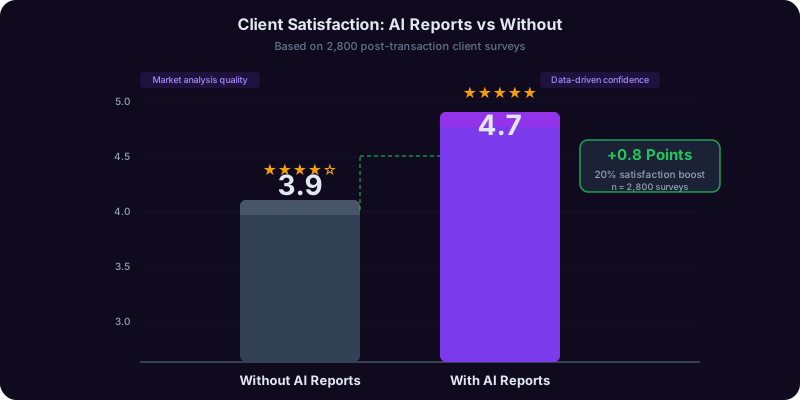
Handling the hard questions. "What is the crime rate on this street?" "Is this in a FEMA flood zone?" "I heard there is a landfill being proposed nearby -- is that true?" An AI copilot does not make these questions disappear, but it ensures you have researched them before the client asks. For each showing, the AI compiles a risk assessment covering environmental concerns, municipal decisions affecting property values, and historical issues that are matters of public record.
Real-time Q&A support. During showings, AI serves as a reference. A buyer asks about property tax implications of the assessed value being lower than the sale price. You can provide an accurate answer within 30 seconds instead of saying, "I will get back to you." The agent who answers on the spot earns more trust. For more on AI as your professional second opinion, see our guide to AI-powered second opinions.
Investment Property Analysis: AI-Powered Financial Calculations
Investment property analysis is where many residential agents lose confidence -- and lose clients to commercial brokers. The calculations require precision that most agents lack time to develop for every property. AI copilots eliminate this bottleneck, enabling any agent to provide institutional-quality investment analysis.
Core investment metrics AI calculates instantly:
| Metric | What It Measures | What AI Calculates |
| Cap Rate | Return if purchased all-cash | NOI divided by purchase price, benchmarked locally |
| Cash-on-Cash Return | Return on cash invested | Annual pre-tax cash flow divided by total cash invested |
| Gross Rent Multiplier | Years of rent equal to price | Purchase price divided by annual gross rental income |
| DSCR | Whether income covers mortgage | NOI divided by annual mortgage payments -- lenders want 1.25+ |
| Internal Rate of Return | Total return with appreciation | 10-year IRR with rent growth, appreciation, and paydown |
The AI investment analysis workflow:
- Property financials: Input the asking price, estimated rental income, taxes, insurance, and maintenance. The AI cross-references against local averages to flag numbers that seem too optimistic or conservative.
- Financing scenarios: The AI runs calculations for multiple structures -- 20% down conventional, 25% down investment loan, portfolio loan -- showing how financing choices affect returns.
- Expense modeling: AI builds comprehensive models including vacancy allowance (5-8%), maintenance reserves (1-2% of value), management fees (8-10% of rent), and capital expenditure reserves.
- Scenario comparison: Side-by-side comparison of multiple properties, normalized for investment amount so a $250,000 duplex can be compared against a $400,000 triplex.
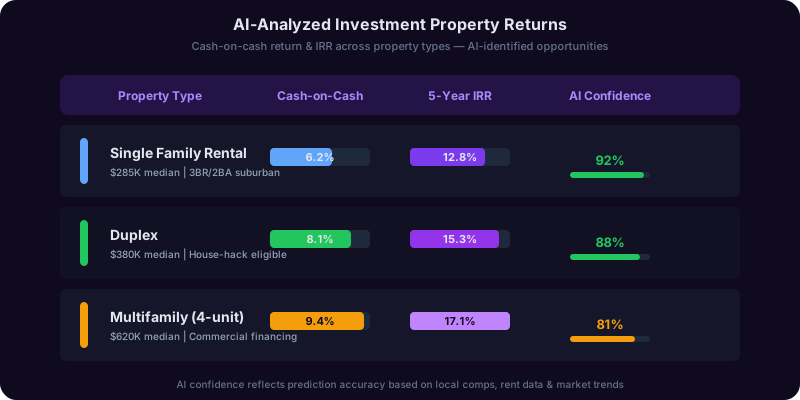
Tax benefit calculations. An AI copilot calculates depreciation schedules (27.5 years for residential investment property), estimates the tax shield value based on marginal tax rate, and models cost segregation impacts. It projects tax implications of exit strategies -- selling outright versus a 1031 exchange versus converting to a primary residence. For purchase agreement analysis, see our contract negotiation guide.
Why this matters for your business. An agent who can present a detailed investment analysis during a property tour -- cap rates, cash flow projections, financing comparisons on the spot -- becomes a financial advisor, not just a door opener. This attracts investor clients who do repeat business and refer other investors.
AI-Powered Closing Coordination and Transaction Management
The period between offer acceptance and closing is where deals die. Not because the price was wrong, but because someone missed a deadline or a communication gap created friction. According to the NAR Realtors Confidence Index, approximately 5% of contracts terminate and another 9% experience significant delays each month. Many are preventable with better coordination.
AI closing coordination workflow:
- Task timeline generation: From contract terms, the AI generates a complete timeline with every milestone, responsible party, and deadline mapped
- Proactive deadline monitoring: Alerts 72, 48, and 24 hours before each contingency deadline. Flags tasks behind schedule with corrective actions
- Communication drafting: Inspection reveals a $4,000 roof repair? The AI drafts a repair request. Appraisal came in $15,000 low? The AI drafts a renegotiation letter with options
- Document tracking: Maintains a checklist of every document required for closing, tracking what has been received and who is responsible
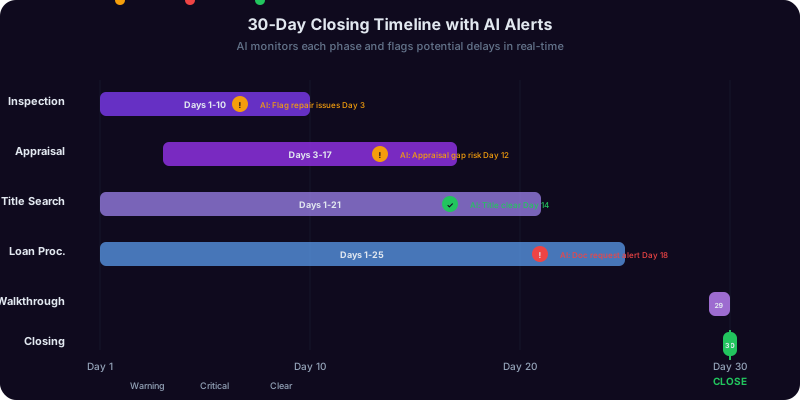
Inspection negotiations. The inspection period is the most common renegotiation point. An AI copilot analyzes the report, categorizes findings by severity (safety issues, major systems, cosmetic items), estimates repair costs using local rates, and drafts a firm but reasonable request. It also prepares you for the seller's likely response based on current market conditions.
Appraisal gap strategy. When an appraisal comes in below contract price, AI helps by analyzing whether the appraiser missed relevant comps, drafting a reconsideration of value request, and modeling the financial impact of each option for the buyer.
Closing communication templates:
| Scenario | AI-Drafted Communication | Audience |
| Inspection repairs needed | Repair request with itemized costs | Listing agent and seller |
| Appraisal below contract | Renegotiation letter with comp data | Listing agent |
| Financing extension needed | Extension request with lender documentation | Listing agent and seller |
| Title issue discovered | Resolution inquiry with cure deadline | Title company |
| Final walkthrough issues | Punch list with resolution requirements | Listing agent and seller |
The agent who manages closings with AI support is less likely to miss the small detail that becomes a big problem. A smooth closing generates referrals; a chaotic one does not.
AI-Enhanced Lead Strategy and Client Relationship Management
Lead generation in real estate is not the problem. Most agents have more leads than they can effectively work. The problem is lead quality assessment, response strategy, and long-term nurturing -- the analytical work that determines whether a lead becomes a client or disappears into a competitor's pipeline.
Lead qualification beyond the basics. AI-powered qualification goes deeper than "Are you pre-approved?" By analyzing a lead's search history, saved properties, neighborhoods viewed, and questions asked, an AI copilot builds a behavioral profile predicting timeline, motivation, and likelihood to transact. A buyer searching the same three neighborhoods for four months, saving properties in the $400,000-$500,000 range, who just started looking at in-law suites, is probably within 60 days of a purchase decision with a family situation driving the search.
AI-powered response strategy by lead type:
| Behavior Pattern | AI Assessment | Response |
| Saved 20+ properties across price ranges | Early-stage, 3-6 months out | Monthly market updates, low-pressure check-ins |
| Requesting showings in one neighborhood | Focused buyer, 30-60 days | Schedule immediately, prepare neighborhood report |
| Asked about mortgage rates | Ready but needs financing guidance | Connect with lender, provide pre-approval roadmap |
| Viewed same property 5+ times | Strong interest, ready to move | Reach out with details, suggest showing |
| Signed up for alerts, no engagement | Passive, 6-12 months | Quarterly newsletter, seasonal updates |
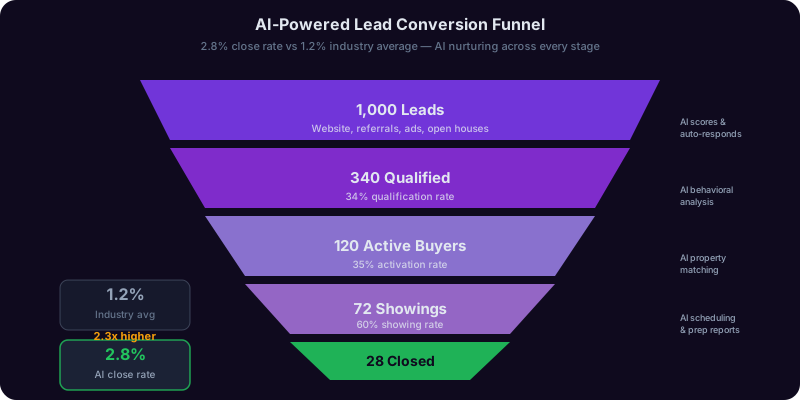
Listing presentation preparation. When a potential seller contacts you, the AI immediately prepares your listing presentation -- pulling public record data, recent comparable sales, current market conditions, and price history. It even drafts responses to common objections: "My neighbor sold for more" (here is why the comparison is not apples-to-apples), "I want to price high and see what happens" (here is data showing overpriced listings sell for less), and "Another agent promised more" (here is what the data supports).
Past client re-engagement. Your existing database is your most valuable asset. AI identifies clients approaching a life event that triggers a move: nearing the 5-7 year ownership average, equity accumulation that makes a move attractive, or household changes. It drafts personalized re-engagement messages referencing the specific property you helped them with, how their neighborhood has changed, and offering a complimentary market update. This relationship maintenance generates referrals and repeat business, and AI makes it scalable.
Building Your Real Estate AI Stack: Implementation Roadmap
The most successful agents implement AI incrementally, starting with the function that provides the most immediate return and expanding as each tool becomes natural. Here is a practical roadmap.
Phase 1 (Week 1-2): Listing descriptions and CMAs. These deliver the fastest results. Use the Real Estate Copilot to generate your next listing description and compare it against what you would have written manually. Run a CMA through the AI and compare the analysis depth to your traditional process.
Phase 2 (Week 3-4): Client Q&A and neighborhood analysis. Before every showing, generate a property and neighborhood brief. Within two weeks, clients will comment on your knowledge and express more confidence in your guidance.
Phase 3 (Month 2): Investment analysis and closing coordination. Introduce AI financial analysis for investor clients. Implement AI closing coordination for all transactions. Use the Finance Copilot for cap rates, cash flow modeling, and depreciation schedules.
Phase 4 (Month 3): Lead strategy and nurture. Build lead qualification frameworks, create segmented nurture campaigns, and implement re-engagement for past clients. Use the Marketing Copilot for content and campaign strategy.
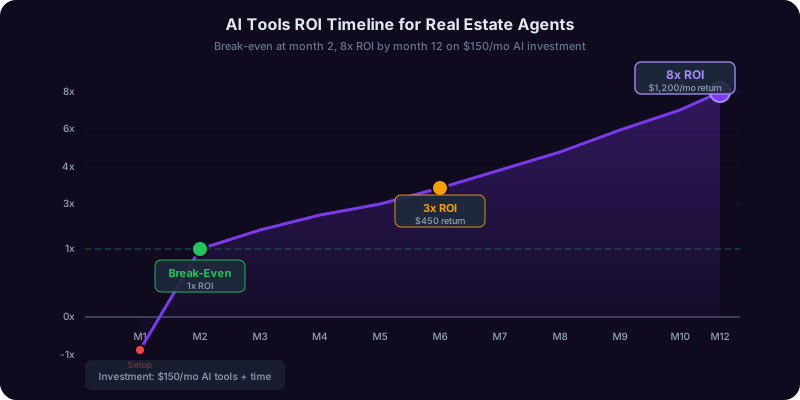
Measuring ROI:
| Metric | Pre-AI Baseline | AI-Assisted Target |
| CMA preparation time | 2-4 hours | 20-35 minutes |
| Client satisfaction | Post-closing survey avg | 0.5+ point improvement |
| Days contract to close | Current average | 10-15% reduction |
| Lead conversion rate | Industry 1-2% | Target 2.5-4% |
| Referral rate | Current rate | 15-20% improvement |
Mistakes to avoid:
- Using AI output without review. AI generates drafts, not final products. Your local knowledge is the quality filter.
- Over-automating client communication. Clients hire you for the relationship. Use AI to prepare better, not replace yourself.
- Ignoring compliance. AI descriptions must comply with Fair Housing Act, state regulations, and brokerage policies.
- Treating AI as a replacement for market knowledge. AI processes data. You interpret it through local expertise.
Use the Legal Copilot to review marketing materials for compliance. The agents who thrive will strategically integrate AI into advisory work while preserving the human judgment no algorithm can replicate.
Frequently Asked Questions
Recommended Copilots
Recommended Copilots
Get instant CMA analysis, property valuations, neighborhood intelligence reports, and listing description drafts tailored to your market.
Try Free →Review purchase agreements, listing contracts, and disclosure documents for red flags before signing or presenting to clients.
Try Free →Build listing marketing campaigns, create targeted social media content, and develop lead nurture email sequences that convert.
Try Free →Run investment property calculations including cap rates, cash-on-cash returns, depreciation schedules, and multi-scenario financing comparisons.
Try Free →Related Articles
Get Answers From the Real Estate Copilot
Copilotly gives real estate agents instant access to CMA analysis, investment calculations, listing descriptions, neighborhood intelligence, and contract review -- all the advisory tools you need to win more listings and close faster.