
The Rise of the AI-Powered Solopreneur Economy
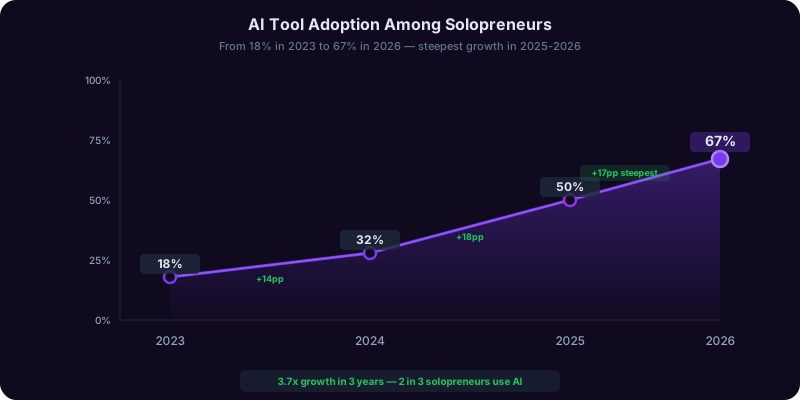
The solopreneur economy is no longer a niche. According to the U.S. Small Business Administration, non-employer firms (businesses with no paid employees) now account for over 28 million businesses in the United States, and that number has grown by 14% since 2022. What has changed in 2026 is not the desire to work independently -- it is the infrastructure that makes it viable at scale.
Until recently, solopreneurs faced a structural ceiling. You could handle the core work yourself -- design, development, consulting, writing -- but the business side demanded expertise you did not have. Contract disputes required a lawyer ($300-$500/hour). Tax optimization required an accountant ($150-$400/hour). Growth required a marketing strategist ($100-$250/hour). Hiring a first contractor required HR knowledge you had to learn the hard way. Each of these represented a cost center that ate into margins and a time sink that pulled you away from revenue-generating work.
AI copilots have changed this equation fundamentally. Not by replacing the need for professional expertise -- there are still situations where you absolutely need a human lawyer, accountant, or strategist -- but by handling the 80% of routine professional tasks that previously required expensive outside help. The result is a new class of solopreneur who operates with the sophistication of a small agency while maintaining the agility and low overhead of a one-person shop.
What a modern AI-powered solopreneur stack looks like:
- Legal: AI copilot for contract review, NDA drafting, terms of service, and compliance checks
- Finance: AI copilot for tax planning, expense categorization, invoicing strategy, and cash flow forecasting
- Marketing: AI copilot for content strategy, SEO planning, email campaigns, and competitive analysis
- Career and HR: AI copilot for hiring contractors, writing job descriptions, evaluating candidates, and managing working relationships
- Operations: AI copilots for project scoping, client communication templates, and process documentation
This guide walks through each of these functions in detail, showing you the specific workflows, the cost savings compared to hiring professionals, and the situations where you should still bring in a human expert. The goal is not to eliminate professional services from your life entirely. It is to reserve them for the high-stakes moments where they matter most, while letting AI handle the daily operational decisions that keep your business running smoothly.
If you are already running a one-person business and feeling stretched thin across too many roles, this is your playbook for building a virtual team that costs less than a single monthly retainer.
Your AI Legal Department: Contract Review, NDAs, and Compliance
Legal work is one of the highest-cost functions for a solopreneur, and also one of the most neglected. Most solo business owners either skip legal review entirely (signing contracts they do not fully understand) or pay steep hourly rates for routine document review. AI copilots offer a middle path that protects you without draining your budget.
Contract review workflow. When a client sends you a contract, your AI legal copilot can parse the full document and flag problematic clauses within minutes. This includes overly broad intellectual property assignment clauses, non-compete restrictions that could limit your future work, indemnification provisions that expose you to unlimited liability, payment terms that are unfavorable, and automatic renewal clauses buried in fine print. For a detailed guide on reading contracts yourself, see our post on how to read and negotiate contracts.
Common contract issues an AI copilot catches:
| Clause Type | Red Flag | AI Copilot Action |
| IP Assignment | Assigns all work product to client, even pre-existing IP | Flags clause, suggests language limiting assignment to deliverables only |
| Non-Compete | Restricts you from working with competitors for 12+ months | Highlights scope and duration, suggests narrower alternative |
| Payment Terms | Net 60 or Net 90 payment windows | Recommends negotiating to Net 30 with late payment penalties |
| Termination | Client can terminate without notice or payment for work completed | Suggests kill fee clause and 30-day notice requirement |
| Liability Cap | No cap on your liability exposure | Recommends capping liability at total contract value |
| Scope of Work | Vague deliverable descriptions that invite scope creep | Suggests specific, measurable deliverable language |
NDA and agreement drafting. Beyond review, AI copilots can draft standard business documents from scratch. Need a mutual NDA before a client discovery call? A subcontractor agreement for a freelancer you are bringing onto a project? A simple terms of service for your website? These are templated documents that follow well-established legal patterns. An AI copilot generates a solid first draft in seconds, customized to your business type and jurisdiction.

Cost comparison -- legal services:
| Service | Traditional Lawyer | AI Copilot | Savings |
| Contract review (per document) | $500 - $1,500 | $0 - $20 | 95-100% |
| NDA drafting | $300 - $800 | $0 - $10 | 97-100% |
| Terms of service | $1,000 - $3,000 | $0 - $20 | 98-100% |
| Annual legal overhead (10 contracts/year) | $5,000 - $15,000 | $200 - $600 | 88-96% |
When you still need a human lawyer: AI copilots handle routine legal work well, but they are not a substitute for professional legal counsel in high-stakes situations. You should consult a real attorney when forming a business entity (LLC, S-Corp), dealing with a legal dispute or threatened litigation, negotiating equity or partnership agreements, handling intellectual property registration (trademarks, patents), or when contract values exceed $50,000. The Legal Copilot can help you determine whether a situation requires professional counsel or falls within the range of routine tasks it can handle.
Your AI Finance Department: Tax Planning, Bookkeeping, and Cash Flow
Financial management is where most solopreneurs leave the most money on the table. Not because they are careless, but because tax optimization and financial planning require specialized knowledge that is expensive to access. An AI finance copilot does not replace a CPA, but it handles the weekly and monthly financial decisions that keep your business healthy between annual tax filings.
Tax planning and deduction tracking. The average self-employed individual misses $3,000-$8,000 in legitimate tax deductions each year simply because they do not know what qualifies. An AI copilot trained on current tax law can categorize your expenses in real time and flag deductions you might miss. For a comprehensive breakdown of what you can deduct, see our guide on freelance taxes and self-employment.
Deductions solopreneurs commonly miss:
- Home office deduction: Both the simplified method ($5/sq ft, up to 300 sq ft) and the actual expense method (percentage of rent, utilities, insurance)
- Health insurance premiums: 100% deductible for self-employed individuals, including dental and long-term care
- Retirement contributions: Solo 401(k) allows up to $23,500 employee contribution plus 25% of net self-employment income as employer contribution
- Professional development: Courses, conferences, books, and subscriptions related to your business
- Vehicle expenses: Standard mileage rate of $0.70/mile in 2026 for business-related driving, as published by the IRS standard mileage rates page
- Software and tools: Every subscription you use for business -- from project management to AI copilots
- Business insurance: Professional liability, errors and omissions, cyber liability

Quarterly estimated tax workflow. As a solopreneur, you owe estimated taxes four times per year (April 15, June 15, September 15, January 15). Underpaying triggers penalties. Overpaying means you gave the IRS an interest-free loan. An AI finance copilot calculates your quarterly payment based on your actual year-to-date income, not last year's numbers, adjusting as your revenue fluctuates. This is particularly valuable for solopreneurs with irregular income -- a $30,000 month followed by a $5,000 month requires very different estimated payments.
Cash flow forecasting. The number one reason small businesses fail is not lack of revenue -- it is cash flow problems. An AI copilot can project your cash flow 30, 60, and 90 days out based on your current invoices, recurring expenses, and historical payment patterns. It flags potential shortfalls before they become emergencies, giving you time to follow up on late invoices, line up additional work, or adjust spending.
Cost comparison -- financial services:
| Service | Traditional CPA/Bookkeeper | AI Copilot | Savings |
| Monthly bookkeeping | $300 - $800/month | $0 - $30/month | 90-100% |
| Tax preparation (annual) | $500 - $2,000 | $0 - $50 (still need CPA for filing) | 75-97% |
| Quarterly tax estimates | $200 - $400/quarter | $0 - $10/quarter | 95-100% |
| Financial planning session | $300 - $1,000 | $0 - $20 | 93-100% |
| Annual total | $5,000 - $14,000 | $200 - $600 | 90-96% |
When you still need a human CPA: Keep a CPA for your annual tax filing (the cost of an error far outweighs the fee), for business entity changes (switching from sole proprietorship to S-Corp), and for any audit-related matters. Use the Finance Copilot for everything in between -- the daily and weekly financial decisions that collectively save you thousands per year.

Get Answers From the Legal Copilot
Tell the Legal Copilot about your next contract, ask the Finance Copilot to review your deductions, or let the Marketing Copilot plan your content strategy. Start with the function that costs you the most time and money.
Your AI Marketing Department: Content Strategy, SEO, and Growth
Marketing is the function most solopreneurs either neglect entirely or outsource at great cost. A freelance marketing consultant charges $100-$250/hour. A content marketing agency charges $3,000-$10,000/month. For a solopreneur generating $100,000-$200,000 in annual revenue, these costs are often prohibitive. AI copilots make sophisticated marketing accessible by handling the strategy, research, and content creation that would otherwise require a dedicated team.
Content strategy workflow. Instead of guessing what to write about, an AI marketing copilot analyzes your niche, identifies content gaps your competitors have not filled, maps topics to buyer intent stages (awareness, consideration, decision), and creates a publishing calendar optimized for your capacity. A solopreneur who can publish two blog posts per month gets a focused editorial calendar with topics ranked by search volume, competition level, and relevance to their services.
The AI-assisted content creation process:
- Step 1 -- Topic research: AI copilot analyzes your niche keywords, competitor content, and search trends to suggest 10-15 topic ideas per quarter
- Step 2 -- Outline generation: For each selected topic, the copilot creates a detailed outline with section headers, key points, and suggested data sources
- Step 3 -- Draft creation: You write the first draft using your expertise and voice, with the copilot suggesting improvements for clarity, SEO, and engagement
- Step 4 -- SEO optimization: The copilot reviews meta titles, descriptions, header structure, internal linking, and keyword placement
- Step 5 -- Distribution planning: The copilot suggests repurposing strategies -- turning a blog post into a LinkedIn article, email newsletter, and social media thread
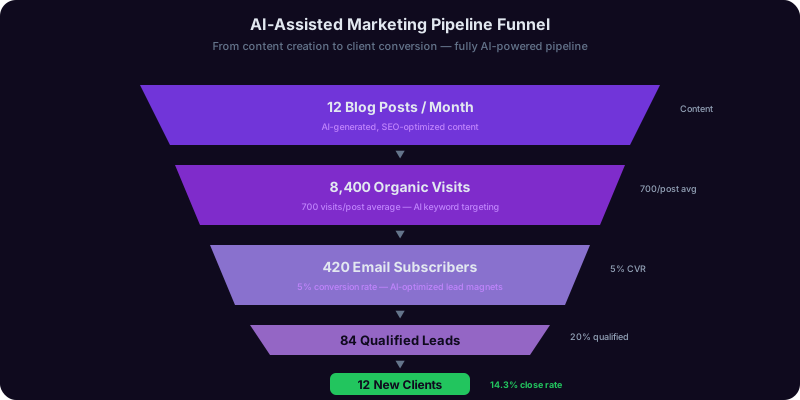
Email marketing automation. Email remains the highest-ROI marketing channel, generating an average of $36 for every $1 spent according to Litmus research. An AI copilot helps you write welcome sequences, nurture campaigns, and promotional emails that sound like you wrote them personally -- because you set the tone and the copilot handles the structure and optimization. It can A/B test subject lines, suggest send times based on your audience's behavior patterns, and write follow-up sequences for leads who engaged but did not convert.
Social media strategy without the time sink. Most solopreneurs spend 5-10 hours per week on social media and see minimal return. An AI copilot can reduce this to 2-3 hours per week by batch-creating content, suggesting optimal posting times, and identifying which platforms actually drive business results for your specific niche. The copilot analyzes your past engagement data and recommends a focused strategy rather than the scatter-shot approach most solopreneurs default to.
Cost comparison -- marketing services:
| Service | Agency/Freelancer | AI Copilot | Savings |
| Content strategy (quarterly) | $2,000 - $5,000 | $0 - $30 | 99% |
| Blog content (per post) | $300 - $1,500 | $0 - $10 (your time still required) | 93-99% |
| Email marketing setup | $1,000 - $3,000 | $0 - $20 | 98-99% |
| SEO audit and strategy | $1,500 - $5,000 | $0 - $30 | 99% |
| Annual marketing total | $12,000 - $50,000 | $300 - $800 | 93-98% |
The Marketing Copilot is particularly effective for solopreneurs who know their craft deeply but struggle to communicate that expertise in a way that attracts clients. It bridges the gap between domain expertise and marketing execution, letting you focus on quality while the copilot handles positioning and distribution strategy.
Your AI HR and Operations Team: Hiring, Onboarding, and Scaling
Even solopreneurs need to hire. Whether it is a virtual assistant, a subcontractor for overflow work, or a specialist for a specific project, the hiring process involves skills most solo business owners have never developed: writing job descriptions, evaluating candidates, structuring agreements, and onboarding effectively. An AI copilot acts as your HR department, guiding you through each step.
Writing effective job descriptions. A poorly written job description attracts the wrong candidates and wastes everyone's time. An AI copilot generates role-specific descriptions that include the right balance of requirements and nice-to-haves, clear deliverable expectations, compensation transparency, and screening questions that filter for quality. It also flags language that could inadvertently discourage qualified candidates or create legal exposure.
Contractor evaluation framework. When you receive 50 applications for a freelance role, you need a systematic way to evaluate them. An AI copilot helps you build a scoring rubric customized to the role, evaluate portfolio samples against your quality standards, draft skills-assessment questions, and create a structured interview process that takes 20 minutes instead of an hour while giving you the information you actually need to make a decision.
The solopreneur hiring workflow with AI:
- Define the role: Tell the copilot what you need done, your budget, and whether this is ongoing or project-based. It generates a complete job posting.
- Screen applications: The copilot creates a screening checklist based on your must-have criteria, helping you sort 50 applications into 5 strong candidates in under 30 minutes.
- Interview preparation: The copilot generates role-specific interview questions that assess both technical skill and working style compatibility.
- Agreement drafting: Once you select a candidate, the copilot drafts a contractor agreement covering scope, payment terms, IP ownership, confidentiality, and termination provisions.
- Onboarding documentation: The copilot creates a welcome document with project context, communication expectations, tool access instructions, and quality standards.

Operations and process documentation. As your business grows, you start doing the same things repeatedly: client onboarding, project kickoff, invoicing, follow-up sequences, quality checks. An AI copilot helps you document these processes into standard operating procedures (SOPs), following frameworks like those described by the SCORE small business resource center that you can eventually hand off to a contractor or virtual assistant. This is how one-person businesses scale without the founder becoming the bottleneck.
Cost comparison -- HR and operations:
| Service | HR Consultant/Recruiter | AI Copilot | Savings |
| Job description writing | $200 - $500 | $0 - $5 | 99% |
| Candidate screening (per hire) | $500 - $2,000 | $0 - $10 | 98-99% |
| Contractor agreement drafting | $300 - $1,000 | $0 - $10 | 97-99% |
| SOP documentation (per process) | $500 - $1,500 | $0 - $10 | 98-99% |
| Annual HR overhead (3-4 hires) | $3,000 - $10,000 | $100 - $300 | 93-97% |
The Career Copilot handles the hiring side of this equation, helping you write descriptions, prepare interview questions, and evaluate candidates. Combined with the Legal Copilot for contractor agreements, you have a complete hiring infrastructure that costs virtually nothing beyond your time.
The Complete Cost Breakdown: AI Copilots vs Traditional Professional Services
The individual department breakdowns tell part of the story. But the real impact becomes clear when you look at the total annual cost of running a professional one-person business with traditional services versus AI copilots.
Annual professional services cost for a typical solopreneur (pre-AI):
| Function | Traditional Cost (Annual) | AI Copilot Cost (Annual) | Net Savings |
| Legal (contract review, NDAs, compliance) | $5,000 - $15,000 | $200 - $600 | $4,400 - $14,400 |
| Finance (bookkeeping, tax planning, forecasting) | $5,000 - $14,000 | $200 - $600 | $4,800 - $13,400 |
| Marketing (strategy, content, SEO, email) | $12,000 - $50,000 | $300 - $800 | $11,700 - $49,200 |
| HR/Operations (hiring, onboarding, SOPs) | $3,000 - $10,000 | $100 - $300 | $2,900 - $9,700 |
| Total | $25,000 - $89,000 | $800 - $2,300 | $24,200 - $86,700 |
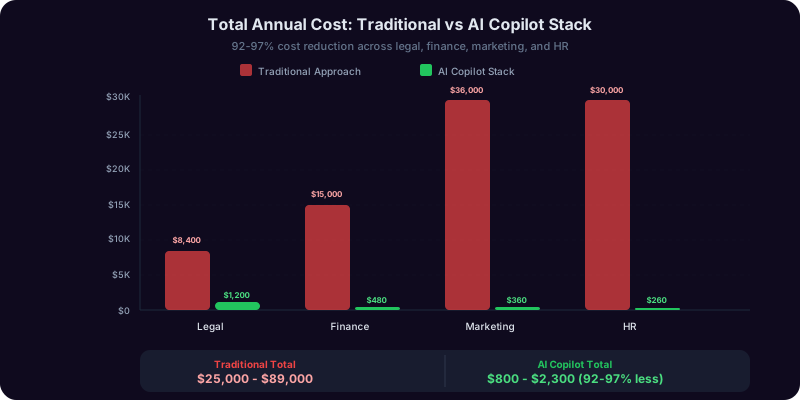
Even at the conservative end, a solopreneur saves over $24,000 per year by using AI copilots for routine professional tasks. For a business generating $100,000 in revenue, that represents a 24% improvement in margins. A McKinsey report on the state of AI found that small businesses adopting AI tools saw productivity gains of 20-40% across administrative functions. For a $200,000 business, it is still a 12% margin improvement -- enough to fund a significant equipment upgrade, a month of travel, or accelerated retirement savings.
But what about the time savings? Cost is only half the equation. The time you previously spent coordinating with outside professionals -- scheduling calls with your lawyer, gathering documents for your accountant, briefing your marketing consultant -- disappears when your AI copilots are available 24/7 and already have context on your business.
Estimated time savings per week:
- Contract review and legal questions: 2-3 hours saved per week
- Financial tracking and tax planning: 1-2 hours saved per week
- Marketing strategy and content planning: 3-5 hours saved per week
- HR and hiring tasks: 1-2 hours saved per week (when actively hiring)
- Total: 7-12 hours per week redirected to revenue-generating work
At a billing rate of $100/hour, those 7-12 reclaimed hours represent $36,400 - $62,400 in additional annual revenue capacity. Combined with the direct cost savings, the total economic impact of an AI copilot stack for a solopreneur ranges from $60,000 to $150,000 per year in savings and additional revenue potential.
The compounding effect. These savings and time reclamation compound over time. The solopreneur who saves $30,000 and reclaims 10 hours per week in year one can invest that capital and time into growth -- better tools, a stronger portfolio, higher-value clients -- creating an upward spiral that accelerates with each passing quarter. This is why the gap between AI-enabled solopreneurs and those relying on traditional methods is widening rapidly.
Real-World Workflows: A Week in the Life of an AI-Powered Solopreneur
Theory is useful, but seeing how these tools work in practice makes the value concrete. Here is a realistic week for a freelance web developer running a one-person business with AI copilots as their virtual team.
Monday: New client inquiry and contract review. A potential client sends a project brief and their standard vendor agreement. The solopreneur pastes the 12-page contract into the Legal Copilot, which flags three issues in under two minutes: an IP assignment clause that transfers ownership of pre-existing code libraries, a 90-day payment term, and a non-compete that would prevent working with any company in the client's industry for six months. The copilot drafts redline suggestions for each clause. Total time: 15 minutes instead of a $750 lawyer consultation. For more on this process, see our guide on how to read and negotiate contracts.
Tuesday: Quarterly tax estimate and expense review. Q2 estimated taxes are due in two weeks. The solopreneur asks the Finance Copilot to calculate the payment based on year-to-date income of $52,000 against last year's total of $118,000. The copilot recommends a $6,200 estimated payment, flags $1,400 in uncategorized expenses that are likely deductible (a new monitor, two online courses, and conference travel), and reminds the solopreneur to make a Solo 401(k) contribution before the deadline. Total time: 20 minutes instead of a $300 accountant consultation.
Wednesday: Content marketing execution. The Marketing Copilot's quarterly plan calls for a case study this week. The solopreneur provides bullet points from a recent e-commerce project that increased the client's conversion rate by 23%. The copilot structures these into a case study outline with a compelling headline, problem-solution-result format, specific metrics, and a call to action. The solopreneur writes the draft in their own voice using the outline, then runs it back through the copilot for SEO optimization. The copilot suggests three internal links, a stronger meta description, and two additional sections that would target related long-tail keywords. Total time: 90 minutes for a piece that would cost $800-$1,200 from a content agency.
Thursday: Hiring a subcontractor. A project requires illustration work outside the solopreneur's skill set. The Career Copilot generates a job posting for a freelance illustrator, including scope, budget range, portfolio requirements, and three screening questions. After posting to two platforms and receiving 30 applications by end of day, the copilot's scoring rubric helps narrow the field to five candidates based on style match, experience with similar projects, and rate alignment. Total time: 45 minutes instead of 4-5 hours of manual screening.
Friday: Strategic planning and client communication. The solopreneur uses the Finance Copilot to review monthly revenue trends and project Q3 income based on current pipeline. The Marketing Copilot analyzes which content pieces drove the most qualified leads in the past 90 days and recommends doubling down on comparison-style posts. The Legal Copilot generates a scope change addendum for an existing client who wants additional features. Three professional-grade business functions handled in one afternoon.
Weekly time investment vs. pre-AI approach:
| Task | Without AI Copilots | With AI Copilots |
| Contract review | 2-3 hours + $750 lawyer fee | 15 minutes |
| Tax estimate and expense review | 1-2 hours + $300 accountant fee | 20 minutes |
| Case study creation | 4-6 hours or $1,000 agency fee | 90 minutes |
| Subcontractor hiring | 6-8 hours | 45 minutes |
| Strategic planning | 3-4 hours | 60 minutes |
| Total | 16-23 hours + $2,050 in fees | 3.5 hours + $0 in fees |
This is not a best-case scenario. This is a typical week. The consistency of these savings -- week after week, month after month -- is what transforms a solopreneur's business economics.
Building Your AI Copilot Stack: A Step-by-Step Implementation Guide
You do not need to adopt every AI copilot at once. The most effective approach is to start with the function that causes you the most pain or costs you the most money, build confidence and workflows around it, then expand. Here is a phased implementation plan.
Phase 1 (Week 1-2): Start with your biggest pain point. For most solopreneurs, this is either legal (you have been signing contracts without review) or finance (your bookkeeping is a mess and tax season is stressful). Pick one and commit to using the AI copilot for every relevant task for two weeks. If you choose legal, run every contract, agreement, and terms of service through the Legal Copilot before signing. If you choose finance, use the Finance Copilot to categorize every expense and calculate your current effective tax rate.
Phase 2 (Week 3-4): Add marketing. Once your first copilot is a natural part of your workflow, add the Marketing Copilot. Start with a content audit: feed it your existing website, blog posts, and social media profiles. Let it identify gaps, suggest a content calendar for the next quarter, and help you create your first AI-assisted piece of content. This phase is about building the habit of consulting the copilot before making marketing decisions.
Phase 3 (Month 2): Add HR and operations. With legal, finance, and marketing running smoothly, bring in the Career Copilot for any hiring or team management tasks. Use it to create SOPs for your most repetitive processes. Document your client onboarding workflow, your project delivery checklist, and your invoicing process. These documents become the foundation for scaling -- whether that means hiring a VA, bringing on a partner, or simply running more efficiently as a solo operation.
Phase 4 (Month 3+): Cross-functional integration. The real power emerges when your copilots work together across functions. A contract review (legal) informs your revenue projection (finance), which shapes your capacity for new work (operations), which determines your marketing investment (marketing). Train yourself to consult the relevant copilot at each decision point rather than making gut-feel choices.
Best practices for maximizing AI copilot effectiveness:
- Be specific with context. The more details you provide about your business, industry, and situation, the more relevant and actionable the copilot's output. "Review this contract" is less useful than "Review this contract for a $15,000 web development project with a mid-size e-commerce company. I am concerned about IP ownership and payment terms."
- Build on previous conversations. AI copilots that maintain context across sessions become more valuable over time as they learn your business patterns, preferences, and recurring needs.
- Verify high-stakes outputs. Use AI copilots as a first pass, not a final word. For contracts over $25,000, have a human lawyer review the AI's suggestions. For tax strategies that could save more than $5,000, confirm with a CPA. The copilot's job is to do 80% of the work so the professional's job takes 20% of the time and cost.
- Create templates from great outputs. When a copilot generates a particularly good contract clause, email template, or process document, save it as a template for future use. Your library of AI-refined templates becomes a valuable business asset.
- Schedule regular reviews. Set a monthly calendar reminder to review your AI copilot usage. Which functions are you using most? Which are you neglecting? Are there new capabilities you have not explored? For guidance on using AI effectively for professional decisions, see our guide to getting a professional second opinion.
The solopreneur who systematically builds their AI copilot stack over 90 days ends up with a virtual team that handles legal, financial, marketing, and operational tasks at a level that would have required $50,000-$80,000 in annual professional services just two years ago. That is the real promise of AI for independent businesses -- not replacing human judgment, but making expert-level support accessible to everyone who builds something on their own.
Frequently Asked Questions
Recommended Copilots
Recommended Copilots
Review contracts, draft NDAs, and handle compliance checks without paying lawyer hourly rates
Try Free →Track deductions, calculate quarterly taxes, and forecast cash flow for your solo business
Try Free →Build content strategy, optimize SEO, and plan email campaigns that drive qualified leads
Try Free →Write job descriptions, screen candidates, and manage the hiring process for contractors
Try Free →Related Articles
Get Answers From the Legal Copilot
Tell the Legal Copilot about your next contract, ask the Finance Copilot to review your deductions, or let the Marketing Copilot plan your content strategy. Start with the function that costs you the most time and money.