

Do You Owe Taxes on Side Income?
The short answer: if you earned $400 or more in net self-employment income during the tax year, you owe taxes on it. This threshold applies to your total profit after expenses, not your gross revenue. It does not matter whether you received a 1099 form or not. The IRS considers all income taxable, whether it came from driving for Uber, selling on Etsy, freelance writing, tutoring, or renting out a spare room.
A common misconception is that platforms only report income above $600 to the IRS, so anything below that is tax-free. That is wrong. The $600 threshold (via Form 1099-K or 1099-NEC) is the reporting requirement for the platform, not for you. You are legally required to report every dollar of income regardless of whether anyone sends you a tax form.
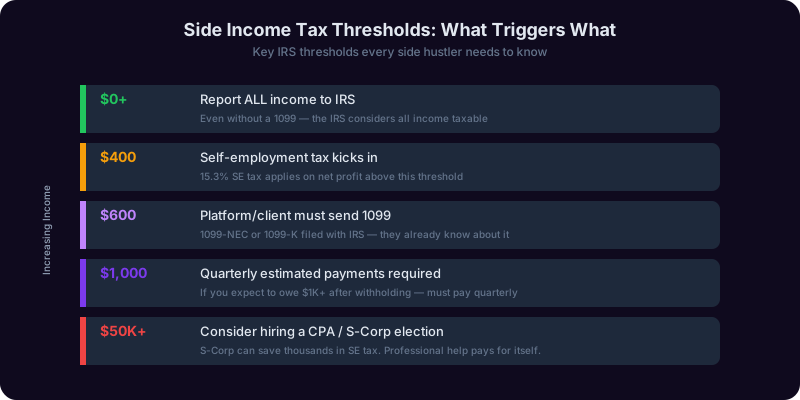
Here is how it breaks down for 2026:
- Under $400 net profit: You still report the income on your tax return, but you do not owe self-employment tax on it. You may still owe regular income tax depending on your total income.
- $400 to $600: You owe self-employment tax. You may or may not receive a 1099 from the payer.
- Over $600: You will almost certainly receive a 1099-NEC or 1099-K. The IRS receives a copy too, so they already know about this income.
If you have a W-2 job and a side hustle, your side income gets added on top of your regular wages. This means it is taxed at your marginal tax rate, which is the rate on your highest dollars of income. For someone earning $60,000 at a day job, side hustle income falls into the 22% federal bracket. Add self-employment tax on top of that, and you could be looking at an effective rate of 35-37% on your side income. To understand exactly how this shows up on your paycheck, check out our guide to reading your pay stub.
The key takeaway: the IRS treats side hustle income the same as any other income. Ignoring it does not make it go away. It makes it worse, because penalties and interest start accumulating the moment you miss a payment deadline.
This is general information, not financial advice. Consult a tax professional for guidance specific to your situation.
See our real-world walkthrough: first freelance tax season.
Self-Employment Tax Explained
Self-employment tax is the part that surprises most new side hustlers. When you work a W-2 job, your employer pays half of your Social Security and Medicare taxes (called FICA). When you are self-employed, you pay both halves.
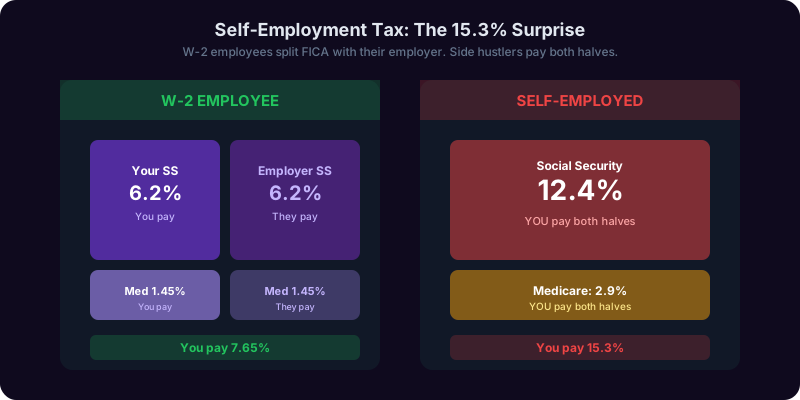
For 2026, the self-employment tax rate is 15.3% on your net earnings:
- 12.4% for Social Security (on the first $168,600 of combined wages and self-employment income)
- 2.9% for Medicare (no income cap)
If your combined income from all sources exceeds $200,000 (single) or $250,000 (married filing jointly), you also owe an additional 0.9% Medicare surtax on the excess. For details on these thresholds, see the IRS self-employment tax guide.
Here is what that looks like in real numbers. If your side hustle generated $20,000 in net profit:
| Social Security portion | $20,000 x 12.4% = $2,480 |
| Medicare portion | $20,000 x 2.9% = $580 |
| Total SE tax | $3,060 |
That $3,060 is in addition to your regular federal and state income tax on that same $20,000. This is why side hustlers are often shocked by their first tax bill.
The silver lining: you can deduct half of your self-employment tax when calculating your adjusted gross income. In the example above, you would deduct $1,530, which reduces the income tax you owe (though not the SE tax itself). This deduction is taken on Schedule 1 of your Form 1040 and does not require itemizing.
Self-employment tax is calculated on Schedule SE, which you file alongside your regular tax return. Your side hustle income itself is reported on Schedule C (Profit or Loss from Business), where you also claim your business deductions.
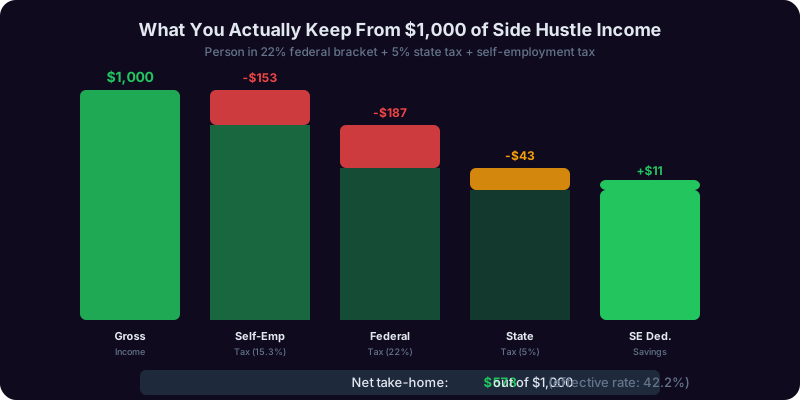
Understanding this tax is critical because it changes your break-even math. A side hustle that earns $1,000 does not put $1,000 in your pocket after taxes. For someone in the 22% federal bracket with a 5% state tax rate, that $1,000 becomes roughly $578 after all taxes.
Quarterly Estimated Payments
The IRS operates on a pay-as-you-go system. When you have a W-2 job, taxes are withheld from every paycheck. With side hustle income, there is no automatic withholding, so you are expected to make quarterly estimated tax payments yourself.
You are required to make quarterly payments if you expect to owe $1,000 or more in tax for the year after subtracting withholding and credits. For most people with meaningful side income, this threshold is reached quickly.
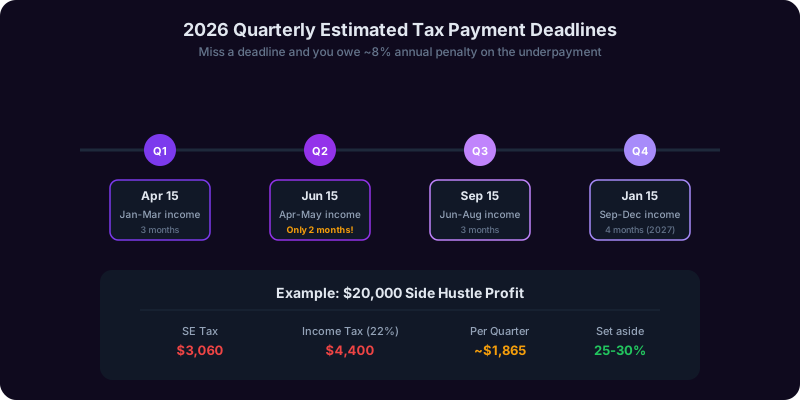
The 2026 quarterly deadlines are:
| Q1 (Jan-Mar) | April 15, 2026 |
| Q2 (Apr-May) | June 15, 2026 |
| Q3 (Jun-Aug) | September 15, 2026 |
| Q4 (Sep-Dec) | January 15, 2027 |
Notice the quarters are not evenly split. Q2 covers only two months, while Q3 and Q4 each cover more. Mark these dates in your calendar because missing them triggers an underpayment penalty, currently calculated at roughly 8% annually on the underpaid amount.
There are two safe harbor methods to avoid penalties:
- Pay 100% of last year's tax liability (110% if your AGI exceeded $150,000). Even if you owe more this year, you avoid the penalty.
- Pay 90% of this year's actual tax liability. This requires estimating your annual income accurately.
The simplest approach for most side hustlers: set aside 25-30% of every payment you receive in a separate savings account. Then use that account to make quarterly payments. This prevents the common problem of spending the money and having nothing left when the tax bill arrives.
You make payments using Form 1040-ES vouchers or through IRS Direct Pay. The IRS also accepts payments through the Electronic Federal Tax Payment System (EFTPS). For state taxes, check your state's department of revenue website, as most states with income tax also require quarterly estimated payments.
If your side income is irregular, you can use the annualized installment method (Form 2210, Schedule AI) to pay based on income actually earned each quarter rather than spreading it evenly.

Get Answers From the Tax Copilot
The Tax Copilot calculates your estimated quarterly payments, identifies deductions you're missing, and walks you through Schedule C -- no CPA needed for straightforward side income.
Deductions You Can Claim
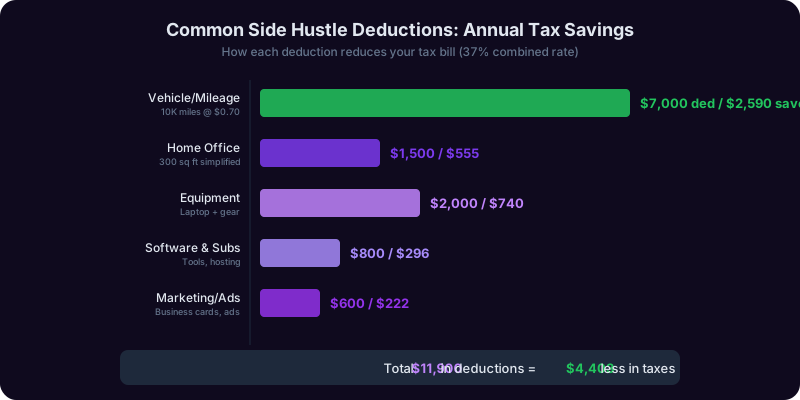
Every legitimate business expense reduces your taxable income, which reduces both your income tax and your self-employment tax. The key word is ordinary and necessary for your specific side hustle. Here are the most common deductions side hustlers miss:
Home Office Deduction
If you use a dedicated space in your home regularly and exclusively for your side hustle, you can deduct it. The simplified method allows $5 per square foot, up to 300 square feet ($1,500 max). The regular method calculates the actual percentage of your home used for business and applies it to rent, mortgage interest, utilities, insurance, and repairs.
Vehicle and Mileage
For rideshare drivers, delivery workers, and anyone who drives for business, this is often the largest deduction. The 2026 standard mileage rate is $0.70 per mile. If you drove 10,000 business miles, that is a $7,000 deduction. You must keep a mileage log with the date, destination, purpose, and miles for each trip.
Supplies and Equipment
Anything you buy specifically for your side hustle: a laptop for freelancing, a camera for photography, craft supplies for Etsy, cleaning supplies for a cleaning business. Items under $2,500 can be expensed immediately under the de minimis safe harbor election. Larger purchases may need to be depreciated or expensed under Section 179.
Software and Subscriptions
Adobe Creative Suite, accounting software, website hosting, domain names, project management tools, industry-specific subscriptions. If you use it for business, it is deductible. If you use it for both personal and business, only the business percentage is deductible.
Marketing and Advertising
Business cards, website costs, social media advertising, flyers, portfolio hosting fees. These are fully deductible in the year you pay them.
Professional Services
Tax preparation fees (the portion related to your Schedule C), legal consultations, bookkeeping services, and professional coaching or mentoring related to your business. For a comprehensive list, see our complete freelancer tax deductions guide.
Track every expense from day one. The Bookkeeping Copilot can help you categorize expenses correctly and identify deductions you might be overlooking. A missed deduction is money left on the table.
Record-Keeping Requirements
The IRS can audit your tax return for up to three years from the filing date (six years if they suspect significant underreporting). That means you need to keep records for at least that long. Good records do more than protect you in an audit. They also make filing easier, help you claim every deduction, and give you a clear picture of whether your side hustle is actually profitable.
What Records to Keep
- Income records: 1099 forms, payment receipts, bank statements showing deposits, invoices you sent, PayPal/Venmo/Stripe transaction records
- Expense receipts: Every business purchase, no matter how small. Digital photos of paper receipts are acceptable. The IRS requires receipts for any expense over $75, but best practice is to keep them all.
- Mileage log: Date, starting location, destination, purpose, and miles driven. Apps like MileIQ or Everlance automate this.
- Home office records: Square footage of your office, total square footage of your home, utility bills, rent or mortgage statements
- Bank and credit card statements: Keep statements for any account used for business transactions
- Asset records: Purchase receipts, dates placed in service, and depreciation schedules for equipment, vehicles, and other business assets
How to Organize
The simplest system: open a separate bank account for your side hustle. Run all business income and expenses through it. This creates an automatic paper trail and makes it easy to separate business from personal transactions. Many online banks offer free business checking accounts with no minimum balance.
For expense tracking, use a dedicated app or spreadsheet. Record each expense with the date, amount, vendor, category, and business purpose. Do this weekly at minimum. Trying to reconstruct a year of expenses at tax time is how deductions get missed and mistakes get made.
The Freelance Copilot can help you set up a record-keeping system tailored to your specific side hustle, so you are not guessing about what to track or how to organize it.
Common Mistakes That Cost Side Hustlers Money
After working with thousands of side hustlers, these are the mistakes that come up repeatedly. Each one is avoidable with basic planning.
1. Not Setting Money Aside for Taxes
This is the number one mistake. You receive a $2,000 payment from a client, spend it all, and then owe $600-$700 in taxes you do not have. The fix is simple: transfer 25-30% of every payment into a separate savings account the day you receive it. Treat it like money that was never yours. Having a solid emergency fund also helps you avoid dipping into your tax savings when unexpected expenses arise.
2. Mixing Personal and Business Finances
Using one bank account and one credit card for everything makes it nearly impossible to accurately track business expenses. It also raises red flags in an audit because the IRS has to take your word for which transactions were business-related. A separate bank account costs nothing and solves this problem completely.
3. Forgetting About State Taxes
Federal taxes get all the attention, but 41 states plus Washington D.C. have income taxes. Some cities (New York City, for example) have their own income tax on top of that. Your side hustle income is subject to state and local taxes wherever you live, and potentially in states where you perform work or have clients. Research your state's requirements for estimated payments, as thresholds and deadlines vary.
4. Calling It a Hobby to Avoid Taxes
Some people claim their side hustle is "just a hobby" to avoid reporting income. The IRS has a specific test for this. If you engage in the activity with the intent to make a profit, it is a business. Factors include whether you keep records, whether you depend on the income, and whether you have made a profit in at least 3 of the last 5 years. Calling a business a hobby does not change the tax obligation. It just means you lose the ability to deduct your expenses.
5. Missing the Quarterly Deadlines
The underpayment penalty is calculated on each missed quarter individually. Even if you pay everything in full on April 15, you can still owe penalties for the earlier quarters you missed. Set calendar reminders for all four quarterly deadlines and pay on time.
6. Not Knowing Your Credit Score Impact
While side hustle income itself does not directly affect your credit score, tax liens from unpaid IRS debt and increased credit utilization from business expenses can hurt it significantly. Understanding what makes a good credit score helps you protect your financial health while growing your side business.
Tools and Resources for Managing Side Hustle Taxes
You do not need to be a tax expert to manage side hustle taxes correctly. The right tools make the process straightforward.
Free IRS Resources
- IRS Free File: If your AGI is under $84,000, you can file federal taxes for free through IRS-partnered software
- IRS Direct Pay: Make quarterly estimated payments directly from your bank account at no cost
- EFTPS (Electronic Federal Tax Payment System): Schedule payments in advance so you never miss a deadline
- IRS Tax Withholding Estimator: Calculate whether your W-2 withholding plus estimated payments will cover your total tax bill
Expense Tracking
- Wave: Free accounting software designed for small businesses and freelancers. Handles invoicing, expense tracking, and basic reports.
- QuickBooks Self-Employed: $15/month. Separates business and personal expenses, tracks mileage, and estimates quarterly taxes automatically.
- Spreadsheet method: A simple Google Sheet with columns for date, description, category, amount, and receipt link works fine if your volume is low.
Mileage Tracking
- MileIQ: Automatically detects and logs drives. Free tier covers 40 drives per month.
- Everlance: Combines mileage tracking with expense tracking. Free tier available.
Tax Filing
- TurboTax Self-Employed: Walks you through Schedule C, SE, and quarterly estimates. Roughly $120-$200 depending on state filing.
- FreeTaxUSA: Federal filing is free (including Schedule C). State filing is $14.99. Significantly cheaper than TurboTax with comparable functionality for straightforward returns.
For real-time guidance on categorizing expenses, understanding deductions, or calculating your estimated quarterly payments, the Tax Copilot is available 24/7 to answer your specific questions and walk you through calculations based on your actual numbers. If you are also thinking about investing your side hustle profits, our guide on how to start investing with $100 is a great next step.
When to Hire an Accountant
Many side hustlers can handle their own taxes with the right tools and education. But there are clear situations where hiring a professional pays for itself.
Hire an Accountant If:
- Your side hustle earns over $50,000/year. At this income level, the complexity increases and the cost of mistakes grows. An accountant typically costs $300-$800 for a Schedule C return but can easily save you more than that in missed deductions and avoided penalties.
- You have multiple income streams. A W-2 job plus two or three side hustles, rental income, or investment income creates interactions between tax rules that are easy to get wrong.
- You are considering an LLC or S-Corp election. Once you are consistently earning over $40,000-$50,000 from self-employment, an S-Corp election can save thousands in self-employment tax. But the paperwork, payroll requirements, and compliance costs mean you need professional guidance to determine if the savings outweigh the costs.
- You received an IRS notice or audit letter. Do not respond to the IRS without professional help. An enrolled agent or CPA who specializes in tax resolution can often reduce or eliminate penalties and negotiate payment plans.
- You have international income or clients. Foreign income reporting (FBAR, Form 8938) has severe penalties for non-compliance, including fines starting at $10,000 per form. This is not DIY territory.
What to Look For
Look for a CPA or Enrolled Agent (EA) with experience in self-employment and small business taxes. Ask specifically about their experience with Schedule C filers. Avoid tax preparers who charge based on the size of your refund, as this creates an incentive to be aggressive with deductions.
A good middle ground: handle your own quarterly estimated payments and bookkeeping throughout the year (using tools like the Bookkeeping Copilot for guidance), then hire an accountant to prepare your annual return. This keeps costs down while ensuring your filed return is professionally prepared.
If you are also looking for ways to set the right rates for your side work, our freelance rate calculator guide walks through exactly how to factor taxes into your pricing. And if your side hustle is growing to the point where you might leave your day job, planning your tax transition is critical.
This is general information, not financial advice. Consult a qualified tax professional for guidance specific to your situation.
For more on this topic, read our guide on Freelancer Tax Deductions: The Complete List You're Probably Missing.
Frequently Asked Questions
Recommended Copilots
Recommended Copilots
Calculate your self-employment tax, quarterly payments, and deductions
Try Free →Set up a bookkeeping system to track income and expenses for tax time
Try Free →Get a complete financial plan that accounts for your side hustle income
Try Free →Continue Exploring
Related Scenarios
For You
How It Works
Related Articles
Get Answers From the Tax Copilot
The Tax Copilot calculates your estimated quarterly payments, identifies deductions you're missing, and walks you through Schedule C -- no CPA needed for straightforward side income.