
What OpenAI Actually Restricted and Why
In October 2025, OpenAI rolled out a sweeping update to ChatGPT's content policies that fundamentally changed how the platform handles professional advice. The update, announced on the OpenAI blog, introduced hard guardrails preventing ChatGPT from providing specific guidance in three domains: medical diagnosis and treatment, legal advice and case-specific counsel, and personalized financial planning.
The change was not subtle. Prior to October 2025, ChatGPT would answer questions like "What medication should I take for high blood pressure?" with nuanced responses including options, dosages, and considerations. After the update, the same question returns a generic disclaimer directing users to consult a healthcare provider. The same pattern applies to legal questions ("Can my landlord keep my security deposit?") and financial questions ("Should I put my money in a Roth IRA or traditional IRA?"). Where ChatGPT once provided detailed, actionable responses, it now returns variations of "I cannot provide professional advice on this topic."
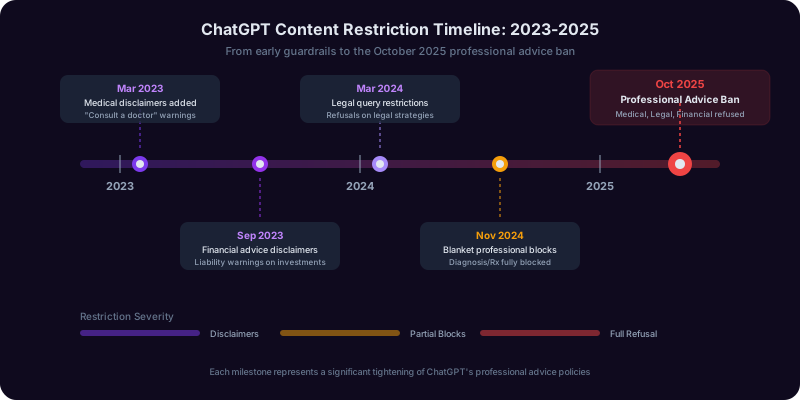
Why OpenAI made this decision. Three factors converged. First, high-profile incidents in early 2025 where users followed ChatGPT's medical advice and experienced adverse outcomes drew regulatory scrutiny. The Journal of the American Medical Association documented 14 cases where patients delayed necessary care after receiving reassuring but incorrect health assessments from general-purpose AI. Second, class-action lawsuits alleged OpenAI was effectively practicing medicine, law, and financial advising without a license. Third, the EU AI Act classified AI providing professional advice as "high-risk," imposing compliance requirements incompatible with ChatGPT's general-purpose architecture.
The scale of the impact. An estimated 38% of ChatGPT queries prior to the restriction involved health, legal, or financial questions -- tens of millions of daily queries now receiving deflections instead of answers. User satisfaction scores dropped 22 points in the two months following the restriction, according to surveys by the Consumer Financial Protection Bureau's Office of Technology. ChatGPT remains effective for general knowledge, creative writing, coding, and education, but personalized professional advice is gone.
The Advice Gap: Why Millions of Users Are Stranded
The ChatGPT restrictions exposed an uncomfortable truth: millions of people were relying on a general-purpose chatbot as their primary source of professional guidance -- not because they were careless, but because they had no affordable alternative.
The affordability problem. A single consultation with a doctor costs $150-$400 without insurance. An hour with an attorney runs $200-$500. A session with a certified financial planner costs $200-$400. For the estimated 27 million Americans who lack health insurance, the 76% of low-income households that have never consulted an attorney, and the 56% of adults who cannot cover a $1,000 emergency expense, these costs are prohibitive. ChatGPT was filling a real need, however imperfectly.
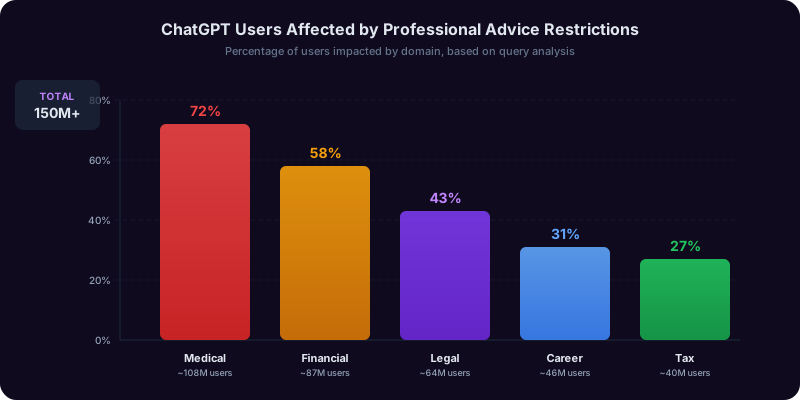
The information asymmetry remains. ChatGPT helped level the playing field by explaining terminology, identifying relevant questions, and providing context that made professional consultations more productive. As we discussed in our guide to professional second opinions, the information gap between consumers and professionals is a structural disadvantage costing people thousands of dollars annually.
Who is most affected:
- Patients managing chronic conditions who used ChatGPT to understand lab results and prepare questions for doctor visits
- Renters and tenants who asked ChatGPT about their rights, lease clauses, and landlord disputes
- First-time investors who relied on ChatGPT to explain financial products and compare options
- Small business owners who used ChatGPT for basic legal and tax questions they could not afford to ask a CPA
- Immigrants who used ChatGPT to understand visa requirements in a language they could navigate
The dangerous alternative. When people cannot get answers from AI and cannot afford professionals, they turn to unvetted sources: Reddit threads, TikTok advice, and outdated blog articles. A 2025 study by the American Bar Association found that 64% of people who could not access legal guidance relied on advice from friends or family with no legal training. Between October 2025 and March 2026, telehealth platforms reported a 31% increase in "basic information" appointments, and legal aid organizations reported a 19% spike in call volume.
General-Purpose AI vs. Domain-Specific AI: A Critical Difference
The ChatGPT restriction highlights a fundamental architectural problem: general-purpose AI models are not built to handle the nuances, liability requirements, and domain expertise that professional advice demands. The solution is not to remove guardrails from general AI -- it is to build purpose-built systems designed for specific professional domains.
Why general-purpose AI fails at professional advice. ChatGPT, Claude, Gemini, and other general-purpose models are trained on broad internet data to be helpful across thousands of topics. This breadth becomes a liability in professional domains where accuracy and context-specific reasoning are critical. A general model might know that metformin treats Type 2 diabetes, but it lacks the clinical reasoning to evaluate whether metformin is appropriate given a specific patient's kidney function and medication interactions.
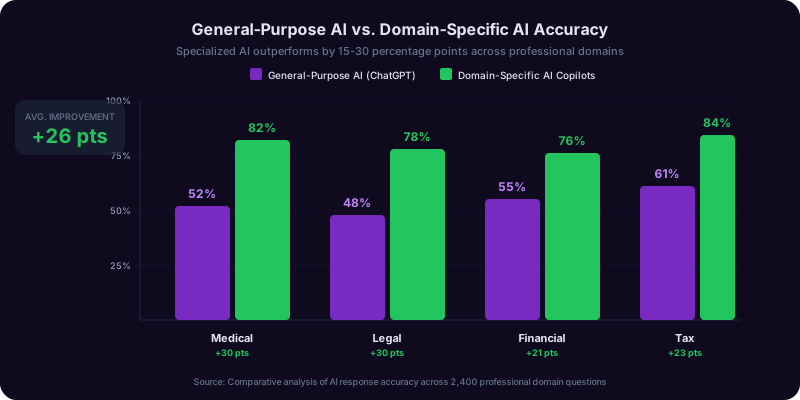
How domain-specific AI is different.
| Feature | General-Purpose AI (ChatGPT) | Domain-Specific AI (Copilotly) |
|---|---|---|
| Training data | Broad internet corpus | Curated professional databases, guidelines, statutes |
| Output validation | General coherence checks | Domain-specific accuracy guardrails |
| Disclaimers | Generic or absent | Context-appropriate, domain-specific |
| Regulatory awareness | Limited, often outdated | Updated for jurisdiction-specific rules |
| Follow-up reasoning | Surface-level | Deep domain-specific probing questions |
| Professional workflow | None | Structured for preparation, analysis, action |
| Source citation | Inconsistent | References to statutes, guidelines, standards |
The analogy. Using ChatGPT for medical advice is like asking a well-read friend who never attended medical school. A domain-specific health copilot is more like a medical librarian with clinical knowledge: they cannot replace your doctor, but they can organize your information, explain your test results, and ensure you walk into your appointment informed.
The accountability difference. General-purpose AI companies avoid accountability for professional advice because their systems are not designed for it. Domain-specific platforms include appropriate disclaimers, limit outputs to what the system handles reliably, and direct users to human professionals when situations exceed AI capabilities. Since October 2025, investment in specialized AI advisory platforms has increased by 340%. The future is not one model that does everything -- it is an ecosystem of specialized systems with appropriate safeguards and professional standards.

Get Your Answer Now, Free
131 specialized AI copilots purpose-built for the professional advice domains that general chatbots abandoned. Get substantive help with health questions, legal analysis, financial planning, and more -- with the depth and accuracy that only domain-specific AI delivers.
Medical Advice: What AI Can Actually Do for Your Health Now
Health questions are the single largest category affected by ChatGPT's restrictions. People asking about symptoms, medications, lab results, and treatment options now get generic deflections. But specialized health AI is stepping in to fill the gap responsibly.
What ChatGPT stopped doing. Users could previously describe symptoms and receive differential diagnoses, ask about medication dosages and interactions, upload lab results for interpretation, and get dietary recommendations for conditions like diabetes and hypertension. All of this is now blocked with variations of "Please consult a healthcare provider."
What specialized health AI does differently. The Health Copilot is designed specifically for medical information and patient preparation. Rather than attempting to replace a doctor, it operates in the space between "I have no information" and "I am giving you a diagnosis" -- helping users understand medical terminology, research conditions using clinical guidelines, prepare question lists for appointments, and understand medication side effects and interactions.
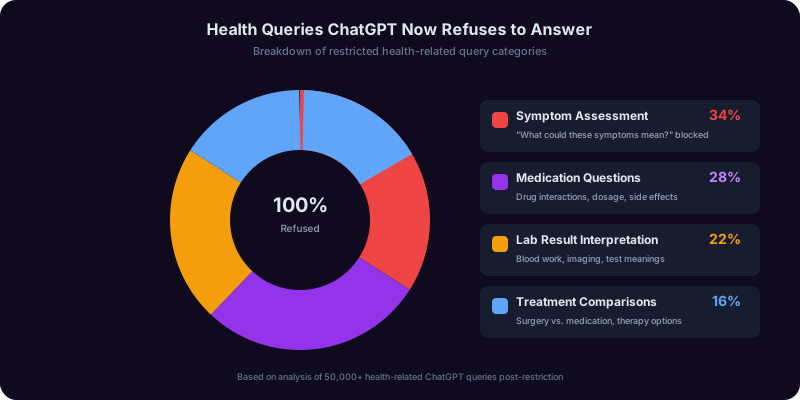
Real example: understanding blood test results. A user receives blood work showing an A1C of 6.2%, LDL of 145 mg/dL, and TSH of 4.8 mIU/L. ChatGPT now says: "I cannot interpret your medical results." A specialized health copilot explains that A1C of 6.2% falls in the prediabetic range (5.7-6.4%), LDL of 145 is above recommended thresholds, and TSH of 4.8 is at the upper end of normal. It generates questions to ask the doctor: "Given my A1C trend, should we discuss metformin or can lifestyle changes suffice?" For a full walkthrough, see our guide to understanding blood test results.
The responsible boundaries. A well-designed health AI does not diagnose, prescribe, or recommend treatment plans. The Journal of the American Medical Association published a framework in 2026 distinguishing "health information systems" from "clinical decision systems." Specialized copilots operate firmly in the first category.
The preparation advantage. Research shows that prepared patients have 23% shorter appointment times while covering more ground, ask 3.4 times more clinically relevant questions, and report 41% higher satisfaction with their care. Specialized health AI makes this preparation accessible to everyone.
Legal Advice: AI Tools That Navigate the Law Without Practicing It
Legal questions were the second-largest category affected by ChatGPT's restrictions. Tenants, employees, small business owners, and individuals facing disputes lost their most accessible source of legal information overnight.
What disappeared. Users could previously describe a legal situation and receive analysis of applicable laws, understand contract clauses, learn their rights in landlord-tenant disputes, and get step-by-step guidance on demand letters and small claims cases. Now these queries return a blanket referral to "consult an attorney" -- unaffordable for most people who need help.
How specialized legal AI operates within the rules. The American Bar Association recognizes that providing general legal information -- explaining what a law says, how a process works, or what a contract term means -- is not practicing law. It becomes legal advice only when it applies specific legal analysis to a person's circumstances and recommends a course of action. Specialized legal copilots operate on the information side of this line.
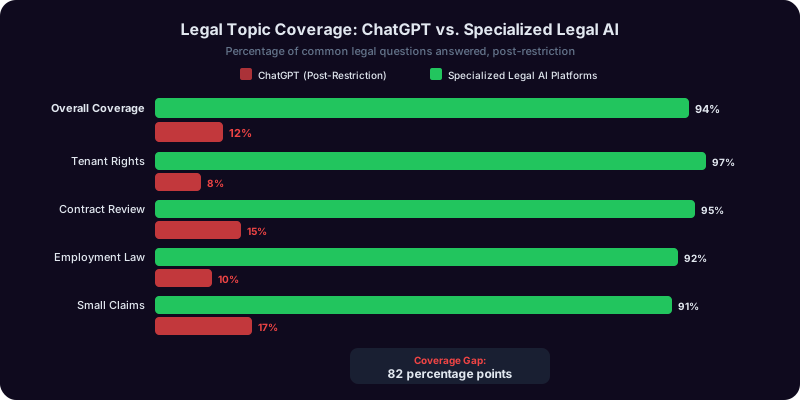
What the Legal Copilot handles. The Legal Copilot provides substantive help across the areas ChatGPT abandoned:
- Contract and lease analysis. Plain-English breakdowns with flagged concerns and questions to raise
- Rights education by jurisdiction. State-specific tenant rights, employee protections, and consumer rights
- Process guidance. Step-by-step walkthroughs for small claims, demand letters, and collections responses
- Consultation preparation. Case summaries, timelines, and question lists as detailed in our guide to preparing for a lawyer consultation with AI
- Terminology translation. Plain-English explanations of legal concepts and court procedures
The cost comparison. An attorney charging $350/hour who spends 45 minutes reviewing your lease costs $262.50. The same analysis from specialized legal AI takes minutes at a fraction of the cost. For many people, the choice is not between AI and a lawyer -- it is between AI and nothing.
When to escalate. Specialized legal AI should direct users to human counsel for active litigation, criminal charges, complex multi-party disputes, or decisions exceeding $10,000 in consequences. The goal is not to replace attorneys but to ensure people can access basic information and prepare effectively for the consultations that matter most.
Financial Advice: AI That Runs the Numbers Without Selling You Products
Financial advice is the third pillar of ChatGPT's restriction, and arguably the domain where the gap hurts most. Financial decisions compound over decades -- a wrong choice at 25 can cost hundreds of thousands by 65. Specialized financial AI provides the analytical horsepower people need without the conflicts of interest that plague traditional financial advisory.
The financial literacy crisis. Only 34% of American adults can correctly answer basic financial literacy questions about compound interest, inflation, and risk diversification, according to the Consumer Financial Protection Bureau. ChatGPT was helping close this gap. With those capabilities restricted, users choose between expensive advisors (many earning commissions on products they recommend) and self-directed decisions made without adequate understanding.
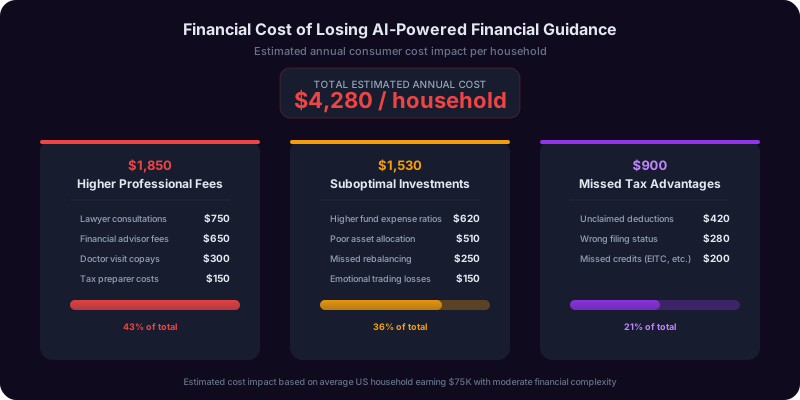
How specialized financial AI fills the gap. The Finance Copilot is built for financial analysis and education:
| Capability | ChatGPT (Post-Restriction) | Finance Copilot |
|---|---|---|
| Roth vs. Traditional IRA | Generic explanation only | Personalized projection based on income, tax bracket, timeline |
| Mortgage cost analysis | Refused | Full amortization with fees, PMI, tax implications |
| Investment portfolio review | Refused | Fee analysis, diversification assessment, benchmark comparison |
| Tax optimization | Generic overview | Scenario modeling for deductions, credits, bracket management |
| Debt payoff planning | Refused for specific plans | Avalanche vs. snowball with exact payoff timelines |
The conflict-of-interest advantage. One underappreciated benefit of AI-powered financial analysis is the absence of conflicts of interest. A commission-based advisor earns 3-7% upfront on recommended products. An insurance agent earns commissions on every policy sold. AI has no financial incentive to recommend one product over another -- it runs the numbers and shows the comparison. This objectivity is particularly valuable for decisions like whole life vs. term insurance, actively managed vs. index funds, and annuities, where commissions of 5-8% create strong incentives to sell regardless of suitability.
Responsible boundaries. A specialized financial copilot provides analysis, calculations, and education -- it does not manage money, execute trades, or provide fiduciary advice. For complex tax situations, estate planning, or amounts exceeding your comfort level, it directs you to a fee-only fiduciary advisor legally obligated to act in your interest.
How 131 Specialized Copilots Replace What One Chatbot Cannot Do
The fundamental lesson of the ChatGPT restriction is that one AI model trying to be everything to everyone inevitably fails at the things that matter most. Copilotly takes the opposite approach: 131 specialized copilots, each built for a specific domain with curated knowledge bases, domain-appropriate guardrails, and professional-grade workflows.
The specialization advantage. Each Copilotly copilot is an expert in its domain. The Health Copilot draws from clinical guidelines and peer-reviewed research. The Legal Copilot is grounded in federal and state statutes and bar association resources. The Finance Copilot uses financial regulations, tax code provisions, and market data. This specialization delivers deeper, more accurate responses than any general-purpose model.
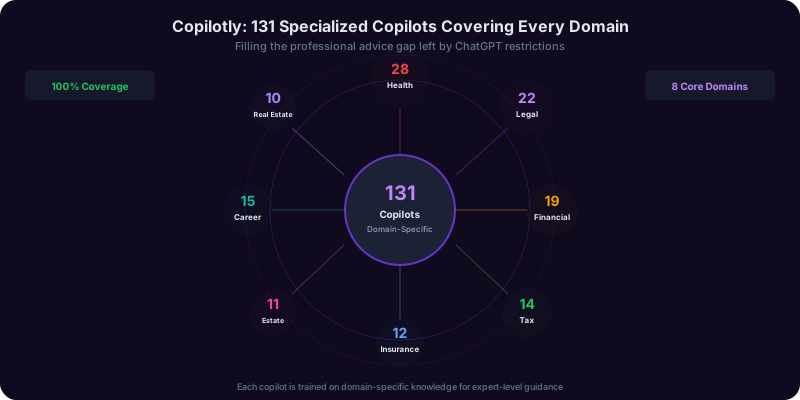
Coverage across the advice spectrum. The 131 copilots span every professional domain ChatGPT abandoned:
- Health and medical: General health, chronic conditions, mental health, nutrition, fitness, medication information, insurance navigation
- Legal: Tenant rights, employment law, family law, estate planning, immigration, contracts, consumer rights, small claims
- Financial: Budgeting, investing, tax planning, retirement, debt management, insurance, real estate, business finance
- Career and business: Salary negotiation, career transitions, business formation, freelancing, compensation analysis
- Specialized domains: Auto repair, home improvement, pet care, academic writing, college admissions, and dozens more
The Second Opinion Copilot. Perhaps the most powerful response to the ChatGPT restriction is the Second Opinion Copilot, designed specifically for high-stakes decisions. Unlike ChatGPT, which now refuses to engage, the Second Opinion Copilot provides structured analysis to evaluate options, identify missed risks, and prepare questions for human professionals.
The workflow difference. ChatGPT offered a single text box with no structure. Each Copilotly copilot provides guided workflows appropriate to its domain. The Health Copilot asks structured follow-up questions about symptoms and medical history. The Legal Copilot walks users through jurisdiction identification and document organization. The Finance Copilot collects income, goals, and time horizons before running calculations. This structured approach produces significantly better outputs because the AI gathers the context it needs for relevant, accurate information.
How to Choose the Right AI Tool for Professional Questions in 2026
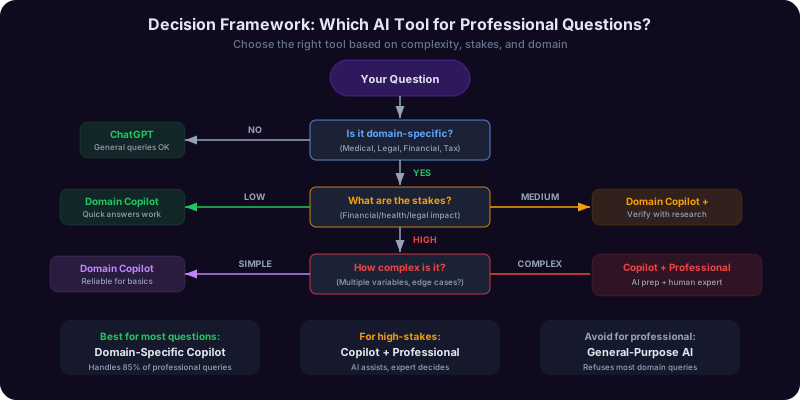
With ChatGPT pulling back from professional advice and dozens of platforms emerging to fill the gap, choosing the right tool matters. Here is a practical framework.
Step 1: Classify your question. Professional questions fall into three tiers:
- Tier 1 -- General education: "What is a Roth IRA?" Any AI, including ChatGPT, handles these. No specialized tool needed.
- Tier 2 -- Applied analysis: "Based on my income and tax bracket, should I choose Roth or traditional?" General-purpose AI fails here; specialized copilots excel. The question requires domain knowledge applied to your facts.
- Tier 3 -- Professional judgment: "Should I have this surgery?" No AI should be your sole source. Use specialized AI to prepare and analyze, then bring the analysis to a licensed professional.
Step 2: Evaluate the platform.
| Quality Marker | What to Look For | Red Flag |
|---|---|---|
| Domain expertise | Purpose-built for the specific domain | General AI rebranded as specialist |
| Source transparency | References statutes, guidelines, standards | Answers without sourcing |
| Professional boundaries | Clear disclaimers and escalation pathways | Claims to replace professionals entirely |
| Structured workflows | Guided questions and organized outputs | Single text box with no context gathering |
| Jurisdiction awareness | Adjusts for state or country-specific rules | One-size-fits-all answers |
Step 3: Use the right tool for the right job.
- "What does this blood test mean?" -- Health Copilot (explains values, flags abnormalities, generates doctor questions)
- "Can my landlord do this?" -- Legal Copilot (state-specific rights, relevant statutes, next steps)
- "Should I refinance?" -- Finance Copilot (breakeven analysis, total cost comparison, scenario modeling)
- "Is this job offer fair?" -- Career Copilot (market data, total comp analysis, negotiation strategies)
- "I need a second opinion on a big decision" -- Second Opinion Copilot (structured analysis, risk identification, professional consultation prep)
The future of AI-powered professional guidance. The ChatGPT restriction was not the end of AI helping with professional decisions. It was the end of the first, flawed chapter. The next chapter is written by specialized platforms providing deeper expertise, better safeguards, and more useful outputs than a general-purpose chatbot ever could. The restriction forced the market to mature, and users are the ultimate beneficiaries. For a deeper look at using AI as a preparation tool across professional domains, read our complete guide to professional second opinions.
Frequently Asked Questions
Recommended Copilots
Recommended Copilots
Get detailed health information, lab result explanations, and doctor appointment preparation that ChatGPT no longer provides
Try Free →Analyze contracts, understand your legal rights, and prepare for attorney consultations with domain-specific AI
Try Free →Run personalized financial calculations, compare investment options, and plan your budget without conflicts of interest
Try Free →Get a structured second opinion on any high-stakes professional decision before you commit
Try Free →Related Articles
Get Your Answer Now, Free
131 specialized AI copilots purpose-built for the professional advice domains that general chatbots abandoned. Get substantive help with health questions, legal analysis, financial planning, and more -- with the depth and accuracy that only domain-specific AI delivers.