
What Is Power of Attorney and Why You Need One
A power of attorney (POA) is a legal document that gives one person - called the agent or attorney-in-fact - the authority to act on behalf of another person, called the principal. The agent can make financial decisions, sign documents, manage property, handle healthcare choices, or conduct business transactions, depending on the type of POA granted.
Here is the uncomfortable reality: if you become incapacitated without a POA in place, your family cannot simply step in and manage your affairs. They would need to petition a court for guardianship or conservatorship - a process that typically takes 3-6 months, costs $3,000-$10,000 in legal fees, and requires a judge to appoint someone to manage your life. During that time, your bills go unpaid, your medical decisions get delayed, and your family faces enormous stress. The Consumer Financial Protection Bureau (CFPB) provides detailed guidance on managing another person's finances and the legal frameworks involved.
Real Scenarios Where a POA Is Essential
- Aging parents: Your 78-year-old mother develops dementia. Without a durable POA already in place, no one can access her bank accounts to pay her mortgage, manage her investments, or sell her home to fund assisted living. By the time she needs help, she lacks the mental capacity to sign a POA - meaning your only option is an expensive court proceeding.
- Unexpected medical emergency: You are 42 and healthy. A car accident leaves you in a coma. Without a healthcare POA, your spouse may not be able to authorize a critical surgery. Hospitals follow strict protocols, and "next of kin" does not automatically equal decision-making authority in many states.
- Military deployment or extended travel: You are deployed overseas for 12 months. Someone needs to file your taxes, manage rental property, and handle any legal matters that arise. A limited POA gives a trusted person exactly the authority they need, and nothing more.
- Business owners: You run a small business and need someone to sign contracts, access business accounts, or manage operations if you are unavailable. Without a POA, business-critical decisions stall.
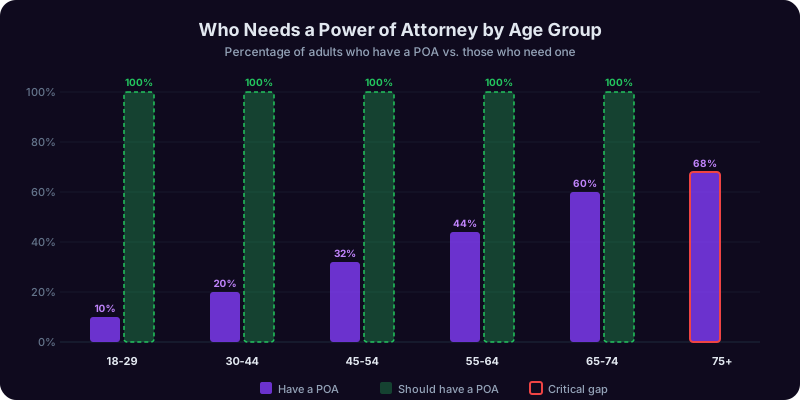
The single most important thing to understand about a POA is timing: you must create it while you are mentally competent. Once a person loses capacity - whether from Alzheimer's, a stroke, or a traumatic injury - it is too late to sign a valid POA. The Legal Copilot can help you understand which type of POA fits your situation and what steps to take first.
Disclaimer: This guide provides general legal information, not legal advice. Power of attorney laws vary by state, and complex situations may require an attorney.
Types of Power of Attorney Explained
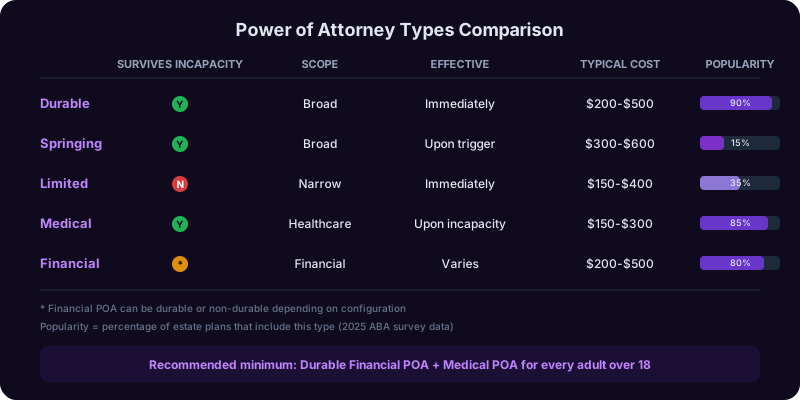
Not all powers of attorney are the same. The type you need depends on what decisions you want your agent to handle, when the authority should take effect, and how long it should last. Here are the five main types, with clear distinctions between them.
1. Durable Power of Attorney
A durable POA remains in effect even if the principal becomes mentally incapacitated. This is the most common and most important type for estate planning. The word "durable" is the key - it means the document survives incapacity. Without the durable designation, a standard POA automatically terminates the moment you become incapacitated, which is exactly when you need it most.
A durable POA can cover financial matters, property management, or both. It typically takes effect immediately upon signing, though you can structure it as a "springing" durable POA (see below). Most estate planning attorneys recommend a durable POA as a baseline document for every adult over 18.
2. Springing Power of Attorney
A springing POA only takes effect when a specific triggering event occurs - usually the principal's incapacitation, as certified by one or two physicians. The advantage is that your agent has no authority until you actually need help. The disadvantage is significant: proving the triggering event can cause delays. Banks and financial institutions sometimes refuse to honor a springing POA because they question whether the triggering condition has been met. Some states, including California, have moved away from springing POAs for this reason. Many attorneys now recommend an immediately effective durable POA with a trusted agent instead.
3. Limited (or Special) Power of Attorney
A limited POA grants authority for a specific purpose or a defined time period. Examples include authorizing someone to sell a particular piece of real estate while you are overseas, sign closing documents for a home purchase, manage a single bank account, or handle a specific legal matter. The authority expires when the task is complete or the time period ends. This is the right choice when you need someone to handle one transaction but do not want to grant broad ongoing authority.
4. Medical (Healthcare) Power of Attorney
A medical POA - also called a healthcare proxy, healthcare surrogate, or advance healthcare directive depending on the state - authorizes your agent to make medical decisions if you cannot communicate your own wishes. This includes consenting to or refusing treatment, choosing doctors and hospitals, accessing medical records, and making end-of-life decisions.
A medical POA is separate from a living will. A living will states your specific treatment preferences (such as whether you want life support). A medical POA appoints a person to make decisions the living will does not cover. Most estate planners recommend having both. If you are navigating healthcare decisions for an aging parent, the Wellness Copilot can help you understand treatment options and questions to discuss with your family.
5. Financial Power of Attorney
A financial POA grants authority over the principal's financial affairs: bank accounts, investments, real estate transactions, tax filings, bill payments, insurance claims, and business operations. This can be durable or non-durable, broad or limited. A general financial POA covers virtually all financial activities. A limited financial POA restricts authority to specific accounts or transactions.
Which Type Do You Need?
Most adults need at minimum two documents: a durable financial POA and a medical POA. If you are only handling a single transaction, a limited POA is sufficient. If you are planning for the possibility of long-term incapacity - whether your own or an aging parent's - a durable POA is non-negotiable. The Legal Copilot can walk you through each type and help you determine the right combination for your circumstances. For a complete overview of estate planning documents and how they work together, the Nolo Power of Attorney guide is an excellent resource.
How to Choose Your Agent (and Why It Matters More Than the Form)
The person you choose as your agent is the most consequential decision in the entire POA process. The form itself is straightforward. Choosing the wrong person can lead to financial abuse, family conflict, and legal catastrophe. According to the Consumer Financial Protection Bureau, elder financial exploitation - much of it committed by family members acting under a POA - costs older Americans an estimated $28 billion annually.
Qualities to Look For
- Trustworthiness above all else: This person will have access to your bank accounts, your property, and potentially your medical decisions. They must be someone whose honesty is beyond question. Do not choose someone because they are the oldest child or the nearest relative - choose them because you trust them completely with your money and your life.
- Financial competence: For a financial POA, your agent needs to be reasonably good with money. They do not need to be a CPA, but they should be able to pay bills on time, manage accounts, understand basic investment concepts, and keep accurate records.
- Emotional resilience: For a medical POA, your agent may need to make agonizing decisions - authorizing surgery, choosing between treatment options, or carrying out your end-of-life wishes. Choose someone who can follow your wishes even under extreme emotional pressure, and who will not be paralyzed by guilt or family pressure.
- Availability and proximity: An agent who lives three time zones away may struggle to handle in-person banking, meet with attorneys, or attend to property issues. Proximity matters for practical execution, though it should not override trustworthiness.
- Willingness to serve: Ask the person directly. Being named as an agent is a significant responsibility, and not everyone wants it. A reluctant agent is a bad agent.
Who Not to Choose
- Someone with a history of financial problems: Bankruptcy, gambling issues, or chronic debt are disqualifying red flags for a financial POA.
- Someone who will benefit from your incapacity: If your child stands to inherit your estate and also controls your finances, the conflict of interest is obvious. This does not mean children cannot serve as agents, but the dynamic requires careful consideration.
- Someone who cannot say no to family pressure: If your medical POA agent will cave to a sibling's demands rather than follow your documented wishes, they are the wrong choice.
Naming Backup (Successor) Agents
Always name at least one successor agent. Your primary agent could become incapacitated themselves, move out of the country, pass away, or simply be unwilling to continue serving. Without a successor named in the document, you are back to square one - needing to create a new POA, assuming you still have capacity to do so. Many people name two or three successors in order of priority.
Co-Agents: Usually a Bad Idea
Naming two people to serve simultaneously as co-agents sounds fair but creates practical problems. Banks, hospitals, and government agencies struggle with dual-signature requirements. Disagreements between co-agents can paralyze decision-making at the worst possible time. If you want checks and balances, a better approach is to name one agent for financial matters and a different agent for healthcare, or to require your agent to provide periodic accountings to another family member. Try our AI contract review tool for step-by-step help.
If you are dealing with complex family dynamics around POA decisions - blended families, estranged relatives, or disputes over who should serve - the Family Law Copilot can help you think through the implications and potential conflicts before you finalize your choice.

Get Answers From the Legal Copilot
The Legal Copilot walks you through POA types, state requirements, agent selection, and document review. Get personalized guidance for your situation before you sign anything.
Step-by-Step: How to Set Up a Power of Attorney
Setting up a POA is not complicated, but each step matters. Missing a requirement - even a technical one - can render the entire document invalid when you need it most. Here is the complete process.
Step 1: Determine What You Need
Before you touch any forms, decide:
- Do you need a financial POA, medical POA, or both? (Most people need both.)
- Should it be durable (survives incapacity) or limited (specific purpose/time)?
- Who will be your agent? Who will be the backup?
- What specific powers do you want to grant or restrict?
Step 2: Obtain the Correct Form for Your State
POA forms are state-specific. Using the wrong state's form can result in banks and institutions refusing to honor it. Sources for valid forms:
- Your state bar association's website: Many provide free statutory POA forms. The American Bar Association's Commission on Law and Aging maintains a directory of state-specific resources.
- Your state legislature's website: Some states publish the official statutory form in their statutes (e.g., New York General Obligations Law Section 5-1513, Illinois Statutory Short Form Power of Attorney Act).
- Online legal services: LegalZoom, Nolo, and similar platforms offer state-specific forms for $35-$150.
- An elder law or estate planning attorney: The most reliable option for complex situations.
Many states have adopted the Uniform Power of Attorney Act, which standardizes certain provisions. However, each state's implementation varies, so always use a form designed for your specific state.
Step 3: Fill Out the Form Carefully
The form will ask you to specify:
- The principal's full legal name and address
- The agent's full legal name and address
- Successor agent(s), if any
- Specific powers granted (many forms use a checklist of categories: real estate, banking, investments, tax matters, personal and family maintenance, etc.)
- Any limitations or restrictions on the agent's authority
- Whether the POA is durable
- The effective date (immediately or upon a triggering event)
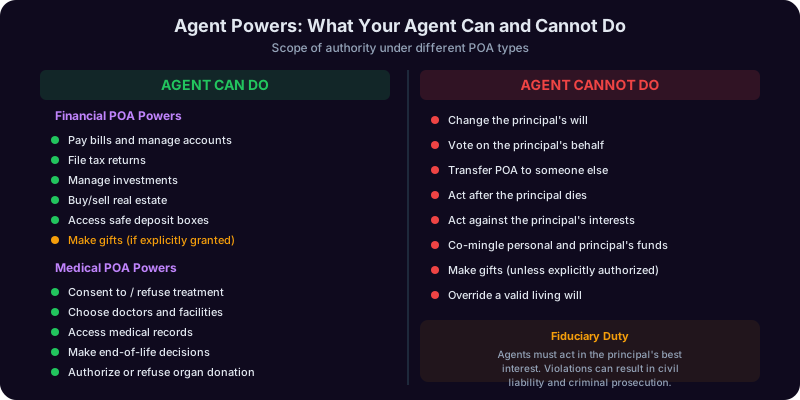
Be precise. If you want your agent to be able to make gifts from your assets (for tax planning or family support), you must explicitly grant that power - it is not included by default in most states. Similarly, if you want to restrict your agent from selling your home, state that explicitly.
Step 4: Sign with Proper Witnessing and Notarization
This is where most DIY POAs fail. Requirements vary by state, but here is the general framework:
- Notarization: Required in virtually all states for financial POAs. The principal must sign in front of a notary public. The notary verifies the principal's identity and confirms they are signing voluntarily. Notary fees: $5-$25 per signature in most states (varies widely).
- Witnesses: Many states require one or two witnesses in addition to notarization. Witnesses generally cannot be the named agent, a family member, or anyone who would benefit from the POA. Some states have specific witness requirements for medical POAs.
- State-specific formalities: Some states (e.g., Florida) require two witnesses AND notarization for a durable POA. Others (e.g., Pennsylvania) are more lenient. Know your state's requirements exactly.
Step 5: Distribute Copies to Key Parties
A POA is useless if no one knows it exists or cannot find it. Distribute copies to:
- Your agent and successor agent(s)
- Your bank(s) and financial institutions - many banks prefer to have the POA on file in advance and may want the agent to sign their own internal POA acceptance form
- Your attorney, if you have one
- Your doctor or healthcare provider (for medical POAs)
- A secure personal location (fireproof safe, safe deposit box)
Step 6: Register If Required
Some states require or recommend recording a real estate POA with the county recorder's office if the agent will handle real property transactions. This is separate from simply creating the document - it creates a public record that the POA exists. Check your state's requirements.
If you are working through this process and want to make sure your form is properly structured, the Contract Review Copilot can help you review the language in your POA document, identify missing provisions, and flag clauses that might cause problems. For a broader understanding of how to read and evaluate legal documents, see our guide on how to read and negotiate contracts.
State-by-State Differences: Key Variations That Matter
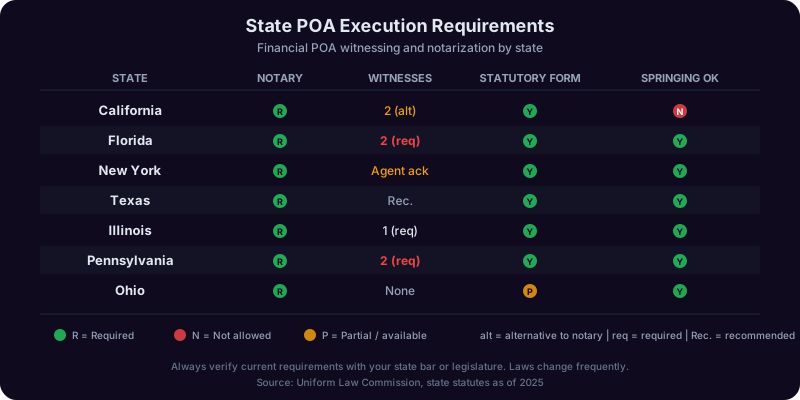
Power of attorney law is fundamentally a state-level matter. A POA that is perfectly valid in Texas may be rejected in Florida if it does not meet Florida's specific requirements. Here are the most critical variations to be aware of.
Witnessing and Notarization Requirements
| State | Financial POA Requirements | Medical POA Requirements |
|---|---|---|
| California | Notarization required; two witnesses if POA is not notarized (notarization strongly preferred) | Two witnesses required; notarization accepted as alternative. Witnesses cannot be treating healthcare providers. |
| Florida | Two witnesses AND notarization required | Two witnesses required; one cannot be spouse or blood relative |
| New York | Notarization required; agent must sign an acknowledgment | Two witnesses required |
| Texas | Notarization required; two witnesses recommended but not always required | Two witnesses required; one cannot be the agent |
| Illinois | Notarization required; one witness required | One witness required (cannot be agent) |
| Pennsylvania | Notarization required; two witnesses required | Two witnesses required |
| Ohio | Notarization required | Notarization required or two witnesses |
| Georgia | Notarization required; one or two witnesses depending on purpose | Two witnesses required |
Statutory Form States
Several states have adopted official statutory POA forms that institutions within the state are legally required to accept. Using the statutory form is not always mandatory, but it significantly reduces the chance of a bank or hospital refusing to honor your POA. States with widely used statutory forms include:
- California: Uniform Statutory Form Power of Attorney (Probate Code Section 4401)
- New York: Statutory Short Form Power of Attorney (General Obligations Law Section 5-1513) - notably complex, with a separate Statutory Gifts Rider required for gifting authority
- Illinois: Statutory Short Form Power of Attorney for Property and Statutory Short Form for Health Care
- Texas: Statutory Durable Power of Attorney (Estates Code Chapter 752)
Springing POA Restrictions
Not all states allow springing POAs. California, for example, eliminated springing financial POAs under the Uniform Power of Attorney Act as adopted in 2000. The state found that springing provisions created too many disputes about whether the triggering condition had been met. If you live in a state that restricts springing POAs, you must use an immediately effective POA or find alternative estate planning tools.
Third-Party Acceptance Laws
One of the most frustrating aspects of POA law is that banks and institutions sometimes refuse to honor a valid POA. Many states have responded by passing laws requiring third parties to accept POAs and imposing penalties for unreasonable refusal. For example:
- Florida: Third parties who unreasonably refuse a valid POA can be held liable for attorney fees and court costs.
- Texas: Financial institutions must accept or reject a POA within seven business days and provide a written explanation for any rejection.
- New York: Institutions must accept a properly executed statutory form POA and can only reject it for specific, limited reasons.
You can find the full text of your state's POA statute through the Uniform Law Commission, which tracks adoption of the Uniform Power of Attorney Act across all 50 states.
Where to Find Your State's Forms and Requirements
- Search: [Your State] statutory power of attorney form
- Check your state bar association's self-help or public resources section
- Visit your state legislature's website and search for the POA statute
- Contact your county courthouse's self-help center - many provide free forms and guidance
Because state requirements change periodically, always verify that the form you are using reflects current law. A form downloaded in 2024 may not comply with a 2025 statutory amendment. The Legal Copilot can help you identify the current requirements for your state and point you to the right resources. For anyone navigating legal questions across multiple areas, keeping up with jurisdiction-specific rules is one of the most common challenges.
What Does a Power of Attorney Cost? DIY vs. Lawyer vs. Online Services
The cost of setting up a POA ranges from essentially free to several thousand dollars, depending on how you create it, whether you use an attorney, and how complex your situation is. Here is a realistic breakdown.
Option 1: DIY with Free State Forms ($0-$30)
If your state provides a free statutory POA form - and many do - your only costs are notarization ($5-$25) and possibly a few dollars for copies. Total: under $30.
This works well if your situation is straightforward: you are a single person or a married couple, you have a clear choice of agent, and your assets are not particularly complex. Download the form, fill it out, get it notarized, and distribute copies.
The risk: if you make a mistake on the form, use outdated language, or fail to include a required provision, you will not know until someone tries to use the POA - which may be years later, during a crisis, when you cannot fix it.
Option 2: Online Legal Services ($35-$200)
Services like LegalZoom, Nolo, Trust & Will, and Rocket Lawyer offer guided POA creation. You answer questions about your situation, and the service generates a state-specific document. Typical pricing:
- LegalZoom: $89-$149 for a POA package (often bundled with other estate planning documents)
- Nolo: $35-$60 for a POA book or software with forms
- Trust & Will: $69-$159 for POA as part of an estate plan
- Rocket Lawyer: Free with membership ($39.99/month); $39.99 for a single document without membership
These services add value by guiding you through the decision points (durable vs. springing, what powers to grant, whether to include gifting authority) and ensuring the form matches your state's current requirements. Some include attorney review for an additional fee.
Option 3: Attorney-Drafted POA ($200-$1,000+)
An estate planning or elder law attorney will draft a customized POA tailored to your specific situation. Typical costs:
- Simple financial POA: $200-$400
- Medical POA / advance directive: $150-$300
- Comprehensive package (financial POA, medical POA, living will, and possibly a basic will): $500-$1,500
- Complex situations (business interests, multiple properties, blended families, special needs trusts): $1,000-$3,000+
Attorney-drafted POAs are worth the cost when you have significant assets, complex family dynamics, business interests, or concerns about potential challenges to the POA's validity. The attorney can also provide guidance on how the POA interacts with your other estate planning documents.
Additional Costs to Budget For
- Notarization: $5-$25 per signature (some states are higher; mobile notaries charge $50-$150 for house calls)
- Recording fees: $10-$50 if you need to record the POA with the county recorder for real estate purposes
- Certified copies: $5-$20 per copy from the county or notary
- Bank acceptance fees: Some banks charge no fee but require the agent to complete their own internal forms, which may take a separate notarization
When You Absolutely Need an Attorney
Do not go DIY if any of these apply:
- The principal has early-stage dementia or questionable capacity (an attorney can assess and document capacity at the time of signing)
- You have a blended family where step-children and biological children may have competing interests
- The principal owns a business or has complex financial holdings
- You expect any family member to challenge the POA
- The POA involves real estate in multiple states
- The principal is in a nursing home or receiving Medicaid
Spending $500 on an attorney now can prevent $10,000 in guardianship proceedings later. If you are weighing whether to use an attorney or handle it yourself, the Legal Copilot can help you assess whether your situation is straightforward enough for DIY or complex enough to justify legal counsel. You can also review our guide on reading and negotiating legal documents to better understand what you are signing.
7 Common Mistakes That Invalidate a Power of Attorney
A POA that looks valid on paper can be completely useless in practice if it was improperly created. These are the most common errors, ranked roughly by how often they cause real problems.
Mistake 1: Waiting Too Long (Capacity Issues)
This is the number one mistake, and it is irreversible. The principal must have mental capacity at the time they sign the POA. Mental capacity means they understand what a POA is, what powers they are granting, who they are appointing, and the consequences of the document. If a parent already has moderate to severe dementia, it is too late. A POA signed by someone who lacks capacity is void and can be challenged by any interested party.
What "too late" looks like in practice: the family realizes Dad cannot manage his finances. They download a POA form, bring it to Dad's bedside, and have him sign it. Three months later, when the agent tries to use the POA at the bank, the bank questions Dad's capacity at the time of signing. A court later invalidates the POA, and the family must go through a full guardianship proceeding - the exact outcome the POA was supposed to prevent.
If there is any question about the principal's capacity, have the POA signed in the presence of an attorney who can document their assessment of the principal's mental state. Some attorneys also recommend having the principal's physician provide a contemporaneous letter confirming capacity.
Mistake 2: Not Making It Durable
A standard (non-durable) POA terminates automatically when the principal becomes incapacitated. This means the agent loses all authority at the exact moment they need it most. If you are creating a POA for future protection, it must include durable language. Most state statutory forms include this by default, but if you are using a generic or custom form, verify that it explicitly states the POA survives incapacity.
Mistake 3: Missing Witnesses or Notarization
Each state has specific execution requirements. A POA that is not properly witnessed or notarized according to your state's law is invalid - period. This is not a technicality that courts overlook. Financial institutions routinely reject POAs that lack proper notarization, and they are within their rights to do so.
The most common sub-errors: having a family member serve as a witness when the state prohibits it, having only one witness when the state requires two, or getting the document notarized but not witnessed when the state requires both. Florida's requirement of two witnesses plus notarization trips people up constantly.
Mistake 4: Using the Wrong State's Form
If you live in New York but use a generic form that does not comply with New York's specific requirements - such as the separate agent acknowledgment that New York mandates - banks in New York will refuse to honor it. Always use a form that complies with the laws of the state where the POA will be used. If the principal owns property in multiple states, you may need a POA that complies with each state's requirements, or separate POAs for each state.
Mistake 5: Not Granting Specific Powers
Many POA forms use a checklist of powers. If you skip a category - say, you check "banking" but not "real estate" - your agent cannot sell your house, even if that is exactly what needs to happen to fund your care. Gifting authority is another common omission. If your agent needs to make gifts from your assets for tax planning purposes (such as annual exclusion gifts to family members), that power must be explicitly stated. In most states, an agent without express gifting authority cannot make gifts, even small ones.
Mistake 6: Not Providing the POA to Institutions in Advance
Many banks have their own POA acceptance procedures. Some require the agent to appear in person, provide identification, and sign the bank's internal forms. If you wait until a crisis to present the POA for the first time, the bank may take days or weeks to review and accept it - or reject it entirely and require their own form. Presenting the POA to major financial institutions while the principal is still healthy avoids this problem entirely.
Mistake 7: Never Updating the Document
A POA signed 15 years ago may reference an agent who has died, an attorney who has retired, or a state's laws that have since changed. Financial institutions become increasingly suspicious of very old POAs, especially if they cannot verify the principal's current wishes. Review and update your POA every 3-5 years, after major life events (marriage, divorce, death of the named agent), and whenever your state updates its POA statutes.
If you already have a POA and are not sure whether it would hold up, the Contract Review Copilot can help you evaluate your existing document for potential weaknesses. For disputes that arise from flawed POAs, our small claims court guide covers the basics of filing a legal claim.
When and How to Revoke or Update a Power of Attorney
A POA is not permanent. The principal can revoke it at any time, as long as they have mental capacity. There are also situations where you should update the document even if you are not revoking it. Understanding when and how to make changes is as important as setting up the POA in the first place.
When to Revoke a POA
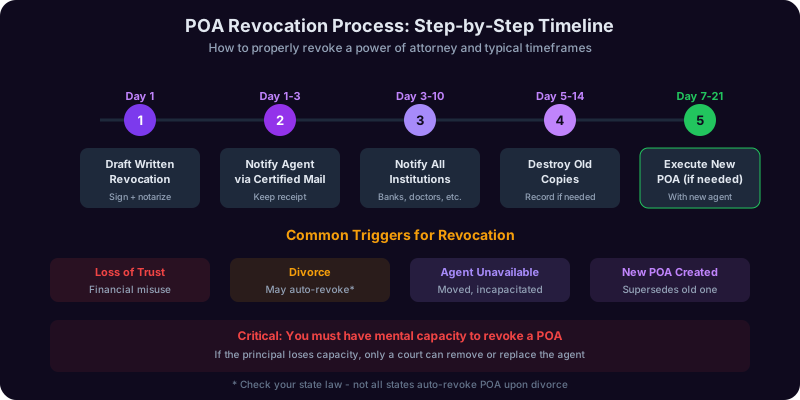
- You no longer trust the agent: If your relationship with your agent has changed - whether due to divorce, a falling out, financial concerns, or simply growing apart - revoke the POA immediately. Do not wait for a problem to surface. An agent who knows they are named but who you no longer trust has, on paper, full authority over your affairs until you formally revoke it.
- You are getting divorced: In many states, divorce automatically revokes a POA granted to a spouse - but not all states. And even in states where it is automatic, it is best practice to execute a formal revocation. Do not assume your divorce decree handles this. For guidance on the divorce process and related legal considerations, see our complete guide to filing for divorce.
- The agent has misused their authority: If you discover your agent has been making unauthorized transactions, diverting funds, or acting against your interests, revoke the POA immediately and consider reporting the conduct to law enforcement. Financial exploitation under a POA is a crime in most states.
- You have created a new POA: When you execute a new POA, the new document should include language revoking all prior POAs. However, institutions that have the old POA on file will not know about the new one unless you notify them.
How to Revoke a POA
- Execute a written revocation. Draft a document that clearly states you are revoking the POA. Include the date of the original POA, the name of the agent, and the date of the revocation. Sign and notarize it.
- Notify the agent in writing. Send the revocation to the former agent via certified mail with return receipt requested. Keep the receipt as proof of notification.
- Notify all institutions. Send the revocation to every bank, financial institution, healthcare provider, and government agency that has a copy of the original POA. Request written confirmation that they have updated their records.
- Destroy copies of the old POA. Retrieve and destroy all copies of the revoked POA that you can locate. If the old POA was recorded with the county, record the revocation as well.
- Create a new POA if needed. If you still need someone to act on your behalf, execute a new POA naming a different agent.
When to Update (Rather Than Revoke)
Sometimes you do not need to revoke the POA entirely - you just need to update it. Common situations:
- Your agent moves away or becomes unavailable: You may want to name a new primary agent while keeping the document otherwise unchanged.
- You acquire new assets: If you purchased real estate, started a business, or opened new financial accounts after the POA was created, the existing POA may not clearly cover these new assets.
- State law changes: If your state updates its POA statute, your existing document may need to be revised for compliance. This happened in New York in 2021, Virginia in 2022, and several other states that have adopted or modified the Uniform Power of Attorney Act in recent years.
- Your successor agent is no longer appropriate: If your backup agent has died, become incapacitated, or is no longer someone you would choose, update the document to name a new successor.
Important Timing Considerations
Revocation only works while you have capacity. If you lose mental capacity, the POA remains in effect with whatever agent is named, and only a court can remove or replace the agent. This is another reason to choose your agent carefully upfront and review the document regularly.
Also note that a POA automatically terminates upon the principal's death. After death, the agent has no authority - the estate passes to an executor or personal representative under the principal's will or state intestacy laws. If you are planning for both lifetime and post-death management of your affairs, you need a POA for lifetime decisions and a will (or trust) for post-death distribution. Our guide on how to write a will without a lawyer covers the estate planning side of this equation.
For families navigating these transitions, particularly when caring for elderly parents, the Family Law Copilot can help you understand the intersection of POAs, wills, and estate planning. If you are dealing with broader financial planning questions, our real-life scenario guides cover a range of situations where legal and financial decisions overlap. And if someone has misused a POA and you need to take legal action, our small claims court guide can help you understand your options for recovering damages.
Frequently Asked Questions
Recommended Copilots
Recommended Copilots
Get guidance on POA types, state requirements, and legal document preparation
Try Free →Review your POA document for missing provisions or problematic language
Try Free →Navigate family dynamics and estate planning decisions around POA
Try Free →Continue Exploring
Related Scenarios
For You
How It Works
Related Articles
Get Answers From the Legal Copilot
The Legal Copilot walks you through POA types, state requirements, agent selection, and document review. Get personalized guidance for your situation before you sign anything.