
Why Your Employment Contract Deserves More Scrutiny Than You Give It
You have just received a job offer. The salary is right, the title is exciting, and HR needs the signed contract back by Friday. So you skim the document, sign it, and start planning your commute. This is one of the most expensive mistakes you can make in your career.
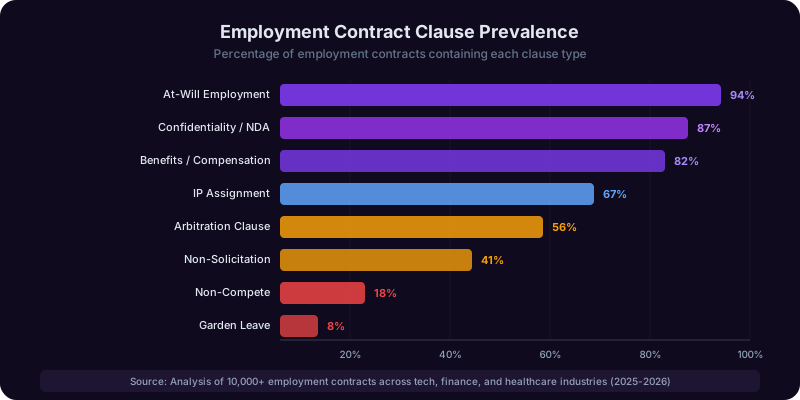
According to a 2025 study by the Economic Policy Institute, approximately 38% of American workers are bound by non-compete agreements, and nearly half of those workers did not realize the full scope of the restriction when they signed. A separate survey by the Workplace Fairness Institute found that 72% of employees spend less than 10 minutes reviewing their employment contract before signing.
The financial consequences are not abstract. The median salary loss for workers constrained by an enforceable non-compete is $8,700 per year in reduced wages due to limited job mobility. Employees who unknowingly sign broad IP assignment clauses have lost side projects worth tens of thousands of dollars. Workers who waive their right to a jury trial through mandatory arbitration clauses recover on average $27,039 less than those who retain their court access, according to research published by the American Association for Justice.
The imbalance is structural. Your employer's legal team drafted the contract. They chose every word deliberately. The document is designed to maximize the company's protection and minimize yours. Your job is to read that move, understand it, and respond before you sign.
What This Guide Covers
This is a clause-by-clause walkthrough of the modern employment contract covering non-compete clauses (including the FTC rule's current status), IP assignment, mandatory arbitration, at-will vs. contract employment, severance terms, stock option vesting, non-solicitation agreements, and confidentiality provisions. For each clause, we provide enforceability data, negotiation scripts, and specific language to watch for - plus how AI tools like Copilotly's Legal Copilot can parse contract language and flag risks before you sign.
Disclaimer: This guide provides general educational information about employment contracts and related legal topics. It is not legal advice. Employment law varies significantly by state and jurisdiction, and the enforceability of specific contract terms depends on the facts of your situation. For contracts involving significant compensation, equity, or restrictive covenants, consult a licensed employment attorney in your state.
Non-Compete Clauses: The 2026 Legal Landscape After the FTC Rule
Non-compete agreements are the most debated and misunderstood clause in employment contracts. Here is the current state of play.
What Happened With the FTC Ban
In April 2024, the Federal Trade Commission issued a final rule that would have banned most non-compete agreements nationwide. The rule was challenged in federal court, and in August 2024, a Texas federal judge struck it down, ruling that the FTC exceeded its statutory authority. As of mid-2026, the FTC has not successfully revived the ban, and non-compete enforceability remains governed by state law.
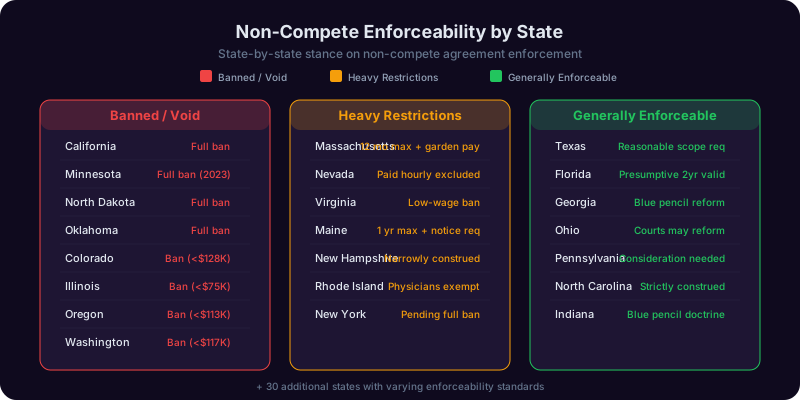
| Category | States | What It Means |
|---|---|---|
| Banned or nearly banned | California, Minnesota, North Dakota, Oklahoma, Colorado (most workers under ~$128K) | Your non-compete is likely void |
| Highly restricted | Washington, Oregon, Illinois, Maine, Maryland, New Hampshire, Virginia, Rhode Island | Enforceable only for high earners with strict limits |
| Moderately restricted | Massachusetts, Nevada, Indiana, Louisiana, and others | Enforceable if "reasonable" - courts weigh case-by-case |
| Generally enforced | Florida, Texas, Georgia, Ohio, Pennsylvania, and others | Courts typically enforce if terms are not wildly unreasonable |
What Makes a Non-Compete Enforceable
Even in enforcement states, courts apply a reasonableness test:
- Duration of 6-12 months. A 24-month non-compete is enforced in fewer than 40% of challenged cases; 6-month restrictions are upheld over 80% of the time.
- Limited geographic scope. A 25-mile radius is far more enforceable than "the entire United States."
- Narrow industry scope. "The five named direct competitors in Exhibit A" beats "any competitor."
- Adequate consideration. In many states, a non-compete signed after employment begins requires additional consideration - a bonus, raise, or promotion.
Red Flags in Non-Compete Language
- "any business that competes directly or indirectly" - "indirectly" massively expands scope
- "worldwide" or "throughout the United States" - geographic overreach
- "for a period of twenty-four (24) months" - duration many courts find excessive
- "in any capacity, including as an employee, consultant, advisor, or investor" - prevents even passive investment
How to Negotiate
"I understand the company's interest in protecting its competitive position. Could we narrow this to [specific direct competitors], limit the duration to [6 months], and define the geographic scope as [the metro area where I work]?"
If the employer refuses, ask for a garden leave clause requiring the employer to pay your salary during the non-compete period. According to the Department of Labor, employees who negotiate garden leave receive an average of 3-6 months of continued salary during the restricted period. For how non-competes interact with wrongful termination, see our wrongful termination guide.
IP Assignment Clauses: Who Owns What You Create
Intellectual property assignment clauses are the sleeper clause in employment contracts - the one that rarely gets attention at signing but can cost you enormously later.
How IP Assignment Works
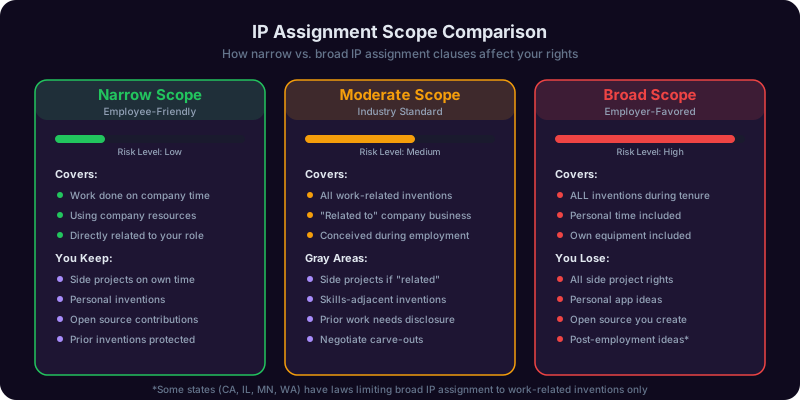
A standard IP assignment clause transfers ownership of any "inventions, discoveries, designs, copyrightable works, and trade secrets" you create during employment to the company. The critical question is how broadly "during your employment" is defined:
- Narrow (employee-friendly): Only work created during business hours, using company resources, directly related to your duties.
- Moderate: Work created during business hours OR relating to the company's current or "reasonably anticipated" business.
- Broad (employer-friendly): ALL work created during the term of employment, regardless of when, what resources were used, or whether it relates to the company's business.
A 2025 survey by the Founders Legal Foundation found that 45% of tech employment contracts contain IP assignment language that could cover personal projects, side businesses, and open-source contributions.
State Protections for Employee Inventions
Several states limit the reach of IP assignment clauses by law:
| State | Protection |
|---|---|
| California (Labor Code 2870) | Cannot claim inventions developed on employee's own time without company resources, unless related to employer's business |
| Illinois (765 ILCS 1060) | Cannot claim inventions made entirely on employee's own time with own resources |
| Minnesota (181.78) | Inventions made on own time without company resources belong to the employee |
| Washington (49.44.140) | Cannot require assignment of employee inventions made on own time |
| Delaware (Title 19, 805) | Similar to California - protections for inventions made on own time |
What to Negotiate
- Schedule of pre-existing IP. List every side project, open-source contribution, or creative work that predates your employment on the contract's exhibit. A blank exhibit implies you have no pre-existing IP.
- Personal project carve-out. Request: "This assignment does not apply to any invention the Employee develops entirely on their own time, without Company equipment or trade secrets, that does not relate to the Company's current or demonstrably anticipated business."
- Open-source contribution rights. Reserve the right to continue contributing to open-source projects: "Employee may contribute to open-source software projects provided such contributions do not incorporate Company confidential information."
- Moonlighting approval process. If the company will not grant a blanket carve-out, negotiate a clear written approval process for side projects.
The Legal Copilot can analyze the specific IP assignment language in your contract and compare it against employee-friendly alternatives.

Get Answers From the Legal Copilot
Paste your employment contract into Copilotly's Legal Copilot for a clause-by-clause breakdown of non-competes, IP clauses, arbitration terms, and severance provisions - with negotiation language you can use immediately.
Mandatory Arbitration: What You Lose and When to Push Back
Mandatory arbitration clauses have become the default in American employment contracts. The Economic Policy Institute estimates that 56% of non-union private-sector employees are subject to mandatory arbitration, covering over 60 million workers.
What Arbitration Actually Means
When you agree to mandatory arbitration, you waive your right to: sue your employer in court, have a jury hear your case, join a class action lawsuit (most clauses include a class waiver), and meaningfully appeal the decision.
The Data on Arbitration Outcomes
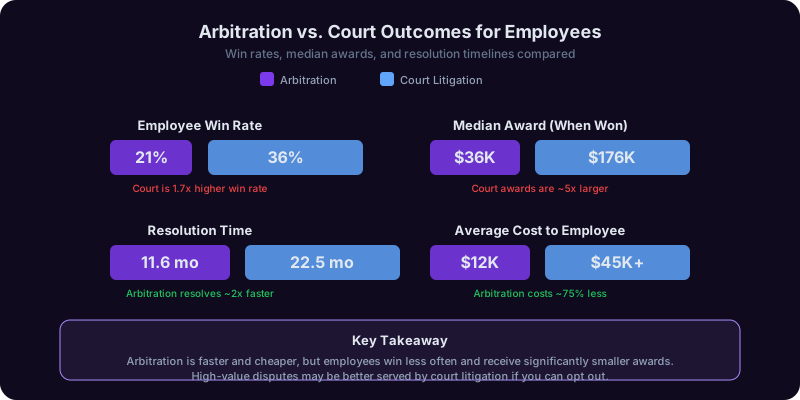
Research from Cornell University and the National Academy of Arbitrators:
| Metric | Arbitration | Federal Court |
|---|---|---|
| Employee win rate | 21.4% | 36.4% |
| Median award when employee wins | $36,500 | $176,426 |
| Class action participation | Not permitted (with class waiver) | Permitted |
| Average resolution time | 11.6 months | 22.4 months |
| Right to appeal | Extremely limited | Full appellate rights |
The speed advantage of arbitration is real, but it comes at a steep cost in outcomes.
Why Employers Prefer It
The class action waiver is the primary motivation. After Epic Systems Corp. v. Lewis (2018), employers can require employees to waive class action rights. Individual arbitration claims are statistically rare - only about 1 in 7,500 employees subject to arbitration actually files a claim in any given year.
Red Flags in Arbitration Clauses
- "The employer shall select the arbitration provider" - the employer should not unilaterally choose who decides the case
- "The employee shall bear all costs of arbitration" - AAA rules require the employer to pay most fees; shifting costs to you may be unconscionable
- "Arbitration shall be conducted in [employer's home city]" - requiring you to travel for arbitration
- "The arbitrator's award shall be kept confidential" - secrecy prevents pattern evidence from building
When to Push Back
Arbitration clauses are most negotiable for senior roles, in competitive job markets, and in states with restrictions (California's AB 51, though contested, attempted to prohibit conditioning employment on arbitration). If you cannot eliminate the clause, negotiate for: mutual arbitrator selection, employer-paid fees, the right to seek injunctive relief in court, and a carve-out for statutory discrimination claims. The Nolo arbitration guide provides additional state-specific details. See also our guide on reading and negotiating contracts.
At-Will Employment, Severance Terms, and Stock Option Vesting
Understanding whether your employment is "at-will" or governed by a contract determines your job security, termination rights, and severance leverage.
At-Will vs. Contract Employment
In 49 of 50 U.S. states (Montana excepted), employment is presumed "at-will" - either party can end the relationship at any time, for any non-illegal reason. However, your employment contract can modify at-will status with notice period requirements, for-cause termination definitions, and severance provisions.
True contract employment specifies a fixed term, grounds for early termination, and breach consequences. Contract employment is most common for executives, physicians, faculty, and union workers. Termination without cause during the term is a breach entitling you to damages.
Severance: What Is Standard
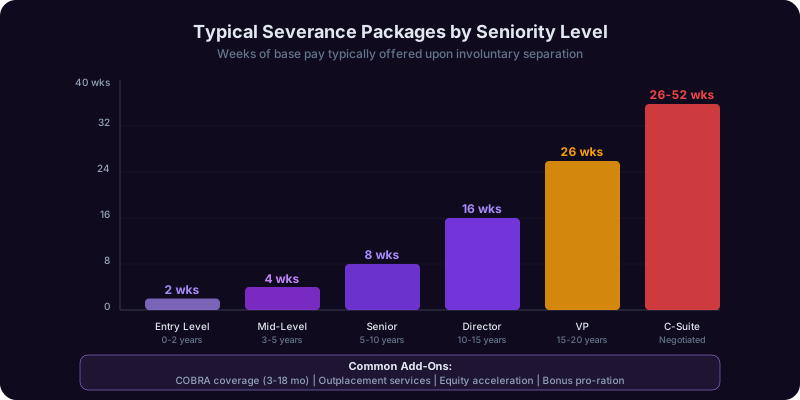
No federal law requires severance. Current norms by level:
| Level | Standard Severance | Additional Components |
|---|---|---|
| Entry-level | 1-2 weeks per year of service | COBRA (1-3 months) |
| Mid-level / Manager | 2-3 weeks per year | COBRA, outplacement, prorated bonus |
| Senior / Director | 3-6 months' salary | COBRA (6 months), accelerated vesting |
| VP / Executive | 6-12 months' salary | Full benefits, accelerated vesting |
| C-suite | 12-24 months' salary | Complete equity acceleration, executive outplacement |
Only 33% of employers offer formal severance plans; the rest negotiate case by case. Watch for "at the sole discretion of the Company" (means they can offer nothing), unreasonably short signing deadlines, and clawback provisions tying severance to non-compete compliance.
Stock Option Vesting
Roughly 36% of U.S. private-sector employees receive equity compensation. The standard structure is a 4-year vesting period with a 1-year cliff (nothing before 12 months, 25% at the cliff, then monthly/quarterly). Key terms:
- Exercise window after departure: Usually 90 days to exercise vested options. If you cannot afford the strike price plus taxes, you lose them. Negotiate for 7-10 year extended windows.
- Change-of-control acceleration: "Single trigger" means options vest fully upon acquisition. "Double trigger" requires acquisition AND your termination within 12-18 months.
- Repurchase rights: Private companies may repurchase your vested shares at fair market value (or original strike price) when you leave.
For detailed severance negotiation scripts, see our wrongful termination guide.
Non-Solicitation Agreements and Confidentiality Provisions
These two clauses are frequently overlooked but carry significant enforceability and real-world consequences.
Non-Solicitation Agreements
While non-competes restrict where you can work, non-solicitation agreements restrict who you can contact after leaving. There are two types:
- Client/customer non-solicitation: Prevents you from soliciting the employer's clients. Usually limited to clients you personally worked with.
- Employee non-solicitation: Prevents you from recruiting former colleagues. Increasingly common in tech where team poaching is a major concern.
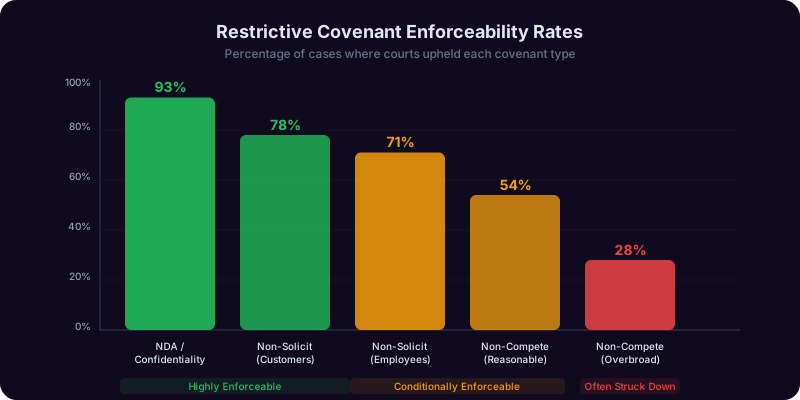
Non-solicitation agreements are more enforceable than non-competes because courts view them as more narrowly tailored. According to a 2025 analysis by Littler Mendelson, non-solicitation clauses are upheld in approximately 68% of contested cases versus roughly 50% for non-competes.
What to negotiate: Limit client non-solicitation to clients you personally serviced, not the company's entire client list. Limit employee non-solicitation to direct reports. Push for a 12-month maximum duration.
Confidentiality Provisions
Legitimate confidentiality clauses protect genuine trade secrets - customer lists, proprietary algorithms, pricing strategies, and unreleased products. These are reasonable and generally enforceable. The problem is scope creep:
- Overly broad definitions: When "Confidential Information" includes "any information relating to the Company's business, operations, or affairs," it covers everything you learn on the job - including general industry knowledge.
- Perpetual duration: Trade secrets deserve long-term protection, but general business information should have a time limit. No expiration date means theoretically forever.
- No general knowledge carve-out: Look for: "This obligation does not apply to information that becomes generally known to the public, or to the Employee's general skills, knowledge, and experience."
- Restrictions on discussing compensation: Under the National Labor Relations Act, employees have the right to discuss wages with each other. A clause prohibiting salary discussions is unenforceable.
Confidentiality provisions are enforced at the highest rate of any restrictive covenant - approximately 89% of the time in contested cases. Negotiate scope and duration carefully because courts will likely hold you to them. For broader contract literacy including these clauses, see our complete guide to reading and negotiating contracts.
How AI Can Parse Employment Contract Language
The gap between receiving an employment contract and understanding it has historically been filled by expensive attorney consultations ($200-$500/hour) or risky guesswork. AI-powered contract analysis tools have created a practical middle option.
What AI Contract Review Does Well
Modern AI tools - including Copilotly's Legal Copilot - can perform several valuable functions:
- Plain-language translation. AI can take "Employee hereby irrevocably assigns to Company all right, title, and interest in any Work Product" and explain it means: "Everything you create during employment belongs to the company permanently."
- Clause identification. AI scans a 15-page contract and identifies every non-compete, non-solicitation, IP assignment, arbitration, and severance clause - even under non-standard headings.
- Risk scoring. By comparing against thousands of analyzed agreements, AI rates whether a clause is standard, moderately aggressive, or unusually one-sided for your industry and role level.
- Negotiation language. AI generates specific alternative wording for clauses you want to modify.
- Missing clause detection. AI identifies important protections absent from the contract - severance provisions, exercise window extensions, mutual non-disparagement.
How to Use Copilotly for Contract Review
- Paste the full contract text. The AI works best with the complete document because clauses reference each other.
- Ask for a risk summary: "What are the five riskiest clauses in this employment contract for me?"
- Drill into specifics: "Explain the non-compete in Section 8.2. Is this enforceable in [your state]?"
- Request negotiation language: "Suggest alternative language for the IP assignment clause that lets me keep personal projects."
- Check for gaps: "This contract has no severance clause. What should I request for a mid-level engineering role?"
What AI Cannot Do
- It is not legal advice. AI provides information and analysis, not professional judgment accounting for your jurisdiction and strategic context.
- Enforceability is complex. AI flags trends by state, but actual enforceability depends on evolving case law and fact-specific analysis.
- It cannot assess intent. A lawyer evaluates counterparty behavior based on experience and industry norms. AI analyzes text.
- It cannot represent you in negotiations, mediation, or litigation.
The Smart Workflow
The most effective approach combines both: use AI first for complete understanding and risk identification, bring AI-generated questions to an attorney for high-stakes contracts, then use AI to draft negotiation responses for attorney review. This costs $300-$800 in attorney time instead of $1,500-$3,000 for a full attorney-only review. See our guide on AI contract review without a lawyer for more on when AI is sufficient and when to escalate.
Your Complete Checklist and When to Hire an Employment Lawyer
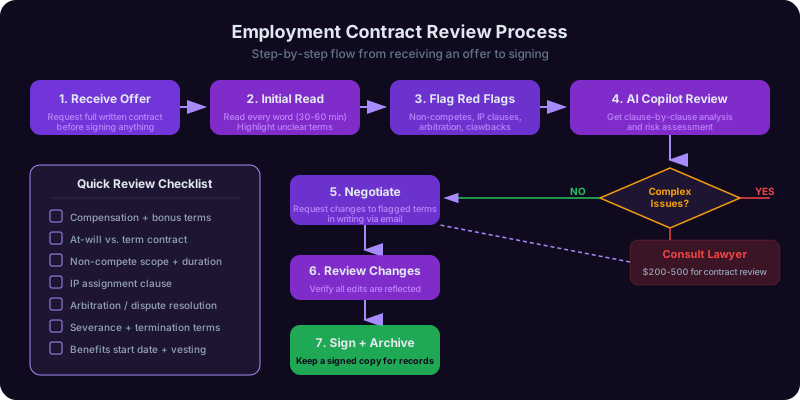
Before you sign any employment contract, work through this checklist - then decide whether you need professional help.
The Review Checklist
Compensation: Base salary, bonus structure (discretionary or guaranteed?), stock options or RSUs (vesting schedule, cliff, exercise window, acceleration triggers), benefits start date, relocation clawback provisions.
Restrictive Covenants: Non-compete (duration, geographic scope, industry scope, enforceability in your state), non-solicitation (clients, employees, or both?), confidentiality (scope, duration, general knowledge carve-out), IP assignment (personal project carve-out? pre-existing IP listed?).
Termination: At-will or for-cause? How is "cause" defined? Notice period, severance amount and conditions, equity treatment upon termination, post-employment obligation durations.
Dispute Resolution: Mandatory arbitration (who pays? who selects?), class action waiver, governing law and jurisdiction, jury trial waiver.
When You Need a Lawyer
- Total compensation exceeds $150,000 - the contract likely includes equity and restrictive covenants whose value justifies $500-$1,500 for attorney review
- Aggressive non-compete in an enforcement state (Florida, Texas, Ohio, Georgia with 12+ months and broad scope)
- Joining a competitor of your current employer while bound by existing restrictive covenants
- Significant equity compensation with complex vesting, tax implications, and repurchase rights
- Executive-level role involving golden parachutes, change-of-control protections, or indemnification
- Signing a separation agreement with a release of claims in exchange for severance
Attorney Costs
| Service | Typical Cost |
|---|---|
| Initial consultation | $0-$300 (many offer free) |
| Standard contract review | $500-$1,500 |
| Executive agreement review | $1,500-$5,000 |
| Non-compete analysis | $300-$800 |
| Full negotiation representation | $2,000-$10,000 |
Find attorneys through state bar referral services via the American Bar Association directory or the Nolo lawyer directory. Ask for employee-side experience and flat-fee pricing.
How Copilotly Helps
- Legal Copilot: Clause-by-clause analysis, risk flags, plain-English explanations, and negotiation alternatives.
- Career Copilot: Overall job offer evaluation, salary benchmarking, and counter-offer strategy.
- Salary Copilot: Data-driven compensation benchmarks for your role, industry, and location.
An employment contract is not a formality. It governs your income, career mobility, and legal rights for years. The 30-60 minutes it takes to review properly - with AI assistance, this checklist, and professional help when warranted - is one of the highest-return investments you will make. For related guidance, see our complete guide to reading and negotiating contracts and our rent negotiation guide for another high-stakes negotiation walkthrough.
Frequently Asked Questions
Recommended Copilots
Recommended Copilots
Analyzes employment contract clauses, flags one-sided terms, and provides plain-English explanations of restrictive covenants
Try Free →Helps evaluate overall job offers, benchmark compensation, and develop counter-offer negotiation strategies
Try Free →Provides data-driven salary and equity benchmarks for your role, industry, and location
Try Free →General-purpose contract analysis that flags risks and suggests negotiation language across all contract types
Try Free →Related Articles
Get Answers From the Legal Copilot
Paste your employment contract into Copilotly's Legal Copilot for a clause-by-clause breakdown of non-competes, IP clauses, arbitration terms, and severance provisions - with negotiation language you can use immediately.