

Renovation Costs by Room: What You Will Actually Pay in 2026
Renovation costs vary enormously depending on the room, the scope, and your location. The numbers below represent national averages for mid-range renovations in 2026, drawn from HomeAdvisor's True Cost Guide and Angi's annual spending report. Your actual costs could be 15-35% higher or lower depending on where you live, which we cover in the regional variations section below.
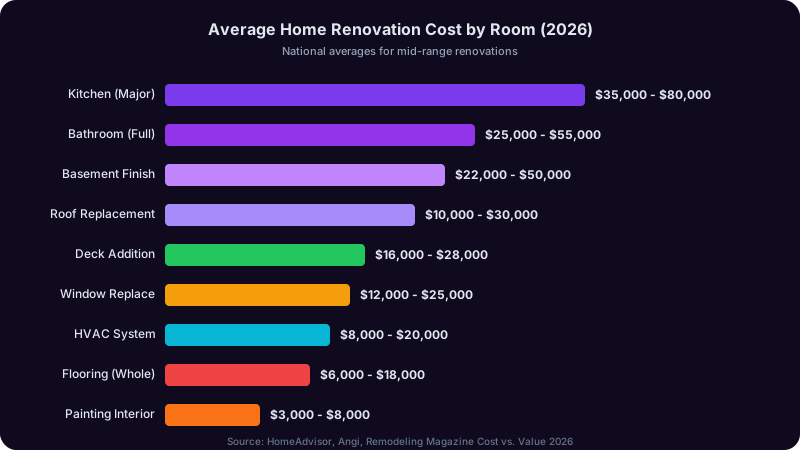
Kitchen Renovation: $35,000 - $80,000 (Major) or $15,000 - $30,000 (Minor)
The kitchen is the most expensive room to renovate and the one most homeowners prioritize. A major kitchen renovation involves new cabinets, countertops, appliances, flooring, lighting, and often layout changes that require moving plumbing and electrical. A minor kitchen renovation keeps the existing layout but updates surfaces: refacing cabinets ($8,000-$15,000), replacing countertops ($3,000-$7,000), upgrading appliances ($3,000-$8,000), and refreshing flooring and backsplash.
The price gap between minor and major is enormous because layout changes trigger permit requirements, structural work, plumbing rerouting, and electrical upgrades. If your kitchen layout works but the finishes are dated, a minor renovation delivers better value per dollar spent.
Bathroom Renovation: $25,000 - $55,000 (Full) or $8,000 - $18,000 (Cosmetic)
A full bathroom renovation includes new fixtures (tub, shower, toilet, vanity), tile work, plumbing updates, lighting, and ventilation. A cosmetic refresh keeps existing plumbing locations but updates surfaces, fixtures, and accessories. The single biggest cost driver in a bathroom is tile: a fully tiled shower with bench and niche runs $4,000-$10,000 for labor and materials. A prefabricated shower surround costs $1,500-$3,500 installed. That one decision can swing your total budget by $5,000-$7,000.
Basement Finishing: $22,000 - $50,000
Finishing an unfinished basement adds livable square footage at a fraction of the cost of an addition. The national average is $35 - $75 per square foot, depending on complexity. A basic finish (framing, drywall, flooring, lighting, egress window) for a 1,000 sq ft basement runs $35,000-$50,000. A simpler approach with drop ceiling and vinyl plank flooring can come in at $22,000-$30,000. The most expensive basement projects include a bathroom ($8,000-$15,000 additional), wet bar ($5,000-$12,000), and exterior egress window well ($3,000-$6,000).
Other Common Projects
| Project | Cost Range | Key Cost Driver |
| Roof Replacement | $10,000 - $30,000 | Material choice (asphalt vs. metal vs. slate) |
| Window Replacement (10 windows) | $12,000 - $25,000 | Frame material and glass type |
| Deck Addition (300 sq ft) | $16,000 - $28,000 | Wood vs. composite vs. PVC |
| HVAC Replacement | $8,000 - $20,000 | System type and home size |
| Whole-House Flooring | $6,000 - $18,000 | Material (vinyl plank vs. hardwood vs. tile) |
| Interior Painting | $3,000 - $8,000 | Square footage and prep work needed |
The most important thing to understand about these ranges is that the low end represents the simplest version of each project with builder-grade materials, and the high end represents mid-to-upper-range materials with full scope. Your actual cost depends on the specific decisions you make during planning, which is exactly where AI-assisted budgeting tools earn their value.
Kitchen and Bathroom Deep Dive: Where Every Dollar Goes
Kitchens and bathrooms account for over 60% of all home renovation spending in the United States. They are also the projects where homeowners are most likely to go over budget, primarily because they underestimate the cost of individual components. Breaking down exactly where the money goes helps you make informed tradeoffs.
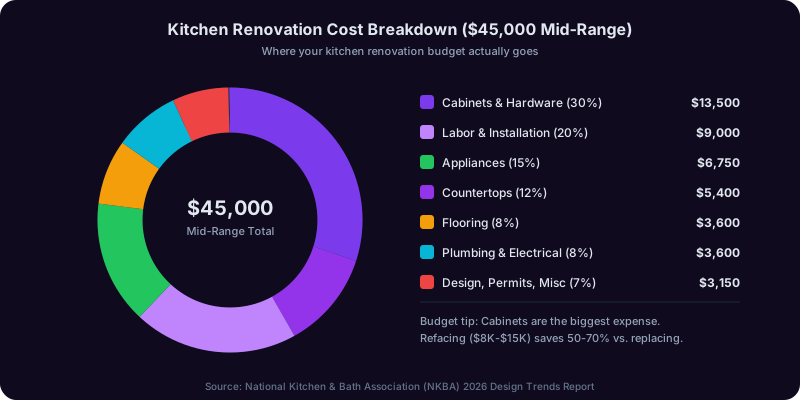
Kitchen: The $13,500 Cabinet Decision
Cabinets consume roughly 30% of a kitchen renovation budget. On a $45,000 mid-range kitchen, that is $13,500. You have three options with dramatically different price points:
- Stock cabinets ($100-$300 per linear foot installed): Pre-manufactured in standard sizes. Limited color and style options. Available at Home Depot, Lowe's, and IKEA. Best value for standard layouts.
- Semi-custom cabinets ($200-$600 per linear foot installed): Standard construction but with more size, style, and finish options. Available through cabinet dealers and kitchen showrooms. The sweet spot for most mid-range renovations.
- Custom cabinets ($500-$1,500 per linear foot installed): Built to your exact specifications. Unlimited options but 3-4x the cost of stock. Only justified if your kitchen has unusual dimensions or you want a truly unique design.
For a kitchen with 25 linear feet of cabinets, the difference between stock ($5,000) and custom ($25,000) is $20,000 on cabinets alone. Cabinet refacing, where you keep the existing cabinet boxes and replace only the doors and drawer fronts, costs $8,000-$15,000 and saves 50-70% compared to full replacement.
Kitchen Countertops: Material Matters
| Material | Cost per sq ft (installed) | Durability | Maintenance |
| Laminate | $25 - $65 | Good (10-15 years) | Low |
| Butcher Block | $40 - $100 | Fair (requires care) | High (oiling, sealing) |
| Quartz | $60 - $150 | Excellent (25+ years) | Very Low |
| Granite | $50 - $200 | Excellent (25+ years) | Low (annual sealing) |
| Marble | $75 - $250 | Good (stains, etches) | High (frequent sealing) |
For a 40 sq ft countertop area, the difference between laminate ($1,800) and marble ($7,000) is over $5,000. Quartz at $80/sq ft ($3,200 total) offers the best balance of durability, appearance, and maintenance for most homeowners.
Bathroom: The Tile and Fixture Trap
Bathrooms are deceptive because the room is small but the per-square-foot cost is the highest in the house. A full bathroom renovation can cost $250-$500 per square foot, compared to $100-$200 for a kitchen. The reason: nearly every surface needs waterproofing, tile, or specialty installation, and the plumbing density is extreme.
The biggest bathroom budget traps are:
- Tile labor: Materials might cost $5-$15/sq ft, but installation labor for walls and floors adds $8-$25/sq ft. A 100 sq ft shower enclosure can cost $2,500-$4,000 in labor alone.
- Moving plumbing: Keeping fixtures in their current locations saves $2,000-$5,000 compared to relocating them. Moving a toilet 4 feet requires cutting into the subfloor and rerouting the drain line.
- Vanity creep: A stock vanity from a home center runs $400-$1,200. A custom floating vanity with undermount sink can hit $3,000-$6,000.
The smartest budget move in a bathroom renovation is to keep the existing plumbing layout and focus your spending on surfaces and fixtures. This single constraint can cut your total cost by 20-30%. Our guide on first-time home buyer mistakes covers additional hidden costs that apply when you are renovating a recently purchased home.
Using AI to Estimate Renovation Costs and Validate Contractor Bids
The biggest financial risk in home renovation is not the project itself. It is the information asymmetry between you and your contractor. Contractors price jobs every day. You do it once every 5-10 years. AI tools are closing that gap by giving homeowners access to the same cost data and analysis that professionals use.
How AI Cost Estimation Works
AI renovation estimators aggregate data from hundreds of thousands of completed projects, adjusting for your ZIP code, project scope, material choices, and local labor rates. The better tools provide line-item breakdowns rather than just a total number. This is critical because a total estimate of $45,000 tells you very little, but a breakdown showing $13,500 for cabinets, $5,400 for countertops, and $9,000 for labor gives you specific numbers to compare against contractor bids.
What to Feed an AI Estimator
The accuracy of any AI estimate depends on the quality of your input. Provide:
- Room dimensions (length, width, ceiling height)
- Specific scope: Are you doing a full gut renovation or a cosmetic refresh? Are you changing the layout?
- Material preferences: Stock vs. semi-custom cabinets, quartz vs. laminate countertops, porcelain vs. ceramic tile
- Your ZIP code: Labor and material costs vary 15-35% between regions
- Permit requirements: Structural, plumbing, and electrical permits add $500-$3,000
- Demolition needs: Removing existing finishes, fixtures, and potentially hazardous materials (asbestos in older homes)
Comparing Contractor Bids with AI
When you receive 3-5 contractor bids, AI can help you identify inconsistencies and potential red flags. Here is what to look for:
| Issue | What It Means | Action |
| One bid is 30%+ lower than others | Missing scope, unlicensed, or bait-and-switch | Ask for a detailed line-item breakdown |
| One bid is 30%+ higher than others | Premium contractor, or padding the estimate | Compare line items to AI estimates |
| Vague line items ("miscellaneous" or "materials") | Hard to verify costs or dispute later | Request itemized breakdown of every category |
| No separate labor vs. materials | Cannot tell if material markup is reasonable | Ask contractor to split labor and materials |
| Low base bid with many "allowances" | Final cost will exceed the estimate | Get specific product selections priced in |
The Finance Copilot can help you analyze multiple contractor bids side by side, flag line items that seem inflated compared to regional averages, and calculate the true total cost including taxes, permits, and contingency. You can paste bid documents or screenshots directly into the chat for analysis.
The 15-20% Contingency Rule
Every renovation budget should include a 15-20% contingency for unexpected costs. This is not padding; it is realistic planning. Common surprises that eat into contingency funds include: water damage behind walls discovered during demolition, outdated wiring that needs upgrading to meet code, asbestos or lead paint in pre-1980 homes, subfloor damage beneath old flooring, and plumbing that fails inspection. On a $45,000 kitchen renovation, your true budget should be $51,750-$54,000 with contingency included. If you do not use the full contingency, that money goes back into your pocket. If you did not budget for it and hit an unexpected $7,000 expense, you are either borrowing more or cutting corners on finishes you already picked out.

Get Answers From the Finance Copilot
Ask a specialist AI copilot the question you just read about. Your first conversation needs no signup and no card.
Contractor Vetting, Bid Comparison, and Common Scams
The Better Business Bureau reports that home improvement is consistently one of the top 10 categories for consumer complaints, with an estimated $8.4 billion in home improvement fraud annually in the United States. Most homeowners who get burned did not get scammed by career criminals. They hired contractors who were underqualified, underinsured, or financially unstable and who could not complete the project as promised.
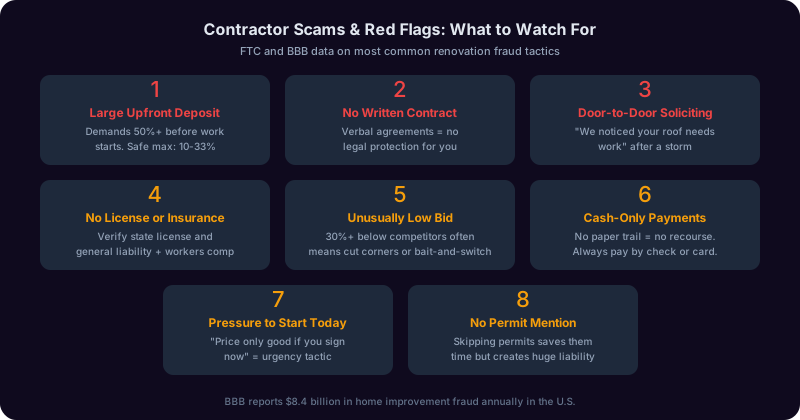
How to Vet a Contractor Properly
Before you accept any bid, verify these five things:
- State license: Most states require contractors to hold a license for work above a certain dollar threshold ($500-$1,000 in most states). Verify the license number on your state's contractor licensing board website. An unlicensed contractor who damages your home or injures a worker creates massive liability for you.
- Insurance: Require a Certificate of Insurance (COI) showing both general liability insurance (minimum $1 million) and workers' compensation insurance. Call the insurance company to confirm the policy is active. If an uninsured worker is injured on your property, you can be held liable.
- References and reviews: Ask for 3-5 references from projects similar to yours completed in the last 12 months. Call them. Also check Google Reviews, Yelp, Angi, and the BBB. A contractor with 50+ reviews averaging 4.5+ stars is a strong signal.
- Written contract: Every project should have a detailed written contract specifying scope of work, materials to be used (with specific product names and model numbers), payment schedule tied to milestones, start and completion dates with a penalty clause for delays, warranty terms, and the process for change orders.
- Lien waiver process: Require the contractor to provide lien waivers from subcontractors and material suppliers at each payment milestone. Without lien waivers, a subcontractor who was not paid by your general contractor can place a mechanic's lien on your home, even though you paid the GC in full.
Payment Structure That Protects You
The industry standard payment structure for a renovation is:
- 10-33% deposit at contract signing (never more than one-third)
- Milestone payments tied to completion of specific phases (demolition complete, rough-in complete, fixtures installed)
- 10% holdback until final walkthrough and punch list completion
Any contractor who demands 50% or more upfront is either financially unstable (using your deposit to finish someone else's job) or running a scam. A legitimate contractor has credit lines with material suppliers and does not need your full payment before starting.
The Change Order Trap
Change orders are modifications to the original scope of work after the contract is signed. They are the number one reason renovations go over budget. Some are legitimate: you discover knob-and-tube wiring that must be replaced, or the tile you selected is discontinued. But unscrupulous contractors use change orders to inflate the final price, presenting low initial bids knowing they will make their margin on changes.
Protect yourself by:
- Specifying in the contract that all change orders must be in writing with a price agreed upon before work proceeds
- Asking the contractor upfront: "What are the most common surprises you encounter on projects like mine?" A good contractor will be transparent about potential issues.
- Getting a not-to-exceed price on the overall project if the contractor is willing. This shifts the risk of surprises from you to them.
For help reviewing renovation contracts and understanding the fine print, our guide on avoiding costly home buyer mistakes covers contract analysis strategies that apply equally to renovation agreements.
Renovation ROI: Which Projects Add Value and Which Do Not
Not all renovations are created equal when it comes to recouping your investment at resale. The Remodeling Magazine Cost vs. Value Report, the industry's most-cited annual study, tracks the percentage of renovation cost recouped at resale across 150 U.S. markets. The data consistently shows that modest, practical projects outperform luxury upgrades.
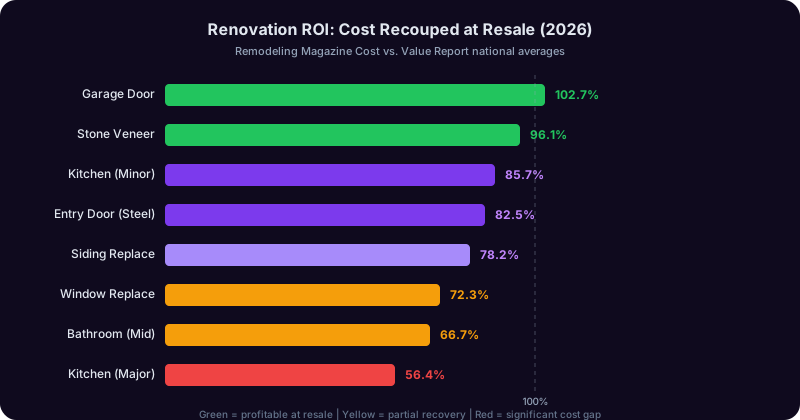
Highest ROI Renovations (75%+ Cost Recouped)
| Project | Average Cost | Resale Value Added | ROI |
| Garage door replacement | $4,302 | $4,418 | 102.7% |
| Manufactured stone veneer | $11,287 | $10,847 | 96.1% |
| Minor kitchen remodel | $27,492 | $23,560 | 85.7% |
| Steel entry door replacement | $2,214 | $1,828 | 82.5% |
| Vinyl siding replacement | $18,662 | $14,592 | 78.2% |
The pattern is clear: curb appeal projects and minor updates consistently outperform major interior renovations in terms of ROI. A $4,302 garage door replacement recoups more than its cost, while a $80,000 major kitchen renovation returns only 56% at resale. This does not mean major renovations are bad investments. It means you should not renovate primarily for resale value unless you are selling within 1-2 years.
Lowest ROI Renovations (Under 65%)
- Major kitchen remodel (56.4%): You spend $80,000 but add only $45,100 in resale value. The $34,900 gap is the cost of enjoying your dream kitchen.
- Master suite addition (48.1%): Adding a master suite costs $175,000+ and recoups under half. Buyers do not value added space at the cost to build it.
- Bathroom addition (53.8%): Adding a new bathroom costs $60,000-$80,000 and returns about $37,000. Adding a half-bath to a one-bathroom home is the exception, often recovering 70%+.
- Home office remodel (52.3%): Despite the work-from-home trend, dedicated office renovations do not translate to proportional resale value.
When ROI Does Not Matter
If you are renovating a home you plan to live in for 7-10+ years, ROI should be secondary to livability. A kitchen renovation that makes cooking enjoyable, a bathroom that starts your day right, or a finished basement that gives your family room to breathe provides value that transcends resale calculations. The financial question is not "Will I get my money back?" but rather "Can I afford to enjoy this improvement for the years I will use it?"
The Finance Copilot can help you model the long-term financial impact of different renovation scenarios, including how the improvement affects your property tax assessment, insurance premiums, and potential resale value based on comparable sales in your area. If you are building an emergency fund before committing to a renovation, our emergency fund guide explains how much cash reserve you need before taking on a major project.
Permit Requirements and Regional Cost Variations
Two factors that catch homeowners off guard are permit requirements and regional cost differences. A $45,000 kitchen renovation in Atlanta might cost $60,750 in New York City for exactly the same scope and materials, purely because of labor cost differences. And skipping a required permit can cost you far more than the permit fee when you try to sell the home.
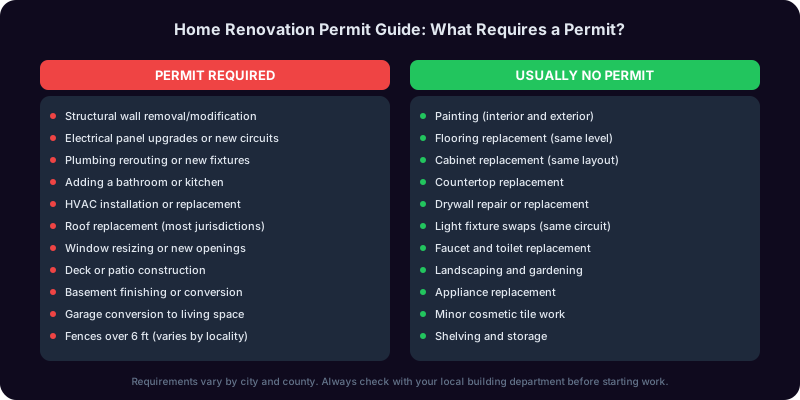
Why Permits Matter More Than You Think
Building permits are not just bureaucratic paperwork. They serve three critical functions:
- Safety: Inspections ensure that structural, electrical, and plumbing work meets building codes designed to prevent fires, collapses, and health hazards.
- Insurance: If unpermitted work causes damage (a fire from faulty wiring, for example), your homeowner's insurance may deny the claim. This is not a theoretical risk. Insurance companies routinely investigate the cause of claims and check permit records.
- Resale: When you sell your home, the buyer's inspector or appraiser may identify unpermitted work. This can kill a deal, require you to retrofit the work to code (at your expense), or force a significant price reduction. In some jurisdictions, you are legally required to disclose unpermitted work.
Permit Costs and Timelines
Permit costs vary by jurisdiction and project scope, but typical ranges are:
| Permit Type | Cost Range | Processing Time |
| Building permit (general renovation) | $400 - $2,000 | 2-6 weeks |
| Electrical permit | $50 - $500 | 1-3 weeks |
| Plumbing permit | $50 - $500 | 1-3 weeks |
| Mechanical/HVAC permit | $100 - $500 | 1-3 weeks |
| Demolition permit | $100 - $600 | 1-2 weeks |
For a major kitchen or bathroom renovation, expect to need a building permit, electrical permit, and plumbing permit at minimum. Total permit costs are typically $500-$3,000, and the process adds 2-6 weeks to your project timeline. Your contractor should handle the permit process, and their bid should include permit fees. If a contractor suggests skipping permits to save time or money, that is a red flag.
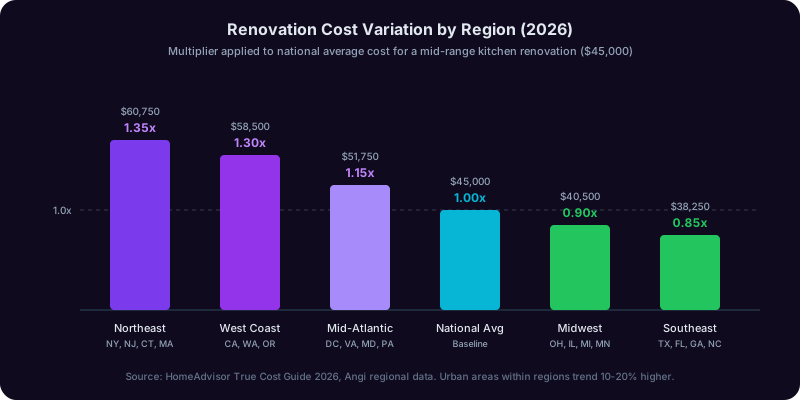
Regional Cost Multipliers
Labor costs are the primary driver of regional variation, and they are significant. The same kitchen renovation with the same materials can cost 50% more in the Northeast than in the Southeast. Within regions, urban areas trend 10-20% higher than suburban, and suburban trends 5-15% higher than rural. These multipliers matter when you are using national average data to set expectations.
To get accurate local pricing, combine AI estimates (which adjust for ZIP code) with 3-5 local contractor bids. If the AI estimate and the average of your local bids are within 10-15% of each other, you have a reliable budget number. If they diverge by more than 20%, investigate the discrepancy. Either the AI data is stale for your market, or the contractors are pricing outside the norm.
For homeowners who recently purchased and want to understand how renovation spending affects their broader financial picture, our guide on rent negotiation is relevant if you are renovating a rental property, and our credit score guide explains how financing a renovation through a HELOC or personal loan affects your credit.
Financing Your Renovation: HELOC, Personal Loans, and Other Options
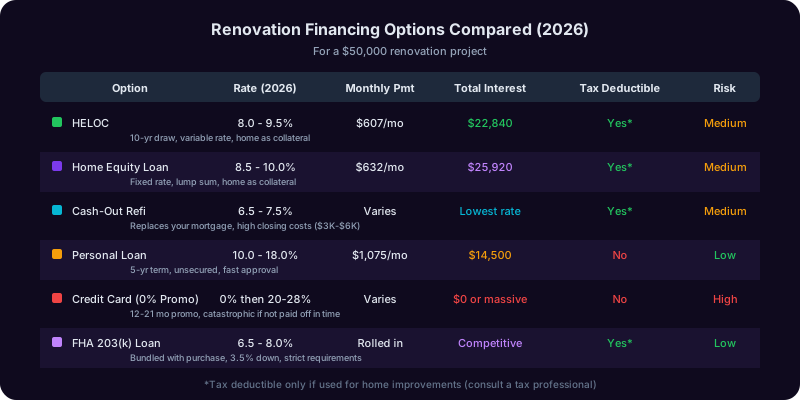
Unless you are paying cash, you need to choose a financing method. Each option has different interest rates, tax implications, risk levels, and approval requirements. The right choice depends on how much equity you have, the project size, and your risk tolerance.
HELOC (Home Equity Line of Credit)
A HELOC is a revolving line of credit secured by your home equity. In 2026, HELOC rates average 8.0-9.5% (variable, tied to the prime rate). You can draw funds as needed during a 5-10 year draw period, paying interest only on what you use. After the draw period, you enter a repayment period (typically 10-20 years) where you pay principal and interest.
Best for: Renovations where costs unfold over time (you do not know the exact total upfront) and homeowners with 20%+ equity. The flexibility to draw funds as needed matches the unpredictable cash flow of a renovation. Risk: Your home is collateral. If you cannot make payments, you risk foreclosure. Variable rates mean your payment can increase if the prime rate rises.
Home Equity Loan
A home equity loan provides a lump sum at a fixed interest rate, typically 8.5-10.0% in 2026. Unlike a HELOC, the rate does not change. You receive the full amount at closing and begin repaying immediately with fixed monthly payments over 5-30 years.
Best for: Homeowners who want payment predictability and have a well-defined renovation budget. If you know you need exactly $50,000, a home equity loan gives you certainty. Risk: Same as HELOC. Your home secures the loan. If you borrow $50,000 and the renovation only costs $40,000, you are paying interest on money you do not need.
Cash-Out Refinance
A cash-out refinance replaces your existing mortgage with a larger one, giving you the difference in cash. If your home is worth $400,000 and you owe $250,000, you could refinance for $300,000 and receive $50,000 in cash (minus closing costs of $3,000-$6,000).
Best for: Homeowners whose current mortgage rate is higher than today's refinance rates, making the refinance a double win (lower rate + renovation funds). Risk: You are increasing your mortgage balance and extending your repayment timeline. Closing costs are significant. In 2026, with rates at 6.5-7.5%, a cash-out refi only makes sense if your existing rate is above 7.5%.
Personal Loan
Unsecured personal loans for renovation range from 10-18% depending on credit score, with terms of 2-7 years. No home collateral is required, which eliminates foreclosure risk. Approval is based on income, credit score, and debt-to-income ratio.
Best for: Smaller renovations ($10,000-$25,000), homeowners without sufficient equity for a HELOC, or those unwilling to put their home at risk. The higher interest rate is the price of not pledging your home as collateral. For a $20,000 bathroom renovation on a 5-year personal loan at 12%, your monthly payment is approximately $445 with total interest of $6,700.
FHA 203(k) Rehabilitation Loan
If you are purchasing a home that needs renovation, an FHA 203(k) loan bundles the purchase price and renovation costs into a single mortgage with a 3.5% down payment. There are two types: the Standard 203(k) for renovations over $35,000 (requires a HUD consultant) and the Limited 203(k) for renovations under $35,000. This is the most powerful financing tool for buyers purchasing fixer-uppers.
The Finance Copilot can help you compare these options side by side based on your specific equity position, credit score, renovation budget, and risk tolerance. It can also calculate the break-even point between a HELOC and a personal loan, accounting for the tax deductibility of home equity interest. If you are weighing renovation financing against other financial goals, our investing guide explains the opportunity cost of diverting savings into home improvements versus market investments.
How Copilotly Helps You Budget and Manage Your Renovation
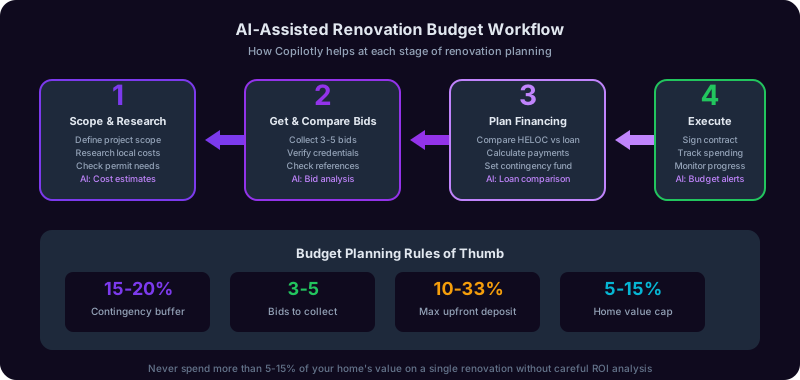
Renovation planning involves dozens of financial decisions spread across weeks or months: estimating costs, comparing bids, choosing financing, tracking spending, and evaluating change orders. Copilotly's AI copilots act as an always-available financial analyst that helps you make better decisions at each stage.
Cost Estimation and Validation
The Finance Copilot can help you build a detailed renovation budget based on your specific project. Describe your renovation scope, dimensions, material preferences, and location, and the AI provides line-item cost estimates calibrated to your region. Use this as a baseline before collecting contractor bids, so you walk into the bidding process with informed expectations rather than going in blind.
When contractor bids come in, paste them into the chat for side-by-side analysis. The AI highlights line items that appear significantly above or below regional norms, flags vague scope descriptions that could lead to change orders, and identifies missing items that contractors may have intentionally omitted to appear cheaper (a common bait-and-switch tactic).
Financing Analysis
Choosing between a HELOC, home equity loan, personal loan, or cash-out refinance involves multiple variables that interact in complex ways. The Finance Copilot can model different scenarios: "If I take a $50,000 HELOC at 8.5% versus a personal loan at 12%, what is the total cost difference over 5 years? What if the HELOC rate increases by 2%?" These calculations take into account tax deductibility, monthly cash flow impact, and total interest paid.
Contract and Bid Review
The Home Copilot can help you understand renovation contracts, identify missing protections (like lien waiver requirements or change order protocols), and prepare questions for your contractor. It can also help you write a clear scope of work document that minimizes ambiguity, one of the leading causes of contractor disputes.
Ongoing Budget Tracking
As your renovation progresses, use the Finance Copilot to track spending against your budget. Log each payment and change order, and the AI maintains a running tally showing where you stand relative to your original budget and contingency fund. This real-time awareness prevents the slow budget creep that causes many renovations to exceed their target by 20-30%.
ROI and Resale Impact
Considering selling within a few years? The Finance Copilot can estimate the resale impact of different renovation choices using Cost vs. Value data for your region. This helps you prioritize projects that maximize home value rather than overspending on improvements with poor returns. For example, a $4,300 garage door replacement that recoups 102% of its cost is a smarter financial move than a $80,000 kitchen overhaul that returns 56%, even if the kitchen is more exciting.
Getting Started
The best time to involve AI in your renovation planning is before you contact a single contractor. Build your budget estimate, understand your financing options, and define your scope clearly. Then use that preparation to evaluate contractor bids from a position of knowledge rather than uncertainty. The Finance Copilot is available as part of Copilotly's browser extension, giving you instant access to renovation budgeting assistance while you research materials, compare contractors, or browse financing options online. If you are also managing other financial priorities alongside your renovation, our student loan repayment guide and emergency fund guide can help you balance competing financial goals.
Frequently Asked Questions
Recommended Copilots
Related Articles
Get Answers From the Finance Copilot
Ask a specialist AI copilot the question you just read about. Your first conversation needs no signup and no card.