
Why Career Pivots Are Accelerating -- and Why Most Fail
Career pivots are no longer rare acts of professional courage. They are becoming a structural feature of the modern labor market. According to the World Economic Forum's Future of Jobs Report, 44% of workers' core skills will be disrupted in the next five years, and 69% of professionals surveyed by LinkedIn in early 2026 said they were actively considering or planning a career change. This is not restlessness. It is rational adaptation to a labor market being reshaped by AI, automation, and the collapse of traditional career ladders.
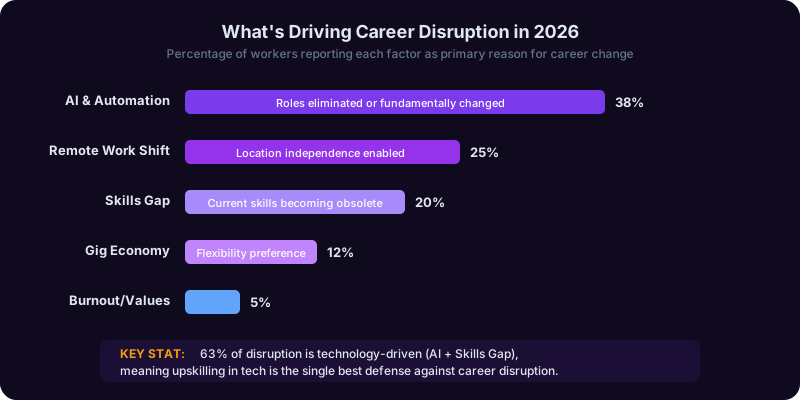
Yet despite this widespread desire to change, most career pivots fail. Research from the Bureau of Labor Statistics shows that the median tenure at a job is now just 3.9 years, and while people switch jobs frequently, relatively few successfully cross into entirely new industries or functions. The failure patterns are consistent:
- No structured timeline. Most career changers operate on vague intentions rather than a concrete, phased plan. They browse job boards sporadically rather than executing a systematic transition.
- Identity anchoring. Professionals define themselves by their current title ("I am an accountant") rather than their transferable capabilities ("I analyze complex data, identify patterns, and communicate financial risk"). This framing makes it psychologically difficult to see a path forward.
- Financial pressure. Without a financial buffer or a clear understanding of the income trajectory in a new field, anxiety overwhelms the transition. Many retreat to the safety of their current role after a few weeks of uncertainty.
- Misunderstanding the hiring landscape. The rise of skills-based hiring means that the rules have changed, but most career changers are still playing by the old rules of matching job titles to job titles rather than demonstrating transferable competencies.
The good news: career pivots have a dramatically higher success rate when they follow a structured plan with clear milestones, financial guardrails, and deliberate skill bridging. This guide provides that plan -- a 90-day framework that has been refined from career coaching best practices, labor market data, and the experiences of thousands of successful career changers.
The plan divides into four phases: Assessment (Days 1-10), Targeting (Days 11-30), Bridge Building (Days 31-60), and Active Search (Days 61-90). Each phase has specific deliverables, and skipping phases is the single biggest predictor of a failed pivot. If you are currently evaluating whether to leave your current role, our guide to quitting your job professionally covers the tactical exit process once you are ready to make the move.
Phase 1: Self-Assessment and Skills Inventory (Days 1-10)
The first 10 days of your career pivot are not about job searching. They are about building a clear, honest inventory of what you bring to a new career -- and what gaps you need to close. This phase is where most people cut corners, and it is exactly why they end up in the wrong role six months later.
Step 1: Map your transferable skills. Every professional has a portfolio of skills that cross industry boundaries. The challenge is that most people cannot articulate them because they are embedded in industry-specific language. A project manager at a construction firm and a product manager at a tech company share 70-80% of the same core competencies: stakeholder management, timeline planning, resource allocation, risk assessment, and cross-functional communication. But neither can see the overlap until they strip away the industry jargon.
Create three lists:
- Hard skills: Technical capabilities that can be demonstrated and measured. Data analysis, financial modeling, regulatory compliance, software proficiency, writing, research methodology, process design.
- Soft skills: Interpersonal and cognitive capabilities that transfer universally. Leadership, negotiation, conflict resolution, presentation, mentoring, strategic thinking, crisis management.
- Domain knowledge: Industry-specific expertise that may have surprising value in adjacent fields. Healthcare compliance knowledge transfers to health-tech companies. Manufacturing process expertise transfers to supply chain consulting. Education curriculum design transfers to corporate learning and development.
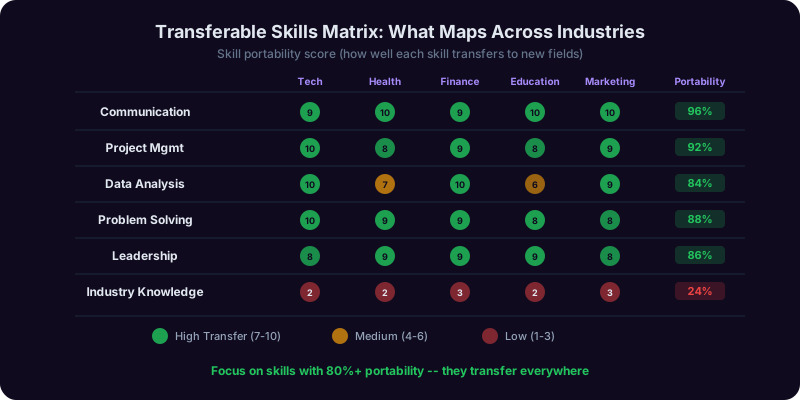
Step 2: Quantify your accomplishments. For each significant role in your career, document 5-8 accomplishments using this formula: Action + Metric + Context. "Managed" becomes "Reduced vendor costs by 22% ($340K annually) by renegotiating 14 supplier contracts during a supply chain disruption." This quantification is essential not just for your resume, but for helping you see your own value through the lens of a new industry. A hiring manager in tech does not care that you "managed budgets" in healthcare -- but they absolutely care that you controlled $4.2M in annual spend with 98% accuracy across 23 cost centers.
Step 3: Take a values and motivations audit. Career pivots driven purely by salary or escaping a bad boss have the highest failure rates. Pivots driven by alignment between your values, strengths, and market demand succeed at 3x the rate. Ask yourself:
- What tasks give you energy even when they are difficult?
- What types of problems do you naturally gravitate toward solving?
- What work environment brings out your best performance (team size, autonomy level, pace)?
- What is your non-negotiable minimum compensation, and what would you trade salary for (flexibility, purpose, growth)?
Step 4: Get external feedback. Your self-assessment has blind spots. Contact 5-8 former colleagues, managers, and collaborators and ask them two questions: "What do you think I do better than most people?" and "If you were hiring for a new team, what role would you put me in?" The patterns in their answers often reveal strengths and career directions you have overlooked.
The Career Copilot can guide you through a structured skills assessment, help you translate industry-specific experience into transferable language, and identify skill gaps for your target careers.
Phase 2: Targeting AI-Resilient Careers and Industries (Days 11-30)
With your skills inventory complete, the next 20 days focus on identifying the specific careers and industries where your existing capabilities create the most value -- and where AI is creating opportunity rather than eliminating it. This is where data replaces guesswork.
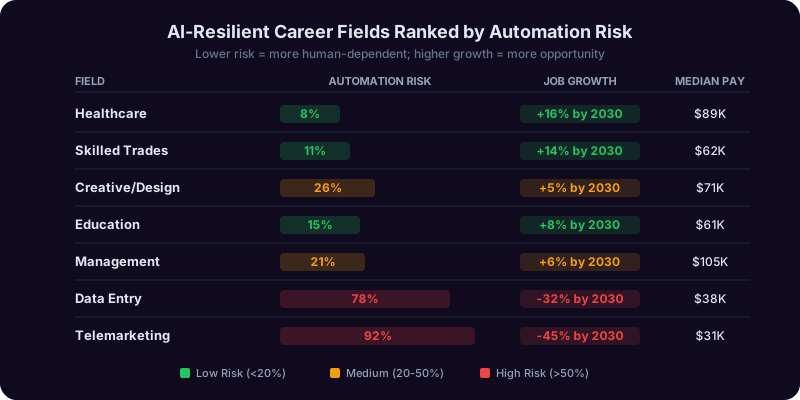
Understanding AI-resilient versus AI-vulnerable careers. The World Economic Forum projects that while AI will displace approximately 92 million jobs by 2030, it will simultaneously create 170 million new roles -- a net gain of 78 million positions. The critical distinction is not whether AI affects your target career, but whether it amplifies human capability in that role or replaces it entirely.
Careers with the highest AI resilience share three characteristics:
- Complex human judgment: Roles requiring contextual decision-making, ethical reasoning, or navigating ambiguity. Examples: healthcare practitioners, strategic consultants, organizational change managers, regulatory specialists.
- Physical-world interaction: Work that requires presence, dexterity, or spatial navigation in unpredictable environments. Examples: skilled trades (electricians, plumbers), infrastructure engineers, logistics coordinators, environmental scientists.
- Creative and relational work: Roles centered on building trust, resolving conflict, inspiring action, or producing original creative work. Examples: sales leadership, therapeutic services, UX research, brand strategy, executive coaching.
The AI literacy salary premium. Across virtually every industry, professionals who combine domain expertise with AI literacy command a 25-40% salary premium over those with domain expertise alone. A marketing manager who can use AI tools for audience segmentation, content optimization, and campaign analytics earns 28-35% more than a marketing manager who cannot. A financial analyst who can build AI-assisted forecasting models earns 30-40% more than one relying solely on traditional methods. This premium exists because most organizations need people who can bridge the gap between AI capability and business application -- and that bridge requires both technical fluency and domain knowledge.
How to research your target careers:
- Use the BLS Occupational Outlook Handbook for salary ranges, growth projections, and educational requirements across 800+ occupations. Filter by projected growth rate (aim for 8%+ annual growth through 2030).
- Analyze job postings at scale. Search your target roles on LinkedIn and Indeed. Read 30-50 job descriptions and track the most frequently requested skills, certifications, and experience levels. Identify which requirements you already meet and which represent gaps.
- Calculate your "skill overlap percentage." For each target role, estimate the percentage of required skills you already possess. Aim for roles where you have 60-80% skill overlap. Below 60%, the ramp-up time makes the pivot impractical within 90 days. Above 80%, you are likely making a lateral move rather than a genuine pivot.
Narrow to 2-3 target roles. Pursuing more than three targets simultaneously dilutes your effort and messaging. Select targets based on three criteria: market demand (growing field with hiring activity), skill overlap (60-80% match), and personal alignment (the values audit from Phase 1). For each target, define the specific job title, industry vertical, company size range, and geographic market you are pursuing. Vague targets produce vague results.
If your career pivot involves starting something independent rather than finding a new employer, our side hustle guide covers the financial and operational fundamentals of launching an independent venture.

Get Answers From the Career Copilot
Use the Career Copilot to assess your transferable skills, identify AI-resilient career targets, reposition your resume for a new industry, and prepare for interviews. The Writing Copilot can refine your professional narrative, and the Finance Copilot can help you plan the financial transition.
The Skills-Based Hiring Revolution: Why Career Changers Have a Historic Advantage
If you tried to change careers five years ago, you faced a wall of job postings demanding 3-5 years of direct industry experience, specific degree requirements, and a linear career trajectory. That wall is crumbling. The shift to skills-based hiring is the single most important structural change working in favor of career pivoters in 2026.
According to LinkedIn's 2026 Future of Recruiting report, 70% of employers now prioritize demonstrated skills over traditional qualifications like degrees and years of industry experience. This is not a philosophical shift -- it is a practical response to talent shortages that forced companies to expand their candidate pools.
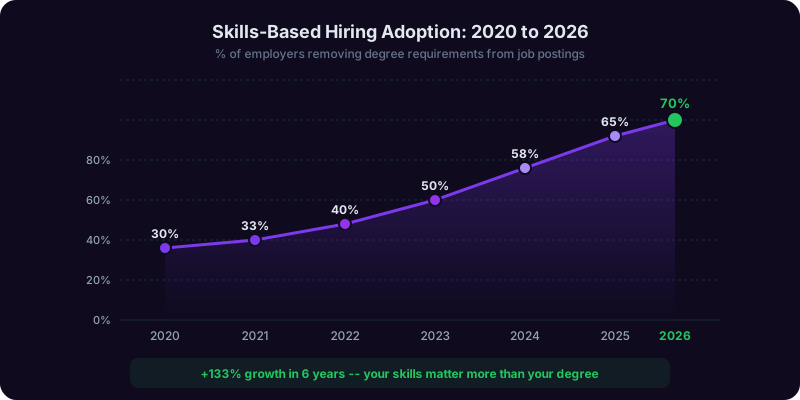
What skills-based hiring means for your pivot:
- Degree requirements are disappearing. Companies including Google, IBM, Apple, Delta, and Walmart have removed degree requirements from the majority of their job postings. The federal government followed in 2025, eliminating degree requirements for 100,000+ positions. If you are avoiding a career change because you lack the "right" degree for your target field, that barrier is significantly lower than it was even two years ago.
- Skills assessments replace resume screening. More employers now evaluate candidates through practical skills assessments, portfolio reviews, and work simulations rather than keyword-scanning resumes. This is an advantage for career changers because you can demonstrate competence directly rather than relying on a linear career narrative.
- Micro-credentials carry real weight. Industry-recognized certifications, professional certificates, and demonstrated project work now serve as legitimate skill validation. A 6-week data analytics certificate from Google or a project management credential from PMI signals competence to employers in ways that matter more than a tangentially related degree from 15 years ago.
How to leverage skills-based hiring in your pivot:
1. Build a skills portfolio. Create a digital portfolio that demonstrates your capabilities through tangible work products rather than employment history. This can include case studies from your current role (anonymized if necessary), personal projects, volunteer work, freelance deliverables, or coursework outputs. A marketing professional pivoting to UX research might include competitive analyses, user survey designs, and data interpretation reports that demonstrate research methodology even without UX-specific job titles on the resume.
2. Target companies that explicitly practice skills-based hiring. Look for signals in job postings: phrases like "equivalent experience considered," skills-based qualification lists rather than rigid degree/experience requirements, and assessment-based hiring processes. Companies that list "what you will do" before "what you need" tend to be more open to non-traditional candidates.
3. Earn strategic micro-credentials. Identify 1-2 certifications that directly address the highest-priority skill gap between your current profile and your target role. Prioritize credentials that are: recognized in your target industry, completable in 4-8 weeks, and tied to a practical project you can add to your portfolio. Avoid credential-stacking (collecting 5-6 certificates) -- it signals a lack of focus and rarely impresses hiring managers more than 1-2 targeted credentials paired with demonstrated application.
4. Reframe your experience in skills language. Instead of "10 years in pharmaceutical sales," lead with "consultative selling, complex stakeholder management, regulatory-aware communication, and data-driven territory optimization across a $12M annual portfolio." The skills are the same. The framing makes them visible to hiring managers in any industry. For a detailed guide on framing your experience for maximum impact, see our cover letter writing guide, which covers the same reframing principles.
The Career Copilot can help you translate your current experience into skills-based language and identify the highest-value micro-credentials for your specific career pivot target.
Phase 3: Bridge Building -- Closing Skill Gaps and Building Credibility (Days 31-60)
You have assessed your skills and selected your targets. Days 31 through 60 are about closing the gaps between where you are and where you need to be. This is the most active phase of the pivot -- the period where you build tangible evidence that you belong in your new field.
The AI literacy fast-track. Regardless of your target career, AI literacy is the single highest-ROI skill investment you can make during your pivot. As noted earlier, the salary premium for AI-literate professionals is 25-40% across industries. But "AI literacy" does not mean learning to code machine learning models. For most career changers, it means:
- Understanding what AI can and cannot do in your target industry. Which tasks are being automated? Which are being augmented? Where are the human-AI collaboration points?
- Proficiency with AI-powered tools relevant to your target role. If you are pivoting to marketing, this means AI content tools, analytics platforms, and audience segmentation systems. If you are pivoting to project management, it means AI scheduling, resource optimization, and risk prediction tools.
- The ability to evaluate AI outputs critically. Knowing when an AI-generated analysis is reliable and when it needs human verification is a skill that separates competent professionals from those who blindly trust or blindly distrust technology.
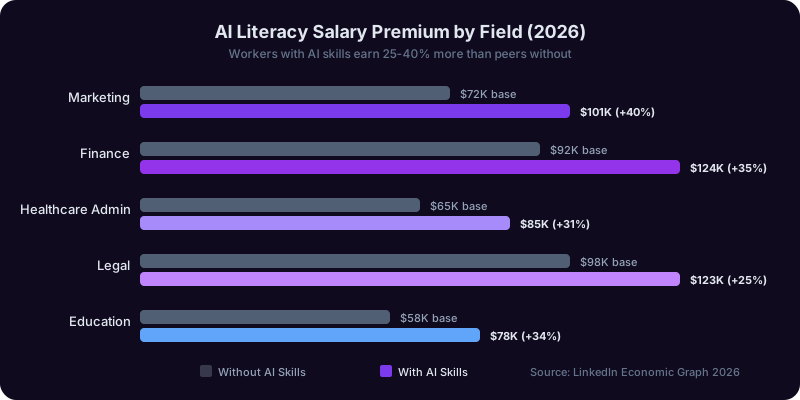
Strategic upskilling plan. You have approximately 30 days in this phase. Do not try to learn everything. Focus on closing the top 2-3 skill gaps that appeared most frequently in the 30-50 job descriptions you analyzed during Phase 2. Structure your learning:
- Week 1-2: Complete one targeted certification or course that addresses your most critical skill gap. Dedicate 1-2 hours per day (10-15 hours per week). Prioritize courses that include practical projects rather than lecture-only formats.
- Week 3-4: Build a bridge project. This is a self-directed project that demonstrates your new skills applied to a real problem in your target industry. A financial analyst pivoting to data science might build a predictive model using publicly available data. A teacher pivoting to corporate L&D might design a training curriculum for a fictional company onboarding program. The project does not need to be polished -- it needs to be real enough to discuss in interviews and demonstrate that you can operate in the new context.
Informational interviews: your secret weapon. During this phase, conduct 8-12 informational interviews with people currently working in your target role or industry. These conversations serve three critical purposes:
- Reality-checking your assumptions. What you think a role involves from the outside is often dramatically different from the daily reality. Better to discover this during the research phase than after you have accepted an offer.
- Building insider vocabulary. Every industry has its own language, priorities, and pain points. Informational interviews immerse you in this language so you can speak it authentically in interviews.
- Creating warm connections. A well-conducted informational interview creates a relationship with someone who may later refer you to open positions, introduce you to hiring managers, or serve as a reference. This is not networking manipulation -- it is genuine relationship building rooted in curiosity about their experience.
For each informational interview, prepare 5-7 thoughtful questions, keep the conversation to 20-25 minutes, send a personalized thank-you within 24 hours, and follow up once per month with relevant articles or insights. Do not ask for a job during an informational interview. If the relationship develops naturally, job referrals will follow organically.
Volunteer and freelance strategically. If you can take on 1-2 volunteer projects or small freelance engagements in your target field during this phase, the credibility impact is enormous. Even 10-20 hours of real work in your new industry gives you recent, relevant experience to discuss in interviews and list on your resume. Nonprofit organizations, small businesses, and startups are often willing to accept pro bono or discounted work from skilled professionals transitioning into new fields. For guidance on setting rates if you pursue freelance bridge work, see our freelance rate calculator guide.
The Career Copilot can help you prepare informational interview questions, identify the highest-impact certifications for your pivot, and structure bridge projects that demonstrate your capabilities to hiring managers.
Resume Repositioning: Rewriting Your Story for a New Industry
Your resume is not a chronological record of your employment history. It is a marketing document designed to convince a specific audience that you can solve their problems. When you are changing careers, this distinction becomes critical. A resume written for your current industry will actively work against you when applied to a new one. You need to reposition it.
The combination resume format. Career changers should use a combination (hybrid) resume format that leads with a skills-based summary followed by a reverse-chronological work history. This format puts your transferable capabilities front and center while still providing the employment timeline that hiring managers and applicant tracking systems expect.
Structure your repositioned resume:
- Professional summary (3-4 sentences): Lead with your target role identity, not your current one. "Data-driven operations leader transitioning to product management" is stronger than "Operations manager with 12 years of experience." Include your total years of relevant experience, your 2-3 strongest transferable skills, and a brief statement of what you bring to the target role.
- Core competencies section: List 8-12 skills that are directly relevant to your target role, drawn from the skills you identified in Phase 1 and the job descriptions you analyzed in Phase 2. Mirror the exact language used in your target industry. If job postings say "cross-functional collaboration," do not write "working with different departments."
- Professional experience: For each role, rewrite your bullet points to emphasize the aspects of your work that are most relevant to your target career. You are not fabricating experience -- you are selecting and framing the experiences that create the strongest bridge to your new field. Use the Action + Metric + Context formula from Phase 1.
- Bridge experience section: If you completed volunteer work, freelance projects, or a bridge project during Phase 3, include it. Label it "Selected Projects" or "Professional Development" and describe it with the same rigor as paid employment.
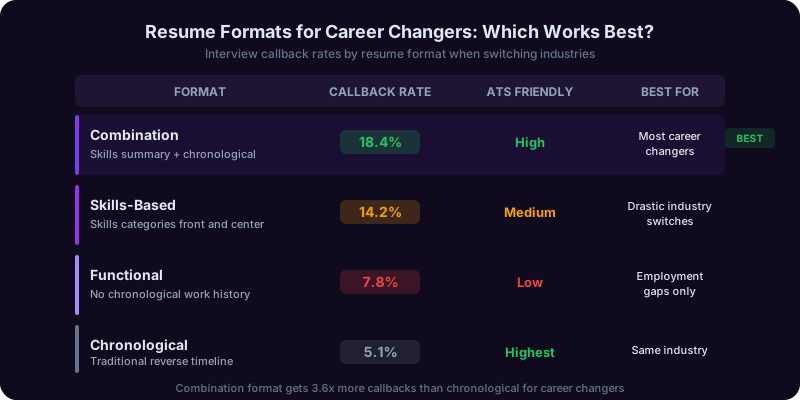
ATS optimization for career changers. Applicant tracking systems are trained to match keywords from job descriptions to resume content. Career changers face a unique ATS challenge because their previous job titles and industry terminology may not match the target role's keyword profile. To address this:
- Use target-industry terminology in your skills section and bullet points, even when describing past-industry work. If your target industry calls it "stakeholder engagement" and your current industry calls it "client management," use both terms.
- Include your target job title in your professional summary. ATS systems weight title matches heavily.
- Add relevant certifications and tools. Even newly completed certifications signal relevance to ATS keyword matching.
The cover letter as a bridge narrative. For career changers, the cover letter is not optional. It is your chance to explain the "why" behind your pivot in a way that a resume cannot. A strong career-change cover letter addresses three questions: (1) Why are you making this change? (2) What from your background directly prepares you for this role? (3) What have you done to bridge the gap? Keep it to 250-350 words and focus on specific, concrete connections between your experience and the target role. For detailed cover letter guidance, our cover letter writing guide includes templates specifically designed for career changers.
Tailor for every application. A single generic resume will not work for a career pivot. Create a master resume with all of your experience reframed for your target industry, then customize it for each specific application by adjusting your summary, reordering your skills, and emphasizing the bullet points most relevant to that particular role. This takes 15-20 minutes per application but dramatically increases your callback rate.
The Career Copilot can help you rewrite resume bullet points in your target industry's language, optimize for ATS keyword matching, and create tailored versions for specific job applications. The Writing Copilot can refine the language and flow of your professional summary and cover letter.
Phase 4: Active Search, Networking, and Financial Planning (Days 61-90)
The final 30 days of your pivot plan shift from preparation to execution. You have your skills inventory, your target roles, your bridge experience, and your repositioned resume. Now you need to find the right opportunity and manage the financial transition.
The multi-channel job search strategy. Career changers who rely exclusively on online applications have a success rate below 5%. The most effective strategy combines multiple channels simultaneously:
- Referral network (target: 40% of effort). This is your highest-conversion channel. By Day 61, your informational interviews from Phase 3 have built a network of 8-12 contacts in your target industry. Now activate those relationships. Let them know you are actively looking, share your repositioned resume, and ask specifically: "Are there any open roles on your team or in your network where my background would be a good fit?" Referred candidates are 4-5x more likely to be hired than cold applicants. If your contacts cannot refer you directly, ask for introductions to hiring managers or recruiters specializing in your target field.
- Targeted applications (target: 30% of effort). Apply to 3-5 positions per week, prioritizing roles that match your skill overlap analysis from Phase 2. Customize every application. Quality over quantity is essential for career changers because each application requires significant tailoring.
- Recruiters and staffing firms (target: 15% of effort). Connect with 3-5 recruiters who specialize in your target industry. Be transparent about your career change and lead with your transferable skills and bridge experience. Some recruiters actively seek career changers for clients who value diverse perspectives.
- LinkedIn visibility (target: 15% of effort). Update your LinkedIn headline to reflect your target role ("Operations Leader Transitioning to Product Management | Certified in Agile & Data Analytics"). Publish 1-2 posts per week sharing insights relevant to your target industry. Engage thoughtfully with content from leaders in your target field. This passive visibility generates inbound interest from recruiters and hiring managers.
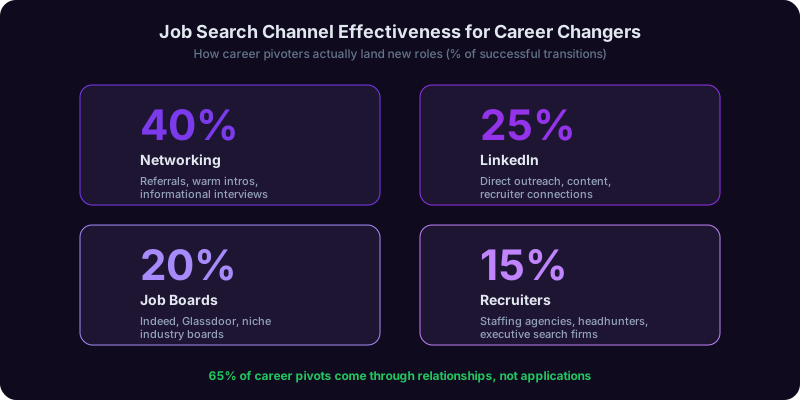
Financial planning for the transition. The financial dimension of a career pivot is where plans most often unravel. Build a transition budget that accounts for these realities:
- Income gap period. Even with the 90-day plan, most career changers experience a 1-3 month income gap between leaving their current role and starting the new one. Calculate your minimum monthly expenses (housing, insurance, food, debt payments) and ensure you have at least 3-6 months of this amount in liquid savings before making the leap.
- Potential salary adjustment. Career changers often take a 5-15% salary reduction in their first role in a new industry, though this is recovered within 18-24 months as they establish credibility. The AI literacy premium can offset or eliminate this gap entirely.
- Upskilling costs. Budget $500-$3,000 for certifications, courses, and professional development. Many are available for under $500 through platforms like Coursera, edX, and Google Career Certificates.
- Health insurance continuity. If you leave your current employer before securing a new role, you need a health insurance plan. COBRA, ACA Marketplace, and spouse coverage are your primary options. For a detailed comparison, see our guide to quitting your job professionally, which includes a section on health insurance transitions.
The two-track approach. Many successful career changers do not quit their current job first. Instead, they execute this 90-day plan while still employed, dedicating evenings and weekends to skill building, networking, and applications. This eliminates financial risk entirely and allows you to negotiate from a position of strength when offers arrive. The tradeoff is pace -- it may extend your timeline from 90 days to 120-150 days.
For detailed guidance on evaluating compensation offers in your new field, our salary negotiation guide provides frameworks for evaluating and negotiating total compensation packages, including when you have less leverage as a career changer.
The Career Copilot can help you structure your job search across channels, prepare for interviews in your new field, and develop responses to the inevitable question: "Why are you changing careers?"
How Copilotly Supports Every Phase of Your Career Pivot
Changing careers is one of the most complex professional challenges you can face. It involves self-assessment, market research, skill development, personal branding, financial planning, and sustained emotional resilience across months of uncertainty. Copilotly is designed to provide structured, personalized guidance at every stage of this journey.
Phase 1 -- Assessment: The Career Copilot guides you through a comprehensive skills inventory, helping you identify and articulate transferable capabilities you may have overlooked. It translates your industry-specific experience into universal, skills-based language that resonates across industries. Instead of spending days trying to categorize your own skills, you can have a structured conversation that surfaces your strongest transferable competencies in minutes.
Phase 2 -- Targeting: The Career Copilot helps you evaluate target careers based on your skill overlap, market demand, and personal values. It provides data-driven guidance on which fields are growing, which are contracting, and where your specific background creates the most value. It can help you calculate the realistic salary range for your target role and estimate the AI literacy premium available in your chosen field.
Phase 3 -- Bridge Building: During the skill-building phase, the Career Copilot helps you identify the highest-impact certifications and learning paths for your specific pivot. It can generate informational interview questions tailored to your target role, help you design bridge projects that demonstrate relevant capabilities, and prepare you for the nuances of your new industry's interview culture.
Phase 4 -- Active Search: When you are applying for roles, the Career Copilot helps you tailor your resume and cover letter for each specific application, ensuring your transferable skills are framed in your target industry's language. It can prepare you for behavioral interviews with industry-specific scenarios, help you develop your career-change narrative, and coach you through salary negotiations in a new field.
Additional Copilotly tools for career changers:
- The Writing Copilot helps you craft compelling professional summaries, LinkedIn content, and networking messages that establish your credibility in your new field.
- The Finance Copilot helps you build a transition budget, model different income scenarios, and plan for the financial realities of a career change including savings drawdown, compensation adjustments, and benefit gaps.
- The Budgeting Copilot helps you create a month-by-month spending plan for the transition period, ensuring you maintain financial stability throughout your pivot.
The career change narrative. One of the most powerful ways Copilotly assists career changers is in crafting their transition story. Every interviewer will ask why you are changing careers. The answer needs to be concise, confident, and forward-looking. It should connect your past experience to your future goals through a logical bridge that makes the interviewer think, "Of course -- this makes perfect sense." The Career Copilot helps you develop this narrative by identifying the strongest connection points between your background and your target role, turning what feels like a disjointed career history into a compelling story of intentional professional evolution.
For more context on how AI career coaching tools compare with traditional human coaching, especially for career transitions, see our detailed comparison in the AI career coach vs. human career coach guide.
Career pivots are hard. They require courage, planning, sustained effort, and the willingness to be a beginner again. But they are also one of the most rewarding professional decisions you can make -- and with a structured plan, the right tools, and the support of AI-powered guidance, the 90-day timeline from consideration to career change is genuinely achievable.
Frequently Asked Questions
Recommended Copilots
Recommended Copilots
Get personalized guidance on skills assessment, career targeting, resume repositioning, and interview preparation for your career pivot
Try Free →Craft compelling professional summaries, cover letters, LinkedIn profiles, and networking messages for your new industry
Try Free →Model income scenarios, plan your transition budget, and evaluate compensation packages in your target field
Try Free →Related Articles
Get Answers From the Career Copilot
Use the Career Copilot to assess your transferable skills, identify AI-resilient career targets, reposition your resume for a new industry, and prepare for interviews. The Writing Copilot can refine your professional narrative, and the Finance Copilot can help you plan the financial transition.