

Legal Definitions and Differences
Employers use terms like "fired," "laid off," "let go," "terminated," and "separated" interchangeably, but they have distinct legal meanings that directly affect your rights, unemployment eligibility, and future job prospects.
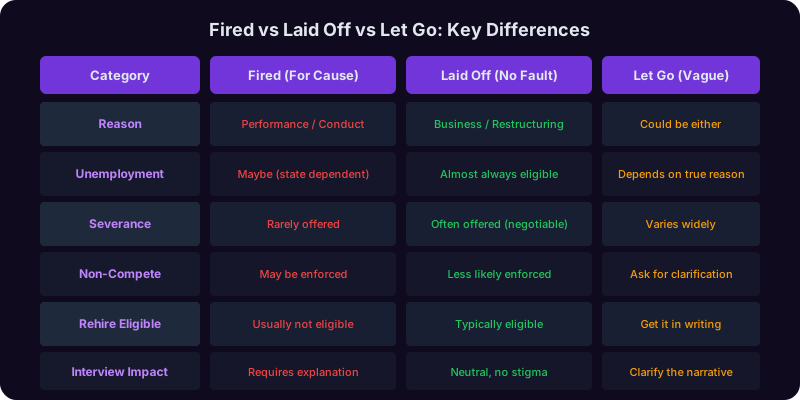
Fired (terminated for cause) means your employer ended your employment due to your actions or performance. Common reasons include policy violations, poor performance (after documented warnings), misconduct, insubordination, or attendance issues. Being fired is an individual action directed at you specifically because of something you did or failed to do.
Laid off (terminated without cause) means your employer eliminated your position due to business reasons unrelated to your performance. This includes restructuring, budget cuts, mergers, position elimination, and company-wide reductions in force (RIFs). Layoffs are not personal. They are business decisions that could happen to anyone in the affected roles.
Let go is an informal term that employers use deliberately because it is vague. It can mean either fired or laid off. When an employer says "we are letting you go," you should ask directly: "Is this a layoff or am I being terminated for cause?" The answer matters for unemployment benefits and how you describe the departure to future employers.
Forced resignation is when an employer pressures you to resign rather than be fired. This is a tactic to avoid paying unemployment benefits and to limit their legal exposure. If you are given the choice to resign or be fired, do not resign on the spot. Ask for time to consult an attorney. In many cases, accepting the termination (rather than resigning) preserves your right to unemployment benefits. According to the Bureau of Labor Statistics Job Openings and Labor Turnover Survey, layoffs and discharges fluctuate significantly by industry and economic cycle, making it essential to understand which category your separation falls into.
The critical distinction for your finances: laid-off employees are almost always eligible for unemployment benefits. Fired employees may or may not be eligible, depending on the reason for termination and your state's rules. Employees who voluntarily resign are generally not eligible.
For help understanding how your specific termination affects your rights, the Employment Law Copilot can walk you through your state's specific rules and what to expect.
See our real-world walkthrough: fired without warning.
Your Rights When Fired
Being fired is stressful and often feels unfair, but you have more rights than most people realize, even in at-will employment states.
At-will employment means your employer can fire you for any reason or no reason, as long as the reason is not illegal. Every state except Montana is at-will. However, the exceptions are significant:
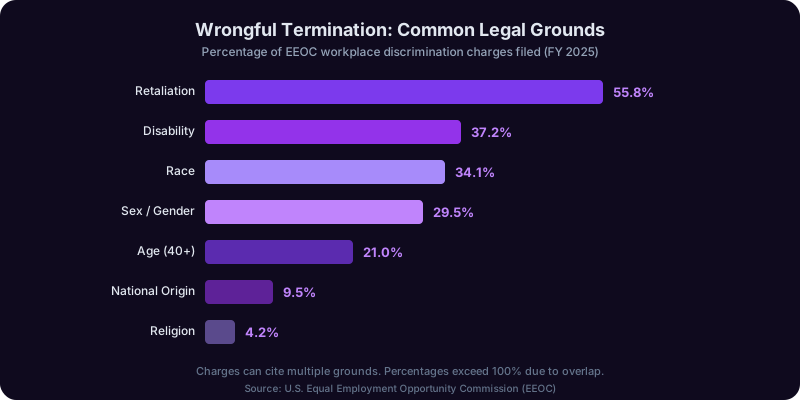
- Discrimination: You cannot be fired based on race, color, religion, sex (including pregnancy and sexual orientation since the 2020 Bostock decision), national origin, age (over 40), disability, or genetic information. These are protected classes under federal law. Many states add additional protections for marital status, gender identity, and political activity.
- Retaliation: You cannot be fired for reporting illegal activity (whistleblowing), filing a workers' compensation claim, requesting FMLA leave, reporting harassment, or participating in a workplace investigation.
- Contract violations: If you have an employment contract (written or implied) that specifies termination only for cause, your employer must follow those terms. Union employees typically have additional protections through collective bargaining agreements.
What you are entitled to when fired:
- Your final paycheck, including all earned wages and accrued vacation (in states that require vacation payout). Many states require this within 72 hours; some require it on the same day.
- Any vested retirement benefits (401k contributions are always 100% yours; employer matches vest according to the plan schedule)
- COBRA continuation of health insurance (you pay the full premium)
- Access to your personnel file (in states that allow it)
The EEOC's filing process allows you to submit a workplace discrimination charge within 180 days (300 days if your state has its own enforcement agency) of the discriminatory act.
What to do immediately: Ask for the termination reason in writing. If your employer refuses, send a follow-up email summarizing the conversation: "Per our meeting today, I understand I am being terminated for [reason]. Please confirm." This creates a record. If the stated reason is pretextual (a cover for discrimination or retaliation), having it documented strengthens any future legal claim.
Do not sign anything on the spot, especially a severance agreement, release of claims, or non-disparagement agreement. You have the right to take these documents home and review them. If you are over 40, federal law (the Older Workers Benefit Protection Act) requires your employer to give you 21 days to review any release of age discrimination claims.
Your Rights When Laid Off
Layoffs trigger additional legal protections that do not apply to individual terminations. Understanding these rights can mean the difference between thousands of dollars received or lost.
The WARN Act (Worker Adjustment and Retraining Notification Act) requires employers with 100+ employees to provide 60 days' written notice before a mass layoff (affecting 50+ employees at a single site) or plant closing. If your employer fails to give adequate notice, you are entitled to 60 days of back pay and benefits from the date you should have been notified. Many states have "mini-WARN" acts with stricter requirements. California's WARN Act applies to employers with 75+ employees and requires 60 days' notice for layoffs of 50+ workers. New York's requires 90 days.
Unemployment benefits are almost guaranteed for laid-off workers because the separation was not your fault. Benefits vary by state but typically replace 40-50% of your prior wages, up to a state maximum. As of 2026, weekly maximums range from $275 (Mississippi) to $1,015 (Massachusetts). Benefits typically last 26 weeks, though some states offer less (Florida offers 12 weeks, North Carolina offers 12-20 weeks). File immediately after your last day. There is usually a one-week waiting period before benefits start.
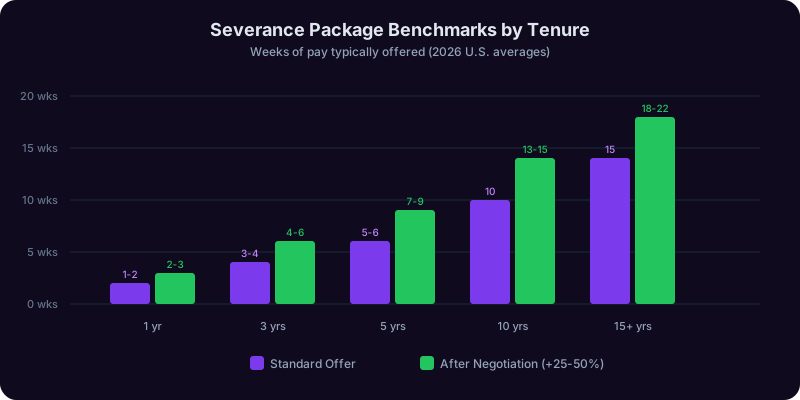
Severance pay is not legally required in most cases, but many employers offer it, especially during larger layoffs. The standard offer ranges from 1-2 weeks of pay per year of service. A 10-year employee might receive 10-20 weeks of severance. This is negotiable (see the next section).
Stock options and RSUs: If you have unvested stock options or RSUs, review your equity agreement immediately. Some companies accelerate vesting upon involuntary termination. Others have a strict cutoff. Most stock option plans give you 90 days after termination to exercise vested options before they expire. This deadline is non-negotiable and missing it means losing the options permanently.
Reference and rehire eligibility: Because layoffs are not performance-related, most companies will confirm you were laid off (rather than fired) to prospective employers and will mark you as eligible for rehire. Ask your HR representative to confirm this in writing.
The Career Copilot can help you develop a job search strategy tailored to your industry and experience level, including optimizing your resume to address the layoff proactively.

Get Answers From the Employment Law Copilot
The Employment Law Copilot explains your specific rights based on your state, termination type, and employment agreement - severance, unemployment, COBRA, and non-compete enforceability.
Severance Negotiation
Most people accept their first severance offer without question. That is a mistake. Severance agreements are almost always negotiable, and employers expect some pushback. Here is how to approach it strategically.
Understand your leverage. Your leverage increases if:
- You are over 40 (age discrimination protections give you more legal standing)
- You were a long-tenured employee (the company has more to lose reputationally)
- You have evidence of potential legal claims (discrimination, retaliation, WARN Act violations)
- You have knowledge of proprietary information or client relationships
- The layoff appears to disproportionately affect a protected class
What to negotiate beyond money:
- Extended health insurance: Ask the company to pay your COBRA premiums for the severance period. COBRA costs $600-$2,000/month for an individual, so this is significant. Some companies will extend your active coverage for 2-3 months rather than putting you on COBRA, which is even better.
- Outplacement services: Professional career coaching and resume services, typically worth $3,000-$10,000. Ask for a specific provider rather than a generic "outplacement package."
- Vesting acceleration: If you are close to a vesting cliff for stock options or RSUs, ask for accelerated vesting. Even partial acceleration can be worth tens of thousands.
- Reference letter: Get a written reference from your manager or a senior leader on company letterhead. This is more valuable than a verbal promise of a good reference.
- Non-compete modification: If your severance agreement includes a non-compete clause, negotiate the duration down (from 12 months to 6, for example) or narrow the geographic or industry scope.
- Resignation language: Some employees prefer to frame the departure as a resignation for career purposes. This can be negotiated into the agreement.
A SHRM survey on severance practices confirms that most organizations have flexibility in their severance offers and expect at least some level of negotiation from departing employees.
Negotiation script: "I appreciate the severance offer and want to reach an agreement. Given my [X years] of service and contributions, I believe a package of [specific amount] weeks, plus [specific benefits], would be fair. I would also like [specific item]. I am happy to sign a mutual release if we can reach these terms."
Do not threaten legal action unless you actually intend to follow through. Do not lie about having other offers. Be professional, specific, and reasonable. Most employers will increase their initial offer by 25-50% in response to a calm, well-reasoned counter. If the severance offer exceeds a few months' pay or includes complex legal provisions, spending $500-$1,000 on an employment attorney to review it is money well spent.
Unemployment Benefits Eligibility
Unemployment insurance exists to provide temporary financial support while you search for new employment. Eligibility rules vary by state, but the core principles are consistent.
General eligibility requirements:
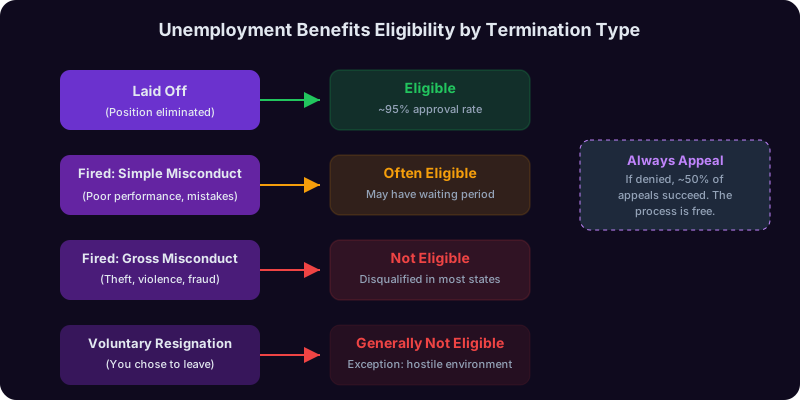
- You lost your job through no fault of your own (layoff, position elimination, company closure). If you were fired, eligibility depends on whether the termination was for "misconduct" as defined by your state.
- You earned enough wages during the "base period" (typically the first four of the last five completed calendar quarters before you filed).
- You are able to work, available to work, and actively seeking employment.
Fired employees and unemployment: Being fired does not automatically disqualify you. Most states distinguish between "simple misconduct" (poor performance, occasional mistakes) and "gross misconduct" (theft, violence, fraud, showing up intoxicated). Simple misconduct often still qualifies for benefits, sometimes after a waiting period. Gross misconduct is a disqualifier. If your employer claims misconduct and you disagree, always appeal. The appeal process is free, and employers frequently fail to provide sufficient documentation to support their claim.
How to file:
- File online through your state's unemployment office website within one week of your last day of work. Delays reduce your total benefit period. Use the CareerOneStop unemployment benefits finder to locate your state's filing portal.
- Gather your documents: Social Security number, driver's license, last employer's name and address, dates of employment, reason for separation, and your last pay stub.
- Complete weekly certification (most states require you to certify each week that you are actively searching for work and report any income earned).
- Keep records of every job you apply to: company name, position, date applied, and method of application. Most states require 3-5 job search activities per week.
Benefit amounts: Most states calculate your weekly benefit as approximately 1/26 of your earnings in the highest-earning quarter of your base period, up to the state maximum. Example: if you earned $20,000 in your highest quarter, your weekly benefit would be roughly $769, capped at your state's maximum.
Benefits are taxable income. You can choose to have federal taxes withheld (10% flat rate) or pay quarterly estimated taxes. Not withholding is a common mistake that leads to an unexpected tax bill in April.
The Employment Law Copilot can help you determine your specific state's eligibility rules, estimate your weekly benefit amount, and guide you through the appeals process if your initial claim is denied.
Health Insurance and COBRA
Losing employer-sponsored health insurance is one of the most stressful aspects of job loss. Understanding your options prevents both gaps in coverage and overspending.
COBRA (Consolidated Omnibus Budget Reconciliation Act) allows you to continue your employer's group health plan for up to 18 months (29 months if disabled). The catch: you pay the full premium plus a 2% administrative fee. Since your employer was likely paying 70-80% of the premium while you were employed, COBRA costs are a shock. Average COBRA premiums in 2026:
| Coverage Type | Average Monthly COBRA Cost |
| Individual | $700 - $850 |
| Employee + Spouse | $1,400 - $1,700 |
| Family | $1,900 - $2,400 |
COBRA applies to employers with 20+ employees. Smaller employers are covered by state continuation laws, which vary in duration and terms.
COBRA timeline: Your employer must notify the COBRA administrator within 30 days of your termination. The administrator then has 14 days to send you an election notice. You have 60 days from receiving the notice to elect COBRA. Coverage is retroactive to your termination date. You then have 45 days to make your first premium payment.
ACA Marketplace alternative: Losing your job is a "qualifying life event" that opens a 60-day Special Enrollment Period on the ACA Marketplace (healthcare.gov). Depending on your income during unemployment, you may qualify for substantial subsidies. A single person earning $30,000/year (including unemployment benefits) could pay as little as $150-$300/month for a Silver plan, compared to $700+ for COBRA. Always compare Marketplace options before defaulting to COBRA.
Medicaid: If your income drops below 138% of the federal poverty level ($20,783 for an individual in 2026), you may qualify for Medicaid in states that expanded coverage under the ACA. Medicaid has no monthly premium. Currently, 40 states plus D.C. have expanded Medicaid.
Strategy: If you are healthy and between jobs, the most cost-effective approach is usually an ACA Marketplace plan with subsidies. If you are mid-treatment for a medical condition and want to keep your current doctors and network, COBRA preserves your existing plan exactly as it was. If money is very tight, check Medicaid eligibility first.
Non-Compete and NDA Considerations
Many employees sign non-compete agreements (NCAs) and non-disclosure agreements (NDAs) during onboarding without fully reading them. These agreements become critically important when you leave a job. For a comprehensive breakdown, see our Non-Compete Agreement Guide.
Non-compete agreements restrict your ability to work for competitors or start a competing business for a specified period after leaving your employer. Key facts for 2026:
- The FTC's 2024 rule banning most non-competes for non-senior executives is currently in effect for new agreements but is being challenged in courts. Check current status before assuming your non-compete is unenforceable.
- Enforceability varies wildly by state. California, Oklahoma, North Dakota, and Minnesota ban non-competes almost entirely. States like Florida, Texas, and Georgia enforce them if they are "reasonable" in scope, duration, and geography.
- Courts generally consider non-competes lasting 6-12 months with a limited geographic area more reasonable than broader restrictions. A 2-year nationwide non-compete is much harder to enforce than a 6-month restriction in your metropolitan area.
- If you were laid off (terminated without cause), courts are significantly less likely to enforce a non-compete because the company, not you, ended the relationship.
NDAs (Non-Disclosure Agreements) restrict what information you can share, not where you can work. NDAs survive termination and typically have no expiration date. Key rules:
- You cannot share trade secrets, proprietary processes, client lists, pricing strategies, or unreleased product information with anyone, including your new employer.
- You can share general knowledge and skills you developed during your employment. The line between "proprietary knowledge" and "general professional skills" is often blurry and is one of the most litigated areas of employment law.
- NDAs cannot prevent you from reporting illegal activity to government agencies (SEC, EEOC, OSHA). This is protected whistleblower activity regardless of what the NDA says.
Practical steps:
- Find and re-read every agreement you signed. Check your onboarding paperwork, employment contract, and any documents you signed when receiving stock options or promotions.
- If you have a non-compete, consult an employment attorney before accepting a new position with a competitor. A 30-minute consultation ($100-$250) can save you from a lawsuit.
- Do not take any company files, documents, emails, or data with you when you leave. This includes forwarding work emails to your personal account. Companies monitor this and it can turn a routine departure into a legal battle.
The Employment Law Copilot can help you understand the general enforceability of non-competes in your state and identify potential issues in your specific agreements.
Immediate Action Checklist
The first 72 hours after losing your job are critical. Emotions run high, but taking these practical steps now protects your finances and legal rights.
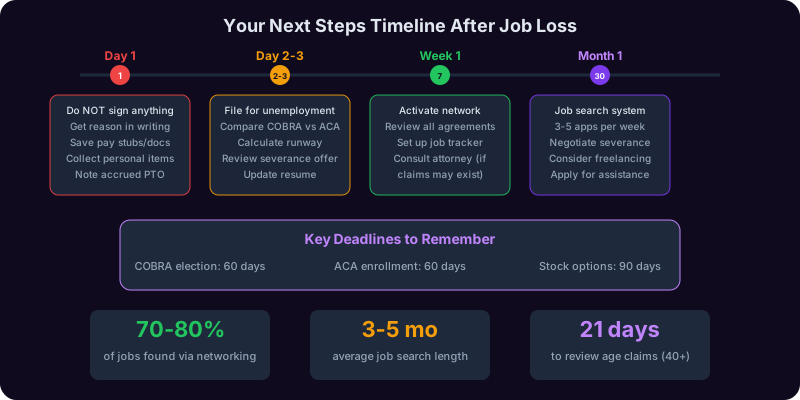
Day 1 (Day of termination):
- Do not sign anything. Take all documents home to review. You have time.
- Ask for the reason for termination in writing. If refused, send yourself an email summarizing what was said, including who was present and the exact words used.
- Collect any personal belongings. Do not take company property, files, or data.
- Note your final day of employment, accrued vacation days, and any bonuses or commissions owed.
- Screenshot or save your pay stubs, benefits enrollment, and any performance reviews you can access from employee portals (these may be locked within hours).
Day 2-3:
- File for unemployment. Do this immediately. Processing takes 2-4 weeks in most states, and every day of delay is a day without benefits. File online through your state's unemployment office.
- Review health insurance options. Compare COBRA costs with ACA Marketplace plans. You have 60 days, but starting early prevents gaps.
- Calculate your financial runway. List your monthly essential expenses (rent/mortgage, utilities, food, insurance, minimum debt payments). Divide your savings by this number. That is how many months you have before running out of money. This number determines how aggressive your job search needs to be.
- Review your severance offer (if you received one). Do not accept or reject it yet. Take notes on what is included and what is missing.
- Update your resume. While your accomplishments and metrics are fresh in your mind, update your resume with your most recent role. Quantify everything: revenue generated, costs saved, team size, projects completed.
Within the first week:
- Contact your professional network discreetly. Let trusted former colleagues, mentors, and industry contacts know you are looking. 70-80% of jobs are filled through networking, not online applications.
- Review all employment agreements (non-compete, NDA, severance) carefully. Consult an attorney if anything is unclear or if you believe you may have legal claims.
- Set up a job search system: spreadsheet tracking applications, follow-ups, and networking conversations.
- Apply for any government assistance you may qualify for (SNAP, Medicaid, utility assistance programs) if your financial runway is short.
Losing a job is one of life's most stressful events, ranking alongside divorce and major illness on stress scales. Be deliberate about self-care during this period. Maintain a daily routine, exercise, and stay connected to your support system. The Resume Copilot can help you craft a resume that positions your experience effectively, while the Career Copilot can guide your overall job search strategy.
For more on this topic, read our guide on Freelance Rate Calculator: The Complete Guide to Pricing Your Services.
Frequently Asked Questions
Recommended Copilots
Recommended Copilots
Understand your rights after termination - severance, non-competes, COBRA, and wrongful termination
Try Free →Get a strategic plan for your job search and career recovery
Try Free →Update your resume and LinkedIn to reflect your experience positively
Try Free →Continue Exploring
Related Articles
Get Answers From the Employment Law Copilot
The Employment Law Copilot explains your specific rights based on your state, termination type, and employment agreement - severance, unemployment, COBRA, and non-compete enforceability.