
Step 1: Check Your Lease for Early Termination Clauses
Before you do anything else, read your lease agreement carefully. Many leases contain an early termination clause that spells out exactly how to break the lease and what it will cost. This is the simplest and most predictable path out of a lease, and approximately 40-50% of standard residential leases include some form of early termination provision.
Common early termination structures include:
| Type | How It Works | Typical Cost |
| Fixed penalty | Pay a set fee to terminate early | 1-2 months' rent |
| Remaining rent buyout | Pay a percentage of remaining lease value | 25-50% of remaining rent |
| Notice-based | Give extended notice (60-90 days) and pay through the notice period | 2-3 months' rent |
| Sliding scale | Penalty decreases as you get closer to lease end | Varies by timing |
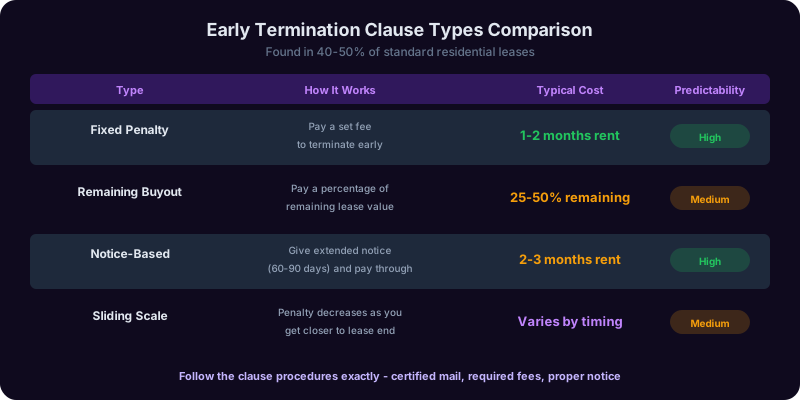
If your lease has an early termination clause, follow its procedures exactly. Send the required notice in writing (certified mail with return receipt is best), pay any required fees, and document everything. Failing to follow the exact procedure can void your right to use the clause and leave you liable for the full remaining rent.
If your lease does not have an early termination clause, you still have options. The following sections cover legal grounds, negotiation strategies, and alternative approaches. For a detailed breakdown of how to understand every clause in your lease, see our guide on how to read a lease agreement. The Tenant Rights Copilot can help you review your specific lease language and identify clauses that affect your options. For a comprehensive lease review, try the lease review tool.
Legal Grounds That Let You Break a Lease Without Penalty
Several legal situations allow you to terminate a lease early without owing any penalty, regardless of what your lease says. These protections exist in state and federal law and override lease terms.
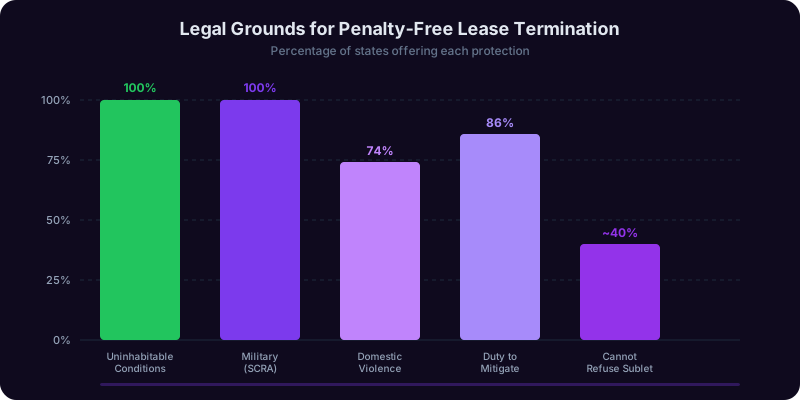
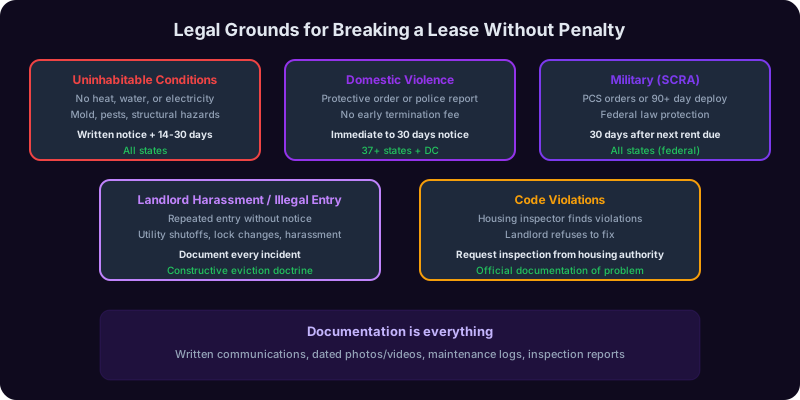
1. Uninhabitable conditions (constructive eviction): Every state has an implied warranty of habitability that requires landlords to maintain rental units in livable condition. If your landlord fails to address serious issues like no heat in winter, persistent water leaks causing mold, pest infestations, broken locks or security concerns, no running water, or sewage problems, you may have grounds to terminate. The key requirements are: (1) the condition must be serious and affect health or safety, (2) you must notify the landlord in writing and give reasonable time to fix it (typically 14-30 days depending on the state and severity), and (3) the landlord must fail to make repairs.
2. Domestic violence: At least 37 states plus DC have laws (the National Network to End Domestic Violence maintains a current list) allowing domestic violence survivors to break a lease early with documentation (typically a protective order or police report). Notice requirements vary from immediate to 30 days. Most states prohibit the landlord from charging an early termination fee in these situations. Some states extend this protection to victims of sexual assault and stalking as well. The WomensLaw.org housing rights page provides state-by-state details on domestic violence lease protections.
3. Military deployment or transfer (SCRA): The federal Servicemembers Civil Relief Act allows active-duty military members to terminate a lease without penalty when they receive permanent change of station (PCS) orders or are deployed for 90+ days. You must provide written notice and a copy of your orders. The lease terminates 30 days after the next rent due date following your notice. You can review the full text of the SCRA at the Department of Justice SCRA page.
4. Landlord harassment or illegal entry: If your landlord repeatedly enters your unit without proper notice (most states require 24-48 hours), harasses you, shuts off utilities, or changes locks, these are illegal actions that may constitute constructive eviction. Document every instance with dates, times, and photos or recordings where legal.
5. Health and safety code violations: If a local housing inspector finds code violations that the landlord refuses to fix, this strengthens your legal position to terminate. Request an inspection through your local housing authority or building department. The inspection report becomes official documentation of the problem.
For all of these situations, documentation is everything. Keep copies of all written communications, take dated photos and videos, save maintenance request records, and keep a log of incidents. The Tenant Rights Copilot can help you assess whether your situation qualifies under your state's laws and guide you through the documentation process. The Legal Copilot can help you understand your rights in more complex situations.
How to Negotiate a Lease Break With Your Landlord
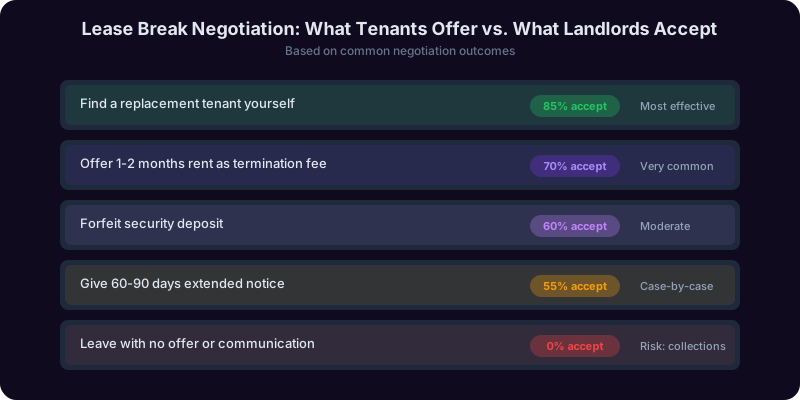
If you do not have legal grounds for a penalty-free break, negotiation is your next best option. Many landlords are willing to negotiate because the alternative -- an unhappy tenant who stops paying, a lengthy eviction process, or a vacant unit -- is often worse for them than an early but orderly departure.
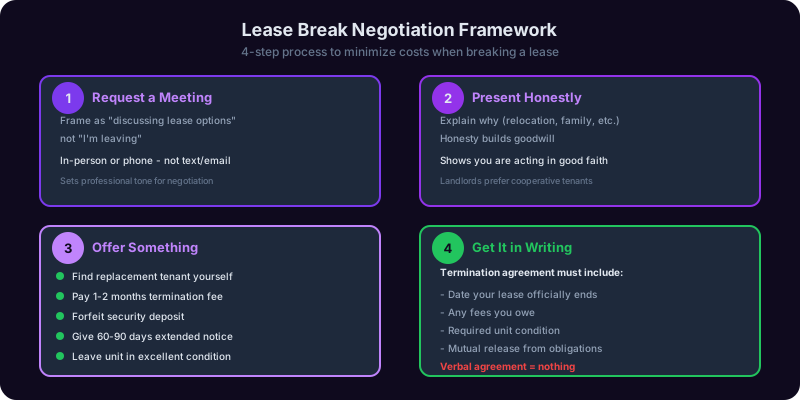
Understand your landlord's perspective. Your landlord's primary concern is financial: they do not want lost rent or a vacant unit. If you can minimize their financial exposure, they are much more likely to agree to let you go. In hot rental markets, your landlord may actually benefit from your early departure if they can re-rent at a higher rate.
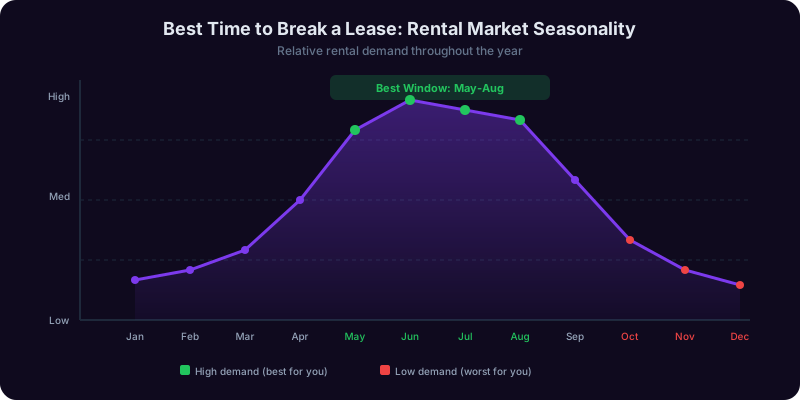
Timing matters. The best time to negotiate a lease break is during peak rental season (typically May through August in most markets), when your landlord is most likely to find a replacement tenant quickly. Breaking a lease in December or January, when demand is lowest, gives you less leverage.
Here is a negotiation framework that works:
Step 1: Request a meeting. Contact your landlord or property manager and request an in-person or phone meeting. Frame it as wanting to discuss your lease options rather than announcing you are leaving.
Step 2: Present your situation honestly. Explain why you need to leave (job relocation, family situation, financial hardship). Being honest builds goodwill and shows you are acting in good faith.
Step 3: Offer something in return. This is the key to successful negotiation. Options include:
- Finding a replacement tenant yourself (saves your landlord the cost and effort of advertising and showing the unit)
- Paying 1-2 months' rent as a termination fee (less than the remaining lease but enough to cover the landlord's re-renting costs)
- Forfeiting your security deposit
- Giving extended notice (60-90 days) to give the landlord time to find a new tenant
- Leaving the unit in excellent condition and professionally cleaned
Step 4: Get everything in writing. Any agreement you reach must be documented in a signed lease termination agreement (sometimes called a mutual lease termination or surrender agreement). This should specify: the date your lease ends, any fees you owe, the condition you must leave the unit in, and confirmation that both parties release each other from further obligations. Without this document, a verbal agreement means nothing.
The Tenant Rights Copilot can help you draft a negotiation approach specific to your situation and review any termination agreement before you sign. For more on contract negotiation techniques, see our guide on how to read and negotiate contracts. For a detailed understanding of your lease language, see our guide on how to read a lease agreement. For renters navigating this process for the first time, our first-time renting scenario guide covers the basics of tenant-landlord communication.

Get Answers From the Tenant Rights Copilot
Use the Tenant Rights Copilot to understand your state's laws, review your lease for termination options, and draft a negotiation strategy. The Legal Copilot can help you write a termination letter and review any agreements.
Subletting and Lease Assignment: Letting Someone Else Take Over
If your landlord will not agree to let you break the lease, subletting or assigning the lease to a new tenant may be an option. These are legally distinct arrangements:
Subletting: You find a subtenant who moves in and pays rent, but your name stays on the lease and you remain legally responsible. If the subtenant stops paying or causes damage, you are on the hook. The subtenant pays you, and you continue paying the landlord. This is the more common arrangement and is often easier to set up because the landlord's risk is lower (they still have you as a backstop).
Lease assignment: You transfer the lease entirely to a new person. They take over all rights and responsibilities, and you are released from the lease. This is the better option for you because it eliminates your ongoing liability, but landlords are less likely to agree because they lose you as a fallback.
Can your landlord refuse? This depends on your lease and your state. Some states (like California, New York, and many others) have laws that say a landlord cannot unreasonably refuse a sublet or assignment, even if the lease prohibits it. "Unreasonable refusal" generally means refusing a qualified subtenant (someone with adequate income and clean rental history) without a valid reason. Other states allow landlords to prohibit subletting entirely through the lease. Check your specific state's laws.
Finding a replacement tenant: List your apartment on platforms like Craigslist, Facebook Marketplace, Zillow, Apartments.com, and local community groups. In college towns, university housing boards are effective. Be transparent about the situation: it is a sublet or lease takeover, here are the remaining months, here is the rent. Screen potential subtenants carefully because if you are subletting (not assigning), their behavior reflects on you.
Getting landlord approval: Present your proposed subtenant to the landlord with their application, proof of income, and references. Make the landlord's job easy by providing everything they would normally require from a new applicant. The more professional and organized your approach, the more likely approval becomes.
The Tenant Rights Copilot can explain your state's subletting laws and help you understand whether your landlord can legally refuse your request. The Legal Copilot can help you draft a subletting agreement that protects your interests.
State-by-State Rules: Landlord's Duty to Mitigate and Key Differences
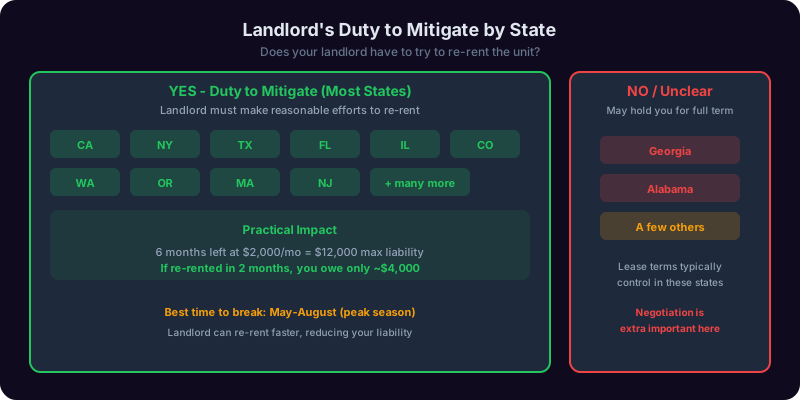
One of the most important legal concepts when breaking a lease is the landlord's duty to mitigate damages. In most states, even if you break your lease, the landlord cannot simply sit back and charge you rent for the remaining lease term. They are legally required to make reasonable efforts to re-rent the unit. If they find a new tenant, your obligation for rent ends when the new tenant's payments begin.
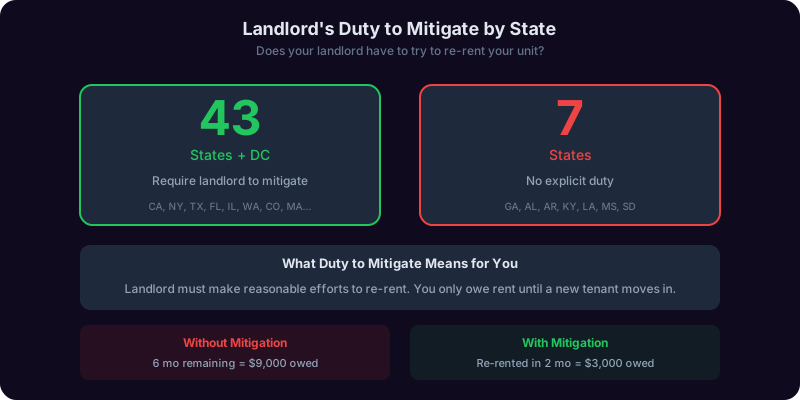
Here is how key states handle the duty to mitigate:
| State | Duty to Mitigate? | Key Notes |
| California | Yes | Landlord must make reasonable efforts to re-rent; cannot collect double rent |
| New York | Yes (since 2019) | Real Property Law 227-e requires mitigation |
| Texas | Yes | Landlord must mitigate; can charge reasonable re-letting fee |
| Florida | Yes | Landlord must use reasonable diligence to re-rent |
| Illinois | Yes | Strong tenant protections in Chicago specifically |
| Colorado | Yes | Landlord must mitigate; new law limits lease break penalties |
| Washington | Yes | Landlord must mitigate; tenant may owe advertising costs |
| Georgia | No explicit duty | Landlord may choose not to re-rent and hold you liable for full term |
| Alabama | No explicit duty | Similar to Georgia; lease terms typically control |
In states with a duty to mitigate, the practical impact is significant. If your rent is $2,000 per month and you have 6 months remaining on your lease, the landlord cannot automatically charge you $12,000. If they re-rent the unit after 2 months, you would owe only 2 months' rent plus any reasonable costs the landlord incurred (advertising, cleaning, etc.). This makes the actual cost of breaking a lease much lower than many tenants fear.
Some cities have additional tenant protections beyond state law. Portland, Seattle, San Francisco, New York City, and Chicago all have local ordinances that provide extra protections around lease termination, subletting rights, and landlord obligations. Always check both state and local law. Nolo's lease-breaking guide provides additional state-specific details. The HUD tenant rights page provides links to state and local resources for understanding your specific protections.
The Tenant Rights Copilot can provide specific information about your state and city's laws regarding lease termination, the duty to mitigate, and any local protections that apply to your situation.
What Breaking a Lease Actually Costs: Real Numbers and How to Minimize Them
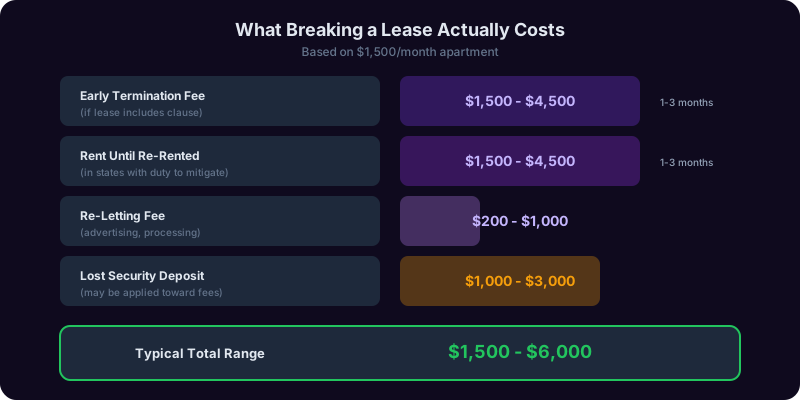
Understanding the true financial exposure of breaking a lease helps you make an informed decision and negotiate effectively. Here is a realistic breakdown of potential costs:
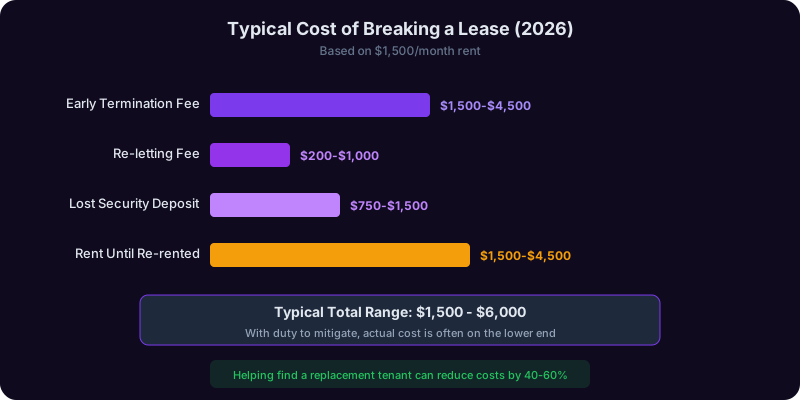
Early termination fee: If your lease includes an early termination clause, the fee is typically 1-3 months' rent. On a $1,500/month apartment, that is $1,500-$4,500. This is often the cleanest and cheapest option because it provides certainty and a clear end to your obligations.
Rent until the unit is re-rented: In states with a duty to mitigate, you owe rent only until the landlord finds a new tenant. In a healthy rental market, this is typically 1-3 months. In a slow market or for hard-to-rent units, it could be longer. You can reduce this period by helping find a replacement tenant.
Re-letting fee: Some landlords charge a fee to cover the cost of advertising, showing, and processing a new tenant. This typically ranges from $200-$1,000 or a percentage of one month's rent. Not all states allow this fee, and it must usually be specified in the lease.
Lost security deposit: Your landlord may apply your security deposit toward unpaid rent or early termination fees. Whether this is legal depends on your state's security deposit laws and the terms of your lease. In many states, the landlord can only deduct for actual damages (physical damage to the unit, unpaid rent) and must return any remaining deposit within 14-30 days with an itemized statement. For a detailed breakdown of your deposit rights, see our complete guide to security deposits.
Credit impact: If you break your lease and owe money that you do not pay, the landlord can send the debt to collections, which will damage your credit score. They can also report the broken lease to tenant screening services, which could make it harder to rent in the future. This is why negotiating a formal termination agreement is so important: it creates a clean break with no lingering obligations.
How to minimize costs:
- Help find a replacement tenant (reduces the landlord's vacancy period)
- Give as much notice as possible (60-90 days is ideal)
- Leave the unit in perfect condition (reduces any damage claims)
- Negotiate: many landlords will accept less than the maximum penalty to avoid the hassle of litigation
- Time your departure during peak rental season when re-renting is fastest
The Budgeting Copilot can help you calculate the total cost of breaking your lease versus staying, factoring in all potential expenses. The Finance Copilot can help you plan how to cover early termination costs without derailing your broader financial goals.
How to Write a Lease Termination Letter: Template and Tips
A well-written lease termination letter is essential regardless of how you are ending your lease. It creates a paper trail, demonstrates professionalism, and protects your legal interests. Here is what to include and a framework you can adapt:
Essential elements of a termination letter:
- Your name and current address (the rental unit)
- Your landlord's or property management company's name and address
- The date
- A clear statement that you are providing notice to terminate your lease
- Your desired move-out date
- The reason for early termination (optional but recommended for goodwill)
- Reference to any applicable lease clause or legal provision
- Your forwarding address for security deposit return
- A request for written confirmation of receipt and agreement
Letter framework:
"Dear [Landlord Name], I am writing to provide formal notice that I intend to vacate the property at [address] on [date]. My lease, signed on [date], is scheduled to end on [original end date]. I am requesting early termination due to [reason]. Per Section [X] of my lease agreement [or per (state) law regarding (applicable protection)], I am providing [number] days' notice. I have been a responsible tenant and intend to leave the unit in excellent condition. I am prepared to [offer: find a replacement tenant / pay an early termination fee / forfeit my security deposit / other]. Please confirm receipt of this letter and let me know how you would like to proceed. My forwarding address for return of my security deposit will be [address]. Sincerely, [Your name]"
Delivery method matters. Send your letter via USPS Certified Mail with Return Receipt Requested. This creates proof that your landlord received it and when. Also send a copy via email for immediate delivery and additional documentation. Keep copies of everything. Some states have specific requirements for how termination notices must be delivered, so check your local laws.
Timing your letter: Review your lease for required notice periods. Even if you are breaking the lease, providing the maximum possible notice demonstrates good faith and may reduce your financial exposure. Most leases require 30-60 days' notice for termination. Providing more than the minimum is always better.
For more guidance on writing effective formal legal letters, see our guide on how to write a demand letter - many of the same principles apply to lease termination letters. If your landlord is engaging in harassment or illegal behavior, you may also want to review our cease and desist letter guide. The Tenant Rights Copilot can help you draft a termination letter tailored to your specific situation, lease terms, and state laws. The Legal Copilot can review your letter for legal accuracy before you send it.
Protecting Yourself After You Leave: Security Deposit, References, and Records
Your responsibilities and risks do not end when you hand over the keys. Take these steps to protect yourself financially and ensure a clean break:
Document the unit's condition. Before you move out, take comprehensive photos and video of every room, including inside closets, cabinets, appliances, and bathrooms. Photograph any pre-existing damage that was there when you moved in. Date-stamp everything. If you have move-in photos (you should always take these when moving into a new place), compare them to your move-out photos. This documentation is your defense against unfair security deposit deductions.
Do a walkthrough with your landlord. Request a move-out inspection with your landlord present. Some states (including California) require landlords to offer a pre-move-out inspection so you can fix issues before the final walkthrough. During the walkthrough, get written confirmation of the unit's condition and any agreed-upon deductions.
Know your security deposit rights. Every state has laws governing how security deposits must be handled:
- Return deadline: Ranges from 14 to 60 days after move-out depending on the state (California: 21 days, New York: 14 days, Texas: 30 days, Florida: 15-60 days)
- Itemized statement: Most states require the landlord to provide a written list of any deductions with receipts or estimates
- What can be deducted: Generally limited to unpaid rent, damage beyond normal wear and tear, and cleaning costs if the unit was left in worse condition than move-in (normal wear and tear is NOT deductible)
- Penalties for violations: Many states impose penalties of 2-3 times the deposit amount if the landlord fails to return it on time or makes improper deductions
Get a reference letter. If you were a good tenant (paid on time, maintained the property, were respectful of neighbors), ask your landlord for a written reference before you leave. Future landlords will want rental references, and having a positive letter from a landlord you broke a lease with demonstrates that you handled the situation professionally.
Keep records for 3-5 years. Store copies of your lease, all correspondence with your landlord, your termination agreement, move-out photos, security deposit receipts, and any other documentation. If a dispute arises later (a collections notice, a challenge from a future landlord, or a legal claim), these records are your protection.
The Tenant Rights Copilot can tell you your state's specific security deposit rules and deadlines. If your landlord withholds your deposit improperly, the Legal Copilot can guide you through the small claims court process to recover it. For anyone navigating renting for the first time, our first-time renter checklist covers these protections in detail.
Frequently Asked Questions
Recommended Copilots
Recommended Copilots
Get personalized guidance on your state's lease termination laws and tenant protections
Try Free →Review lease agreements, draft termination letters, and understand your legal options
Try Free →Calculate the total cost of breaking your lease and plan how to cover termination expenses
Try Free →Continue Exploring
Related Scenarios
Related Articles
Get Answers From the Tenant Rights Copilot
Use the Tenant Rights Copilot to understand your state's laws, review your lease for termination options, and draft a negotiation strategy. The Legal Copilot can help you write a termination letter and review any agreements.