

What Just Happened: CMS Plan Exits Affecting Millions in 2026
Medical & insurance disclaimer: This article is educational only and is not insurance, medical, legal, or tax advice. Medicare rules change yearly. Confirm details with Medicare.gov, your State Health Insurance Assistance Program (SHIP), or a licensed broker before making coverage decisions.
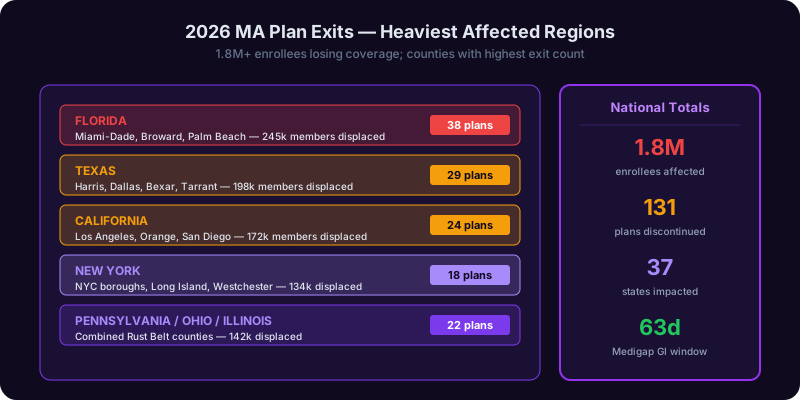
If you opened your mail in September or October and found a letter beginning with the phrase Important: Your Medicare Advantage plan will not be renewed for 2026, you are not alone - and you are not being singled out. According to the KFF Medicare Advantage 2026 Spotlight, insurers are exiting or shrinking plans that collectively cover an estimated 1.8 million enrollees, the largest single-year MA contraction since the program began.
The pullback is concentrated in three carriers - Humana, Aetna (CVS Health), and several Blue Cross Blue Shield affiliates - and hits hardest in rural counties, the Gulf South, and parts of the Midwest. KFF estimates that roughly 105 U.S. counties will have zero Medicare Advantage HMO option in 2026, forcing residents back to Original Medicare or to a PPO with a much wider geographic footprint.
Why insurers are pulling out
Three policy shifts collided this year:
- CMS payment rate cuts. The 2026 Rate Announcement finalized an effective payment change of roughly +5.06% - but after accounting for risk-coding normalization and Star Ratings methodology, many plans saw flat or negative net revenue.
- IRA drug-price negotiation. The Inflation Reduction Act capped insulin at $35, eliminated Part D catastrophic cost-sharing, and shifted more drug liability onto plans. Actuarial filings show this added $40 to $90 per member per month in plan-borne risk.
- V28 risk-adjustment model. The phased rollout of HCC V28 reduced reimbursement for several high-volume diagnosis codes, particularly in vascular disease and depression.
Your notice timeline
CMS rules require non-renewal notices be mailed by October 2. If you received yours, your coverage continues until December 31, 2026, and your Special Enrollment Period to choose a new plan runs from December 8, 2026 through February 28, 2027. We will walk through what that letter says, what your options are, and - critically - how to verify your doctor and prescriptions are covered before you sign anything.
Reading Your Non-Renewal Letter: 7 Things to Look For
The non-renewal notice is a federally templated document, but carriers add their own marketing on top. Strip away the cover page and find these seven items, in this order. Anything missing is a red flag - call 1-800-MEDICARE or your SHIP counselor immediately.
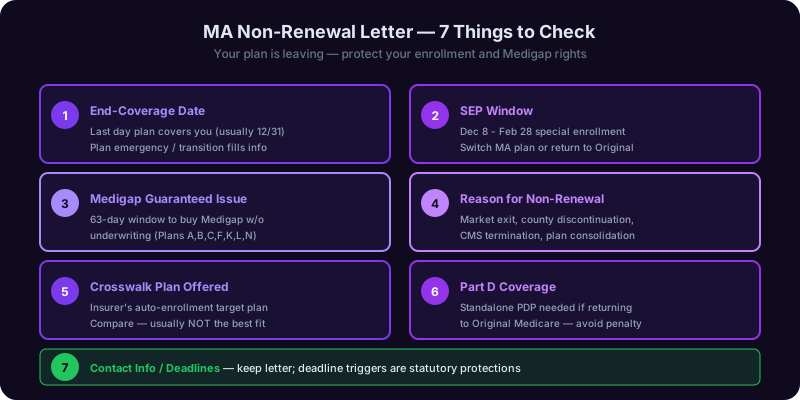
- The exact end date. Look for the phrase your coverage will end on. For 2026 non-renewals this should read December 31, 2026 - never earlier. If a carrier writes November 30 or a mid-month date, it is a service-area reduction (SAR), not a non-renewal, and your SEP rules differ.
- The CMS contract and plan ID. Format is
H1234-001. You will need this to file complaints, to confirm with Medicare.gov, and to prove the plan was discontinued (some carriers later deny this on phone calls). - The Guaranteed Issue Right (GIR) trigger language. Federal law requires the letter to state that you are eligible for a Medigap policy with guaranteed acceptance - no medical underwriting - within 63 days of the loss of MA coverage. The phrase is usually You have a guaranteed right to buy certain Medicare Supplement Insurance (Medigap) policies.
- Your SEP window opening date. By regulation this is December 8, 2026 for plan-year-2026 non-renewals, and the window runs through February 28, 2027. This SEP overlaps the AEP but extends two months past it.
- Default crosswalk plan. Some carriers auto-enroll you into a sister plan. You can decline, but only if you act before December 7. If you ignore the letter, you may wake up January 1 in a plan you did not choose.
- Part D enrollment warning. If you return to Original Medicare without a standalone Part D plan, you face a 1% per month late enrollment penalty, permanently. The letter must disclose this.
- Continuation-of-care transition language. Medicare requires the new plan to honor in-progress treatment (chemo, dialysis, post-surgical) for at least 90 days. Note this clause - you may need it.
The fine print most miss
Buried near the bottom of every non-renewal notice are three small-print clauses that disproportionately affect cost and coverage. First, the creditable coverage statement - confirming that your discontinued plan included drug coverage that meets Medicare standards, which preserves your protection from the Part D late enrollment penalty as long as you re-enroll within 63 days. Second, the continuation of benefits clause, which clarifies that all approved prior authorizations and pending appeals transfer to your replacement plan automatically. Third, the refund and unprocessed claims clause, which obligates the discontinued carrier to process any claims with dates of service through December 31 even if billed in 2027. Photograph these clauses too - they prevent a great deal of post-transition billing chaos.
What to do in the first 48 hours
Photocopy or photograph the letter. Save it. Carriers routinely lose proof of non-renewal during disputes, and your GIR is the most valuable consumer protection in Medicare. With this document you can purchase Plan F, Plan G, or Plan N without a single underwriting question - even if you have advanced cancer, ESRD, or have been declined before. The letter is your golden ticket; treat it like a bond certificate.
Special Enrollment Period (SEP) Rules: Your 31-63 Day Clock
Medicare uses several overlapping enrollment windows, and the terminology trips up even experienced agents. Here is the clean version for a non-renewal SEP.
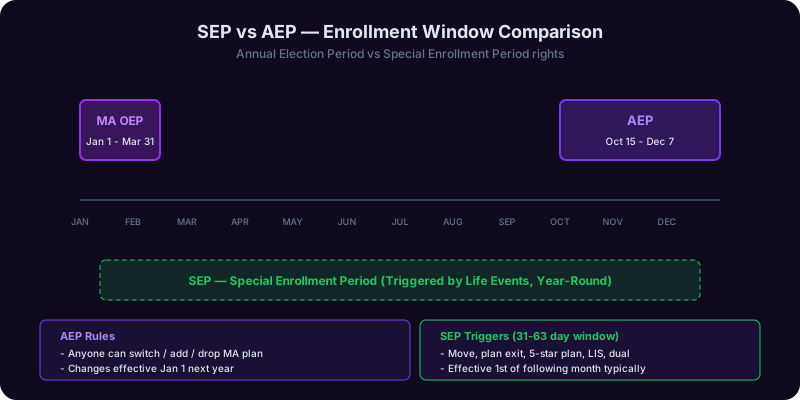
The two windows you can use
| Window | Dates (2026 non-renewal) | What you can do |
|---|---|---|
| Annual Enrollment Period (AEP) | Oct 15 - Dec 7, 2026 | Switch to any MA or Part D plan available in your county |
| Plan Termination SEP | Dec 8, 2026 - Feb 28, 2027 | Enroll in MA, Part D, or return to Original Medicare + Medigap (with GIR) |
| Medigap Guaranteed Issue Right | 63 days after coverage ends (until Mar 4, 2027) | Buy Medigap Plan A, B, C, D, F, G, K, or L with no underwriting |
What counts as discontinued
Per CMS Chapter 2 of the Medicare Managed Care Manual, four events trigger the plan-termination SEP and a Guaranteed Issue Right:
- Full contract non-renewal (carrier exits the entire contract)
- Plan termination (specific plan ends but contract continues)
- Service area reduction (your county is dropped)
- CMS sanction-based termination
Voluntary downgrades by the carrier - for example dropping vision benefits - do not trigger the SEP. Higher premiums alone do not trigger it either, which is why many seniors miss the window: they assume a premium hike from $0 to $80 is the same as a discontinuation. It is not.
The 31-day rule trap
You may have seen the term 31 days in carrier marketing. That number refers to the OEP (Open Enrollment Period) for newly aged-in beneficiaries, not to plan-termination SEPs. For a non-renewal you have the full 63-day GIR window - do not let an aggressive agent rush you. However, if you want your January 1 coverage to begin on time, you must enroll by December 7. Enrollments between December 8 and February 28 take effect the first day of the following month.
How effective dates work
The effective date of your new coverage depends on when within the SEP you enroll. Enrollments completed by December 7 take effect January 1. Enrollments completed in December 8-31 take effect February 1. Enrollments in January take effect March 1, and February enrollments take effect April 1. If you switch back to Original Medicare, that change is automatic on the day your MA plan ends - there is no separate enrollment required for Parts A and B. However, your Medigap policy and standalone Part D plan must be timed to start the same day, or you create a gap. Most Medigap carriers will write a policy with an effective date up to 6 months in the future, so submit your Medigap application in November or early December for a clean January 1 start.
What if you miss the SEP
Missing the SEP is rare because non-renewal letters trigger automatic crosswalk enrollment. But if you actively disenrolled, did not pick a replacement, and missed the window, you can still enroll during the next AEP (October 15, 2027). You will, however, have a gap in coverage and may owe the Part D late enrollment penalty for life.

Get Answers From the Health Copilot
Upload your non-renewal letter, prescriptions, and provider list. Copilotly's Insurance Copilot compares every 2026 plan in your county, flags prior auth risks, and generates a side-by-side cost projection in 25 minutes - for free.
Original Medicare + Medigap: The Path Most Don't Know
Roughly 54% of all Medicare beneficiaries are on Medicare Advantage; the other 46% use the older architecture: Original Medicare (Parts A and B) + a Medigap supplement + a standalone Part D drug plan. After an MA non-renewal you can return to this structure with no underwriting - a window many seniors will never get again.
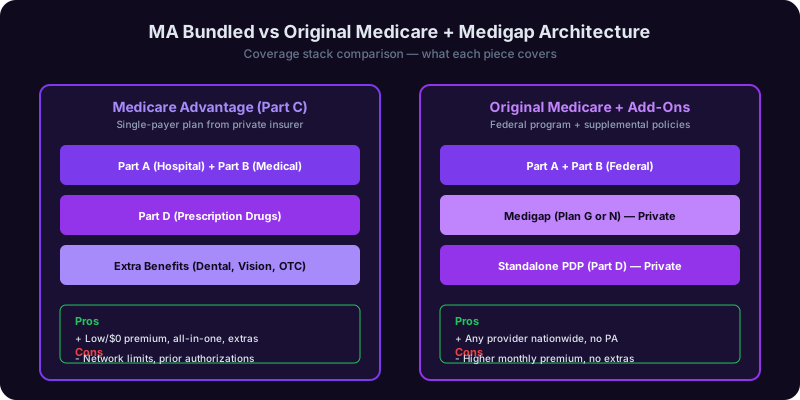
How the architecture works
- Part A. Hospital insurance. Premium-free for most people who paid Medicare taxes for 40 quarters.
- Part B. Outpatient and physician services. Standard premium in 2026 is approximately $206.50/month; higher for IRMAA-affected incomes.
- Medigap. Private supplement that pays the 20% coinsurance, hospital deductibles, and (on Plan F/G) the Part B excess charges. National monthly premiums range $90 to $280 depending on age, ZIP, and plan letter.
- Part D. Standalone prescription drug plan. National benchmark premium is about $36.78 for 2026.
Why this is often cheaper than MA - really
The myth that Original Medicare is more expensive comes from comparing the premium alone. Total cost of care, however, often favors Original + Medigap for people who actually use medical services. A 2025 Commonwealth Fund analysis found that MA enrollees in fair-or-poor health spent on average $1,650 more out-of-pocket per year than Original Medicare + Medigap Plan G enrollees, once specialist copays, prior authorization friction, and out-of-network surprises were included.
The Guaranteed Issue Right window
Outside of your initial Medigap Open Enrollment Period (the six months after you first enrolled in Part B at 65), you normally must answer health questions to buy Medigap - and carriers can decline you for diabetes, heart disease, cancer history, or weight. A plan non-renewal gives you 63 days of guaranteed acceptance, federally protected. You can buy Plans A, B, C, D, F (if first eligible before 2020), G, K, or L without any medical questions.
Trade-offs to weigh
| Factor | Original Medicare + Medigap + Part D | Medicare Advantage |
|---|---|---|
| Monthly premium (typical) | $330-$520 | $0-$80 |
| Provider network | Any provider accepting Medicare (97%) | HMO/PPO network only |
| Prior authorization | Rare | Common (avg. 1.5 per enrollee/year) |
| Extra benefits (dental, vision, OTC) | None | Often included |
| Out-of-pocket maximum | Capped by Medigap to near-zero | Capped at $9,350 (2026) |
Comparing Replacement MA Plans: The 5-Factor Framework
If you decide to stay in Medicare Advantage rather than switch back to Original Medicare, evaluate replacement plans on these five factors - in this order. Most seniors compare on premium first, which is exactly backward.
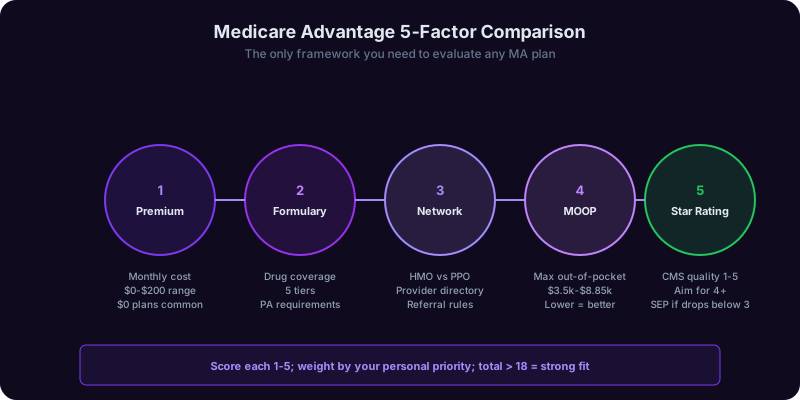
Factor 1: Provider network (weight: 35%)
A plan is worthless if your primary care physician, your specialists, and your hospital are out of network. Call each provider directly - do not rely on the carrier directory, which the HHS OIG found is 51% inaccurate on average. We provide a script in Section 7.
Factor 2: Drug formulary (weight: 25%)
Pull your current prescriptions (names, doses, frequency) and check each plan's formulary on the Medicare Plan Finder. Look at tier placement, quantity limits, step therapy, and prior auth flags.
Factor 3: Maximum Out-of-Pocket (MOOP) cap (weight: 15%)
2026 MOOP caps range from $3,500 (rare) to $9,350 (the federal max). For someone with a chronic condition, picking a $3,500 MOOP plan can save more than $5,000 in a hospitalization year - even at $40 higher monthly premium.
Factor 4: Star Rating (weight: 15%)
CMS rates plans 1 to 5 stars. Below 3.5 is considered low; 4.5+ is excellent. Star Ratings predict customer service responsiveness, appeal success rates, and care coordination. Per CMS Star Ratings data, plans below 3 stars get terminated within 3 years 41% of the time - increasing your risk of going through this again.
Factor 5: Premium and extra benefits (weight: 10%)
Yes, premium is last. The reason: a $0 premium plan with a 4.5 star rating that includes your drugs and doctors is great, but a $0 premium plan that does not cover your insulin or your cardiologist is a financial trap. Treat premium as a tiebreaker, not a leading criterion.
Why this order matters
Most seniors begin by sorting plans on the Medicare Plan Finder by monthly premium, ascending. This is the worst possible starting point because it elevates the least informative factor. A $0 premium plan with a 3.0 Star Rating, a narrow HMO network that excludes your cardiologist, and a formulary that places your blood thinner on Tier 4 will cost a typical 70-year-old roughly $4,800 more per year than a $42 premium plan with 4.5 stars, broad network, and Tier 2 placement on the same drug. The premium difference is $504 per year; the total cost difference is nearly ten times that. By weighting network and formulary first, you eliminate plans that look cheap on the marketing brochure but are expensive in practice. This framework also catches plan changes year-to-year: a plan you loved in 2025 might have shifted your specialist out-of-network or moved a critical drug to a higher tier for 2026, and the framework forces you to re-check rather than auto-renew.
Putting it together
| Factor | What to check | Pass threshold |
|---|---|---|
| Network | PCP + 3 most-used specialists + preferred hospital | All 5 in-network |
| Formulary | Every current Rx, tier and PA status | All covered at Tier 1-3, no step therapy |
| MOOP | In-network MOOP and combined MOOP (PPO) | <$7,500 |
| Stars | Overall plan rating | 4.0+ |
| Premium | Monthly + Part D + Part B | Within budget |
The Drug Formulary Check: Don't Switch Until You Verify
Switching MA plans without verifying your prescription drug coverage is the single most common - and most expensive - mistake seniors make. A drug that costs $4 on your current plan can cost $480 on the new one if it lands on a different formulary tier or requires prior authorization you do not yet have.
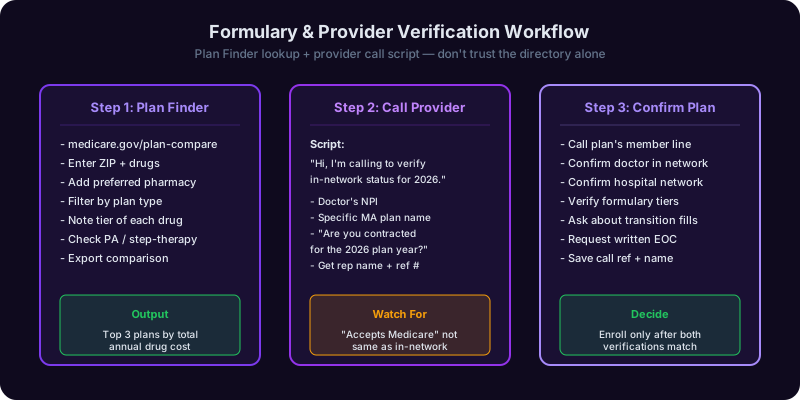
Step-by-step Plan Finder walkthrough
- Go to Medicare.gov Plan Finder. Log in with your Medicare account (creates a personalized comparison).
- Enter your ZIP code and confirm your county.
- Add every prescription: name, strength, quantity per fill, and refill frequency. Get this from your pharmacy app or call them - guessing is dangerous.
- Select your preferred pharmacies. Most plans offer lower copays at preferred network pharmacies; switching from CVS to Walgreens or vice versa can change annual drug cost by hundreds.
- Filter plans by Medicare Advantage with drug coverage (MAPD).
- Sort by Estimated Annual Drug + Premium Cost, not by premium.
- Click into the top 3 plans. Verify tier placement and check for these red flags:
- Prior authorization (PA) required
- Step therapy (must try cheaper drug first)
- Quantity limits below your normal fill
- Coverage gap (donut hole) treatment of your drug
Prior authorization: the silent cost
Per the KFF analysis of CMS data, MA plans process more than 50 million prior authorization requests per year and deny roughly 7.4% of them on first submission. Even if you eventually win the appeal, you may go 2-4 weeks without your medication. Drugs particularly likely to require PA in 2026:
- GLP-1 receptor agonists (Ozempic, Mounjaro, Wegovy, Zepbound)
- Biologics (Humira, Stelara, Dupixent, Skyrizi)
- Oral cancer therapies
- Brand-name DOACs (Eliquis, Xarelto) when the IRA-negotiated price applies
- High-dose narcotic regimens
Coverage gap rules in 2026
The Inflation Reduction Act eliminated the Part D coverage gap (donut hole) starting in 2025 and added a $2,000 annual out-of-pocket cap on Part D drug spending for 2026. This is the single biggest improvement in Part D since the program launched. Once your true out-of-pocket spending hits $2,000, every additional covered drug is $0 for the rest of the calendar year. You can also opt into the Medicare Prescription Payment Plan to spread that $2,000 across monthly installments. When comparing plans, make sure the Plan Finder estimate reflects the new cap - older comparison tools may still show pre-IRA math.
The medication transition rule
If you switch plans and a drug you take daily is not on the new formulary, CMS requires the new plan to give you a one-time 30-day transition supply within the first 90 days. Use that window to either (a) get a formulary exception approved or (b) have your doctor switch you to a covered alternative. Do not wait until day 28 - the appeals process averages 14 days.
The Provider Network Check: Will Your Doctor Take the New Plan?
The single biggest complaint of switching seniors is discovering, in mid-January, that the cardiologist they have seen for nine years no longer takes their plan. Avoid this by calling - not clicking - before you enroll.
The script that works
Call each provider's billing office (not the front desk). Use this script verbatim:
Hello, this is [your name], date of birth [DOB]. I am considering enrolling in [plan name, contract H#####-###] starting January 1, 2026. Can you confirm three things: First, will Dr. [name] be in-network for that specific contract and plan ID for 2026? Second, what tier? Third, can I get that confirmation in writing or by email today?
The contract and plan ID matter because carriers run many sub-networks under one brand. A provider can be in-network for the carrier's HMO but out of network for the PPO with the same brand name.
What to do if the network is unclear
| Situation | Your move |
|---|---|
| Provider not yet contracted for 2026 | Wait until November 15 and re-check; many contracts finalize late |
| Provider in-network at lower tier (higher copay) | Get tier in writing; calculate annual copay impact |
| Provider out-of-network in HMO | Switch to a PPO version of the plan if it exists |
| Provider out-of-network everywhere | Switch to Original Medicare + Medigap (any Medicare-accepting provider works) |
Continuation-of-care transition rights
If you are mid-treatment when your plan changes, federal regulations (42 CFR 422) require the new plan to honor your current treatment for at least 90 days, even with an out-of-network provider, in these scenarios:
- Active course of cancer treatment (chemo, radiation, surgery)
- Pregnancy in the second or third trimester
- Scheduled non-elective surgery within 90 days
- End-stage renal disease (dialysis)
- Terminal illness (hospice)
- Recent organ transplant (within 12 months)
Request the transition in writing within 30 days of enrollment. Include diagnosis, treating provider name, and expected end date of treatment. The plan must respond within 14 days.
When the directory and the office disagree
Carrier provider directories are notoriously inaccurate. The HHS OIG audit of MA directories found 51% inaccuracy on average and 80% inaccuracy at some carriers. Common errors include providers listed who retired years ago, providers in the directory but not actually contracted for the current plan year, and providers listed at the wrong office location. Always trust the provider's billing office over the directory. If the directory says yes and the office says no, document both in writing - you may need this evidence for a network exception request later. If you discover a directory error after enrollment that costs you out-of-pocket money, you can file a complaint with 1-800-MEDICARE and request reimbursement under the reliance on directory rule, which CMS has reinforced in recent guidance.
Network tier disputes
If your provider says we accept the plan but the plan says not contracted, ask the provider for their billing NPI (National Provider Identifier) and Tax ID (TIN). Then call the plan's provider relations line and ask them to confirm by NPI/TIN. Brand-name directory mismatches are common; NPI lookups never lie.
Medigap Eligibility After MA Discontinuation: Federal vs State
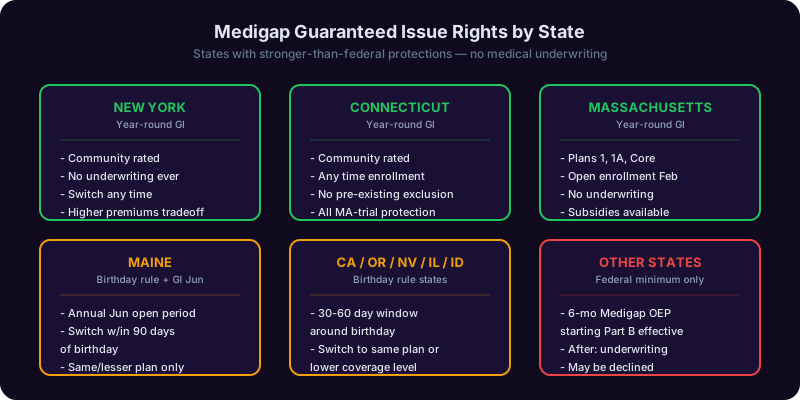
Your Guaranteed Issue Right to a Medigap policy is federal law, but several states layer additional protections on top. Knowing your state's rules can be the difference between a $135 monthly premium and a $280 one - for identical coverage.
The federal floor: Trial Right and Termination Right
Two federally protected paths give you Medigap with no medical underwriting:
- Trial Right. If you joined MA when first eligible for Medicare and want to switch back within the first 12 months, you can buy any Medigap plan sold in your state.
- Termination Right. If your MA plan terminates, leaves your area, or you move out of its service area, you have 63 days to buy Medigap Plans A, B, C, D, F, G, K, or L. (Plans C and F are limited to those eligible for Medicare before January 1, 2020.)
States with stronger consumer protections
| State | Rule | What it means for you |
|---|---|---|
| New York | Continuous open enrollment, community-rated | Any Medigap, any time, no underwriting, same price regardless of age or health |
| Connecticut | Continuous open enrollment | Any Medigap, any time, no underwriting |
| Massachusetts | Annual open enrollment (Feb 1 - Mar 31) | Guaranteed Medigap each year during a 60-day window |
| Maine | Annual Plan A switch month + lifetime continuous for same-letter plans | Can switch to same Medigap letter any time without underwriting |
| California | Birthday rule | 30 days after birthday to switch to equal-or-lesser Medigap without underwriting |
| Oregon, Idaho, Illinois, Louisiana, Nevada, Oklahoma, Washington | Birthday rule variants | Similar to California; check exact window |
| Missouri | Anniversary rule | 30-60 days around policy anniversary to switch to same-letter Medigap |
The 12-month MA-to-Medigap window
If you originally enrolled in MA when first eligible for Medicare and are still within your first 12 months, you have a federal Trial Right to return to Original Medicare + Medigap. This is in addition to - not instead of - the Termination Right. If both apply, use the broader of the two.
Medigap shopping tips
- Plans with the same letter (G is G) cover identical services at every carrier. Compare on price, financial rating (A.M. Best A or higher), and rate-increase history.
- Ask if the carrier uses community rating, issue-age rating, or attained-age rating. Attained-age premiums rise sharply after 75; community-rated stay flat.
- Plan G is the most popular for new enrollees. Plan N is the value pick if you can tolerate a $20 office-visit copay.
- Use Medicare.gov Medigap Finder to see every carrier and price in your ZIP.
- Free help: SHIP and NCOA Medicare resources.
Avoiding the Biggest Switching Mistakes
Across thousands of post-mortem cases at SHIPs and SMP (Senior Medicare Patrol) offices, the same handful of mistakes drain seniors' wallets year after year. The good news: every one is preventable.
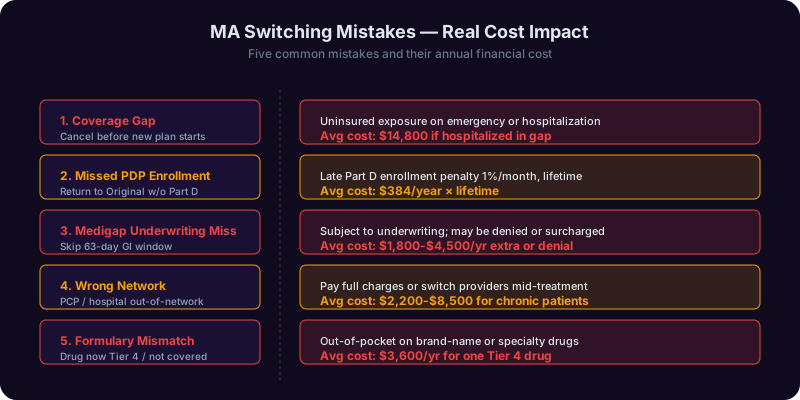
Mistake 1: Gap in coverage
Some seniors disenroll from MA on December 31, intending to enroll in Original Medicare + Medigap on January 5. There is no gap to the federal program - A and B continue automatically - but a 5-day gap can void your Guaranteed Issue Right if you do not document it correctly. Fix: always enroll in the new coverage before the old one ends; effective dates align automatically.
Mistake 2: Forgetting Part D
If you return to Original Medicare + Medigap, you must actively enroll in a standalone Part D plan. Medigap does not include drug coverage. Many seniors discover this in February when they refill a prescription and get a $400 cash bill. Fix: enroll in Part D in the same session you enroll in Medigap.
Mistake 3: The Part D late enrollment penalty trap
If you go more than 63 days without creditable drug coverage, CMS adds 1% of the national base beneficiary premium per uncovered month, permanently, to your Part D premium for as long as you have Medicare. The 2026 base is $36.78, so a 24-month gap adds $8.83 every month - for life. Per CMS LEP guidance, the penalty is calculated using the rounded base beneficiary premium times months without coverage. Fix: enroll in Part D the moment you lose creditable coverage - even if you take no medications today.
Mistake 4: Signing during a cold-call sales pitch
Telephonic Medicare marketing is heavily restricted but heavily violated. If an unknown caller offers to enroll you in a plan right now, hang up. Per CMS regulations, agents may not solicit you by phone unless you specifically requested the call. SMP estimates that 30-40% of TPMO (Third-Party Marketing Organization) enrollments include some form of misrepresentation. Fix: only enroll through Medicare.gov, a SHIP counselor, or a broker you contacted first.
Mistake 5: Picking the cheapest premium
$0 premium plans are subsidized by aggressive prior authorization and narrow networks. The total cost of care often exceeds a $30 plan by hundreds annually. Fix: use the 5-factor framework in Section 5.
Mistake 6: Not using SHIP
State Health Insurance Assistance Programs are federally funded and completely free. Counselors are unbiased, non-commissioned, and trained to read your individual situation. Find yours at shiphelp.org or call 1-877-839-2675. Fix: book a SHIP appointment before signing anything.
Mistake 7: Believing the "same as last year" claim
Even plans that renew can change formularies, networks, and copays for the new year. The Annual Notice of Change (ANOC) mailed in September contains every change. Fix: read the ANOC every year, not just when you receive a non-renewal.
How Copilotly's Insurance Copilot Helps You Choose
Medical & insurance disclaimer: Copilotly's Insurance Copilot is an educational and comparison tool. It does not sell insurance, earn commissions, or replace a licensed agent. Always verify final coverage details with the carrier and a SHIP counselor before enrolling.
You have 8-10 hours of homework ahead of you: pulling prescriptions, calling providers, comparing formularies, reading ANOCs, and modeling out-of-pocket costs across multiple plans. Copilotly's Insurance Copilot compresses that into roughly 25 minutes - and produces a personalized side-by-side report you can take to a SHIP counselor or family member.
What the Insurance Copilot does
- Drug check. Upload your prescription list (or paste a screenshot from your pharmacy app). The copilot maps each drug to every MA and PDP formulary available in your county, flags prior auth and step therapy, and estimates annual drug cost.
- Doctor check. Enter your providers by NPI. The copilot cross-references each one against current 2026 plan networks, flagging tier and any out-of-network gaps.
- Total cost projection. Combines premium + Part D + estimated copays + likely MOOP hits based on your historical utilization (you can import claims from your Medicare account).
- Side-by-side report. Generates a one-page PDF comparing your top 3 options, color-coded by risk.
- Non-renewal letter parser. Upload a photo of your letter; the copilot extracts the 7 key fields (plan ID, end date, SEP dates, GIR language) and tells you exactly which windows apply.
- Medigap shopper. Pulls every Medigap carrier in your ZIP, sorts by Plan letter, financial rating, and rate-increase history.
What it does not do
It does not enroll you, take commissions, or recommend a specific carrier. Final enrollment happens on Medicare.gov or with a licensed broker. Think of the copilot as a research assistant that does the homework - you still make the decision.
Try it free during your SEP window
If you received a non-renewal letter for 2026, time matters. Run your scenario through the Insurance Copilot tonight, schedule a SHIP appointment for next week, and enroll by December 7 to lock in January 1 coverage.
Related Copilotly reading
Frequently Asked Questions
Recommended Copilots
Related Articles
Get Answers From the Health Copilot
Upload your non-renewal letter, prescriptions, and provider list. Copilotly's Insurance Copilot compares every 2026 plan in your county, flags prior auth risks, and generates a side-by-side cost projection in 25 minutes - for free.