
Dealer Pricing Decoded: Invoice, MSRP, and What You Should Actually Pay
Before you set foot in a dealership, you need to understand the three numbers that define every car deal. Most buyers only know one, and that ignorance is exactly what dealerships count on.
MSRP (Manufacturer's Suggested Retail Price)
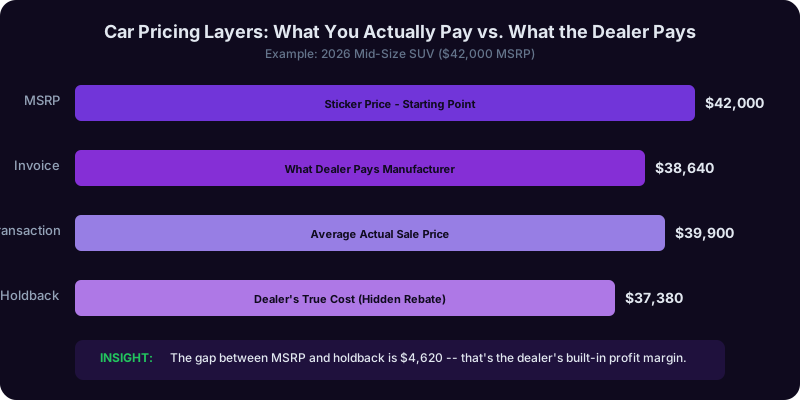
The sticker price on the window. This is not what the dealer paid, not what the car is worth, and not what anyone should pay without negotiating. Manufacturers set MSRP high enough to give dealers room to offer "discounts" while still making profit. On a $45,000 vehicle, the gap between MSRP and dealer invoice is typically $2,000 to $5,000.
Dealer Invoice Price
This is what the dealer appears to pay the manufacturer. Dealers love to show you the invoice and say "I am selling it to you at cost." That sounds generous until you understand holdback. You can look up invoice prices on Edmunds or Kelley Blue Book before visiting.
Holdback and Hidden Profit
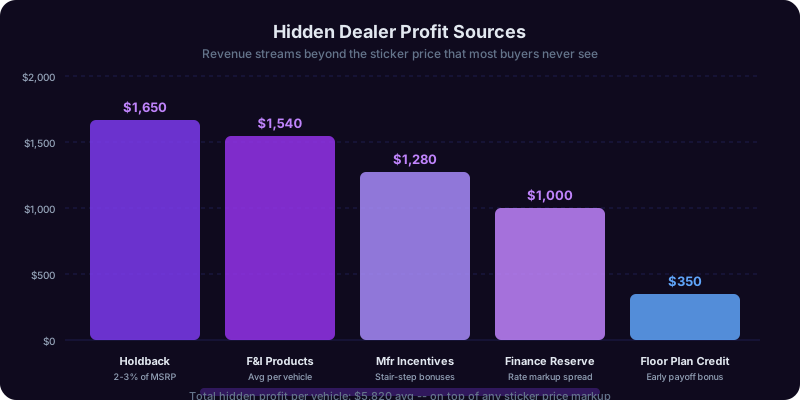
Holdback is a payment the manufacturer sends back to the dealer after the car is sold, typically 2-3% of MSRP. On a $45,000 car, that is $900 to $1,350 in profit that does not appear on any document shown to you. Manufacturers also offer dealer cash incentives of $500 to $3,000 per vehicle, separate from customer rebates.
What You Should Target
| Vehicle Demand | Target Price | Realistic Range |
|---|---|---|
| High demand / limited supply | MSRP (no markup) | MSRP to $500 below |
| Average demand | Invoice + $200-500 | 3-6% below MSRP |
| Slow seller / high inventory | Invoice minus rebates | 7-12% below MSRP |
| End-of-year clearance | Below invoice | 10-15% below MSRP |
The Finance Copilot can research current invoice pricing, rebates, and incentives for any make and model so you walk in knowing the dealer's true cost.
Pre-Dealership Research: The 2-Hour Homework That Saves Thousands
Every dollar you save at the dealership is earned during preparation. Dealers negotiate car deals daily. You do it once every few years. The only way to close that gap is with superior information.
Step 1: Define What You Want
Dealers exploit indecision. Lock in your make, model, trim, and 2-3 must-have options before visiting. Use Consumer Reports reliability ratings to narrow your list.
Step 2: Get the Real Numbers
Cross-reference three sources:
- Edmunds TMV (True Market Value): What others in your area actually pay. Your single best data point.
- KBB Fair Purchase Price: Another transaction-price estimate with regional adjustments.
- Dealer invoice price: Available on both sites. Write it down for your exact configuration.
Step 3: Check Incentives and Rebates
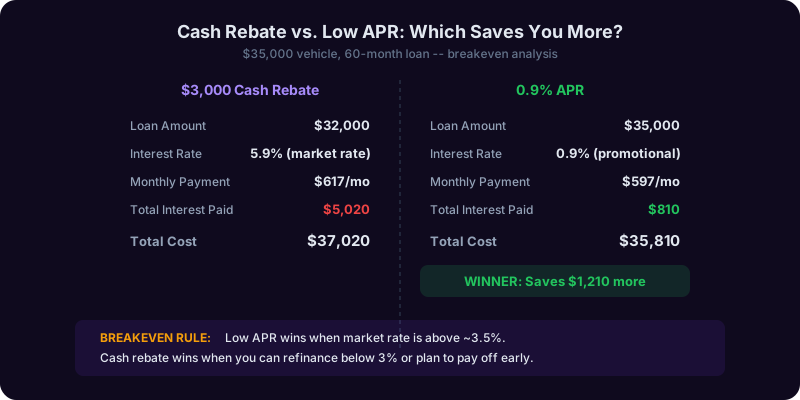
Manufacturer incentives change monthly: customer cash ($500-$5,000), loyalty bonuses, special APR (0%-2.9%), and lease deals. Some are stackable. Others force you to choose between cash back and low APR. Know which combination saves the most.
Step 4: Get Pre-Approved for Financing
Before visiting any dealership, get pre-approved from your credit union or bank. Credit unions consistently offer rates 1-2 points lower than dealer financing. On a $35,000 loan over 60 months, a 2% difference costs $1,800+ in extra interest. Pre-approval also removes financing as a lever dealers can use against you.
Step 5: Get Competing Quotes
Email internet sales departments at 3-5 dealerships within 50 miles:
"I am looking to purchase a [Year Make Model Trim] within the next [timeframe]. I am comparing offers from several dealerships. Could you send me your best out-the-door price? I have financing arranged. Stock number [X] is ideal, but I am flexible on color."
Internet sales managers are measured on volume, so they offer sharper pricing upfront to competitive shoppers.
Step 6: Research Your Trade-In Separately
Get independent valuations from KBB Instant Cash Offer, Edmunds, CarMax (written offer, valid 7 days), and Carvana. A CarMax offer gives you a guaranteed floor price. The Finance Copilot can build a deal analysis sheet comparing out-the-door costs across multiple quotes.
Word-for-Word Scripts for Every Stage of the Deal
Your job is to control the sequence: negotiate purchase price first, handle the trade-in separately, then address financing. Dealers want to blend everything because confusion benefits the side with more information.
Script 1: The Opening (After the Test Drive)
"I like the car. I have done my homework and I am ready to make a deal today if the numbers work. I have quotes from [two/three] other dealerships and my own financing arranged. I am looking for your best out-the-door price on this car. Can we start there?"
Script 2: When They Ask About Monthly Payments
This is a trap. If you say $500/month, they hit that number by extending the loan to 84 months, burying thousands in interest.
"I am not focused on monthly payment right now. I want to agree on the purchase price first. What is your best price on this vehicle?"
Script 3: Responding to the First Offer
Never accept the first number, even if it looks reasonable.
"I appreciate the offer. The Edmunds True Market Value for this configuration is $[amount], and I have a competing quote at $[amount]. I would like to get this done at $[target]. Can you work with that?"
If they say no, use the silence technique. Stop talking. Let them fill the void with a better number or an explanation you can work with.
Script 4: The "Let Me Talk to My Manager" Move
"Take your time. I need $[target] out the door, not including tax and registration. If your manager can get there, I sign today. If not, no hard feelings, I will go with another offer."
Script 5: "We Are Losing Money on This Deal"
"I respect that you need a fair profit. I am not asking you to lose money. But holdback and manufacturer incentives are part of the equation, and my price is in line with what other dealers are offering."
Script 6: The Close
"That works. Before paperwork, I want to confirm: the out-the-door price is $[agreed amount] plus tax, title, and registration. No additional charges or add-ons will be added in the finance office. Correct?"
Get verbal confirmation before moving to F&I. This prevents the back-end upsell ambush. For more evidence-based negotiation tactics, see our guide on how to negotiate rent, which uses a similar framework.

Get Answers From the Finance Copilot
Tell the Finance Copilot your target vehicle and budget, and get a complete deal analysis with invoice pricing, competing offer strategies, financing comparisons, and customized negotiation scripts.
Trade-In vs. Private Sale: How to Maximize Your Old Car's Value
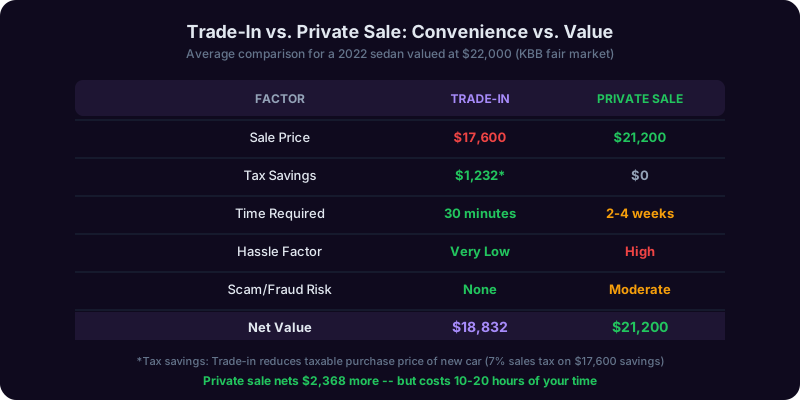
The average trade-in leaves $1,500 to $3,000 on the table compared to a private sale. Dealers know most people take the convenient option and price accordingly.
The Trade-In Tax Advantage
In most states, you only pay sales tax on the difference between the new car's price and your trade-in value. Buy a $40,000 car and trade in one worth $15,000, and you pay tax on $25,000. At 7%, that saves $1,050. This can narrow or even eliminate the private-sale gap.
| Factor | Trade-In | Private Sale |
|---|---|---|
| Value received | Wholesale (lower) | Retail (higher) |
| Tax savings | Yes (most states) | No |
| Convenience | High (one transaction) | Low (listing, showing, paperwork) |
| Time required | Minutes | Days to weeks |
| Scam risk | None | Moderate |
The Golden Rule: Negotiate Separately
Never blend your trade-in into the purchase negotiation. Dealers offer a "great" trade-in value but inflate the purchase price, or vice versa.
"I want to negotiate the purchase price first. Once we agree on that, we can discuss my trade-in as a separate transaction. If your offer is competitive, great. If not, I have other options."
Getting the Best Trade-In Value
- Get a CarMax written offer. Your floor price. Valid 7 days. Dealers know about CarMax and often try to match it.
- Get a Carvana or Vroom online offer. Takes 2 minutes, gives another data point.
- Check KBB and Edmunds appraisals. Enter exact mileage, condition, and options.
- Clean the car. A detail and wash can increase perceived value by $300-$500.
When to Sell Privately
- Cars worth $5,000-$15,000: The percentage gap is largest. After tax savings, you still come out $1,500-$2,000 ahead privately.
- Desirable models: Popular cars like the Camry, Civic, or RAV4 sell quickly, minimizing hassle.
- Cars under $5,000: The dollar gap is small enough that trade-in convenience usually wins.
- Cars over $25,000: The gap can reach $3,000+, making private sale worthwhile if you have the time.
The Consumer Rights Copilot can calculate whether the tax savings from trading in outweigh the private sale premium for your specific situation.
Financing Traps: How Dealers Make Thousands on Your Loan
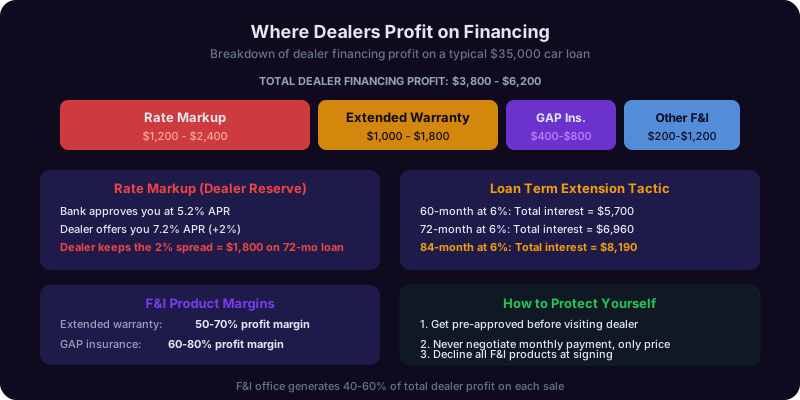
The sticker price gets all the attention, but the finance office is where dealerships make their largest per-deal profits: $1,500 to $2,500 per vehicle, according to the National Automobile Dealers Association.
Trap 1: The Rate Markup (Dealer Reserve)
The dealer submits your application to lenders who approve a "buy rate," then marks it up before presenting it to you. If a lender approves 5.5%, the dealer might offer 7.5%. On a $35,000 loan over 60 months, that 2% markup costs approximately $1,800 in extra interest.
"My credit union approved me at [X]%. Can you beat that? If so, I will finance through you. If not, I will use my own financing."
Trap 2: Extending the Loan Term
Longer terms reduce monthly payments but cost dramatically more in total interest and leave you underwater for most of the loan.
| Loan Term | Monthly Payment ($35K at 6.5%) | Total Interest | Months Underwater |
|---|---|---|---|
| 48 months | $830 | $3,846 | 0-6 |
| 60 months | $685 | $6,071 | 6-18 |
| 72 months | $590 | $8,452 | 18-36 |
| 84 months | $523 | $10,969 | 36-54 |
If you cannot afford the 48- or 60-month payment, you are buying too much car.
Trap 3: The F&I Product Gauntlet
- Extended warranty: Marked up 50-100%. Buy later from the manufacturer or a third-party at a lower price.
- GAP insurance: Buy from your auto insurer for $25-$50/year instead of $700-$1,000 from the dealer.
- Paint protection: $300-$800 for a product costing the dealer $50. A $15 spray sealant does the same job.
- Nitrogen tires: $100-$300 for a gas that is 78% of air. Costco fills with nitrogen free.
- VIN etching: $150-$400 for a $25 DIY kit.
How to Handle the Finance Office
"I am going to decline all additional products today. I would like to proceed with just the vehicle purchase at the price we agreed on."
Review every number on the contract before signing. Make sure no products you declined were added. For the best rates, see our guide on understanding your credit score and how to build credit from scratch.
Doc Fees, Dealer Add-Ons, and Charges You Can Refuse
After you agree on a price, the dealer adds fees. Some are legitimate. Some are inflated. And some are pure profit disguised as mandatory charges. Knowing the difference saves $500 to $2,000.
Documentation Fee (Doc Fee)
Every dealer charges a doc fee for processing paperwork. The actual cost is around $50-$75. What they charge varies wildly by state.
| State Regulation | States | Typical Doc Fee |
|---|---|---|
| Capped by law | CA ($85), NY ($175), WA ($200), CO ($699), FL ($1,000) | At or near cap |
| No cap | TX, GA, IL, OH, VA, NC, and most others | $300-$999 |
In uncapped states, doc fees are negotiable despite claims otherwise:
"I am evaluating total out-the-door cost. $[amount] for paperwork is above what other dealers charge. Can you reduce it or adjust the vehicle price to compensate?"
Dealer-Installed Add-Ons
Dealers pre-install accessories and mark them up significantly:
- Window tinting: $400-$800 (costs $200-$300 at a tint shop)
- Door edge guards: $100-$200 ($15 stick-on strips)
- All-weather floor mats: $200-$300 ($60-$100 on Amazon)
- Wheel locks: $75-$150 ($25 from the parts department)
- Dealer accessories package: $500-$1,500 for low-cost bundled items
Ask for add-ons to be removed from the price, or find a car on the lot without them.
The "Market Adjustment" (ADM)
On high-demand vehicles, dealers add $2,000 to $20,000 above MSRP. In 2026, supply has largely normalized, but ADMs still appear on popular models. Your options:
- Walk away and wait. Supply usually catches up within weeks.
- Factory-order at MSRP. Most manufacturers allow this with an 8-16 week wait.
- Shop wider. Call 10 dealers and you will likely find one selling at MSRP.
- Negotiate it down. Cars on the lot 30+ days with a markup are negotiable.
Legitimate Fees
- Sales tax: Set by law. Not negotiable (but reduced by trade-in value).
- Title and registration: Fixed DMV amounts.
- Emissions testing: Required in some states. Usually $20-$50.
Before signing, demand a complete itemized out-the-door breakdown. If anything new appeared, ask for it to be removed. You have maximum leverage here because the dealer has invested hours and does not want to lose the sale. The Consumer Rights Copilot can look up your state's doc fee caps and consumer protection laws.
Best Time to Buy and New vs. Used Tactics
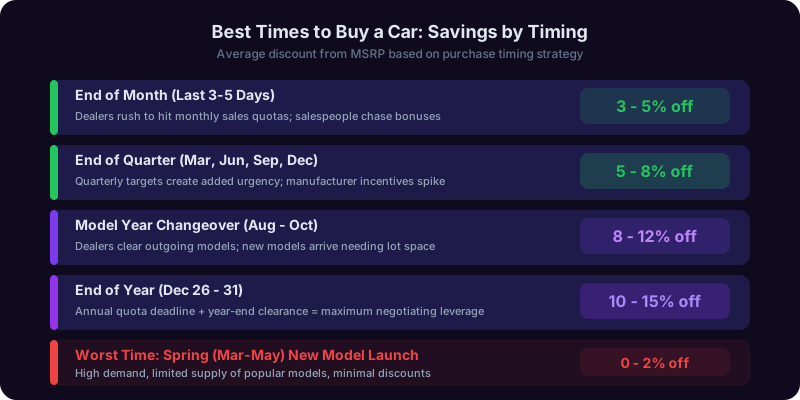
When you buy matters almost as much as how you negotiate. Dealerships operate on monthly, quarterly, and annual sales targets, creating predictable windows of maximum leverage.
Best Times to Buy New
- Last 3-5 days of the month: Salespeople near bonus thresholds accept thinner margins to close one more deal.
- End of quarter (March, June, September, December): Manufacturers pay quarterly volume bonuses. A dealer needing 5 more sales to earn $50,000 will happily lose $1,000 on yours.
- Late December: Monthly, quarterly, and annual targets converge with model-year clearance for the most aggressive pricing all year.
- Model year changeover (August-October): Current-year inventory becomes "last year's model." Savings of 10-15% off MSRP are common.
When NOT to Buy
- First 2 weeks after a model launch: Maximum demand, minimum inventory, zero incentive to negotiate.
- April-May: Tax refund season floods dealerships with buyers.
- Saturday afternoon: Busiest time. Weekday mornings give you more attention and flexibility.
Used Car Advantages
- Higher margins (20-40% markup) mean more room to negotiate than new cars (5-10%).
- Simpler negotiation: No holdback or incentive complexity. Just market value vs. asking price.
- CPO programs offer manufacturer warranties on used cars, reducing risk while saving on depreciation.
Used Car Due Diligence
- Vehicle history report: Run the VIN through Carfax and AutoCheck for accidents, owners, and title status.
- Pre-purchase inspection: Pay $100-$200 for an independent mechanic. Non-negotiable for any used car over $5,000. If the dealer refuses, walk away.
- Recall check: Search the VIN on the NHTSA recall database. Open recalls must be completed before delivery at no cost.
Used Car Script
"I checked KBB and Edmunds for a [year/make/model] with [mileage] miles in [condition] condition. The range is $[low] to $[high]. Your asking price is [above/at/below] that range. Based on the data, I would like to offer $[target]. I am ready to close today."
Target 10-15% below asking price. Dealers expect negotiation on used cars even more than new. The Finance Copilot can calculate total cost of ownership including depreciation, insurance, and maintenance.
How AI Tools Level the Playing Field and Your Final Checklist
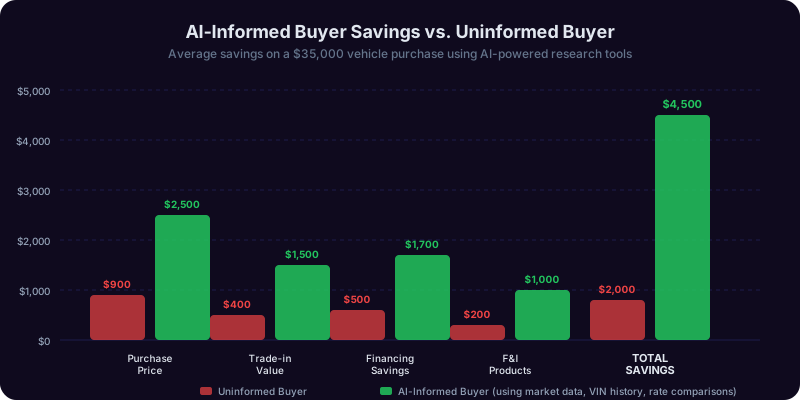
Car buying has historically been one of the most information-asymmetric transactions consumers face. The dealer knows the invoice, holdback, incentives, and market demand. You know the sticker price. AI tools in 2026 are closing that gap, giving buyers the analysis that once required professional car-buying services.
How AI Helps
- Instant price research: The Finance Copilot pulls invoice pricing, incentives, and local transaction prices for any configuration in seconds.
- Deal analysis: Paste a dealer's offer and get instant analysis of whether the price is fair and which fees are inflated.
- Script customization: AI tailors the templates in this guide with your specific numbers and local market conditions.
- Financing comparison: Model rebate-vs-low-APR, different down payments, and loan term impacts instantly.
- Real-time support: At the dealership and the finance manager offers a rate? Step outside, check with AI, and counter in 30 seconds.
Before You Go Checklist
| Step | Done |
|---|---|
| Decided on make, model, and trim | |
| Looked up invoice price on Edmunds/KBB | |
| Checked manufacturer incentives and rebates | |
| Got pre-approved financing from bank/credit union | |
| Obtained 3-5 competing dealer quotes via email | |
| Got independent trade-in value (CarMax, Carvana, KBB) | |
| Calculated rebate vs. low-APR best option | |
| Set target price and walk-away price |
At the Dealership Checklist
| Step | Done |
|---|---|
| Negotiated purchase price FIRST | |
| Refused to negotiate on monthly payment | |
| Handled trade-in as separate transaction | |
| Compared dealer rate to pre-approval | |
| Declined all F&I add-on products | |
| Questioned all fees above tax, title, registration | |
| Reviewed final contract line by line | |
| Confirmed out-the-door price matches agreed number |
After You Buy
- Add the car to your insurance before driving off the lot.
- Set up loan autopay to protect your credit score.
- Save all documentation: purchase agreement, loan contract, warranty info, and window sticker.
For strategies on building savings after the purchase, see our guides on investing with $100 and building an emergency fund.
This is general information, not legal or financial advice. Consult a qualified professional for guidance specific to your situation.
Frequently Asked Questions
Recommended Copilots
Recommended Copilots
Research invoice pricing, analyze dealer offers, compare financing options, and calculate total cost of ownership for any vehicle
Try Free →Look up state-specific doc fee caps, lemon laws, dealer advertising regulations, and buyer protection statutes
Try Free →Related Articles
Get Answers From the Finance Copilot
Tell the Finance Copilot your target vehicle and budget, and get a complete deal analysis with invoice pricing, competing offer strategies, financing comparisons, and customized negotiation scripts.