

What "Total Loss" Actually Means and When Insurers Declare It
A total loss happens when the cost to repair your vehicle exceeds a specific percentage of its pre-accident Actual Cash Value (ACV), or when the car is deemed structurally unsafe regardless of repair cost. The threshold is not universal - every state sets its own rule, and your insurer applies the stricter of the state rule or its internal Total Loss Formula (TLF).
The TLF most major insurers use is: Repair Cost + Salvage Value ≥ ACV. If a car worth $18,000 has $13,000 in repair estimates and a $6,000 salvage value, the math is $13,000 + $6,000 = $19,000, which exceeds the $18,000 ACV - so it gets totaled. This formula often totals cars at 65-72% of ACV in repair damage, well below what most owners expect.
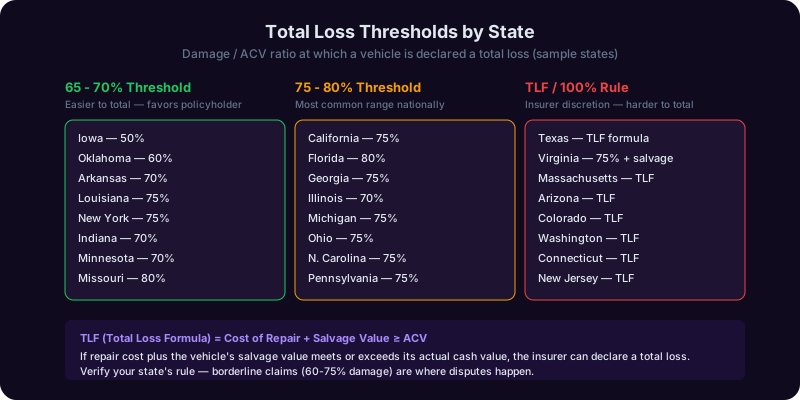
State Total Loss Thresholds (2026)
| State Rule Type | Threshold | Example States |
|---|---|---|
| Total Loss Formula (TLF) | Repair + salvage ≥ ACV | CA, AZ, CO, MA, NY, NJ, OH, WA, MI |
| 75% of ACV | Repair cost ≥ 75% of ACV | NV, IA |
| 70% of ACV | Repair cost ≥ 70% of ACV | IN, TX (insurer custom) |
| 80% of ACV | Repair cost ≥ 80% of ACV | FL, MD, WV |
| 65% of ACV | Repair cost ≥ 65% of ACV | OK |
| 100% of ACV | Repair cost ≥ 100% of ACV | TX (state minimum), MS |
Constructive Total Loss vs. Actual Total Loss
An actual total loss means the vehicle is physically destroyed or stolen and unrecovered - think a burned-out frame after a fire. A constructive total loss means the car is technically repairable but uneconomical to fix. Roughly 95% of declared totals are constructive losses, which is where negotiation leverage exists - the insurer made a financial judgment, and you can challenge that judgment with better numbers.
What Happens After the Declaration
Within 7-10 business days of declaration, the insurer assigns a Total Loss Adjuster (different from the field adjuster who first inspected the car). The adjuster pulls a valuation report from a third-party system (CCC, Mitchell, or Audatex), applies any policy deductible, and presents a settlement offer. This first offer is the negotiation starting point - not the final number. Industry data from the National Association of Insurance Commissioners (NAIC) shows initial total loss offers run 15-25% below true market value on average.
Your Two Options
- Accept the settlement and surrender the title - the insurer pays the ACV minus your deductible, and the vehicle goes to salvage auction.
- Retain the vehicle as an owner-retained salvage - the insurer pays you the ACV minus the deductible minus the salvage value. You receive a salvage title and can attempt repairs, but in most states the car must pass a state inspection before re-registration.
If you have a loan, your lienholder controls the title and almost always requires you to surrender the vehicle. If you owe more than the ACV, gap insurance (covered in section 6) pays the difference.
Disclaimer: This article provides general educational information about negotiating total loss settlements. It is not legal, insurance, or financial advice. Insurance regulations vary by state, and policy language controls. Consult a licensed attorney or public adjuster in your jurisdiction before pursuing significant disputes.
How Insurers Calculate ACV: CCC, Mitchell, and Audatex Decoded
Your insurer does not calculate your car's value internally. They outsource the work to one of three third-party valuation services that dominate the U.S. market. Understanding which system your insurer used, and the specific biases of that system, is the single most important factor in successful negotiation.

The Three Valuation Systems
| System | Used By | Methodology | Known Biases |
|---|---|---|---|
| CCC ONE Market Valuation | State Farm, USAA, Liberty Mutual, Farmers, Allstate (selectively) | Comparable vehicle listings from dealer inventory feeds, adjusted | Heavy "projected sold adjustments" that reduce listing prices 8-12% |
| Mitchell WorkCenter Total Loss | GEICO, Progressive (selectively), Nationwide, smaller regional carriers | Auction data, dealer listings, NADA wholesale benchmarks | Skews toward wholesale rather than retail replacement |
| Audatex Autosource | Progressive (primary), Allstate (selectively), some commercial | Aggregated dealer listings with regional weighting | Narrow geographic radius can miss higher-priced comparables |
The "Projected Sold Adjustment" Problem (CCC)
This is the most controversial deduction in the industry. CCC takes the asking price of comparable vehicles from dealer listings, then subtracts a "projected sold adjustment" typically ranging from $800 to $2,200 per comparable, on the theory that dealers negotiate down from asking. Multiple class-action lawsuits have challenged this methodology, with several states - including Washington and Illinois - issuing regulatory guidance that this adjustment must be supported by actual transaction data, not estimates. Always demand the source data for projected sold adjustments. If the insurer cannot produce verifiable sold prices for the exact comparables, the adjustment must be removed.
Common Valuation Errors
Independent audits of valuation reports consistently find errors in 60-75% of total loss valuations. The most common:
- Wrong trim level or package: An LX valued instead of an EX-L, missing $1,500-$3,500 in factory options
- Mileage misreporting: Adjuster used 95,000 miles when actual was 78,000 (each 10,000 miles is roughly $800-$1,500)
- Condition rating too low: Defaulted to "average" when the vehicle was "clean" or "excellent" per industry guides
- Missing options: Sunroof, leather, navigation, premium audio, towing package, tech packages - each worth $400-$2,800
- Stale comparables: Listings from 60-180 days ago in a rising market
- Distant comparables: Vehicles 100-300 miles away when local inventory exists
- Wrong drivetrain: AWD coded as FWD or vice versa - can be a $2,000+ swing
What to Request Immediately
The moment the insurer presents a settlement offer, request these documents in writing:
- The full valuation report (CCC, Mitchell, or Audatex PDF, typically 15-30 pages)
- The exact list of comparable vehicles used, with VIN, mileage, asking price, and adjustments
- The condition rating applied and the basis for that rating
- Itemized factory options the valuation included or excluded
- Documentation of any "projected sold" or market-adjustment deductions
Under most state insurance regulations, the insurer must provide this within 5-10 business days of written request. If they refuse, that is a regulatory violation and grounds for a complaint to your state insurance commissioner.
Top 10 Reasons Your Settlement Offer Is Too Low (and How to Spot Them)
Lowball offers are not random. They follow patterns. After auditing thousands of valuation reports, the same ten errors and biases account for nearly all underpayments. Walk through this checklist with your own valuation report in hand.
The Top 10 Underpayment Causes
- Projected sold adjustments not backed by actual sales data. If the report shows $1,200 deductions on each comparable with no transaction data, demand removal. Average recovery: $1,000-$2,500.
- Wrong vehicle condition rating. Insurers default to "average" or "fair" without inspecting. A correct "clean" or "excellent" rating typically adds 8-15% to ACV. Average recovery: $1,200-$3,000.
- Missing factory options. Pull your original window sticker, build sheet, or VIN decode and itemize every option. Average recovery: $800-$3,500.
- Trim-level error. Compare the VIN to the trim used in the report. A single trim level can swing $1,500-$4,000.
- Mileage error. Provide oil change records, inspection records, or a service history report showing actual mileage. Average recovery: $400-$1,500.
- Stale comparables (90+ days old). In a 2026 used-car market with monthly price movement, comparables must be current. Demand listings under 30-45 days old. Average recovery: $500-$2,000.
- Geographic mismatch. Comparables from a 300-mile-away cheaper market are not appropriate. Insist on local-market comparables within 75-100 miles. Average recovery: $700-$2,200.
- Missing aftermarket equipment. Bed liners, lift kits, premium tires/wheels, tow packages, performance upgrades, custom audio - typically requires receipts but adds 50-80% of installed value. Average recovery: $300-$5,000+.
- Recent major service ignored. A timing belt replaced 3,000 miles ago, new tires, new brakes, recent transmission - these increase value. Bring receipts. Average recovery: $300-$1,500.
- Sales tax, title, and registration fees not included. Many states require these be included in the settlement (covered in section 6). Insurer often "forgets" them. Average recovery: $1,000-$2,500.
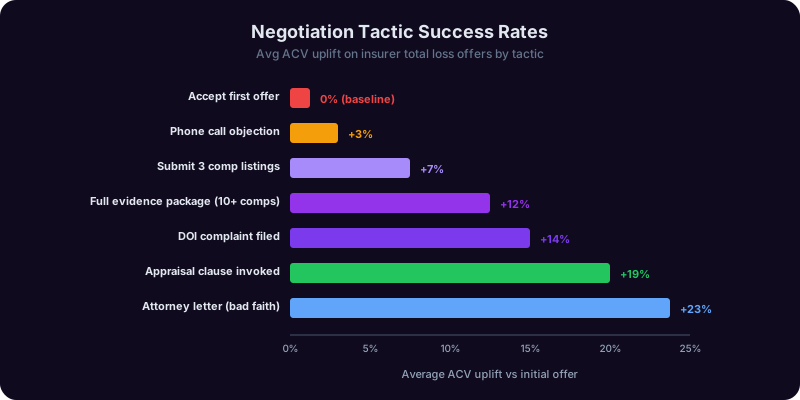
Red Flags in the Valuation Report
- Fewer than 3-4 comparable vehicles listed (most state regulations require minimum 3-5)
- Comparables with significantly different mileage (more than 20,000-mile difference without proper adjustment)
- No itemized breakdown of how condition was determined
- Round-number deductions with no explanation
- "Refurbishment" or "reconditioning" line items deducted from your specific vehicle
- Failure to include any geographic premium when your market is high-cost
The Math of Compounding Errors
A typical lowball valuation has three or four of these errors layered. A $19,500 actual-value vehicle might be initially offered at $15,800 - a $3,700 gap that consists of: $1,200 projected sold adjustment + $1,400 wrong condition + $700 missed options + $400 mileage error. Identify each, document each, and the increase is rarely contested when properly evidenced.

Get Answers From the Insurance Copilot
Upload your insurance valuation report and the Insurance Copilot will identify every lowball error, build your evidence checklist, and draft a line-by-line counter-offer letter that typically adds $2,000-$8,000 to total loss settlements.
Building Your Counter-Valuation Evidence Package
A successful counter-offer is not a complaint - it is a documented, line-by-line replacement of the insurer's valuation with verifiable, comparable, current market data. The goal is to make accepting your number easier for the adjuster than fighting it.
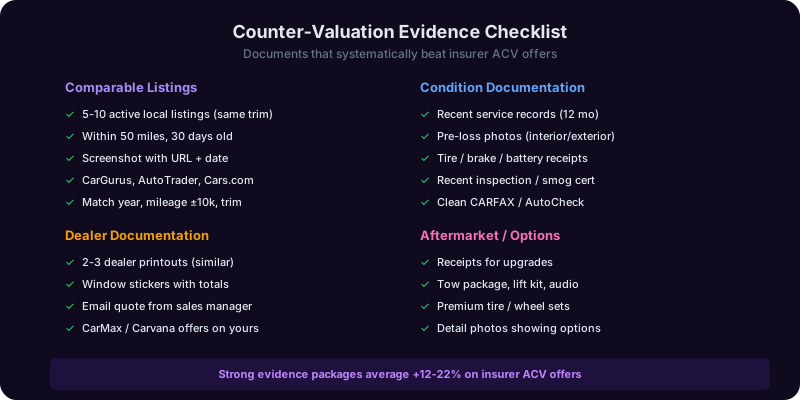
The Five-Pillar Evidence Package
1. Comparable Vehicle Listings (Active Market)
Pull 5-10 listings of vehicles matching yours as closely as possible in year, make, model, trim, mileage, and condition. Sources:
- CarGurus: Includes deal ratings (Great, Good, Fair, High) and days-on-market data
- AutoTrader: Strong for dealer inventory with detailed option listings
- Cars.com: Good for regional pricing variance
- CarMax: No-haggle prices - powerful because the listed price IS the transaction price
- Carvana: Same logic as CarMax - listed price equals transaction price
- Edmunds and KBB: Both provide private-party and dealer-retail values; use these as supporting reference, not primary evidence
Screenshot each listing with URL, date, asking price, mileage, and options. PDF the full listing pages. CarMax and Carvana listings are the strongest evidence because they remove the "projected sold adjustment" argument entirely.
2. Recent Local Sold Comparables
Where available, pull actual sale data. NADA, JD Power, and Black Book provide transaction-level data on subscription. Some states require insurers to use recent sold transactions when challenged - check your state insurance regulation.
3. Dealer Quote Printouts
Visit or call 2-3 local dealers selling comparable vehicles. Ask for an "out-the-door price" quote in writing. Dealer-quoted prices on inventory matching yours are powerful evidence and difficult for the insurer to discount.
4. Condition Documentation
Build a binder proving your vehicle was in superior condition:
- 20-40 pre-accident photos showing exterior, interior, engine bay, tires, undercarriage
- Complete maintenance records (oil changes, scheduled services)
- Recent repair receipts (new tires, new brakes, recent battery, fluid services)
- Carfax or AutoCheck report showing no accidents and consistent maintenance
- State inspection records showing mileage history
5. Factory Build Sheet and VIN Decode
Request the original window sticker or build sheet from your manufacturer (most have an online VIN-lookup tool). This produces a definitive list of every factory option, eliminating any insurer claim that an option was not present.
Aftermarket Evidence
For aftermarket additions, gather: original purchase receipts, installation labor receipts, professional installation documentation, and photos showing installed condition. The insurer typically pays 50-80% of installed value for aftermarket equipment less than 5 years old.
Organize as a Single PDF
Compile everything into one indexed PDF with a table of contents. Include a one-page summary at the front showing: (1) the insurer's offered ACV, (2) your demanded ACV, (3) the gap, and (4) a line-item explanation of each adjustment. Adjusters are far more likely to approve a fully-documented counter than to spend hours rebuilding a valuation themselves. The Insurance Copilot can structure this package and identify any missing categories before submission.
The Negotiation Letter Template With Line-by-Line Dollar Adjustments
The counter-offer letter is the centerpiece of your negotiation. It should be specific, calm, professionally formatted, and reference exact dollar amounts with exact documentation. Vague complaints get ignored. Itemized demands get paid.
Letter Structure
- Header: Your name, address, policy number, claim number, date of loss, date of letter
- Subject line: "Counter-Offer to Total Loss Settlement Valuation - Claim [number]"
- Opening paragraph: Acknowledge the offer, state you are providing a documented counter, do not be combative
- Itemized adjustments: Line-by-line corrections with dollar amounts
- Revised ACV calculation: Show the math
- Demand for response: Specific deadline (10-15 business days)
- Reservation of rights: Reference to appraisal clause and state regulator
- Attachments list: Index of all evidence
Sample Adjustment Section
The body of the letter should read like this (with your specific numbers):
"The settlement offer of $15,800 dated [date] understates the Actual Cash Value of my 2022 Honda Accord EX-L for the following documented reasons:
- Projected Sold Adjustment ($1,400 total across comparables): The CCC valuation deducts $350 per comparable as a ‘projected sold adjustment’ without providing transaction data. Per [your state] regulation, market adjustments must be supported by verifiable sold prices. I request removal of this adjustment. Adjustment: +$1,400.
- Condition Rating Correction: The valuation applied ‘Average’ condition. Attached are 32 pre-accident photographs and complete maintenance records establishing ‘Clean’ condition per NADA criteria. Industry standard adjustment from Average to Clean is 10%. Adjustment: +$1,580.
- Missing Factory Options: The valuation omits the Honda Sensing safety package (window sticker shows $1,250 MSRP), heated rear seats ($350), and adaptive damper system ($800). Honda VIN build report attached. Combined depreciated value adjustment: +$725.
- Mileage Correction: The valuation reflects 95,200 miles. The actual odometer reading at loss was 78,840 miles per the police report and the salvage yard inspection. Difference: 16,360 miles. Adjustment per CCC mileage table: +$1,180.
- Recent Tire Replacement: Four Michelin Defender tires installed [date], 4,200 miles before loss. Receipts attached. Adjustment: +$420.
- Comparable Vehicle Refresh: Five current local-market comparables from CarGurus, CarMax, and AutoTrader, all within 60 miles and listed within 21 days, attached. Median asking price: $19,450.
Adjusted ACV calculation: $15,800 (initial offer) + $1,400 + $1,580 + $725 + $1,180 + $420 = $21,105. Cross-checked against five local comparables averaging $19,450 supports a settlement of $19,800.
I request a revised settlement of $19,800 plus state-mandated sales tax, title, and registration fees, with response within 15 business days. If we cannot reach agreement, I reserve the right to invoke the appraisal clause under my policy and to file a complaint with the [state] Department of Insurance."
What Makes This Work
- Specific dollar amounts for every adjustment - no "feels low" language
- Documentation references for each line
- Math that adds up and ties to a final number
- Cross-validation with independent comparable data
- Regulatory leverage at the close without threats
Submit by certified mail and email to the adjuster, with copies of all attached evidence. Keep delivery confirmation. The Insurance Copilot can generate this letter customized to your valuation report and evidence package in under five minutes.
Sales Tax, License, Registration Fees, and Gap Insurance Interaction
The ACV is only part of what you are owed. In 38 states, your insurer is also required to pay the sales tax, title, license, and registration fees you will incur replacing the vehicle. These often total $1,200-$3,500 and are routinely omitted from initial settlement offers.

State Treatment of Sales Tax and Fees
| Treatment | States (Examples) | What Insurer Owes |
|---|---|---|
| Sales tax + title + reg automatically included | CA, FL, NY, NJ, MA, WA, IL, MD, MN, CO, OR | Full reimbursement at time of settlement |
| Sales tax only on proof of replacement vehicle purchase | TX, NC, GA, VA, OH, IN, MO, TN, KY | Reimbursed after you buy replacement and submit receipt |
| Sales tax included only if owner-retained salvage | PA, MI (older policy forms) | Negotiable - demand it |
| No requirement (rare) | A small number of states | Still negotiate - many insurers pay regardless |
How to Calculate What You Are Owed
- Sales tax: Apply your state and local sales tax rate to the ACV settlement amount. Example: $19,800 ACV at 8.25% combined rate = $1,634 sales tax
- Title fee: Typically $15-$95 depending on state
- Registration fee: Varies by vehicle weight and state, typically $50-$300
- Other state-specific fees: Emissions, lien recording, transfer fees
Gap Insurance: When ACV Is Less Than Your Loan
If you financed or leased the vehicle and owe more than the ACV, the difference is paid by gap insurance - only if you have it. Gap (Guaranteed Asset Protection) insurance is a separate coverage typically purchased from the dealer or your lender, costing $300-$700 over the life of a loan. The Insurance Information Institute (III) notes that approximately 25-30% of financed vehicles end up with negative equity at some point during the loan, making gap coverage critical for new-car buyers.
How Gap Insurance Interacts With Your Settlement
The gap insurer pays the difference between the ACV your auto insurer pays the lienholder and your outstanding loan balance. Importantly:
- Gap insurance pays AFTER the ACV settlement is final - meaning a higher ACV reduces gap payout dollar-for-dollar but does not reduce what you owe
- Gap does not cover your deductible in most policies - you still owe the $500-$1,000 deductible
- Gap does not cover missed payments, late fees, or extended warranty refunds owed to the lender
- Negotiating a higher ACV is still in your interest if you have gap, because some gap policies cap reimbursement at a percentage of ACV or MSRP
If You Don't Have Gap and Owe More Than ACV
Options include: (1) negotiate the ACV as high as possible to minimize the gap, (2) ask the lender about hardship deferral while you regroup, (3) explore whether your credit report qualifies you for a low-rate consolidation loan to close the gap, or (4) for severe cases involving manufacturer defects, review whether lemon law protections apply.
Whichever path applies, demand the sales tax, title, and registration amounts in writing as part of your counter-offer. Do not accept "we will reimburse those separately" - get the dollar amount in the final settlement.
Diminished Value Claims: When Not-At-Fault Accidents Cost You More
Diminished value (DV) is the loss in resale value a vehicle suffers because it now has an accident on its history report, even after high-quality repairs. A car with a clean Carfax that is repaired perfectly after a moderate accident still loses 10-30% of its pre-accident value in the resale market simply because buyers will pay less for any car with reported damage.
Diminished value claims apply when you are not at fault and the at-fault driver's insurer pays. They generally do not apply to first-party claims under your own collision coverage, although a few states allow this.
States That Recognize Third-Party Diminished Value Claims
Diminished value claims are well-established in approximately 30 states, with the strongest case law in:
- Georgia (Mabry v. State Farm, 2001 - cornerstone DV case)
- North Carolina
- Kansas
- Virginia
- Washington
- California (with limitations - statute of limitations 3 years)
- Florida
- Texas
- Massachusetts
A smaller number of states - notably Michigan and a few others - either do not recognize DV or have severe restrictions. Check your specific state's insurance regulations or consult a local attorney before investing significant time.
The Three Types of Diminished Value
- Inherent Diminished Value: Loss in value purely from the accident history, even after perfect repair. This is the most commonly claimable type.
- Repair-Related Diminished Value: Loss in value from imperfect or substandard repairs - mismatched paint, panel gaps, lower-quality replacement parts.
- Immediate Diminished Value: The difference between pre-accident value and value immediately after the accident, before repair. Used mainly in litigation, rarely in insurance claims.
The 17c Formula (and Why You Should Not Use It)
Most insurers calculate DV using the "17c formula" from the Mabry case: take 10% of pre-accident value as the base, apply a damage multiplier (0.00 to 1.00 based on severity), then a mileage multiplier (1.00 down to 0.20 based on miles). The formula often produces lowball results, especially for high-mileage vehicles. A 2020 vehicle with 95,000 miles and moderate damage might score $300-$800 in DV under 17c.
Independent appraisers using actual market comparable analysis - comparing your repaired vehicle's value against identical undamaged vehicles - typically produce DV amounts 3-5x higher than 17c calculations. For claims over $1,500, hiring an independent DV appraiser ($150-$400) almost always pays for itself.
How to File a Diminished Value Claim
- Confirm you were not at fault and that the at-fault driver's insurer accepted liability
- Have repairs completed and obtain full repair documentation
- Order a DV appraisal from an independent licensed appraiser using market comparables
- Submit a written demand to the at-fault insurer with the appraisal report
- If denied or lowballed, escalate via your state insurance commissioner or small claims court (DV claims are common small-claims matters)
For total losses (covered in earlier sections), DV does not apply directly - you receive ACV, not a repaired vehicle. DV applies only when the car is repaired. However, the underlying principle - that the at-fault insurer owes you full economic recovery - extends to total loss settlements too.
Appraisal Clause, State Complaints, and AI-Drafted Counter-Offers
If your insurer refuses to budge on a documented counter-offer, you have two structured escalation paths that work in nearly every state: the policy's appraisal clause, and a formal complaint to your state insurance commissioner. Both can be invoked without an attorney, and both materially shift negotiating dynamics.
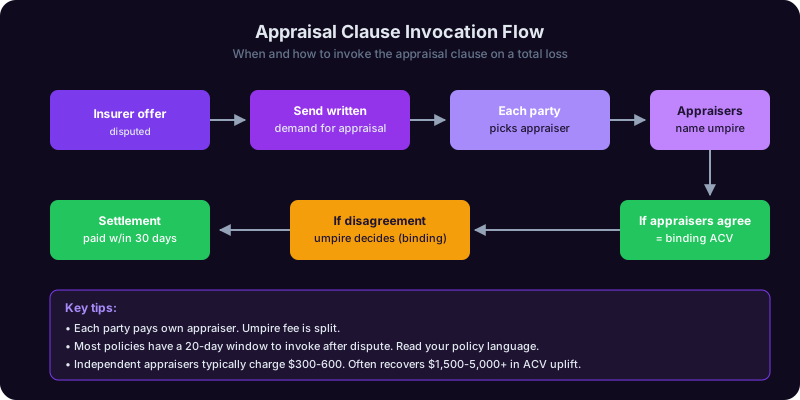
The Appraisal Clause: Your Built-In Arbitration
Virtually every standard auto policy contains an appraisal clause - usually in the "Conditions" section. It works like this:
- You and the insurer each select an independent appraiser at your own expense ($300-$800 typical fee)
- The two appraisers attempt to agree on the ACV
- If they cannot agree, they select a neutral umpire, also at shared expense
- Any two of the three (your appraiser, insurer's appraiser, or umpire) can set the binding ACV
The appraisal clause produces ACV decisions that are binding on both parties, removing the dispute from the insurer's internal process entirely. Statistics from public adjuster associations show appraisal awards average 22-38% higher than the insurer's pre-appraisal final offer. For disputes over $1,500-$2,000 in gap, appraisal is almost always cost-effective.
How to Invoke the Appraisal Clause
- Send written notice to the insurer citing the specific policy provision invoking appraisal
- Identify your selected appraiser - public adjusters and independent auto appraisers are appropriate; some attorneys specialize
- Insurer typically responds within 7-14 days with their appraiser
- Process completes in 30-60 days
State Insurance Commissioner Complaints
Every state has an insurance commissioner or department of insurance that accepts consumer complaints against insurers. Filing a complaint is free, requires no attorney, and typically generates a response from the insurer within 14-30 days. Find your state department through the NAIC state insurance department directory.
What to Include in a Complaint
- Policy number, claim number, dates
- Specific factual narrative of what the insurer did or failed to do
- Specific regulatory violations if you can identify them (failure to provide valuation documentation, use of unsupported adjustments, refusal to include statutorily-required sales tax)
- Your counter-offer letter and supporting evidence
- The specific resolution you are requesting
Insurers track complaint ratios as a regulatory and reputational metric. A well-documented complaint often produces a settlement adjustment within days of being filed - sometimes before the regulator even formally responds.
When to Hire a Public Adjuster or Attorney
For total loss disputes under $3,000 in gap, self-representation with strong documentation is usually sufficient. For disputes of $3,000-$15,000, a public adjuster (working on contingency, typically 8-15%) can manage the entire process. For disputes over $15,000, or where bad-faith claims handling appears, an attorney specializing in first-party insurance claims may be warranted - many state bar associations maintain referral lists.
How Copilotly's Insurance Copilot Helps
The Insurance Copilot handles the most time-consuming parts of this process for you:
- Valuation report audit: Upload the CCC, Mitchell, or Audatex PDF and get a line-by-line review of every comparable, adjustment, condition rating, and option, with flagged errors
- Counter-offer letter generation: Produces a fully-formatted, itemized counter-offer letter based on your valuation report and evidence package
- Evidence checklist: Personalized list of documents to gather based on your specific vehicle and circumstances
- State-specific guidance: Pulls the relevant regulations and requirements for your state, including sales tax inclusion rules and complaint filing procedures
- Appraisal clause invocation letter: Generates the formal notice if you need to escalate
- State commissioner complaint draft: Builds the complaint narrative with citations to specific regulatory provisions
For broader context on what to do immediately after an accident, see our complete guide on what to do after a car accident. If you are also negotiating a replacement vehicle purchase, our guide on how to negotiate car price applies the same evidence-based approach to dealer transactions. And if your loss was caused by an underlying vehicle defect, review lemon law protections for additional recovery paths.
The combined effect of strong documentation, a professional counter-offer, and credible willingness to invoke the appraisal clause or file a regulatory complaint adds an average of $2,000-$8,000 to total loss settlements in the audits we have reviewed. The process takes 2-6 weeks but is among the highest hourly returns available in personal finance.
Disclaimer: This guide provides general information and is not legal, insurance, or financial advice. Insurance regulations and case law vary by state, and policy language ultimately controls disputes. For settlements involving significant dollar amounts, suspected bad faith, or complex coverage questions, consult a licensed attorney or public adjuster in your jurisdiction. Copilotly tools assist with documentation and drafting but do not replace professional legal advice.
Frequently Asked Questions
Recommended Copilots
Recommended Copilots
Audit your CCC, Mitchell, or Audatex valuation report and draft a documented counter-offer that adds thousands to your settlement
Try Free →Calculate the true market value of your vehicle, model gap insurance interactions, and structure replacement vehicle financing
Try Free →Related Articles
Get Answers From the Insurance Copilot
Upload your insurance valuation report and the Insurance Copilot will identify every lowball error, build your evidence checklist, and draft a line-by-line counter-offer letter that typically adds $2,000-$8,000 to total loss settlements.