
Money & Finance
What to Do When a Credit Bureau Ignores Your Dispute
One in five Americans has a credit report error, and bureau dispute resolution rates are at historic lows. When the 30-day investigation window passes with no fix, the FCRA and a CFPB complaint give you real leverage; here is the exact escalation path with templates.
Credit Report Errors Are More Common Than You Think
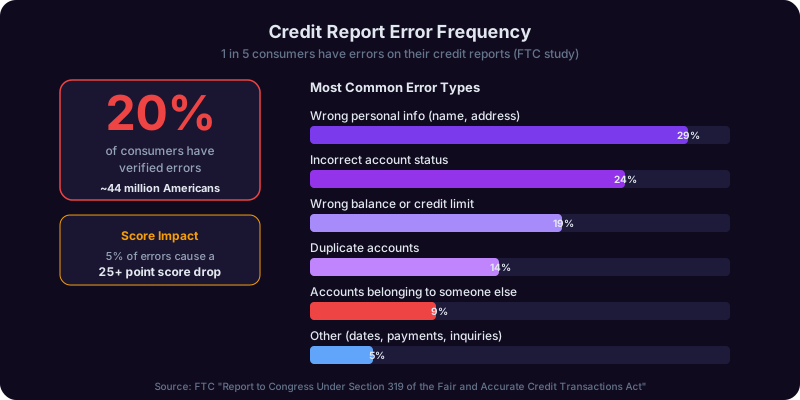
If you assume your credit report is accurate, you are in the majority. You are also likely wrong. A landmark study by the Federal Trade Commission found that one in five consumers had a verified error on at least one of their three credit reports. Among those who disputed errors, over 20% saw their score increase after corrections were made, with more than half experiencing a meaningful jump of 25 points or more.
That FTC study was conducted in 2012, and the situation has not improved. The credit reporting ecosystem processes approximately 4.4 billion data points per month across 200 million consumer files. With that volume, errors are not exceptions. They are a statistical certainty.
The Most Common Types of Credit Report Errors
Understanding what to look for is half the battle. Errors fall into several categories, and some are far more damaging than others.
Identity errors: These occur when someone else's information appears on your report. Mixed files (where two people with similar names or Social Security numbers have their data merged) are surprisingly common. You might see an address you have never lived at, an employer you have never worked for, or accounts that belong to someone with a similar name.
Account status errors: An account reported as open when it was closed. A paid collection still showing as unpaid. An account listed as delinquent when it was current. These status errors directly impact your score because the scoring model reads the reported status, not what actually happened.
Balance and limit errors: Your credit card balance reported as $5,200 when it was actually $520. Your credit limit showing $3,000 instead of $10,000. These errors inflate your utilization ratio, which accounts for 30% of your FICO score. A single misreported balance can drop your score by 50 points or more.
Duplicate accounts: The same debt appearing twice, often when an account is transferred from one servicer to another. Both the original and the new servicer report it, making it look like you owe twice the actual amount.
Outdated negative information: Late payments, collections, and other negative marks are supposed to fall off your report after 7 years (10 years for Chapter 7 bankruptcy). But the removal is not always automatic, and old negatives that should have aged off sometimes linger.
If you are unsure how these errors affect your score, our guide on understanding your credit score explains each factor and its weight.
This is general information, not legal or financial advice. Consult a qualified professional for guidance specific to your situation.
How to Get Your Free Credit Reports in 2026
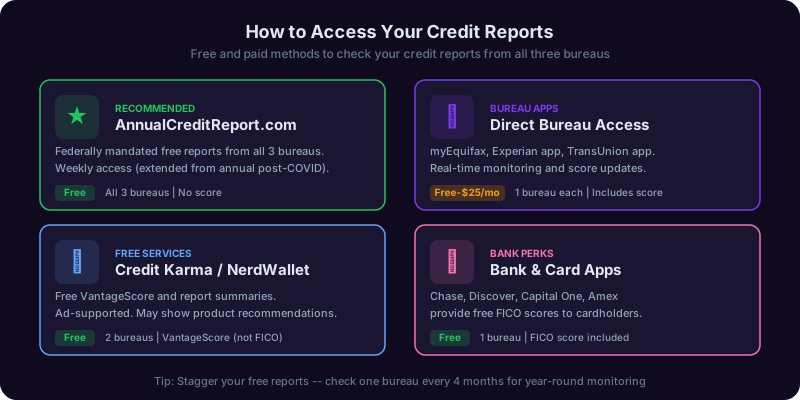
Before you can dispute errors, you need to see your reports. The only federally authorized source for free credit reports is AnnualCreditReport.com. This site was created by the three major bureaus as required by the Fair Credit Reporting Act (FCRA). Do not confuse it with other sites that offer "free" reports but require a credit card or sign you up for paid monitoring.
What You Are Entitled To
Under federal law, you are entitled to one free credit report per bureau per week. This expanded access was originally introduced as a pandemic-era policy in 2020 and has been extended through 2026. Before this change, you were limited to one free report per bureau per year.
You may also be entitled to additional free reports:
- Denied credit, insurance, or employment: The adverse action notice must name the bureau. You have 60 days to request a free copy.
- Identity theft victim: Additional free reports beyond the weekly allotment.
- Unemployed and job-seeking: You can request a free report.
- Placed a fraud alert: You are entitled to a free report from each bureau.
How to Pull Your Reports
- Go to AnnualCreditReport.com. Do not use any other URL.
- Select all three bureaus (Equifax, Experian, TransUnion).
- Verify your identity by answering security questions pulled from your credit file.
- Download or print each report. Save a PDF copy for your records.
What Your Report Contains
Each credit report includes four main sections:
- Personal information: Name, addresses, Social Security number (partially masked), date of birth, employers
- Credit accounts (tradelines): Every credit card, loan, and line of credit with opening date, limit or amount, balance, payment history, and status
- Public records: Bankruptcies and civil judgments
- Inquiries: Hard inquiries (lender checks when you apply) and soft inquiries (pre-approvals, your own checks)
The Stagger Strategy
Rather than pulling all three reports at once, consider staggering requests every four months. Pull Equifax in January, Experian in May, and TransUnion in September. This gives you year-round coverage and lets you catch errors sooner. However, if you are about to apply for a major loan, pull all three at once so you can compare them side by side and dispute errors before the lender checks.
The Finance Copilot can help you set up a schedule for checking your reports and remind you when it is time to pull each one.
How to Dispute Errors With Each Bureau
Once you have identified errors, you need to file disputes with the specific bureau (or bureaus) reporting the incorrect information. If the same error appears on all three reports, you must dispute it separately with each bureau. There is no unified dispute system.
Three Ways to Dispute
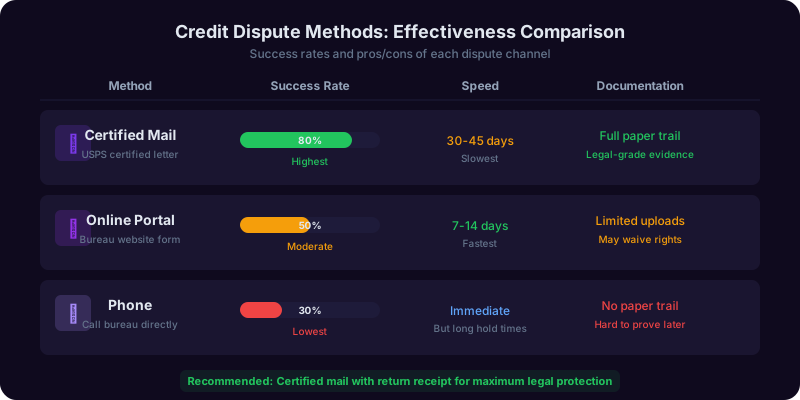
Each bureau offers three dispute methods: online, by mail, and by phone. Here is what you need to know about each.
Online disputes are the fastest to file (10 to 20 minutes per bureau) and provide a tracking number immediately. However, online disputes have a significant limitation: the text fields for explaining your dispute are often restricted to 300 characters or fewer, and you may not be able to upload all supporting documentation. For simple errors (wrong address, incorrect account status), online is fine. For complex disputes (mixed files, identity theft, fraudulent accounts), mail is better.
Mail disputes take longer but give you unlimited space to explain the error and attach as many supporting documents as you need. Under the FCRA, mailing a dispute via certified mail with return receipt creates a legal paper trail that proves when the bureau received your dispute, which starts the 30-day investigation clock. Consumer attorneys almost universally recommend mail for disputes you may need to escalate later.
Phone disputes are available but least recommended. There is no written record of what you said, and the bureau representative may paraphrase your dispute inaccurately.
Equifax Disputes
- Online: equifax.com/personal/disputes. Create or log into your Equifax account, select the item to dispute, and choose the reason.
- Mail: Equifax Information Services LLC, P.O. Box 740256, Atlanta, GA 30374-0256
- Phone: 1-866-349-5191
Experian Disputes
- Online: experian.com/disputes. Log in, select the account with the error, and submit your dispute with an explanation.
- Mail: Experian, P.O. Box 4500, Allen, TX 75013
- Phone: 1-888-397-3742
TransUnion Disputes
- Online: transunion.com/credit-disputes. Create or log into your account and follow the dispute flow.
- Mail: TransUnion Consumer Solutions, P.O. Box 2000, Chester, PA 19016
- Phone: 1-800-916-8800
What to Include in Every Dispute
Regardless of which method you choose, every dispute should include your full name, current address, date of birth, Social Security number (last four digits if online, full number if by mail), a clear description of the error, the account name and number associated with the error, and copies (never originals) of supporting documents such as payment confirmations, account statements, or correspondence with the creditor.
If you have already frozen your credit, disputes still work. A credit freeze does not block dispute investigations.
Dispute Letter Templates You Can Use Today
A well-crafted dispute letter is your most powerful tool. These templates meet FCRA requirements and are structured for bureau investigators to process correctly. Customize them with your specific information.
Template 1: General Error Dispute
Use this for incorrect balances, wrong account statuses, or other straightforward errors.
[Your Full Name] [Your Address] [City, State, ZIP] [Date] [Bureau Name] [Bureau Dispute Address] Re: Dispute of Inaccurate Information Dear Sir or Madam, I am writing to dispute information in my credit file pursuant to Section 611 of the Fair Credit Reporting Act (15 U.S.C. 1681i). Account Name: [Creditor Name] Account Number: [Full or Partial Number] Reason for Dispute: [Describe the error. Example: "This account shows a balance of $4,200, but my statement shows $420. Copy enclosed."] Enclosed: [List documents] Please investigate and correct the disputed items. Under the FCRA, you have 30 days to investigate and respond. Sincerely, [Signature] [Printed Name] SSN: XXX-XX-[Last 4] DOB: [Date of Birth]
Template 2: Collection That Is Not Yours
[Your Full Name] [Your Address] [City, State, ZIP] [Date] [Bureau Name] [Bureau Dispute Address] Re: Dispute of Collection Account Dear Sir or Madam, I am disputing a collection account on my report that I do not recognize. Collection Agency: [Agency Name] Account Number: [Number] Reported Balance: [Amount] I have no record of this debt. I request investigation under Section 611 of the FCRA and verification including original creditor name, account number, and documentation proving this debt is mine. If unverifiable, please remove it immediately. Sincerely, [Signature] [Printed Name] SSN: XXX-XX-[Last 4] DOB: [Date of Birth]
Template 3: Outdated Information Beyond 7 Years
[Your Full Name] [Your Address] [City, State, ZIP] [Date] [Bureau Name] [Bureau Dispute Address] Re: Removal of Outdated Negative Information Dear Sir or Madam, The following item exceeds the maximum reporting period under Section 605 of the FCRA. Account Name: [Creditor or Agency] Account Number: [Number] Date of First Delinquency: [Date, 7+ years ago] Under the FCRA, this item must be removed. I request immediate deletion. Sincerely, [Signature] [Printed Name] SSN: XXX-XX-[Last 4] DOB: [Date of Birth]
Mailing tips: Send all dispute letters via USPS Certified Mail with Return Receipt Requested ($4 to $7). The green card signed by the bureau proves when they received your letter. Keep copies of everything. This documentation is essential if you escalate to the CFPB or consult an attorney.
The Consumer Rights Copilot can help you customize these templates for your specific situation and review your letter before you send it.
The 30-Day Investigation: What Happens After You Dispute
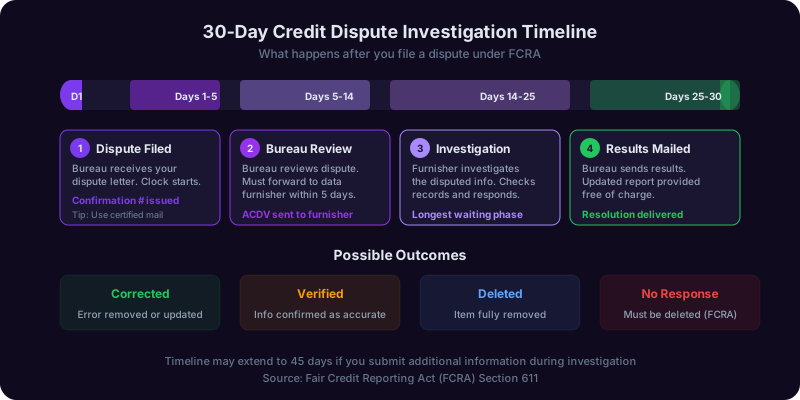
Once a bureau receives your dispute, a federal clock starts ticking. Under the Fair Credit Reporting Act, the bureau has 30 calendar days to investigate and respond (45 days if you submit additional information during the investigation). Here is exactly what happens during that window.
Step 1: The Bureau Reviews Your Dispute (Days 1-5)
The bureau assigns your dispute to an investigator. In practice, the term "investigator" is generous. Most bureau investigations are handled through an automated system called e-OSCAR (Online Solution for Complete and Accurate Reporting). Your dispute is converted into a two- or three-digit code and transmitted electronically to the data furnisher (the creditor or collection agency that reported the information).
This is where the system breaks down for consumers. A nuanced dispute letter explaining that a debt was paid in full on a specific date with a confirmation number gets reduced to a code like "Consumer states account paid." The data furnisher then checks their own records against that code.
Step 2: The Data Furnisher Investigates (Days 5-25)
The creditor or collection agency receives the dispute code from e-OSCAR and is required to conduct a "reasonable investigation." In practice, many furnishers simply check whether the information in their system matches what they reported to the bureau. If it matches, they verify it as accurate, even if their own records are wrong.
This is why direct disputes with the creditor (in addition to bureau disputes) can be more effective. When you contact the creditor directly with documentation, they are more likely to update their records, which flows through to the bureau on the next reporting cycle.
Step 3: The Bureau Sends You Results (Days 25-30)
The bureau must notify you of the results in writing within 5 days of completing the investigation. Three possible outcomes:
- Modified: The information was inaccurate and has been corrected. You receive a free updated credit report.
- Deleted: The item was removed entirely. This happens when the furnisher cannot verify the information or fails to respond within 30 days.
- Verified as accurate: The furnisher confirmed the information. No changes were made. This is the most common outcome, and it does not necessarily mean the information is actually accurate.
If Your Dispute Is Rejected
A "verified as accurate" result does not end the process. You can add a 100-word consumer statement to your credit file explaining your side. While automated underwriting systems ignore these statements, it creates a record that you contested the information. You can also re-dispute with additional documentation or file directly with the creditor under a separate FCRA provision.
The Finance Copilot can help you track your dispute timeline and prepare next steps based on the bureau's response.
Why Bureau Dispute Outcomes Are Getting Worse
Here is the uncomfortable truth about credit report disputes: the system is tilted against consumers, and the data shows it is getting worse.
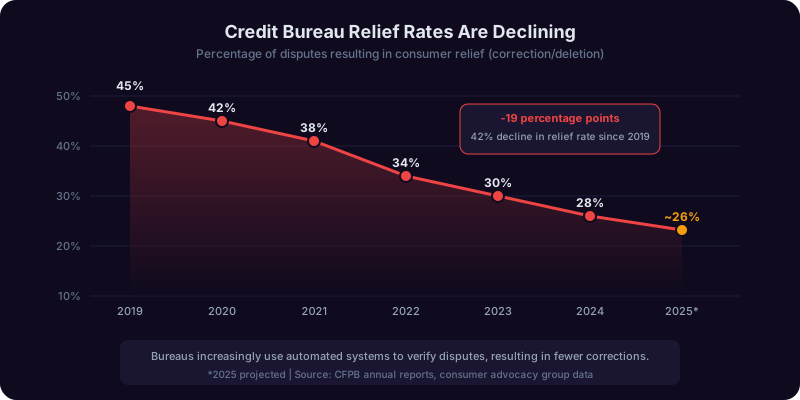
The Consumer Financial Protection Bureau (CFPB) publishes annual reports on credit reporting complaints and dispute outcomes. In 2020, bureaus resolved approximately 42% of disputes in the consumer's favor (the item was modified or deleted). By 2024, that rate dropped to approximately 31%. In early 2025, preliminary data suggests it fell further to around 28%.
Why Relief Rates Are Falling
Increased automation: The e-OSCAR system converts disputes into standardized codes and sends them to furnishers electronically. A 2023 CFPB report found that bureaus frequently failed to forward supporting documentation consumers included, forcing furnishers to decide without the evidence.
Furnisher rubber-stamping: Data furnishers verify the vast majority of disputes as accurate without meaningful investigation. A CFPB enforcement action against a major bank revealed it verified 95% of disputes by simply checking whether the information matched its own database, without reviewing the consumer's evidence.
Volume overwhelms quality: The three bureaus collectively handle approximately 35 million disputes per year. Individual attention to each case is economically impractical. Bureau investigators handle dozens of disputes per day.
CFPB and FTC Enforcement
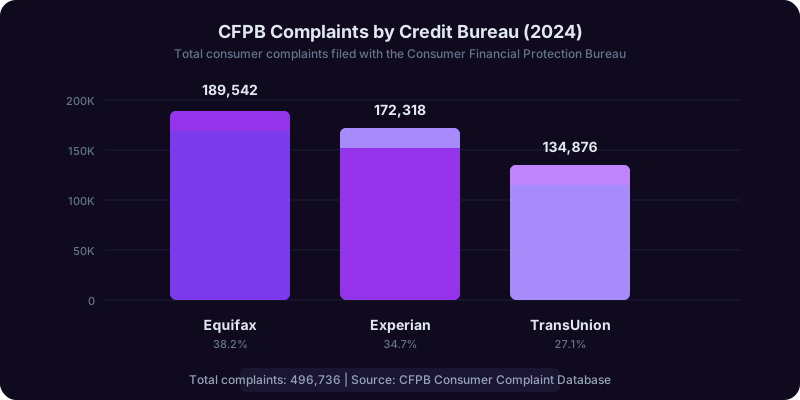
Federal enforcement agencies have taken action. The CFPB has issued consent orders totaling over $200 million in penalties against the major bureaus since 2020 for dispute handling failures. The FTC has pursued enforcement under the FCRA against furnishers who fail to investigate disputes. However, these actions have not reversed the trend because the underlying economics remain unchanged: bureaus profit from selling data, not correcting it.
Understanding these challenges does not mean giving up. It means being strategic about how you dispute and knowing when to escalate. For a broader view of why accuracy matters, see our guide on what is a good credit score.
How to Escalate: CFPB Complaints and Beyond
When the bureau dispute process fails, federal law provides several escalation paths. Some are remarkably effective.
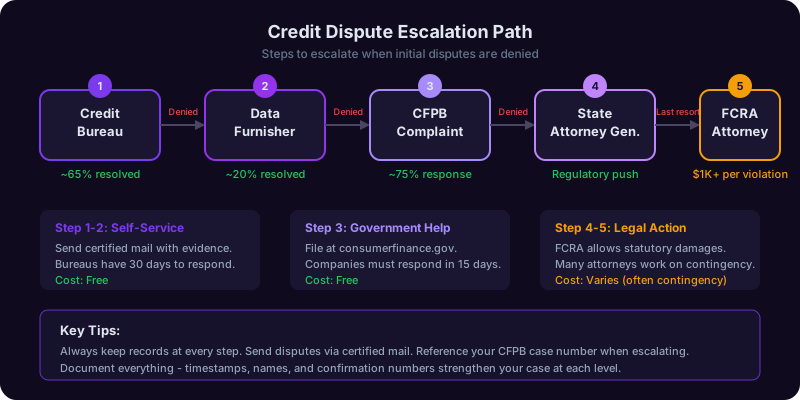
Step 1: File a Complaint With the CFPB
The CFPB complaint portal is the single most effective escalation tool. When you file through the CFPB, the bureau must respond within 15 days (with a possible 45-day extension). The response goes to both you and the CFPB, creating a regulatory record.
Why this works: CFPB complaints are handled by dedicated teams at each bureau, not through e-OSCAR. These teams have more authority to investigate. Data suggests CFPB-routed complaints are resolved in the consumer's favor at roughly double the rate of standard disputes.
How to file effectively:
- Go to consumerfinance.gov/complaint
- Select "Credit reporting" as the product
- Write a detailed narrative including dates, account numbers, what you disputed, what documentation you provided, and the bureau's response
- Attach copies of your dispute letter, the bureau's response, and supporting evidence
- Submit and note your complaint number
Step 2: Dispute Directly With the Data Furnisher
Under Section 623 of the FCRA, you can dispute directly with the creditor or collection agency. Send a written dispute to the furnisher's address with the same documentation you sent to the bureau. The furnisher has 30 days to investigate and must notify all bureaus of corrections. This bypasses e-OSCAR entirely.
Step 3: File a State Attorney General Complaint
Your state AG's consumer protection division handles credit reporting complaints. Some states have laws stronger than federal FCRA. Filing with both the CFPB and your state AG creates pressure from two regulatory directions.
Step 4: Consult a Consumer Rights Attorney
If your dispute involves significant financial harm (denied mortgage, higher interest rate, job loss), a consumer attorney may take your case. Under the FCRA, successful plaintiffs can recover:
- Actual damages: Financial harm caused by the error
- Statutory damages: $100 to $1,000 per violation
- Punitive damages: For willful noncompliance
- Attorney fees: The bureau pays your attorney if you win
Many consumer attorneys take FCRA cases on contingency. The National Association of Consumer Advocates (consumeradvocates.org) maintains a directory of credit reporting specialists.
The Consumer Rights Copilot can help you draft your CFPB complaint and determine whether your case warrants attorney consultation.
How Copilotly Helps You Through the Entire Dispute Process
Disputing credit report errors rewards preparation, persistence, and documentation. The steps are straightforward, but the details matter. Missing a deadline, using the wrong dispute reason, or failing to include key documentation can turn a winnable dispute into a dead end.
What the Finance and Consumer Rights Copilots Can Do
The Finance Copilot and Consumer Rights Copilot walk you through each stage of the credit dispute process.
Identify what to dispute: Describe the items on your report that look wrong, and the copilot will classify the error type, assess its likely score impact, and recommend the best dispute approach. A wrong address is low-priority. A paid debt showing as unpaid is high-priority.
Draft dispute letters: The copilot helps you customize letters for your specific error, creditor, and documentation. It suggests the right FCRA sections to cite and organizes your evidence clearly.
Track timelines: The 30-day investigation window is a legal deadline. The copilot tracks when you sent each dispute, when the bureau received it, and when the response is due. A missed deadline is itself an FCRA violation you can reference in an escalation.
Prepare escalation documents: If rejected, the copilot helps you draft a CFPB complaint, direct furnisher dispute, or state AG complaint with a clear narrative of what happened and why the response was inadequate.
What Copilotly Does Not Do
Copilotly provides information and guidance. It does not file disputes on your behalf, provide legal advice, or guarantee outcomes. For significant financial harm or potential litigation, consult a qualified consumer rights attorney.
Quick Action Checklist
| Step | Action | Timeline |
|---|---|---|
| 1 | Pull free reports from AnnualCreditReport.com | Today |
| 2 | Review each report line by line for errors | 1-2 hours |
| 3 | Gather supporting documentation for each error | 1-3 days |
| 4 | Send dispute letters via certified mail | Day 3-5 |
| 5 | Send disputes directly to the data furnisher | Same day |
| 6 | Wait for bureau response (30-day deadline) | Days 5-35 |
| 7 | If rejected, file CFPB complaint | Day 35-40 |
| 8 | If unresolved, consult consumer attorney | Day 40+ |
Credit report accuracy determines the interest rates you pay, the housing you qualify for, and sometimes whether you get a job. Errors cost you real money every month they persist. The process to fix them is well-defined, and you have stronger legal protections than most consumers realize.
For related guidance, see our articles on building credit from nothing and how to freeze your credit.
This article provides general information about credit reporting disputes. It is not legal or financial advice. Consult a qualified professional for guidance on your specific situation.
Frequently asked questions
How long do I have to dispute an error on my credit report?
Can I dispute credit report errors online or do I have to send a letter?
What happens if the credit bureau does not respond within 30 days?
Should I dispute with the credit bureau or directly with the creditor?
How much does it cost to dispute errors on my credit report?
Do credit repair companies work, and should I use one?
Can disputing a credit report error hurt my credit score?
What is the CFPB complaint process for credit reporting, and does it really help?
Get help with this from the Finance & Money Copilot
Describe your situation and get specific, actionable guidance - not the generic hedging a general-purpose chatbot gives you on finance & money questions.
Free plan, no card. Pro from $4.99/week for every copilot across all 20 domains - about what one hour with any single professional costs per year.
Not a financial advisorThis is financial information, not financial advice. Consult a licensed financial professional.