
Legal & Rights
How Many Repair Attempts Before Your Car Is a Lemon? State Rules, Demand Letters, and Refunds
Most states call a car a lemon after 3-4 failed repair attempts for the same defect, or 30 cumulative days out of service. Learn the exact rules in California, New York, Texas, and Florida, the documentation that builds an airtight case, and how arbitration gets you a refund without a lawsuit.
What Qualifies as a Lemon: Substantial Defects, Repair Attempts, and Time Limits
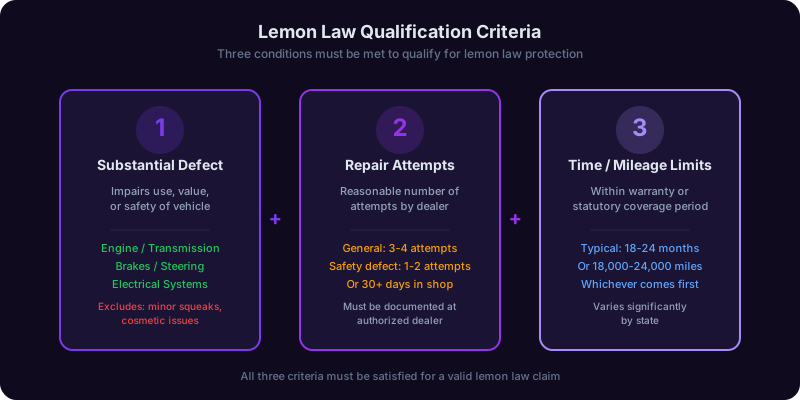
A "lemon" is a vehicle with a substantial defect that the manufacturer or its authorized dealers cannot repair after a reasonable number of attempts. Every state has its own lemon law, and while the specifics vary, they all share three core requirements: the defect must be substantial, the manufacturer must have had a reasonable opportunity to fix it, and the claim must fall within a specific time or mileage window.
Disclaimer: This guide provides general information about lemon laws across the United States. It is not legal advice. Lemon laws vary significantly by state, and your specific situation may involve nuances not covered here. If you believe you have a lemon, consult a licensed attorney in your state who specializes in lemon law cases. Most lemon law attorneys offer free consultations and work on contingency.
Requirement 1: Substantial Defect
Not every problem with a car qualifies under lemon law. The defect must be substantial, meaning it impairs the vehicle's use, value, or safety. Qualifying defects typically include:
- Safety hazards: Brake failures, steering malfunctions, airbag system failures, sudden acceleration or stalling, seatbelt defects, or electrical fires
- Drivetrain problems: Transmission failures, engine stalling, persistent overheating, loss of power while driving
- Persistent electrical issues: Recurring battery drain, dashboard warning lights that cannot be resolved, infotainment system failures that affect vehicle controls (not just entertainment)
- Structural defects: Water leaks that cause interior damage or mold, frame defects, suspension failures
What does NOT typically qualify:
- Minor cosmetic issues (small paint chips, interior trim rattles, minor squeaks)
- Defects caused by owner abuse, neglect, or unauthorized modifications
- Normal wear and tear items (brake pads, tires, wiper blades)
- Issues resulting from accidents or environmental damage
- Problems caused by using the vehicle for purposes it was not designed for (e.g., off-roading in a sedan)
Requirement 2: Reasonable Number of Repair Attempts
Before you can invoke lemon law protections, you must give the manufacturer a reasonable opportunity to fix the problem. What counts as "reasonable" varies by state, but the most common thresholds are:
| Standard | Typical Threshold | States Using This Standard |
|---|---|---|
| Number of repair attempts for same defect | 3-4 attempts | Most states (CA, NY, FL, TX, and others) |
| Repair attempts for safety defect | 1-2 attempts | CA, NY, NJ, and several others |
| Total days out of service | 30 cumulative days | Most states |
| Combined standard | Either repair attempts OR days out of service | CA, NY, FL, WA, and others |
Key point: You must take the vehicle to an authorized dealer for repairs, not an independent mechanic. Repairs performed outside the manufacturer's authorized network generally do not count toward lemon law thresholds. Every visit must be documented with a repair order.
Requirement 3: Time and Mileage Limits
Lemon law claims must be filed within a specific window, which varies by state. The most common windows are:
- During the manufacturer's warranty period (the most common standard)
- Within 18-24 months of purchase (some states use this as an alternative or additional standard)
- Within 18,000-24,000 miles (some states use mileage limits)
- Whichever comes first of the time or mileage limit
The federal Magnuson-Moss Warranty Act provides an additional layer of protection. While not technically a lemon law, it allows consumers to sue manufacturers for breach of warranty in federal court and may apply even after state lemon law protections have expired. It covers any consumer product costing more than $25 with a written warranty, which includes virtually all new vehicles.
If you are unsure whether your vehicle's problems qualify, the Legal Copilot can help you evaluate your defect against your state's specific criteria and determine whether you have met the repair attempt threshold.
State-by-State Lemon Law Rules: California, New York, Texas, Florida, and Beyond
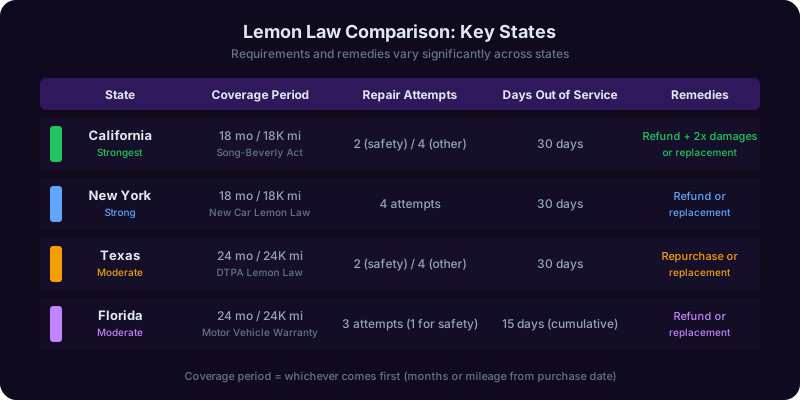
Every state has its own lemon law, and the differences between them can determine whether you qualify for a refund, a replacement, or nothing at all. Here are the key rules for the four most populous states and a comparison table for additional states.
California: The Song-Beverly Consumer Warranty Act
California has one of the strongest lemon laws in the country. Under the Song-Beverly Consumer Warranty Act:
- Vehicles covered: New and used vehicles sold with a manufacturer's warranty (including certified pre-owned). Leased vehicles are also covered.
- Repair attempts: 2 or more attempts for a safety defect that could cause death or serious injury; 4 or more attempts for the same non-safety defect; OR the vehicle has been out of service for 30 or more cumulative days
- Time limit: Within 18 months of delivery OR 18,000 miles, whichever comes first (this creates a "presumption" - you can still file outside this window if the defect is within the warranty period)
- Remedies: Refund (purchase price minus a reasonable use deduction) OR replacement vehicle of comparable value. The manufacturer must also pay incidental damages (towing, rental cars, etc.)
- Attorney fees: The manufacturer must pay your attorney fees if you prevail. This is why most California lemon law attorneys take cases on contingency with no upfront cost.
- Notable: California's Tanner Consumer Protection Act adds a presumption that a vehicle is a lemon if the defect persists after a reasonable number of repair attempts. The manufacturer bears the burden of proving the vehicle is NOT a lemon once the presumption is triggered.
New York: New Car Lemon Law and Used Car Lemon Law
New York has separate lemon laws for new and used vehicles:
- New vehicles: Covered during the first 18,000 miles OR 2 years from delivery, whichever comes first. After 4 repair attempts for the same defect or 30 cumulative days out of service, the vehicle is presumed to be a lemon.
- Used vehicles: New York is one of the few states with a used car lemon law. Dealers must provide a minimum warranty: 90 days or 4,000 miles for cars with 36,001-79,999 miles; 60 days or 3,000 miles for cars with 80,000-99,999 miles. Vehicles over 100,000 miles are not covered.
- Remedies: Refund or replacement. For used cars, the dealer must repair the defect or refund the full purchase price.
- Attorney fees: Manufacturer pays if you prevail.
- Arbitration: The New York Attorney General operates a free arbitration program (the New Car Lemon Law Arbitration Program) that resolves cases within 40 days.
Texas: Texas Lemon Law (Chapter 2301)
- Vehicles covered: New vehicles only. Texas does not have a used car lemon law, though the Deceptive Trade Practices Act may provide some protection for used car buyers.
- Repair attempts: 4 or more attempts for the same defect; OR 2 or more attempts for a serious safety defect that could cause death or serious bodily injury; OR the vehicle has been out of service for 30 or more cumulative days
- Time limit: Within 24 months of delivery OR 24,000 miles, whichever comes first
- Remedies: Repurchase or replacement, at the manufacturer's option (this is less favorable than states that give the consumer the choice)
- Process: You must file a complaint with the Texas Department of Motor Vehicles (TxDMV) before filing a lawsuit. A state-appointed hearing examiner reviews the case.
- Attorney fees: Not explicitly required by the lemon law statute, though recoverable under the Texas Deceptive Trade Practices Act if the claim qualifies.
Florida: Florida Lemon Law (Chapter 681)
- Vehicles covered: New or demonstrator vehicles purchased or leased in Florida. Does not cover used vehicles, motorcycles, or vehicles above 10,000 pounds gross vehicle weight.
- Repair attempts: 3 or more attempts for the same defect; OR 1 attempt for a defect likely to cause death or serious bodily injury; OR the vehicle has been out of service for 15 or more cumulative days (notably shorter than most states)
- Time limit: Within the Lemon Law Rights Period, which is 24 months from the date of delivery
- Remedies: Refund or replacement, at the consumer's choice
- Arbitration: Florida requires participation in the manufacturer's arbitration program (if one exists and is state-certified) before filing a lawsuit. The Florida New Motor Vehicle Arbitration Board handles cases where no manufacturer program exists.
- Attorney fees: Manufacturer pays if you prevail.
Additional State Comparison
| State | Repair Attempts | Days Out of Service | Used Cars Covered |
|---|---|---|---|
| New Jersey | 3+ attempts | 20+ days | Yes (limited) |
| Pennsylvania | 3+ attempts | 30+ days | No |
| Illinois | 4+ attempts | 30+ days | No |
| Ohio | 3+ attempts (or 1 for safety) | 30+ days | No |
| Washington | 4+ attempts (or 2 for safety) | 30+ days | No |
| Massachusetts | 3+ attempts | 15+ business days | Yes (limited) |
| Connecticut | 4+ attempts (or 2 for safety) | 30+ days | Yes |
| Minnesota | 4+ attempts (or 1 for safety) | 30+ business days | No |
For the complete lemon law details for your specific state, the Legal Copilot can provide the exact statutory thresholds, time limits, and procedural requirements.
New vs. Used Car Lemon Law Coverage: What Is and Is Not Protected
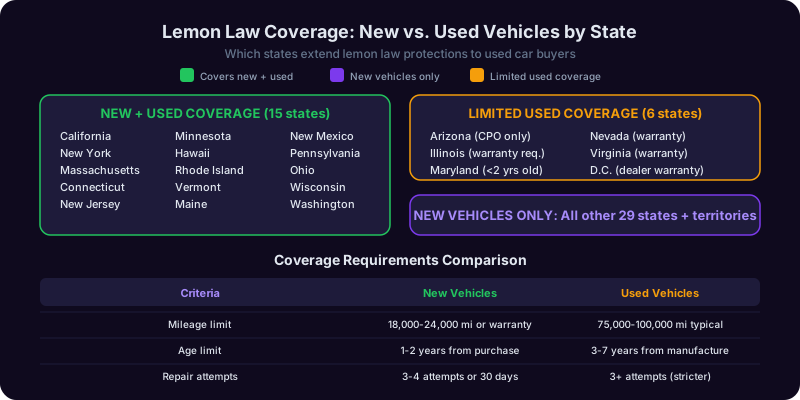
One of the most common misconceptions about lemon laws is that they only apply to brand-new vehicles. The reality is more nuanced: while most state lemon laws focus on new vehicles, several states extend protections to used cars, and federal law provides an additional safety net regardless of whether your vehicle is new or used.
New Vehicle Coverage
All 50 states and the District of Columbia have lemon laws that cover new vehicles. "New" generally means a vehicle that has never been titled to a consumer, though the exact definition varies:
- Most states: The vehicle must be purchased or leased new from an authorized dealer and still be within the manufacturer's original warranty
- Demonstrator and dealer loaner vehicles: Covered in some states (Florida, California) but not all
- Leased vehicles: Covered in most states, with the lessee (you) having the right to file the claim
- Fleet vehicles: Some states exclude vehicles purchased for business use or fleets above a certain size
Used Vehicle Coverage
Used car lemon law coverage is the exception, not the rule. Here is what exists:
States with explicit used car lemon laws:
- New York: Dealers must provide a minimum warranty based on mileage at sale (see previous section). This is the strongest used car lemon law in the country.
- Massachusetts: Used cars must pass state inspection within 7 days of sale, and dealers must repair defects that cause the vehicle to fail inspection at no cost.
- Connecticut: Used vehicles sold by dealers with fewer than 40,000 miles are covered for 60 days or 3,000 miles.
- New Jersey: Used vehicles with fewer than 100,000 miles sold by dealers are covered by an implied warranty of merchantability.
- Minnesota: Used vehicle warranty law requires dealers to cover major components for varying periods based on mileage.
Certified Pre-Owned (CPO) vehicles: Even in states without used car lemon laws, CPO vehicles come with a manufacturer-backed warranty. If a CPO vehicle has a persistent defect during that warranty period, the state's lemon law may apply because the law typically covers vehicles "sold with a manufacturer's warranty" rather than only "new" vehicles. California's Song-Beverly Act explicitly covers CPO vehicles.
The Federal Magnuson-Moss Warranty Act
The Magnuson-Moss Warranty Act is a federal law that applies to all consumer products with written warranties, including used vehicles. If your used vehicle came with any written warranty (from the dealer, the manufacturer's remaining warranty, or an extended warranty), and the warrantor fails to repair a defect after a reasonable number of attempts, you may have a claim under Magnuson-Moss.
Key advantages of Magnuson-Moss over state lemon laws:
- Applies to both new and used vehicles with written warranties
- No specific repair attempt threshold - uses a "reasonable number of attempts" standard
- Allows you to sue in federal court if the amount in controversy exceeds $50,000 (or $75,000 for diversity jurisdiction)
- The manufacturer must pay your attorney fees if you prevail
- Can be combined with state lemon law claims for maximum leverage
Private Sales and "As-Is" Purchases
Vehicles purchased from private sellers (not dealers) are generally not covered by any lemon law. Private sales are typically "as-is" unless the seller provided a written warranty. However, if the private seller actively concealed a known defect, you may have a fraud claim under your state's consumer protection laws.
Vehicles purchased "as-is" from dealers are more complicated. In some states, dealers cannot disclaim implied warranties even with an "as-is" label. The FTC's Used Car Rule requires dealers to display a Buyers Guide on every used vehicle that states whether the vehicle comes with a warranty or is sold "as-is." Some states (including Massachusetts, Connecticut, Maine, West Virginia, and others) prohibit "as-is" sales entirely.
If you bought a used car that turned out to be defective, the Consumer Rights Copilot can help you determine whether any warranty protections apply to your purchase and what options you have under your state's laws. For disputes about what a car dealer told you versus what was in writing, our guide on reading and negotiating contracts covers how to interpret purchase agreements.
Documentation Requirements: Building an Airtight Lemon Law Case
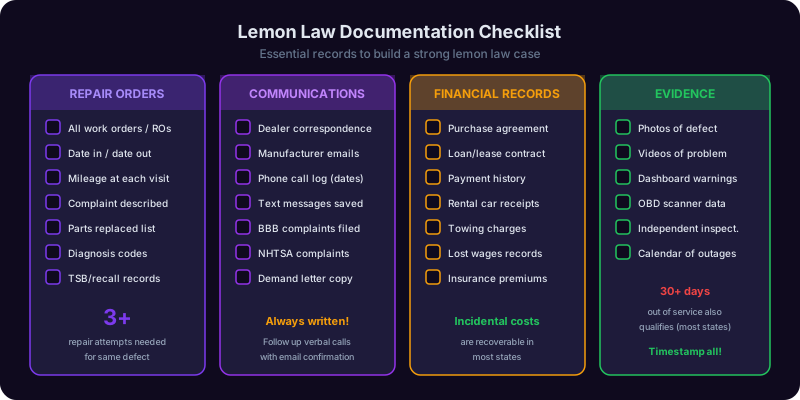
Lemon law cases are won or lost on documentation. The manufacturer will argue that the defect was fixed, that the problem is intermittent, that you caused the damage, or that you did not give them enough chances to repair it. Your documentation is what defeats every one of those arguments. Start building your paper trail from the first repair visit and never stop.
Essential Documents to Collect and Preserve
1. Every Repair Order (Work Order / Service Invoice)
This is the single most important category of documentation. For every repair visit, you need:
- The date you brought the vehicle in and the date you picked it up (this establishes "days out of service")
- Your description of the problem - make sure the service writer records YOUR words accurately. Read the repair order before you sign it. If the description is wrong or incomplete, insist they correct it before you leave.
- The dealer's diagnosis and what repairs were performed
- Parts replaced (with part numbers if possible)
- The mileage at drop-off and pick-up
- The name of the service advisor and the technician who worked on the vehicle
Critical tip: Many dealers will write vague descriptions like "customer states vehicle has issue" or "could not replicate concern." Push back on this. Insist that the repair order specifically describes the defect: "Customer reports vehicle stalls without warning at highway speeds, occurring 3-4 times per week, beginning at approximately 8,200 miles." Specificity matters.
2. Communication Records
- Every email, letter, and text message between you and the dealer
- Every phone call log (date, time, who you spoke with, what was discussed)
- Any communications with the manufacturer's customer service line (case numbers, representative names)
- Written correspondence sent to the manufacturer (keep copies of everything you send and proof of delivery)
3. Financial Records
- Purchase agreement or lease contract
- Loan documents
- All payments made (monthly payments, down payment)
- Rental car receipts for days your vehicle was in the shop
- Towing invoices
- Any other expenses caused by the defect (missed work, alternative transportation costs)
4. Vehicle Condition Evidence
- Photos and videos: Document the defect every time it occurs. Dashboard warning lights, fluid leaks, visible damage, error messages. Video is especially powerful for intermittent problems like engine stalling or transmission jerking - mount your phone on the dash and record your drives.
- Diagnostic reports: If the dealer runs a diagnostic scan, request a printout of all stored trouble codes (DTCs). These are stored in the vehicle's computer and can prove a defect exists even when it is not actively occurring.
- Third-party inspection: Consider having an independent mechanic inspect the vehicle and provide a written report. While lemon law repair attempts must be performed by authorized dealers, an independent inspection provides a credible third-party opinion about the defect.
The Vehicle Problem Log
Maintain a detailed log of every instance of the defect, even when you do not take the vehicle in for repair. Record:
- Date and time the problem occurred
- What you were doing (driving on highway, idling, starting the engine)
- Exact symptoms (stalling, warning light, noise, vibration)
- Road conditions and weather
- Mileage at the time
- Whether anyone else was in the vehicle who can corroborate
This log serves two purposes: it shows the frequency and severity of the defect, and it defeats the manufacturer's common argument that the defect is minor or occurred only once. A log showing 47 instances of engine stalling over 6 months is extremely persuasive in arbitration.
What Manufacturers Will Try to Use Against You
- "Customer could not replicate the concern": Counter this with your video evidence and vehicle log.
- "Normal operating characteristic": Counter this with evidence that other vehicles of the same make and model do not exhibit the behavior, or with technical service bulletins (TSBs) issued by the manufacturer acknowledging the issue.
- "Caused by owner misuse or modification": Counter this by maintaining your vehicle according to the owner's manual schedule and never making modifications while a lemon law claim is pending.
The Legal Copilot can help you organize your documentation, identify gaps in your evidence, and ensure your vehicle log contains the level of detail that lemon law arbitrators and attorneys consider persuasive.
How to Write a Manufacturer Demand Letter: Template and Strategy
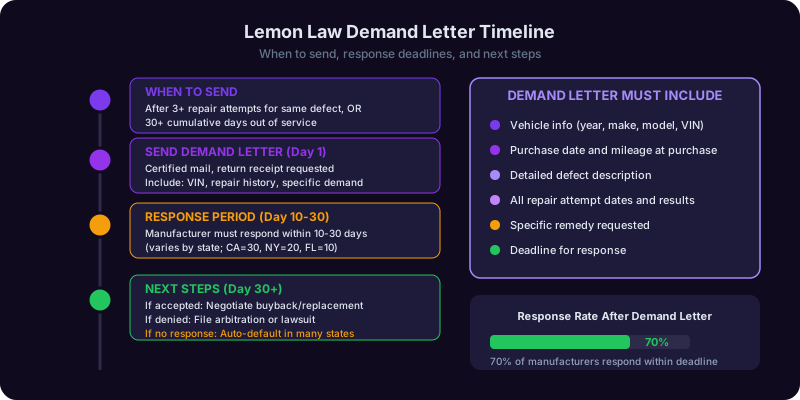
Before filing for arbitration or a lawsuit, most states require (or strongly recommend) that you send a formal written demand to the manufacturer. This letter puts the manufacturer on official notice that you are invoking your lemon law rights and gives them a final opportunity to buy back or replace the vehicle. A well-crafted demand letter also demonstrates to an arbitrator or judge that you acted reasonably and in good faith.
When to Send the Demand Letter
Send the demand letter after you have met your state's threshold for repair attempts or days out of service. If you send it too early, the manufacturer will argue you did not give them a reasonable opportunity to fix the problem. If you wait too long after meeting the threshold, you may run into statute of limitations issues.
Some states have specific notice requirements:
- California: You should notify the manufacturer in writing, though the Song-Beverly Act does not impose a rigid pre-suit notice requirement. However, sending a demand letter strengthens your case significantly.
- Texas: You must file a complaint with the TxDMV, which serves as the formal notice.
- Florida: You should send written notice by certified mail to the manufacturer before filing for arbitration.
- New York: Notice to the manufacturer is part of the arbitration application process.
Demand Letter Template
Send this letter via certified mail with return receipt requested to the manufacturer's customer relations department AND the selling dealer's general manager. Keep copies of everything.
[Your Full Legal Name]
[Your Street Address]
[City, State, ZIP Code]
[Your Phone Number]
[Your Email Address]
[Date]
Via Certified Mail, Return Receipt Requested
[Manufacturer Name]
[Customer Relations Department]
[Manufacturer Address]
Re: Lemon Law Demand - [Year] [Make] [Model]
VIN: [Vehicle Identification Number]
Purchase/Lease Date: [Date]
Current Mileage: [Mileage]
Dear [Manufacturer] Customer Relations:
I am writing to formally notify you that the above-referenced vehicle qualifies as a lemon under [Your State]'s lemon law, [cite specific statute, e.g., "the Song-Beverly Consumer Warranty Act, Cal. Civ. Code sections 1790-1795.8" or "New York General Business Law section 198-a"].
I purchased/leased this vehicle on [date] from [Dealer Name] in [City, State]. Since that time, the vehicle has exhibited [describe the substantial defect in specific, factual terms - e.g., "recurring engine stalling without warning at speeds between 35-65 mph"]. This defect substantially impairs the vehicle's [use/value/safety].
I have presented the vehicle to your authorized dealer(s) for repair of this defect on the following occasions:
1. [Date] - [Dealer Name] - Repair Order #[number] - [Brief description of repair attempted] - Vehicle in shop [X] days
2. [Date] - [Dealer Name] - Repair Order #[number] - [Brief description] - Vehicle in shop [X] days
3. [Date] - [Dealer Name] - Repair Order #[number] - [Brief description] - Vehicle in shop [X] days
4. [Date] - [Dealer Name] - Repair Order #[number] - [Brief description] - Vehicle in shop [X] days
Despite [number] repair attempts and [total number] cumulative days out of service, the defect persists. I am entitled to [choose one: a refund of the full purchase price including taxes, registration fees, and incidental damages / a replacement vehicle of comparable value] under [state statute].
I demand that you [repurchase this vehicle for the full purchase price of $[amount] plus incidental costs of $[amount] / provide a replacement vehicle of equivalent value] within [15/30] days of receipt of this letter. Enclosed are copies of all repair orders, purchase documents, and a detailed vehicle problem log.
If this matter is not resolved within [15/30] days, I will pursue all available legal remedies, including [arbitration under your state's program / filing a lawsuit under the lemon law], in which I will seek a refund or replacement plus attorney fees and costs as provided by law.
Sincerely,
[Your Signature]
[Your Printed Name]
Enclosures: [List all documents you are including copies of]
cc: [Dealer General Manager Name], [Dealer Name and Address]
After Sending the Letter
Keep the certified mail receipt and the return receipt (green card) when it comes back. The manufacturer typically has 15-30 days to respond (varies by state). Three common responses:
- They offer a buyback or replacement. Review the offer carefully - make sure it includes the full purchase price, taxes, registration, all incidental costs, and any loan payoff amount. Check that the "reasonable use" deduction (a mileage-based offset for the use you got before the defect appeared) is calculated correctly.
- They deny the claim. Proceed to arbitration or consult a lemon law attorney.
- They do not respond. This is common and actually helps your case - it shows the manufacturer refused to resolve the issue despite proper notice. Proceed to arbitration or litigation.
If you need general guidance on writing demand letters, our comprehensive guide on how to write a demand letter covers the principles, formatting, and strategic considerations. The Legal Copilot can help you customize the template above for your state's specific statutory language and requirements.
The Arbitration Process: How Lemon Law Disputes Are Resolved Without a Lawsuit
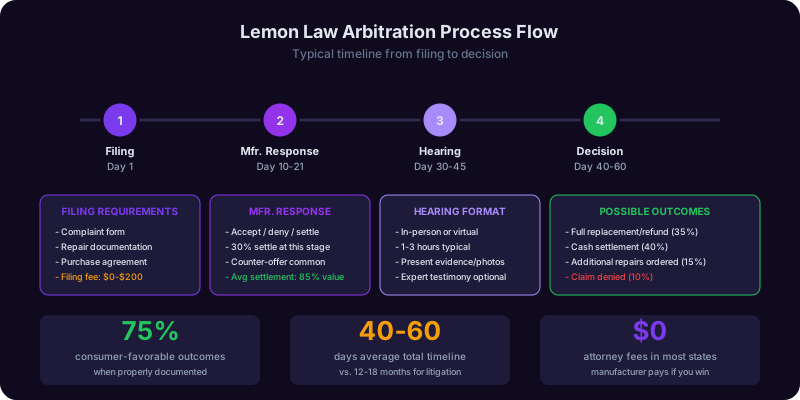
Most lemon law disputes are resolved through arbitration rather than a full lawsuit. Some states require you to go through the manufacturer's arbitration program before you can file a lawsuit. Others offer state-run arbitration as a free alternative. Understanding how arbitration works, what to expect, and how to prepare gives you a significant advantage.
Types of Arbitration Programs
Manufacturer-Sponsored Programs: Many major manufacturers operate their own arbitration programs (or contract with organizations like the Better Business Bureau Auto Line). These are free to consumers. Some states (including Florida) require you to use the manufacturer's certified program before filing a lawsuit. Common programs include:
- BBB AUTO LINE: Used by many manufacturers including Ford, GM, Honda, Toyota, and others. The program is certified in many states and decisions are typically issued within 40 days.
- Manufacturer-specific programs: Some manufacturers (like BMW and Mercedes-Benz) operate their own internal arbitration programs.
State-Run Programs: Several states operate their own lemon law arbitration programs:
- New York: The New Car Lemon Law Arbitration Program (run by the Attorney General's office) - free, decisions within 40 days
- Florida: The Florida New Motor Vehicle Arbitration Board - free, handles cases where no certified manufacturer program exists
- Vermont, Connecticut, Washington: State-administered programs with varying procedures
Independent Arbitration: If you and the manufacturer agree, or if your state does not require a specific program, you can use an independent arbitration organization like the American Arbitration Association (AAA).
How to Prepare for Arbitration
Arbitration is less formal than a courtroom, but preparation matters just as much. Here is how to build a winning case:
- Organize your documentation chronologically. Create a binder (physical or digital) with tabs for: purchase documents, every repair order in date order, your vehicle problem log, all correspondence with the dealer and manufacturer, photos and videos, financial records (rental car receipts, towing costs, loan statements), and any third-party inspection reports.
- Write a clear, concise summary. Most arbitration programs ask you to submit a written statement. Structure it as: (a) when you bought the vehicle, (b) when the defect first appeared, (c) each repair attempt and what happened, (d) that the defect persists despite reasonable repair attempts, (e) what remedy you are seeking.
- Bring the vehicle. Most arbitration hearings include a vehicle inspection. Make sure the vehicle is in the condition that demonstrates the defect. Do not get the defect repaired by an independent mechanic before arbitration - you need the problem to be visible or demonstrable.
- Check for Technical Service Bulletins (TSBs). Search the NHTSA database for TSBs and recalls related to your vehicle's defect. A TSB is an acknowledgment by the manufacturer that a known problem exists, even if a formal recall has not been issued. This is powerful evidence that the defect is real and not caused by something you did.
- Prepare for the manufacturer's arguments. They will likely argue: the defect was fixed on the last visit, the problem is minor, you did not give them enough chances, or the issue is "normal." Have specific responses ready for each.
What Happens at the Hearing
A typical arbitration hearing involves:
- An arbitrator (or panel) who reviews the evidence and makes a decision
- Your presentation of the case (15-30 minutes to explain the problem and present documentation)
- The manufacturer's representative presenting their side (they often send a factory technical representative and sometimes an attorney)
- Questions from the arbitrator to both sides
- A vehicle inspection (the arbitrator or a technical expert inspects the vehicle, sometimes test-drives it)
- A decision issued in writing, usually within 10-30 days after the hearing
Possible Outcomes
- Refund/Repurchase: The manufacturer must buy back the vehicle. The refund includes the purchase price, taxes, registration fees, and incidental damages, minus a "reasonable use" deduction based on the mileage you drove before the defect first appeared.
- Replacement: The manufacturer provides a comparable new vehicle.
- Additional repair: The arbitrator may order one final repair attempt (less common but possible).
- Denial: The arbitrator finds the vehicle does not qualify as a lemon.
If You Lose in Arbitration
In most states, the manufacturer's arbitration decision is not binding on you. If you lose, you can still file a lawsuit. The arbitration decision IS typically binding on the manufacturer if you win. This asymmetry is built into most state lemon laws to protect consumers. However, if you file a lawsuit after losing arbitration, the manufacturer will use the arbitration decision as evidence, so you should strongly consider consulting a lemon law attorney before proceeding.
If you need help with other dispute resolution processes, our small claims court guide covers the alternative of filing in court for amounts within your state's small claims limits.
Attorney Fees, Electric Vehicle Lemon Issues, and the Cost of Filing a Claim
Two of the most common questions about lemon law claims are "How much will this cost me?" and "Do lemon laws apply to electric vehicles?" The answers to both are more favorable than most consumers expect.
Attorney Fees: Why Lemon Law Claims Cost You Little or Nothing
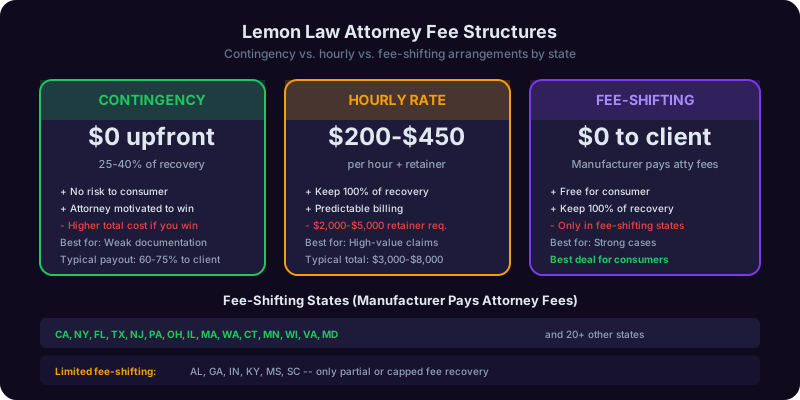
One of the strongest features of lemon laws is the fee-shifting provision. In the vast majority of states, if you prevail on your lemon law claim, the manufacturer must pay your attorney fees. This means:
- Most lemon law attorneys work on contingency. You pay nothing upfront. The attorney's fee comes from the manufacturer, not from your settlement or refund.
- Free consultations are standard. Almost every lemon law attorney offers a free initial evaluation of your case.
- You keep the full refund or replacement value. Unlike personal injury cases where the attorney takes a percentage of your recovery, in lemon law cases the manufacturer pays the attorney directly on top of your refund.
States with explicit fee-shifting provisions (manufacturer pays your attorney fees if you prevail):
| Strong Fee-Shifting | Limited Fee-Shifting | No Explicit Fee-Shifting |
|---|---|---|
| California, New York, Florida, New Jersey, Massachusetts, Pennsylvania, Connecticut, Washington, Oregon, Colorado, Virginia, Maryland, Illinois, Ohio, Michigan, Georgia, Arizona, North Carolina | Texas (through DTPA, not lemon law statute directly) | A few states leave fee recovery to general consumer protection statutes |
Even in states without explicit lemon law fee-shifting, the federal Magnuson-Moss Warranty Act provides fee-shifting, so attorneys can still take cases on contingency.
What a Lemon Law Claim Costs You Out of Pocket
If you handle the claim yourself through arbitration:
- Arbitration filing fee: Usually free for state-run and manufacturer-sponsored programs
- Certified mail costs: $5-$15 for the demand letter
- Document copying: $10-$50 for copies of repair orders and supporting documents
- Vehicle inspection: $100-$300 if you want an independent pre-arbitration inspection (optional but helpful)
Total out-of-pocket cost for a self-represented arbitration claim: typically under $400.
Electric Vehicle Lemon Law Issues
Electric vehicles (EVs) and plug-in hybrids (PHEVs) are covered by the same lemon laws as gasoline-powered vehicles. However, EVs present unique challenges and opportunities in lemon law cases:
Common EV Defects in Lemon Law Claims:
- Battery degradation beyond specifications: If the battery loses range significantly faster than the manufacturer's warranty specifications, this can qualify as a substantial defect. A vehicle advertised with 300 miles of range that consistently delivers only 180 miles has a substantial defect affecting use and value.
- Charging system failures: Repeated inability to charge, slow charging speeds significantly below specifications, or charging port malfunctions
- Thermal management problems: Battery overheating, unexpected shutdowns, "turtle mode" activations that limit the vehicle to minimal speed
- Software-related defects: Over-the-air (OTA) software updates that introduce new problems, infotainment failures that affect vehicle controls (climate, navigation, driver assistance), phantom braking from driver-assistance systems
- Electric motor and drivetrain issues: Unusual noises, vibrations, loss of power, or complete drivetrain failure
EV-Specific Challenges:
- "Software will fix it" defense: Manufacturers frequently argue that a defect will be resolved by a future software update. This is not a valid defense if the defect currently impairs the vehicle's use, value, or safety. You bought a working car, not a promise of a future fix.
- Dealer unfamiliarity: Many dealership service departments are less experienced with EVs than with gasoline vehicles. This can lead to misdiagnosis, longer repair times, and more repair attempts - all of which actually help your lemon law case by increasing your repair count and days out of service.
- Range as a "defect": Manufacturers argue that range varies based on driving conditions, temperature, and habits. However, if the vehicle consistently falls significantly below the EPA-rated range under normal conditions, this can constitute a substantial defect. Document your charging habits, typical driving conditions, and actual range achieved.
- OTA updates as "repair attempts": Whether a software update counts as a repair attempt is an evolving legal question. In most jurisdictions, if the manufacturer pushes an update specifically to address your reported defect and it does not fix the problem, it should count as a repair attempt.
The NHTSA's vehicle safety database tracks complaints and investigations for EVs just as it does for gasoline vehicles. Filing a complaint with NHTSA creates an official record that strengthens your lemon law case and helps identify patterns affecting other owners. The Legal Copilot can help you understand how your state's lemon law applies to EV-specific defects and whether your vehicle's problems meet the qualification threshold.
How AI and Copilotly Help You Navigate a Lemon Law Claim
Filing a lemon law claim requires understanding your state's specific statutes, meeting documentation thresholds, drafting formal correspondence, and navigating either arbitration or the legal system. For most consumers, this is the first and only time they will deal with this process. AI-powered legal guidance tools like Copilotly can level the playing field between you and a manufacturer's legal team without the cost of hiring an attorney for every question.
Where AI Makes the Biggest Difference
1. Evaluating Whether You Have a Case
The Legal Copilot can analyze your situation against your state's specific lemon law criteria. Describe your vehicle's defect, the number of repair attempts, and the time since purchase, and the copilot will help you determine whether you have met the threshold for a lemon law claim. This initial assessment helps you decide whether to invest time in pursuing the claim or whether additional repair attempts are needed first.
2. Identifying Your State's Specific Requirements
With 50 different state lemon laws, each with different repair attempt thresholds, time limits, notice requirements, and arbitration procedures, identifying the exact rules that apply to you is the first major hurdle. The Legal Copilot provides state-specific guidance rather than generic advice, pointing you to the correct statute, the right arbitration program, and the specific notice requirements for your jurisdiction.
3. Drafting and Customizing Your Demand Letter
The demand letter template provided earlier in this guide gives you the structure, but your letter needs to cite the correct state statute, describe your specific defect in legally effective language, and accurately list your repair history. The Legal Copilot can help you customize the letter for your situation, ensuring the language is precise and the statutory references are correct.
4. Organizing Your Documentation
One of the most time-consuming parts of a lemon law claim is organizing months or years of repair records, communications, and financial documents into a coherent case file. AI tools can help you identify what you have, what you are missing, and how to structure your evidence for maximum impact in arbitration.
5. Preparing for Arbitration
The Legal Copilot can help you anticipate the manufacturer's arguments based on common defense strategies and prepare specific responses. It can help you draft your written statement for the arbitration panel and identify the key points that arbitrators typically focus on when making their decisions.
6. Understanding the Financial Offer
When the manufacturer makes a buyback offer, the calculation includes your purchase price, taxes, registration, incidental costs, and a "reasonable use" deduction. The math can be complex, especially with leased vehicles or vehicles with outstanding loans. AI tools can help you verify that the offer is calculated correctly and identify any amounts that should be included but were omitted.
What AI Cannot Replace
AI legal guidance is not a substitute for a licensed attorney in every situation. You should consult a lemon law attorney if:
- Your case involves a high-value vehicle where the stakes justify professional representation
- The manufacturer has denied your claim and you are considering filing a lawsuit
- Your situation involves unusual circumstances (salvage title, multiple owners, out-of-state purchase)
- You are unsure whether to accept a settlement offer
- The statute of limitations is approaching and you need to act quickly
The good news is that because most states require the manufacturer to pay your attorney fees, consulting a lemon law attorney is usually free and hiring one costs you nothing out of pocket. AI guidance helps you make an informed decision about whether and when to bring in an attorney.
Getting Started
If you believe you have a lemon, start with these steps:
- Gather all your repair orders and purchase documents
- Use the Legal Copilot to evaluate your defect against your state's lemon law criteria
- Begin your vehicle problem log if you have not already
- Draft your demand letter using the template and AI assistance for customization
- File for arbitration or consult a lemon law attorney based on the manufacturer's response
The Consumer Rights Copilot can also help with related issues like dealing with car accident claims, understanding your rights under vehicle warranty law, and navigating disputes with dealerships. For broader legal questions, explore the full range of Copilotly legal guidance tools.
Frequently asked questions
How many repair attempts do I need before I can file a lemon law claim?
Does the lemon law apply to used cars?
Do I need to hire a lawyer for a lemon law claim?
What is the difference between a refund and a replacement under lemon law?
How long does a lemon law claim take from start to finish?
Does the lemon law apply to electric vehicles and hybrids?
What is the 'reasonable use' deduction and how is it calculated?
Can the manufacturer force me to accept another repair attempt instead of a refund?
Get AI Legal Guidance for Your Lemon Law Claim
The Legal Copilot helps you evaluate whether your vehicle qualifies under your state's lemon law, draft a manufacturer demand letter, organize your documentation, and prepare for arbitration. Get clear, state-specific guidance tailored to your situation.
- Legal CopilotGet state-specific lemon law guidance, evaluate your defect against qualification criteria, and draft demand letters
Free plan, no card. Pro from $4.99/week for every copilot across all 20 domains - about what one hour with any single professional costs per year.
Not a law firmThis is legal information, not legal advice. Consult a licensed attorney for your specific situation.