
Why U.S. Immigration Feels Impossible to Navigate (and Why It Does Not Have to Be)
The United States Citizenship and Immigration Services processes roughly 8 million applications per year across more than 80 visa categories, each with its own eligibility criteria, documentation requirements, processing timelines, and quirks. For most immigrants, the system feels deliberately opaque. Forms reference other forms. Timelines change without notice. A single error on a petition can result in a denial that delays your plans by years.
The complexity is not accidental. U.S. immigration law has been built through decades of legislation, executive orders, agency memoranda, and court decisions that layer on top of each other rather than replacing what came before. The Immigration and Nationality Act, first passed in 1952, has been amended hundreds of times. The result is a system where even experienced immigration attorneys specialize in narrow subsets of the law because no single person can master all of it.
For skilled immigrants -- the engineers, researchers, entrepreneurs, and professionals this guide is written for -- the stakes are enormous. Your ability to work, live, travel, and build a career in the United States depends on selecting the right visa category, filing the right petitions at the right time, and maintaining valid status through every transition. A misstep can trigger bars to reentry, employment authorization gaps, or years of waiting in backlogs that could have been avoided with better planning.
Here is the good news: while immigration law is complex, the pathways available to most skilled immigrants fall into a manageable set of categories. If you understand six key visa types -- H-1B, O-1, EB-2, L-1, F-1 OPT, and the green card process -- you cover the vast majority of situations.
This guide is written for immigrants themselves, not for immigration lawyers. It explains each visa category in plain language, provides realistic timelines based on current processing data, lists the documentation you will need, and shows you exactly how AI tools can help you prepare and track your case. It also tells you, without hedging, when you need to stop researching and hire a qualified immigration attorney.
A critical caveat: immigration law changes frequently. Policy memoranda, executive orders, and USCIS processing updates can alter eligibility criteria and timelines with little warning. The information in this guide reflects the law as of June 2026. Always verify current requirements at USCIS.gov and the U.S. Department of State before making decisions.
The Six Visa Pathways Every Skilled Immigrant Should Understand
Each visa category serves a different purpose and suits a different profile. Choosing the wrong one wastes time and money. Choosing the right one can shave years off your immigration journey.
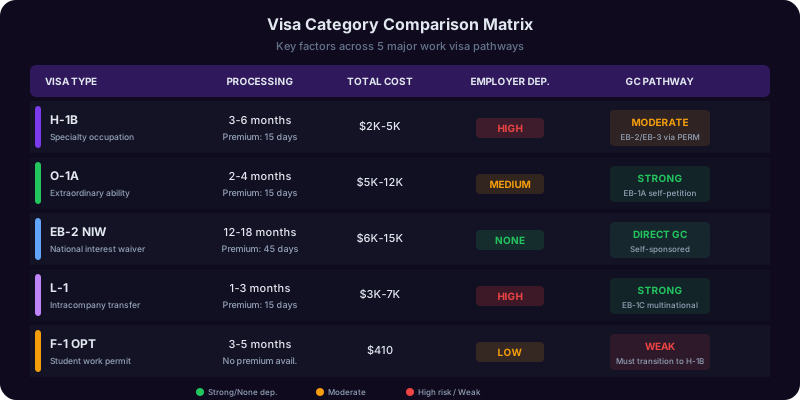
| Visa Type | Who It Is For | Duration | Employer Required? | Path to Green Card? | Annual Cap |
|---|---|---|---|---|---|
| H-1B | Specialty occupation workers with a bachelor's degree or equivalent | 3 years, renewable to 6 | Yes | Yes, through employer | 85,000 |
| O-1A | Individuals with extraordinary ability in sciences, business, education, or athletics | Up to 3 years, renewable | Yes (petitioner or agent) | Yes, strong EB-1 alignment | No cap |
| EB-2 NIW | Advanced degree professionals whose work benefits the U.S. | Permanent (green card) | No (self-petition) | This IS the green card | ~40,000/year |
| L-1A / L-1B | Intracompany transferees: managers (L-1A) or specialized knowledge (L-1B) | L-1A: 7 years; L-1B: 5 years | Yes (same employer) | Yes, L-1A aligns with EB-1C | No cap |
| F-1 OPT | Recent graduates from U.S. institutions | 12 months (+ 24 for STEM) | Must have qualifying employment | Not directly | No cap |
| Green Card (EB-1/2/3) | Permanent residents through employment | Permanent | Usually (except EB-1A, NIW) | This IS permanent residence | ~140,000/year |
H-1B: The Default Path (and Its Lottery Problem)
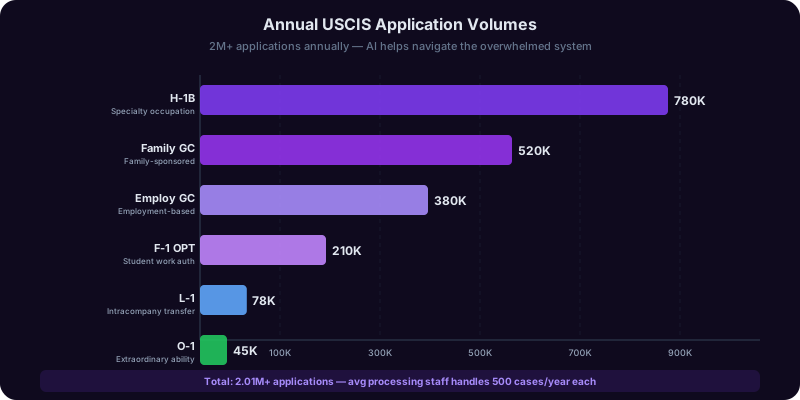
The H-1B remains the most common work visa for skilled immigrants, but the lottery system has made it a gamble. In fiscal year 2026, USCIS received approximately 780,000 registrations for 85,000 slots -- a selection rate under 11 percent. The visa requires employer sponsorship, a specialty occupation position, and proof of at least a bachelor's degree in a related field.
O-1A: The Overlooked Alternative
Many qualified immigrants overlook the O-1A because they assume "extraordinary ability" means Nobel Prize-level achievement. It does not. The standard requires meeting at least three of eight criteria, including published articles, judging the work of others, original contributions of major significance, and high salary relative to peers. Many senior engineers, researchers with publications, and startup founders qualify. The O-1A has no annual cap and no lottery.
EB-2 NIW: Self-Sponsorship for the National Interest
The EB-2 National Interest Waiver allows you to self-petition for a green card without an employer sponsor. Under the Dhanasar framework, you must show your endeavor has substantial merit and national importance, you are well positioned to advance it, and it would be beneficial to waive the labor certification requirement. Researchers, engineers working on critical technologies, and healthcare professionals commonly qualify.
L-1: The Multinational Transfer
If you work for a multinational company with U.S. operations, the L-1 lets you transfer without a lottery. L-1A (managers/executives) leads to EB-1C green card sponsorship. L-1B covers specialized knowledge employees. You must have worked for the foreign entity for at least one continuous year within the preceding three years.
F-1 OPT: The Bridge for Graduates
F-1 OPT provides 12 months of work authorization after completing a U.S. degree. STEM degree holders can extend for an additional 24 months, providing 36 months total to find H-1B sponsorship or transition to another status. For more on career planning during transitions, see our guide to professional decision-making.
Realistic Timelines: How Long Each Step Actually Takes in 2026
Immigration timelines are one of the most misunderstood aspects of the process. Official USCIS processing times are averages that can mask enormous variation. A case quoted at "6 to 8 months" might resolve in 4 months or take 14. Understanding realistic timelines is essential for planning your career and life.
H-1B Timeline
| Step | Timeframe | Notes |
|---|---|---|
| Registration period | March (2-3 week window) | Employer registers; $215 fee |
| Lottery results | Late March to early April | ~11% selection rate in FY2026 |
| Petition filing | April 1 to June 30 | All supporting documents required |
| Regular processing | 3 to 8 months | Varies by service center |
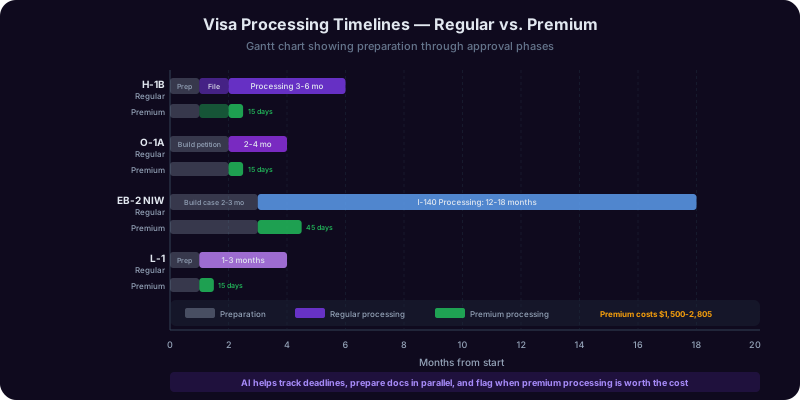
| Premium processing | 15 business days | Additional $2,805 fee |
| Start date | October 1 (earliest) | Cap-subject petitions only |
Total realistic timeline: 7 to 13 months from registration to starting work, assuming selection.
O-1A Timeline
| Step | Timeframe | Notes |
|---|---|---|
| Evidence gathering | 2 to 4 months | Recommendation letters, documentation |
| Petition preparation | 1 to 2 months | Attorney drafts petition narrative |
| Regular processing | 3 to 6 months | No cap; file any time |
| Premium processing | 15 business days | Additional $2,805 fee |
Total realistic timeline: 4 to 8 months with premium processing. No lottery and no annual cap make this significantly more predictable than the H-1B.
EB-2 NIW Timeline
| Step | Timeframe | Notes |
|---|---|---|
| Evidence gathering | 2 to 4 months | Build the three-prong Dhanasar case |
| I-140 petition preparation | 1 to 2 months | Petition letter, exhibits, letters |
| I-140 processing (regular) | 8 to 14 months | Nebraska Service Center |
| I-140 premium processing | 45 business days | $2,805 fee |
| Priority date wait | 0 to 5+ years | India and China face the longest waits |
| I-485 adjustment of status | 8 to 18 months | After priority date becomes current |
Total realistic timeline: 12 to 24 months for most countries. For Indian-born applicants, the priority date backlog can add 5 to 10 years or more, even with an approved I-140.
L-1 and F-1 OPT Timelines
L-1 petitions take 2 to 6 months with premium processing. Blanket L-1 petitions for large multinationals move faster by going directly to consular processing. F-1 OPT applications should be filed 90 days before your program end date, with processing averaging 3 to 5 months for the EAD card. STEM OPT extensions include an automatic 180-day extension of your existing EAD while the new one is processed. Track processing times at the USCIS processing times page.
One critical planning note: these timelines assume no Requests for Evidence (RFEs). An RFE adds 60 to 90 days to any timeline. Approximately 30 to 40 percent of O-1A petitions and 20 to 25 percent of EB-2 NIW petitions receive RFEs.

Get Answers From the Legal Copilot
From visa eligibility screening to document preparation and deadline tracking, Copilotly helps you understand your options and prepare stronger petitions. Get plain-language answers to complex immigration questions.
Documentation Deep Dive: What You Need to File and How to Organize It
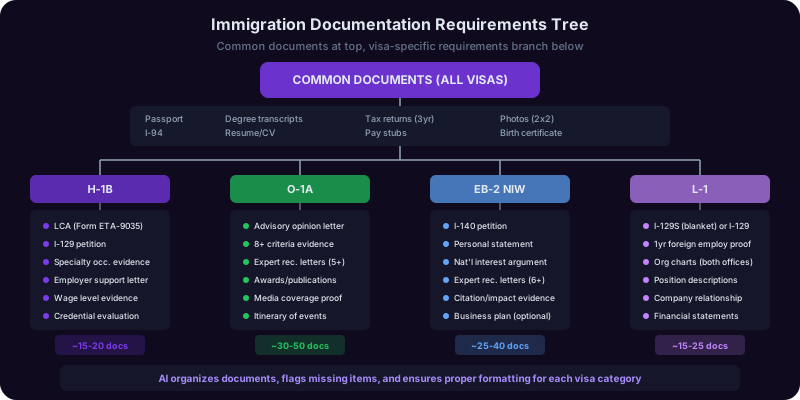
Immigration petitions succeed or fail on documentation. USCIS adjudicators review your case based entirely on the paper record -- they do not interview you, call your references, or visit your workplace. Every claim must be supported by documentary evidence, organized clearly enough for an officer to find and evaluate it quickly.
Universal Documentation
- Valid passport: Must be valid for at least six months beyond your intended period of stay.
- Educational credentials: Diplomas, transcripts, and if your degree is from outside the U.S., a credential evaluation from a NACES-member agency such as WES or ECE.
- Employment verification: Letters from current and former employers on company letterhead, including job title, dates, duties, and compensation.
- Immigration history: Copies of all previous visa stamps, I-94 records (download from CBP's I-94 website), previous I-797 approval notices, and any prior applications or denials.
O-1A Evidence: The Eight Criteria
| Criterion | Evidence Needed | Tips |
|---|---|---|
| Awards or prizes | Certificates, selection criteria, media coverage | Industry awards count |
| Membership in associations | Membership confirmation, bylaws showing outstanding achievement requirement | Must require achievement, not just a fee |
| Published material about you | Articles, interviews, press features about you (not by you) | Trade publications count |
| Judging others' work | Peer review confirmations, panel invitations | Journal peer review is strong evidence |
| Original contributions | Patents, cited research, expert testimonials | Focus on impact, not just novelty |
| Scholarly articles | Published papers, conference proceedings | Include citation counts |
| Critical employment role | Org charts, job descriptions | Show you are essential |
| High salary | Pay stubs, offer letters, BLS comparison data | High relative to your field |
EB-2 NIW: The Dhanasar Framework
- Prong 1 (Substantial merit and national importance): Research publications, project descriptions, industry impact statements, and government reports on your field's importance.
- Prong 2 (Well positioned to advance): Education, skills, record of success, and a detailed plan. Recommendation letters from field leaders are critical.
- Prong 3 (Balance of equities): Evidence that requiring labor certification would be impractical. Arguments about the urgency and self-directed nature of your contributions.
Recommendation Letters: The Most Underestimated Element
Strong recommendation letters are the backbone of O-1A and EB-2 NIW petitions. Each letter should come from an expert who can speak to the significance of your work. Independent experts -- those who have never worked with you directly but are aware of your work through publications or industry reputation -- carry the most weight. Aim for 5 to 8 letters, with at least 3 from independent experts. Each letter should be specific, citing particular achievements and explaining why they matter to the field. Generic praise without concrete examples weakens your case significantly.
How AI Can (and Cannot) Help You Navigate Immigration in 2026
AI tools have become genuinely useful for immigration preparation, but they operate within strict boundaries that every applicant must understand. Used correctly, AI saves time, reduces errors, and helps you build a stronger case. Used incorrectly, AI can lead to costly mistakes in a system where mistakes have life-altering consequences.
What AI Can Reliably Do
Eligibility assessment: AI can evaluate your profile -- education, work history, achievements, publications, salary -- against eligibility criteria for multiple visa categories and suggest which pathways are strongest. This is particularly valuable for the O-1A and EB-2 NIW, where many qualified applicants do not realize they meet the requirements.
Document checklist generation: AI creates comprehensive, visa-specific checklists based on your circumstances, accounting for your country of birth, current status, degree type, and filing strategy.
Form preparation assistance: Immigration forms like the I-129, I-140, and I-485 are dense. AI helps you understand what each field asks, what the correct response is for your situation, and which supporting documents correspond to which sections.
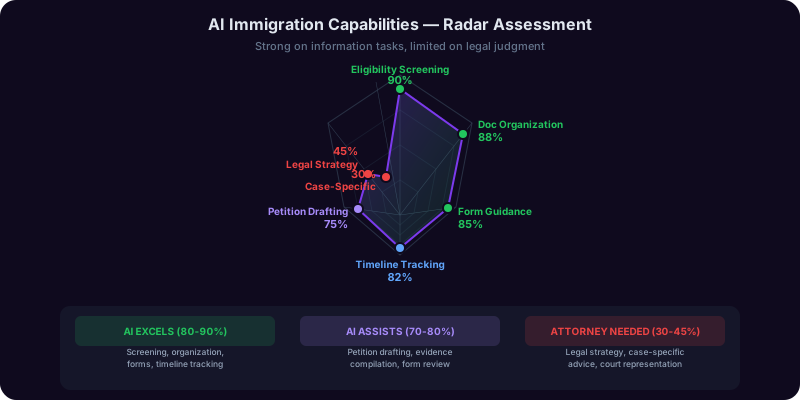
Petition narrative drafting: For O-1A and EB-2 NIW petitions, the petition letter is a legal brief that argues your case. AI can draft initial narratives, structure arguments logically, and ensure you address each criterion with specific evidence. This does not replace an attorney's legal reasoning, but it saves hours of writing.
Timeline tracking: Immigration involves dozens of deadlines -- filing windows, response deadlines, status expiration dates, priority date monitoring. AI tools track these across multiple petitions and alert you in advance. Missing a deadline can result in falling out of status.
What AI Cannot Reliably Do
Provide case-specific legal advice. AI cannot account for unpublished USCIS policy changes, adjudicator tendencies at specific service centers, or interactions between your immigration history and current filing. Only a licensed attorney can provide legal advice tailored to your specific circumstances.
Predict outcomes. No AI tool can tell you whether your petition will be approved. Anyone claiming AI can guarantee approval is misleading you.
Handle emergencies. If you receive a Notice to Appear, a denial with appeal rights, or any enforcement action, you need a lawyer immediately.
Navigate complex multi-step strategies. Concurrent filing, consular processing vs. adjustment of status, and managing dependent family members involve tradeoffs that require professional judgment.
Copilotly's Legal Copilot handles eligibility screening, document organization, form guidance, and timeline tracking while clearly flagging when to escalate to a human attorney. For career decisions intertwined with immigration strategy, the Career Copilot helps you evaluate job offers and plan career moves that align with your immigration goals.
When to Hire an Immigration Attorney (and How to Find a Good One)
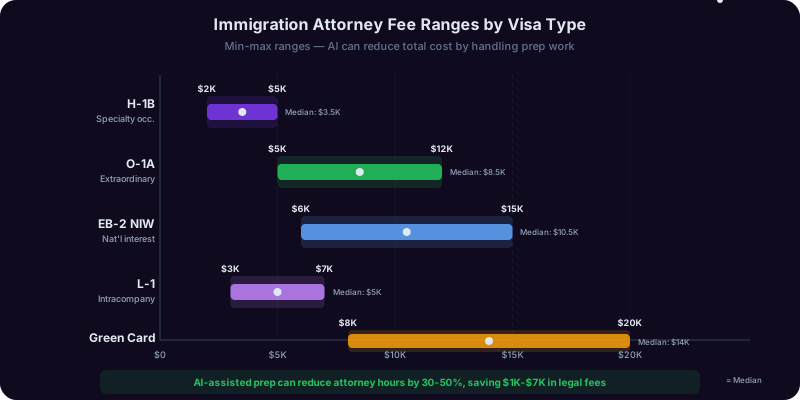
The question is not whether to use an attorney at all -- it is when their involvement adds enough value to justify the cost. Immigration attorneys charge between $3,000 and $15,000 for a full case depending on visa type and complexity. In certain situations, the cost of not having an attorney far exceeds their fees.
You Need an Attorney When:
- Your case has complications. Prior visa denials, periods of unlawful presence, criminal history (even minor offenses), or prior immigration violations require professional handling.
- You are filing an O-1A or EB-1A petition. The petition letter is essentially a legal brief. Most applicants benefit significantly from an experienced attorney who knows how to frame achievements persuasively.
- You are navigating a status transition. Moving from F-1 to H-1B, H-1B to green card, or L-1 to EB-1C involves overlapping timelines where errors can be catastrophic.
- You have country-of-birth backlog issues. Indian and Chinese nationals face multi-year backlogs. Strategic decisions about category, timing, and status maintenance require professional guidance.
- Your employer's immigration counsel has different interests. Your employer's lawyer represents the company, not you. In layoffs, employer changes, or disputes, you need your own attorney.
- You received an RFE or denial. An attorney's RFE response typically costs $1,500 to $3,000 and is almost always worth it.
You Can Likely Handle It Without an Attorney When:
- Your employer has dedicated immigration counsel handling your H-1B or L-1
- You are filing a straightforward F-1 OPT application through your university's International Students Office
- You are renewing or extending a visa with no change in circumstances
- You are at the early research phase -- understanding your options before deciding to file
How to Find a Qualified Immigration Attorney
- Use the American Immigration Lawyers Association (AILA) directory to find attorneys who specialize in immigration law.
- Verify credentials. Confirm the attorney is licensed and has no disciplinary actions via your state bar's attorney search tool.
- Ask about specific experience. An attorney who primarily handles family-based immigration may not be right for an O-1A petition. Ask how many cases of your type they have handled in the last 12 months.
- Request a flat fee. Hourly billing creates uncertainty. Most reputable immigration attorneys offer flat fees by case type.
- Get a second opinion for cases over $5,000 in legal fees. See our guide to getting second opinions on professional decisions.
Maximizing Value from Your Attorney
The most cost-effective approach combines AI preparation with targeted attorney involvement. Use AI to understand your options, organize documents, and draft initial materials. Then bring your attorney a well-organized case with specific questions. Clients who come prepared typically save 20 to 40 percent on legal fees compared to those who hand everything over from scratch.
The Country Backlog Reality: Strategic Planning for Indian and Chinese Nationals
If you were born in India or mainland China, the single most important factor in your immigration planning is the employment-based green card backlog. This backlog affects your timeline more than your qualifications, your employer, or your visa category.
How the Backlog Works
U.S. immigration law limits employment-based green cards per country to 7 percent of the total annual allotment. With approximately 140,000 employment-based green cards available per year, no single country can receive more than roughly 9,800. India, which generates the highest number of skilled worker petitions, faces a backlog exceeding a decade for EB-2 and EB-3. China faces a 3-to-6-year backlog depending on category.
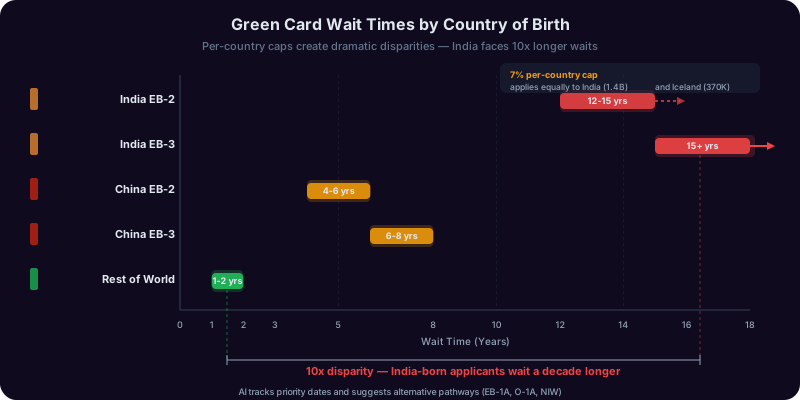
In practice: an Indian national filing an EB-2 petition today will wait an estimated 12 to 15 years before their priority date becomes current. During that entire period, they must maintain valid nonimmigrant status through H-1B extensions.
Strategic Options for Backlogged Applicants
EB-1 instead of EB-2: EB-1 has a significantly shorter backlog for Indian nationals (currently 2 to 4 years vs. 12+ for EB-2). Many EB-2 applicants could qualify for EB-1 with additional evidence preparation. AI can help assess whether you meet the higher standard.
EB-2 NIW filed early: Filing an EB-2 NIW petition early establishes a priority date. If you later qualify for EB-1, you can file a new petition in the faster category while retaining the earlier date as a backup.
I-140 portability: Once your I-140 has been approved for 180 days, you can change employers and retain your priority date. This prevents "golden handcuffs" -- being trapped at an employer solely because of your immigration case.
Concurrent filing windows: When priority dates advance unexpectedly, eligible applicants can file I-485 concurrently. Being prepared requires keeping medical exams, civil documents, and affidavits ready in advance. AI tools excel at tracking the monthly Visa Bulletin and alerting you when your date approaches currency.
Managing Status During the Wait
- H-1B extensions beyond 6 years: With an approved I-140, you are eligible for 3-year H-1B extensions under AC21 provisions.
- Travel planning: International travel requires valid visa stamps. Some consulates have 3-to-6-month appointment waits, plus administrative processing risk.
- EAD through pending I-485: If you file I-485, the resulting EAD allows work for any employer -- flexibility H-1B status does not provide.
- Advance Parole: Filed with I-485, this allows international travel without a valid H-1B stamp. However, using it while in H-1B status can complicate your nonimmigrant status.
The country backlog is the defining challenge of employment-based immigration for Indian and Chinese nationals. Every strategic decision -- which category to pursue, when to file, whether to change employers -- must account for this reality. Professional legal counsel is strongly recommended here.
Your Immigration Action Plan: From Research to Filing
Navigating immigration requires a structured approach. Here is a step-by-step action plan you can follow regardless of which visa category you are pursuing.
Phase 1: Self-Assessment and Research (Weeks 1-2)
- Inventory your qualifications. List your degrees, years of experience, publications, patents, awards, and salary history. Be thorough -- many people undercount their accomplishments.
- Run an AI eligibility screening. Ask an AI tool to evaluate you against H-1B, O-1A, EB-2 NIW, and EB-1A criteria. Look for the strongest match, not the most familiar category.
- Check the Visa Bulletin. Visit the Department of State Visa Bulletin to understand priority date movement for your country of birth.
- Assess your timeline urgency. When does your current status expire? Do you need to act within a specific window?
Phase 2: Strategy Selection (Weeks 2-3)
| Your Profile | Primary Strategy | Backup Strategy | Attorney Needed? |
|---|---|---|---|
| Recent STEM graduate, U.S. institution | F-1 OPT while seeking H-1B sponsor | O-1A if strong research record | Usually no for OPT |
| Experienced professional, employer sponsors | H-1B or H-1B transfer | O-1A, EB-2 NIW for green card | Employer provides counsel |
| Senior professional with publications/patents | O-1A; EB-1A for green card | EB-2 NIW as parallel filing | Strongly recommended |
| Employee of multinational | L-1A (manager) or L-1B | EB-1C through L-1A | Employer provides counsel |
| Researcher or academic | EB-1B or O-1A | EB-2 NIW self-petition | Yes, especially EB-1B |
| Entrepreneur or founder | O-1A through agent | EB-2 NIW self-petition | Yes for both |
Phase 3: Document Gathering (Weeks 3-8)
- Use AI to generate a visa-specific document checklist
- Request recommendation letters early -- writers need 3 to 4 weeks
- Order credential evaluations (allow 2 to 3 weeks for WES or ECE)
- Gather employment verification letters
- Download your I-94 record from the CBP website and verify accuracy
Phase 4: Petition Preparation (Weeks 6-10)
- If using an attorney, provide your organized document package
- If self-preparing, use AI to draft initial petition narratives and review form responses
- Ensure every factual claim is supported by a specific document
- Double-check all dates, names, and reference numbers for consistency
Phase 5: Filing and Monitoring (Ongoing)
- File with correct fees; request premium processing if timeline is critical
- Set up a USCIS online account to track your case
- Monitor processing times monthly
- Keep additional evidence organized for a possible RFE
- Maintain your current status throughout -- do not let your visa or EAD expire
AI is most valuable as a persistent assistant across all five phases -- screening eligibility, generating checklists, reviewing drafts, and tracking deadlines. The key is to treat AI as a tool that augments your preparation, not as a replacement for understanding the process. For contract and legal document review related to your employment, see our guide to AI-assisted contract review.
Frequently Asked Questions
Recommended Copilots
Recommended Copilots
Get AI-assisted analysis of immigration forms, petition requirements, and legal terminology explained in plain language.
Try Free →Plan career moves that align with your visa status and green card timeline, including employer negotiations and job transitions.
Try Free →Get a second perspective on immigration strategy decisions, attorney recommendations, and whether to pursue alternative visa categories.
Try Free →Related Articles
Get Answers From the Legal Copilot
From visa eligibility screening to document preparation and deadline tracking, Copilotly helps you understand your options and prepare stronger petitions. Get plain-language answers to complex immigration questions.