The AI Tutoring Landscape in 2026: What Parents Need to Understand
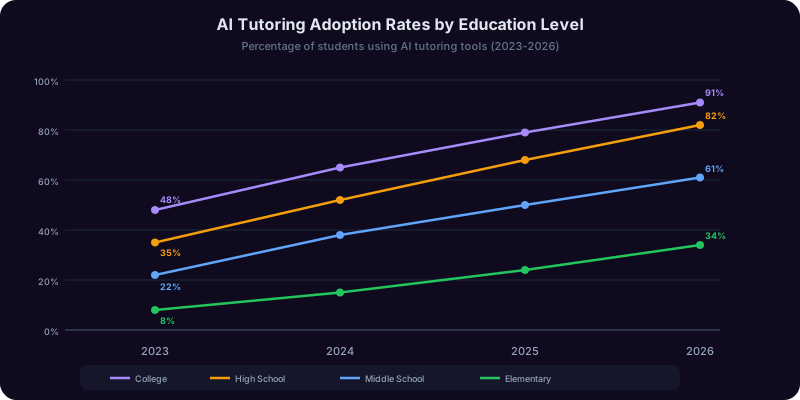
The AI tutoring market in 2026 looks nothing like it did even two years ago. What began with ChatGPT-powered homework assistance in 2023 has matured into a sprawling ecosystem of specialized educational AI tools, each claiming to revolutionize how children learn. By mid-2026, an estimated 68% of U.S. students in grades 6 through 12 have used an AI tool for academic purposes at least once, according to a survey published by the International Society for Technology in Education (ISTE). Among high school students, that figure rises to 82%. The question for parents is no longer whether their child will encounter AI tutoring but how to navigate it responsibly.
The market has segmented considerably. On one end, general-purpose large language models like GPT-5, Claude, and Gemini can answer homework questions and explain concepts across every subject. On the other end, purpose-built educational platforms like Khan Academy's Khanmigo, Duolingo Max, Photomath, and dozens of newer entrants have integrated AI into structured curricula with pedagogical frameworks, progress tracking, and guardrails designed specifically for student use.
Investment in the edtech AI sector reached $9.4 billion globally in 2025, with approximately 40% directed toward K-12 tools. This flood of capital has produced rapid innovation but also a marketing environment where every product claims to be "personalized," "adaptive," and "proven," regardless of whether peer-reviewed evidence supports those claims. Parents are right to be skeptical.
The research on AI tutoring effectiveness is more encouraging than for many other consumer AI applications, but it comes with important caveats. A 2025 meta-analysis published in Educational Research Review examined 112 studies of AI-assisted learning tools and found an average effect size of 0.41, which represents a moderate positive impact on student learning outcomes. However, effect sizes varied enormously by subject (strongest in math, weakest in writing), by age group (strongest for older students), and by implementation quality (strongest when AI supplemented rather than replaced human instruction).
This guide will help you cut through the marketing and make informed decisions. We will examine the evidence subject by subject, address the legitimate concerns about safety, integrity, and dependency, compare AI tutoring to traditional human tutoring on both cost and outcomes, and provide a practical framework for selecting age-appropriate tools.
Subject-by-Subject Guide: Where AI Tutoring Works Best (and Where It Struggles)
Not all subjects benefit equally from AI tutoring. The effectiveness varies dramatically depending on the nature of the subject, the type of reasoning required, and whether the AI can provide accurate, verifiable feedback.
Mathematics: The Strongest Case
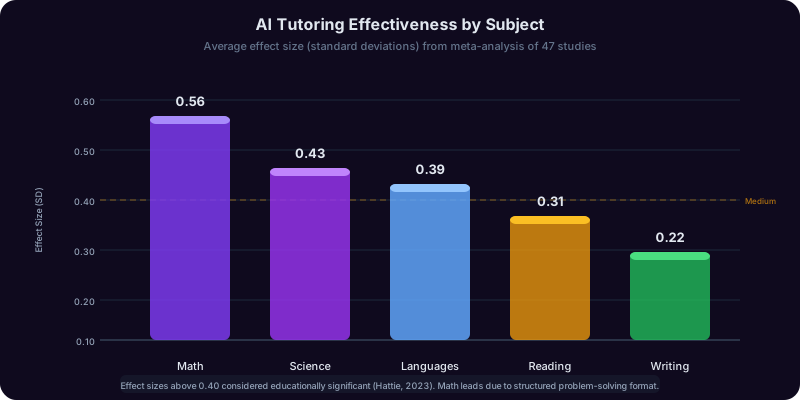
Mathematics is where AI tutoring has the most robust evidence base. Math problems have objectively correct answers, solution paths can be broken into discrete steps, and errors can be diagnosed with high accuracy. A 2025 randomized controlled trial involving 3,200 middle school students found that those using an AI math tutor for 30 minutes per day improved their standardized scores by 0.56 standard deviations, roughly equivalent to four additional months of learning. AI math tutors excel at step-by-step problem decomposition, identifying precisely where a student's reasoning breaks down.
Science: Strong for Concepts, Weaker for Inquiry
AI tutoring shows moderate effectiveness in science (effect size 0.43). The strongest results appear in conceptual understanding: AI can explain mitosis versus meiosis, walk through stoichiometry, or model physics scenarios with clarity. Where AI struggles is in teaching the process of scientific inquiry, forming hypotheses, designing experiments, and interpreting ambiguous data.
Foreign Languages: Practice Yes, Fluency No
AI language tutors demonstrate effectiveness for vocabulary, grammar, and reading comprehension (effect size 0.39). However, students who relied primarily on AI scored 23% lower on spontaneous conversation assessments than those with regular human conversation partners.
Writing: The Most Complex Picture
Writing produces the weakest results (effect size 0.22). AI can catch grammar errors and suggest structural improvements, but a 2025 study found students using AI feedback produced essays that were more technically correct but rated lower on originality and voice.
| Subject | AI Effectiveness | Best Use Case | Key Limitation |
|---|---|---|---|
| Mathematics | Strong (0.56) | Step-by-step problem solving | Cannot teach mathematical intuition |
| Science | Moderate (0.43) | Conceptual explanations | Weak on inquiry and experimental design |
| Languages | Moderate (0.39) | Vocabulary and grammar drills | Cannot replace real conversation |
| Reading | Moderate (0.31) | Comprehension checks | Limited cultural and experiential context |
| Writing | Weak (0.22) | Grammar and structure | Flattens voice, rewards formulaic writing |
AI Tutors vs. Human Tutors: An Honest Cost and Effectiveness Comparison
One of the most practical questions parents face is whether AI tutoring can replace or supplement a human tutor. The answer depends on your child's needs, your budget, and what you are optimizing for.
Cost Comparison
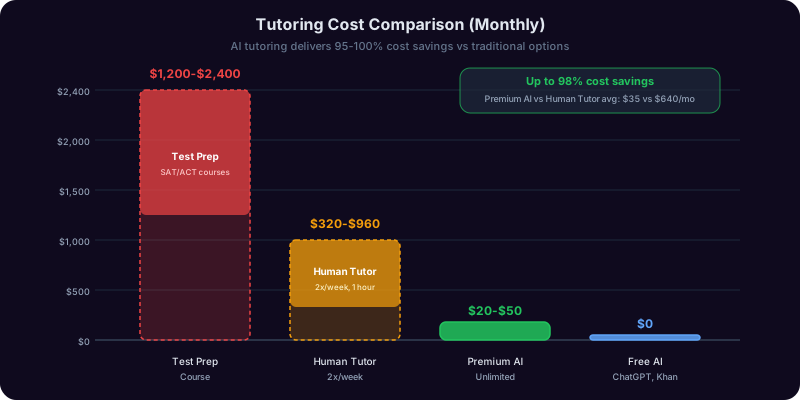
In the United States in 2026, a qualified human tutor costs between $40 and $120 per hour. Specialized test prep tutors charge $150 to $300 per hour. At two sessions per week, human tutoring costs $320 to $960 per month. AI tutoring ranges from free (Khan Academy, basic ChatGPT) to $20-$50 per month for premium platforms. This price differential makes AI tutoring the most significant equalizer in educational access since the public library.
Effectiveness Comparison
A 2024 meta-analysis found an average effect size of 0.72 for human tutoring compared to 0.41 for AI tutoring. However, this compares AI to the best-case scenario: a qualified, experienced tutor working one-on-one. When compared to peer tutoring or group tutoring, the gap narrows considerably.
Where Human Tutors Win
- Motivation and accountability: Noticing disengagement, adjusting to emotional cues, and building a relationship
- Complex reasoning: Modeling thinking processes and encouraging intellectual risk-taking
- Executive function: Addressing organization, time management, and self-regulation
- Learning differences: Flexibility for students with ADHD, dyslexia, or autism spectrum conditions
Where AI Tutors Win
- Availability: 24/7 access for help at 10 PM or 6 AM
- Patience: Never frustrated, never makes a student feel ashamed for repeated questions
- Pacing: Adapts to the student's exact speed in real time
- Data: Detailed tracking of specific skills mastered and struggling with
- Cost: Accessible to families who cannot afford human tutoring
The most effective approach for most families is a hybrid model: AI for daily practice and immediate homework help, human tutoring for motivation, complex reasoning, and executive function support.
Get Answers From the Education Copilot
Copilotly's Education Copilot guides students through academic challenges step by step, building real understanding instead of delivering easy answers. Pair it with the Health Copilot for age-appropriate screen time guidance and the Second Opinion Copilot to evaluate your child's educational options.
Safety, Privacy, and Age-Appropriate Use: A Parent's Checklist
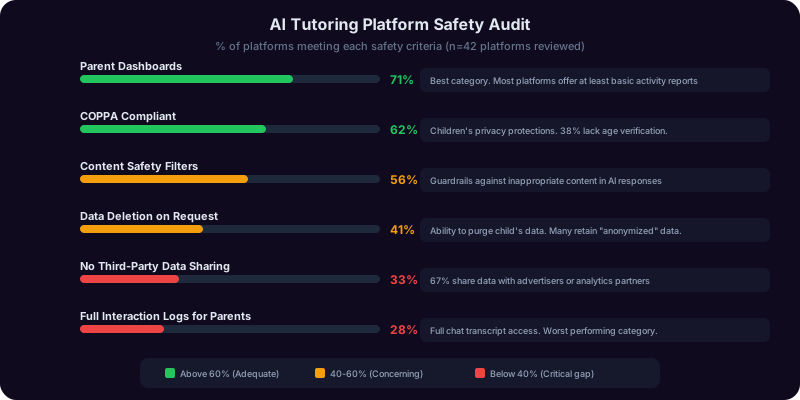
When your child interacts with an AI tutor, they are sharing data with a technology company. Safety encompasses content safety, data privacy, and age-appropriate design.
Content Safety
A 2025 audit by Common Sense Media tested 18 AI tools marketed for education and found that 44% could be prompted to generate age-inappropriate content through creative prompt engineering, even with safety filters enabled. Purpose-built educational platforms have stronger guardrails than general-purpose models. Parents should strongly prefer these tools for younger children.
Data Privacy
Children's data receives legal protection under COPPA (for children under 13) and FERPA (in school contexts), but enforcement is inconsistent. Key questions to ask:
- Is conversation data used to train the company's AI models?
- Is data shared with advertisers or data brokers?
- Can parents review and delete their child's data?
- How long is data retained after account closure?
Age-Appropriate Guidelines
| Age Group | Recommended Approach | Parent Involvement |
|---|---|---|
| Under 8 | Avoid AI tutoring. Focus on human interaction and play-based education. | Full supervision |
| 8-10 | Limited purpose-built educational AI only. No general-purpose chatbots. | Co-use: sit with your child |
| 11-13 | Structured platforms with parental controls. Introduce AI limitations concept. | Weekly check-ins and history review |
| 14-16 | Broader access with clear family agreements on academic integrity. | Weekly conversations, periodic review |
| 17-18 | Full access with emphasis on self-regulation for college readiness. | Advisory role |
Before allowing any AI tutoring platform, test the tool yourself, check Common Sense Media ratings, verify content filters, confirm parent dashboard availability, and establish a family usage agreement. The Copilotly Education Copilot is designed with these principles in mind, focusing on teaching reasoning rather than delivering answers.
Academic Integrity: Addressing the Cheating Question Head-On
AI makes cheating extraordinarily easy. A student can paste an essay prompt into a chatbot and receive a competent response in seconds, photograph a math worksheet and get every answer with shown work, or generate lab reports that are increasingly difficult for teachers to distinguish from student-written work. AI detection tools remain unreliable, with problematic false positive and false negative rates.
A 2025 survey by the National Center for Education Statistics found that 58% of high school students had used AI to complete at least one assignment without the teacher's knowledge. Among those students, 71% did not consider it cheating because "the teacher did not specifically say we could not use AI."
Learning Loss from AI Dependency
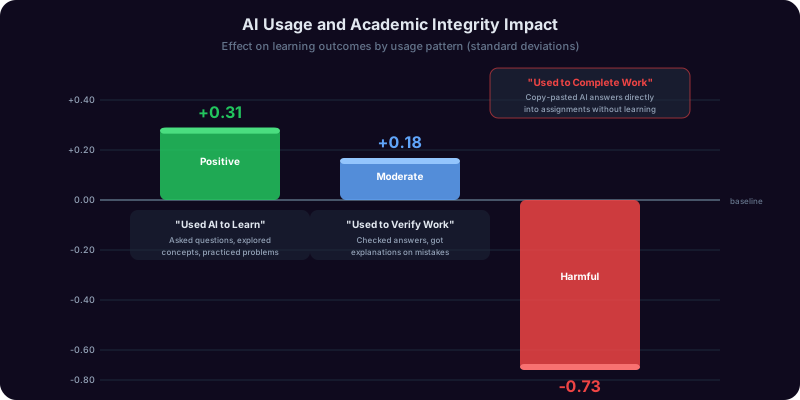
A 2025 longitudinal study tracking 1,800 students found that those who frequently used AI to complete assignments scored 0.73 standard deviations lower on proctored exams compared to students who used AI to learn material.
The Tutor Test Framework
Before using AI for any school task, apply the Tutor Test: "If a human tutor were sitting next to me, would I ask them to do this for me, or to help me understand how to do it myself?"
- Legitimate: "I do not understand how to balance this equation. Walk me through the steps." Then the student balances the next one independently.
- Cheating: "Balance these 20 equations for me." The student copies the answers.
- Legitimate: "I wrote this paragraph. Is my argument logical?" The student revises based on feedback.
- Cheating: "Write a five-paragraph essay about World War I." The student submits the output.
Having the Conversation
The most effective approach is honest conversation, not surveillance. Talk about why learning matters beyond grades. Acknowledge that AI is a powerful tool they will use throughout their careers, but that using it to bypass learning now is like having someone else do your physical therapy: the point is not to finish the exercises but to build the strength yourself.
Screen Time, Dependency, and Cognitive Offloading: Managing the Risks
Parents who have spent years managing screen time face a paradox: the same device they have been limiting for entertainment is now positioned as essential for education.
What the Research Shows
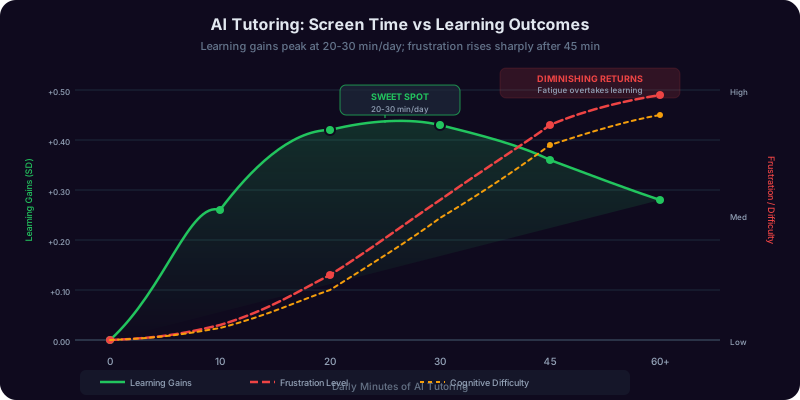
The American Academy of Pediatrics (AAP) updated its guidelines in 2025 to distinguish between passive consumption, interactive engagement, and communicative use. Interactive, goal-directed screen use, including AI tutoring, has significantly fewer negative associations than passive consumption. However, a 2025 study found children using AI tutoring for more than 45 minutes per day showed increased difficulty transitioning to offline activities and higher frustration when required to work without AI.
Cognitive Offloading: The Real Risk
The deeper concern is cognitive dependency. When instant explanations are always available, the incentive to struggle productively decreases. Research shows that desirable difficulty, challenges requiring effort but within reach, produces stronger learning than frictionless instruction. A 2026 Stanford preprint found students who had an imposed delay before AI hints learned 34% more than those receiving immediate assistance.
Warning Signs of Dependency
- Refusal to attempt problems independently before reaching for AI
- Frustration or anxiety when AI tools are unavailable
- Growing gap between homework grades and proctored test grades
- Loss of confidence: "I cannot do math without AI"
- Using AI as a first resort rather than a last resort
Management Strategies
- Set time limits: 20-30 minutes per session for optimal learning gains
- Implement the attempt-first rule: 5-10 minutes of independent work before consulting AI
- Alternate AI and non-AI sessions: Designate some study time as AI-free
- Separate screens: Dedicated device or profile for educational AI
- Monitor the homework-test gap: Significant differences signal over-reliance
How to Evaluate and Choose an AI Tutoring Platform
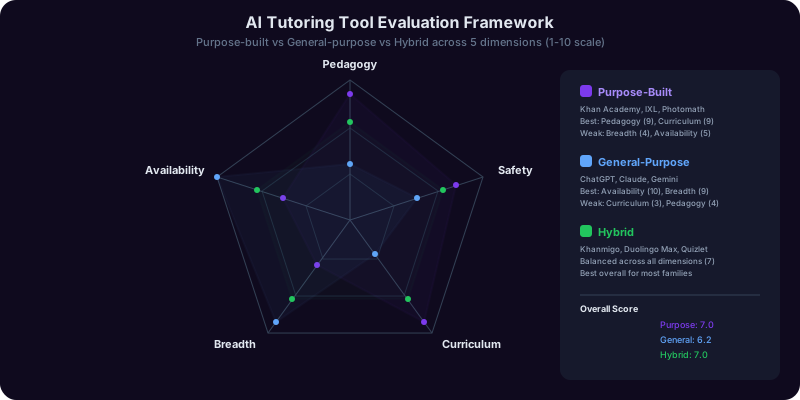
With hundreds of AI tutoring tools available, parents need a structured evaluation approach. Assess any platform across five dimensions.
The Five-Factor Framework
1. Pedagogical Approach: Does the tool guide learning through Socratic questioning, or does it deliver answers? Test by giving it a problem and observing whether it asks what the student has tried before providing help.
2. Accuracy: A 2025 ISTE evaluation found accuracy rates ranging from 78% to 96% depending on platform and subject. Test with known problems before relying on any tool.
3. Adaptivity: Look for platforms that track mastery at a granular level and generate personalized practice based on identified weaknesses.
4. Safety and Privacy: Prioritize COPPA compliance, no student data used for AI training, parent dashboards, and robust content filters.
5. Curriculum Alignment: The most effective tools align with your child's school curriculum to reinforce rather than conflict with classroom instruction.
Platform Categories
| Category | Examples | Best For | Watch Out For |
|---|---|---|---|
| Purpose-Built Educational AI | Khanmigo, Photomath, Duolingo Max | Structured learning, younger students | Limited subject scope |
| General-Purpose AI | ChatGPT Edu, Claude, Gemini | Broad coverage, older students | Weaker safety filters, easier cheating |
| School-Integrated AI | Google Classroom AI, Canvas | Curriculum alignment, teacher oversight | Quality varies widely |
| Subject-Specific Tools | Grammarly, Wolfram Alpha, Quizlet AI | Deep expertise in one domain | Some provide answers too readily |
For a versatile educational AI emphasizing reasoning, the Copilotly Education Copilot guides students through problem-solving step by step. For questions about age-appropriate boundaries, the Health Copilot can help you think through the developmental considerations.
The Bottom Line: Practical Recommendations for Every Age Group
After reviewing the research on effectiveness, safety, academic integrity, and dependency, here are clear recommendations organized by age group.
Elementary School (Ages 5-10)
- Do: Use purpose-built AI apps for math facts and phonics, limited to 15-20 minutes
- Do: Sit with your child during all AI interactions
- Do not: Allow access to general-purpose AI chatbots
- Do not: Use AI as a substitute for reading together or hands-on activities
Middle School (Ages 11-13)
- Do: Introduce structured platforms with parent dashboards and the Tutor Test framework
- Do: Implement the attempt-first rule and limit sessions to 20-30 minutes
- Do not: Allow unsupervised use of general-purpose AI for homework
High School (Ages 14-18)
- Do: Allow broader access within a clear family agreement on integrity
- Do: Monitor the homework-test performance gap
- Do: Discuss AI ethics and your school's specific policies
- Do not: Take a purely prohibitive approach, which drives AI use underground
Key Principles for All Parents
- AI tutoring is a supplement, not a replacement. It works best alongside human instruction. Our second opinion guide explores this principle across many domains.
- Process matters more than product. Focus on how your child uses AI, not just whether they use it.
- Start with structure, then expand freedom. Begin with purpose-built tools and clear rules, then gradually expand access.
- Stay informed. Follow ISTE and Common Sense Media for updated reviews.
- Model healthy AI use yourself. Demonstrate using AI as a thinking partner, not a thinking replacement.
The families who navigate this transition most successfully treat AI tutoring as a parenting decision, one requiring the same thoughtful engagement and boundary-setting as every significant aspect of a child's development. The Copilotly Education Copilot can help you and your child explore academic concepts together, while the Second Opinion Copilot can help you think through educational decisions for your family.
Frequently Asked Questions
Recommended Copilots
Recommended Copilots
The Health Copilot helps parents evaluate screen time guidelines, developmental milestones, and age-appropriate technology boundaries for their children.
Try Free →The Second Opinion Copilot helps parents think through educational decisions, compare tutoring options, and evaluate whether their child's learning approach is on track.
Try Free →Related Articles
Get Answers From the Education Copilot
Copilotly's Education Copilot guides students through academic challenges step by step, building real understanding instead of delivering easy answers. Pair it with the Health Copilot for age-appropriate screen time guidance and the Second Opinion Copilot to evaluate your child's educational options.