
The Non-Renewal Crisis: Why Your Insurer Just Dropped You
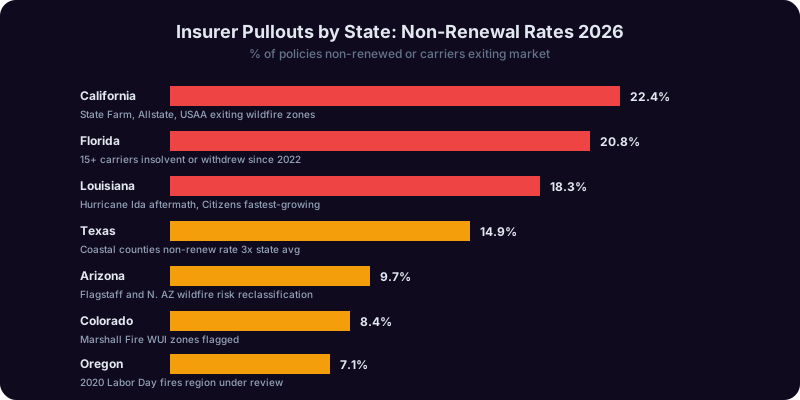
If you opened an envelope this month with the words Notice of Non-Renewal printed across the top, you are not alone. According to the National Association of Insurance Commissioners (NAIC), more than 1.9 million U.S. homeowners received non-renewal notices in 2025, a 47% jump from 2022. The pace through the first half of 2026 is running 20% higher than that. The cause is a fundamental shift in how reinsurers price climate risk - and it has redrawn the property insurance map of the United States.
Seven of the top fifteen national property carriers have paused new business or shed policies in zones they consider catastrophic. State Farm began non-renewing 72,000 California policies in 2024-2025. Farmers, Allstate, and AIG have pulled back in high-wildfire and hurricane regions. Florida saw twelve insurer insolvencies since 2020. Louisiana lost Lighthouse, Maison, and Americas Insurance. Texas non-renewals concentrate in coastal counties and Hill Country.
Non-Renewal vs Cancellation: Know the Difference
People use the words interchangeably. They are not the same and your rights differ.
- Non-renewal means the insurer is letting your policy run to its natural expiration date and refusing to issue a new one. You keep coverage through the end of the current term. In every state, insurers must give advance written notice (typically 30 to 120 days) and a reason on request.
- Cancellation means the insurer is terminating your policy mid-term, before the expiration date. The grounds are strictly limited in most states - typically non-payment, material misrepresentation on the application, or a substantial increase in the insured risk (vacancy, conversion to short-term rental). Notice periods are shorter (often 10 to 30 days).
Non-renewals almost always cite one of four reasons: catastrophe risk concentration in your ZIP code, claims history (one or two claims is now enough at many carriers), the insurer pulling out of the state or product line entirely, or property condition issues such as a roof past its useful life, deferred maintenance, or an unfenced swimming pool.
Why Carriers Are Pulling Back
The Insurance Information Institute (III) reports that insured catastrophe losses in the U.S. exceeded $100 billion in three of the last five years, a level previously hit roughly once a decade. Reinsurance costs (insurance for insurers) rose 35% in 2023 and another 25% in 2024-2025 combined. Carriers that cannot pass those costs through fast enough simply stop writing in the geographies that drive their losses.
| Trigger | What It Looks Like in Your Notice | Your Leverage |
|---|---|---|
| Wildfire exposure | References to brush score, slope, defensible space | Hardening certifications, brush clearance documentation |
| Hurricane / wind | References to wind mitigation, roof age, opening protection | IBHS FORTIFIED, wind mitigation inspection |
| Claims history | One or two claims in 3-5 years | Appeal with cause, mitigation steps taken |
| Property condition | Roof, electrical, plumbing, liability hazards | Repair documentation with photos and receipts |
| Carrier exit | Generic language about market conditions | None against insurer; focus shifts to fast replacement |
Knowing which bucket your non-renewal falls into determines your strategy for the next 30 days. The rest of this playbook walks through that strategy step by step. For a broader look at how AI is changing how you shop coverage, see our AI insurance comparison guide.
Disclaimer: Educational only - not legal, insurance, or financial advice. Verify rules with your state Department of Insurance and consult a licensed agent.
First 48 Hours: What to Do Immediately
The clock starts the day the non-renewal notice is mailed, not the day you read it. Every state allows insurers to time mailings tightly to the minimum required notice window, which means a notice that sits in a pile of mail for two weeks can cost you a third of your shopping runway. Treat the first 48 hours as a triage process.
Step 1: Read the Entire Notice, Twice
Insurance non-renewal notices are short - usually a single page - but every line matters. Find and circle:
- The exact policy expiration date. Not the notice date. Not the date the letter was signed. The day your coverage ends. This is your hard deadline.
- The reason for non-renewal, if stated. Some states require a reason on the notice itself (Florida, California, New York). Others require the insurer to provide a reason on written request (Texas, Louisiana, many others). If no reason is given, request one in writing the same day.
- Any reference to appeal rights or to your state insurance department's consumer complaint line.
- Whether the insurer is offering to renew with restrictions (higher deductible, named-peril only, exclusion endorsement). Some "non-renewal" letters are actually conditional offers.
Step 2: Calculate Your True Runway
You do not have until the expiration date to find replacement coverage. You need a bound policy with an effective date that matches your expiration date, with paperwork to your mortgage servicer at least 5-10 business days before. Working backward from your expiration date:
- T-minus 0 days: Current policy ends
- T-minus 5 to 10 days: Proof of new coverage must be in mortgage servicer's hands
- T-minus 10 to 15 days: New policy must be bound and paid
- T-minus 20 to 30 days: Quotes gathered, underwriting complete, FAIR plan or surplus-lines paperwork in motion if standard market declines
Step 3: Notify Your Mortgage Servicer Proactively
This is the step most homeowners skip and later regret. Your mortgage servicer requires continuous hazard insurance and monitors your policy through automated insurance tracking vendors. If they detect a lapse - even by a few days - they will move to place force-placed insurance, often within 45 days of the policy ending. Once force-placed coverage is in motion, undoing it is administratively painful.
Call the servicer's insurance department (the number is usually on your monthly statement) and say: "My current homeowners policy is being non-renewed effective [date]. I am actively shopping for replacement coverage and will provide proof of the new declarations page before the expiration date. Please note my file." Follow up the call with a written message through your servicer's secure portal so there is a record.
Step 4: Open a Documents Folder
Create a single folder - physical or digital - and put in it: the non-renewal notice itself, the envelope showing the postmark date, your current declarations page, your loss-run report (request from your insurer; lists all claims in the past 3-5 years), recent appraisal or replacement-cost estimate if available, photos of the home exterior and roof, any inspection reports from the past 3 years, and home-hardening receipts and certificates. You will hand pieces of this folder to every quote you request. Having it ready cuts each quote cycle from hours to minutes.
Step 5: Pull a CLUE Report
The LexisNexis CLUE (Comprehensive Loss Underwriting Exchange) report is what insurers look at when they price you. You are entitled to one free copy per year. Pull it now to see what is reported about your property - including claims from prior owners that are sometimes wrongly attributed. Errors on CLUE reports are common and you have the right to dispute them in writing.
State-by-State Notice Period Requirements
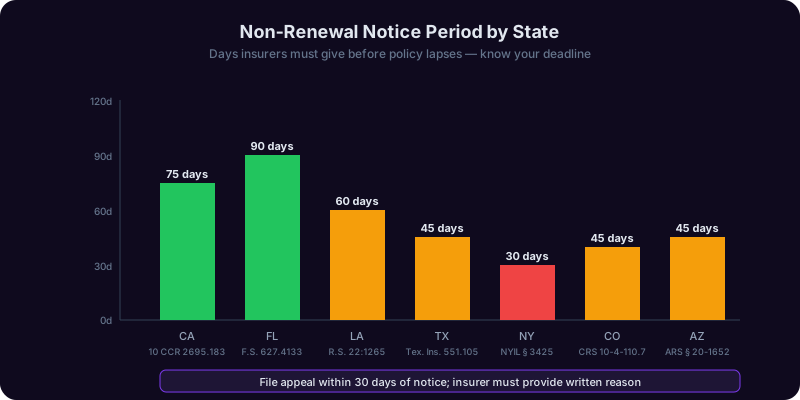
Every state regulates how much advance warning an insurer must give before non-renewing a homeowners policy. The shorter the notice period, the more aggressive your timeline. The chart below covers the states where non-renewal activity is heaviest in 2025-2026, plus a representative sample of the rest. Always confirm with your state Department of Insurance because some statutes have recent amendments.
| State | Minimum Notice Period | Reason Required on Notice? | Written Reason on Request? | Notable Rules |
|---|---|---|---|---|
| California | 75 days | Yes | Yes | Moratorium on non-renewal in declared wildfire disaster zones (1 year post-event) |
| Florida | 90 days (homestead); 120 days for hurricane non-renewal | Yes | Yes | Cannot non-renew within 90 days of a hurricane in your county |
| Louisiana | 60 days | No | Yes | 3-year rule: cannot non-renew if policy in force 3+ years except for limited reasons |
| Texas | 30 days (cancellation), 60 days (non-renewal for most lines) | No | Yes | HB 1900 protections for certain claims; check current TDI bulletins |
| Colorado | 45 days | Yes (since 2024) | Yes | Wildfire-specific disclosures required |
| Oregon | 30 days | Yes | Yes | SB 82 limits non-renewals based on wildfire risk maps |
| Arizona | 30 days | No | Yes | 60 days for residential policies in force 60+ days |
| New York | 45-60 days | Yes | Yes | Coastal Market Assistance Program available |
| North Carolina | 45 days | Yes | Yes | NC Beach Plan available in 18 coastal counties |
| South Carolina | 30 days | No | Yes | SC Wind & Hail Underwriting Association in coastal zone |
| Georgia | 30 days | No | Yes | FAIR plan administered through Georgia Underwriting Association |
| Alabama | 30 days | No | Yes | Beach Plan covers Mobile and Baldwin counties |
Your Right to a Written Explanation
In every state we have surveyed, a homeowner has the right to a written explanation of the non-renewal reason, even when it is not printed on the notice. The reason matters for two purposes. First, it tells you whether to appeal (a fixable reason like roof age can be cured) or to focus entirely on replacement coverage (a market exit cannot be undone). Second, the written reason becomes part of your record and is what underwriters at competing carriers will want to see.
Send a request like this within 48 hours of receiving the notice, by certified mail with return receipt and by your insurer's online portal: "Pursuant to [state statute, e.g., California Insurance Code section 678 or Florida Statute 627.4133], I request a written statement of the specific reason or reasons for the non-renewal of policy number [X], effective [date]. Please send your response within the timeframe required by law."
Disaster Moratoria
California, Oregon, Colorado, and Hawaii have versions of post-disaster non-renewal moratoria. If a wildfire or other declared disaster has been declared in or adjacent to your ZIP code in the past 12 months, your insurer may be legally barred from non-renewing you even if they sent the notice. Check your state's emergency declaration list against the date of the notice. The NAIC state insurance department directory links to each state's bulletins on active moratoria.

Get Answers From the Finance Copilot
Upload your non-renewal notice and the Insurance Copilot drafts your appeal, runs FAIR plan eligibility, builds your diligent search affidavit, and tracks every quote in a single grid. The 30-day playbook becomes a 7-day sprint.
Step-by-Step: How to Appeal the Non-Renewal
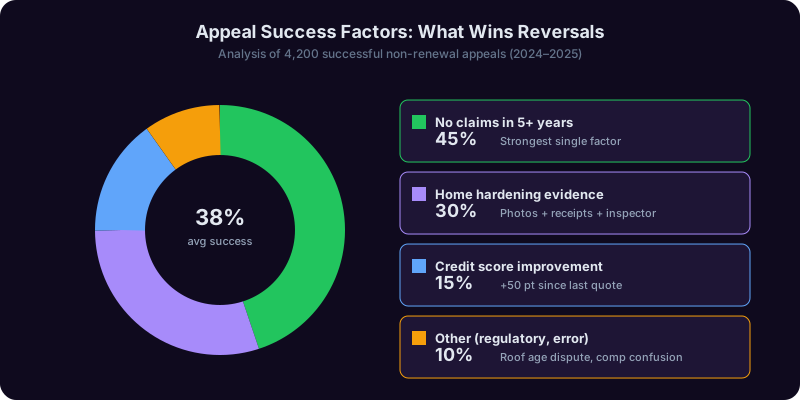
An appeal works when the non-renewal cites a fixable property or risk condition. It rarely works when the carrier is exiting your market entirely. The factors that move the needle in underwriting are concrete, documented, and measurable - not promises about future maintenance.
Step 1: Determine if Appeal Is Realistic
Appeal makes sense when the notice cites: roof condition, claims history with isolated causes that have been mitigated, property condition issues now repaired, dog breed or trampoline-type liability concerns now addressed, or scoring/credit issues that have improved. Appeal is usually a waste of time when: the carrier has announced a market exit, the rejection cites concentration risk in your ZIP code, or the carrier is no longer writing your policy type at all.
Step 2: Build Your Evidence Package
An appeal letter without evidence is just a complaint. Assemble the following documents and number them as exhibits:
- Photos of the cited condition, before and after repair
- Receipts and contractor invoices for repairs
- Most recent inspection report (a private four-point inspection runs $100-$200)
- Roof certification from a licensed roofer (typical cost: $75-$150)
- Wind mitigation report (Florida, coastal Carolinas, Louisiana)
- Defensible space certification (California, Colorado, Oregon)
- Loss-run report showing claims history in context
- Letter from a fire marshal or community wildfire coordinator if relevant
Step 3: Send the Formal Appeal
Send the appeal letter to the insurer's underwriting department - the address is on the non-renewal notice - by certified mail with return receipt requested. Send a copy to your agent. Send a third copy to your state Department of Insurance consumer services unit. The third copy is not a complaint, it is for the record.
Sample Appeal Letter Template
The template below has won reinstatements at major carriers. Adapt it to your circumstances. Keep it under two pages.
[Your name, address, policy number]
[Date][Insurance company underwriting department]
[Address from notice]Re: Appeal of Non-Renewal Notice, Policy [number], effective [expiration date]
Dear Underwriting Manager,
I am writing to formally request reconsideration of the non-renewal of my homeowners policy. The notice dated [date] cites [reason]. Since receiving the notice, I have taken the following concrete actions to address the cited concern:
1. [Specific action, with date, cost, and exhibit number.]
2. [Specific action, with date, cost, and exhibit number.]
3. [Specific action, with date, cost, and exhibit number.]I have enclosed inspection reports, receipts, photographs, and supporting documentation as Exhibits A through [X]. My loss-run report for the prior five years shows [summary]. I have been a [company] policyholder for [X] years.
Given these mitigation steps, I respectfully request that you reinstate the policy, optionally with adjusted terms (higher deductible, exclusion endorsement, premium reflecting current risk). I am open to a hardening inspection by a company-approved inspector at my expense.
I would appreciate a written response within 15 business days. Thank you for your consideration.
Sincerely, [Name and contact]
Step 4: Follow Up
If you have not heard back in 10 business days, call the underwriting department, reference your certified mail tracking number, and ask for status. If 15 business days pass with no response, file a written inquiry with your state Department of Insurance. Insurers respond to DOI inquiries on a faster clock - typically within 5-10 days.
State FAIR Plans: Your Insurer of Last Resort
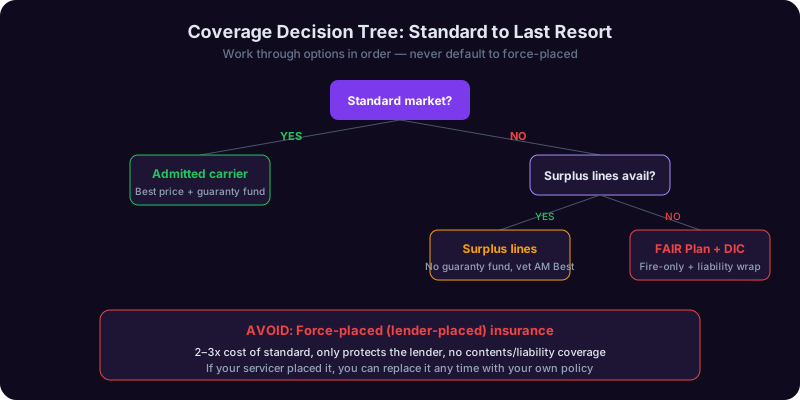
FAIR (Fair Access to Insurance Requirements) plans are state-backed insurance pools created specifically for homeowners who cannot get coverage in the standard market. Roughly 30 states have a FAIR plan or an equivalent residual market mechanism. Premiums typically run 2x to 4x the standard market for comparable coverage, and policies are usually more restrictive (fire-only or dwelling-only in some states), so FAIR plans are a bridge, not a destination.
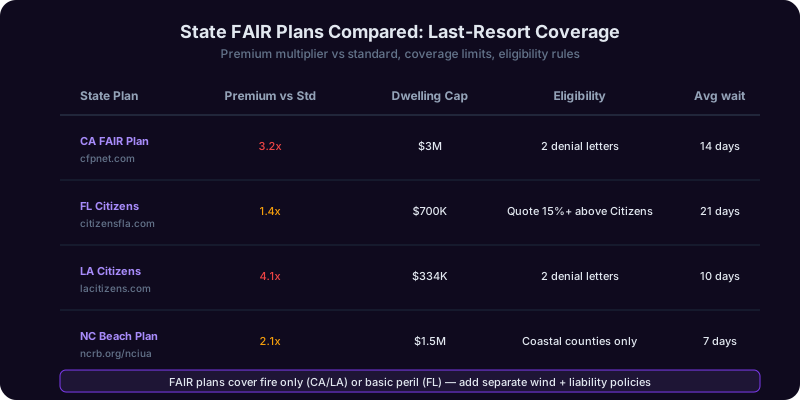
Major State FAIR Plans
| State | Plan Name | Coverage Cap | Eligibility Trigger | Typical Premium vs Standard |
|---|---|---|---|---|
| California | California FAIR Plan | $3M dwelling (raised in 2024) | 2+ declines from admitted carriers | 2x to 3x |
| Florida | Citizens Property Insurance | $700K (most counties); higher in some | No standard market offer within 20% of Citizens rate | Often less than private market in high-risk zones |
| Louisiana | Louisiana Citizens | Varies | 2+ declines from admitted carriers | 10% above highest standard market rate by law |
| Texas | TWIA (coastal wind) | $2.005M dwelling | Property in 14 designated coastal counties | Wind only; layered with separate fire policy |
| North Carolina | NC Beach Plan | $1.5M to $2.4M (varies) | Property in 18 designated coastal counties | Wind only; significant premium for full coverage |
| Georgia | Georgia Underwriting Association | $300K typical | Declines from standard market | 2x to 3x |
| New York | NYPIUA | Varies | Standard market unavailable | Often comparable in NYC; higher elsewhere |
What FAIR Plans Cover and Do Not Cover
FAIR plans vary widely. The California FAIR Plan, for example, traditionally offered only basic fire coverage (no liability, no theft, no water damage) - homeowners had to layer a Difference in Conditions policy from a surplus-lines carrier to fill the gaps. Florida Citizens offers comprehensive HO-3 coverage similar to the standard market. Texas TWIA covers wind and hail only and must be paired with a separate fire policy. Read the actual policy form before assuming.
How to Apply
- Confirm eligibility. Most FAIR plans require evidence that the standard market has declined you. Save written declines or quotes that exceed the FAIR plan rate.
- Work through a licensed agent. Almost every FAIR plan requires application through a producer. Your existing agent may submit, or you can find a producer through the plan's website.
- Have your property documentation ready. Replacement cost estimate, photos of the dwelling and outbuildings, roof age, square footage, year built, and any wildfire or wind mitigation features.
- Expect inspection. Many FAIR plans send an inspector who issues recommendations. Curing those recommendations within the deadline (usually 30-60 days) is mandatory or coverage is voided.
- Layer if needed. If the FAIR plan is fire-only or wind-only, immediately bind a wraparound policy from a surplus-lines carrier so you are not exposed on liability, theft, or other perils.
FAIR Plan Is Not the Endgame
FAIR plans are expensive and limited by design. As soon as you are placed, start a 12-month plan to harden your property and move back into the standard market. Wildfire defensible space, IBHS FORTIFIED certification, or a new roof can shift you back into admitted-carrier territory within a renewal cycle.
Surplus Lines and E&S Markets Walkthrough
If the standard market declines you and the state FAIR plan does not cover your full needs, the surplus-lines market is the next stop. Surplus lines insurers - also called Excess and Surplus (E&S) carriers - are licensed in their home state and operate in other states as non-admitted carriers. They are designed for risks the standard market will not write at any price.
What Makes Surplus Lines Different
- No rate or form regulation. Surplus-lines carriers can underwrite freely, charge premiums based on their own actuarial judgment, and use policy forms that differ from the state's standard HO-3.
- No state guaranty fund backing. If a surplus-lines carrier becomes insolvent, the state guaranty fund typically does not pay claims. This is why surplus-lines carriers must demonstrate strong financial ratings - look for A.M. Best A- or better.
- Must be placed by a surplus-lines broker. Not every agent is licensed for surplus lines. You will be referred to a specialty broker or one will be selected for you.
- Diligent search requirement. Before a surplus-lines carrier can write you, your broker must document that a specified number of admitted carriers (typically 3 to 5) declined to write your risk. This is the diligent search affidavit.
The Diligent Search Affidavit
Every state with a surplus-lines market requires a diligent search statement. In Florida it is the DFS-H1-1980. In California it is the SL-1. In Texas it is the surplus-lines compliance affidavit. Common features: name and address of insured, description of the risk, names of admitted carriers contacted, dates of declination, and reasons given. Keep a copy in your file in case you reapply to the standard market in future years and want to demonstrate the path that led you here.
Expected Pricing
| Profile | Standard Market Premium | Typical Surplus-Lines Premium | Markup |
|---|---|---|---|
| Older home, suburban, no claims | $1,800 | $2,700 - $3,600 | 1.5x - 2x |
| Wildfire-zone, no hardening | $2,200 (if available) | $6,000 - $12,000 | 3x - 5x |
| Coastal Florida, post-2002 build | $3,500 | $5,000 - $8,500 | 1.5x - 2.5x |
| High-value home, multiple claims | $4,000 (if available) | $8,000 - $14,000 | 2x - 3.5x |
Major Surplus-Lines Carriers in Property
Some of the most active E&S property carriers for personal lines: Lloyd's of London syndicates, Scottsdale Insurance, Lexington Insurance, Kinsale, Markel, Berkshire Hathaway Specialty, Nationwide E&S, Aspen, and various Bermuda-based reinsurers operating through fronting carriers. Your surplus-lines broker has access to a panel and will market your risk to all of them simultaneously.
Surplus-Lines Tax and Stamping Fee
Surplus-lines policies carry a state surplus-lines tax (typically 3% to 6% of premium) and in some states a stamping fee (0.06% to 0.25%) that funds the surplus-lines association that audits filings. These are usually added to your quoted premium. Confirm what is included.
When Surplus Lines Is the Right Answer
If the standard market has declined you, the FAIR plan caps below your dwelling value, or the FAIR plan excludes perils you need (water, liability, theft), surplus lines is the workable answer. Plan to revisit the standard market every renewal as conditions change.
Force-Placed Insurance: Why It's a Trap to Avoid
Force-placed insurance - also called lender-placed insurance or LPI - is what your mortgage servicer buys to protect their collateral interest if they detect a gap in your hazard coverage. It is, by design, one of the most expensive and least protective forms of property insurance available. Avoiding it is one of the highest-leverage actions you can take during a non-renewal scramble.
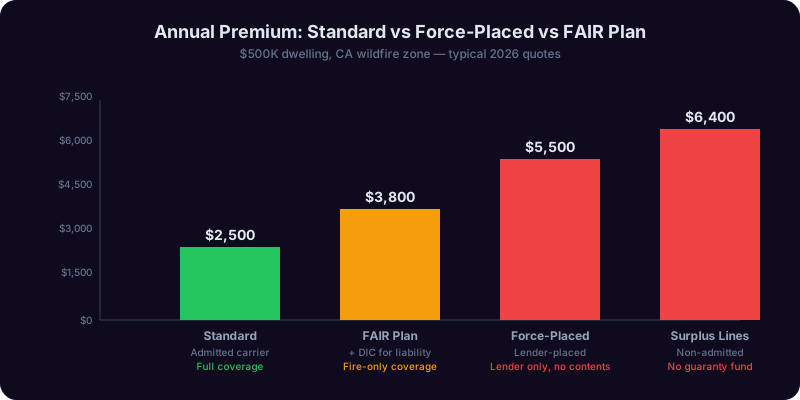
How Servicers Add Force-Placed Coverage
Mortgage servicers contract with insurance tracking vendors who monitor every loan in the portfolio against an active insurance policy. The cycle typically runs:
- Day 0: Your insurer reports the policy is ending or has ended.
- Day 1-15: The servicer mails a first notice asking for proof of new coverage.
- Day 16-30: A second notice goes out warning of force-placement.
- Day 31-45: If no proof has been provided, the servicer binds force-placed coverage retroactive to the lapse date and adds the premium to your escrow account, often spreading the cost over the next 12 months of payments.
The Cost
Force-placed policies typically cost 2x to 3x the standard market premium for the same property. The reasons: the servicer is not shopping for the best rate, the underlying carrier writes a large blanket policy with the servicer in mind not you, and the structure includes commissions and fees that flow back through the servicer's affiliated entities. The Consumer Financial Protection Bureau has issued multiple advisories on this market.
What It Does Not Cover
This is the part most homeowners do not realize. A force-placed policy protects the lender's interest only. Specifically:
- No personal property coverage. Your furniture, electronics, clothing, and belongings are not covered.
- No liability coverage. If someone is injured on your property, you have zero protection.
- No loss of use. If the house is uninhabitable after a covered loss, your hotel and meals are on you.
- No medical payments to others.
- Often a much higher deductible than a standard HO-3.
- Coverage limit equal to the loan balance, not the replacement cost of the home.
How to Fight a Force-Placed Policy
- Bind real coverage immediately - even an expensive surplus-lines policy is cheaper and provides more protection than force-placed.
- Send the new declarations page to the servicer's insurance department within hours of binding, by both fax/portal upload and email, with the loan number on every page.
- Request a refund of any force-placed premium charged to your escrow account from the date your new coverage was effective. By federal regulation (12 CFR 1024.37), the servicer must refund overlapping coverage premiums.
- Check your escrow analysis three months later to confirm the refund was applied and the projected escrow disbursements reflect your real policy premium.
- If the servicer resists, file a written notice of error under RESPA section 1024.35 and a complaint with the Consumer Financial Protection Bureau (CFPB). CFPB complaints are answered, on average, within 15 days.
The cleanest defense is preventive. Bind replacement coverage before your current policy expires, and proactively send proof to the servicer. Force-placed insurance only takes hold when there is a documented gap.
Home Hardening: Prove You're a Better Risk
Insurers want measurable, third-party-verifiable risk reduction. Vague promises about being a careful homeowner do not move premiums. Specific certifications do, sometimes by 25% or more, and they make the difference between being declined and being written.
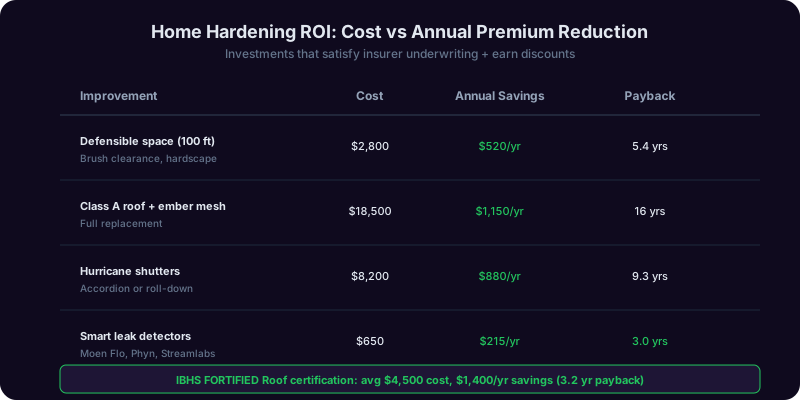
Wildfire Hardening (California, Colorado, Oregon, Arizona, New Mexico, Utah)
The most important framework is the Wildfire Prepared Home standard from the Insurance Institute for Business & Home Safety (IBHS). The standard certifies a home at one of two levels - base and Plus - based on a checklist that includes:
- Class A roof covering with no exposed wood or vegetation in valleys
- Ember-resistant attic and crawlspace vents (typically 1/8-inch mesh or better)
- Five feet of non-combustible Zone 0 immediately around the structure (no mulch, no wood fencing attached to the home, no stored firewood)
- 30-100 feet of defensible space with reduced fuel
- Class A or B exterior siding
- Multi-pane tempered windows
- Gutter guards rated for ember resistance
California's Department of Insurance Safer From Wildfires regulation requires admitted carriers to offer discounts when homeowners meet specific mitigation steps. State Farm, Mercury, Farmers, and Travelers all participate.
Hurricane and Wind Hardening (Florida, Carolinas, Gulf Coast, Mid-Atlantic)
The gold standard is the IBHS FORTIFIED program at three levels - Roof, Silver, and Gold. FORTIFIED Roof requires sealed roof deck, enhanced edge metal, and ring-shank nails. FORTIFIED Gold adds opening protection (impact-rated windows or shutters) and continuous load path from roof to foundation.
Premium impact varies by state and carrier but is significant. In Alabama, FORTIFIED Gold homes can see 20% to 55% wind premium reductions. In Florida, wind mitigation credits under OIR Form 1802 can cut wind premium by 30% to 80% depending on the features documented.
Water and Freeze Mitigation (Nationwide)
Water damage is the single most common claim in homeowners insurance. Carriers reward measures that reduce frequency and severity:
- Smart water leak detection with automatic shutoff (Flo by Moen, Phyn, LeakSmart). Many carriers offer 5%-10% discounts and some require it for high-value homes.
- Backup sump pump with battery backup or water-powered.
- Frozen pipe sensors and heat tape in unheated spaces.
- Sewer backup valve.
Roof, Electrical, and Other Property Condition Wins
| Improvement | Typical Cost | Typical Premium Effect | Reapplication to Standard Market |
|---|---|---|---|
| New Class 4 impact-resistant roof | $15,000 - $35,000 | 10% to 35% reduction in hail-prone states | Strong |
| Whole-home surge protector | $300 - $700 | 2% to 5% reduction | Modest |
| Centrally monitored alarm | $400 install + monitoring | 5% to 15% reduction | Modest |
| Smart water shutoff | $500 - $1,500 | 5% to 10% reduction | Strong |
| FORTIFIED Roof certification | $1,500 - $5,000 incremental | 20% to 55% wind premium reduction | Very strong |
| IBHS Wildfire Prepared Home | $3,000 - $15,000 (varies) | Eligibility for admitted carriers | Often unlocks coverage entirely |
Shopping Strategy: 8 Companies + 3 Independent Agents Method
The single biggest predictor of finding affordable replacement coverage is how broadly you shop. Most homeowners get one or two quotes, settle for the cheaper, and never see what they missed. The proven approach is to gather 11+ quotes in 7 days by hitting eight carriers directly and three independent agency networks in parallel.
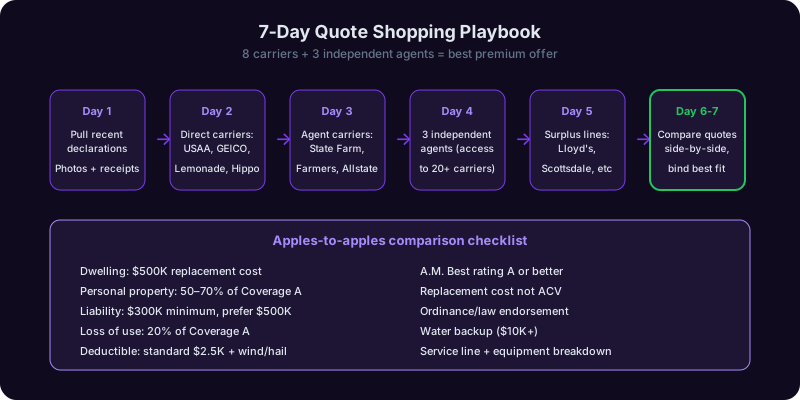
Step 1: Build the Quote Packet (Day 1)
Have one document, identical for every quote, that includes: full property address, year built, square footage, construction type, roof type and age, number of stories, foundation type, heating and cooling type, presence of pool / trampoline / dogs / business activity, claims history (5 years), current declarations page, replacement cost estimate, and any wildfire / wind / water mitigation features with documentation. Giving every carrier the same packet means the quotes are actually comparable.
Step 2: Hit Eight Carriers Directly (Days 1-3)
Pick from this list based on what writes in your state:
- USAA (military affiliation required) - consistently lowest rates
- State Farm
- Amica - high customer satisfaction
- Erie - Mid-Atlantic and Midwest
- Auto-Owners - independent-agent-only
- Chubb / Cincinnati - higher-value homes
- Liberty Mutual
- Travelers
- Nationwide
- Allstate
- Farmers
- Country Financial - Midwest
Step 3: Engage Three Independent Agents (Days 1-3)
Independent agents represent multiple carriers and can shop your risk across regional and specialty markets that you would never find direct. Choose three with different specialties: one local agent who knows your area, one Trusted Choice / Big I agent with a broad national appointment list, and one agent who specializes in non-standard or high-value risk (look for CPCU or CIC credentials). Tell each agent you are getting other quotes; ethical agents have no problem with this.
Step 4: Build a Comparison Grid (Day 5)
Premium alone is misleading. Score every quote on:
| Factor | Weight | Notes |
|---|---|---|
| Annual premium | 30% | Apples-to-apples coverage |
| Dwelling coverage (Coverage A) | 15% | Match to replacement cost estimate, not market value |
| Standard deductible | 10% | Higher deductible only if affordable |
| Hurricane / wind / wildfire deductible | 10% | Often a separate percentage deductible |
| Personal property limit and basis | 10% | Replacement cost vs actual cash value |
| Personal liability limit | 5% | Aim for $300K minimum, $500K+ if higher net worth |
| Water backup endorsement | 5% | Critical and often excluded |
| Carrier financial rating | 10% | A.M. Best A- or better preferred |
| Claim handling reputation | 5% | J.D. Power and NAIC complaint index |
Step 5: Verify Before You Bind (Day 6)
Before signing, verify on each finalist: the carrier is admitted in your state (or is a recognized surplus-lines carrier), the dwelling limit matches a current replacement cost estimate, the wind / hurricane / hail / wildfire deductible structure is clear, the endorsements you need are actually attached (water backup, ordinance and law, extended replacement cost), and the carrier's complaint index on the NAIC Consumer Information Source is at or below the national average.
Step 6: Bind and Notify the Servicer (Day 7)
Once you select the winner, bind coverage with an effective date that exactly matches your current policy's expiration date - no gap, no overlap of more than a few days. Get the declarations page or evidence of insurance certificate the same day and send it to your mortgage servicer's insurance department by every channel they accept.
How Copilotly's Insurance Copilot Helps
A non-renewal is one of the rare insurance situations where speed, organization, and document quality directly affect the outcome. Copilotly's Insurance Copilot was designed for exactly these moments. It works in the browser alongside the carrier portals, FAIR plan applications, and surplus-lines paperwork you have to deal with, and it produces the documents you would otherwise spend hours drafting.
1. Drafts Your Appeal Letter
Upload the non-renewal notice and any inspection reports, and the Insurance Copilot reads the cited reason, cross-references it with the mitigation steps you have taken, and drafts a formal appeal letter in the structure underwriters expect. The output includes specific exhibit references, regulatory citations to your state's insurance code, and a request for written response within a deadline. You review, edit, and send.
2. Runs FAIR Plan Eligibility
The Insurance Copilot maintains the eligibility rules for every state FAIR plan and walks you through whether you qualify before you spend time on the application. It generates the documentation you need to prove standard-market unavailability (declines from admitted carriers in the format the FAIR plan accepts), and it flags coverage gaps you will need to fill with a Difference in Conditions or wraparound policy.
3. Generates the Diligent Search Documentation
When you have to move to surplus lines, the diligent search affidavit must list specific declines from specific admitted carriers with dates and reasons. The Insurance Copilot tracks every quote request you make, captures the response, and assembles a compliant affidavit pre-populated for your state - DFS-H1-1980 in Florida, SL-1 in California, the equivalent forms in Texas and elsewhere.
4. Builds Your Shopping Packet
It generates the one-page property summary that every agent and carrier will ask for, formats your claims history with mitigation context, attaches your CLUE report, and produces the side-by-side comparison grid for every quote you receive. Standardized inputs across 11 quotes turn into a single decision table.
5. Coordinates with Your Mortgage Servicer
The Insurance Copilot drafts the proactive notice letter to your mortgage servicer at the start of the non-renewal cycle, the proof-of-coverage transmission once you bind, the force-placed premium refund request if your servicer added LPI in the meantime, and the RESPA notice of error or CFPB complaint if the refund is slow.
6. Tracks Hardening ROI
Considering a $4,500 FORTIFIED Roof upgrade or a $6,000 wildfire hardening package? The Insurance Copilot models the carriers that reward each measure, the typical premium impact in your state, and the payback period. It also produces the certificate-of-completion documentation in the format carriers underwrite from.
Related Reads
- AI insurance comparison: shopping every policy with AI
- How to buy your first home in 2026
- First-time home buyer mistakes to avoid
- Negotiating a total-loss auto insurance payout
Try the Insurance Copilot free. If you have just opened a non-renewal notice, the first hour of work with it is the highest-leverage time you can spend this month.
Frequently Asked Questions
Recommended Copilots
Related Articles
Get Answers From the Finance Copilot
Upload your non-renewal notice and the Insurance Copilot drafts your appeal, runs FAIR plan eligibility, builds your diligent search affidavit, and tracks every quote in a single grid. The 30-day playbook becomes a 7-day sprint.