

The True Cost of Buying a Home: Beyond the Listing Price
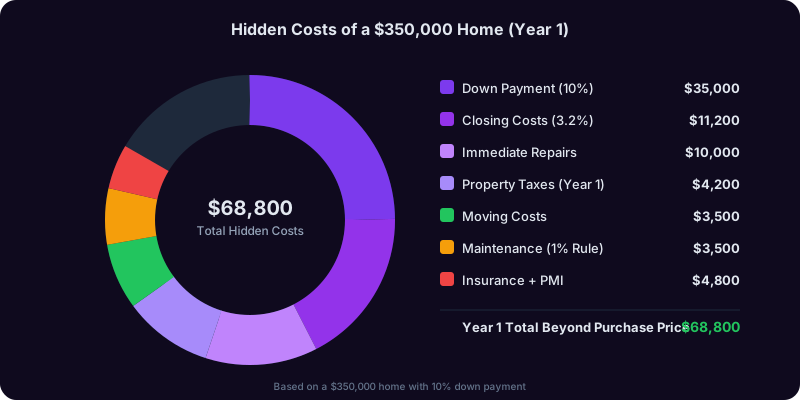
When you see a house listed at $350,000, your brain registers $350,000 as the cost. That is wrong. The actual first-year cost of buying that house is closer to $390,000-$420,000, and the ongoing annual costs add $10,000-$20,000 beyond your mortgage payment. Here is a realistic breakdown of what a $350,000 home actually costs.
Upfront Costs
| Cost | Amount | Notes |
| Down payment (10%) | $35,000 | 3.5% FHA minimum is $12,250, but 10-20% avoids or reduces PMI |
| Closing costs (2-5%) | $7,000 - $17,500 | Average is 3.2% nationally, varies significantly by state |
| Home inspection | $400 - $600 | Standard inspection. Add $200-$500 for specialty inspections |
| Appraisal | $400 - $700 | Required by lender, paid by buyer |
| Moving costs | $1,500 - $5,000 | Local move averages $1,700; long-distance averages $4,800 |
| Immediate repairs/updates | $2,000 - $10,000 | Locks, minor fixes, paint, appliance replacements |
| Total upfront beyond price | $46,300 - $68,800 | On top of the $350,000 purchase price |
Ongoing Monthly Costs Beyond Your Mortgage
| Cost | Monthly Amount | Annual Amount |
| Property taxes | $290 - $580 | $3,500 - $7,000 (avg 1-2% of value) |
| Homeowners insurance | $150 - $300 | $1,800 - $3,600 |
| PMI (if less than 20% down) | $100 - $250 | $1,200 - $3,000 (0.3-0.8% of loan annually) |
| Maintenance (1% rule) | $290 | $3,500 |
| Utilities (increase over renting) | $100 - $300 | $1,200 - $3,600 |
| HOA fees (if applicable) | $200 - $500 | $2,400 - $6,000 |
| Total additional monthly | $1,130 - $2,220 | $13,600 - $26,700/year |
This means a $350,000 house with a 30-year mortgage at 6.5% ($2,212/month principal and interest) actually costs $3,342 - $4,432 per month when you include everything. Many first-time buyers budget only for the mortgage payment and find themselves stretched thin within months.
The 1% maintenance rule is particularly important: expect to spend about 1% of your home's value each year on maintenance. For a $350,000 home, that is $3,500 per year. Some years you spend less, and some years the HVAC dies ($5,000-$12,000) or the roof needs replacing ($8,000-$15,000). The 1% rule averages out over time, but you need a reserve fund from day one. The Consumer Financial Protection Bureau's homeownership guide provides a detailed walkthrough of the true costs of homeownership.
If you want to make sure you have adequate savings before buying, our guide on building an emergency fund breaks down exactly how much cash reserve you need by life situation.
The Pre-Approval Mistake That Costs You Thousands
Most first-time buyers make one of two mortgage mistakes before they even start looking at houses: they either skip pre-approval entirely, or they get pre-approved by only one lender. Both errors cost real money.
Pre-Qualification vs. Pre-Approval
These sound similar but are fundamentally different:
| Pre-Qualification | Pre-Approval | |
| What it involves | Self-reported income and debt info | Full application, credit check, income verification, asset documentation |
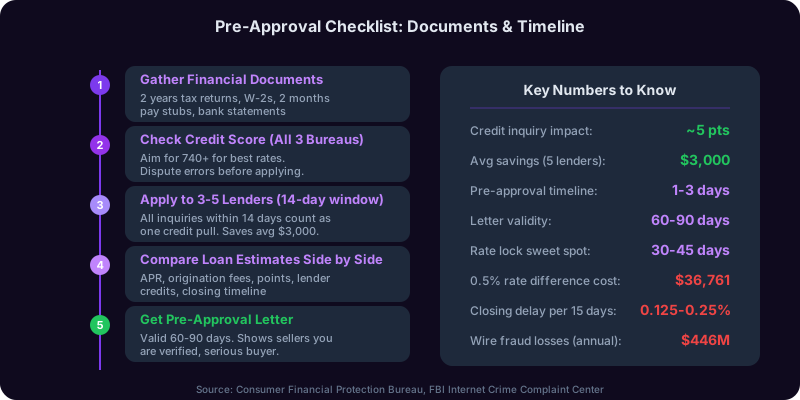
| How long it takes | Minutes | 1-3 days |
| How much it means | Almost nothing. It is an estimate. | The lender has verified your finances and committed to a specific loan amount |
| Seller perception | Weak. Does not differentiate your offer. | Strong. Shows you are a serious, verified buyer. |
In a competitive market, submitting an offer with a pre-qualification letter instead of a pre-approval letter can cost you the house. Sellers and their agents know the difference. A pre-approval tells them the deal is likely to close. A pre-qualification tells them nothing.
Why You Must Shop Multiple Lenders
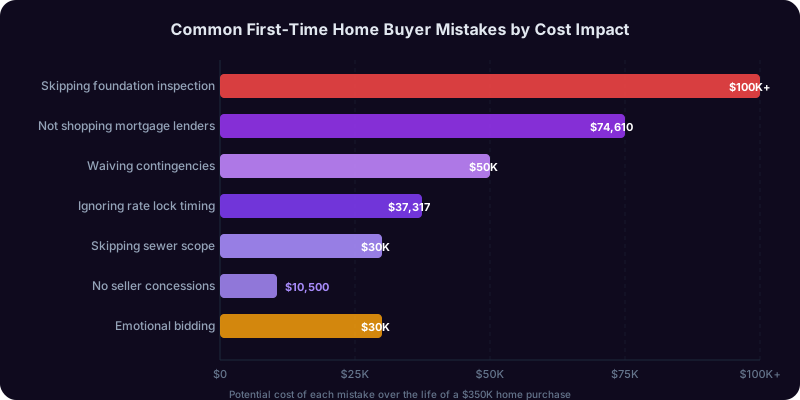
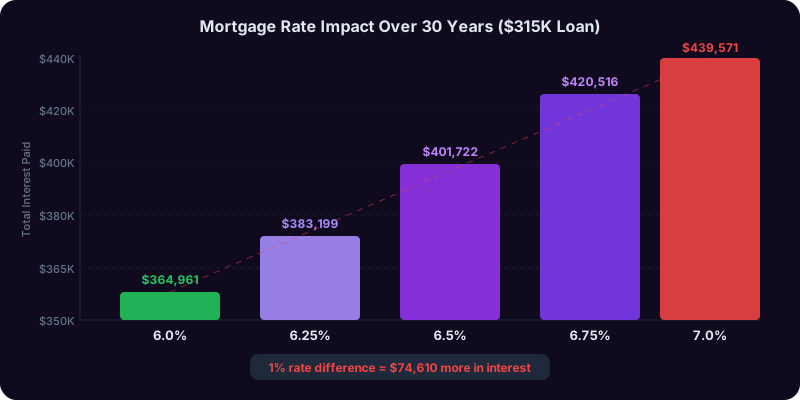
Here is where the real money is lost. The Consumer Financial Protection Bureau found that borrowers who obtain quotes from five lenders save an average of $3,000 over the life of the loan compared to those who go with the first offer. On a $315,000 mortgage (our $350,000 house with 10% down), here is what rate differences cost over 30 years:
| Rate | Monthly Payment (P&I) | Total Interest Paid | Difference vs. 6.0% |
| 6.0% | $1,889 | $364,961 | -- |
| 6.25% | $1,939 | $383,199 | +$18,238 |
| 6.5% | $1,991 | $401,722 | +$36,761 |
| 6.75% | $2,043 | $420,516 | +$55,555 |
| 7.0% | $2,096 | $439,571 | +$74,610 |
A 0.5% rate difference on a $315,000 loan costs you approximately $36,761 in extra interest over 30 years. That is why shopping lenders is not optional.
The 14-Day Credit Inquiry Window
Many buyers avoid shopping lenders because they believe each credit inquiry will damage their score. This is a myth that costs thousands. The FICO scoring model treats all mortgage-related credit inquiries within a 14-day window (some models use 45 days) as a single inquiry. You can have 10 lenders pull your credit within that window and it counts as one pull.
The impact of that single inquiry is typically 5 points or less, and it recovers within a few months. Compare that to the tens of thousands of dollars you save by finding the best rate. Understanding how credit inquiries work is one piece of a larger picture. Our guide to credit scores explains the full scoring model.
What to Compare Beyond the Rate
The interest rate is not the only number that matters. Compare:
- Annual Percentage Rate (APR): Includes rate plus fees, giving a truer cost comparison
- Origination fees: Some lenders charge 0.5-1.5% of the loan amount ($1,575-$4,725 on $315,000)
- Points: Prepaid interest that lowers your rate. Only worth it if you plan to stay in the home long enough to break even (typically 4-7 years)
- Lender credits: Some lenders offer credits toward closing costs in exchange for a slightly higher rate
- Underwriting timelines: A lender who cannot close on time can blow up your deal
The Mortgage Copilot can help you compare loan estimates from multiple lenders and understand which terms matter most for your specific situation.

Get Answers From the Home Buying Copilot
Copilotly's Home Buying and Mortgage Copilots help you compare loan estimates, understand inspection reports, review purchase contracts, and navigate closing, so you catch the expensive mistakes before they happen.
Inspection Shortcuts That Lead to $20,000+ Surprises
A standard home inspection costs $400-$600 and covers the visible, accessible components of a house. It is essential, but it is not enough. A standard inspection does not include several systems that can cost five figures to repair. Here are the specialty inspections that protect you from the most expensive surprises.
Sewer Scope Inspection: $200-$400 (Saves Up to $15,000-$30,000)
A sewer scope sends a camera through your sewer line to check for tree root intrusion, cracks, bellied pipes (low spots where waste accumulates), and collapsed sections. A standard home inspector does not check sewer lines.
Sewer line replacement costs $5,000-$30,000 depending on length, depth, and method (trenchless vs. traditional excavation). In older homes (pre-1970s), clay or cast iron sewer pipes are common and have a limited lifespan. Tree roots seeking moisture can crack into pipe joints and create blockages. A $250 sewer scope is the cheapest insurance you will ever buy.
When it is critical: Any home over 25 years old, any property with large trees near the sewer line, any home with a history of slow drains or backups.
Radon Test: $150-$200 (Protects Against a Known Carcinogen)
Radon is a naturally occurring radioactive gas that seeps through foundation cracks. It is the second leading cause of lung cancer in the United States, responsible for an estimated 21,000 deaths per year according to the EPA. You cannot see, smell, or taste it. The only way to know if it is present is to test.
The EPA estimates that 1 in 15 homes has elevated radon levels (above 4 pCi/L). Radon mitigation systems cost $800-$2,500 to install, which is reasonable, but you want to know before closing so you can negotiate the seller to pay for it or reduce the price accordingly.
Roof Certification: $100-$300 (Prevents the Biggest Single Repair Cost)
A standard inspection includes a visual assessment of the roof, but it is not a detailed roof inspection. A dedicated roof inspection by a licensed roofer provides:
- Estimated remaining lifespan of the roof
- Detailed assessment of shingle condition, flashing, valleys, and penetrations
- Identification of active or potential leaks
- A written certification that lenders and insurance companies may require
A full roof replacement costs $8,000-$20,000+ depending on size, materials, and complexity. If the roof has 3-5 years of life left, you need to know that before you buy, because that cost is coming.
Foundation Inspection: $300-$500 (The Most Expensive Problem a House Can Have)
Foundation issues are the most costly repair a homeowner can face, with costs ranging from $5,000 for minor crack repair to $100,000+ for major structural work including underpinning. A standard home inspector will note visible cracks and signs of settling, but a structural engineer can assess whether those signs indicate a serious problem.
Warning signs that warrant a foundation inspection:
- Cracks in walls, especially diagonal cracks near door frames or windows
- Doors or windows that stick or will not close properly
- Uneven or sloping floors
- Gaps between walls and ceiling or floor
- Cracks in the exterior foundation wider than 1/4 inch
- Bowing or bulging basement walls
Other Specialty Inspections Worth Considering
| Inspection | Cost | What It Catches | Potential Repair Cost |
| Termite/pest | $75 - $150 | Active infestations, wood damage | $2,000 - $8,000+ |
| Mold testing | $300 - $600 | Hidden mold behind walls, in attics/crawlspaces | $1,500 - $30,000+ |
| Chimney inspection | $150 - $300 | Cracked flue liner, deteriorated mortar, fire hazards | $1,000 - $10,000 |
| Well water test | $100 - $300 | Bacteria, nitrates, heavy metals, pH | $2,000 - $15,000 (new well) |
| Septic inspection | $300 - $600 | Tank condition, drain field function | $5,000 - $30,000 |
| Asbestos survey | $200 - $800 | Asbestos in insulation, tiles, pipe wrap (pre-1980 homes) | $2,000 - $30,000 (abatement) |
For a $350,000 purchase, spending an additional $1,000-$2,000 on specialty inspections represents 0.3-0.6% of the purchase price and can save you from five- or six-figure repair bills. The Home Inspection Copilot can help you understand inspection reports and identify which findings are serious versus cosmetic.
The Mortgage Rate Lock Trap: Timing Can Cost You $35,000
Once you have an accepted offer, your lender will ask whether you want to lock your interest rate. This decision can save or cost you tens of thousands of dollars, and most first-time buyers have no idea how it works.
What a Rate Lock Is
A rate lock is a guarantee from your lender that your interest rate will not change for a specified period, typically 30, 45, or 60 days. Once locked, your rate stays the same even if market rates increase. However, if rates drop after you lock, you are stuck at the higher rate unless you have negotiated a float-down option. You can track current average mortgage rates through the Federal Reserve's selected interest rates data.
Lock Periods and Their Costs
| Lock Period | Typical Cost | When to Use |
| 30 days | Usually free or cheapest | Fast closings, competitive rates |
| 45 days | 0 - 0.125% of loan amount | Standard purchase timeline |
| 60 days | 0.125% - 0.25% of loan amount | New construction or delayed closings |
| 90 days | 0.25% - 0.50% of loan amount | Extended timelines only |
On a $315,000 loan, a 60-day lock that costs 0.25% adds $787.50 to your closing costs. That is worth it if rates are rising, but expensive if they are falling.
When to Lock
There is no perfect answer, because no one can predict interest rate movements with certainty. But here are guidelines:
- Lock immediately if you are happy with the rate and the economic environment suggests rates may rise (inflation increasing, strong employment data, Fed signaling hawkish policy)
- Float (wait to lock) if rates have been trending down and economic indicators suggest further decreases
- Lock if your budget is tight. If a 0.25% rate increase would push your monthly payment above what you can comfortably afford, eliminate the risk
The Float-Down Option
Some lenders offer a float-down provision that lets you take advantage of lower rates if they drop after you lock. This is the best of both worlds, but it comes with conditions:
- The rate must drop by a minimum amount (often 0.25-0.50%) before the float-down activates
- You can typically only use it once
- There may be an additional fee (0.25-0.50 points)
- Not all lenders offer it, and you usually need to request it explicitly
What Happens If Your Lock Expires
If your closing gets delayed past your lock period, you may need to pay for a lock extension (typically 0.125-0.25% of the loan for each additional 15 days) or re-lock at current market rates, which could be higher. This is why closing delays are more expensive than most buyers realize.
To illustrate the stakes: on a $315,000 30-year fixed mortgage, the difference between a 6.25% and 6.75% rate means:
- $104 more per month in mortgage payments
- $37,317 more in total interest over 30 years
The Mortgage Copilot can help you understand rate lock options from different lenders and calculate the long-term cost impact of different rate scenarios.
Negotiation Mistakes in the 2026 Market
The 2026 housing market is a different animal than the frenzied bidding wars of 2021-2022 or the higher-rate slowdowns of 2023-2024. Inventory has improved in most markets, but desirable homes in good school districts still move fast. This creates a nuanced negotiation environment where strategy matters more than ever.
Mistake 1: Waiving Contingencies to "Win" the Deal
During the peak of the seller's market, buyers routinely waived inspection, appraisal, and financing contingencies to make their offers more attractive. This is still happening, and it is still dangerous. Here is what each contingency protects:
- Inspection contingency: Lets you back out or renegotiate if the inspection reveals serious problems. Without it, you are buying the house as-is, including the $40,000 foundation issue the inspector would have found.
- Appraisal contingency: Protects you if the home appraises below your offer price. Without it, you must cover the gap with cash. On a $375,000 offer that appraises at $350,000, that is $25,000 out of your pocket.
- Financing contingency: Protects your earnest money deposit if your loan falls through. Without it, you could lose $10,000-$35,000 in earnest money if you cannot close.

In 2026, there is rarely a reason for a first-time buyer to waive the inspection contingency entirely. A better strategy is to shorten the inspection period (5-7 days instead of 10-14) or specify that you will only request repairs for issues exceeding a certain dollar threshold (for example, $5,000). This makes your offer competitive without eliminating your protection.
Mistake 2: Not Using an Escalation Clause Strategically
An escalation clause automatically increases your offer in preset increments up to a maximum cap if competing offers come in. For example: "I offer $350,000 and will escalate by $2,500 above any competing offer, up to a maximum of $375,000."
The mistake buyers make is setting the cap too high (revealing your maximum willingness to pay) or too low (losing the house over $2,500). Research comparable sales carefully. If similar homes have sold for $345,000-$365,000, an escalation cap of $370,000-$375,000 is aggressive but defensible.
Mistake 3: Asking for Repairs Instead of Credits
After the inspection, you will likely want the seller to address certain issues. Most first-time buyers ask the seller to make repairs before closing. This is usually the wrong move, and here is why:
- The seller will hire the cheapest contractor available to do the work
- You have no control over quality
- Repairs may be done cosmetically rather than properly
- It can delay closing
Instead, request a repair credit: a dollar amount deducted from the purchase price or provided as a credit at closing. This gives you cash to hire your own contractor and do the work to your standards after you own the home. A $5,000 repair credit is worth more to you than $5,000 in seller-directed repairs.
Mistake 4: Ignoring Seller Concessions
Seller concessions are contributions from the seller toward your closing costs. In a balanced or buyer-friendly market, you can often negotiate 2-3% of the purchase price in seller concessions. On a $350,000 home, that is $7,000-$10,500 in closing cost assistance.
This is especially valuable for first-time buyers who are cash-strapped. Instead of negotiating $10,000 off the purchase price (which saves you about $50/month on your mortgage), negotiate $10,000 in seller concessions that reduces the cash you need at closing. The price difference barely affects your monthly payment, but the concession keeps $10,000 in your bank account. For a deeper dive into negotiation strategy, Bankrate's guide to seller concessions covers the mechanics in detail.
Mistake 5: Emotional Bidding
You tour a house, fall in love with the kitchen, and suddenly you are willing to pay $30,000 over asking. First-time buyers are particularly susceptible to emotional bidding because every house feels like "the one." Set your maximum price before you make an offer, based on comparable sales data and your budget, and do not exceed it. There will always be another house.
For help evaluating offer terms and understanding purchase contracts, the Contract Review Copilot can help you analyze the fine print before you sign. If you are currently renting while you shop, learn how to negotiate your rent to save more toward your down payment.
Closing Day Surprises and How to Avoid Them
Closing day should be straightforward. You sign documents, hand over a very large check, and get keys to your new home. In reality, last-minute problems derail an estimated 20-30% of closings to some degree, ranging from minor delays to deals falling apart entirely. Here is how to avoid the most common disasters.
Wire Fraud: A $446 Million Problem
This is the most dangerous closing day risk, and most first-time buyers have never heard of it. The FBI's Internet Crime Complaint Center reports that real estate wire fraud resulted in losses of $446.1 million in a recent year. Here is how the scam works:
- Criminals hack into the email account of a real estate agent, lender, or title company
- They monitor the transaction and learn the closing details
- Just before closing, they send you an email that looks like it comes from your title company, with updated wire transfer instructions
- You wire your down payment and closing costs, often $30,000-$80,000, to the criminal's account
- The money is gone, usually within hours, and is rarely recovered
How to protect yourself:
- Never trust wire instructions received by email. Always call your title company at a phone number you verified independently (not a number from the email) to confirm wire instructions.
- Verify the account number verbally before initiating any wire transfer.
- Be suspicious of any last-minute changes to wire instructions. This is the primary red flag.
- Use your title company's secure portal if they offer one for sharing wire instructions.
The Final Walkthrough: Your Last Line of Defense
The final walkthrough happens 24-48 hours before closing. It is your last chance to verify the property's condition before you own it. Do not treat it as a formality. Use this checklist:
- Turn on every faucet (hot and cold) and flush every toilet. Run the dishwasher and washing machine if possible.
- Test every light switch, outlet, and ceiling fan. Bring a phone charger to test outlets.
- Open and close every window and door. Check locks.
- Run the HVAC system in both heating and cooling mode.
- Check that all agreed-upon repairs were completed. Get documentation or receipts.
- Verify that all fixtures and appliances included in the contract are still present. Sellers have been known to swap out high-end appliances for cheaper models between inspection and closing.
- Check the garage door opener and any smart home devices.
- Look for new damage: water stains, holes in walls, damaged flooring that was not there during inspection.
- Confirm the property is fully vacated unless a rent-back agreement is in place.
What to Bring to Closing
- Government-issued photo ID (two forms if possible)
- Cashier's check or wire transfer confirmation for closing funds (personal checks are not accepted for large amounts)
- Proof of homeowners insurance (your lender requires this before closing)
- Your loan estimate and closing disclosure for comparison (you should have received the Closing Disclosure at least 3 business days before closing)
Closing Disclosure Red Flags
By law, you must receive your Closing Disclosure (CD) at least 3 business days before your closing date. Compare it line by line to your original Loan Estimate. The CFPB provides a line-by-line explainer of the Closing Disclosure form. Watch for:
- Interest rate changes (should match your rate lock)
- Loan amount discrepancies
- Unexpected fees that were not on the Loan Estimate
- Higher-than-estimated closing costs (some costs can increase, but certain charges cannot increase at all, and others are limited to a 10% increase)
- Missing seller concessions that were agreed upon in the contract
If anything on the CD does not match your expectations, raise it with your lender immediately. Do not wait until you are sitting at the closing table. Changes to the CD can trigger a new 3-day waiting period, delaying your closing.
Frequently Asked Questions
Recommended Copilots
Recommended Copilots
Compare loan options, understand rate locks, and analyze mortgage terms from multiple lenders
Try Free →Understand inspection report findings and identify which issues are serious vs. cosmetic
Try Free →Review purchase agreements, addendums, and closing documents for unfavorable terms
Try Free →Get step-by-step guidance through the entire home buying process
Try Free →Evaluate homeowners, title, flood, and umbrella insurance options for your property
Try Free →Understand how a home purchase fits into your overall financial plan and budget
Try Free →Related Articles
Get Answers From the Home Buying Copilot
Copilotly's Home Buying and Mortgage Copilots help you compare loan estimates, understand inspection reports, review purchase contracts, and navigate closing, so you catch the expensive mistakes before they happen.