
What Is Scope Creep at Work?
Scope creep at work happens when your job responsibilities gradually expand beyond your original role without a corresponding change in title, compensation, or formal acknowledgment. Unlike a promotion (which comes with a new title and raise) or a temporary stretch assignment (which has a defined end date), scope creep is informal, gradual, and often invisible to everyone except the person doing the extra work. Try our AI salary negotiation guide for step-by-step help.
How scope creep typically unfolds. It rarely starts with a dramatic change. Instead, it follows a predictable pattern: a coworker leaves and you pick up "just a few" of their tasks. You are good at something, so more of that work flows to you. Your manager asks you to "help out" with a project that becomes permanent. You volunteer for something visible, and it quietly becomes your ongoing responsibility. Over 6-12 months, your actual job looks nothing like the one you were hired for.
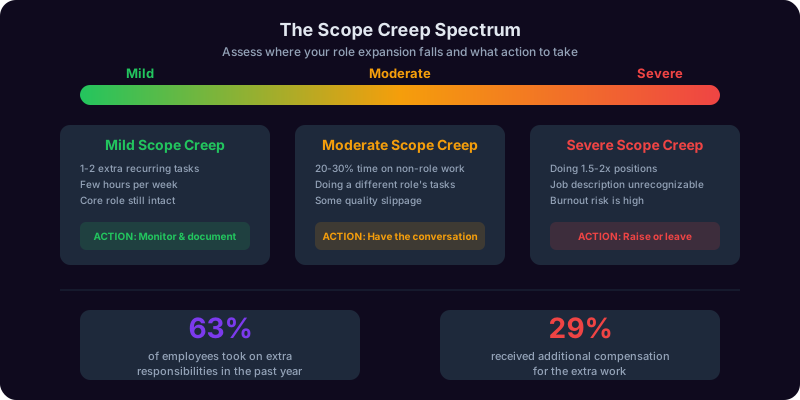
The scope creep spectrum:
- Mild: You have taken on 1-2 additional recurring tasks that take a few hours per week. Your core role is still intact.
- Moderate: You are doing significant work outside your job description. 20-30% of your time goes to responsibilities that belong to a different role or a more senior position.
- Severe: You are effectively doing a different job than the one you were hired for, or you are doing the work of 1.5-2 positions. Your original job description is unrecognizable.
A 2024 survey by the Society for Human Resource Management (SHRM) found that 63% of employees reported taking on additional responsibilities beyond their job description within the past year, and only 29% of those received additional compensation for the extra work. Scope creep is not just common; it is the default in most workplaces.
The Career Copilot can help you assess where you fall on the scope creep spectrum and whether your expanded role represents a growth opportunity or exploitation.
Signs Your Role Has Expanded Beyond Your Job Description
Scope creep is gradual enough that many people do not recognize it until they are overwhelmed. These are the concrete signs that your role has expanded significantly.
Time-based indicators:
- You regularly work 45+ hours to finish your workload, but your position is scoped for 40 hours
- Tasks that are not in your job description consume more than 20% of your weekly time
- You have less time for your core responsibilities than you did 6 months ago
- You skip lunch, arrive early, or stay late to keep up, and this has become normal rather than occasional
Responsibility-based indicators:
- You are making decisions that used to require manager approval
- You are training or supervising people without a management title
- You attend meetings that your manager used to attend
- You are the go-to person for a function that is not in your department (IT, HR, vendor management)
- You manage a budget, process, or vendor relationship without that being in your role
Emotional indicators:
- You feel resentful about your workload relative to your pay
- You dread Mondays specifically because of the accumulated extra tasks
- You feel guilty about not doing your "real" job well because the extra work takes priority
- You fantasize about quitting, not because you dislike your core work but because the additional responsibilities are crushing
The comparison test. Pull up your original job description or offer letter. List every task you do in a typical week. Highlight anything not on the original description. If more than 25% of your weekly tasks are highlighted, you have significant scope creep. If more than 50%, you are doing a materially different job.
Another useful exercise: Look at job postings for your title at other companies. If the responsibilities listed do not match what you actually do, either your role has crept significantly or your company has a unique (and possibly exploitative) definition of your position. This comparison data becomes valuable when you have conversations with your manager about compensation.
Why Scope Creep Happens
Understanding why scope creep happens helps you address it without appearing adversarial. In most cases, no one is deliberately exploiting you. The causes are usually structural, cultural, or simply the result of inattention.
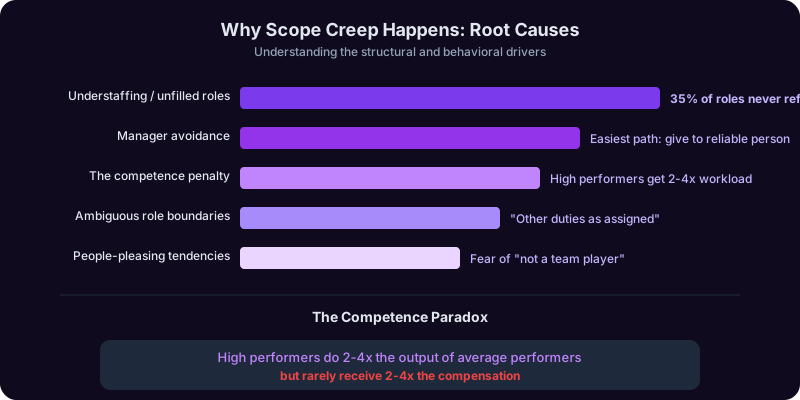
Organizational understaffing. This is the most common cause. When companies operate lean (which nearly all do in 2026), departing employees' work gets distributed rather than replaced. A 2025 Gartner survey found that the average time to fill a position is 44 days, and 35% of positions vacated through attrition are never refilled. The work still needs to get done, so it falls on the remaining team members. What starts as temporary coverage becomes permanent by default.
Manager avoidance. Many managers find it easier to add tasks to a reliable employee than to hire, train, or performance-manage someone else. If you are competent and do not push back, you become the path of least resistance. This is not malicious. Managers are overwhelmed too, and giving work to someone who will just do it is the simplest option.
The competence penalty. Being good at your job creates a paradox: the better you perform, the more work flows to you. High performers are estimated to do 2-4 times the output of average performers (McKinsey, 2024), but they rarely receive 2-4 times the compensation. Instead, they receive 2-4 times the workload. Organizations unconsciously exploit their most capable people.
Ambiguous role boundaries. Startups and small companies often use vague job descriptions ("other duties as assigned" is a legal catch-all that covers almost anything). In flat organizations without clear departmental boundaries, work flows to whoever can do it rather than whoever should do it. The lack of formal role definition makes scope creep invisible because there was no clear scope to begin with.
Your own tendencies. Be honest about your role in the dynamic. People-pleasers, those who tie their self-worth to productivity, and those who fear being seen as "not a team player" often invite scope creep by volunteering, not setting boundaries, and saying yes reflexively. Recognizing your own patterns is essential to breaking the cycle.
The Career Copilot can help you analyze whether your scope creep is temporary (and worth riding out) or structural (and unlikely to resolve without intervention).

Get Answers From the Salary Copilot
Document your expanded responsibilities with the Salary Copilot, benchmark your market value, and get a script for the compensation conversation.
How to Document Scope Creep
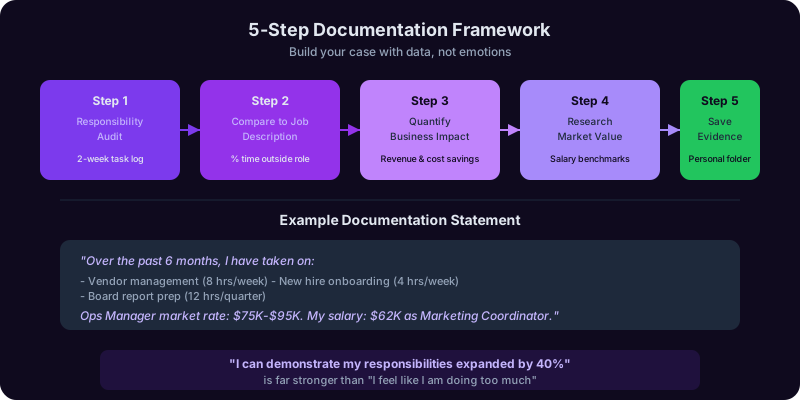
Documentation is your leverage. Without it, conversations about scope creep become subjective ("I feel like I am doing too much" vs. "I can demonstrate that my responsibilities have expanded by 40%"). Here is exactly how to build your case.
Step 1: Create a responsibility audit. For two full work weeks, log every task you perform. Use a simple spreadsheet with these columns: Date, Task, Time Spent, Category (core role vs. additional), Who Assigned It, and Notes. Be precise. "Helped Sarah with the Q2 report" becomes "Compiled data, built 3 charts, and wrote executive summary for Q2 sales report (3.5 hours, assigned by Sarah, not in my job description)."
Step 2: Compare to your job description. Place your logged tasks next to your original job description (or offer letter). Create two lists: tasks that match your role and tasks that do not. Calculate the percentage of time spent on each category. If 30% of your time goes to work outside your job description, that is a quantifiable data point.
Step 3: Quantify the business impact. For each additional responsibility, document: the revenue or cost savings it generates, who would do this work if you did not, and what would happen if you stopped doing it. This reframes the conversation from "I am overworked" to "I am providing $X of value beyond my role."
Step 4: Research the market value. Look up job postings that include your additional responsibilities. If you are doing project management, look up project manager salaries in your area. If you are handling data analysis, find data analyst compensation. The Salary Copilot can help you benchmark the market value of your expanded role. If you are considering freelancing as an alternative, our freelance rate calculator can help you benchmark market rates. Common findings: employees doing the work of a more senior role are typically underpaid by 15-30% relative to the market rate for that actual work.
Step 5: Save everything. Keep copies of emails where additional work was assigned, messages where you were thanked for going above and beyond, and any performance reviews that mention your expanded contributions. Store these in a personal folder (not on company systems). This documentation protects you in three scenarios: negotiating a raise, applying for a promotion, and updating your resume for external opportunities.
What good documentation looks like in practice: "Over the past 6 months, I have taken on vendor management (8 hours/week), new hire onboarding coordination (4 hours/week), and quarterly board report preparation (12 hours/quarter). These responsibilities are typically handled by an Operations Manager role, which pays $75,000-$95,000 in our market. My current salary is $62,000 as a Marketing Coordinator."
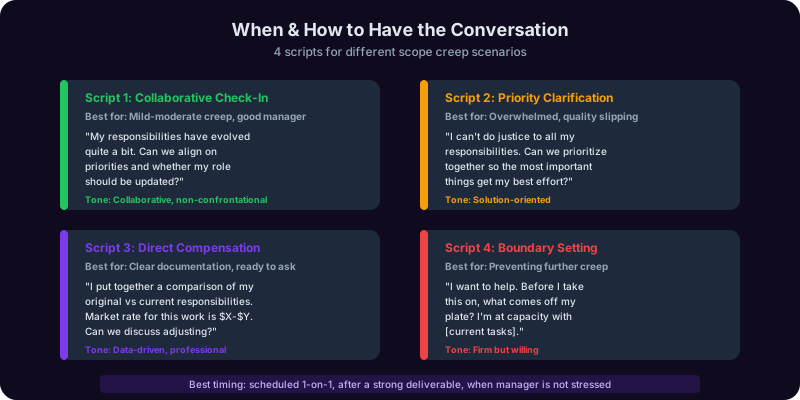
Conversation Scripts With Your Manager
Having the conversation is the hardest part. These scripts give you a framework for different scenarios. Adapt the tone and language to your workplace culture.
Script 1: The collaborative check-in (best for mild-moderate scope creep with a reasonable manager).
"I wanted to set up a check-in about my role. Over the past [timeframe], I have noticed my responsibilities have evolved quite a bit from my original job description. I have been [list 2-3 specific additions]. I am glad to contribute in these areas, and I want to make sure we are aligned on priorities. Can we talk about which of these should be my ongoing focus, and whether my role and compensation should be updated to reflect the change?"
Script 2: The priority clarification (best when you are overwhelmed and quality is slipping).
"I want to deliver great work on everything, but I am at a point where I cannot do justice to all my current responsibilities within a normal work week. I have put together a list of everything on my plate. Can we go through it together and prioritize? I want to make sure the most important things get my best effort rather than spreading too thin across everything."
Script 3: The direct compensation conversation (best when you have documentation and the scope creep is clear).
"I have been thinking about how my role has evolved since I started. I put together a comparison of my original job description versus my current responsibilities. [Show documentation.] I am now handling [specific functions] that are typically part of a [higher title] role. Based on my research, the market rate for this work is [$X-$Y]. I love the work and want to keep doing it. Can we discuss adjusting my compensation and title to reflect what I am actually doing?"
Script 4: Setting a boundary on new requests (best for preventing further creep).
"I want to help with that. Before I take it on, can we talk about what comes off my plate? I am currently at capacity with [list current responsibilities]. I can absolutely do [new request] if we deprioritize or reassign [existing task]. What makes the most sense?"
Timing matters. Have these conversations during scheduled one-on-ones rather than dropping them in casual hallway chats. Choose a time when your manager is not stressed by deadlines. The best timing is often just after you have delivered a strong result, when your value is most visible. Avoid having this conversation when you are visibly frustrated; prepare when calm.
The Career Copilot can help you customize these scripts for your specific situation and practice your talking points before the meeting.
When to Ask for a Raise vs When to Push Back
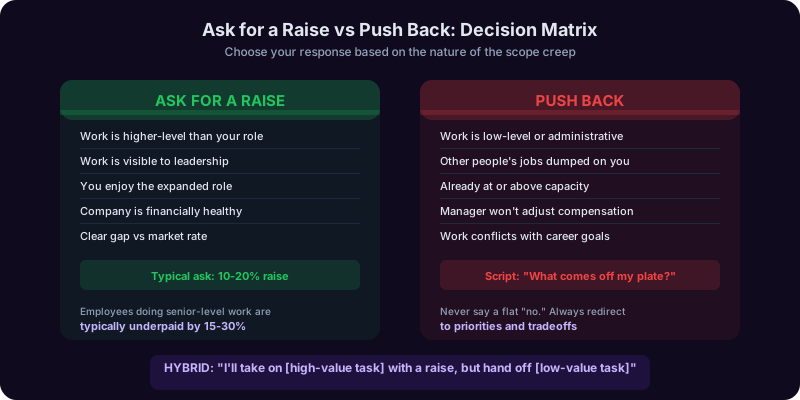
Not all scope creep deserves the same response. Some expanded roles are genuine growth opportunities worth leveraging for a raise. Others are exploitation that requires firm boundaries. Here is how to tell the difference.
Ask for a raise when:
- The additional work is higher-level than your current role (managing people, owning strategy, client-facing responsibilities that were previously your manager's)
- The work is visible and valued by leadership
- You enjoy the expanded role and want to continue doing it
- The company is financially healthy and has budget for compensation adjustments
- Your documentation shows a clear gap between your current pay and the market rate for your actual responsibilities
How much to ask for: Research the market rate for a role that matches your actual responsibilities. If you are doing the work of a Senior Analyst ($85,000 market rate) but paid as an Analyst ($65,000), asking for a $15,000-$20,000 adjustment is reasonable. Frame it as bringing your compensation in line with the market for the work you are already doing, not as a demand. A 10-20% raise for significant scope expansion is typical and reasonable. Research from Glassdoor confirms that internal promotions with expanded scope typically come with 10-15% salary increases.
Push back (set boundaries) when:
- The extra work is low-level or administrative (not advancing your career)
- The work comes from other people's jobs being dumped on you after layoffs or departures with no plan to backfill
- You are already at or above capacity and the new work degrades the quality of your core responsibilities
- Your manager has no authority or intention to adjust your compensation
- The additional work conflicts with your career goals (you are a developer being asked to do project management when you want to stay technical)
The hybrid approach. Sometimes the best strategy is: "I am willing to take on [specific high-value task] with a compensation adjustment, but I need to hand off [low-value task] to make room." This shows you are flexible and strategic, not just resistant. It also forces a conversation about what your time is actually worth.
For detailed negotiation scripts, see our salary negotiation guide. Use the Salary Copilot to benchmark your compensation against the market rate for your expanded responsibilities and build a data-driven case for a raise.
When It's Time to Leave
Sometimes the right answer to scope creep is not a conversation. It is a job search. Here are the signs that the situation is not fixable in your current role.
Leave when:
- You have had the conversation and nothing changed. If you raised the issue with documentation, had a constructive conversation, and 60-90 days later nothing has improved (no raise, no title change, no workload reduction), the company has shown you its priorities. Believe them.
- The scope creep is structural, not incidental. If the company's business model depends on understaffing and overloading employees, no conversation will fix it. This is especially common at startups that glorify "wearing many hats" and companies that have had multiple rounds of layoffs without proportional workload reduction.
- Your health is suffering. Chronic overwork leads to burnout, and burnout has real health consequences: increased risk of cardiovascular disease, depression, anxiety, and weakened immune function. If you are experiencing persistent exhaustion, insomnia, irritability, or physical symptoms (headaches, digestive issues, frequent illness), the job is costing you more than a paycheck can cover.
- Your career development has stalled. If the extra work is low-level and preventing you from developing the skills you need for your career goals, staying is actively harmful to your long-term trajectory. Spending two years doing admin work when you should be developing technical expertise sets you back considerably.
- The expanded role gives you leverage elsewhere. Ironically, scope creep can make you more marketable. If you have been doing project management, people management, or strategic work, your resume now reflects a more senior role. Other companies may be willing to pay for that experience when your current employer will not.
How to leave strategically:
- Update your resume to reflect your actual responsibilities. Our cover letter guide can also help you frame scope creep experience as leadership, not your job title. The work you have been doing is your real experience.
- Use your documentation of scope creep to quantify achievements: "Managed vendor relationships for 12 accounts, reducing costs by 15%" is much stronger than "Helped with vendor management."
- Target roles that match your expanded responsibilities, not your current title. You may qualify for positions one level above your current title.
- Do not announce your job search or use it as leverage unless you have an offer in hand. When you are ready to leave, our resignation guide walks you through every step.
The Employment Law Copilot can help you understand your rights during a job transition, including whether your non-compete (if any) is enforceable and what you are entitled to upon departure.
For more on this topic, read our guide on Fired vs Laid Off vs Let Go: Your Rights and Next Steps Explained.
See our real-world walkthrough: fired without warning.
Frequently Asked Questions
Recommended Copilots
Recommended Copilots
Build a case for a raise or title change based on your expanded responsibilities
Try Free →Evaluate whether scope creep is a growth opportunity or exploitation
Try Free →Get scripts and strategies for the conversation with your manager
Try Free →Continue Exploring
Related Scenarios
For You
Related Articles
Get Answers From the Salary Copilot
Document your expanded responsibilities with the Salary Copilot, benchmark your market value, and get a script for the compensation conversation.