
Health Insurance Terms Decoded: Premium, Deductible, Copay, Coinsurance, and Out-of-Pocket Maximum
Health insurance has its own language, and until you understand it, every bill, explanation of benefits, and plan comparison will feel like reading a foreign document. The five terms below form the backbone of how every health insurance plan in America works. Once you understand these, the rest of the system becomes far more navigable.
Disclaimer: This guide provides general educational information about health insurance concepts in the United States as of 2026. It is not legal, financial, or insurance advice. Plans vary significantly by state, employer, and insurer. Always read your specific plan documents (Summary of Benefits and Coverage) and consult a licensed insurance broker or benefits administrator for decisions about your coverage.
Premium
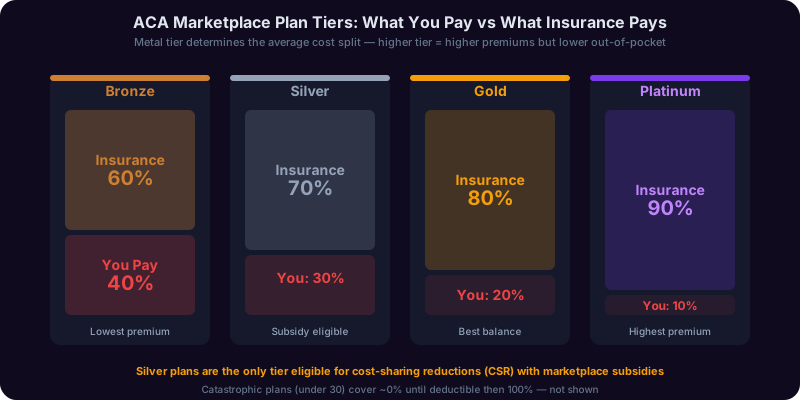
Your premium is the amount you pay every month just to have insurance, regardless of whether you use any healthcare services. Think of it like a subscription fee. For employer-sponsored plans in 2026, the average worker pays approximately $130 per month ($1,560 per year) for individual coverage and $540 per month ($6,480 per year) for family coverage. Your employer typically pays the rest, which averages an additional $630/month for individual and $1,580/month for family plans. If you buy insurance through the ACA marketplace, your premium depends on your age, location, tobacco use, and plan tier (Bronze, Silver, Gold, Platinum), but subsidies can reduce it significantly based on income.
A critical concept: lower premiums almost always mean higher out-of-pocket costs when you actually use care. A plan with a $200/month premium and a $6,000 deductible will cost you less each month but far more if you need surgery or ongoing treatment than a plan with a $500/month premium and a $1,500 deductible. Choosing the cheapest premium without considering your expected healthcare usage is one of the most expensive mistakes people make.
Deductible
Your deductible is the amount you must pay out of your own pocket before your insurance starts paying for most services. If your deductible is $2,000, you pay the first $2,000 of covered medical expenses yourself (at the insurer's negotiated rate, not the sticker price). After you hit $2,000, your insurance begins to share costs with you through coinsurance or copays.
Important details most people miss:
- Preventive care is covered before the deductible. Annual physicals, vaccinations, cancer screenings, and other preventive services listed under the ACA are covered at 100% even if you have not met your deductible. This is federal law for all ACA-compliant plans.
- Family plans have two deductibles. There is an individual deductible (often $2,000-$4,000) and a family deductible (often $4,000-$8,000). A single family member can meet the individual deductible on their own, triggering cost-sharing for that person. The family deductible is the combined total that must be met before the plan pays for all family members.
- The deductible resets every plan year. If you have met $1,800 of a $2,000 deductible by December 31, it resets to $0 on January 1. Timing elective procedures before year-end, after you have met your deductible, can save thousands.
Copay (Copayment)
A copay is a fixed dollar amount you pay at the time of a specific service. For example, your plan might charge a $30 copay for a primary care visit, $50 for a specialist visit, $15 for generic prescriptions, and $250 for an emergency room visit. Some plans apply copays before the deductible is met (especially for doctor visits and prescriptions), while others require you to meet the deductible first. Check your Summary of Benefits and Coverage (SBC) to know which applies to your plan.
Coinsurance
Coinsurance is the percentage of costs you share with your insurer after you have met your deductible. The most common split is 80/20, meaning the insurer pays 80% and you pay 20%. Here is what that looks like in practice:
| Scenario | Total Billed | Negotiated Rate | Deductible (already met) | Insurance Pays (80%) | You Pay (20%) |
| MRI scan | $3,500 | $1,800 | $0 remaining | $1,440 | $360 |
| Knee surgery | $45,000 | $28,000 | $0 remaining | $22,400 | $5,600 |
| 3-day hospital stay | $62,000 | $38,000 | $0 remaining | $30,400 | $7,600 |
Notice the insurance company pays based on the negotiated rate, not the billed amount. This is one of the primary financial advantages of having insurance: in-network providers have agreed to accept significantly lower rates. Without insurance, you would owe the full billed amount.
Out-of-Pocket Maximum (OOP Max)
The out-of-pocket maximum is your financial safety net. It is the most you will pay for covered in-network services in a plan year. For 2026, the federal limit is $9,450 for individual coverage and $18,900 for family coverage. Many plans set their OOP max lower than these federal limits. Once you reach your OOP max, your insurance pays 100% of covered in-network costs for the rest of the plan year.
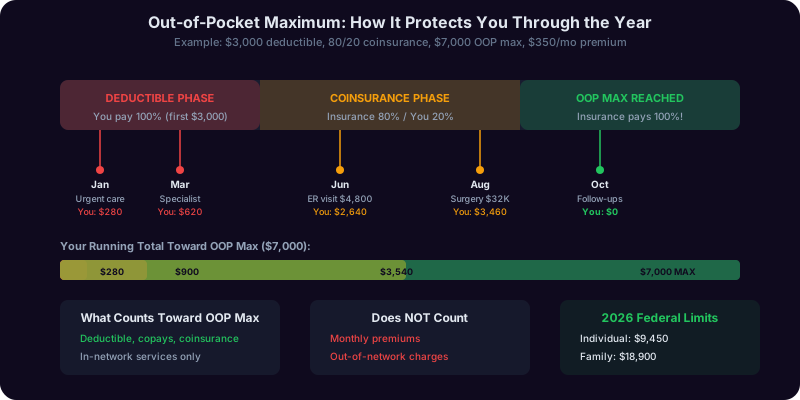
Your deductible, copays, and coinsurance all count toward the OOP max. Premiums do not. Neither do out-of-network charges (unless your plan has out-of-network benefits), balance-billed amounts, or non-covered services.
Here is a full-year cost scenario to make this concrete:
| Event | Negotiated Cost | You Pay | Running Total You Paid |
| Monthly premiums (12 months x $350) | N/A | $4,200 | $4,200 (does not count toward OOP max) |
| January: Urgent care visit | $280 | $280 (deductible) | $280 toward $3,000 deductible |
| March: Specialist visit + labs | $620 | $620 (deductible) | $900 toward deductible |
| June: ER visit after accident | $4,800 | $2,100 (remaining deductible) + $540 (20% coinsurance on $2,700) | Deductible met. $3,540 toward $7,000 OOP max |
| August: Surgery + hospital stay | $32,000 | $3,460 (20% coinsurance until OOP max hit) | $7,000 OOP max reached |
| October: Follow-up visits, PT, prescriptions | $4,200 | $0 (OOP max reached) | $7,000 total (insurance pays 100% rest of year) |
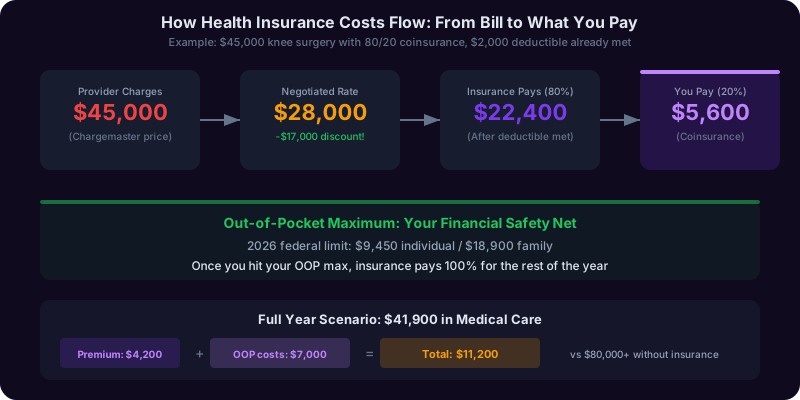
In this scenario, despite receiving over $41,900 in medical care, the most you paid beyond premiums was $7,000. Without insurance, the billed amounts could easily exceed $80,000. For guidance on when an ER visit is truly necessary versus using lower-cost urgent care, see our ER vs urgent care decision guide. The Insurance Copilot can help you understand how your specific plan's cost-sharing works and model out scenarios like these based on your actual plan details.
Plan Types Explained: HMO vs PPO vs EPO vs HDHP/HSA
Choosing between plan types is one of the most consequential financial decisions you make during open enrollment, and most people make it based on little more than premium price. Each plan type structures your access to doctors, your costs, and your flexibility differently. Here is what you actually need to know about each one.
HMO (Health Maintenance Organization)
An HMO requires you to choose a primary care physician (PCP) who acts as your gatekeeper. You need a referral from your PCP to see any specialist. All care must be received from in-network providers only, with the exception of true emergencies. If you see an out-of-network doctor without a referral, you pay 100% of the cost yourself.
Pros: Lower premiums and lower out-of-pocket costs. Simpler billing because everything goes through your PCP. Predictable copays for most services. Cons: No flexibility to see specialists directly. Limited or no out-of-network coverage. Switching PCPs requires contacting your plan. Can feel restrictive if you have complex health needs requiring multiple specialists.
PPO (Preferred Provider Organization)
A PPO gives you the most flexibility. You can see any doctor, specialist, or hospital without a referral. You pay less when you use in-network providers, but you still get partial coverage for out-of-network care. Most PPOs cover out-of-network services at a lower rate, such as 60/40 instead of 80/20.
Pros: No referrals needed. See any specialist directly. Out-of-network coverage provides a safety net. Best option if you travel frequently or see specialists in different health systems. Cons: Highest premiums of any plan type. Higher deductibles and copays compared to HMOs. Out-of-network bills can still be expensive because you pay a larger share.
EPO (Exclusive Provider Organization)
An EPO is a hybrid between HMO and PPO. Like a PPO, you do not need referrals to see specialists. Like an HMO, you must stay within the network, and there is no out-of-network coverage except for emergencies. EPOs are becoming increasingly popular because they offer PPO-like flexibility at closer to HMO pricing.
Pros: No referral requirement. Lower premiums than PPOs. Direct specialist access. Cons: No out-of-network coverage. If your preferred doctor leaves the network, you must switch or pay full price.
HDHP with HSA (High-Deductible Health Plan with Health Savings Account)
An HDHP has a higher deductible than traditional plans. For 2026, the IRS defines an HDHP as having a minimum deductible of $1,650 for individual coverage or $3,300 for family coverage. The trade-off is significantly lower premiums and eligibility to open a Health Savings Account (HSA), which is one of the most powerful tax-advantaged tools in the American financial system.
HSA contributions are triple tax-advantaged: contributions are tax-deductible, growth is tax-free, and withdrawals for qualified medical expenses are tax-free. In 2026, you can contribute up to $4,300 for individual coverage or $8,550 for family coverage. If you are 55 or older, you can contribute an additional $1,000 catch-up. Unlike an FSA, HSA funds never expire and the account is yours permanently, even if you change jobs or insurance plans. Many people use HSAs as a supplemental retirement account, paying current medical expenses out of pocket and letting the HSA grow tax-free for decades.
Pros: Lowest premiums. HSA is a powerful savings and investment vehicle. Employer HSA contributions are common. Good for healthy people with low expected healthcare usage. Cons: High deductible means significant out-of-pocket costs if you need care. Can discourage people from seeking necessary treatment. Not ideal for those with chronic conditions requiring frequent visits and prescriptions.
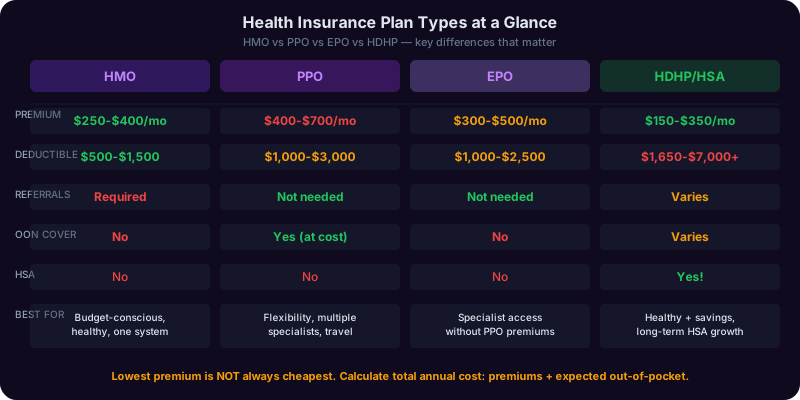
Side-by-Side Comparison
| Feature | HMO | PPO | EPO | HDHP/HSA |
| Monthly Premium | Low ($250-$400) | High ($400-$700) | Medium ($300-$500) | Lowest ($150-$350) |
| Deductible | Low ($500-$1,500) | Medium ($1,000-$3,000) | Medium ($1,000-$2,500) | High ($1,650-$7,000+) |
| Need Referrals? | Yes | No | No | Varies |
| Out-of-Network Coverage | No (except emergencies) | Yes (at higher cost) | No (except emergencies) | Varies by plan |
| HSA Eligible? | No (unless HDHP-HMO) | No (unless HDHP-PPO) | No (unless HDHP-EPO) | Yes |
| Best For | Budget-conscious, healthy individuals and families comfortable with one health system | People who want flexibility, see multiple specialists, or travel often | People who want specialist access without PPO premiums and are OK staying in-network | Healthy people with savings; anyone wanting HSA tax benefits long-term |
The Insurance Copilot can help you compare the plans available to you during open enrollment and estimate your total annual cost (premiums plus expected out-of-pocket) based on your anticipated healthcare usage. For help with the financial planning side of choosing a plan, the Finance Copilot can model different scenarios and show you how HSA contributions fit into your overall budget.
How to Read Your Summary of Benefits and Coverage (SBC)
Every health insurance plan is required by federal law to provide a Summary of Benefits and Coverage (SBC), a standardized document that uses plain language and a uniform format to describe what a plan covers and what it costs. Despite this requirement, most people never read their SBC, and those who do often find it confusing. Here is how to read it section by section so you know exactly what you are buying.
Where to Find Your SBC
Your employer's HR or benefits department must provide the SBC during open enrollment and within 7 business days if you request it. For ACA marketplace plans, the SBC is available on healthcare.gov or your state exchange before you enroll. For existing coverage, check your insurer's member portal. The document is typically 6-8 pages.
Key Sections to Focus On
Section 1: The Cost Summary Table. This table lists your premium, deductible, out-of-pocket maximum, and coinsurance percentage. These four numbers determine more about your annual healthcare costs than anything else in the document. Compare these numbers across plans first before diving into details.
Section 2: Common Medical Events Table. This is the most useful part of the SBC. It lists specific scenarios (like visiting a primary care doctor, having outpatient surgery, or having a baby) and shows exactly what you pay for each. Look for these critical rows:
- Primary care visit: Is it a copay ($30-$50 is typical) or coinsurance after deductible? Plans that charge a copay for office visits before the deductible offer more predictable costs.
- Specialist visit: Copay or coinsurance? Specialist copays of $50-$75 are common. If your plan uses coinsurance after deductible instead, a single specialist visit could cost $200-$400 until you meet your deductible.
- Generic drugs / Preferred brand drugs / Specialty drugs: The prescription drug tiers determine what you pay at the pharmacy. Tier 1 (generics) typically costs $10-$20. Tier 2 (preferred brands) runs $30-$60. Tier 3 (non-preferred brands) can be $75-$150. Tier 4 (specialty drugs) can be 20-30% coinsurance, which on a $5,000/month specialty medication means $1,000-$1,500 per fill.
- Emergency room: ER copays typically range from $150-$500, often in addition to coinsurance for services rendered. Some plans waive the ER copay if you are admitted as an inpatient. Check this detail; it matters significantly in a real emergency.
- Hospital stay: This is where cost-sharing structures diverge dramatically. Some plans charge a flat per-day copay ($500-$1,500/day). Others apply coinsurance (20% of a $50,000 hospital bill is $10,000 before your OOP max kicks in). Know which structure your plan uses.
Section 3: Excluded Services. This section lists what the plan does not cover. Common exclusions include cosmetic surgery, weight loss surgery (though this is changing), infertility treatment (depends on state mandates), dental care (usually requires a separate plan), and long-term care. Do not assume a service is covered just because it seems medically necessary. If it is on the exclusion list, you pay 100%.
Section 4: Coverage Examples. The SBC includes two standardized coverage examples: managing Type 2 diabetes (a chronic condition requiring ongoing care) and having a baby (a high-cost event). These examples show estimated total costs and what your plan would pay versus what you would pay. They use the same assumptions across all SBCs, making them useful for apples-to-apples plan comparison.
What to Watch For
- Prior authorization requirements: Some services require your insurer's approval before you receive them. Failing to get prior authorization can result in the insurer refusing to pay. The SBC should note which services require it, but the full list is usually in the plan's Evidence of Coverage document.
- In-network vs out-of-network columns: Always compare both columns. Some plans have an out-of-network deductible that is 2-3 times higher than in-network, with a separate (and much higher) out-of-pocket maximum.
- Separate deductibles for prescriptions: Some plans have a separate prescription drug deductible in addition to the medical deductible. A plan with a $1,500 medical deductible and a $500 prescription deductible means you must meet both independently.
If you are comparing multiple plans and the SBC feels overwhelming, the Insurance Copilot can walk you through each section, explain what specific terms mean for your situation, and help you compare plans based on your expected healthcare needs. For understanding how your plan's prescription coverage works with specific medications you take, the Medication Copilot can check formulary coverage and estimate your out-of-pocket drug costs.

Get Answers From the Insurance Copilot
Use the Insurance Copilot to compare plans, understand your benefits, and fight denied claims. The Finance Copilot can help you model total annual costs, and the Budgeting Copilot keeps your premiums, HSA contributions, and medical expenses on track.
Choosing the Right Plan: A Calculator Approach Based on Your Expected Usage
Most people choose a health insurance plan by looking at the monthly premium and picking the cheapest one. This is almost always wrong. The correct way to choose is to estimate your total annual cost: premiums plus expected out-of-pocket spending. A plan with a $200/month premium and a $6,000 deductible can cost you far more in a year than a plan with a $450/month premium and a $1,500 deductible if you need anything beyond basic preventive care.
Step 1: Estimate Your Expected Healthcare Usage
Look at the last 12-24 months of your healthcare spending. How many doctor visits did you have? Any specialist visits? How many prescriptions do you fill regularly? Any planned procedures, surgeries, or pregnancies in the coming year? If you do not have records, check your current insurer's claims history in their member portal. Most insurers show a full year of claims with the billed amounts and what you paid.
Then categorize yourself into one of these profiles:
| Usage Profile | Typical Annual Services | Estimated Out-of-Pocket (before insurance) |
| Healthy / Minimal Use | 1 annual physical, 1-2 sick visits, 0-1 prescriptions | $500 - $1,500 |
| Moderate Use | 3-5 doctor visits, 1-2 specialist visits, 2-4 regular prescriptions, 1-2 lab orders | $2,000 - $5,000 |
| High Use / Chronic Conditions | 6+ doctor visits, 3+ specialists, 5+ prescriptions, imaging or procedures | $5,000 - $15,000 |
| Major Event Expected | Surgery, pregnancy/delivery, cancer treatment, hospitalization | $15,000 - $80,000+ |
Step 2: Calculate Total Annual Cost for Each Plan
For each plan available to you, calculate:
Total Annual Cost = (Monthly Premium x 12) + Expected Out-of-Pocket Costs
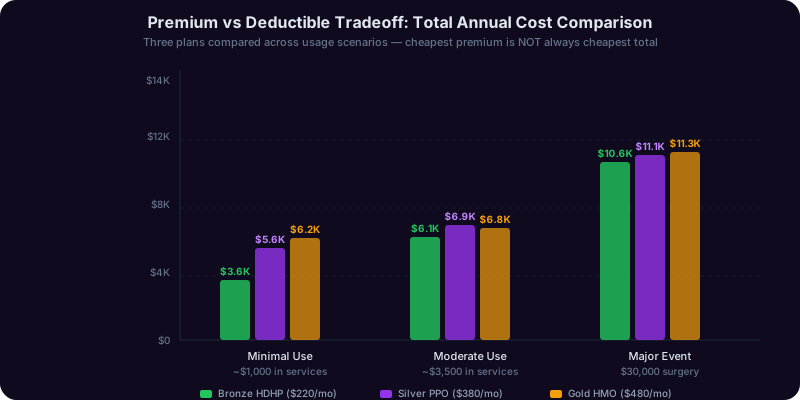
Your expected out-of-pocket costs depend on your usage profile and the plan's deductible, copay, and coinsurance structure. Here is a worked example comparing three plans for a moderate-use individual:
| Plan Feature | Bronze HDHP | Silver PPO | Gold HMO |
| Monthly Premium | $220 | $380 | $480 |
| Annual Premium Cost | $2,640 | $4,560 | $5,760 |
| Deductible | $5,000 | $2,000 | $750 |
| Coinsurance | 80/20 after deductible | 80/20 after deductible | $30 copay visits, 90/10 procedures |
| OOP Maximum | $8,000 | $6,500 | $5,500 |
| Expected OOP (moderate use, ~$3,500 in services) | $3,500 (all under deductible) | $2,000 (deductible) + $300 (coinsurance) = $2,300 | $750 (deductible) + $150 (copays) + $125 (coinsurance) = $1,025 |
| Total Annual Cost | $6,140 | $6,860 | $6,785 |
In this example, the Bronze HDHP is actually cheapest for moderate use. But watch what happens if you need surgery costing $30,000 (negotiated rate):
| Scenario: $30,000 Surgery | Bronze HDHP | Silver PPO | Gold HMO |
| Annual Premium | $2,640 | $4,560 | $5,760 |
| You Pay (up to OOP max) | $8,000 | $6,500 | $5,500 |
| Total Annual Cost | $10,640 | $11,060 | $11,260 |
With a major event, total costs converge because the OOP max caps your exposure. The HDHP is still slightly cheaper overall, but the difference narrows to just $420-$620. And the HDHP requires you to come up with $8,000 in cash, which not everyone can do. If you cannot comfortably cover your plan's full deductible from savings, that plan is too risky for you regardless of the premium savings.
Step 3: Factor in HSA and FSA Benefits
If you choose an HDHP, your HSA contributions reduce your taxable income. At a 24% marginal tax rate, a $4,300 HSA contribution saves you $1,032 in federal taxes plus state tax savings. Factor this into your total cost calculation. If your employer contributes to your HSA (many contribute $500-$1,500 per year), subtract that as well.
For non-HDHP plans, you may have access to a Flexible Spending Account (FSA). The 2026 FSA limit is approximately $3,300. FSA contributions are also pre-tax, but unlike HSAs, most FSA funds expire at year-end (some plans offer a $640 rollover or 2.5-month grace period). Only contribute what you are confident you will spend.
Step 4: Check the Provider Network
The best plan on paper is worthless if your doctors are not in the network. Before enrolling, verify that your primary care doctor, any specialists you see, your preferred hospital, and your pharmacy are all in-network. Call the provider's office directly to confirm because insurer directories are notoriously inaccurate, often showing providers as in-network who have actually left.
The Insurance Copilot can help you run these total annual cost calculations for your specific plan options, and the Budgeting Copilot can help you figure out how to allocate funds for deductibles, HSA contributions, and monthly premiums within your overall budget.
Open Enrollment and Qualifying Life Events: When You Can Get or Change Coverage
Unlike most products you buy, you cannot purchase or change health insurance whenever you want. There are specific windows during which you can enroll, and missing them means waiting until the next year unless you experience a qualifying event. Understanding these timing rules prevents gaps in coverage that can be both financially devastating and medically dangerous.
Open Enrollment Periods
Employer-sponsored plans: Most employers hold open enrollment once per year, typically in October or November for coverage starting January 1. The exact dates vary by employer. This is your annual opportunity to switch plans, add or remove dependents, enroll in or change FSA/HSA contributions, and update beneficiaries. If you do nothing during open enrollment, most employers will auto-renew your current plan, but your premiums and benefits may change. Always review your options even if you plan to keep the same coverage.
ACA Marketplace (healthcare.gov): The federal marketplace open enrollment for 2026 coverage runs from November 1, 2025 through January 15, 2026. Some state-run exchanges (California, New York, Colorado, etc.) have extended deadlines. If you enroll by December 15, coverage begins January 1. If you enroll between December 16 and January 15, coverage begins February 1.
Medicare: The initial enrollment period is a 7-month window around your 65th birthday (3 months before, the birthday month, and 3 months after). The annual open enrollment period for Medicare Advantage and Part D runs from October 15 through December 7.
Qualifying Life Events (QLEs) That Trigger Special Enrollment
Outside of open enrollment, you can enroll in or change your health insurance only if you experience a qualifying life event. You typically have 30-60 days from the event date to make changes (60 days for marketplace plans, 30 days for most employer plans). After that window closes, you must wait until the next open enrollment.
Qualifying life events include:
- Marriage: You can join your spouse's plan or enroll in a new plan. This is retroactive to the date of marriage in most cases.
- Divorce or legal separation: If you lose coverage through a spouse's plan, you can enroll in your employer's plan or a marketplace plan.
- Birth or adoption of a child: Newborns and adopted children can be added to your plan. Coverage for newborns is typically retroactive to the date of birth.
- Loss of other coverage: This includes losing employer-sponsored insurance due to job loss, layoff, reduction in hours, or aging off a parent's plan at age 26. Voluntary cancellation of your plan does not qualify.
- Moving to a new area: If you move to a location where your current plan is not available, you qualify for special enrollment in your new area.
- Change in income: If your income changes and you gain or lose eligibility for marketplace subsidies or Medicaid, you may qualify.
- Turning 26: When you age off a parent's plan, you have 60 days to enroll in your own coverage.
COBRA: The Expensive Safety Net
If you lose employer-sponsored coverage (due to job loss, reduction in hours, or certain other events), COBRA (Consolidated Omnibus Budget Reconciliation Act) allows you to continue your exact same employer plan for up to 18 months (36 months in some cases). The catch: you pay the full premium, including the portion your employer was previously paying, plus a 2% administrative fee. For family coverage, COBRA premiums typically run $1,800-$2,400 per month.
COBRA makes sense in specific situations: if you are mid-treatment and your doctors are in-network, if you have already met your deductible for the year, or if you need coverage for a short gap before new employer coverage starts. Otherwise, an ACA marketplace plan is almost always cheaper. After job loss, you qualify for special enrollment on the marketplace and may be eligible for substantial subsidies based on your reduced income.
What Happens If You Have a Gap in Coverage?
As of 2019, there is no federal tax penalty for being uninsured (the individual mandate penalty was reduced to $0). However, some states (California, Massachusetts, New Jersey, Rhode Island, Vermont, and DC) impose their own penalties. Beyond penalties, a gap in coverage means you are fully exposed to healthcare costs. A single emergency room visit averages $2,200, a broken bone can cost $7,000-$15,000 to treat, and a hospital stay averages $13,000 per day. The financial risk of being uninsured far exceeds the cost of almost any insurance plan. If cost is a barrier, read our guide on what to do when you cannot afford healthcare for options including Medicaid, marketplace subsidies, community health centers, and charity care programs.
If you are navigating a life change and unsure about your insurance options, the Insurance Copilot can help you determine whether you qualify for a special enrollment period and what coverage options are available to you. The Finance Copilot can help you evaluate whether COBRA or a marketplace plan makes more financial sense based on your specific situation.
How to Fight a Denied Claim: The Complete Appeal Process Step by Step
Claim denials are not rare. According to a 2024 KFF analysis, insurers deny an average of 17% of in-network claims. For some insurers, the denial rate exceeds 25%. Yet fewer than 1% of denials are ever appealed, and of those that are appealed, roughly 40-60% are overturned. The math is clear: if your claim is denied, you should almost always appeal. The system is designed to discourage appeals through complexity and delay, but understanding the process gives you significant leverage.
Common Reasons for Claim Denials
- Lack of prior authorization: The insurer required pre-approval for the service and it was not obtained. This is the most common and most frustrating reason.
- Out-of-network provider: You received care from a provider not in your plan's network.
- Not medically necessary: The insurer determined the service was not required based on clinical guidelines. This is the most commonly overturned denial on appeal.
- Coding errors: The provider used incorrect billing codes (CPT, ICD-10, or modifier codes). This is common and often fixable with a simple call to the provider's billing department.
- Timely filing: The provider submitted the claim after the insurer's filing deadline (typically 90-180 days from the date of service).
- Coordination of benefits: If you have two insurance plans, the claim was sent to the wrong insurer first.
- Benefit exclusion: The service is explicitly not covered under your plan.
Step 1: Understand the Denial
When you receive a denial, your insurer must send an Explanation of Benefits (EOB) or a denial letter that includes the specific reason for the denial, the clinical basis (if applicable), and instructions for how to appeal. Read this carefully. If the reason is unclear, call the insurer's member services line and ask them to explain the denial in plain language. Note the claim number, the denial code, and the name of the representative you speak with.
Step 2: Check for Simple Fixes First
Before launching a formal appeal, check whether the denial can be resolved quickly:
- Coding errors: Call your provider's billing office and ask them to review the codes submitted. A single wrong digit in a CPT code can turn a covered service into a denied one. Ask them to resubmit with corrected codes.
- Missing information: Sometimes claims are denied because the insurer did not receive required documentation (medical records, referral forms). Your provider can resubmit with the missing information.
- Retroactive prior authorization: Some insurers will grant authorization retroactively if your provider documents that the service was urgent or that a good-faith effort was made to obtain authorization.
Step 3: File an Internal Appeal
Under the ACA, you have the right to file an internal appeal within 180 days of receiving a denial. The internal appeal must be reviewed by someone who was not involved in the original denial decision. Here is how to make your appeal as strong as possible:
- Write a formal appeal letter that references your plan's specific coverage provisions. Cite the relevant section of your Evidence of Coverage (EOC) or Summary Plan Description (SPD) that supports coverage.
- Get a letter from your doctor. This is the single most important element of a successful appeal. Ask your treating physician to write a letter of medical necessity explaining why the service was required, what clinical evidence supports it, and why alternative treatments are inappropriate.
- Include supporting documentation: medical records, lab results, imaging reports, peer-reviewed journal articles supporting the treatment, and any clinical guidelines (from the AMA, specialty societies, or NCCN for cancer treatment) that recommend the service.
- Cite relevant regulations. If your denial involves a surprise bill from an out-of-network provider at an in-network facility, cite the No Surprises Act (effective January 2022), which protects patients from balance billing in most emergency and many non-emergency situations.
The insurer must respond to your internal appeal within 30 days for pre-service denials (services you have not yet received) and 60 days for post-service denials (services you already received). For urgent care situations, they must respond within 72 hours.
Step 4: External Review
If your internal appeal is denied, you have the right to an external review by an independent third party not affiliated with your insurer. This is a powerful tool: the external reviewer examines the clinical evidence and can override the insurer's decision. External reviewers overturn denials in approximately 40-50% of cases. You typically have 4 months after the internal appeal denial to request external review. There is no cost to you for external review.
Step 5: Escalate Further If Needed
- File a complaint with your state's Department of Insurance. Every state has an insurance commissioner who regulates insurers and investigates complaints. A formal complaint can pressure the insurer to reconsider.
- Contact your employer's HR department (for employer-sponsored plans). HR has leverage with the insurer because they represent a large group of customers.
- Seek help from a patient advocate. Non-profit organizations like the Patient Advocate Foundation offer free case management for people fighting claim denials.
Throughout this process, document everything: save copies of every letter, note every phone call with the date, time, representative name, and what was discussed. For a detailed guide on fighting specific medical bills, see our guide on how to dispute a medical bill. The Insurance Copilot can help you understand your denial letter, identify the strongest grounds for appeal, and draft your appeal letter.
Understanding Your Medical Bills: EOB vs. Bill, Negotiated Rates, and What You Actually Owe
Medical billing in the United States is one of the most confusing consumer experiences in any industry. A single hospital visit can generate separate bills from the hospital, the physician, the anesthesiologist, the radiologist, the pathologist, and the lab, each arriving at different times and with different amounts. The first step to managing medical bills is understanding what each document means and recognizing what you actually owe versus what you can challenge.
Explanation of Benefits (EOB) vs. Actual Bill
The most important distinction most people miss: an EOB is not a bill. Your insurer sends you an EOB after processing a claim. It shows what was billed by the provider, the insurer's negotiated (allowed) amount, what the insurer paid, and what you owe. The EOB typically arrives before the provider's actual bill. Use the EOB to verify the bill's accuracy when it arrives.
Here is how to read the key lines on an EOB:
| EOB Line Item | What It Means | Example |
| Amount Billed (Provider's Charge) | The full sticker price the provider submitted. This is almost always inflated and is not what anyone actually pays. | $4,500 |
| Allowed Amount (Negotiated Rate) | The discounted rate your insurer has agreed to pay for this service with in-network providers. This is the real price. | $1,800 |
| Provider Discount | The difference between the billed amount and allowed amount. The provider writes this off. You do not owe it. | $2,700 (discount) |
| Plan Paid | What your insurance company actually paid the provider. | $1,440 (80% of $1,800) |
| Your Responsibility | What you owe. This is the amount the provider should bill you. | $360 (20% coinsurance) |
Critical action: When you receive a bill from the provider, compare the "patient responsibility" amount on the EOB to the amount on the bill. They should match. If the bill is higher than the EOB says you owe, do not pay the difference. Contact the provider's billing department and reference your EOB. Common reasons for mismatches include the provider not applying the insurance payment yet, billing you at the full charge rate instead of the negotiated rate, or the claim being reprocessed after the initial EOB was issued.
The Chargemaster and Why Billed Amounts Are Meaningless
Every hospital maintains a chargemaster, a master list of prices for every service and supply item. These prices are notoriously inflated, often 3-10 times what Medicare pays for the same service. An IV bag of saline that costs the hospital $1 might be listed at $300 on the chargemaster. A 15-minute consultation billed at $2,500 might have an insurance-negotiated rate of $400. Under a 2021 federal rule, hospitals are now required to publish their chargemaster prices and negotiated rates online, making these disparities publicly visible for the first time.
No one is expected to pay chargemaster prices. Insurance companies negotiate lower rates. Medicare and Medicaid set their own rates. Even uninsured patients can negotiate. If you receive a bill at chargemaster prices and you are uninsured, you have significant room to negotiate. Many hospitals offer financial assistance (charity care) programs that reduce or eliminate bills based on income. Non-profit hospitals are legally required to have these programs.
Surprise Bills and the No Surprises Act
The No Surprises Act, effective since January 2022, protects you from the most egregious form of medical billing abuse: surprise out-of-network bills. You are protected when:
- You receive emergency care at any facility, even if the facility or providers are out of network.
- You receive care from an out-of-network provider at an in-network facility without your knowledge or consent (such as an out-of-network anesthesiologist at an in-network hospital).
- You use air ambulance services from out-of-network providers.
Under the No Surprises Act, you are only responsible for your in-network cost-sharing amount (deductible, copay, coinsurance). The provider and insurer must negotiate the remaining balance between themselves. If you receive a surprise bill that violates these protections, you can file a complaint at cms.gov/nosurprises or call 1-800-985-3059.
Steps When You Receive a Medical Bill
- Wait for the EOB. Do not pay a provider's bill until you have received and reviewed the EOB from your insurer.
- Compare the bill to the EOB. Your responsibility on the bill should match the EOB's "patient responsibility" amount.
- Check for errors. Medical billing errors are estimated to occur on 30-80% of bills (depending on the study). Look for duplicate charges, charges for services you did not receive, and incorrect coding. If something looks wrong, call the billing department.
- Review for No Surprises Act violations. If you were treated at an in-network facility but billed by an out-of-network provider you did not choose, this may be a surprise bill.
- Negotiate if needed. If you owe a large balance, most providers will set up interest-free payment plans. Many also offer discounts for prompt payment (5-20% off for paying in full within 30 days). As of 2023, medical debt under $500 can no longer appear on credit reports.
If you are struggling with a confusing or unexpectedly large medical bill, our detailed guide on how to dispute a medical bill walks you through the negotiation and dispute process step by step. Unsure whether your ER visit was handled correctly? See our guide on when to go to the emergency room for details on ER billing. The Insurance Copilot can help you decode your EOB and verify that your bill matches what you actually owe.
Maximizing Your Benefits: Preventive Care, FSA/HSA Strategies, and Getting the Most From Your Plan
Most people leave significant value on the table with their health insurance. Between unused preventive services, suboptimal HSA/FSA strategies, and missed opportunities for savings, the average insured American could save hundreds to thousands of dollars per year simply by understanding what their plan offers and using it strategically.
Preventive Care: Free Services You Are Probably Not Using
Under the ACA, all marketplace and most employer plans must cover a comprehensive list of preventive services at 100%, with no copay, no coinsurance, and no deductible. This is true even for HDHPs. Many people do not realize the breadth of what is covered. Here are the most valuable free preventive services for adults:
- Annual wellness visit / physical exam
- Blood pressure screening
- Cholesterol screening (for adults at elevated risk, typically over age 35 for men, over 45 for women)
- Colorectal cancer screening (starting at age 45 for average risk; colonoscopy is fully covered as preventive)
- Depression screening
- Diabetes (Type 2) screening (for adults with high blood pressure)
- Immunizations: flu, COVID-19, Tdap, shingles (age 50+), pneumococcal (age 65+), HPV (through age 26), hepatitis B, and more
- Mammograms (every 1-2 years for women age 40+)
- Cervical cancer screening (Pap smear and HPV testing)
- Lung cancer screening (annual low-dose CT for adults 50-80 with a 20+ pack-year smoking history)
- Obesity screening and counseling
- STI screening
- Contraception (all FDA-approved methods for women, at no cost)
Important caveat: A visit is only classified as "preventive" if no new problems are diagnosed or treated during the visit. If you go for an annual physical and your doctor orders a follow-up blood test because of an abnormal result, the follow-up test may be billed as diagnostic rather than preventive, meaning your deductible and cost-sharing apply. To protect yourself, ask at the time of service: "Is this being coded as preventive?" If your doctor wants to address a new issue during your annual physical, ask them to schedule a separate visit for it.
HSA Strategy: The Triple Tax Advantage
If you have an HDHP with an HSA, you have access to what many financial advisors call the best tax-advantaged account in the tax code. Here is the optimal strategy for maximizing its value:
- Contribute the maximum. In 2026, that is $4,300 for individual coverage or $8,550 for family coverage. If your employer contributes to your HSA, their contribution counts toward these limits.
- Pay current medical expenses out of pocket if you can afford to. Keep receipts for every medical expense. Let your HSA balance grow and invest it in low-cost index funds (most HSA providers offer investment options once your balance exceeds $1,000-$2,000). There is no time limit on reimbursing yourself, so you can pay for a $500 doctor visit today, save the receipt, and reimburse yourself from the HSA 20 years from now after the invested funds have grown tax-free.
- After age 65, HSA funds can be used for any purpose. Withdrawals for non-medical expenses after 65 are taxed as ordinary income (like a traditional IRA) but carry no penalty. For medical expenses, withdrawals remain tax-free at any age.
The math is compelling. If you contribute $4,300 per year to an HSA for 20 years and invest it at an average 7% annual return, your HSA could grow to approximately $190,000, all of which can be withdrawn tax-free for medical expenses (including Medicare premiums, long-term care, and medical expenses in retirement).
FSA Strategy: Use It or Lose It (Mostly)
If your employer offers a Flexible Spending Account and you are not eligible for an HSA, use the FSA strategically. FSA funds are use-it-or-lose-it: any unspent balance at year-end is forfeited (though some plans offer a $640 rollover or a 2.5-month grace period). The key is to estimate your annual out-of-pocket medical and dental expenses accurately and contribute that amount.
Common FSA-eligible expenses people forget about:
- Prescription sunglasses and contact lenses
- Dental cleanings, fillings, crowns, and orthodontia
- Physical therapy copays
- Mental health therapy copays
- Prescription medications
- First aid supplies, bandages, thermometers
- Menstrual products (eligible since 2020)
- Sunscreen (SPF 15+)
- Acupuncture
- CPAP machines and supplies
If you are approaching year-end with unspent FSA funds, stock up on eligible items: new glasses, contact lens supply, dental work you have been postponing, over-the-counter medications, and first aid supplies.
Other Ways to Maximize Your Plan
- Use in-network providers exclusively. The negotiated rate discount alone saves 40-70% on every service. Use your insurer's online directory to verify network status before every appointment, and call the provider's office to double-check.
- Use mail-order pharmacy for maintenance medications. Most plans offer a 90-day supply through mail order at the cost of a 60-day supply at retail. For a prescription costing $50/month retail, switching to 90-day mail order can save $200 per year.
- Ask about generic alternatives. Generic drugs are required by the FDA to have the same active ingredient, strength, and dosage form as brand-name drugs. Generics cost 80-85% less on average. If your doctor prescribes a brand-name drug, ask if a generic is available. The Medication Copilot can identify generic alternatives for your prescriptions.
- Use telehealth when appropriate. Most plans cover telehealth visits at a lower copay ($0-$20) than in-person visits ($30-$50). For minor issues like colds, rashes, UTIs, and prescription refills, telehealth is faster, cheaper, and equally effective.
- Schedule elective procedures strategically. If you have already met your deductible for the year, schedule any planned procedures (wisdom teeth removal, elective surgery, imaging) before December 31 while your insurer is covering a larger share. If you have not met your deductible and a procedure is not urgent, consider whether waiting until the new plan year makes sense if you expect to meet the deductible from other expenses.
- Get a second opinion before major procedures. Many insurers will cover the cost of a second opinion, and it can reveal alternative treatment approaches that are less expensive or less invasive.
Managing all of these strategies can feel overwhelming, but the Health Copilot can help you keep track of which preventive screenings you are due for, the Budgeting Copilot can help you plan your FSA and HSA contributions, and the Insurance Copilot can answer specific questions about what your plan covers. For broader health and wellness support across the health domain, explore the full range of scenario-based guides available on our platform. To understand the lab work your insurance covers at preventive visits, see our guide on how to read your blood test results.
Disclaimer: This guide provides general educational information about health insurance in the United States. It is not legal, financial, tax, or insurance advice. Health insurance plans, regulations, contribution limits, and tax rules change frequently. Consult a licensed insurance broker, tax professional, or benefits administrator for guidance specific to your situation. HSA and FSA contribution limits referenced are for the 2026 tax year and are subject to IRS adjustments.
Frequently Asked Questions
Recommended Copilots
Recommended Copilots
Ask health questions related to your coverage, preventive screenings, and when to seek care
Try Free →Compare health insurance plans, understand your benefits, decode denial letters, and estimate your costs
Try Free →Evaluate the financial impact of different plan choices and model HSA investment growth scenarios
Try Free →Plan monthly premium payments, HSA/FSA contributions, and medical expense allocations in your budget
Try Free →Check prescription formulary coverage, find generic alternatives, and estimate drug costs under your plan
Try Free →Continue Exploring
Related Articles
Get Answers From the Insurance Copilot
Use the Insurance Copilot to compare plans, understand your benefits, and fight denied claims. The Finance Copilot can help you model total annual costs, and the Budgeting Copilot keeps your premiums, HSA contributions, and medical expenses on track.