
When to Negotiate: Timing Is Everything
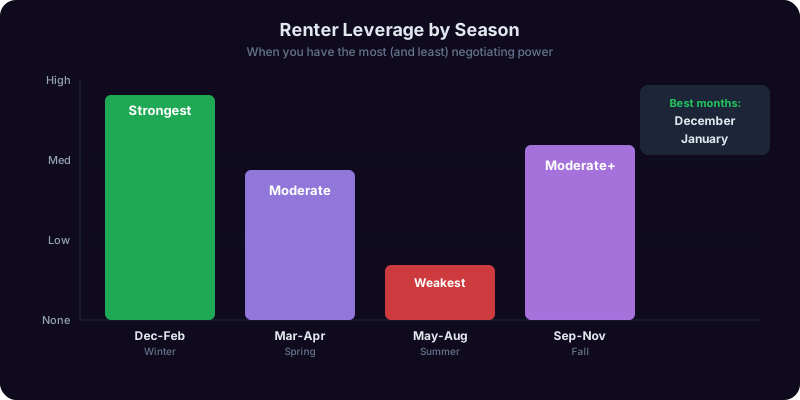
Rent negotiation is not a matter of luck or charisma. It is a matter of timing and leverage. The same request that gets rejected in September might get accepted in January, because the rental market shifts throughout the year and your bargaining position changes with it.
Lease Renewal vs. New Lease
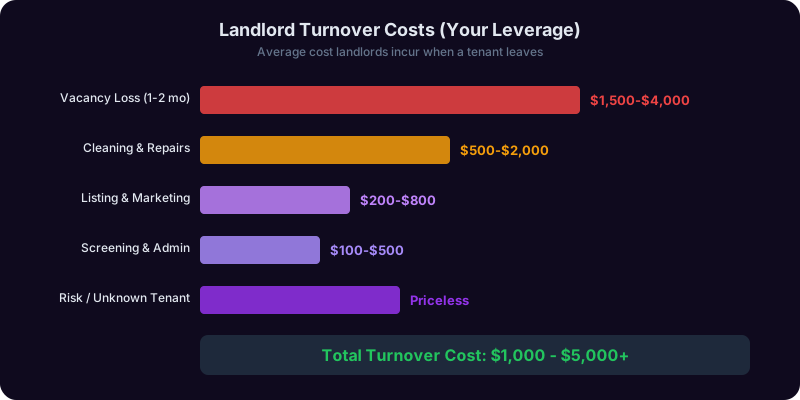
Your strongest negotiating position is at lease renewal. Here is why: landlords hate turnover. When you leave, the landlord faces vacancy costs (typically 1-2 months of lost rent while the unit sits empty), cleaning and repair expenses ($500-$2,000+), listing fees, time spent showing the unit, application screening costs, and the risk that the next tenant is worse than you. A study by the National Apartment Association found that the average cost of tenant turnover is $1,000 to $5,000 per unit, depending on the market. That means your landlord has a built-in financial incentive to keep you, even at a slightly lower rent.
When signing a new lease, your leverage is different. You do not have a track record with this landlord, so your bargaining chip is the competitive market. If the landlord has multiple applicants, your negotiating power is limited. If the unit has been listed for 30+ days with no takers, your power increases significantly.
Seasonal Timing
Rental markets follow predictable seasonal patterns that directly affect your negotiating leverage:
| Season | Market Conditions | Your Leverage |
|---|---|---|
| December - February | Lowest demand, fewest movers | Strongest. Landlords dread winter vacancies. |
| March - April | Demand starts rising | Moderate. Still favorable but tightening. |
| May - August | Peak moving season, highest demand | Weakest. Landlords have plenty of applicants. |
| September - November | Demand declining post-summer | Moderate to strong. Market cooling off. |
If your lease renewal falls in the summer, you are negotiating at a disadvantage. One strategy: ask to shift your lease term. If your current lease ends in July, propose a 10-month renewal that ends in May the following year, putting your next renewal in a softer market.
Vacancy Rate Signals
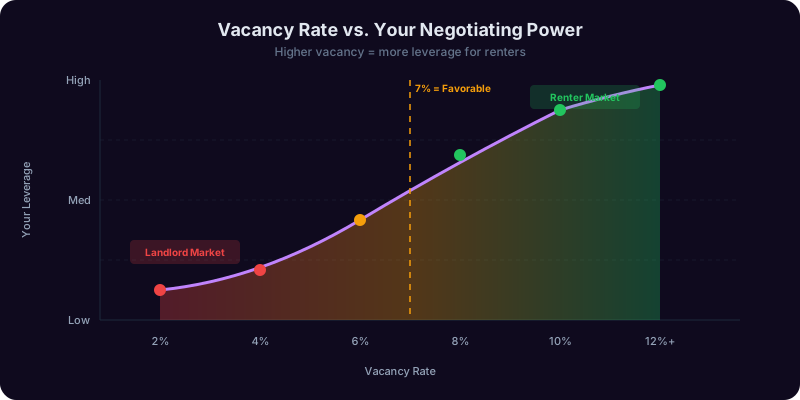
The single most useful data point for rent negotiation is the vacancy rate in your building and neighborhood. When vacancy is high, landlords are desperate to fill units and will make concessions. When vacancy is low, they can be picky.
How to gauge vacancy rates:
- Walk your building. Count empty units. If you see 3-4 vacancy signs in a 20-unit building, that is a 15-20% vacancy rate and the landlord is feeling the pressure.
- Check listings. Search Zillow, Apartments.com, and Craigslist for your building and neighborhood. If there are multiple available units, the landlord needs tenants.
- Look at concessions. Are buildings in your area offering "first month free" or "no security deposit" deals? That signals soft demand, which means you have leverage even if your specific building appears full.
- Check census data. The U.S. Census Bureau publishes quarterly rental vacancy rates by metro area. A rate above 7% is favorable for renters.
The Rental Copilot can help you analyze current vacancy rates and market conditions in your specific area to determine exactly how much leverage you have before you start the conversation.
Research and Preparation: Building Your Case
Walking into a rent negotiation without data is like walking into a salary negotiation without knowing the market rate. You need three things: comparable rents, an understanding of your landlord's perspective, and a documented case for why you deserve a better deal.
Finding Comparable Rents
Your most powerful tool is evidence that similar units in the area rent for less. Here is how to build a comps sheet:
- Search the same neighborhood. Use Zillow, Apartments.com, Rent.com, and Craigslist to find units within a half-mile radius of your building. Filter for the same number of bedrooms, similar square footage, and comparable amenities.
- Document at least 5 comparables. For each, note the address, monthly rent, square footage, amenities, and listing date. Screenshot the listings because they disappear.
- Calculate price per square foot. This normalizes the comparison. If your landlord is charging $2.50/sq ft and comparable units are $2.15/sq ft, you have a concrete data point.
- Note building age and condition. A renovated unit in a new building justifies a premium. If your unit has aging appliances and worn carpet, that works in your favor.
- Check your building's other listings. If the same landlord is listing identical units at a lower price than your proposed renewal rate, that is your strongest comp.
Understanding Your Landlord's Perspective
Effective negotiation requires understanding the other side. Your landlord cares about three things:
- Consistent cash flow. A reliable tenant who pays on time every month is worth more than a slightly higher rent from an unknown tenant.
- Minimizing costs. Turnover is expensive. Every month of vacancy, every cleaning crew, every listing fee eats into profit.
- Minimizing hassle. Landlords value tenants who do not generate complaints, keep the unit in good condition, and handle minor issues themselves.
Your job is to remind the landlord that replacing you is expensive and risky. You are not begging for a discount. You are presenting a business case.
Building Your Tenant Resume
Before you negotiate, compile your track record:
| Factor | Why It Matters | How to Document |
|---|---|---|
| Payment history | On-time payments reduce landlord risk | Bank statements showing consistent payments |
| Lease length | Longer tenure = lower turnover risk | Note how many years you have rented |
| Unit condition | Well-maintained unit saves repair costs | Take photos showing the current state |
| No complaints | Low-maintenance tenants are valuable | Reference your clean record |
| Referrals | Bringing other tenants saves marketing costs | Mention any referrals you have made |
Setting Your Target and Walk-Away Number
Before any negotiation, define two numbers:
- Target rent: The price you want. This should be based on your comps research. If comparable units average $1,800 and your landlord is proposing $2,000, your target might be $1,850.
- Walk-away number: The maximum you will pay before looking elsewhere. This should be based on your budget (rent should not exceed 30% of gross income, a guideline supported by the Consumer Financial Protection Bureau) and what the market will bear.
The gap between these numbers is your negotiating range. Go in asking for your target and be prepared to meet somewhere in the middle. Never reveal your walk-away number.
Use the Budgeting Copilot to calculate exactly what rent fits your budget and how much you need to save by negotiating to hit your financial goals. For a deeper understanding of how rent fits into your overall finances, see our guide on building an emergency fund and learn how your credit score can affect your rental applications.
Word-for-Word Negotiation Scripts for 5 Scenarios
These scripts are field-tested frameworks. Adapt them to your situation, but keep the structure: open with value, present evidence, make a specific ask, and offer something in return. Confidence matters, but data matters more. You are not asking for a favor. You are proposing a deal that works for both parties.
Script 1: Lease Renewal (Pushing Back on a Rent Increase)
This is the most common scenario. Your landlord sends a renewal notice with a rent increase, and you want to negotiate it down or eliminate it.
You: "Hi [Landlord/Property Manager], thank you for sending the renewal offer. I want to stay. I have enjoyed living here and I have taken good care of the unit over the past [X years]. Before I sign, I wanted to discuss the rent increase.
I have been looking at comparable units in the area, and similar [1BR/2BR] apartments within half a mile are renting for $[amount] to $[amount]. My current rent of $[current rent] is already at the higher end of that range, and the proposed increase to $[proposed rent] would put it above market rate.
Given my track record of on-time payments, the condition I have maintained the unit in, and the current market rates, I would like to propose renewing at $[your target]. I am happy to sign a longer lease if that helps provide stability on your end.
What do you think?"
If they counter, respond with:
"I appreciate you working with me on this. I understand costs go up. Would $[midpoint between your target and their counter] work? I can commit to a [14/18]-month lease at that rate, which gives you guaranteed occupancy through the slower season."
Script 2: New Lease (Negotiating Before Signing)
You have found a unit you want, completed the application, and been approved. Now you negotiate before signing.
You: "Thanks for approving my application. I am excited about the unit at [address]. Before we finalize the lease, I wanted to ask about the monthly rent.
I have been researching the area and comparable units are listing between $[low comp] and $[high comp]. Your listing at $[asking rent] is on the higher end. I noticed the unit has been listed for [X weeks], and I am ready to sign immediately and move in by [specific date].
Would you consider $[target rent]? I have strong credit, stable income, and excellent references from my previous landlord. I am a low-maintenance tenant and I plan to stay at least [2-3] years."
Script 3: Mid-Lease Rent Reduction (Market Has Dropped)
If the market has shifted significantly during your lease, you can request a mid-lease adjustment. This is harder but possible, especially in markets with rising vacancies.
You: "Hi [Landlord], I hope you are doing well. I wanted to have an honest conversation about my rent. I have been a reliable tenant for [X months/years] and I want to continue living here.
However, I have noticed that comparable units in the building and neighborhood are now renting for $[lower amount], which is $[difference] less than my current rate. I have seen [specific examples: 'the 1BR on the third floor listed at $1,650' or 'three units on Apartments.com within two blocks at $1,700'].
I would rather work this out with you than move to one of those units. Would you be open to adjusting my rent to $[target] for the remainder of my lease, or at minimum, applying the adjustment at my next renewal?"
Script 4: Corporate Landlord or Property Management Company
Negotiating with a large property management company requires a different approach. The person you are talking to often does not have unilateral authority, so you need to give them ammunition to take to their manager.
You: "Hi [Property Manager Name], I received the renewal offer and I would like to discuss the terms. I understand you may need to check with your team on any adjustments, and I am happy to be patient with that process.
Here is my situation: I have been here [X years], I have never been late on rent, and I have zero complaints or maintenance issues on my record. I have also done my research on the current market. Comparable units managed by [competitor property companies] are offering rates between $[range], and several are including concessions like a free month or waived parking fees.
I would like to propose a renewal at $[target rent]. Alternatively, I am open to a longer lease term at the current rate if an outright reduction is not on the table. Could you check what flexibility your team has? I would like to have this settled by [date one week out] so we both have clarity."
Script 5: Private Landlord (Individual Owner)
Private landlords are often more flexible but also more emotionally attached to pricing decisions. Lean into the personal relationship.
You: "Hi [Landlord first name], I wanted to talk about the renewal. First, I want you to know I really appreciate how you have handled things. [Reference a specific positive: 'You got the plumber out quickly last March' or 'The building is always well-maintained.'] I genuinely enjoy living here.
I have been looking at the market because I want to make sure I am being smart with my budget. I found that similar apartments in the neighborhood are going for $[lower amount]. I know you have costs to cover too, so I am not looking for something unreasonable. But would you be open to keeping the rent at $[current or slight increase] instead of going up to $[proposed]? Try our AI budget planning tool for step-by-step help.
I will sign a longer lease, and you will not have to deal with finding a new tenant, cleaning the unit, or risking a vacancy. I think that is a win for both of us."
For each of these scripts, practice once out loud before the actual conversation. Hearing yourself say the words removes hesitation and makes you sound more natural. For more negotiation techniques you can apply across your financial life, see our guide on Salary Negotiation Scripts which uses a similar evidence-based framework.
The Tenant Rights Copilot can help you customize these scripts based on your specific state laws and landlord type, ensuring your negotiation stays within legal bounds while maximizing your leverage.

Get Answers From the Rental Copilot
Tell the Rental Copilot your current rent, lease terms, and market conditions, and get a customized negotiation plan with scripts, comparable rent data, and walk-away analysis.
What to Negotiate Besides Rent Price
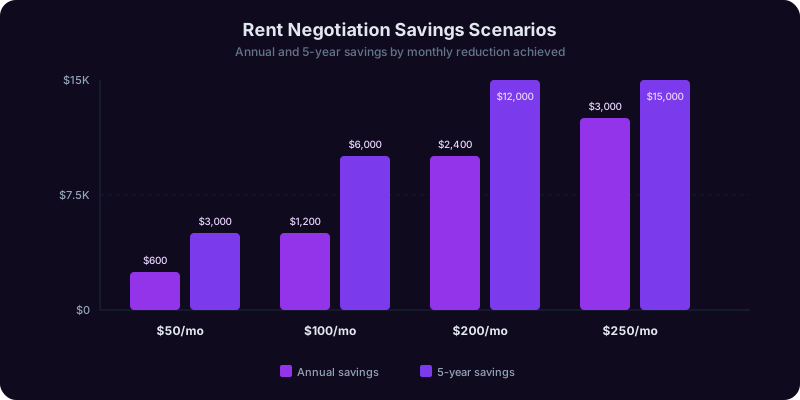
Here is a secret experienced renters know: the monthly rent number is only one part of your total housing cost. Even if the landlord will not budge on the headline rent, there are dozens of other terms that put money back in your pocket. Sometimes a landlord who refuses a $50/month rent reduction will happily waive a $200 parking fee because it "feels" different on their spreadsheet.
The Full Menu of Negotiable Items
| Item | Typical Cost | Annual Savings If Waived/Reduced | How to Ask |
|---|---|---|---|
| Parking fee | $75-$250/month | $900-$3,000 | "Can you include one parking spot in the rent?" |
| Pet fee/pet rent | $25-$75/month + $200-$500 deposit | $300-$900 + deposit | "I will provide a pet reference from my vet and previous landlord." |
| Storage unit | $50-$150/month | $600-$1,800 | "Is there a storage unit you could include with the lease?" |
| Move-in costs | $500-$3,000+ | One-time savings | "Can we reduce the security deposit or waive the application fee?" |
| Lease length | Varies | Flexibility value | "I will sign an 18-month lease for a lower monthly rate." |
| Rent-free period | 1-2 months free | $1,200-$4,000+ | "Would you offer a free month if I sign by Friday?" |
| Unit upgrades | $500-$5,000 | Quality of life | "I will sign if you replace the carpet with LVP flooring." |
| Utilities included | $100-$300/month | $1,200-$3,600 | "Would you bundle water/trash into the rent?" |
| Gym/amenity fee | $25-$75/month | $300-$900 | "Can the amenity fee be waived for a longer commitment?" |
| Early termination clause | 1-2 months penalty | Flexibility value | "Can we add a 60-day break clause after month 6?" |
The "If Not Price, Then What" Framework
When the landlord says no to a rent reduction, pivot immediately:
"I understand you cannot adjust the rent. Would you be open to [pick one or two from the list above] instead? That would help me make the numbers work without changing your rental income."
This works because many landlords think in terms of monthly rental income reported to their accountant or lender. A waived parking fee or free month does not change the lease's stated rent, which matters for the landlord's property valuation and mortgage qualification.
Upgrades That Benefit Both Parties
Some negotiable items actually increase the landlord's property value. Frame these as investments, not costs: Try our AI investment analysis tool for step-by-step help.
- New appliances: "If you upgrade the dishwasher, you will be able to charge more when I eventually move out. I will commit to a 2-year lease to give you that return."
- Fresh paint: Low cost for the landlord ($200-$500 per room), high impact on your satisfaction and the unit's market value.
- Smart thermostat: "I will install a Nest thermostat at my expense if you allow it and reduce rent by $25/month. It will save on your utility costs long-term and is a selling point for future tenants."
- New flooring: Carpet-to-LVP conversion ($3-$7 per square foot) increases the unit's rental value by $50-$100/month. Offer a longer lease to offset the cost.
Move-In Cost Negotiation
For new leases, the upfront costs are often more negotiable than the monthly rent:
- Security deposit: Ask to reduce it to half a month's rent or pay it in installments over 2-3 months.
- Application fee: Ask if it can be waived or credited to your first month's rent upon approval.
- Administrative fees: These are often made up. Push back or ask for an itemized explanation.
- First and last month's rent: Ask to pay just first month upfront and add last month to your second payment.
For a complete guide to understanding and protecting your security deposit, read our Security Deposit Complete Guide. If you are also working on building your credit, strong credit history gives you additional leverage in deposit negotiations. The Consumer Rights Copilot can help you identify which fees are legally required in your state and which ones are negotiable or even prohibited.
Email Templates for Rent Negotiation
Some negotiations happen in person or over the phone, but email has a strategic advantage: everything is documented. If the landlord agrees to a lower rent or waived fee over email, you have it in writing. Email also gives you time to craft your message carefully and removes the pressure of an on-the-spot conversation.
Template 1: Responding to a Renewal Notice with a Rent Increase
Subject: Lease Renewal Discussion - Unit [Your Unit Number]
Hi [Landlord/Property Manager Name],
Thank you for sending the renewal offer. I appreciate you reaching out early so we can work through this.
I would like to renew my lease. I have enjoyed living at [address] for the past [X years], and I have consistently paid rent on time, maintained the unit in excellent condition, and been a considerate neighbor.
That said, the proposed increase to $[amount] is above what I am seeing in the current market. I have researched comparable units in the area and found the following:
- [Address/Building 1]: [beds/baths], $[rent]/month
- [Address/Building 2]: [beds/baths], $[rent]/month
- [Address/Building 3]: [beds/baths], $[rent]/monthBased on this, I would like to propose renewing at $[your target rent]. I am also open to signing a longer lease term (up to [18 months]) if that provides additional value on your end.
I would love to get this resolved and signed this week. Please let me know your thoughts or if there is a good time to discuss.
Best,
[Your Name]
Unit [Number]
Template 2: Negotiating a New Lease Before Signing
Subject: Application Approved - Lease Terms for [Address]
Hi [Landlord/Property Manager Name],
Thank you for approving my application for [address]. I am very interested in the unit and ready to move forward.
Before we finalize, I wanted to discuss the terms. I noticed the unit has been available for [X weeks/days], and comparable units in the area are listed at $[lower comp] to $[mid comp]. Given my strong credit score of [range], stable employment at [company/industry], and excellent rental references, I believe I represent a low-risk, long-term tenant.
Would you consider a monthly rent of $[target]? I am prepared to sign a [12-18] month lease and can move in by [specific date], ensuring no gap in your rental income.
I am also flexible on other terms if the rent is firm. For example, I would be interested in discussing [waived parking / included utilities / reduced deposit].
Looking forward to hearing from you.
Best,
[Your Name]
Template 3: Requesting a Mid-Lease Rent Reduction
Subject: Rent Adjustment Request - Unit [Number]
Hi [Landlord/Property Manager Name],
I hope this message finds you well. I am writing to discuss my current rent in light of recent market changes.
Over the past [X months], rental rates in our neighborhood have shifted. I have found [number] comparable units within [distance] currently listed at $[amount] to $[amount], which is $[difference] below my current rate of $[your rent]. I have attached screenshots of these listings for reference.
I value our landlord-tenant relationship and I want to stay. However, the gap between my rent and current market rates is significant enough that I need to raise it.
Would you be willing to adjust my rent to $[target] effective [date]? I believe this is fair for both of us, and it ensures continued occupancy of the unit at a competitive rate.
Thank you for considering this. I am happy to discuss further at your convenience.
Best,
[Your Name]
Unit [Number]
Template 4: Counter-Offer After Initial Rejection
Subject: Re: Lease Renewal Discussion - Unit [Number]
Hi [Landlord/Property Manager Name],
Thank you for getting back to me. I understand that $[your original ask] may not work on your end. I appreciate your willingness to discuss.
Would $[revised offer, between your target and their number] be possible? To sweeten the deal, I can offer [one or more of the following]:
- Signing an 18-month lease instead of 12
- Paying 2 months upfront to guarantee cash flow
- Handling minor maintenance myself (lightbulbs, caulking, etc.)
- Referring a qualified tenant for your vacant unit in [building/floor]I think we can find a number that works for both of us. Let me know what you think.
Best,
[Your Name]
Pro Tips for Email Negotiation
- Send emails Tuesday through Thursday between 9 AM and 11 AM. This is when response rates are highest and people are in problem-solving mode.
- Keep it under 250 words. Landlords manage dozens of units. Respect their time.
- Always attach evidence. Screenshots of comparable listings, your payment history, or a photo of the well-maintained unit.
- Set a soft deadline. "I would love to resolve this by Friday" creates urgency without being aggressive.
- Follow up once after 3 business days. If no response, send a brief follow-up: "Hi [Name], just following up on my email below. I would love to get this sorted out. Let me know your thoughts."
The Finance Copilot can help you draft customized versions of these templates with your actual numbers, comps, and specific situation details filled in.
When to Walk Away (And How to Do It Right)
The most powerful negotiating tool you have is your willingness to leave. But walking away only works if you actually mean it and if the math supports the decision. Here is a framework for knowing when to stand firm, when to compromise, and when to pack your boxes.
The Walk-Away Math
Before you threaten to leave, calculate the true cost of moving:
| Moving Cost | Estimated Range | Your Number |
|---|---|---|
| Security deposit at new place | $1,000-$3,000 | |
| First and last month's rent upfront | $2,000-$6,000 | |
| Moving company or truck rental | $500-$2,500 | |
| Application fees (multiple applications) | $100-$300 | |
| Time off work for moving | $200-$800 | |
| Utility setup fees and deposits | $100-$400 | |
| Address change hassle (mail, subscriptions, etc.) | Priceless frustration | |
| Total estimated moving cost | $4,000-$13,000 |
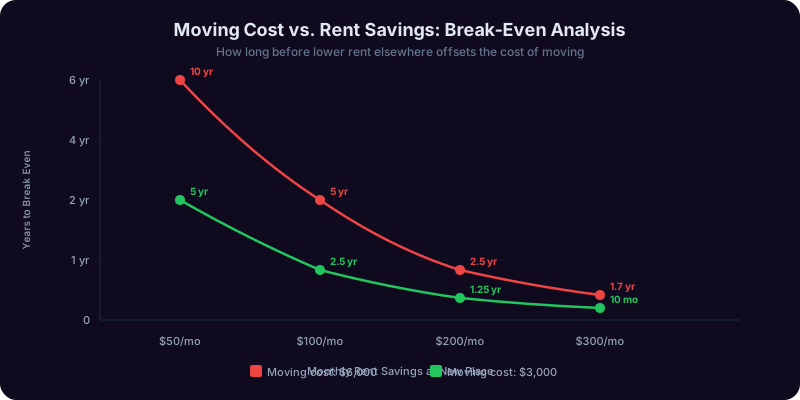
Now compare that to your annual savings from the lower rent. If you are trying to negotiate $100/month off your rent, that is $1,200/year in savings. If moving costs you $6,000, you need to stay at the new place for 5 years just to break even. That changes the equation significantly.
When Walking Away Makes Sense
- The gap is large. If comparable units are $300+/month cheaper and the landlord will not negotiate meaningfully, the annual savings ($3,600+) justifies the moving costs within 1-2 years.
- The unit has problems. If you are overpaying AND dealing with maintenance issues, noisy neighbors, or safety concerns, the negotiation is not just about money.
- Your needs have changed. If you need a different size, location, or amenity set, do not negotiate hard to stay somewhere that no longer fits.
- The landlord is disrespectful. If the negotiation reveals that your landlord does not value you as a tenant, that is useful information about how future issues will be handled.
When to Stay Even If the Price Is Not Perfect
- You love the location and unit. There is real value in a short commute, good neighbors, and a space that feels like home. Quantify it. Would you pay $50/month to avoid 20 extra minutes of commuting each way? That is probably worth it.
- The landlord is responsive and fair. A landlord who fixes things quickly and treats you with respect is worth a small premium.
- Moving costs outweigh savings. As shown above, small monthly savings can take years to offset moving expenses.
- Your lease renewal lands in a better season next year. Sometimes the best strategy is to accept a modest increase now and negotiate harder at the next renewal when market conditions favor you.
How to Walk Away Gracefully
If you decide to leave, do it professionally. The rental world is smaller than you think, and landlords talk to each other.
"Thank you for discussing this with me. Unfortunately, the numbers do not work for my budget at $[their final offer]. I have decided to look at other options. I will provide proper notice as required by the lease and leave the unit in excellent condition. I appreciate the time I have spent here and I wish you well finding a new tenant."
This leaves the door open. In many cases, a landlord who says no will call back in a few days with a better offer once they realize you are serious about leaving. Do not bluff about leaving if you are not willing to follow through. Landlords can tell, and an empty threat destroys your credibility for future negotiations.
For guidance on what your landlord can and cannot do during the move-out process, see our Security Deposit Complete Guide. The Tenant Rights Copilot can walk you through your state-specific notice requirements and ensure you protect your deposit when you leave.
Rent Increase Laws by State: What Your Landlord Cannot Do
Before you negotiate, you need to know the legal ceiling. In some states and cities, your landlord is legally limited in how much they can raise your rent. In others, there are no limits at all. Understanding these laws changes your strategy entirely. The U.S. Department of Housing and Urban Development (HUD) provides additional resources on tenant rights and rental assistance programs.
States with Rent Control or Rent Stabilization Laws (2026)
| State | Type of Law | Key Provisions | Cities Affected |
|---|---|---|---|
| California | Statewide cap (AB 1482) | Max increase: 5% + local CPI or 10%, whichever is lower. Applies to buildings 15+ years old. | Statewide (with local additions in LA, SF, Oakland, San Jose, etc.) |
| New York | Rent stabilization | Increases set annually by Rent Guidelines Board. Typically 2-5% for 1-year leases. | NYC (approx. 1 million units), plus select counties |
| Oregon | Statewide cap (SB 608) | Max increase: 7% + CPI. Does not apply to buildings under 15 years old. | Statewide |
| New Jersey | Local rent control | Varies by municipality. Many cities cap increases at 2-5% annually. | Over 100 municipalities including Newark, Jersey City, Hoboken |
| Maryland | Local rent stabilization | Varies by county. Montgomery County caps at CPI or 6%, whichever is lower. | Montgomery County, Prince George's County, select cities |
| Maine | Local rent control | Portland caps increases at 70% of CPI with just-cause eviction protections. | Portland |
| Minnesota | Local rent stabilization | St. Paul caps increases at 3% per year. | St. Paul |
| Washington | Statewide notice requirements | 60-day notice required for increases over 3%. Proposed statewide cap pending. | Statewide (Seattle has additional protections) |
| Connecticut | Fair rent commissions | Tenants can challenge "excessive" increases before a municipal commission. | Multiple municipalities |
| Washington DC | Rent stabilization | Max increase: CPI + 2% (or CPI + 5% for small landlords). Elderly tenants capped at CPI. | District-wide |
States That Ban Rent Control
Many states have preemption laws that prevent cities from enacting rent control. In these states, landlords can raise rent by any amount with proper notice:
- Full preemption (no local rent control allowed): Alabama, Arizona, Arkansas, Colorado, Florida, Georgia, Idaho, Illinois, Indiana, Iowa, Kansas, Kentucky, Louisiana, Michigan, Mississippi, Missouri, Montana, Nebraska, New Hampshire, New Mexico, North Carolina, North Dakota, Ohio, Oklahoma, South Carolina, South Dakota, Tennessee, Texas, Utah, Virginia, Wisconsin, Wyoming
In these states, your leverage comes entirely from market conditions and your value as a tenant, not from legal limits. The negotiation scripts above become even more important.
Notice Requirements (Even Without Rent Control)
Even in states without rent caps, landlords must provide advance notice of rent increases. Common requirements:
- 30 days notice for month-to-month leases (most states)
- 60-90 days notice in some states (California, Washington, Oregon for larger increases)
- During a fixed-term lease: In most states, rent cannot be increased mid-lease unless the lease specifically allows it
This is critical: if you are in a fixed-term lease and your landlord tries to raise your rent before it expires, you likely have the right to refuse unless the lease has an escalation clause. Read your lease carefully.
How to Use Legal Knowledge in Negotiation
You do not need to threaten legal action to benefit from knowing the law. Simply demonstrating awareness changes the dynamic:
"I noticed the proposed 12% increase exceeds the [state law] cap of [X%]. I want to make sure we are both on the same page about the applicable limits. Based on the current CPI, the maximum allowable increase would be approximately [amount]. I am happy to renew at that rate."
Explore the Finance Domain for more tools and resources to protect your financial interests as a renter. The Tenant Rights Copilot can look up the specific rent control laws, notice requirements, and tenant protections that apply to your exact address.
Long-Term Rent Savings Strategies
Negotiating rent once is great. Building a system that keeps your rent below market rate year after year is how you save tens of thousands of dollars over a renting career. The average American renter spends over $180,000 on rent over 10 years. Even a 5% annual reduction compounds into serious money.
The Compound Effect of Rent Negotiation
Rent increases are cumulative. If your landlord raises rent 4% per year on a $2,000 apartment, here is what happens over 5 years:
| Year | Rent Without Negotiating | Rent With $75/Month Negotiated Off Each Year | Monthly Savings | Cumulative Annual Savings |
|---|---|---|---|---|
| Year 1 | $2,080 | $2,005 | $75 | $900 |
| Year 2 | $2,163 | $2,010 | $153 | $2,736 |
| Year 3 | $2,250 | $2,015 | $235 | $5,556 |
| Year 4 | $2,340 | $2,020 | $320 | $9,396 |
| Year 5 | $2,434 | $2,025 | $409 | $14,304 |
By consistently negotiating just $75 off each annual increase, you save over $14,000 in five years. And that money, invested at a 7% annual return, grows to over $16,500. This is not a hypothetical exercise. This is the real cost of accepting every rent increase without pushback. To learn how to put those savings to work, see our guide on how to start investing with $100.
Strategy 1: The Annual Negotiation Habit
Treat every lease renewal as a negotiation event. Start preparing 90 days before your lease expires:
- 60-90 days before: Research current comparable rents. Update your tenant resume. Note any building issues that have not been resolved.
- 45-60 days before: If you have not received a renewal offer, contact the landlord proactively. This puts you in the driver's seat and shows you are organized.
- 30-45 days before: Negotiate using the scripts and templates above. Have your comps ready and your walk-away number defined.
- 14-30 days before: Finalize terms and sign. If negotiations failed, you still have time to find alternative housing.
Strategy 2: Build Landlord Loyalty
The best way to keep rent low is to make your landlord want to keep you so badly that they pre-emptively offer favorable terms. Throughout the year:
- Pay rent early. Not just on time. Early. Set up autopay for the 25th of the previous month. Landlords notice.
- Report maintenance issues promptly and reasonably. Do not let small problems become expensive emergencies.
- Be a good neighbor. Landlords hear from other tenants. A tenant who generates zero complaints is gold.
- Handle minor fixes yourself. Changing lightbulbs, tightening loose handles, replacing air filters. Mention these casually at renewal time.
- Refer quality tenants. If a unit opens in your building, recommend someone reliable. Landlords remember this.
Strategy 3: Negotiate the Lease Structure
Beyond the monthly amount, the structure of your lease affects long-term costs:
- Longer lease = lower increases. A 2-year lease with a 2% increase built in is often cheaper long-term than annual renewals with 4-5% market increases.
- Cap future increases in writing. Some landlords will agree to a clause like "rent shall not increase more than 3% per renewal period." This protects you from spike years.
- Include a renewal option. A clause giving you the right (not obligation) to renew at a predetermined rate locks in your future cost.
Strategy 4: Invest Your Savings
The money you save from rent negotiation should not just sit in a checking account. Redirect it:
- Emergency fund first. Build 3-6 months of living expenses. This also gives you walk-away power in future negotiations because you can afford to move.
- High-yield savings account. Park your rent savings in a HYSA earning 4-5% APY while you decide where to deploy it.
- Down payment fund. If homeownership is a goal, rent savings can accelerate your timeline. Every $100/month saved and invested gets you to a down payment faster. Avoid the common first-time home buyer mistakes when you get there.
- Retirement accounts. Maxing out an IRA or increasing your 401(k) contributions with the savings compounds dramatically over decades.
Strategy 5: Know When to Buy
Renting is not throwing money away, despite what social media influencers claim. But there is a crossover point where buying becomes financially advantageous. The general rule: if you plan to stay in an area for 5+ years and the local price-to-rent ratio is below 20, buying may save you money long-term. Use the Finance Copilot to model your specific buy-vs-rent scenario.
Regardless of whether you rent or buy, the negotiation skills you develop through rent negotiation transfer directly to every financial transaction in your life: salary negotiations, car purchases, contractor quotes, and more. Think of rent negotiation as practice for a lifetime of financial confidence. Explore more strategies and tools at Copilotly Scenarios.
This is general information, not legal or financial advice. Consult a qualified professional for guidance specific to your situation.
Frequently Asked Questions
Recommended Copilots
Recommended Copilots
Model your rent budget, calculate savings from negotiation, and analyze buy-vs-rent scenarios
Try Free →Determine the right rent target based on your income, expenses, and financial goals
Try Free →Look up rent control laws, notice requirements, and tenant protections for your specific location
Try Free →Research comparable rents, vacancy rates, and market conditions in your area
Try Free →Identify which landlord fees are legally required versus negotiable or prohibited in your state
Try Free →Related Articles
Get Answers From the Rental Copilot
Tell the Rental Copilot your current rent, lease terms, and market conditions, and get a customized negotiation plan with scripts, comparable rent data, and walk-away analysis.