
What Is an Explanation of Benefits (And Why It Is Not a Bill)
Every time you visit a doctor, fill a prescription, or receive any medical service covered by health insurance, your insurance company generates a document called an Explanation of Benefits (EOB). This document is sent to you after your insurer processes the claim submitted by your healthcare provider. It is one of the most important financial documents you will receive in any given year, and it is also one of the most frequently ignored. According to a 2025 survey by the Centers for Medicare and Medicaid Services (CMS), fewer than half of insured Americans read their EOBs regularly. Among those who do, 37% discover at least one billing error that affects what they owe.
The single most critical thing to understand about an EOB is this: it is not a bill. An EOB is a statement from your insurance company that explains what services were billed, how much the provider charged, how much the insurance plan covered, and how much you may owe. It does not require you to send payment to anyone. The bill comes separately from your healthcare provider, and it should match the patient responsibility amount shown on your EOB. When those numbers do not match, you have likely found a billing error.
This distinction matters because many patients receive an EOB, see a dollar amount listed under "patient responsibility," and either panic or throw it away. Neither response is helpful. The correct response is to read the EOB carefully, understand what each number means, and then compare it against the actual bill you receive from your provider. If the amounts align, you can pay the bill with confidence. If they do not align, you have grounds to dispute the charge before paying anything.
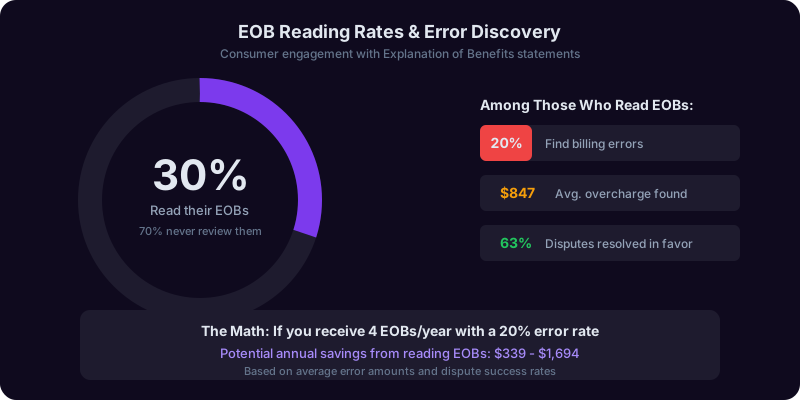
EOBs serve several purposes beyond informing you of your financial responsibility. They are your insurance company's official record of how a claim was processed. They document whether a service was covered, partially covered, or denied. They show you how much of your annual deductible has been met. They reveal the difference between what your provider billed and what your insurance company actually allows for that service, a gap that can be enormous and that directly affects your out-of-pocket costs. And they provide the claim number and processing details you need if you want to dispute anything.
Insurance companies are required by federal law to send you an EOB for every claim they process. Most insurers now provide EOBs electronically through their member portals, though you can request paper copies. Some insurers send a single consolidated EOB covering multiple claims processed during the same period, while others send individual EOBs for each claim. Regardless of the format, the information contained in the EOB follows a standardized structure that this guide will walk you through section by section.
Understanding your EOB is not optional if you want to avoid overpaying for healthcare. Medical billing errors are not rare exceptions. They are a systemic feature of a system where over 3 billion claims are processed annually in the United States, many through automated systems that make mistakes at scale. Your EOB is the first and best tool you have to catch those mistakes before they cost you money. For a broader understanding of how health insurance works and the terminology involved, see our comprehensive health insurance guide.
Every Section of Your EOB Explained: Provider, Dates, Amounts, and Adjustments
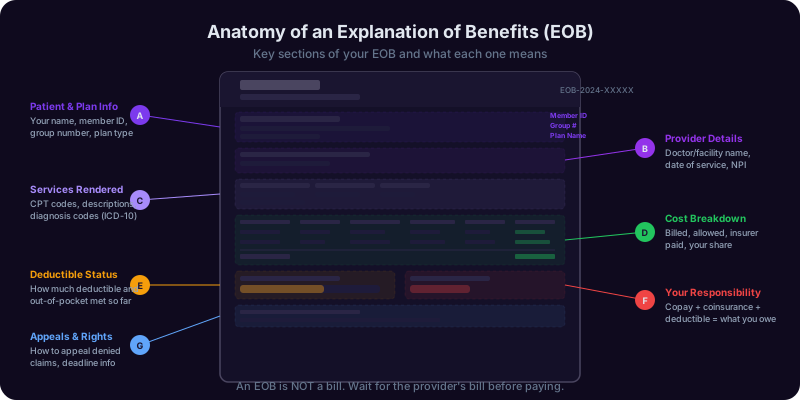
An EOB can look intimidating at first glance, but every EOB in the United States contains the same core sections, regardless of which insurance company issued it. Once you understand what each section means, you can read any EOB from any insurer. Below is a detailed breakdown of every field you will encounter, what it means, and why it matters for your wallet.
Patient and Plan Information
The top of your EOB identifies you (the patient or subscriber), your insurance plan, your member ID number, and the group number if you have employer-sponsored coverage. Verify that this information is correct. Errors in your member ID or group number can cause claims to be processed incorrectly or denied entirely. If your name is misspelled or your date of birth is wrong, contact your insurer immediately because these errors can cascade into claim denials.
Provider Information
This section identifies the healthcare provider who submitted the claim. It includes the provider's name, their National Provider Identifier (NPI) number, and their billing address. Check that the provider listed is the one who actually treated you. If you see a provider name you do not recognize, it could be a billing error, a provider who was involved in your care without your knowledge (such as an assistant surgeon or anesthesiologist), or in rare cases, a fraudulent charge for services you never received.
Date of Service
This is the date you actually received the medical service. It is not the date the claim was submitted or the date the EOB was generated. Verify that this date matches your records. If you see a date of service for a day when you did not visit a healthcare provider, flag it immediately as a potential error or fraud.
Description of Service and Procedure Codes
This section lists the specific services that were billed, usually identified by CPT (Current Procedural Terminology) codes and ICD-10 (International Classification of Diseases) diagnosis codes. CPT codes describe what was done (for example, CPT 99213 is a standard office visit for an established patient), while ICD-10 codes describe why it was done (the diagnosis). You do not need to memorize these codes, but you should be able to look them up if something seems wrong. A single incorrect digit in a CPT code can change a covered service into a non-covered one, turning a $30 copay into a $3,000 bill.
Billed Amount (Provider's Charge)
This is the amount your healthcare provider submitted to the insurance company for the service. It is the provider's full list price, sometimes called the "chargemaster rate." This number is almost always higher, often dramatically higher, than what anyone actually pays. A hospital might bill $5,000 for an MRI that the insurance company's negotiated rate values at $1,200. The billed amount is the starting point, not the actual cost.
Allowed Amount (Negotiated Rate)
This is arguably the most important number on your EOB. The allowed amount is the maximum amount your insurance company has agreed to pay for a specific service, based on the contract between your insurer and the provider. It is also called the negotiated rate, contracted rate, or eligible amount depending on your insurer's terminology. Everything you owe as a patient is calculated based on the allowed amount, not the billed amount. If the billed amount is $5,000 and the allowed amount is $1,200, your copay, coinsurance, and deductible obligations are all calculated against the $1,200 figure.
Plan Paid (Insurance Payment)
This is the amount your insurance company actually paid to the provider. It equals the allowed amount minus whatever portion you owe (deductible, copay, or coinsurance). If the allowed amount is $1,200 and you owe a $200 copay plus 20% coinsurance on the remaining $1,000, the plan pays $800 and your responsibility is $400.
Adjustments and Write-Offs
The adjustment is the difference between the billed amount and the allowed amount. If the provider billed $5,000 and the allowed amount is $1,200, the adjustment is $3,800. For in-network providers, this amount is written off entirely. The provider agreed to accept the negotiated rate when they joined the insurance network, and they cannot bill you for the difference. This write-off is one of the primary financial benefits of using in-network providers.
Patient Responsibility
This is the total amount you may owe for the service. It typically breaks down into three components: your deductible (the annual amount you must pay before insurance starts covering costs), your copay (a fixed dollar amount per visit or service), and your coinsurance (a percentage of the allowed amount you share with your insurer after meeting your deductible). The patient responsibility on your EOB should match the amount on the bill you receive from your provider. If it does not, one of them is wrong.
Claim Status and Remarks
At the bottom of most EOBs, you will find a claim status (processed, pending, denied, or partially denied) and remark codes that explain any adjustments or denials. These codes reference specific reasons such as "service not covered under your plan," "deductible not yet met," or "prior authorization required." If your claim was denied or partially denied, this section tells you why and is the starting point for any appeal.
The 8 Most Common EOB Billing Errors (And How Much They Cost You)
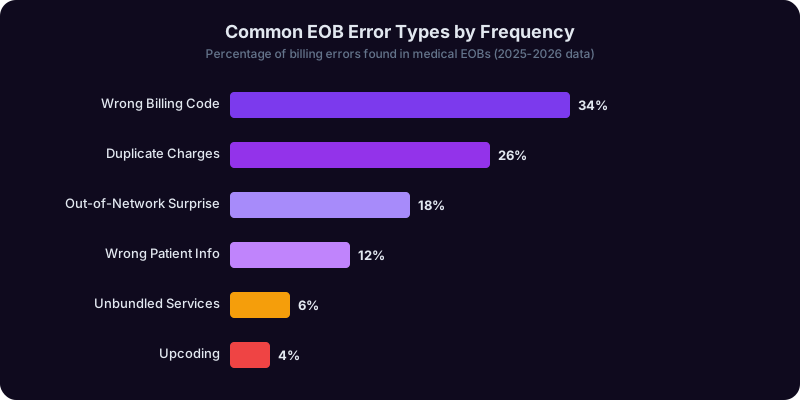
Medical billing errors are not an occasional inconvenience. They are a pervasive problem that affects millions of patients every year. A frequently cited analysis by medical billing advocates estimates that up to 80% of medical bills contain at least one error, though the severity ranges from minor discrepancies to charges that inflate your bill by thousands of dollars. Learning to recognize the most common error types on your EOB is the single most effective way to protect yourself from overpaying.
1. Duplicate Charges
This is the most straightforward error and one of the most common. The same service appears on your EOB twice, meaning the provider submitted the claim twice or the insurer processed it twice. This can happen when a provider's billing system automatically resubmits a claim that was initially delayed, or when both a hospital and a physician independently bill for the same service. Always count the number of charges on your EOB and compare them to the number of services you actually received. If you had one blood draw but see two charges for venipuncture, you have found a duplicate.
2. Incorrect CPT or ICD-10 Codes
A single incorrect digit in a procedure code or diagnosis code can change your financial responsibility dramatically. Common coding errors include billing a comprehensive office visit (CPT 99215, typically $250 to $400) when you had a brief follow-up visit (CPT 99212, typically $75 to $125), assigning a diagnosis code that is not covered by your plan when the correct diagnosis code would be covered, and using a code for a more complex procedure than what was actually performed, a practice known as upcoding. The Health Copilot can help you look up CPT and ICD-10 codes to verify that they match the services you received.
3. Unbundling
Unbundling occurs when a provider bills separately for services that should be billed together under a single, less expensive code. For example, a group of lab tests that should be billed as a panel (one charge) might be billed as individual tests (multiple higher charges). The CMS fraud and abuse guidelines specifically identify unbundling as an improper billing practice. If your EOB shows an unusually high number of individual charges for what seemed like a routine visit, unbundling may be the cause.
4. Balance Billing by In-Network Providers
Balance billing occurs when a provider bills you for the difference between their billed amount and the insurance company's allowed amount. If a provider billed $5,000 and the allowed amount is $1,200, balance billing means the provider sends you a bill for the $3,800 difference. In-network providers are contractually prohibited from balance billing you. If you see your provider billing you more than the patient responsibility shown on your EOB, this is an error or a contract violation. Under the No Surprises Act, you are also protected from balance billing in many out-of-network emergency situations.
5. Wrong Patient Information
Claims processed under the wrong member ID, wrong date of birth, or wrong subscriber name can result in denials or incorrect cost calculations. This is especially common in families where multiple members are on the same plan, or after life events like marriage, divorce, or a child aging off a parent's plan. Check the patient name and member ID on every EOB.
6. Incorrect Quantities or Days
If you were hospitalized, check the number of days billed against the number of days you were actually admitted. A common error is billing for the discharge day as a full inpatient day when it should not be. For prescriptions, verify that the quantity dispensed matches the quantity billed. Being billed for 90 pills when you received 30 is a $200 to $1,000 error depending on the medication.
7. Services Not Rendered
Occasionally, your EOB will include charges for services you never received. This can result from clerical errors where another patient's charges were posted to your account, from automatic bundling of services that were ordered but canceled before being performed, or from outright fraud. Review every line item on your EOB and confirm that you actually received each service listed.
8. Out-of-Network Processing for In-Network Providers
Sometimes a claim from an in-network provider is processed at out-of-network rates, resulting in a dramatically higher patient responsibility. This can happen when the provider submits the claim with an incorrect tax ID number, when the insurer's provider directory is outdated, or when a provider recently joined or left the network. If you verified that a provider was in-network before your visit but your EOB shows out-of-network processing, contact your insurer immediately. Keep any documentation showing you confirmed network status before the service, such as screenshots of the insurer's provider directory.
The financial impact of these errors adds up. A 2025 study found that patients who systematically reviewed their EOBs and disputed errors saved an average of $400 to $1,300 per year. For patients with chronic conditions requiring frequent care, the savings can be substantially higher. Every error you catch is money that stays in your pocket rather than being paid for services that were incorrectly billed.

Get Answers From the Health Copilot
Ask a specialist AI copilot the question you just read about. Your first conversation needs no signup and no card.
EOB vs. Medical Bill: How to Compare Them and Spot Discrepancies
The relationship between your Explanation of Benefits and the medical bill you receive from your provider is the key to catching billing errors. These are two separate documents from two separate parties, and they should tell the same financial story. When they do not, someone has made a mistake, and that mistake is almost always costing you money. Understanding how to compare them side by side is a skill that can save you hundreds or thousands of dollars over time.
What Each Document Tells You
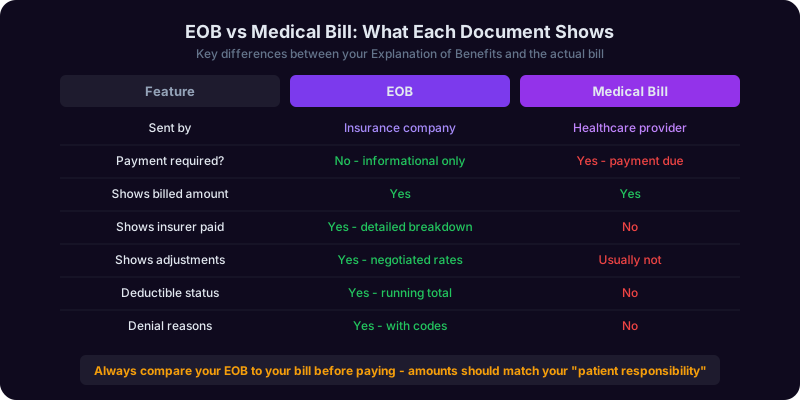
Your EOB comes from your insurance company and tells you how the claim was processed. It shows the billed amount, the allowed amount, what the plan paid, and what you owe. Your medical bill (also called a statement or invoice) comes from your healthcare provider and tells you how much to pay them. In a properly functioning system, the "patient responsibility" on your EOB should exactly match the "amount due" on your medical bill. When these numbers differ, you need to investigate before paying.
Step-by-Step Comparison Process
Follow this process every time you receive a medical bill:
- Wait for the EOB before paying. Never pay a medical bill until you have received the corresponding EOB from your insurance company. Providers sometimes send bills before the insurance claim has been fully processed, and the amount on that initial bill may not reflect your actual responsibility after insurance. If a provider pressures you to pay immediately, tell them you are waiting for your EOB. You are within your rights to do this.
- Match the dates and services. Find the EOB that corresponds to the same date of service and provider as your medical bill. Verify that every service listed on the bill also appears on the EOB, and vice versa. If the bill includes services not on the EOB, the claim may not have been submitted to your insurance at all.
- Compare the patient responsibility figures. The bottom-line number you owe on the EOB should match the amount due on the bill. If the bill is higher than the EOB's patient responsibility, the provider may be balance billing you improperly, billing for services not submitted to insurance, or using a different fee schedule.
- Check for payments already made. If you paid a copay at the time of service, your bill should reflect that payment as a credit. If it does not, the provider may be billing you for the copay a second time.
- Verify the insurance payment. The EOB shows how much the plan paid. If the plan paid $800 but the provider says they only received $600, there is a discrepancy that needs to be resolved between the provider and the insurer before you pay anything.
Common Discrepancy Patterns
The most frequent mismatches between EOBs and medical bills fall into predictable categories:
- Bill arrives before EOB: The provider sent the bill before the insurance claim was processed. The bill may show the full billed amount without insurance adjustments. Wait for the EOB, then request an updated bill from the provider.
- Bill is higher than EOB patient responsibility: The provider is likely balance billing you for the difference between their charge and the allowed amount. For in-network providers, this is a contract violation. Contact the provider's billing department and reference your EOB.
- Bill shows different services than EOB: Either the provider submitted different services to the insurer than what appears on your bill (which is a billing error), or there are services that were never submitted to insurance. Ask the provider to submit all services to your insurance before billing you.
- EOB shows $0 patient responsibility but you received a bill: This often happens when the insurance company has not yet sent payment to the provider. The provider may be billing you prematurely. Check whether the EOB shows a payment was sent. If the plan paid the full allowed amount, contact the provider and provide your EOB as evidence.
- Multiple EOBs for one visit: A single doctor's visit can generate multiple claims if lab work is sent to a separate lab, if imaging is billed by both the facility and the reading physician, or if your visit involved multiple providers. You may receive separate EOBs for each claim and separate bills from each entity. Track them all to ensure nothing is double-billed across providers.
Creating a Tracking System
For anyone who has more than a few medical visits per year, maintaining a simple tracking spreadsheet is invaluable. For each service, record the date, provider name, service description, billed amount, allowed amount, plan paid amount, patient responsibility from the EOB, the amount billed by the provider, the amount you paid, and whether the EOB and bill matched. This tracking system takes minutes to maintain and can save you significant money over time. For a detailed walkthrough on what to do when you find a discrepancy, see our guide on how to dispute a medical bill.
How to Cross-Reference Your EOB: Deductibles, Out-of-Pocket Maximums, and Network Status
Reading individual EOB line items is only part of the picture. To truly protect yourself from overpaying, you need to cross-reference your EOBs against your plan's annual accumulators, the running totals of your deductible progress, out-of-pocket maximum, and benefit usage. Insurance companies track these numbers, but they make mistakes, and those mistakes almost always cost you money rather than saving it.
Tracking Your Deductible
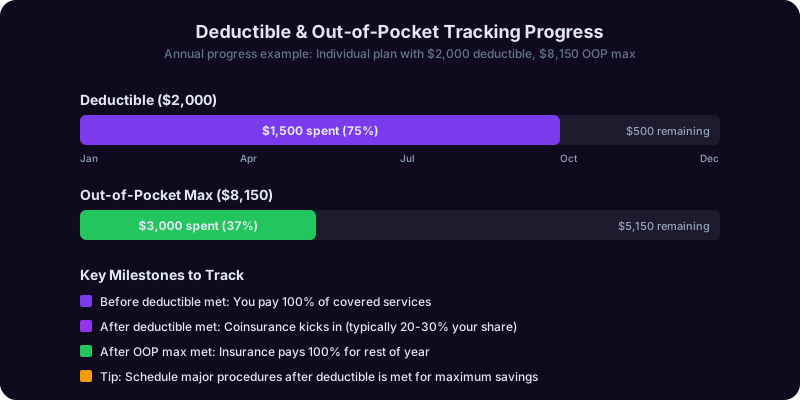
Your annual deductible is the amount you must pay out of pocket before your insurance begins covering costs (beyond services exempt from the deductible, such as preventive care). Most EOBs show how much of your deductible has been applied from the current claim and your cumulative deductible progress for the year. Cross-reference this against your own records. If your plan has a $2,000 individual deductible and your EOB shows $1,800 applied year-to-date, but your own records show you have already paid $2,100 in deductible-eligible expenses, your insurer may have failed to apply some of your earlier payments correctly.
This error is more common than most patients realize, particularly when claims are processed out of order (a claim from March might be processed after a claim from May), when you have both in-network and out-of-network deductibles, or when family plans have both individual and family deductible thresholds. The HealthCare.gov glossary provides clear definitions of how deductibles work across different plan types.
Monitoring Your Out-of-Pocket Maximum
The out-of-pocket maximum is the most you will pay for covered services in a plan year. Once you reach this limit, your insurance pays 100% of covered services for the rest of the year. For 2026, the ACA caps out-of-pocket maximums at $9,450 for individual coverage and $18,900 for family coverage. Many plans set their maximums below these federal caps. Track your cumulative out-of-pocket spending across all EOBs throughout the year. When you are approaching your maximum, pay particular attention to ensure that every dollar you have spent is being counted. If your insurer fails to credit a payment toward your out-of-pocket maximum, you end up paying more than the legal limit.
Verifying Network Status on Your EOB
Every EOB indicates whether the claim was processed as in-network or out-of-network. This designation has a massive impact on your costs. In-network claims benefit from negotiated rates (lower allowed amounts), lower copays and coinsurance, and count toward your in-network deductible and out-of-pocket maximum. Out-of-network claims may be subject to higher cost-sharing, separate (higher) deductibles, balance billing, and reduced or no coverage depending on your plan type.
Verify the network status on every EOB. If you specifically chose an in-network provider and the EOB shows out-of-network processing, contact your insurer immediately. Common causes include the provider's billing department submitting the claim under a different tax ID or NPI number than the one in the insurer's network directory, the provider recently joining or leaving the network, and the insurer's directory being outdated or incorrect.
Preventive Care Coverage Verification
Under the ACA, most health plans must cover preventive care services at no cost to you when provided by an in-network provider. This includes annual wellness exams, immunizations, certain screenings (mammograms, colonoscopies, blood pressure checks), and more. Your EOB for preventive services should show $0 patient responsibility. If your EOB shows a copay, coinsurance, or deductible applied to a preventive service, it may have been coded incorrectly. A common example is a screening colonoscopy (which should be covered at no cost) being coded as a diagnostic colonoscopy (which is subject to cost-sharing) because a polyp was found during the procedure. Several states and recent federal guidance require that the removal of polyps during a screening colonoscopy does not change its preventive classification.
Coordination of Benefits
If you have coverage under two health plans (for example, your own employer plan and your spouse's plan), your EOBs become more complex. The primary insurer processes the claim first, and the secondary insurer covers some or all of the remaining patient responsibility. When reviewing EOBs under dual coverage, verify that the correct plan is listed as primary, that the secondary insurer received and processed the claim after the primary EOB was issued, and that your total out-of-pocket cost does not exceed what you would have owed under the more generous plan alone. Coordination of benefits errors are a frequent source of overpayment because the secondary insurer may not receive accurate information about what the primary insurer paid.
When to Call Your Insurer vs. Your Provider: A Decision Framework
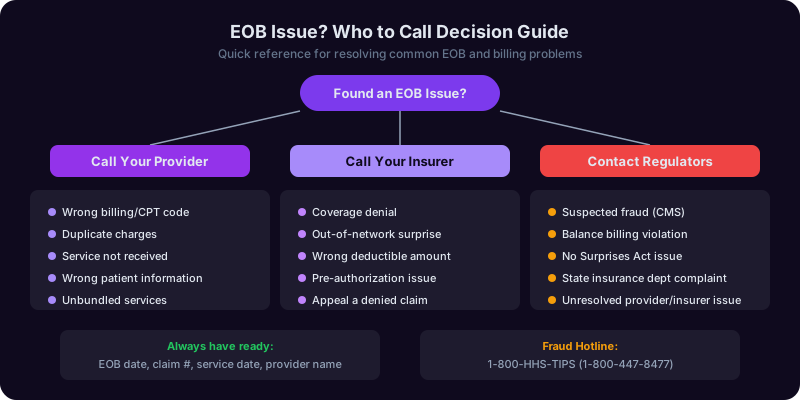
Once you have identified a problem on your EOB, the next question is who to contact. Calling the wrong party wastes time and delays resolution. The answer depends on the type of error you have found. Here is a clear framework for determining whether to call your insurance company, your healthcare provider's billing department, or both.
Call Your Insurance Company When...
Contact your insurer's member services number (printed on the back of your insurance card and on your EOB) in these situations:
- A claim was denied and you believe it should have been covered. The insurer made the coverage determination, so they are the ones who can explain the denial reason and tell you how to appeal. For a complete walkthrough of the appeal process, see our guide on how to appeal a health insurance denial.
- The claim was processed as out-of-network but you used an in-network provider. The insurer controls network designations and can reprocess the claim at in-network rates if the error was on their end.
- Your deductible or out-of-pocket maximum accumulator appears incorrect. The insurer tracks these numbers and can audit your year-to-date totals.
- A preventive service was not covered at 100%. The insurer determines whether a service qualifies as preventive under ACA guidelines. If the coding is correct but the insurer still applied cost-sharing, you need to dispute the coverage decision with them.
- Coordination of benefits is not working correctly. If you have dual coverage and the primary or secondary insurer is not processing claims in the right order, start with the insurer that should be primary.
- You do not understand something on your EOB. Member services representatives are required to explain EOBs in plain language. Ask them to walk through each line item with you.
Call Your Provider's Billing Department When...
Contact the provider's billing office in these situations:
- The bill you received does not match the EOB patient responsibility. The provider generated the bill, so they need to correct it. Have your EOB in front of you and reference the specific amounts.
- You suspect a coding error (wrong CPT or ICD-10 code). The provider's billing department submitted the codes, and they are the ones who can correct and resubmit the claim. Tell them which code appears incorrect and ask them to review the medical record for the correct code.
- You see duplicate charges. The provider's billing system generated the duplicate submission, so they need to void the duplicate claim.
- You were balance billed by an in-network provider. Remind the billing department that their contract with your insurer prohibits balance billing and ask them to adjust the bill to match the EOB's patient responsibility amount.
- Services on the bill were never rendered. The provider needs to review their records and remove charges for services you did not receive.
- You need an itemized bill. Under federal and most state laws, you have the right to receive a detailed, line-by-line itemized bill. The initial statement you receive often shows only summary charges. Request the itemized version before paying.
When to Call Both
Some situations require coordinating with both your insurer and your provider. These include claims that were denied due to missing information that the provider needs to resubmit, situations where the provider says the insurer has not paid them but the EOB shows payment was sent, disputes where the provider and insurer disagree about the allowed amount or contracted rate, and cases where a corrected claim needs to be submitted by the provider and reprocessed by the insurer. In these situations, start with whichever party you believe made the error, get their response in writing or note the details of the call, and then contact the other party with that information.
How to Prepare for the Call
Before calling either your insurer or provider, gather the following: your EOB for the claim in question, the medical bill from the provider, your insurance card with member ID and group number, a pen and paper or digital note to record the call details, and the specific discrepancy or question you want resolved. During the call, record the date, time, representative's name and ID number, reference or case number assigned to your inquiry, what was discussed, and what resolution was promised including the timeline. This documentation is essential if the issue is not resolved on the first call or if you need to escalate. The Insurance Copilot can help you prepare for these calls by analyzing your EOB, identifying the specific issue, and suggesting the right questions to ask.
How to Dispute EOB Errors and Your Rights Under the No Surprises Act
When you have identified a billing error through your EOB review, you need a systematic process to dispute it. The good news is that federal and state laws give you strong protections, and the dispute process, while sometimes time-consuming, is well-defined. The even better news is that the No Surprises Act, which took effect in 2022 and has been expanded through 2026 regulations, provides specific protections against some of the most costly billing practices.
Step-by-Step Dispute Process
- Request an itemized bill. Before disputing anything, make sure you have a complete, line-by-line itemized bill from your provider. The summary statement many providers send initially does not provide enough detail to identify specific errors. You have a legal right to receive an itemized bill. Under the Consolidated Appropriations Act of 2021 and subsequent CMS guidance, providers must furnish itemized bills within 30 days of a request.
- Document the error in writing. Write a clear, concise letter or email to the appropriate party (insurer or provider, based on the framework in the previous section) identifying the specific error. Include your name, member ID, date of service, claim number from the EOB, the specific charge you are disputing, why you believe it is incorrect, and what resolution you are requesting. Keep a copy of everything you send.
- Request a claim review or correction. Ask the provider to correct and resubmit the claim (for coding errors, duplicates, or services not rendered) or ask the insurer to reprocess the claim (for coverage, network, or accumulator errors). Set a clear follow-up date, typically 30 days, and mark your calendar.
- Escalate if not resolved. If the error is not corrected within 30 days, escalate by sending a follow-up letter referencing your original dispute and the lack of resolution, filing a complaint with your state Department of Insurance (for insurer errors) or state attorney general's consumer protection division (for provider billing errors), and contacting the provider's patient advocate or compliance department if the billing office is unresponsive.
- Do not pay the disputed amount while the dispute is active. You are not obligated to pay charges that are under active dispute. If the provider threatens collections, inform them in writing that the charge is disputed and reference the specific error. Under the Fair Debt Collection Practices Act, a debt collector must cease collection activity on a disputed debt until the dispute is resolved.
No Surprises Act Protections
The No Surprises Act is one of the most significant consumer protection laws affecting medical billing in the past decade. It directly impacts what you see on your EOB in several ways:
- Emergency services: If you receive emergency care at an out-of-network facility, your cost-sharing (copay, coinsurance, deductible) must be calculated at in-network rates. The provider and insurer must resolve the payment difference between themselves through an independent dispute resolution process. Your EOB should reflect in-network cost-sharing for emergency services regardless of the provider's network status.
- Surprise out-of-network providers at in-network facilities: If you go to an in-network hospital but are treated by an out-of-network anesthesiologist, radiologist, pathologist, or other provider without your advance knowledge and consent, the No Surprises Act limits your cost-sharing to in-network amounts. Check your EOB to ensure these services are processed at in-network rates.
- Good faith estimates for uninsured and self-pay patients: If you are uninsured or choose to pay out of pocket, providers must give you a good faith estimate of expected charges. If the final bill exceeds the estimate by $400 or more, you can dispute the difference through a patient-provider dispute resolution process.
- Advanced EOBs: For scheduled services, insurers are required to provide an Advanced EOB upon request, showing the estimated cost-sharing for a planned service before you receive it. This lets you understand your financial responsibility and make informed decisions about your care.
If your EOB shows cost-sharing that violates No Surprises Act protections, you can file a complaint at cms.gov/nosurprises or call the No Surprises Help Desk at 1-800-985-3059. You can also contact your state's consumer assistance program, many of which have been expanded to handle No Surprises Act complaints.
State-Level Billing Protections
Many states have enacted their own surprise billing and billing transparency laws that provide protections beyond the federal No Surprises Act. States including California, New York, Texas, Colorado, and Oregon have particularly strong consumer protections that may apply to billing situations not covered by the federal law. Check with your state Department of Insurance to understand the full scope of protections available to you.
How Copilotly Helps You Read, Understand, and Act on Your EOB
Reading an EOB and catching billing errors requires understanding medical billing codes, insurance terminology, network rules, and federal protections. For most patients, this is not knowledge they use regularly enough to feel confident about. This is exactly the type of problem that AI-powered tools are designed to solve: taking complex, specialized information and making it accessible and actionable for non-experts.
Using the Health Copilot for EOB Analysis
The Health Copilot on Copilotly can help you make sense of the clinical side of your EOB. When you see procedure codes (CPT) and diagnosis codes (ICD-10) on your EOB, the Health Copilot can explain in plain language what each code means, what procedure was performed, and what diagnosis it was linked to. This is critical for catching coding errors because you cannot identify a wrong code if you do not know what the codes mean. If your EOB shows CPT 99215 (comprehensive office visit, 40+ minutes) but you had a 10-minute follow-up appointment, the Health Copilot can flag that discrepancy and explain why it matters for your bill.
The Health Copilot can also help you understand whether the services listed on your EOB are clinically appropriate for your diagnosis. If your EOB shows charges for diagnostic tests that seem unrelated to the reason for your visit, the Health Copilot can help you evaluate whether those tests make medical sense or whether they might be billing errors. This is not a replacement for your doctor's clinical judgment, but it is a useful screening tool for identifying charges that warrant a closer look.
Using the Insurance Copilot for Coverage and Dispute Support
The Insurance Copilot focuses on the financial and regulatory side of your EOB. It can help you understand your coverage by explaining in plain language what your plan covers for specific services, how your deductible and out-of-pocket maximum work, and what cost-sharing applies to different types of care. When your EOB shows a denial or partial coverage, the Insurance Copilot can explain the denial reason, identify whether it might be an error, and outline your options for dispute or appeal.
For patients who need to dispute an EOB error, the Insurance Copilot can help draft a dispute letter that includes the specific claim information, a clear description of the error, the relevant legal protections (including No Surprises Act provisions if applicable), and a request for specific resolution. It can also help you prepare for phone calls with your insurer or provider by suggesting the right questions to ask and the information to have ready.
Practical Workflow: From EOB to Resolution
Here is how to use Copilotly as part of your EOB review workflow:
- Receive your EOB through your insurer's portal or mail.
- Review it with the Health Copilot to understand the procedure and diagnosis codes, verify they match the services you received, and flag any clinical discrepancies.
- Check the financial details with the Insurance Copilot to verify cost-sharing calculations, confirm deductible and out-of-pocket accumulator accuracy, and ensure network status was applied correctly.
- Compare against your medical bill using the side-by-side comparison process outlined earlier in this guide.
- If you find an error, use the Insurance Copilot to draft your dispute communication, whether it is a letter to the provider's billing department, a call to your insurer, or a formal appeal for a denied claim.
This process takes 10 to 15 minutes per EOB and can save you hundreds of dollars per billing error caught. For patients with chronic conditions, ongoing treatments, or complex medical situations involving multiple providers, this systematic review process is especially valuable because the volume and complexity of claims increases the probability of errors.
The goal of using AI for EOB review is not to replace your own judgment or your relationship with your healthcare providers. It is to give you the knowledge and confidence to ask the right questions, catch errors that would otherwise go unnoticed, and assert your rights when billing mistakes occur. In a healthcare system that processes billions of claims through automated systems, having an AI tool that helps you verify the output of those systems is a practical safeguard for your financial health. For a broader understanding of how to navigate health insurance beyond EOBs, explore our complete health insurance guide and our guide on what to do when you cannot afford healthcare.
Frequently Asked Questions
Recommended Copilots
Recommended Copilots
Look up CPT and ICD-10 codes, understand medical procedures listed on your EOB, and verify that billed services match what you actually received.
Try Free →Decode EOB terminology, verify cost-sharing calculations, check deductible and out-of-pocket accumulator accuracy, and draft dispute letters for billing errors.
Try Free →Related Articles
Get Answers From the Health Copilot
Ask a specialist AI copilot the question you just read about. Your first conversation needs no signup and no card.