

What a Prenuptial Agreement Actually Is (and Isn't)
A prenuptial agreement is a legally binding contract signed by both partners before marriage that defines how assets, debts, and financial responsibilities will be handled during the marriage and in the event of divorce. Think of it as a financial blueprint that you create while you still like each other, rather than leaving those decisions to a judge who knows nothing about your life.
Prenups are governed by state law, and every state recognizes them as valid contracts. The Uniform Premarital Agreement Act (UPAA) has been adopted in some form by 28 states and the District of Columbia, providing a common legal framework. However, each state has its own specific requirements for what makes a prenup enforceable.
What a prenup CAN do:
- Define which assets are separate property and which are marital property
- Protect a business you own or plan to start
- Protect you from your partner's debts (including student loans)
- Determine spousal support (alimony) terms or waive it entirely
- Protect inheritance rights for children from a previous relationship
- Establish financial responsibilities during the marriage (who pays which bills, savings goals)
What a prenup CANNOT do:
- Determine child custody or child support (courts always decide this based on the child's best interest)
- Include terms that are illegal or encourage divorce
- Waive rights to basic necessities or leave one spouse destitute
- Include personal lifestyle clauses (weight requirements, chore duties) in most states
The Legal Copilot can explain your state's specific rules about what can and cannot be included in a prenuptial agreement.
Who Actually Needs a Prenup
The outdated perception is that prenups are only for millionaires protecting their fortune. The reality in 2026 is very different. A Harris Poll found that 40% of unmarried adults say they would want a prenup before marriage, and the number rises to 50% among millennials. Here are the situations where a prenup is especially valuable:

You own a business. Without a prenup, your spouse may be entitled to a share of your business in a divorce, even if they never worked in it. A business valued at $500,000 at the time of marriage that grows to $2 million during the marriage could mean your ex-spouse claims $750,000 or more in some states. A prenup can keep the business as separate property.
You have significant student loan debt (or your partner does). The average student loan balance is approximately $37,000. In community property states, debt acquired during the marriage can become shared. A prenup can clarify that each partner is responsible for their own pre-existing debt.
You have children from a previous relationship. Without a prenup, a new spouse may have claims to assets you intended to leave to your children. This is especially important for blended families and estate planning. Our guide on writing a will covers how to coordinate your will with a prenup for maximum protection.
One partner earns significantly more than the other. A prenup can establish fair spousal support terms upfront, protecting both the higher-earning partner from excessive claims and the lower-earning partner from receiving nothing.
You are bringing significant assets into the marriage. Real estate, retirement accounts, investments, or inheritance are all easier to protect with a prenup than trying to trace separate property during a contentious divorce.
You live in a community property state. Nine states (Arizona, California, Idaho, Louisiana, Nevada, New Mexico, Texas, Washington, and Wisconsin) treat most assets acquired during marriage as 50/50. A prenup lets you opt out of this default.
The Family Law Copilot can help you evaluate whether your specific financial situation would benefit from a prenup.
How Much a Prenup Costs in 2026
Prenup costs vary widely depending on complexity, location, and whether both parties hire separate attorneys (which is strongly recommended for enforceability).
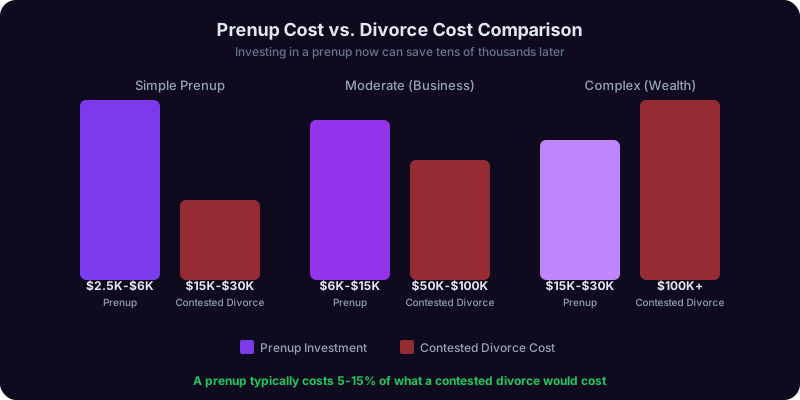
Typical cost ranges:
- Simple prenup (straightforward assets, no business): $1,500 to $3,000 per person for attorney fees
- Moderate prenup (business interests, real estate, blended family): $3,000 to $7,500 per person
- Complex prenup (significant wealth, multiple businesses, trusts): $7,500 to $15,000+ per person
The total cost for a couple typically ranges from $2,500 to $10,000 for a standard prenup. That may sound expensive, but consider this: the average cost of a contested divorce in the United States is $15,000 to $30,000, and divorces involving disputes over business assets or significant property can easily exceed $50,000 to $100,000. A prenup is essentially divorce insurance.
Online prenup services have emerged in recent years, charging $300 to $2,000. Services like HelloPrenup, Prenup.com, and Rocket Lawyer offer templated agreements that you can customize. These are better than nothing, but they carry risks. A judge may scrutinize a template agreement more closely than one drafted by experienced attorneys. If your situation involves a business, significant assets, or complex state law issues, invest in proper legal counsel.
Who pays for the prenup? There is no legal rule. Some couples split the cost equally. In some cases, the partner who wants the prenup pays for both attorneys. The approach that best protects enforceability is for each person to hire and pay for their own independent attorney.
The Finance Copilot can help you evaluate whether the cost of a prenup is justified based on your specific asset profile and risk factors.

Get Answers From the Legal Copilot
Ask the Legal Copilot about prenuptial agreement requirements, costs, and enforceability rules specific to your state and financial situation.
Key Clauses Every Prenup Should Include
A well-drafted prenup addresses the most common financial conflicts that arise in divorce. Here are the clauses that experienced family law attorneys recommend including:

1. Asset classification. Clearly list each partner's separate property (assets owned before marriage) and define how property acquired during the marriage will be classified. Include a schedule of assets attached to the agreement. This is the backbone of the prenup.
2. Debt allocation. Specify that each partner is responsible for their own pre-marital debts. Define how debt acquired during the marriage (mortgage, car loans, credit cards) will be allocated in a divorce.
3. Business protection. If either partner owns a business, define whether the business and its growth during the marriage are separate or marital property. Many prenups classify the business itself as separate property but provide the non-owner spouse with compensation for the business's growth during the marriage. Understanding how to read and negotiate contracts is helpful when reviewing the business valuation clauses.
4. Spousal support (alimony). Define whether spousal support will be paid, for how long, and in what amount. Some prenups use formulas (for example, $2,000 per month for every 5 years of marriage). Some waive alimony entirely. Note that courts in some states (California, for example) can override alimony waivers if enforcement would be unconscionable.
5. Property division. Define how the marital home and other real estate will be divided. Common approaches include selling and splitting proceeds, one partner buying out the other at fair market value, or the custodial parent retaining the home until the youngest child turns 18.
6. Retirement accounts. Address 401(k)s, IRAs, pensions, and other retirement assets. Without a prenup, retirement contributions made during the marriage are typically marital property subject to division.
7. Sunset clause. Some prenups include a provision that the agreement expires after a certain number of years (often 10 to 20 years) or after certain milestones (such as having children). This addresses the concern that a prenup drafted for a young couple may not reflect their circumstances decades later.
8. Infidelity clause. Some states allow clauses that alter the financial terms if one partner commits adultery. These are enforceable in some states but not others. The Legal Copilot can tell you whether infidelity clauses are enforceable in your state.
State Requirements for a Valid Prenup
A prenup is only useful if a court will enforce it. Courts throw out prenups more often than most people realize. Here are the requirements that virtually every state imposes:
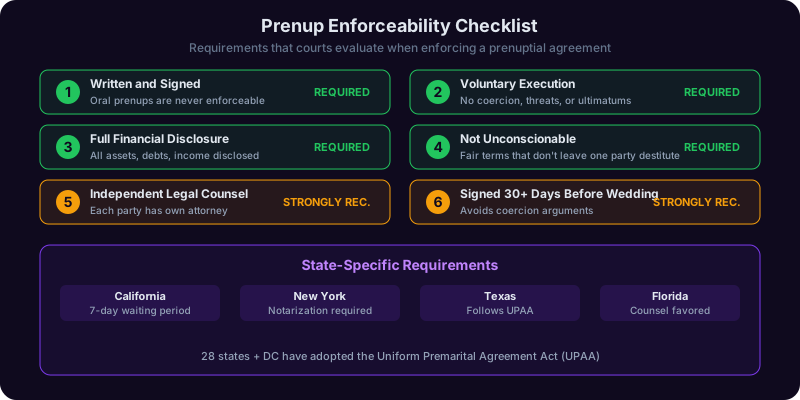
Written agreement. Oral prenups are not enforceable anywhere. The agreement must be in writing and signed by both parties.
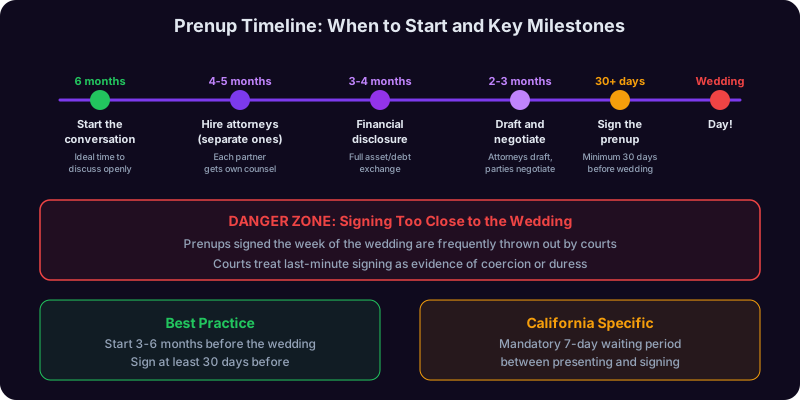
Voluntary execution. Both parties must sign voluntarily, without coercion or duress. A prenup presented the night before the wedding, with an ultimatum to "sign or the wedding is off," is the classic scenario that courts invalidate. Best practice: finalize the prenup at least 30 days before the wedding, and ideally 2 to 3 months before.
Full financial disclosure. Both parties must fully disclose their assets, debts, income, and financial obligations. Hiding assets is the fastest way to get a prenup thrown out. Attach complete financial schedules to the agreement.
Independent legal counsel. While not legally required in every state, having each party represented by their own attorney dramatically increases enforceability. In California, a prenup waiving spousal support is automatically unenforceable unless the waiving party had independent legal counsel. The FindLaw prenuptial agreement resource provides additional state-specific guidance.
Not unconscionable. A prenup that is grossly unfair to one party at the time of enforcement may be invalidated. A prenup that leaves a stay-at-home parent of 15 years with nothing while the other spouse keeps $5 million is unlikely to survive judicial scrutiny.
State-specific nuances:
- California: Requires a 7-day waiting period between presenting the final prenup and signing it
- New York: Requires the prenup to be notarized and signed with the same formalities as a deed
- Texas: Community property state where prenups are especially important; follows the UPAA
- Florida: Does not require independent counsel but strongly favors it for enforceability
The Family Law Copilot can walk you through your specific state's requirements and help you identify potential enforceability issues before you finalize the agreement.
How to Bring Up a Prenup Without Ruining Your Relationship
The conversation about a prenup is often harder than the legal process itself. A 2024 survey by The Knot found that 73% of people who wanted a prenup were afraid to bring it up, fearing their partner would see it as a lack of trust or a prediction of divorce. Here is how to have the conversation productively.
Start early. Do not wait until the wedding invitations are printed. Bring up the topic during engagement or even before you get engaged. Frame it as part of your financial planning conversation, not as a legal maneuver.
Frame it as mutual protection. A prenup protects both partners, not just the wealthier one. If your partner has student loans, the prenup protects you from inheriting that debt. If you quit your career to raise children, the prenup can guarantee you financial support. Present it as "our plan" rather than "my demand."
Use "we" language. Instead of "I want a prenup to protect my assets," try "I think we should create a financial agreement so we're both protected and on the same page about money from the start." The framing matters enormously.
Normalize it. Share articles, statistics, or stories about couples who benefited from prenups. Mention that financial disagreements are the second leading cause of divorce (after infidelity), and a prenup forces you to have the money conversations that many couples avoid until it is too late.
Be transparent about your reasons. If you own a business, explain that your business partners or investors may require it. If you have children from a previous marriage, explain that you need to protect their inheritance. If you have been through a difficult divorce before, be honest about that experience.
Suggest couples financial counseling. If your partner is resistant, offer to see a financial planner together before involving lawyers. A neutral third party can help both of you understand the financial implications of marriage with and without a prenup.
The Estate Planning Copilot can help you understand how a prenup fits into your broader financial and estate plan.
Prenup vs. Postnup: What If You Are Already Married?
If you are already married and did not get a prenup, you are not out of options. A postnuptial agreement is essentially the same contract, signed after the wedding. Postnuptial agreements are recognized in all 50 states, though the enforceability standards are generally stricter than for prenups.
Why couples get postnups:
- One partner starts a business during the marriage and wants to clarify ownership
- One partner receives a large inheritance and wants to keep it separate
- The couple is considering separation and wants to define terms before deciding
- Financial circumstances have changed dramatically since the wedding (major career change, significant debt, windfall)
- One partner was unfaithful and the couple is reconciling with new financial terms
Key differences from a prenup: Because you are already married, courts scrutinize postnups more closely for fairness. The concern is that one spouse may have more leverage or more access to information than the other within an existing marriage. Full financial disclosure is even more critical, and independent legal counsel for both parties is strongly recommended (and required in some states). The Nolo postnuptial agreement guide provides additional details on state-by-state requirements.
Cost: Postnup costs are similar to prenup costs, typically $2,500 to $10,000 total for both attorneys. Some couples use a postnup as a way to formalize financial agreements they have been operating under informally.
If you are considering divorce and need to understand the full process, our divorce filing guide covers every step. The Legal Copilot can help you understand whether a postnup makes sense for your situation and what your state requires for enforceability.
7 Mistakes That Get Prenups Thrown Out
A prenup is only as strong as its drafting and execution. Here are the most common mistakes that lead courts to invalidate prenuptial agreements:
1. Signing too close to the wedding. A prenup signed the day before or the week of the wedding invites a coercion argument. Courts have thrown out prenups signed even 2 to 3 weeks before the ceremony. Best practice is 30 to 90 days before.
2. Incomplete financial disclosure. If either party fails to fully disclose assets, the prenup can be voided entirely. This includes failing to disclose the value of a business, stock options, cryptocurrency holdings, or offshore accounts. Attach detailed financial statements to the agreement.
3. Only one attorney for both parties. Having a single attorney draft the prenup and advise both parties creates a conflict of interest. Courts strongly disfavor this arrangement. Each party should have independent counsel.
4. Unconscionable terms. A prenup that leaves one spouse with virtually nothing after a long marriage, especially if that spouse sacrificed career opportunities to raise children, will likely be modified or invalidated by a court.
5. Including unenforceable provisions. Clauses about child custody, child support, or illegal activities can taint the entire agreement. Some courts sever the invalid provisions; others throw out the whole prenup.
6. Failing to update the prenup. A prenup drafted when you had $50,000 in assets may not reflect your situation when you have $5 million. Major life changes (children, career shifts, significant wealth changes) may warrant an amendment.
7. Not following state-specific procedures. California's 7-day waiting period, New York's notarization requirements, and other state-specific rules are not optional. Missing any procedural requirement can invalidate the agreement. Understanding your power of attorney options is another part of comprehensive legal planning that protects your interests.
The Family Law Copilot can review your prenup process and flag potential enforceability issues before you sign.
Frequently Asked Questions
Recommended Copilots
Recommended Copilots
Get guidance on prenuptial agreement requirements and enforceability in your state
Try Free →Understand how family law in your state affects prenup terms and divorce proceedings
Try Free →Evaluate whether a prenup makes financial sense for your specific asset and debt profile
Try Free →Continue Exploring
Related Scenarios
How It Works
Related Articles
Get Answers From the Legal Copilot
Ask the Legal Copilot about prenuptial agreement requirements, costs, and enforceability rules specific to your state and financial situation.