

Grounds for Divorce: No-Fault vs. Fault-Based (State-by-State Comparison)
Before you file a single piece of paperwork, you need to understand the legal basis for your divorce. Every state requires you to state a ground - a legally recognized reason - for ending the marriage. The ground you choose affects the timeline, the complexity, and in some states, the outcome of your case.
No-Fault Divorce
Every state in the U.S. now offers some form of no-fault divorce, meaning you do not have to prove that your spouse did something wrong. The most common no-fault ground is irreconcilable differences - a legal term that simply means the marriage is broken and cannot be repaired. Some states use alternative language such as "irretrievable breakdown of the marriage" or "incompatibility." In a no-fault divorce, neither party is blamed, and the court does not need to hear evidence of misconduct.
No-fault divorce is overwhelmingly the most common path. It is faster, less expensive, less emotionally damaging, and in most cases leads to the same outcome as a fault-based filing. If both spouses agree the marriage is over, no-fault is almost always the right choice.
Fault-Based Divorce
Some states still allow (or in rare cases require) you to file for divorce on fault-based grounds. Common fault grounds include:
- Adultery: One spouse engaged in a sexual relationship outside the marriage.
- Cruelty or abuse: Physical, emotional, or psychological abuse by one spouse.
- Abandonment or desertion: One spouse left the marital home for a specified period (typically 6-12 months) without consent or justification.
- Substance abuse: Habitual drunkenness or drug addiction.
- Felony conviction or imprisonment: One spouse has been convicted of a felony and/or imprisoned for a specified period.
- Impotence: Recognized in a handful of states as a ground if it existed at the time of marriage and was not disclosed.
Filing on fault grounds requires evidence. You must prove the misconduct to the court's satisfaction, which means witnesses, documentation, and often a contested hearing. This makes fault-based divorce significantly more expensive and time-consuming. However, in some states, proving fault can influence the division of assets, alimony awards, or custody decisions, which is why some people choose this path strategically.

State-by-State Comparison
| State | No-Fault Available | Fault Grounds Available | Separation Requirement |
|---|---|---|---|
| California | Yes (irreconcilable differences) | No (purely no-fault state) | None |
| Texas | Yes (insupportability) | Yes (adultery, cruelty, abandonment, felony conviction, confinement in mental hospital, living apart 3+ years) | None for no-fault |
| New York | Yes (irretrievable breakdown for 6+ months) | Yes (cruel and inhuman treatment, abandonment 1+ year, imprisonment 3+ years, adultery) | None for no-fault; some fault grounds require time periods |
| Florida | Yes (irretrievably broken) | No (purely no-fault state) | None |
| Illinois | Yes (irreconcilable differences) | No (eliminated fault grounds in 2016) | 6-month separation or waivable |
| Virginia | Yes (living separate and apart) | Yes (adultery, cruelty, abandonment, felony conviction) | 6 months (with children) or 1 year (without) for no-fault |
| North Carolina | Yes (living separate and apart) | Limited (incurable insanity) | 1 year mandatory separation |
| Pennsylvania | Yes (irretrievable breakdown with mutual consent, or 1-year separation) | Yes (adultery, cruelty, abandonment, bigamy, imprisonment, indignities) | 1 year if no mutual consent |
Note that several states - including California, Florida, Oregon, Washington, Wisconsin, Montana, Nebraska, Michigan, Hawaii, Minnesota, Colorado, Indiana, Iowa, Kansas, and Kentucky - are purely no-fault states and do not allow fault-based filings at all.
Separation Requirements
Some states require couples to live apart for a specified period before a divorce can be finalized. This ranges from no requirement at all (California, Florida, Texas) to a full year (North Carolina, Virginia without children, Pennsylvania without mutual consent). The separation period must typically be continuous - moving back in together, even briefly, may reset the clock.
Understanding which ground to use and whether your state has a separation requirement is the essential first step. You can look up your state's specific divorce statutes through the U.S. Courts family law overview or your state's judicial branch website. The Legal Copilot can help you identify the specific grounds and requirements in your state so you can plan accordingly. For broader legal context, the legal resource hub covers a range of situations where understanding your rights matters.
Disclaimer: This guide provides general legal information about the divorce process in the United States. It is not legal advice and does not create an attorney-client relationship. Divorce laws vary significantly by state, and the outcome of any case depends on its specific facts. If you are considering divorce, especially where children, significant assets, or domestic violence are involved, consult a licensed family law attorney in your state.
Contested vs. Uncontested Divorce: Which Path Applies to You
The single biggest factor that determines how long your divorce takes, how much it costs, and how stressful the process will be is whether your divorce is contested or uncontested. Understanding the distinction early allows you to set realistic expectations and choose the right strategy.
Uncontested Divorce
An uncontested divorce means both spouses agree on all major issues: the grounds for divorce, the division of property and debts, spousal support, child custody and visitation, and child support. Both parties sign a settlement agreement, submit it to the court, and the judge approves it - often without a hearing or with a brief procedural hearing.
Advantages of an uncontested divorce:
- Speed: Many uncontested divorces are finalized in 1-3 months, depending on the state's mandatory waiting period.
- Cost: Typically $500-$2,500 total (filing fees plus minimal attorney or document preparation costs).
- Privacy: Because there is no trial, the details of your finances and personal life are not aired in open court.
- Less emotional damage: Particularly important when children are involved. A cooperative process reduces conflict and models healthy resolution for kids.
- Control: You and your spouse decide the terms, rather than having a judge impose them.
An uncontested divorce is realistic when both spouses are communicating, there is no history of abuse or severe power imbalance, and the financial situation is relatively straightforward. It does not require that you and your spouse agree on everything from day one - many couples reach agreement through negotiation or mediation.
Contested Divorce
A contested divorce means the spouses cannot agree on one or more major issues, and the court must intervene to resolve the dispute. This can involve hearings, depositions, discovery (formal exchange of financial and other information), expert witnesses, and ultimately a trial where a judge makes the final decisions.
Common reasons a divorce becomes contested:
- Disagreement over who gets the house or how retirement accounts should be divided
- Disputes about child custody or parenting time
- One spouse claims the other is hiding assets or income
- Spousal support disagreements - whether it should be paid, how much, and for how long
- One spouse refuses to agree to the divorce at all (though this cannot prevent it indefinitely in any state)
- Allegations of fault, such as adultery or cruelty, that one party wants the court to consider
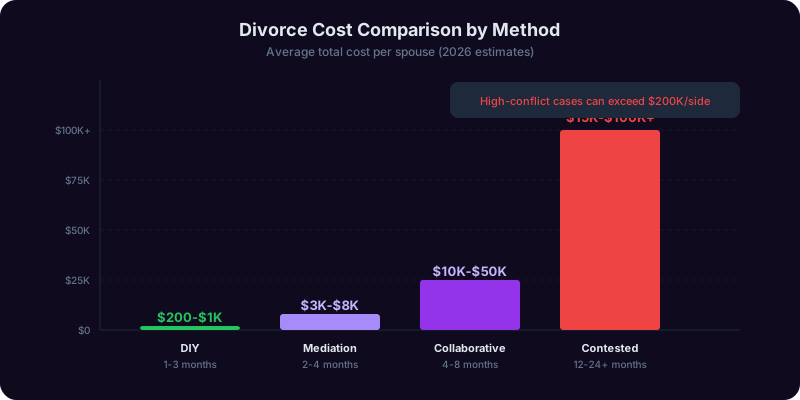
Contested divorces are significantly more expensive, typically costing $15,000-$100,000+ in attorney fees, and they often take 12-24 months or longer to resolve. They are emotionally exhausting and can damage the co-parenting relationship for years after the decree is signed.
The Middle Ground: Mediation and Collaborative Divorce
Most divorces do not need to be fully contested or perfectly uncontested. There are structured processes designed to help you reach agreement without a trial:
- Mediation: A neutral third party (the mediator) helps both spouses negotiate a settlement. The mediator does not decide anything - they facilitate discussion and help bridge disagreements. Mediation typically costs $3,000-$8,000 total and resolves most divorces in 3-6 sessions. Success rates are high: approximately 70-80% of mediated divorces reach a full agreement.
- Collaborative divorce: Each spouse hires their own attorney, but all parties agree in advance to resolve the case through negotiation rather than litigation. If the collaborative process fails and the case goes to court, both attorneys must withdraw and the spouses hire new ones. This creates a strong incentive for everyone to negotiate in good faith. Cost: $5,000-$25,000 per spouse.
- Arbitration: A private judge (the arbitrator) hears both sides and makes a binding decision. This is faster and more private than court litigation but still involves an adversarial process. Less common in divorce but available in some states.
If you are unsure whether your divorce will be contested, the honest answer depends on your spouse's willingness to negotiate. Starting with a conversation about whether mediation or an uncontested process is possible can save both of you tens of thousands of dollars. The Family Law Copilot can help you evaluate which approach makes sense for your situation and what to expect from each path.
The Filing Process: Step-by-Step Guide to Filing for Divorce
Regardless of whether your divorce is contested or uncontested, the procedural steps follow a similar framework. Here is exactly what happens, in order, from the decision to file through the final decree.
Step 1: Meet Your State's Residency Requirements
Before you can file for divorce in any state, you (or your spouse) must meet that state's residency requirement. Most states require that at least one spouse has been a resident for a minimum period:
- 6 months: California, New York, Illinois, Pennsylvania, and most other states
- 90 days: Idaho, Wyoming (in the county where you file)
- 60 days: Nevada (one of the shortest - historically a destination for quick divorces)
- 12 months: Some states for military personnel filing under specific circumstances
You typically must file in the county where you or your spouse currently reside. If you recently moved, check whether you have met the new state's residency requirement or need to file in your previous state.
Step 2: Gather Essential Documents
Before you file, assemble the following documents. You will need them for the petition, financial disclosures, and settlement negotiations:
- Marriage certificate (certified copy)
- Financial records: Bank statements (all accounts, last 12 months), credit card statements, investment and retirement account statements, tax returns (last 3 years), pay stubs (last 6 months)
- Property records: Mortgage statements, property deeds, vehicle titles, appraisals
- Debt documentation: Outstanding loans, credit card balances, medical bills, student loans
- Insurance policies: Health, life, auto, and homeowner's insurance details
- Business records: If either spouse owns a business, profit-and-loss statements, business tax returns, and valuation documents
- Prenuptial or postnuptial agreement, if one exists
- Children's records: Birth certificates, school enrollment, medical records, childcare expenses
Having these documents organized before you file prevents delays during financial disclosure and gives you a clear picture of the marital estate. The Finance Copilot can help you create a comprehensive inventory of your financial situation.
Step 3: File the Petition (Complaint) for Divorce
The spouse who initiates the divorce is called the petitioner (or plaintiff). They file a petition for dissolution of marriage (also called a complaint for divorce) with the family court in the appropriate county. The petition includes:
- Names and addresses of both spouses
- Date and location of the marriage
- Names and dates of birth of minor children
- The grounds for divorce (no-fault or fault)
- What the petitioner is requesting: property division, custody arrangements, spousal support, child support
Filing fees range from $100-$450 depending on the state and county. Fee waivers are available in most states for those who demonstrate financial hardship. You can check your local court's filing fee schedule through the Nolo divorce filing FAQ or by contacting your county clerk's office directly.
Step 4: Serve Your Spouse
After filing, you must formally serve your spouse with copies of the petition and a summons. Service ensures your spouse has legal notice of the proceedings. Methods of service vary by state but typically include:
- Personal service: A process server or sheriff's deputy physically delivers the documents to your spouse. This is the most common and universally accepted method.
- Service by mail: Some states allow certified mail with return receipt requested.
- Waiver of service: In uncontested cases, the spouse can sign a waiver acknowledging they received the documents, eliminating the need for formal service.
You generally cannot serve your spouse yourself. A third party must deliver the papers. Process server fees typically range from $50-$150.
Step 5: Your Spouse Responds
After being served, your spouse (now called the respondent or defendant) has a deadline to file a response (also called an answer). This is typically 20-30 days, depending on the state. The response indicates whether the respondent agrees with the terms in the petition, disagrees, or wants to make their own requests (a counter-petition).
If the respondent does not file a response within the deadline, the petitioner can request a default judgment - the court may grant the divorce on the petitioner's terms without the respondent's input.
Step 6: Financial Disclosures
Both spouses are required to exchange detailed financial disclosures - sworn statements listing all assets, debts, income, and expenses. This is mandatory in virtually every state, whether the divorce is contested or uncontested. Hiding assets during disclosure is illegal and can result in severe penalties, including the court awarding a larger share of the estate to the other spouse.
Step 7: Negotiate a Settlement or Go to Trial
If both parties can reach agreement on all issues (often through direct negotiation, attorney-assisted negotiation, or mediation), they submit a marital settlement agreement to the court. If they cannot agree, the unresolved issues go to trial, where a judge decides.
Step 8: Final Hearing and Divorce Decree
In an uncontested case, the final hearing may last only 10-20 minutes - the judge reviews the agreement, confirms both parties consent, and signs the decree of dissolution. In a contested case, the trial can last days or weeks. Once the decree is signed, your divorce is final - though some states have a short waiting period before the decree takes legal effect.
If you are managing the paperwork yourself or reviewing documents prepared by an attorney, the Contract Review Copilot can help you understand the terms in your settlement agreement and flag provisions that might be unfavorable. For a broader understanding of legal document review, see our guide on how to read and negotiate contracts.

Get Answers From the Legal Copilot
The Legal and Family Law Copilots walk you through filing requirements, custody considerations, asset division, and financial planning for divorce. Get personalized guidance for your situation before you make decisions that affect your future.
Division of Assets and Debts: Community Property vs. Equitable Distribution
Dividing everything you and your spouse have accumulated during the marriage is often the most complex and contentious part of the divorce process. How your assets and debts are divided depends primarily on which state you live in and whether it follows community property or equitable distribution rules.
Community Property States (50/50 Split)
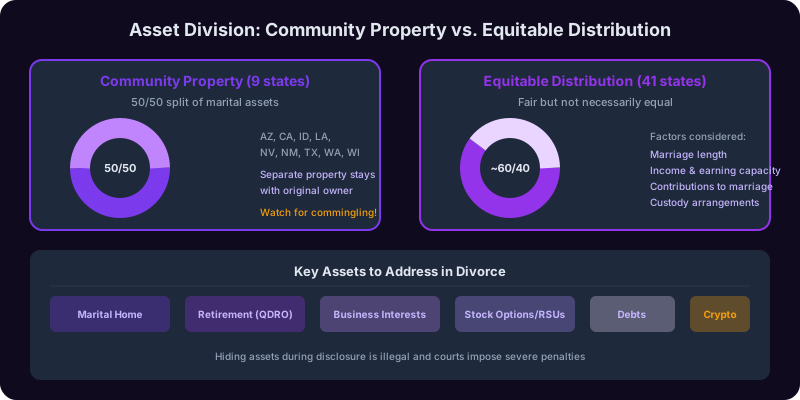
Nine states follow community property law: Arizona, California, Idaho, Louisiana, Nevada, New Mexico, Texas, Washington, and Wisconsin. Alaska allows couples to opt in to community property by agreement.
In community property states, virtually all assets and debts acquired during the marriage are considered equally owned by both spouses, regardless of who earned the income or whose name is on the account. Upon divorce, these assets are divided 50/50 (though some community property states allow the court to deviate from a strict 50/50 split in limited circumstances).
Separate property - assets owned before the marriage, gifts received by one spouse individually, and inheritances - remains with the owning spouse and is not subject to division. However, if separate property has been commingled with marital property (for example, depositing an inheritance into a joint bank account or using premarital savings to improve the marital home), it may lose its separate character and become divisible.
Equitable Distribution States (Fair, Not Necessarily Equal)
The remaining 41 states follow equitable distribution, which means marital property is divided fairly - but not necessarily equally. A judge considers a range of factors to determine what is equitable:
- Length of the marriage: Longer marriages generally result in a more equal split.
- Each spouse's income and earning capacity: A stay-at-home parent who sacrificed career advancement may receive a larger share.
- Contributions to the marriage: Both financial contributions and non-financial contributions (homemaking, childcare, supporting a spouse's education) are considered.
- Age and health of each spouse: An older or ill spouse may receive more assets or longer support.
- Custody arrangements: The parent with primary custody of children may receive the marital home or a larger share of liquid assets.
- Each spouse's separate property and financial resources
- Tax consequences of the division
- Whether either spouse wasted or dissipated marital assets (e.g., gambling losses, spending on an affair)
In practice, equitable distribution often results in a split somewhere between 50/50 and 60/40, but the range can be wider in cases with significant disparities in income, health, or misconduct.
Key Assets to Address
| Asset Type | Key Considerations |
|---|---|
| The marital home | Options include: one spouse buys out the other, the home is sold and proceeds split, or one spouse retains exclusive use (often the custodial parent) until a specified event (children turn 18, remarriage). A formal appraisal is essential. |
| Retirement accounts | 401(k)s, pensions, and IRAs accumulated during the marriage are divisible. Dividing a 401(k) or pension requires a Qualified Domestic Relations Order (QDRO) - a court order directing the plan administrator to split the account. Rolling over retirement funds without a QDRO can trigger taxes and penalties. |
| Business interests | If either spouse owns a business, it must be valued. Business valuation methods include asset-based approaches, income-based approaches, and market comparisons. Disputes over business valuation are among the most expensive parts of contested divorces. |
| Stock options and RSUs | Unvested stock options and restricted stock units granted during the marriage are generally considered marital property. Valuation and division can be complex, often requiring a financial expert. |
| Debts | Mortgages, car loans, credit card debt, student loans, and tax liabilities incurred during the marriage are also divided. Importantly, a divorce decree dividing debt between spouses does not bind creditors - if the decree assigns a joint credit card to your spouse but they do not pay, the creditor can still come after you. |
| Digital assets and cryptocurrency | Increasingly relevant. Crypto holdings, NFTs, and other digital assets acquired during the marriage are marital property and must be disclosed and valued. |
Protecting Yourself During Asset Division
The most critical step is complete financial transparency. Know what you own, what you owe, and what your spouse owns and owes. If you suspect your spouse is hiding assets, your attorney can use the discovery process to compel disclosure, subpoena bank and financial records, and hire a forensic accountant. Courts impose severe penalties for hiding assets, including awarding a larger share of the hidden assets to the other spouse.
A prenuptial or postnuptial agreement can simplify asset division significantly by establishing in advance what is separate and marital property. For guidance on prenuptial agreements, see our complete prenuptial agreement guide. If you have questions about how an existing prenuptial agreement might apply, the Contract Review Copilot can help you understand its terms. For guidance on navigating the overall financial picture, the Finance Copilot can help you organize your assets and plan for post-divorce financial stability.
Child Custody Basics: Legal vs. Physical Custody and Best Interest Factors
If you have minor children, custody is likely the most emotionally charged and consequential part of your divorce. Understanding how courts approach custody decisions is essential to advocating for your children's well-being and your own parental rights.
Types of Custody
Courts distinguish between two separate forms of custody, and they are decided independently:
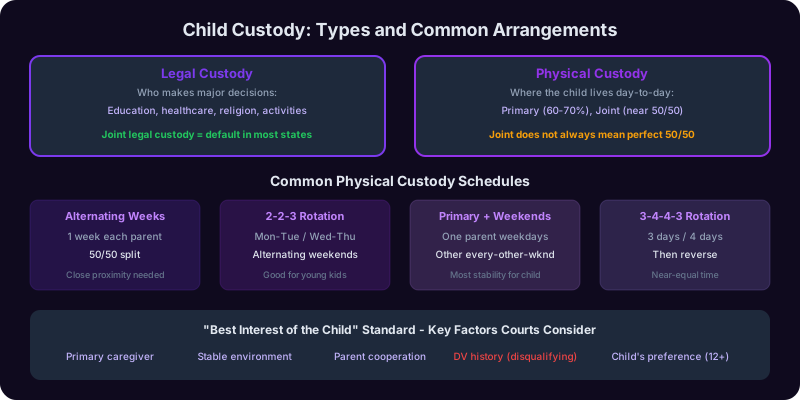
Legal custody refers to the right to make major decisions about the child's life: education (which school they attend, whether they are homeschooled), healthcare (medical treatment, therapy, medications), religion, and extracurricular activities. A parent with legal custody participates in these decisions. Joint legal custody means both parents share decision-making authority and must consult each other on major choices. Sole legal custody means one parent has exclusive decision-making power.
Joint legal custody is the default in most states, and courts strongly prefer it unless one parent is unfit, abusive, or completely uninvolved. Even in high-conflict divorces, judges often award joint legal custody while giving one parent "tie-breaking authority" on specific categories of decisions.
Physical custody refers to where the child lives on a day-to-day basis. Primary physical custody means the child resides primarily with one parent, with the other parent having scheduled parenting time (visitation). Joint physical custody (also called shared custody) means the child splits time relatively equally between both homes - common arrangements include alternating weeks, a 2-2-3 schedule, or a 3-4-4-3 rotation.
Joint physical custody does not necessarily mean a perfect 50/50 split. Many "joint" arrangements are closer to 60/40 or 65/35, reflecting practical realities like work schedules, school proximity, and the child's needs.
The "Best Interest of the Child" Standard
Every state uses some version of the best interest of the child standard as the guiding principle for custody decisions. The Child Welfare Information Gateway provides a comprehensive overview of how each state defines best interest factors. While specific factors vary by state, the most common considerations include:
- The child's emotional and physical needs and which parent has been the primary caregiver
- Each parent's ability to provide a stable, safe, and nurturing home environment
- The child's relationship with each parent, siblings, and other important figures
- Each parent's willingness to support the child's relationship with the other parent - courts look very unfavorably on a parent who undermines or blocks the child's contact with the other parent (sometimes called the "friendly parent" factor)
- The child's adjustment to their current home, school, and community
- The mental and physical health of each parent
- Any history of domestic violence, abuse, or neglect - this is heavily weighted and can be disqualifying
- The child's preference, if the child is old enough and mature enough to express one (many states consider the child's preference at age 12-14, though judges give it varying weight)
- Each parent's work schedule and availability
- Geographic proximity between the parents' homes
Common Custody Arrangements
| Arrangement | Schedule | Works Best When |
|---|---|---|
| Alternating weeks | Child spends one week with each parent | Parents live close to each other and the child's school; both have flexible work schedules |
| 2-2-3 rotation | Mon-Tue with Parent A, Wed-Thu with Parent B, Fri-Sun alternating | Parents want frequent contact; works well for younger children who struggle with long separations |
| Primary custody with every-other-weekend | Child lives primarily with one parent; other parent has every other weekend and one weeknight dinner | One parent works long hours, lives far away, or the child needs schedule stability |
| 3-4-4-3 rotation | Three days with Parent A, four with Parent B, then reverse | Parents want near-equal time; reduces the length of separations |
| Bird's nest custody | The child stays in one home; parents rotate in and out | Rare arrangement used to minimize disruption for the child; requires a high level of cooperation and typically three residences |
Parenting Plans
Most courts require divorcing parents to submit a parenting plan (also called a custody agreement or parenting agreement). This document covers far more than just the weekly schedule:
- Holiday and vacation schedules (Thanksgiving, Christmas, summer break, school holidays, birthdays)
- Transportation arrangements and pick-up/drop-off logistics
- Communication rules (how parents will communicate with each other and how each parent can communicate with the child when they are with the other parent)
- Decision-making procedures for education, healthcare, and religion
- Rules about introducing new partners to the children
- Relocation provisions (what happens if one parent wants to move)
- Dispute resolution (mediation before returning to court)
The more detailed your parenting plan, the fewer conflicts you will have later. Vague plans lead to frequent disputes and return trips to court. The Family Law Copilot can help you think through the components of a comprehensive parenting plan and identify issues you may not have considered.
A Word About Custody and Gender
It is a common misconception that courts automatically favor mothers in custody disputes. While historical patterns leaned that way, modern family law in every state is officially gender-neutral. Judges are legally required to apply the best interest factors without regard to the parent's gender. In practice, the parent who has been the primary caregiver - the one who handled school pickups, doctor's appointments, homework help, and daily routines - has a practical advantage because continuity of care is a best-interest factor. If both parents were equally involved caregivers, courts increasingly award joint physical custody.
Spousal Support and Alimony: Types, Factors, and Duration
Spousal support (also called alimony or spousal maintenance, depending on the state) is a court-ordered payment from one spouse to the other during or after the divorce. Its purpose is to prevent an unfair economic impact on the lower-earning spouse - particularly when one spouse sacrificed career opportunities to support the marriage, raise children, or contribute to the other spouse's education and career advancement.
Types of Spousal Support
Courts may award several different types of support, sometimes combining more than one:
- Temporary support (pendente lite): Paid during the divorce process, before the final decree. This helps the lower-earning spouse maintain a reasonable standard of living while the case is pending. Temporary support automatically ends when the divorce is finalized and may be replaced by a longer-term award.
- Rehabilitative support: The most common type. Paid for a defined period to allow the receiving spouse to gain education, training, or work experience to become self-supporting. Example: a spouse who left the workforce for 10 years to raise children receives support for 3-5 years while completing a degree and re-entering the job market.
- Permanent support: Open-ended support with no set termination date. Increasingly rare and generally reserved for long marriages (20+ years) where the receiving spouse is older, in poor health, or otherwise unlikely to become fully self-supporting. Even "permanent" support can be modified if circumstances change significantly.
- Reimbursement support: Compensates a spouse who financially supported the other through education or professional training. Example: if you worked to put your spouse through medical school with the expectation of benefiting from their increased earning capacity, reimbursement alimony recognizes that investment.
- Lump-sum support: A one-time payment instead of ongoing monthly payments. This can be attractive because it provides a clean break - no ongoing financial relationship - but requires the paying spouse to have sufficient liquid assets.
Factors Courts Consider
When deciding whether to award alimony, how much, and for how long, courts evaluate a range of factors. While specific criteria vary by state, common considerations include:
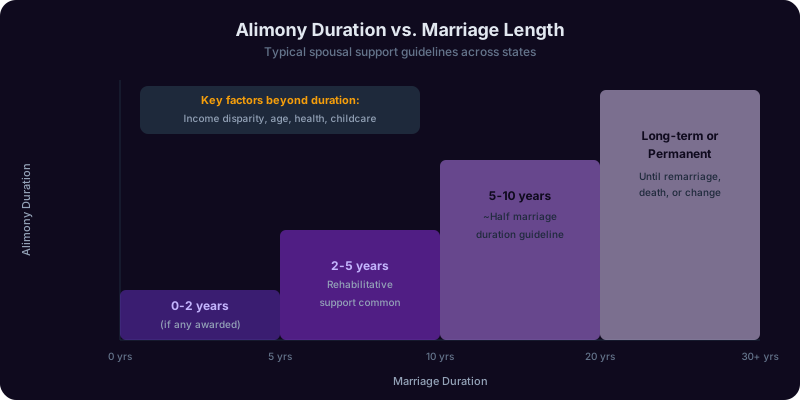
- Length of the marriage: The longer the marriage, the more likely alimony will be awarded and the longer it will last. Marriages under 5 years rarely result in significant alimony. Marriages over 20 years have the highest likelihood of permanent or long-term support.
- Income disparity: The greater the gap between the spouses' incomes, the more likely alimony is. If both spouses earn similar incomes, alimony is unlikely regardless of the marriage's length.
- Standard of living during the marriage: Courts aim to allow both parties to maintain a standard of living reasonably comparable to what they enjoyed during the marriage, though this is a goal rather than a guarantee.
- Each spouse's earning capacity and employability: A spouse's education, skills, work experience, and age all factor in. A 55-year-old who has not worked in 25 years has very different earning potential than a 35-year-old with a professional degree.
- Contributions to the other spouse's career: If you relocated for your spouse's job, gave up career opportunities, or supported them through professional school, courts recognize these sacrifices.
- Childcare responsibilities: The parent with primary custody of young children may receive more or longer support because childcare limits their ability to work full-time.
- Health and age: Chronic illness or advanced age that limits employability can increase the duration and amount of support.
- Fault (in some states): In states that allow fault-based divorce, marital misconduct (particularly adultery) can affect alimony awards. Some states bar alimony to a spouse who committed adultery. Others consider fault as one factor among many.
How Long Does Alimony Last?
| Marriage Duration | Typical Alimony Duration | Notes |
|---|---|---|
| Under 5 years | 0-2 years (if any) | Short marriages rarely result in significant alimony unless there is a major income disparity |
| 5-10 years | 2-5 years | Rehabilitative support is most common; designed to bridge the gap |
| 10-20 years | 5-10 years or half the length of the marriage | Many states use a guideline of support lasting roughly half the marriage duration |
| 20+ years | Long-term or permanent | Courts may set no termination date; support continues until death, remarriage, or substantial change in circumstances |
Alimony can typically be modified if there is a substantial change in circumstances: the paying spouse loses their job, the receiving spouse begins earning significantly more, or either party experiences a major health change. Alimony usually terminates automatically if the receiving spouse remarries or either party dies. Cohabitation by the receiving spouse may also be grounds for modification or termination, depending on the state.
Tax Implications
Under the Tax Cuts and Jobs Act of 2017 (for divorces finalized after December 31, 2018), alimony is no longer tax-deductible for the paying spouse and is no longer taxable income for the receiving spouse. This changed the economics of alimony negotiations significantly. For divorces finalized before 2019, the old rules (deductible for payer, taxable for recipient) still apply unless the decree is modified and both parties agree to adopt the new rules. The IRS Tax Topic 452 provides the official guidance on how alimony is treated for federal tax purposes.
Understanding how spousal support interacts with your overall financial picture is important for post-divorce planning. The Finance Copilot can help you model different alimony scenarios and understand their long-term impact on your budget. If you are also navigating insurance questions - such as whether you can remain on your spouse's health plan - getting clarity on those details early prevents surprises after the decree is final.
Divorce Cost Breakdown: DIY vs. Mediation vs. Attorney (With Price Ranges)
Divorce can be surprisingly affordable or devastatingly expensive, and the cost is almost entirely determined by how you and your spouse choose to handle it. Here is a realistic breakdown of what each path costs in 2026.
Option 1: DIY Uncontested Divorce ($200-$1,000)
If you and your spouse agree on everything and handle the paperwork yourselves, the cost is minimal:
- Court filing fees: $100-$450 (varies by state and county; some of the lowest include Montana at around $130 and some of the highest include California at around $435-$450)
- Service of process: $0-$150 (free if your spouse signs a waiver of service; $50-$150 for a process server)
- Document preparation service: $0-$300 (optional; online services like CompleteCase, 3StepDivorce, and similar platforms charge $150-$300 to prepare your forms)
- Certified copies of decree: $10-$30
Total DIY cost: $200-$1,000
This path works when: the marriage is short, there are no children or both parents agree on custody, there are minimal shared assets and debts, and both spouses are capable of understanding and completing legal forms. The risk is making an error that costs you far more to fix later - an improperly drafted settlement agreement is difficult and expensive to modify after the judge signs it.
Option 2: Mediated Divorce ($3,000-$8,000)
Mediation adds professional guidance to the negotiation process without the adversarial structure of litigation:
- Mediator fees: $100-$400 per hour, with most divorces requiring 3-8 sessions of 2-3 hours each. Total mediator cost: $2,000-$6,000
- Court filing fees: $100-$450
- Review attorney (recommended): $500-$1,500. Each spouse hires an independent attorney to review the mediated agreement before signing. This ensures neither party is agreeing to terms they do not fully understand.
- Document preparation: Sometimes included in the mediator's fee; otherwise $200-$500
Total mediation cost: $3,000-$8,000
Mediation works well for most couples who are willing to negotiate in good faith. It is significantly faster than litigation (typically 2-4 months from start to finish), less adversarial, and gives both parties more control over the outcome. It is not appropriate when there is a history of domestic violence, a significant power imbalance, or when one spouse is determined to be obstructive.
Option 3: Collaborative Divorce ($10,000-$50,000)
Collaborative divorce involves a team approach with both attorneys and sometimes financial specialists and mental health professionals:
- Each spouse's attorney: $5,000-$20,000 per spouse
- Financial specialist (optional): $1,000-$5,000
- Divorce coach/therapist (optional): $1,000-$3,000
- Court filing fees: $100-$450
Total collaborative cost: $10,000-$50,000
Collaborative divorce is best for cases with significant assets, complex financial issues, or high-emotion situations where both parties are committed to staying out of court. The cost is higher than mediation but typically far less than full litigation.
Option 4: Contested Litigation ($15,000-$100,000+)
If you end up in court, costs escalate dramatically:
- Attorney fees: $10,000-$75,000+ per spouse. Family law attorneys typically charge $200-$500 per hour, and a contested divorce can require 50-200+ hours of attorney time.
- Expert witnesses: $2,000-$10,000+ each. Common experts include forensic accountants (to trace hidden assets), business valuators, real estate appraisers, and custody evaluators (psychologists who assess each parent and make custody recommendations to the judge).
- Custody evaluation: $3,000-$10,000. If custody is disputed, the court may order a formal evaluation by a licensed psychologist.
- Deposition costs: $1,000-$5,000 per deposition (court reporter fees, videographer, transcript preparation)
- Court filing fees and miscellaneous: $500-$2,000
Total litigation cost: $15,000-$100,000+ per spouse
In high-asset or high-conflict divorces with multiple experts, business valuations, and extended trials, total costs can exceed $200,000 per side. The most expensive divorces are those that go to trial on both property and custody issues.
Cost Comparison Summary
| Method | Typical Cost Range | Timeline | Best For |
|---|---|---|---|
| DIY Uncontested | $200-$1,000 | 1-3 months | Simple divorces with full agreement |
| Mediation | $3,000-$8,000 | 2-4 months | Most divorces where both parties negotiate in good faith |
| Collaborative | $10,000-$50,000 | 4-8 months | Complex finances, high emotion, commitment to avoid court |
| Contested Litigation | $15,000-$100,000+ | 12-24+ months | Disputes that cannot be resolved through negotiation |
Ways to Reduce Costs
- Agree on as much as possible before involving attorneys. Every hour you and your spouse spend negotiating directly is an hour you are not paying a lawyer $300-$500 for.
- Use limited-scope representation. Some attorneys offer "unbundled" services - they will review your settlement agreement, prepare specific documents, or coach you for a hearing without representing you for the entire case. This can cost $500-$3,000 instead of full representation. Your state bar association's lawyer referral service can help you find attorneys who offer limited-scope representation.
- Avoid unnecessary motions and hearings. Every court appearance costs money in attorney fees, preparation time, and sometimes lost work.
- Stay organized. Attorneys charge by the hour. If you walk into a meeting with all your financial documents organized and your questions written down, you save hours of attorney time that would otherwise be spent gathering information you could have provided.
- Do not use your attorney as a therapist. It is natural to need emotional support during a divorce, but your attorney charges $300-$500 per hour. A therapist charges $100-$200. Use each professional for what they are trained to do.
The Finance Copilot can help you create a divorce budget, model different scenarios, and understand the long-term financial impact of various settlement options. If you are also buying or selling a home as part of the divorce, our guide on home buying covers the financial considerations involved.
Protecting Yourself Financially Before, During, and After Divorce
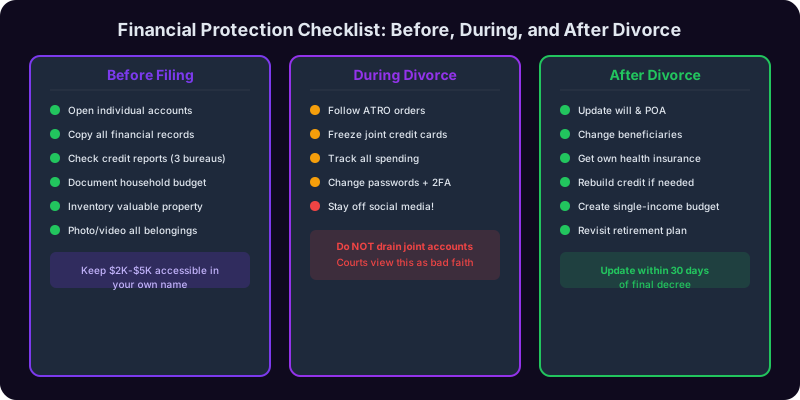
Divorce is not only an emotional upheaval - it is a financial restructuring of your entire life. The decisions you make before, during, and after the process can affect your financial security for decades. Here is a practical roadmap for protecting yourself at every stage.
Before You File: Immediate Steps
- Open individual bank and credit accounts. If all your accounts are joint, open a checking account and a credit card in your name only. This ensures you have access to funds if your spouse freezes joint accounts (which happens more often than you might expect). Do not drain joint accounts - courts view that as bad faith - but having $2,000-$5,000 accessible in your own name is a reasonable safety measure.
- Document everything financial. Make copies of all financial records: bank statements, investment accounts, retirement account statements, tax returns (last 3-5 years), mortgage documents, loan agreements, credit card statements, business records, pay stubs, and Social Security statements. Store copies somewhere your spouse cannot access (a trusted friend's home, a safe deposit box in your name only, or a secure cloud account). If financial records disappear during the divorce, having copies prevents your spouse from hiding assets.
- Check your credit report. Pull your credit report from all three bureaus (Equifax, Experian, TransUnion) for free at AnnualCreditReport.com. Look for any accounts or debts you did not know about. Your spouse may have opened credit cards or taken out loans you are unaware of - and if they were opened during the marriage, you may be responsible for them.
- Understand your household budget. Know exactly what it costs to run your household: mortgage/rent, utilities, groceries, insurance premiums, car payments, childcare, medical costs, and all recurring expenses. You will need this information for financial disclosures and for negotiating support.
- Inventory valuable personal property. Walk through your home and photograph or video-record every room, including the contents of closets, garages, and storage areas. Document jewelry, art, electronics, furniture, and any items of significant value. This creates a record in case items disappear during the separation.
During the Divorce: Protecting Your Interests
- Do not make major financial decisions unilaterally. Most states issue automatic temporary restraining orders (ATROs) when a divorce is filed. These typically prohibit both spouses from selling, hiding, or transferring significant assets; canceling insurance policies; changing beneficiaries on retirement accounts or life insurance; and taking on new major debts. Violating an ATRO can result in sanctions, contempt of court, and an unfavorable outcome.
- Close or freeze joint credit accounts. Contact each credit card company and request that the joint account be frozen so no new charges can be made. You cannot unilaterally close a joint account, but you can request a freeze. This prevents your spouse from running up debt you will be responsible for.
- Keep a record of all expenses and financial transactions. From the moment you decide to divorce, track every dollar that goes in and out. Courts expect both parties to account for their spending during the divorce process.
- Secure your digital life. Change passwords on personal email, financial accounts, and social media. If your spouse knows your passwords or had access to your devices, assume they have seen everything. Enable two-factor authentication on all important accounts.
- Be careful on social media. Anything you post can be used as evidence. A photo of an expensive vacation or a new luxury purchase during the divorce can undermine your claims about financial need. A post disparaging your spouse can affect custody evaluations. The safest approach: stay off social media entirely until the divorce is final.
After the Divorce: Rebuilding Your Financial Foundation
- Update all legal and financial documents. Within 30 days of your divorce being finalized, update your will, power of attorney, retirement account beneficiaries, life insurance beneficiaries, bank account ownership, and property titles. Failing to update beneficiary designations is one of the most common and costly post-divorce mistakes. Your ex-spouse may receive your retirement account or life insurance death benefit if you forget to update the beneficiary form.
- Secure your own insurance coverage. If you were covered under your spouse's health insurance, you are typically eligible for COBRA continuation coverage for up to 36 months, though it is expensive (often $500-$2,000/month). Explore options through the health insurance marketplace, your own employer, or the Insurance Copilot for help comparing plans and understanding your options.
- Establish or rebuild your credit. If your credit history is limited because accounts were in your spouse's name, start building credit immediately. A secured credit card, a small personal loan, and consistent on-time payments will rebuild your credit score within 12-24 months.
- Create a new budget for your single-income household. Your expenses and income have both changed. Build a realistic budget that reflects your new reality - including any alimony or child support you are paying or receiving.
- Revisit your retirement plan. Divorce often significantly impacts retirement savings. If you gave up part of your 401(k) or pension in the settlement, you may need to increase contributions, delay retirement, or adjust your investment strategy. A financial advisor can help you model the long-term impact.
- Set up child support enforcement if needed. If your ex-spouse fails to pay court-ordered child support, do not simply absorb the loss. Contact your state's child support enforcement agency. They can garnish wages, intercept tax refunds, suspend licenses, and take other enforcement actions. The Office of Child Support Services provides information on federal enforcement programs and links to state agencies.
Common Financial Mistakes to Avoid
- Fighting over the house when you cannot afford it. The marital home carries emotional weight, but if you cannot afford the mortgage, taxes, insurance, and maintenance on a single income, keeping the house is a financial trap. Sometimes the smarter move is to sell, split the equity, and start fresh.
- Ignoring tax consequences. The way assets are divided has tax implications. A $200,000 retirement account and $200,000 in cash are not equivalent - the retirement account will be taxed when withdrawn. Make sure any settlement accounts for the after-tax value of assets, not just the face value.
- Forgetting about hidden debts. Your spouse may have debts you do not know about. A thorough financial disclosure and, if necessary, a forensic accountant can uncover liabilities that would otherwise surprise you after the divorce.
- Failing to enforce the decree. If your ex-spouse does not comply with the divorce decree - whether by not paying support, not transferring property, or not following the custody schedule - you have legal remedies. Filing a contempt motion compels compliance and can result in penalties. Do not let violations slide. If you need to enforce your decree, our guide on how to write a demand letter can help with the initial steps, and our small claims court guide covers the process for recovering money owed.
If your divorce coincides with job loss, our wrongful termination guide can help you understand your employment rights. Divorce is a financial reset, not a financial ending. With careful planning, complete information, and the right support, you can emerge in a stable financial position. The Finance Copilot can help you build a post-divorce financial plan, and the Legal Copilot can guide you through enforcing your decree if your ex-spouse does not comply. For a broader view of real-life scenarios where legal and financial decisions intersect, our scenario guides cover many situations that arise during and after major life transitions.
Disclaimer: This guide provides general legal and financial information about the divorce process. It does not constitute legal advice, financial advice, or tax advice. Divorce laws vary significantly by state, and individual outcomes depend on the specific facts of each case. For matters involving domestic violence, child abuse, substantial assets, complex custody disputes, or any situation where your safety is at risk, consult a licensed family law attorney and, if applicable, law enforcement immediately.
Frequently Asked Questions
Recommended Copilots
Recommended Copilots
Get guidance on divorce grounds, filing requirements, and state-specific procedures
Try Free →Navigate child custody arrangements, parenting plans, and spousal support decisions
Try Free →Model asset division scenarios, create post-divorce budgets, and plan for financial independence
Try Free →Review your settlement agreement, prenuptial agreement, or QDRO for unfavorable terms
Try Free →Understand health insurance options after divorce, including COBRA and marketplace plans
Try Free →Continue Exploring
Related Articles
Get Answers From the Legal Copilot
The Legal and Family Law Copilots walk you through filing requirements, custody considerations, asset division, and financial planning for divorce. Get personalized guidance for your situation before you make decisions that affect your future.